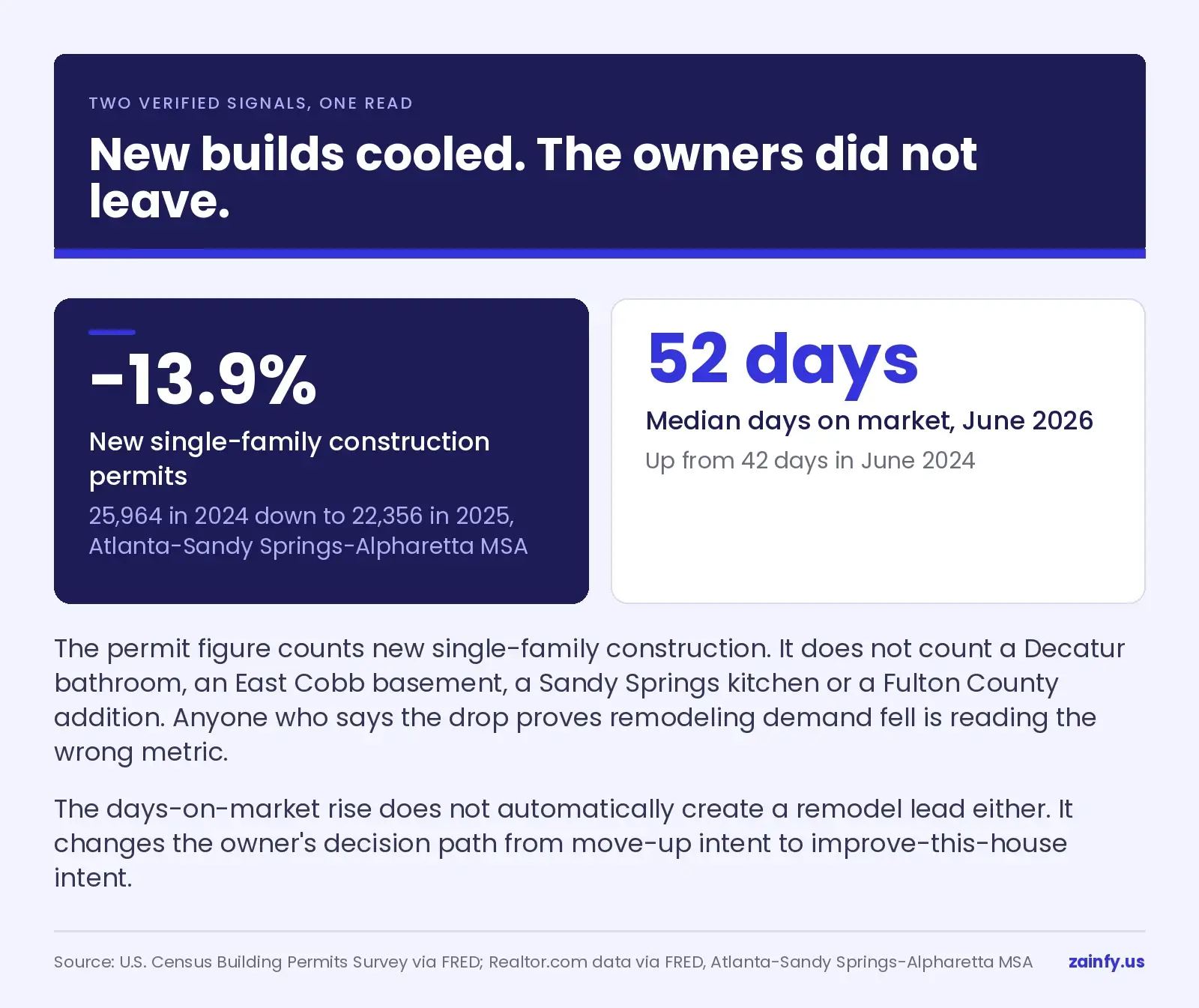
Metro Atlanta remodeling contractors should read the permit slowdown as a search-timing problem, not as proof that every job disappeared. The U.S. Census Building Permits Survey via FRED shows new single-family construction permits in the Atlanta-Sandy Springs-Alpharetta MSA fell from 25,964 in 2024 to 22,356 in 2025, down 13.9%.
That number is important. It is also easy to misuse.
It counts new single-family construction. It does not count bathroom remodels in Decatur, basement finishes in East Cobb, kitchen updates in Sandy Springs, or additions in Fulton County. If somebody tells you the permit drop proves remodeling demand is down, he is reading the wrong metric.
The better question is this: when fewer people buy new, where does the existing-home owner go next?
He stays put longer. He searches harder. He compares remodelers from his phone.
That is where your visibility either holds the line or vanishes.
The number everyone’s quoting is a new-build number
The Atlanta permit slowdown is real. The label matters more than the headline.
FRED’s Census series for the Atlanta MSA shows 22,356 new single-family construction permits in 2025, down from 25,964 in 2024. HBW Construction Data, looking at a broader all-residential cut, reported 19,529 metro Atlanta new residential permits in 2025, down about 12% year over year, and 9,636 through Q2 2026, down 11% year over year.
Those are two different cuts of the same cooling trend. One is a government single-family series. One is an institutional all-residential view. Neither is a remodeling permit count.
That distinction keeps your marketing decisions honest. The same discipline applies statewide, where what permit volume across the state actually looks like is a different series again.
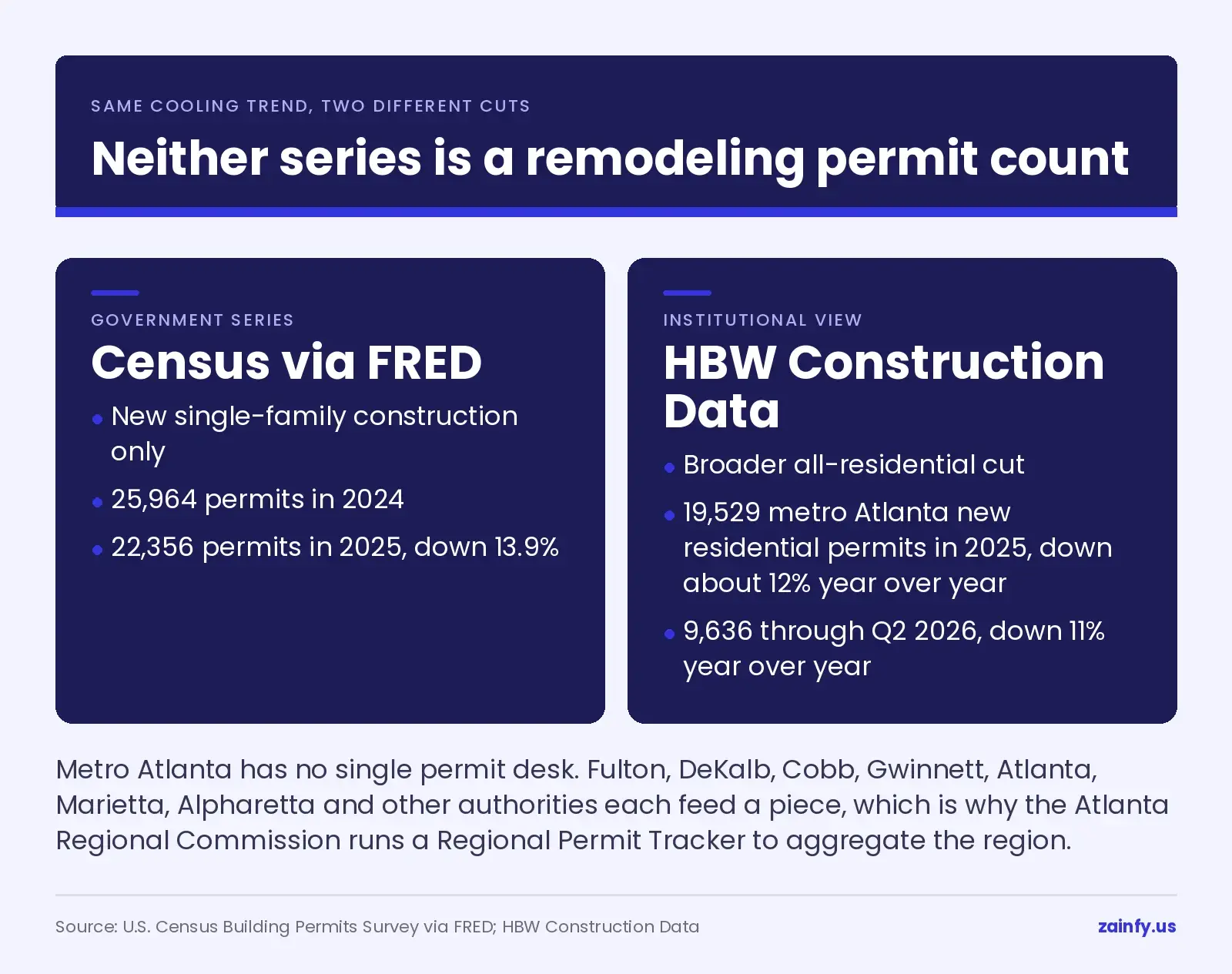
Metro Atlanta does not have one permit desk. Fulton, DeKalb, Cobb, Gwinnett, Atlanta, Marietta, Alpharetta, and the other local authorities all feed pieces of the picture. The Atlanta Regional Commission’s Regional Permit Tracker exists because the region has to be aggregated; no single office issues “metro Atlanta” permits.
So the useful read is not “remodeling is down 13.9%.” That would be fake precision.
The useful read is narrower and more practical: the new-build pipeline that many construction companies chased is thinner, and contractors who were relying on new-home momentum have to fight for existing-home work with better proof, better search visibility, and clearer local positioning.
Fewer new builds, but the owners didn’t leave
The stay-put signal is stronger than the panic headline. Realtor.com data via FRED shows metro Atlanta median days on market at 52 days in June 2026, compared with 42 days in June 2024. Homes are sitting longer. That does not automatically create a remodel lead, but it changes the owner’s decision path. A family that expected to sell and move into a newer house in Alpharetta may now look at the house it already owns and ask whether the kitchen, bath, basement, or layout can carry them another few years. An older DeKalb or Decatur house does not stop needing work because new construction slowed. It often becomes the backup plan. That is the contractor-side opportunity: not a made-up Atlanta remodeling growth percentage, but a shift from move-up intent to improve-this-house intent. Your site has to meet that owner at the moment he starts comparing local options, because the project does not wait until the market report sounds optimistic.
That demand shows up as different words in the search bar
The stay-and-renovate owner does not search like a new-home buyer.
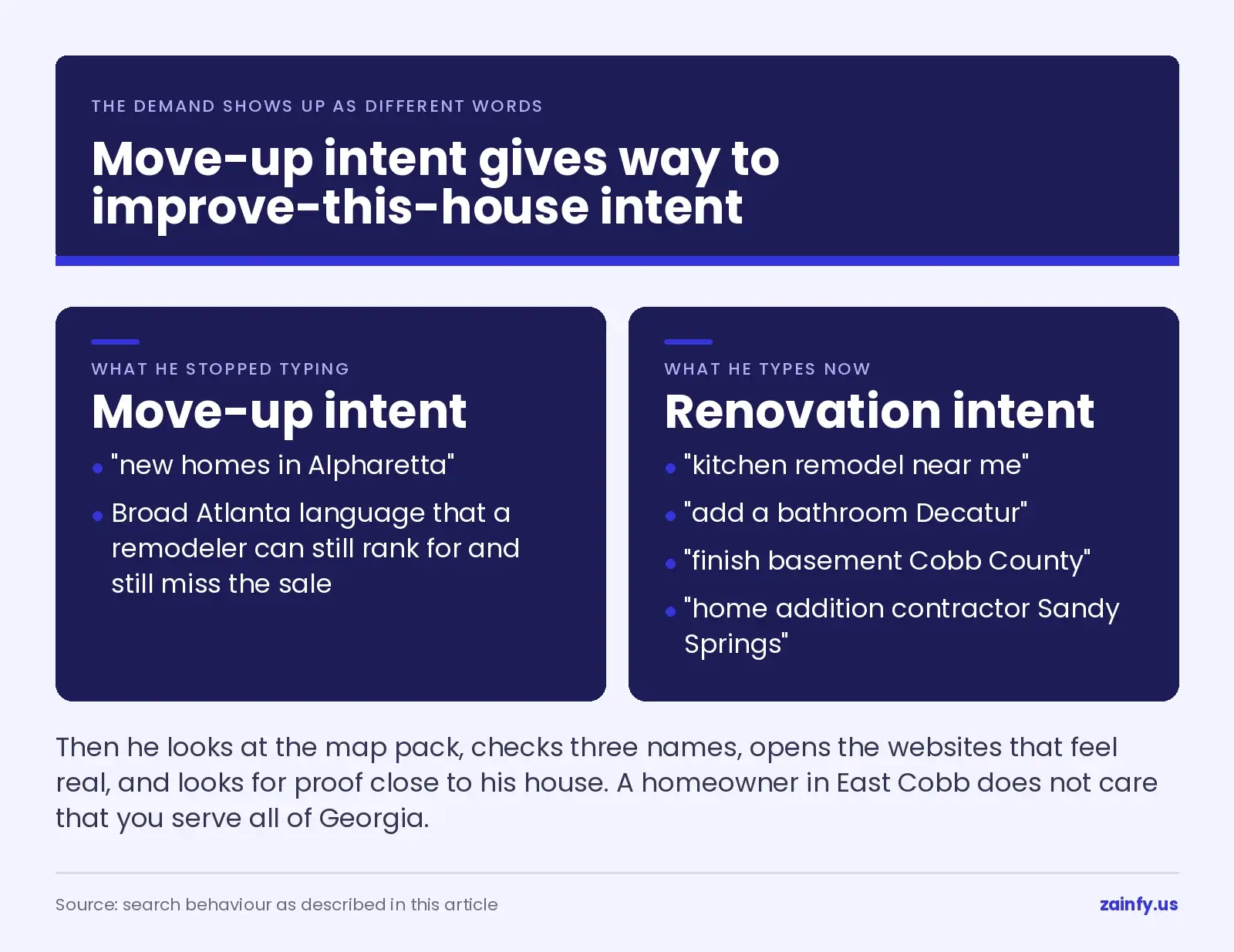
He is not typing “new homes in Alpharetta” anymore.
He is typing “kitchen remodel near me,” “add a bathroom Decatur,” “finish basement Cobb County,” or “home addition contractor Sandy Springs.” Then he looks at the map pack, checks three names, opens the websites that feel real, and looks for proof close to his house.
That is the shift your marketing has to catch.
If your visibility is still built around broad Atlanta language, you miss the smaller searches where the serious comparison happens. A homeowner in East Cobb does not care that you “serve all of Georgia.” He wants to know whether you have handled work near Cobb County, whether your reviews sound current, and whether your photos match the type of project he is pricing in his head.
You do not win a quieter market by being the cheapest name in a directory.
You win it by being the name the right local searches keep finding.
What to actually do in search while the market’s quiet
Point your search presence at renovation intent, county by county.
Start with the places you truly work. If your crew regularly handles jobs in Cobb, DeKalb, and Fulton, your site should make that clear with service-area pages that have substance: project proof, neighborhood language, review context, and the work types those owners are likely to compare. A Cobb basement page should not read like a DeKalb bath page with the county swapped.
Then tighten your Google Business Profile for the map pack. Categories, services, photos, review requests, service areas, and recent project language all have to support one story. A profile that says you work metro Atlanta but a website that barely names Cobb, DeKalb, or Fulton gives Google a weak signal and gives the owner a weaker reason to call.
This is also where you stop renting the whole pipeline from Houzz or Angi. Those profiles can send attention, but you do not own the channel and you do not build long-term search equity there.
Use the slowdown to clean up the proof that already exists. If you have three East Cobb kitchens, one Decatur bath, and two Fulton additions, those should not sit as nameless gallery photos. Turn them into project proof with the city, scope, service type, and a short note about what changed for the owner. Ask recent clients to mention the neighborhood or county naturally when they review you. Check that your phone number, service areas, and business name match across your site and major profiles. None of that requires inventing a market or pretending to have an office in every suburb. It just gives Google and the homeowner the same answer: this contractor works here, on this kind of job, with proof that can be checked. That is the same groundwork behind a Marietta remodeler who grew through a slow permit year.
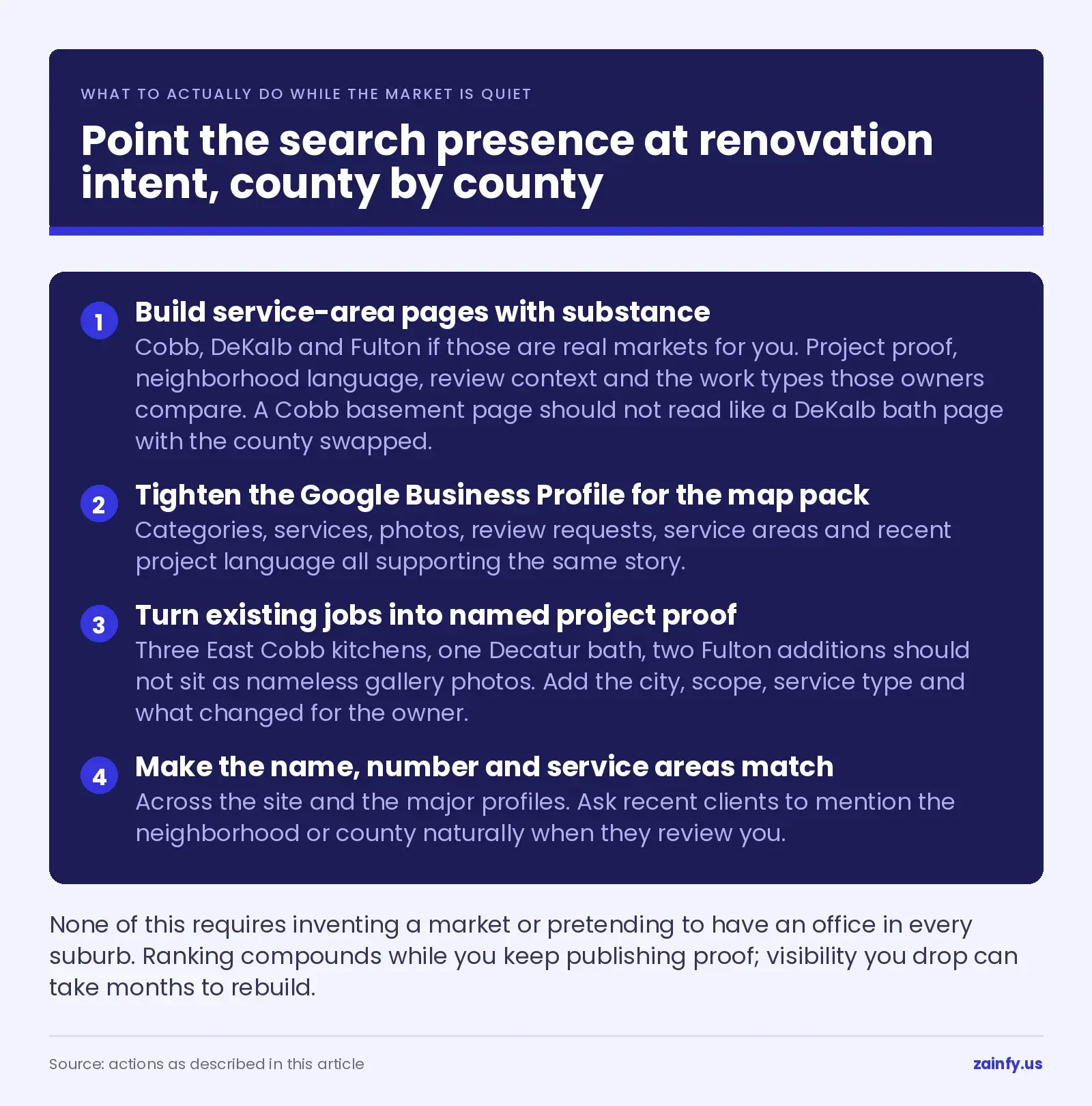
The quiet stretch is when the search real estate is easiest to claim. Contractors pull back when the phone slows. Ranking does not wait for your mood to improve; it compounds while you keep publishing proof, earning reviews, fixing pages, and making the service area clear.
That is exactly where Atlanta remodelers competing for renovation searches fits if you want the work handled for the Atlanta market instead of guessed at from a generic contractor checklist.
The one move that costs you the recovery
Do not cut your marketing because the market cooled.
That is the reflex. Work dips, the owner looks at expenses, and marketing is the line item that feels easiest to kill. In search, that move is backwards.
The 13.9% new single-family permit dip is the moment when search real estate gets cheaper in attention, not the moment to vacate it. If you go quiet, the renovation searches do not wait for you. They go to the remodeler who kept showing up in Google Maps, kept asking for reviews, kept adding project proof, and kept tightening his county pages while everyone else was watching the market.
Visibility you drop can take months to rebuild.
The contractors who lose the recovery are usually not the ones who saw the slowdown coming. They are the ones who went quiet in the dip. If your service area crosses county lines, the next question is ranking across the counties this data covers.
Metro Atlanta’s permit slowdown: quick answers
[wps_faq style=”classic” question=”Is Atlanta construction slowing down in 2026?”]Yes. Metro Atlanta new single-family construction permits fell from 25,964 in 2024 to 22,356 in 2025, down 13.9%, according to the U.S. Census Building Permits Survey via FRED. That is a new-construction number, not a remodeling number. HBW Construction Data also reported a softer all-residential permit trend through Q2 2026, with county movement varying across places like Fulton and Gwinnett. Read it as a cooling new-build pipeline, not as a direct count of remodel demand.[/wps_faq]
[wps_faq style=”classic” question=”Does a construction slowdown mean less remodeling work in metro Atlanta?”]No. It means the work can shift toward existing homes, and metro Atlanta has a clear stay-put signal: Realtor.com data via FRED shows median days on market moved from 42 days in June 2024 to 52 days in June 2026. When owners in DeKalb, Decatur, or Sandy Springs do not move as quickly, they often compare whether updating the house they own makes more sense. Your marketing has to catch that comparison before another contractor does.[/wps_faq]
[wps_faq style=”classic” question=”How do you get remodeling leads in metro Atlanta when new construction slows?”]Show up for renovation-intent searches in the counties you actually serve. That means a Google Business Profile built for the map pack, service-area pages for Cobb, DeKalb, and Fulton when those are real markets for you, and project proof that matches the work homeowners are comparing. Do not make the site say only “metro Atlanta” and expect Google to infer the rest. The slower market rewards the contractor whose local proof is easiest to verify.[/wps_faq]
Before the recovery, check what you already rank for
Open Google from the county you care about and search the jobs you actually want: “kitchen remodel near me,” “bathroom remodel Decatur,” “basement finishing Cobb County,” “home addition contractor Sandy Springs.” Then write down whether you appear in the map pack, the organic results, neither, or both. The same audit runs the same way in every Georgia market we work in.
That audit is the next move.
Do it before the recovery, not after the phone starts ringing again for everyone. A quieter construction market is not the problem to wait out. For a metro Atlanta remodeler, it is the window to become the contractor existing-home owners find first.