
Permits, search demand and homeowner economics across Georgia’s remodeling markets — Atlanta to Savannah, Augusta to Gainesville. Measured, not estimated.
The Georgia construction clock is climbing into remodel season
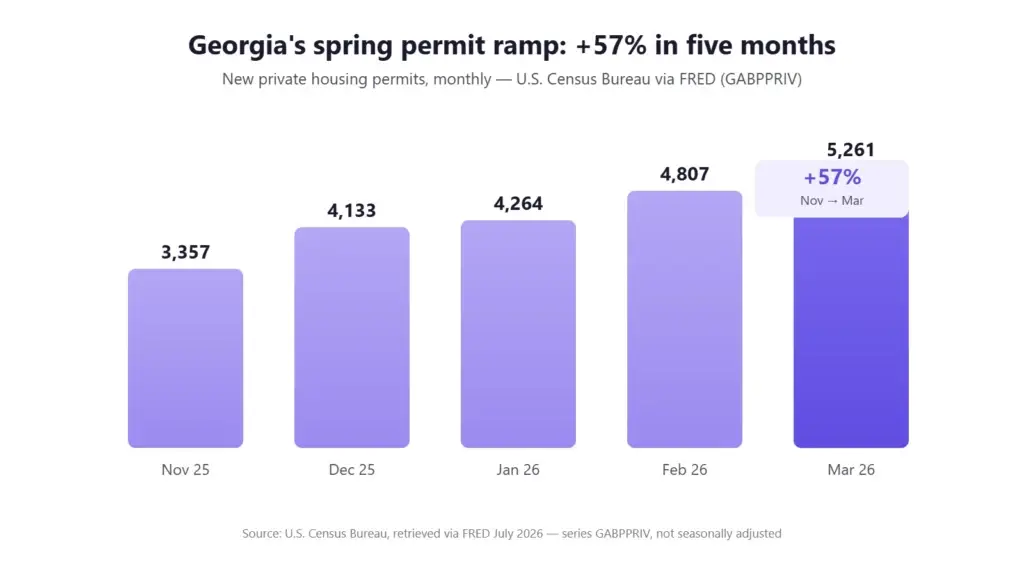
New private housing permits in Georgia climbed from 3,357 in November 2025 to 5,261 by March 2026 — a 57% ramp into the spring season (U.S. Census Bureau via FRED, series GABPPRIV). That new-construction curve matters to remodelers for a simple reason: the suburban housing stock that boomed in the 1980s–2000s is now entering its prime renovation years, and remodel demand follows homeowners, not builders.
Metro Atlanta: one metro, three different buyers
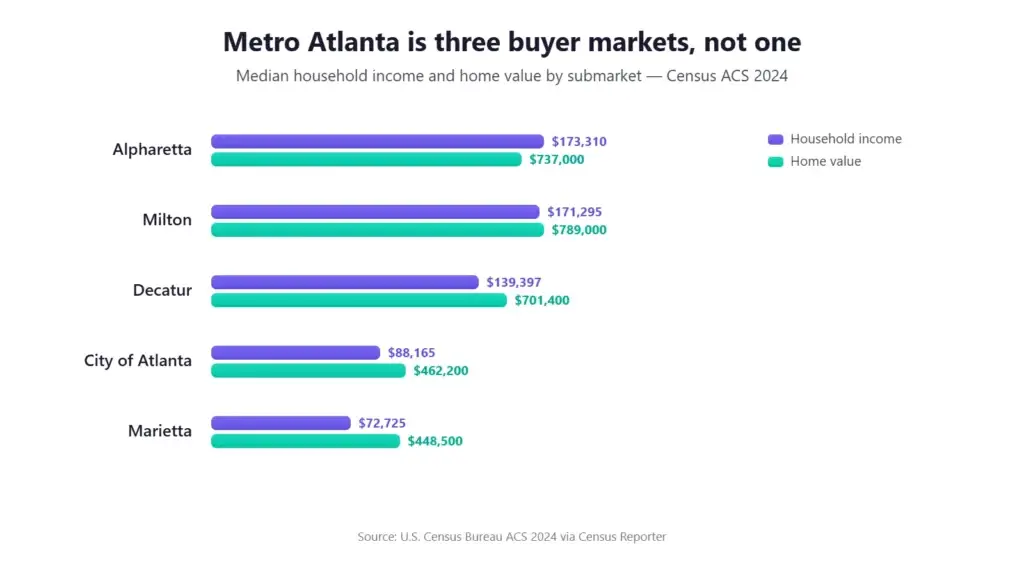
Household economics set what homeowners spend and what proof they expect before hiring. Census ACS 2024 figures (via Census Reporter) across metro Atlanta’s submarkets:
| Submarket | Median household income | Median home value |
|---|---|---|
| Alpharetta | $173,310 | $737,000 |
| Milton | $171,295 | $789,000 |
| Decatur | $139,397 | $701,400 |
| City of Atlanta | $88,165 | $462,200 |
| Marietta | $72,725 | $448,500 |
The spread is the story: the same metro contains a $72K-income market and a $173K-income market twenty minutes apart. Contractors who treat “Atlanta” as one market are pricing and marketing to an average customer who does not exist.
Savannah: permits up 61% in a market ruled by review boards
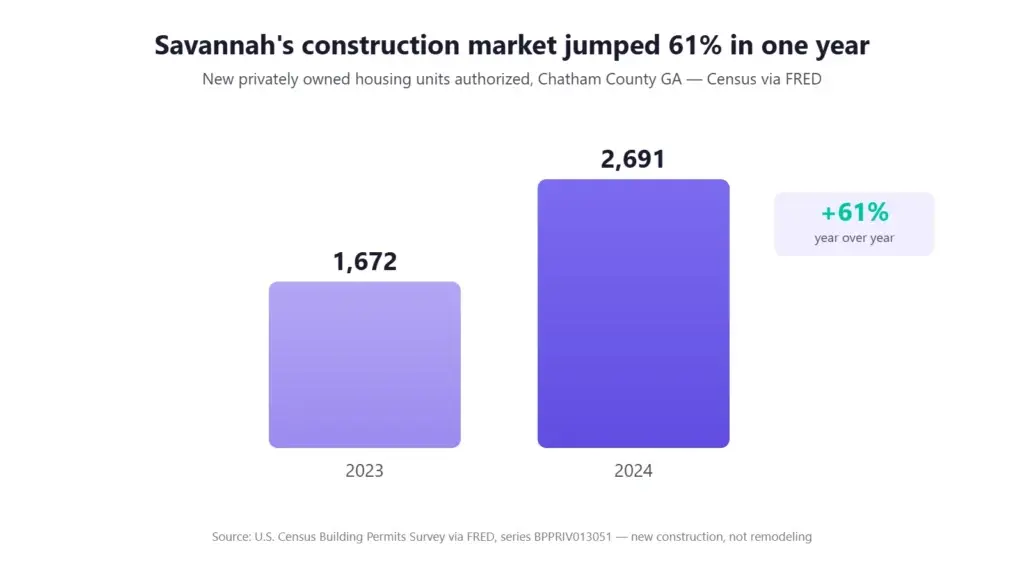
Chatham County authorized 2,691 new privately owned housing units in 2024, up from 1,672 in 2023 — a 61% year-over-year jump (U.S. Census Building Permits Survey via FRED, series BPPRIV013051). But Savannah remodeling runs on a second clock that no other Georgia market has: historic review. The Historic District Board of Review (est. 1973) covers the Landmark downtown district, and the Historic Preservation Commission (est. 2019) covers Victorian, Streetcar/Mid-City, Cuyler-Brownville, Parkside, Ardmore, Ardsley Park-Chatham Crescent and Carver Village. In all of them, a Certificate of Appropriateness comes BEFORE the building permit — which is why historic-experienced contractors are a separate, premium market in Savannah.
Augusta: the only bi-state remodeling market in Georgia
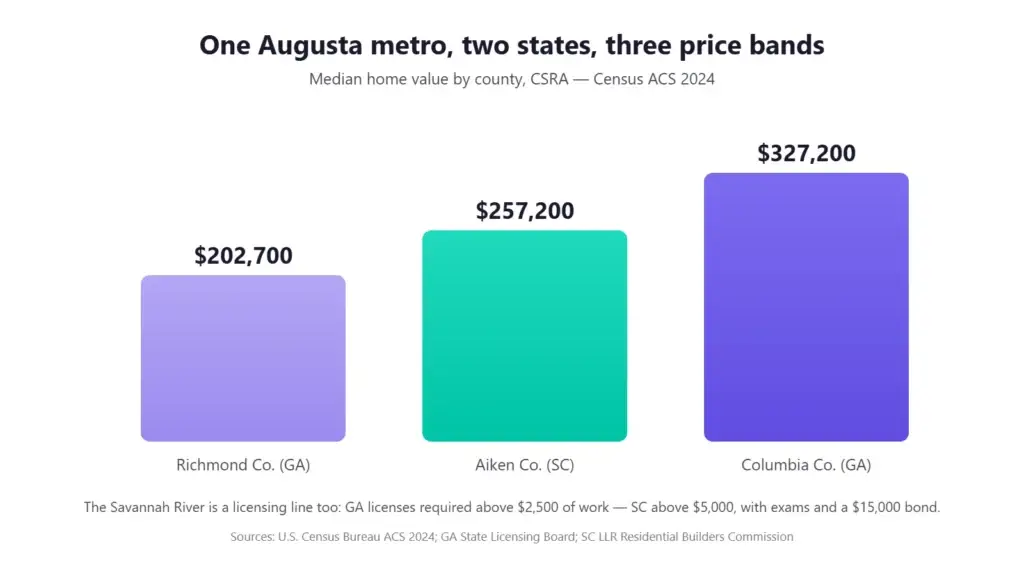
The Augusta metro crosses the Savannah River into South Carolina — and the river is a regulatory line, not just a landmark. Median home values tell the market story (Census ACS 2024): Richmond County GA $202,700, Columbia County GA $327,200, Aiken County SC $257,200. The licensing line is just as real: Georgia requires a state license above $2,500 in work; South Carolina’s Residential Builders Commission kicks in above $5,000 with exams and a $15,000 bond. A CSRA remodeler who holds both licenses can serve a metro competitors legally cannot — and can say so publicly.
Columbus: a market that turns over every PCS season
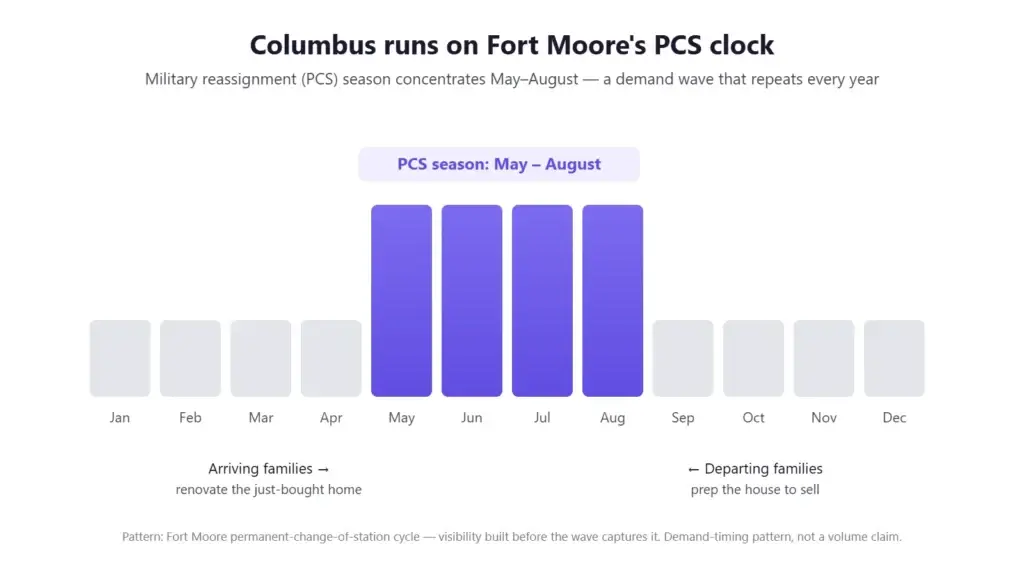
Columbus sits on Fort Moore’s clock. PCS season — roughly May through August — brings a recurring wave of military families arriving (renovating just-bought homes) and departing (prepping to sell). The demand pattern repeats every year, which means visibility built before the wave captures it. Columbus contractors also fight a search battle nobody else in Georgia has: being found as Columbus, GEORGIA, not Columbus, Ohio — county, landmark and neighborhood signals decide who wins that disambiguation.
Gainesville and Hall County: nine permitting departments and a locked lake
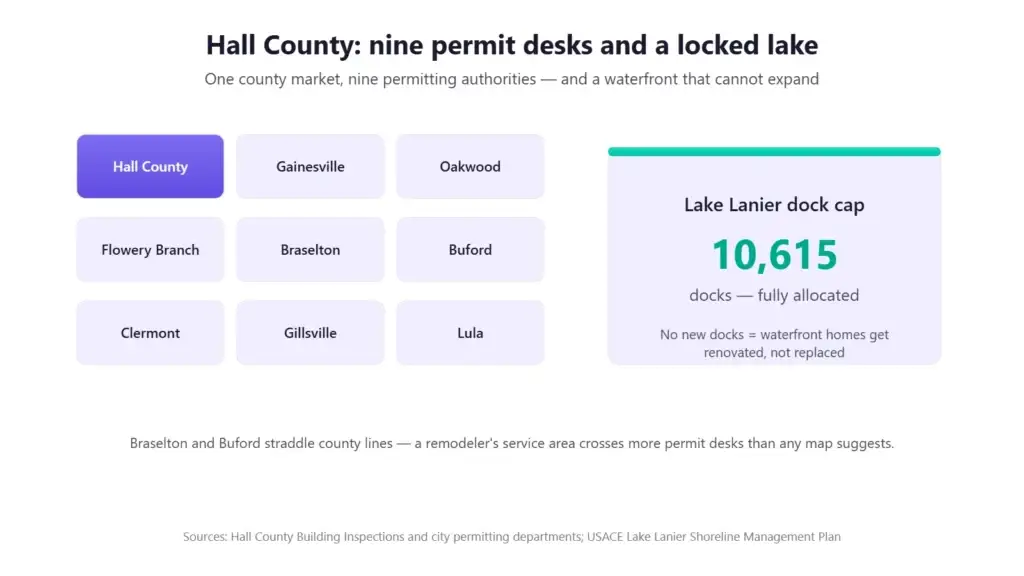
Hall County remodeling runs through Hall County Building Inspections plus eight separate city permitting departments — Gainesville, Oakwood, Flowery Branch, Braselton, Buford, Clermont, Gillsville and Lula, with Braselton and Buford straddling county lines. And Lake Lanier adds a market nobody can expand: the US Army Corps of Engineers’ Shoreline Management Plan caps docks at 10,615 — fully allocated. When no new docks can be built, existing waterfront homes get renovated instead of replaced — a structural remodel-demand floor most markets do not have.
Middle and South Georgia: six more markets, six different stories
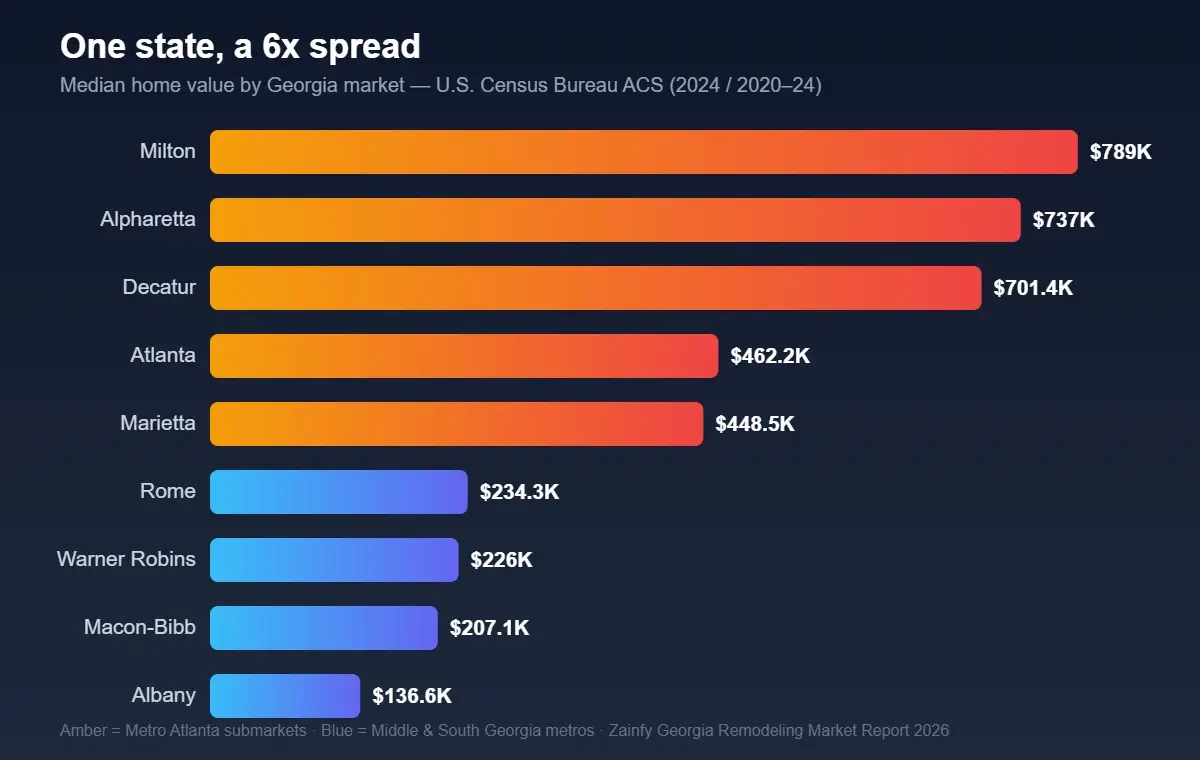
Beyond the five metros above, Georgia’s mid-size markets each run on their own economics. The clearest way to see it is home value: the same state contains a $789,000 median market and a $136,600 one — a nearly 6x spread that dictates what a remodel budget looks like and what proof a homeowner demands before hiring.
Macon-Bibb: a remodel market, not a build market
Macon-Bibb recorded just 154 residential building permits in 2024 (U.S. Census Bureau via FRED, BPPRIV013021) against 71,955 existing housing units and a 61.9% owner-occupancy rate (ACS 2024). That ratio is the story: almost nothing new is being built, so contractor demand concentrates in renovating what stands — at a $207,100 median home value that supports serious kitchen and bath budgets.
Warner Robins: the PCS cycle, Georgia’s other military market
Robins AFB anchors roughly 22,000 personnel in a county of 174,897 (ACS 2024). Military relocation churn means homes in Centerville, Perry and Bonaire trade hands on orders, not on market timing — and each transfer triggers a buy-then-renovate cycle. The county’s $250,200 median home value runs above the city’s $226,000, pushing renovation spend toward the suburban ring.
Athens-Clarke: a university calendar and a review board
Clarke County issued 1,172 new private housing permits in 2024 (Census Building Permits Survey via FRED), but two local forces shape remodeling demand more than permits do. UGA’s calendar times rental renovations to lease turnover, and exterior work in Athens’ locally designated historic districts requires a Certificate of Appropriateness from the Athens-Clarke County Historic Preservation Commission — homeowners there actively look for contractors who already understand that review.
Rome: half owner, half investor
Rome’s 49.2% owner-occupancy rate (ACS 2020–24) is the lowest of these six markets — nearly half of its 16,566 housing units are rentals. Remodeling demand splits accordingly: owner-led kitchen and bath work on one side, investor and rental-turn renovation on the other, across older stock valued at a $234,300 median.
Valdosta: the first-full-remodel wave
Valdosta’s median home was built in 1986 (ACS via Point2Homes), which puts a large share of Lowndes County kitchens, baths and roofs past their first full remodel right now. Two accelerants: Moody AFB’s 6,500+ personnel create a relocating-family audience, and downtown’s $45M historic revitalization (City of Valdosta, 2025) is pulling adaptive-reuse renovation work into public view.
Albany: Georgia’s oldest housing stock, still owner-held
Albany’s median home was built around 1974 — the oldest stock among these markets — and about 62% of Dougherty County housing is owner-occupied (ACS 5-year). The $136,600 median value caps individual project size, but a half-century-old, owner-held housing base produces the steadiest kind of remodeling demand there is: repair, replacement and modernization that cannot be deferred forever.
What Georgia contractors are searching for (first-party data)
From Zainfy’s Search Console footprint across 40+ Georgia-market pages (July 2026, shares of geo-tagged demand):
- Georgia carries 54% of all three-state contractor-marketing demand we measure — roughly double what Florida’s two-season remodeling market draws and three times the demand behind Michigan’s compressed four-month season.
- Demand is not confined to Atlanta: Smyrna, Gainesville, Valdosta and Augusta all appear as distinct query markets.
- The newest pocket: 100% of “seo gainesville” demand appeared in the last 28 days — the Hall County corridor is waking up.
- Small-metro pages consistently rank pages ahead of big-metro ones: the ranking bar in Macon, Valdosta and Augusta is measurably lower than in the Atlanta core.
What Georgia homeowners search for
These are bottom-of-funnel money terms — the people typing them are choosing a contractor, not browsing ideas. Atlanta-tagged volumes (Source: Ahrefs, US, July 2026):
| Keyword | Searches/month (Ahrefs) | Keyword Difficulty | CPC |
|---|---|---|---|
| bathroom remodel atlanta | 400 | 40 | $1.70 |
| kitchen remodel atlanta | 200 | 42 | $0.80 |
| remodeling contractors atlanta | 150 | 48 | $4.50 |
The read: volumes look modest next to national head terms, but “remodeling contractors atlanta” costs $4.50 per click to rent in ads — and the national cluster behind these city terms (“bathroom remodel” alone: 115,000 US searches/month) funnels through local results. City-tagged searches are where the hiring decision actually lands — and increasingly that decision starts in an AI answer, which is why we measured how the AI platforms answered for Georgia contractors.
What happens when a Georgia contractor closes the visibility gap
Three verified Georgia engagements, figures from the clients’ own accounts:
| Client | Market | Verified result | Window |
|---|---|---|---|
| Custom Home Renovations | Marietta | Organic clicks +402% (1.18K → 5.93K); impressions 5.99x (33.2K → 199K) | 4 months |
| All About Tile | Georgia | +400% leads; conversion rate +163%; avg position 3.6 | 12 months |
| Kitchen Design Studio | Atlanta | Facebook leads 12 → 114/mo (+850%); CPL $98.21 → $35.57 (−63.8%) | 6 months |
What this means for a Georgia remodeler
- The spring permit ramp (Nov 3,357 → Mar 5,261) is the annual demand clock — visibility work done in winter captures the spring surge.
- Alpharetta/Milton and Marietta/Smyrna are different businesses in the same metro — pages, pricing and proof should split accordingly.
- Savannah’s COA layer, Augusta’s two licenses, Columbus’s PCS season and Lake Lanier’s dock cap are each a moat: local complexity a contractor can own online before competitors do.
- Macon, Valdosta and Albany are the open lanes: real demand, low competition, faster rankings than the Atlanta core.
That market picture is the context behind how we build that visibility for Georgia remodelers.
About the data: This report pairs with our three-state Remodeling Contractor Search Demand Report 2026. Georgia permits — U.S. Census Bureau via FRED (GABPPRIV; Chatham County BPPRIV013051), retrieved July 2026. Household income, home values, housing units, occupancy and year-built figures — U.S. Census Bureau ACS (2024 1-year and 2020–24 5-year), via Census Reporter, Data USA and Point2Homes. Macon-Bibb permits — FRED BPPRIV013021; Clarke County permits — Census Building Permits Survey via FRED. Valdosta revitalization — City of Valdosta, 2025. Licensing — Georgia State Licensing Board for Residential & General Contractors; South Carolina LLR Residential Builders Commission. Lake Lanier — USACE Shoreline Management Plan. Search-demand shares — first-party Google Search Console data, Zainfy (40+ Georgia pages), July 2026. Client figures verified in client-owned accounts. The full series and its shared methodology are listed on Zainfy Research.
This page is refreshed annually. Next refresh: July 2027.
Zainfy — SEO, WordPress web design, social media marketing and paid ads management for home remodeling and construction contractors in Georgia, Florida and Michigan. Based in Douglasville, GA.