If you run a remodeling company in Lansing,If you run a remodeling company in Lansing, almost every figure you have read about shared-lead costs deserves to be checked before it reaches your budget. The strongest reason is not an opinion from another marketing company. In a March 2022 complaint, the Federal Trade Commission charged HomeAdvisor, Inc. with making false, misleading, or unsubstantiated claims about the quality and source of leads. The FTC describes HomeAdvisor as affiliated with Angi, formerly known as Angie's List.
The complaint also alleged that HomeAdvisor often gave providers job-conversion claims at rates higher than it could substantiate. That does not tell you whether your own contract is profitable. It tells you why borrowed conversion promises cannot answer the question.
The useful arithmetic begins with records you already control: what you paid, how many leads you quoted, and how many booked jobs resulted. Run that calculation over a meaningful period, then compare cost per booked job with enquiries arriving through a channel you own. A vendor's cost-per-lead headline cannot replace the outcome on your schedule and invoices.
What the FTC actually charged
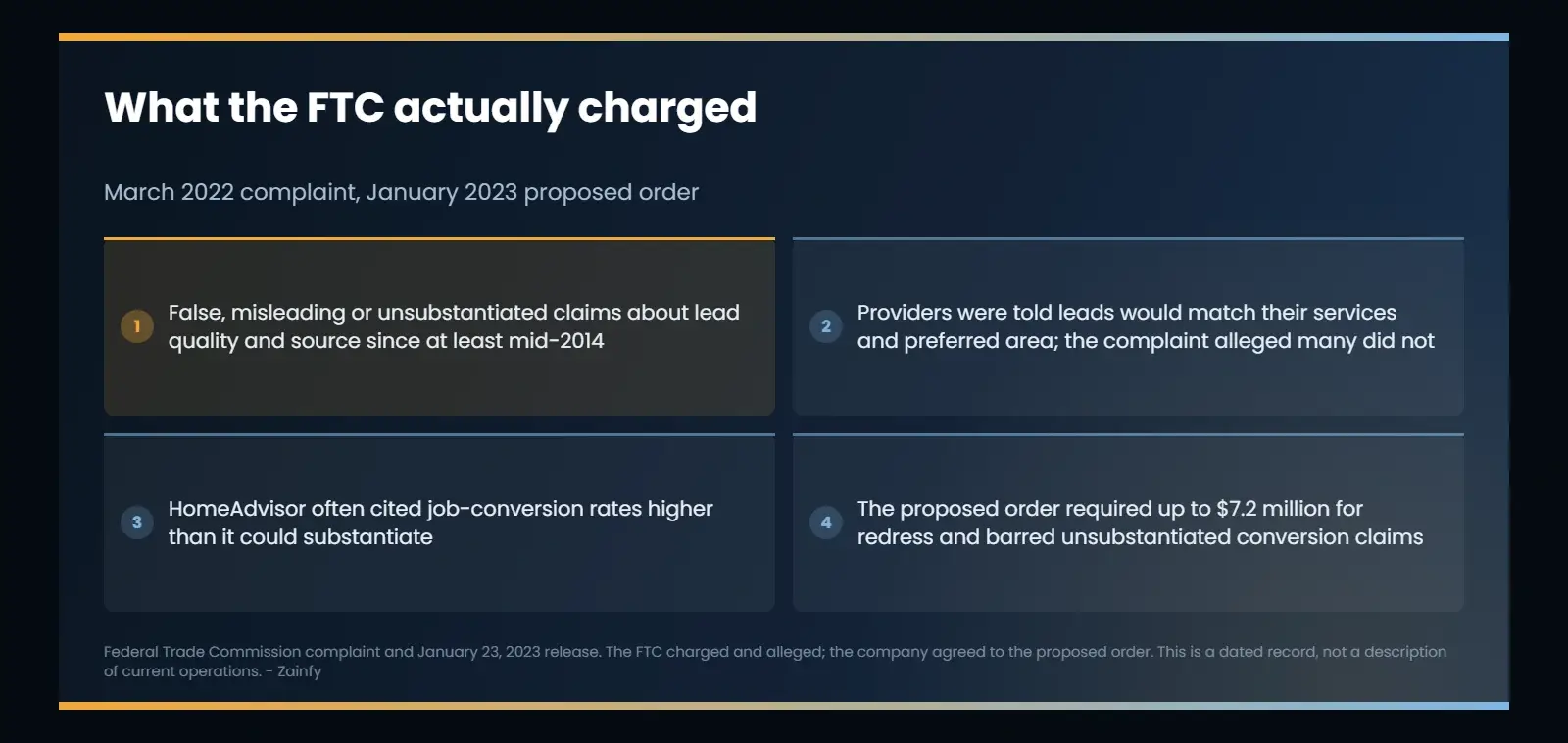
The FTC's March 2022 administrative complaint named HomeAdvisor, Inc., which the agency described as a company affiliated with Angi, formerly known as Angie's List. The complaint charged that, since at least mid-2014, HomeAdvisor had made false, misleading, or unsubstantiated claims about the quality and source of leads sold to service providers.
Two allegations matter directly to a contractor evaluating a lead contract. First, providers were told that leads would match the services they offered and their preferred geographic area, while the complaint alleged that many did not. Second, the FTC said HomeAdvisor often told providers its leads produced jobs at rates much higher than it could substantiate.
The FTC's January 23, 2023 release also described the historical fee structure. Providers generally paid an annual membership fee of $287.99 plus a separate fee for each lead, and many paid an additional $59.99 for an optional one-month software subscription. Those are the FTC's descriptions of the arrangement addressed by the case, not current prices.
Under the proposed consent order announced in that release, the company agreed to pay up to $7.2 million for redress. The order prohibits false or misleading statements about lead quality and source, including whether a consumer was ready to hire or had submitted a request directly to HomeAdvisor. It also bars unsubstantiated claims about the rate at which leads become paying jobs.
That record needs precise language. The FTC charged; the complaint alleged; the order requires; the company agreed. It does not provide a verdict on what your account produces now. Its practical value is narrower and more useful: conversion claims require evidence, and your renewal decision should rest on evidence you can inspect.
The number everyone quotes, and where it comes from
Search for what a booked customer costs through a shared-lead platform and you will find a confident number repeated across pages. Follow the citation. In this topic, the trail often ends at a marketing company's own article with no underlying study, dataset, invoices, or customer sample attached.
Then read the recommendation beneath it. The publisher frequently presents its service as the better alternative. The number is doing sales work, not measurement work.
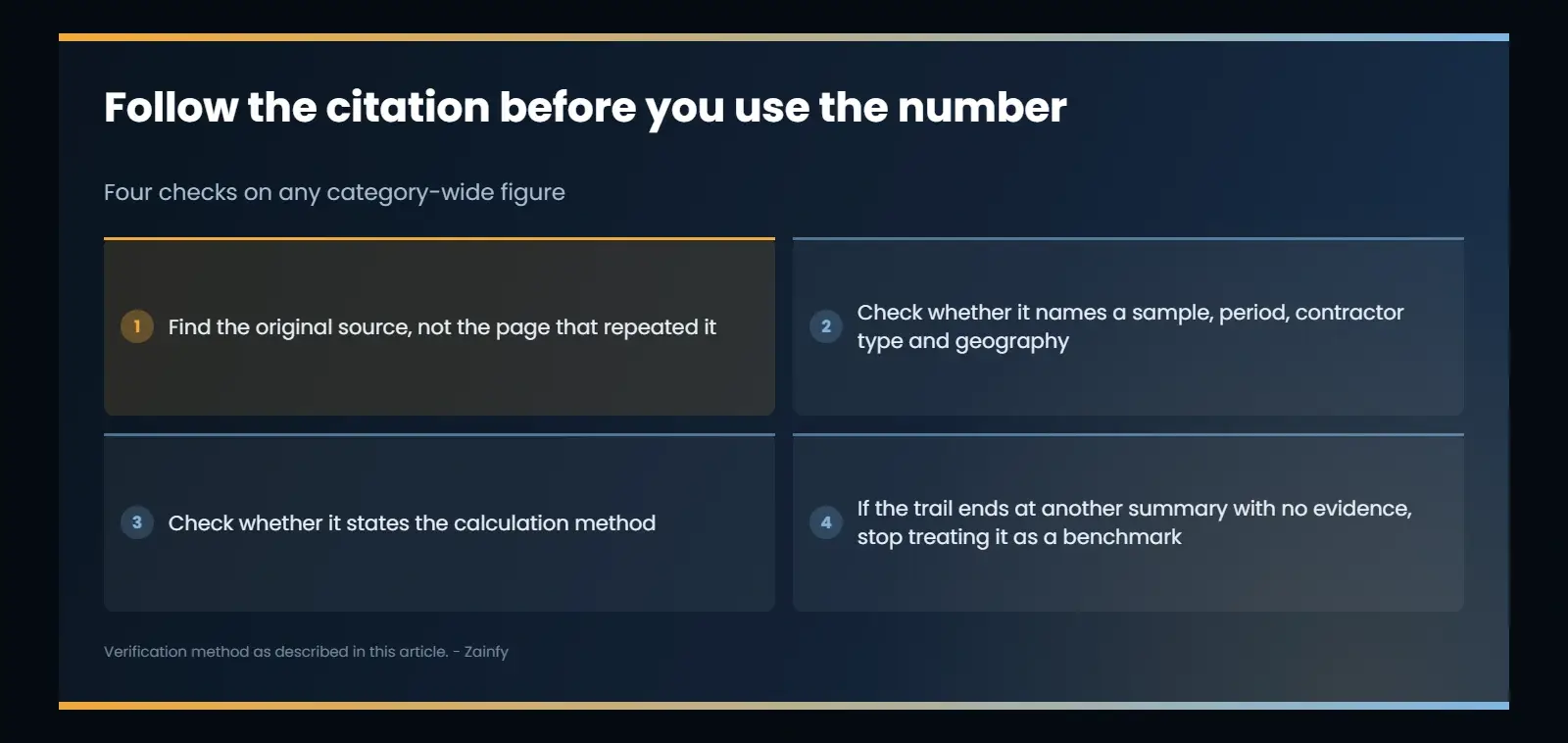
You can check this pattern without trusting us. Open any article that gives a category-wide cost or close rate. Find the original source, not the page that repeated it. Check whether the source names a sample, period, contractor type, geography, and calculation method. If the citation leads to another summary, continue until you reach the underlying evidence. If there is none, stop treating the figure as a benchmark.
Shared and exclusive leads also cannot be collapsed into one number. A request offered to multiple contractors creates a different sales condition from an enquiry delivered to one company. Geography, project type, response time, and minimum job size alter the result again.
The honest conclusion is not a replacement average. It is that arithmetic built on a number nobody can audit should not decide your renewal.
The three numbers you already have
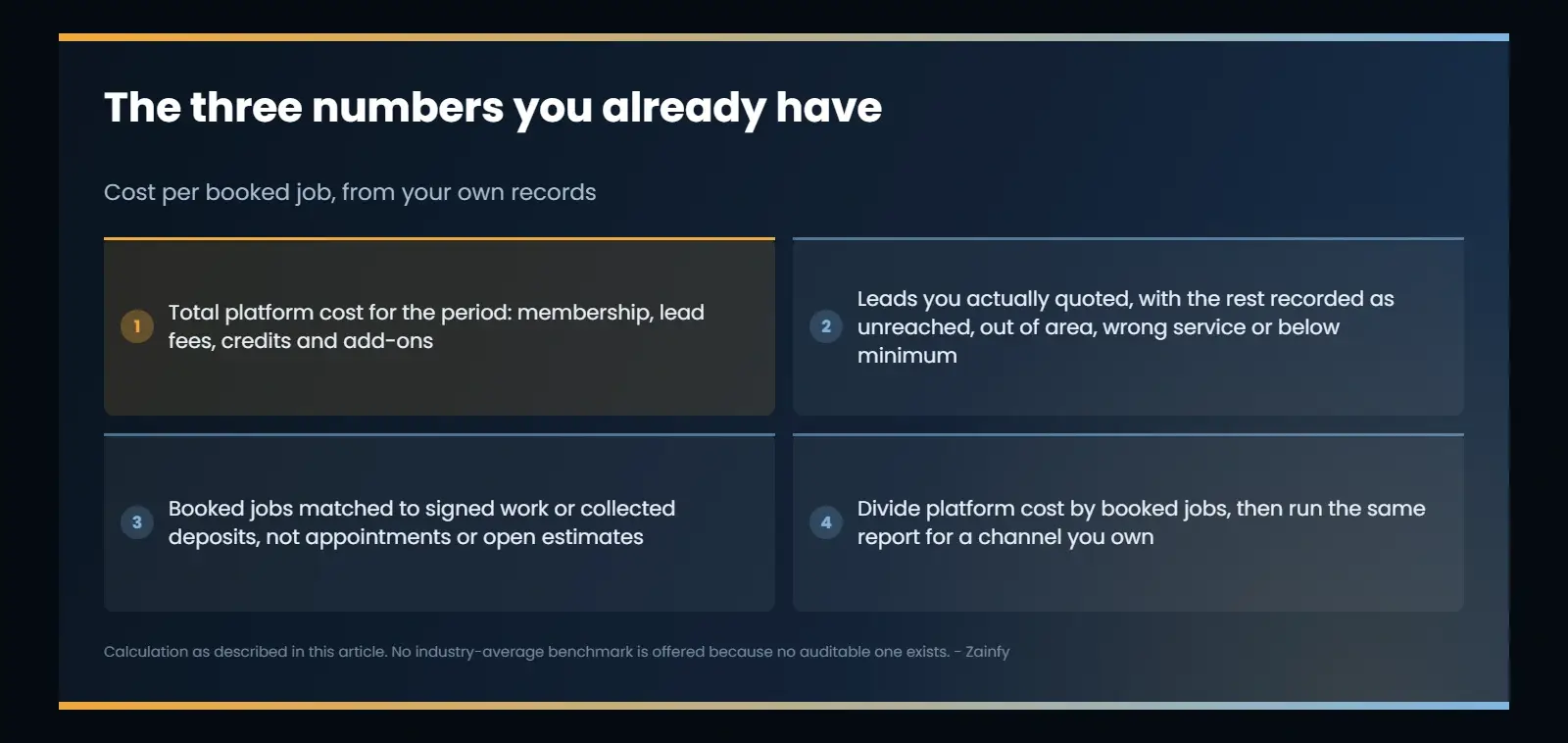
Start with the total platform cost for a defined period. Include membership charges, lead fees, credits, add-ons, and any contract cost required to receive those enquiries. Do not use the advertised lead price if the invoice total says something different.
Next, count how many platform leads your company actually quoted. Separate requests that never answered, sat outside the service area, asked for work you do not perform, or failed your minimum scope. Keep those records visible rather than allowing a single lead total to hide where the pipeline broke.
Then count booked jobs tied to those leads. Match them to signed work or collected deposits, not appointments, estimates sent, or opportunities marked open. Divide total platform cost by booked jobs. That is your cost per booked job. If no jobs booked, record the full cost and the zero outcome rather than forcing a ratio that cannot be calculated.
Close rate supplies a second view: booked jobs divided by the relevant lead pool, with the pool defined consistently from one period to the next. Revenue and gross profit can deepen the analysis, but they do not repair incomplete lead attribution.
Run an equivalent report for direct enquiries from channels you control. Include the real cost of producing and maintaining those channels, then compare booked jobs and gross profit over a comparable period. Cost per lead alone is not the deciding figure because cheap requests can still produce expensive customers, which is the case for generating your own remodeling leads instead of buying them.
We are not giving you an industry-average close rate or cost benchmark. The ranking pages do not provide an auditable one, and inventing a range would repeat the problem this calculation is meant to solve. Your invoices, lead records, and booked-job list are enough to make a defensible decision.
What owning the channel actually means
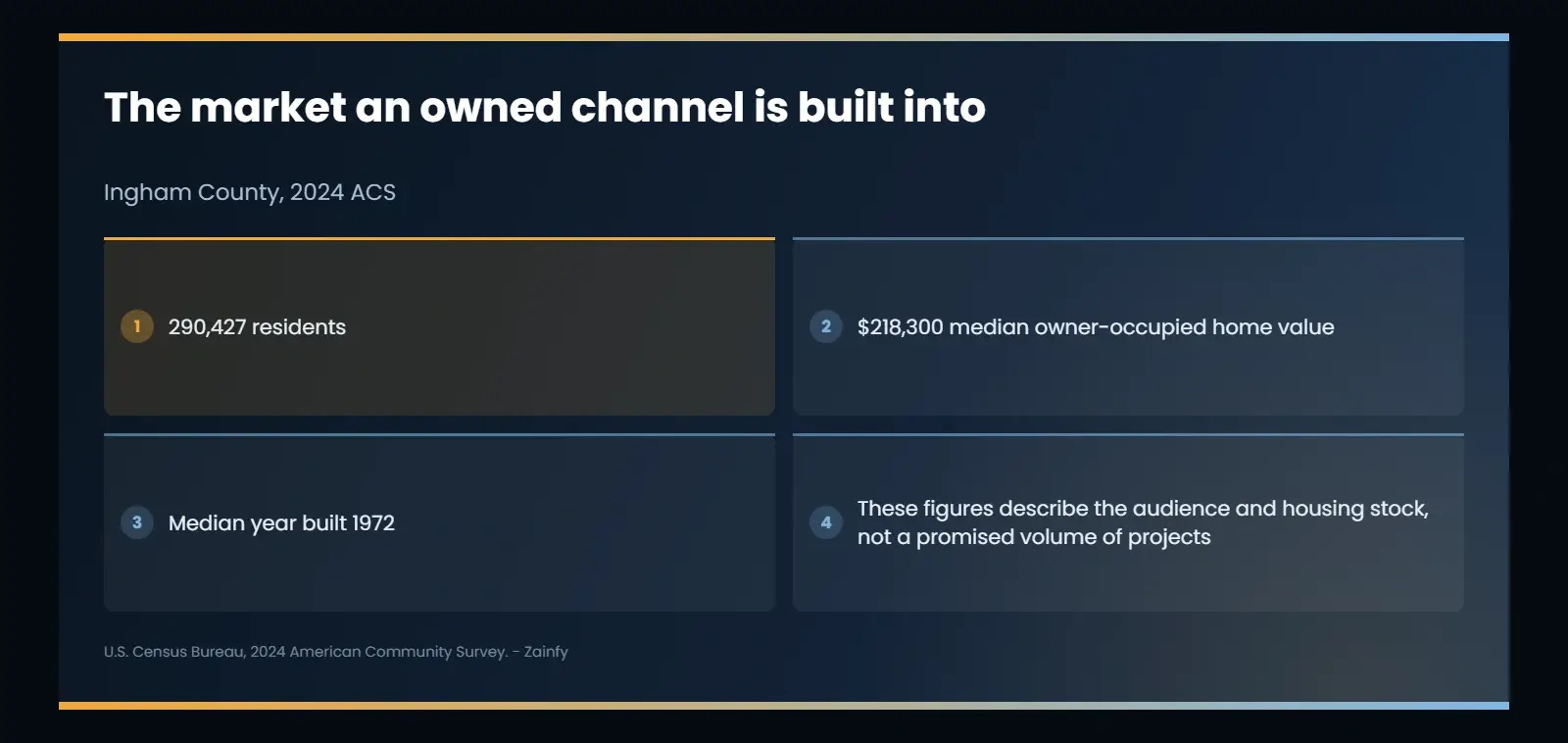
An owned channel is one where the enquiry reaches your company without a fee charged for each individual lead and without the request being distributed to competing contractors as part of the arrangement. That does not make the channel free: useful pages, project documentation, local visibility, and follow-up all require work. It changes what remains after the work is done. Ingham County already contains the market a Lansing remodeler is trying to reach: the U.S. Census Bureau's 2024 American Community Survey counts 290,427 residents, reports a $218,300 median value for owner-occupied homes, and gives the county a median build year of 1972. Those figures describe the local audience and housing stock, not a promised volume of projects. They tell you why a searchable record of relevant Lansing-area work can accumulate value instead of disappearing when a lead contract ends. As secondary evidence only, NextGen Construction, a Tampa, Florida remodeler, grew organic clicks from 56 to 1,730 per month, a 2,989% increase, over four months without paid advertising; that is a named Florida result, not a Michigan forecast. For remodelers who'd rather own the Lansing pipeline, the strategic question is whether today's investment leaves behind a findable asset, clearer project proof, and direct enquiry history the company keeps. Ownership means the channel can continue producing and teaching you after one billing period. It does not mean instant results, zero expense, or freedom from measurement.
Search and social are the two owned channels a Michigan contractor can actually build. Our Kalamazoo and Saginaw social programmes exist for the same reason this article does: the enquiry should arrive without a per-lead fee attached.
Don't just rent a different channel
Switching from one shared-lead platform to another is not a fix. The arrangement is the problem, not the vendor.
If a homeowner request is distributed to multiple contractors, you enter a race you do not control. A different logo on the invoice does not change that structure. Contractors describe stale requests, weak matches, and contract frustration in public discussions, but those reports cannot calculate your account. Your own cost per booked job can.
Be skeptical of every page telling you to leave a lead platform, including this page. Many "best contractor lead generation" roundups are published by companies that place their own service first. Their recommendation has a financial conflict.
Ours does too. Zainfy benefits if a contractor chooses to build an owned search channel. That interest does not make the recommendation false, but it does mean you should not accept it merely because we wrote it.
The calculation in the previous section survives that conflict. Your invoices do not depend on our sales pitch. Your quoted-lead count does not improve because a vendor wrote a persuasive comparison. Your booked jobs either sit against the spend or they do not.
Keep a platform if its verified economics work for your company. Reduce or leave it if they do not. Do not swap vendors merely to avoid measuring the arrangement.
Are Angi leads worth it for remodeling contractors?
Angi leads can be worth it for an individual remodeling contractor, but only that contractor's records can establish the answer. Calculate the platform's total cost per booked job over a real period, then compare it with booked-job cost and gross profit from a channel the company owns.
Category-wide answers fail because the variables belong to the account. Trade, service area, minimum scope, response process, competition for each request, and job profitability all alter the result. A lead that looks expensive can still produce a profitable job. A low-priced lead can remain costly if it never reaches a quote or becomes work.
The FTC record explains why measurement matters. Its 2022 complaint alleged that HomeAdvisor often gave service providers conversion claims at rates higher than it could substantiate. The proposed 2023 order requires substantiation for claims about how often leads become paying jobs. That history does not calculate your present return, and it should not be rewritten as a claim about current platform conduct. It does show why a sales conversion statement is not a substitute for account-level evidence.
Shared leads also begin under a different competitive condition from direct enquiries. Multiple contractors may pursue one request, so speed, fit, and sales follow-up affect the result before workmanship is ever evaluated. Measure that structure as purchased distribution. Measure the owned channel as an asset with ongoing costs and retained value.
The decision is not "platform or marketing" in the abstract. It is which recorded cost produces booked, profitable work without creating a dependency your company cannot afford.
Before you sign or renew
[wps_faq style=”classic” question=”What did the FTC say about HomeAdvisor's leads?”]
The FTC's March 2022 administrative complaint charged HomeAdvisor, Inc., which the agency described as affiliated with Angi, formerly known as Angie's List, with false, misleading, or unsubstantiated claims about lead quality and source. It alleged that many providers did not receive leads matching their services and preferred areas, and that HomeAdvisor often cited job-conversion rates higher than it could substantiate. A proposed January 2023 consent order required up to $7.2 million for redress and barred unsubstantiated conversion claims. This dated regulatory record does not describe current operations. Use it to demand evidence for every conversion promise.
[/wps_faq]
[wps_faq style=”classic” question=”What should I measure before renewing a lead contract?”]
Measure total platform cost, leads received, leads quoted, booked jobs, booked revenue, and gross profit for a defined period. Pull figures from invoices, the lead export, estimates, signed work, and accounting records. Calculate cost per booked job by dividing platform cost by jobs won, then document why unquoted leads failed: no response, wrong geography, wrong service, or unsuitable scope. Use consistent definitions across periods. Do not count an appointment or open estimate as a booked job. The renewal conversation becomes clearer when every purchased request has a recorded disposition rather than disappearing into a sales representative's average.
[/wps_faq]
[wps_faq style=”classic” question=”Is it cheaper to buy leads or build my own pipeline in a market like Lansing?”]
It depends on recorded cost per booked job and how long you measure the owned channel. Ingham County has 290,427 residents, a $218,300 median owner-occupied home value, and a 1972 median build year in the Census Bureau's 2024 ACS. Those figures establish a local audience and housing base; they do not guarantee enquiries. Purchased leads can produce work quickly but carry recurring acquisition costs. An owned channel requires upfront and ongoing investment while leaving behind pages, project proof, and direct attribution. Compare both using booked jobs and gross profit, then account for what remains after billing ends.
[/wps_faq]
Pull twelve months before the renewal call
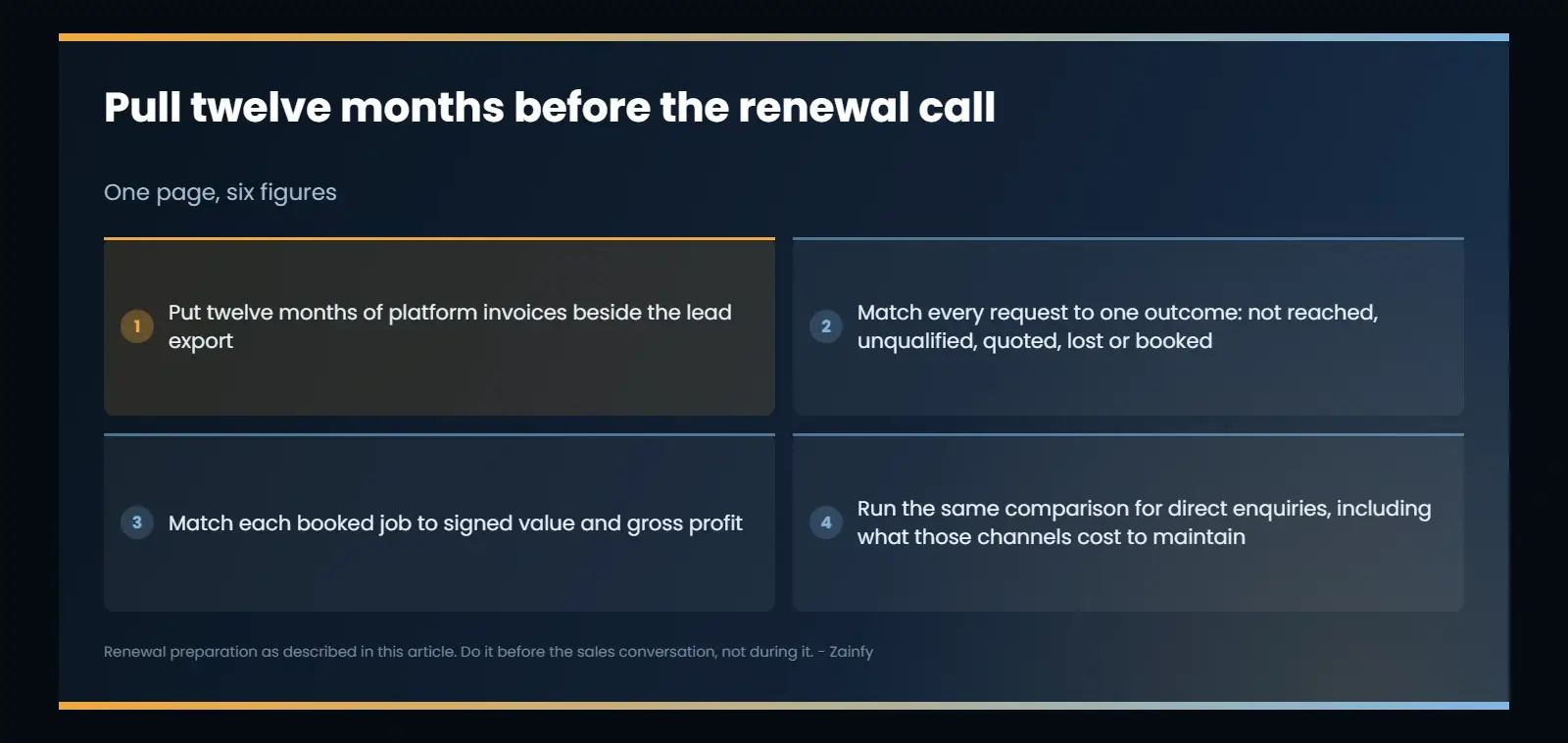
Before the renewal conversation, pull twelve months of platform invoices and place them beside the lead export. Match each request to one outcome: not reached, unqualified, quoted, lost, or booked. Then match each booked job to signed value and gross profit.
Do this before speaking with the sales representative. A renewal offer can change the future price, but it cannot rewrite the last twelve months. If attribution is incomplete, repair the records first and delay the decision until booked jobs can be counted.
Then run the comparison against direct enquiries from your owned channels over a comparable period. Include the cost of the work required to maintain them. The goal is not to make one side win by hiding expenses.
Your decision should fit on one page: total cost, quoted leads, booked jobs, cost per booked job, booked revenue, and gross profit. That page is more valuable than another platform review because every number on it belongs to your business.