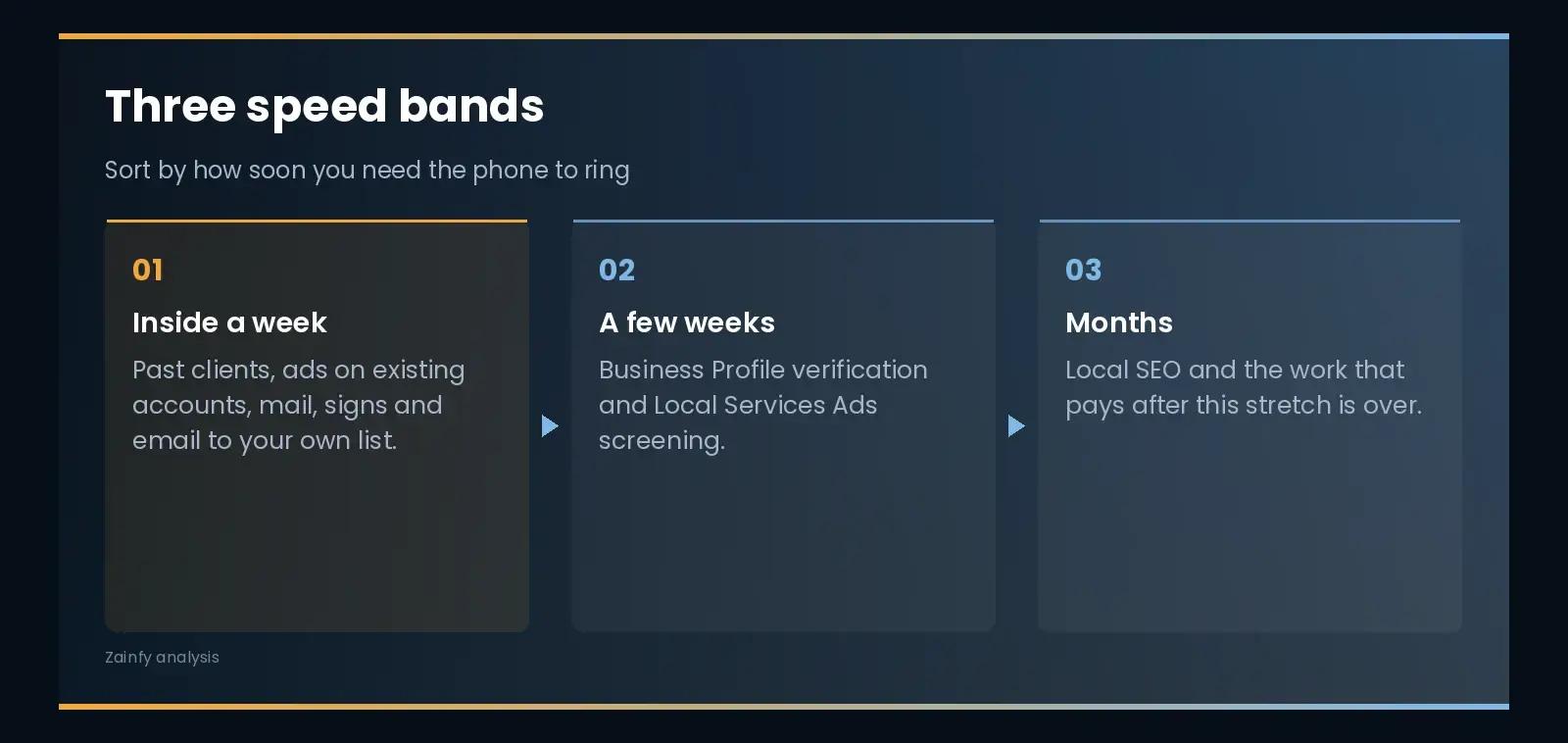
Most construction marketing ideas, and most contractor marketing ideas in general, are sorted by what they cost. If your schedule has gone quiet and you need work in front of you soon, you need it sorted by how fast each idea can be live. Here are those ideas sorted by speed, in three bands: things that can be running inside a week, things that sit in somebody else’s queue for a few weeks, and things that take months to pay. That order holds for remodeling marketing ideas and for marketing ideas for a small construction business.
One result surprises people. Printed mail entered at your local post office carries a two-day USPS delivery standard, while a brand-new Local Services Ads profile takes Google’s published average of three to four weeks to clear screening. The old-fashioned option is the faster one.
A note on what these durations mean. Each one is the earliest a channel can put you in front of somebody, based on what the platform or agency publishes. None of them is a promise of a phone call. But when the calendar is empty, elapsed time is the constraint that matters most, more than price, and it’s the one almost nobody sorts by.
Is the phone quiet because of the market or your marketing?
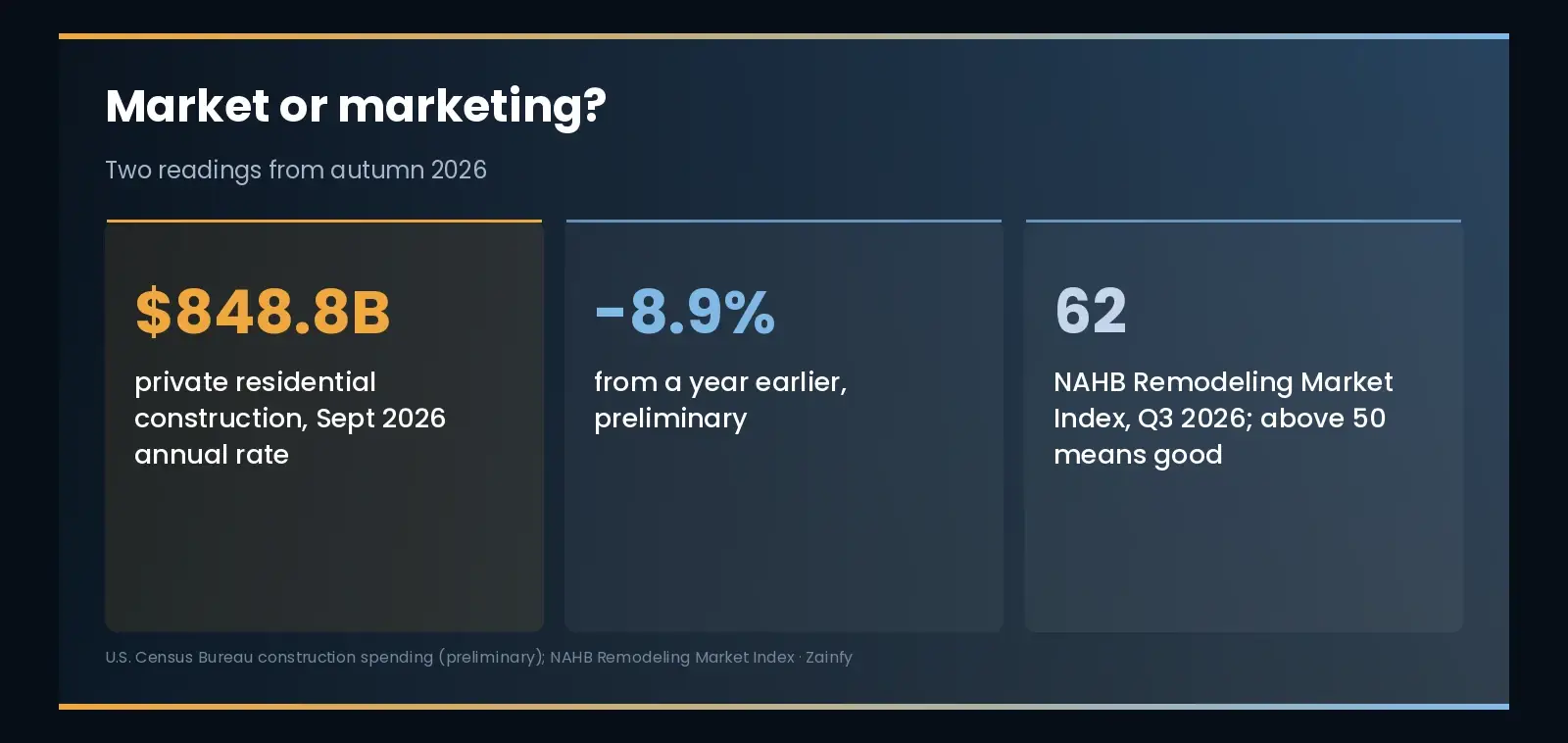
The first question a quiet stretch raises is whether the market dried up or the business went invisible. The numbers point in two directions. Total private residential construction spending ran at a seasonally adjusted annual rate of $848.8 billion in September 2026, 8.9% below a year earlier (>U.S. Census Bureau, preliminary). Yet remodelers themselves still rate the market positively. The National Association of Home Builders’ >Remodeling Market Index read 62 in the third quarter of 2026, where anything above 50 means more remodelers call conditions good than poor, and NAHB expects remodeling activity to hold steady through the year.
So spending overall is down, and remodeling demand is holding. For a remodeler whose phone has gone quiet, that usually points to visibility before it points to the economy.
The usual advice doesn’t help with that, because it ranks ideas by price, from free to expensive. Price is the right sort for an owner who’s short on money. An owner who’s short on time needs a different order.
Inside a week: what can be live before Friday
This band answers the question most owners actually ask, which is how to promote yourself as a contractor this week, often with almost no budget. The first three cost mostly time.
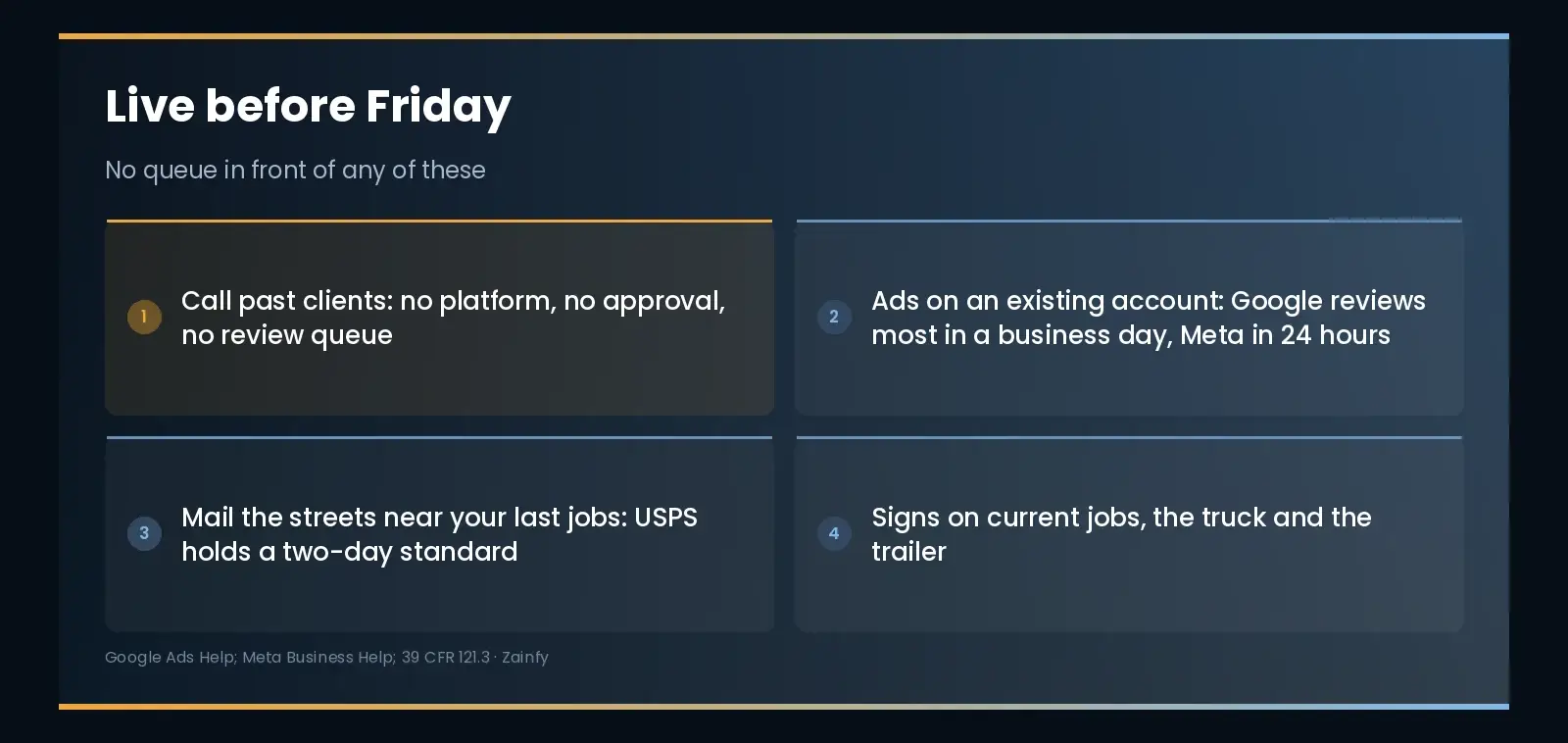
Call the people who already hired you. It’s the fastest thing on this page. There’s no platform, no approval and no review queue, and most lists of marketing ideas bury it somewhere in the middle without saying it beats everything else on speed. Past clients refer neighbors, and some of them have a second project they never mentioned.
Run an ad on an account that already exists. Google Ads and Meta (Facebook and Instagram) ads are the fastest way to advertise a construction business to strangers. >Google says most ads are reviewed within one business day, and Meta says most are reviewed within 24 hours. Both review an ad again after you edit it, so rewriting the creative on day two costs you another day. A paid campaign is the only option on this list that can reach a stranger this week, and owners usually reach for it late because nobody explains what standing up a paid campaign actually involves anywhere near the advice telling them to run one.
Mail the streets where your last jobs are. USPS holds a two-day service standard for Marketing Mail entered at the destination delivery unit (>39 CFR § 121.3), and Every Door Direct Mail at the retail counter enters there. Design and printing sit outside those two days, and nobody publishes a standard for them, so count your printer’s turnaround on top.
Put signs up today. Signs are the oldest construction advertising there is. Yard signs on current jobs, lettering on the truck and trailer, a board at the site. Nothing to approve and nothing to verify.
Email the list you already own. No institution publishes a response window for this, so there’s no number to give you. It goes out the moment you send it.
Door hangers around a finished job. Opinion is split on whether they work, and saying so is more honest than pretending otherwise. They are fast, though.
A few weeks: the things with a queue in front of them
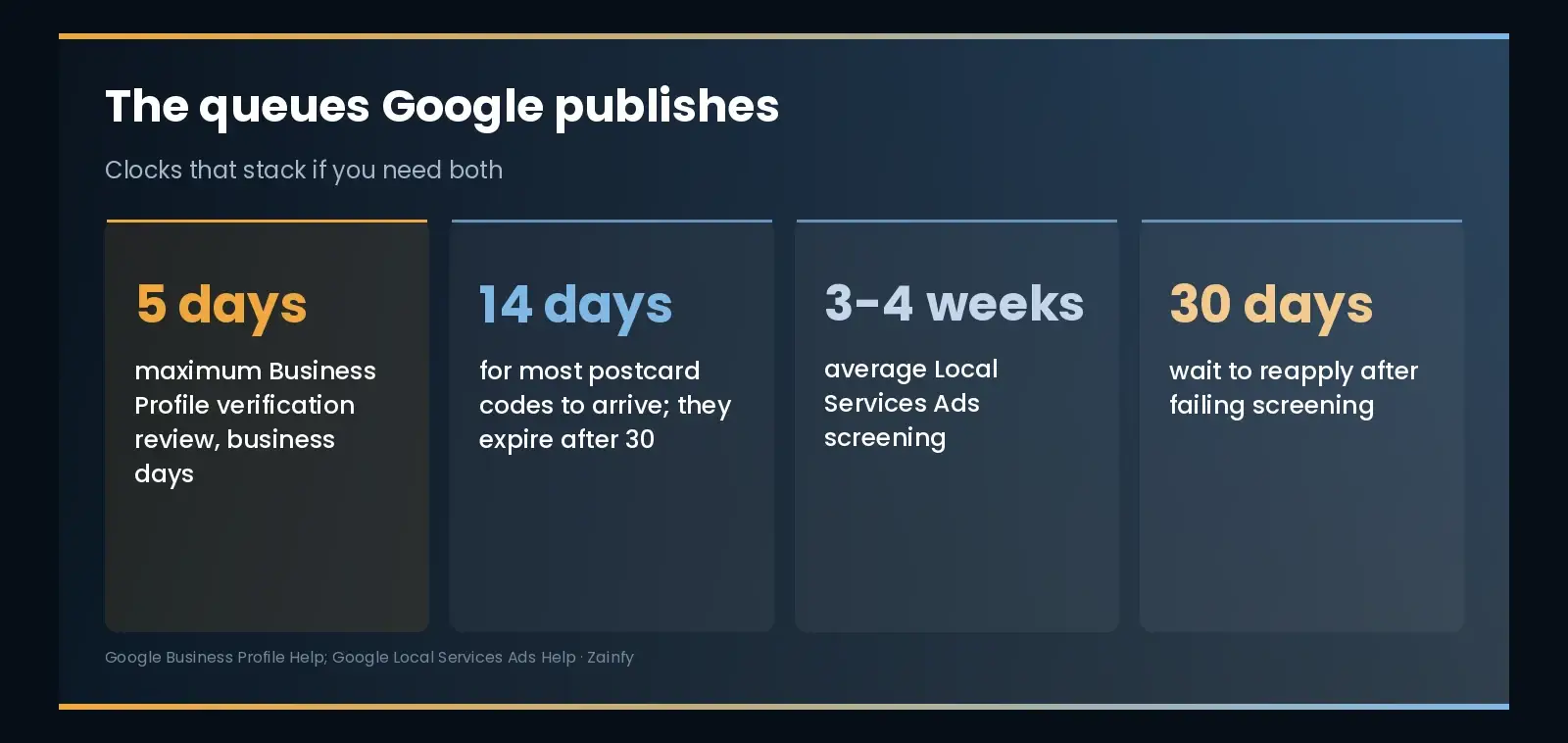
Google Business Profile verification. >Google says verification reviews take up to 5 business days. If you’re sent a postcard, most codes arrive within 14 days, and they expire after 30. If your profile is already verified, you’re at day zero here.
Local Services Ads. >Google puts the average at 3 to 4 weeks after you submit documents, and the screening checks your Business Profile ownership as part of it. So the two clocks stack. If your profile isn’t verified yet, the Local Services wait starts after the profile wait ends.
The tail if something goes wrong. A D-U-N-S number from Dun & Bradstreet can take up to 30 days if you don’t have one. Your insurance certificate must stay valid for at least 14 days after you submit it. Fail screening and you wait 30 days to reapply. Fail twice and every further attempt waits 180 days.
The one clock Google leaves blank. Google gives a duration for almost every step above. For the background check itself, it gives none.
An owner who needs work this month can’t absorb that tail. An owner planning for next quarter should start it now.
Months: the work that pays after this problem is over
None of what sits in this band helps an empty week, which is exactly why it gets dropped every time the work comes back, and why so many owners end up reading lists like this one again a year later. How long does local SEO take? Google’s own >SEO starter guide says “some changes might take effect in a few hours, others could take several months,” and getting a page recrawled alone can take anywhere from a few days to a few weeks, so search has a fast end and a slow end, and you don’t get to pick which one your changes land on. And how long does it take to get leads from Google Ads? The ad itself can be live in a day, but paid search has its own warm-up. After structural changes Google says a campaign can show a learning status for up to 7 days, and after a significant change in conversion behavior it asks you to allow 1 to 2 conversion cycles, which for a remodeler whose customers take weeks to decide is a long way from a same-week result. Reviews belong here too, along with trade associations, sponsorships, community work and video, all of which pay in relationships and reputation over time. Everything in this band is worth having eventually. That’s a different claim from everything in it being worth having now, and the owner who has outgrown half of this list is usually better off running two of these properly than six of them half-done.
What a speed sort of construction marketing ideas can’t decide for you
Speed tells you what to reach for first. A construction marketing strategy needs three more answers.
The first is money. A speed sort says nothing about which of these suits your size of business or what each one costs, and the difference between a panic that empties the account and a budget you can actually sustain once the panic is over is whether anyone priced the options before the quiet stretch started.
The second is what to keep once work returns. That’s a capacity question, and the months band above is where it bites.
The third is whether the call can land. A homeowner who sees your yard sign checks you online before dialing, so the fastest channel still converts only as well as the website and reviews they find.
Don’t spend a quiet stretch rebuilding the brand
Don’t spend an empty schedule on a rebrand.
A new logo, a new name, a rebuilt site and a fresh color palette are the most satisfying projects to start when nothing is booked. They feel like progress, and nobody can reject them. Every one of them also sits in the slowest band on this page, and none of them puts work on the calendar in the weeks you need it.
Here’s the tell. It’s the only work on the list that nobody outside your business ever sees a result from.
If your identity genuinely needs redoing, redo it in a month that already has jobs in it.
What are some effective marketing ideas for a construction company?
The most effective marketing ideas for a construction company depend on how soon you need work. Calling past clients, running an ad on an existing account and sending printed mail can be live within days, and USPS holds a two-day standard for mail entered at the local delivery unit. A Google Business Profile takes up to five business days to verify, Local Services Ads screening averages three to four weeks, and search results can take from a few hours to several months to respond. All of these are the earliest a channel can reach someone, which is different from a promised lead. The common lists aren’t wrong. They’re sorted for a reader who isn’t in a hurry. That applies whether you’re figuring out how to market a construction company, a remodeling business or a small specialty shop.
If you want more remodeling jobs this month, pull up your list of completed jobs from the last two years and count how many of those clients have heard from you since the final invoice. That number is your fastest marketing channel. You’ve already paid for it, and it’s the only thing on this page that needs nobody’s approval to start today.
Durations checked against the linked USPS, Google and Census sources on November 10, 2026.