If you are a metro-Atlanta remodeler using social media marketing for Atlanta remodelers, you are talking to Cobb, North Fulton, and intown buyers at the same time, and one identical feed does not fit all three. That is the part most national remodeler-social advice misses. It tells you to post before-and-afters, pick a platform, answer comments, and stay consistent. Fine. But a Marietta homeowner asking neighbors who did their kitchen is not reading your feed like a Milton homeowner studies a polished whole-home reveal, and neither one behaves exactly like a Decatur bungalow owner watching short project clips.
This is not a platform problem first.
It is an audience problem. Metro Atlanta is one market on a map, but it is not one buyer in the feed. The contractor who understands that can use the same project documentation with different edits, different captions, and different proof by submarket. The contractor who ignores it usually posts whatever looked good that week and wonders why the likes came from other trades instead of homeowners. That is how a feed gets busy without becoming useful.
One metro, three buyers who scroll differently
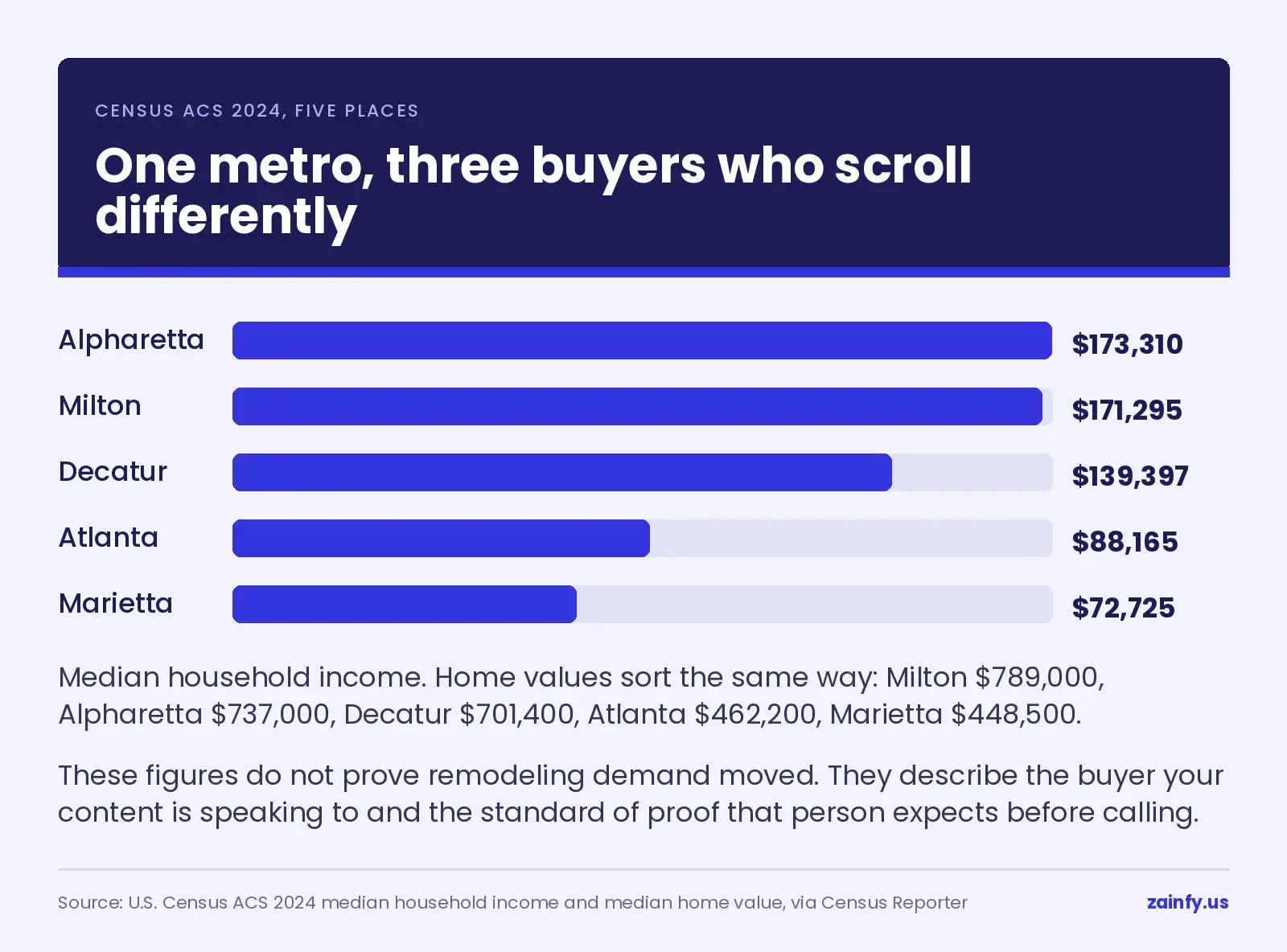
The audience split is not a vibe; it is visible in the numbers. Census Reporter shows Alpharetta at $173,310 median household income and Milton at $171,295, while Marietta sits at $72,725 and the city of Atlanta at $88,165. Decatur creates its own intown band at $139,397. Home-value figures sort that way: Alpharetta at $737,000, Milton at $789,000, Marietta at $448,500, Atlanta at $462,200, and Decatur at $701,400. Those figures do not prove remodeling demand moved. They describe the buyer your content is speaking to, the financial setting around the house, and the standard of proof that person expects before he or she calls. North Fulton buyers are often checking whether your work looks controlled enough for a higher-value property. Cobb and Marietta buyers are often weighing trust, price clarity, and whether a neighbor would recommend you. Intown Atlanta and Decatur buyers may care more about whether you understand older bungalow and Craftsman work without flattening the character of the house. That is why the phrase “post before-and-afters” is too thin by itself. A before-and-after that works in East Cobb needs a different caption than one posted for Alpharetta, and a Decatur progress clip needs a different rhythm than a Milton portfolio image. If your feed treats all of them as “Atlanta homeowners,” it strips out the buying context that makes the post useful. Social media for a metro remodeler is not just visibility. It is sorting. You are trying to help the right homeowner recognize, quickly, that you work in the kind of home, budget band, and neighborhood situation she is comparing.
That sorting matters because the same owner may work all three areas in one month. A crew can finish a Marietta kitchen, price a Milton main-floor remodel, and walk a Decatur bath in the same week. The camera roll may look like one business. The buyer signals are not one business. Cobb needs to see steadiness. North Fulton needs to see finish control. Intown needs to see judgement around older-house constraints.
Cobb still runs on the neighbor’s word
Cobb County social works closer to referral than performance theater. Marietta, East Cobb, West Cobb, Smyrna, and Kennesaw homeowners still want to know who did the work, whether the crew showed up, whether the kitchen stayed usable, and whether the contractor handled the messy middle without excuses.
That is why Facebook and Nextdoor matter here. A recommendation thread in a local group can do more for a Cobb remodeler than a pretty grid with no neighborhood signal. The feed still needs decent photography. But the post that travels is usually the one that lets a homeowner picture the job in a familiar house, with a clear explanation of what changed and why the contractor made the choices he made.
For a Marietta audience with a $72,725 median household income and $448,500 median home value, budget clarity is not a cheapness signal. It is a trust signal. A post that says “we kept the existing cabinet boxes and changed the layout this way” will often beat a glossy reveal that gives the owner no sense of scope.
That is also true for before-and-after content. Do not just post the after photo. Show the dated bath, the framing issue, the new tile line, the final finish, and the caption that explains the decision in plain language.
That is where social content that reaches Cobb County homeowners has to feel like a local proof trail, not a showroom brochure.
Replying matters too. A remodeler who answers a neighborhood question cleanly, without sounding like he is pitching the room, can be remembered when the owner is ready to ask for estimates. That is not glamorous social media. It is Cobb County social media.
The practical test is simple: could the post survive inside a Marietta or East Cobb recommendation thread without sounding imported? If the caption reads like it was written for every city in Georgia, it will not carry much weight in Cobb. Name the kind of job, the neighborhood context when appropriate, and the decision the homeowner was probably worried about before the work started.
North Fulton buys the polish before the project
A North Fulton buyer judges the feed before she judges the estimate.
In Alpharetta, Milton, Roswell, and Johns Creek, the numbers are different enough that the content has to be different. Alpharetta’s median household income is $173,310, Milton’s is $171,295, and the home-value band runs from $737,000 in Alpharetta to $789,000 in Milton. That buyer is not only asking, “Can you do this?” She is asking whether your work will feel controlled, tasteful, documented, and worth bringing into a high-value home.
Instagram and Houzz carry more weight here because the visual standard is higher. A messy feed says more than you think. Crooked jobsite photos, random captions, and three-month gaps make the company feel casual before the owner has even clicked through.
This does not mean every post needs to look like a magazine shoot.
It means the finished work needs breathing room. Detail shots matter. Hardware, lighting, stone, trim, cabinet spacing, and the way the room photographs from the entry all carry signal. The feed should show that the contractor notices finish quality before the client has to ask.
For this segment, building a social presence North Fulton buyers actually trust means building a portfolio-led feed with enough discipline that the homeowner believes the process behind it is disciplined too.
North Fulton is not impressed by noise. It is persuaded by visible control.
That control has to show up before the sales conversation. If the feed jumps from a luxury kitchen to a blurry jobsite photo to a generic quote graphic, the buyer does not see range; she sees inconsistency. A North Fulton portfolio can still be warm and human, but it should not make the homeowner wonder whether the finished result was an accident.
Intown is younger, older-homed, and on short-form video
Intown Atlanta is not just the urban version of North Fulton. The city of Atlanta’s median age is 34.5, Decatur’s is 39.8, and both audiences sit around a different kind of housing story than suburban expansion. Buckhead can behave more like North Fulton because polish and finish still lead. East Atlanta, Decatur, Inman Park, Grant Park, and parts of Midtown often reward a different signal: proof that you understand older houses, tighter lots, visible character, and the weird things that show up after demo.
That changes the format.
In North Fulton, a finished image can carry the post. Intown, TikTok and Reels can carry the process. A quick clip of a wall opening, a floor repair, a trim match, a layout correction, or a preserved detail can say more than a static carousel. The intown buyer is not always looking for the smoothest reveal. Sometimes he wants to know whether you know what not to erase.
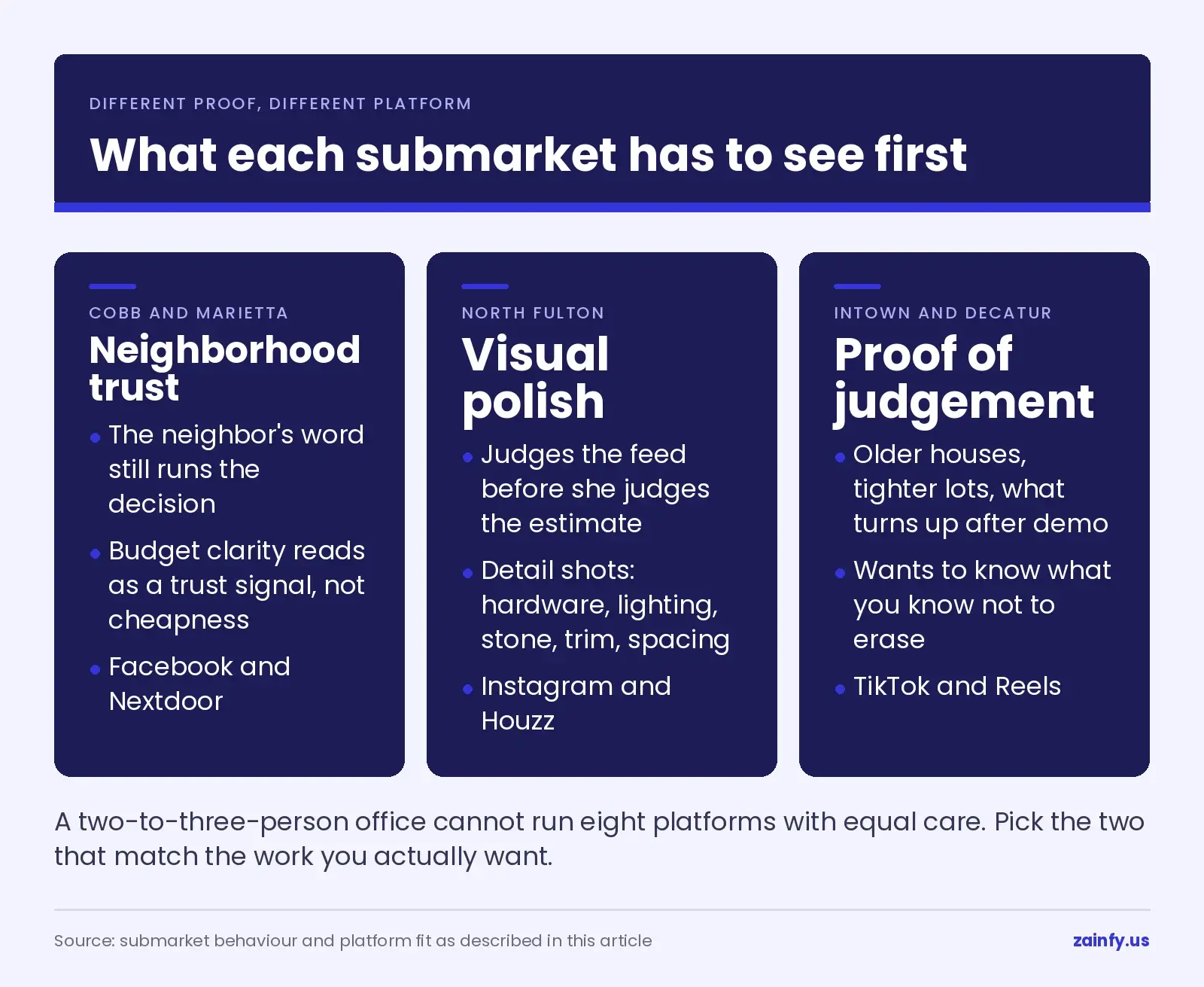
Cobb wants neighborhood trust. North Fulton wants visual polish. Intown wants proof of judgement.
That is why a Grant Park bungalow clip should not sound like a Milton whole-home reveal. The caption can be shorter, more specific, and more craft-led: what was kept, what had to change, what the house would not let you fake. A Decatur Craftsman update can show the small decision that made the project believable. An East Atlanta bath can show constraint as part of the story, not as an excuse.
The intown version of social is where Atlanta’s intown remodeler social feeds belongs: short-form proof, neighborhood language, and enough restraint that the post does not turn a real house into generic content.
This is also where restraint protects the contractor. Do not pretend every old-house surprise is charming. Some of it is slow, dusty, and expensive to correct. The post can still be useful if it explains the judgement: what the crew opened up, what had to stay, what could be modernized, and what the owner needed to understand before the next phase started.
The content types are the same; the edit is not
Every remodeler-social guide ends up naming the same content types because the basics are real. Before-and-afters work. Testimonials work. Progress clips work. Budget-clarity posts work. Finished-detail posts work. Google Business Profile activity helps when a homeowner sees your post and then searches your name.
The mistake is treating those buckets as finished strategy.
Take one kitchen shoot. Same job. Same photos. Same contractor.
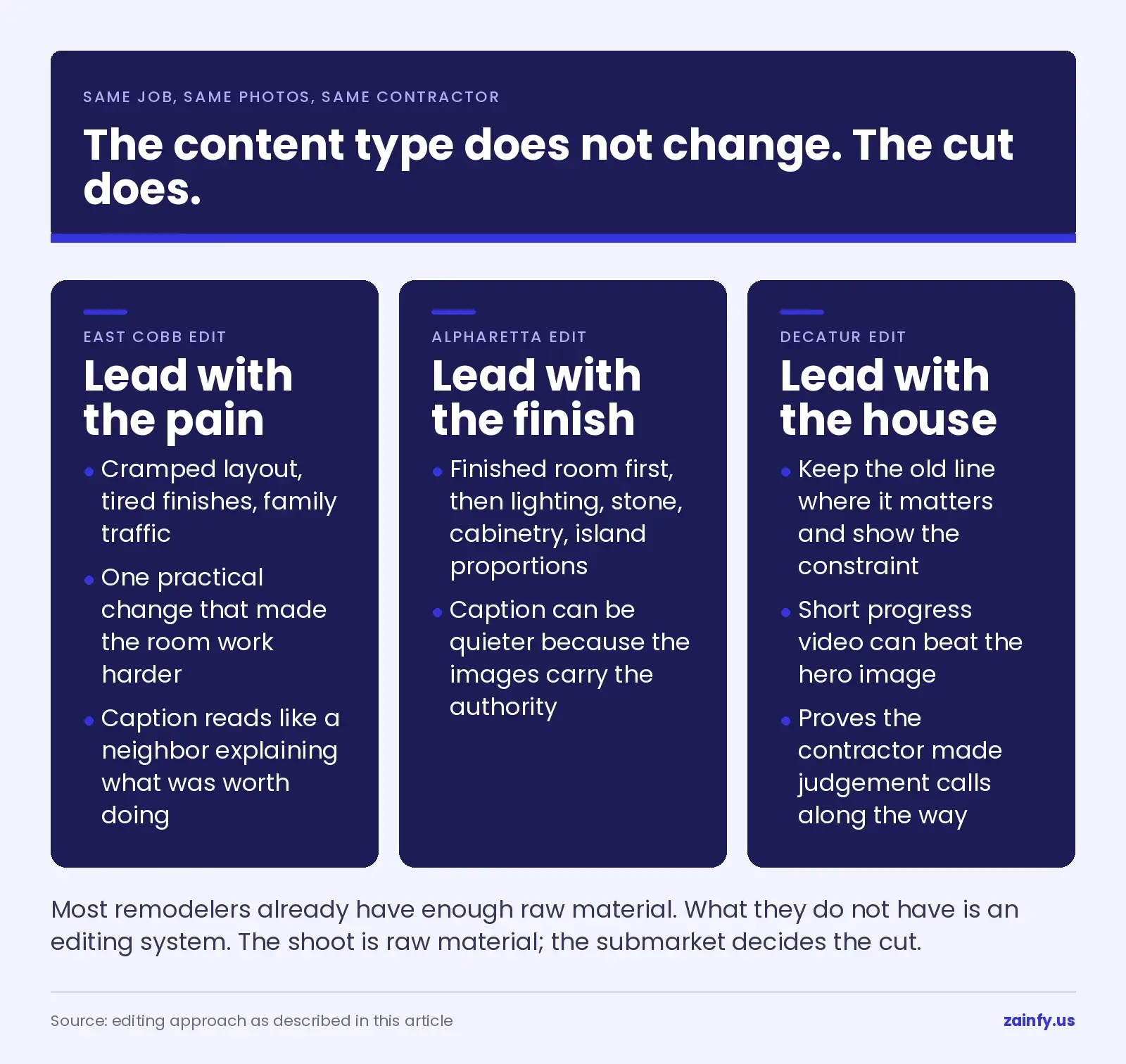
For East Cobb, the best edit may start with the original pain: cramped layout, tired finishes, family traffic, budget-conscious decisions, and one practical change that made the room work harder. The caption should read like a neighbor explaining what was worth doing.
For Alpharetta, the edit may lead with the finished room, then move into detail shots: lighting, stone, cabinetry, appliance wall, island proportions, and the finish choices that make the project feel intentional. The caption can be quieter because the images carry more of the authority. That is the pattern behind an intown studio that built its audience this way.
For Decatur, the edit may focus on the house. Keep the old line where it matters. Show the constraint. Explain why a modern finish had to respect the room instead of swallowing it. A short progress video may be stronger than the hero image because it proves the contractor made judgement calls along the way.
Client testimonials need that treatment too. A Marietta testimonial about communication during a lived-in kitchen can be stronger than a broad “we love our remodel” quote. A Milton testimonial should speak to trust, finish, and the feeling that the contractor managed the details. An intown testimonial can point to problem-solving in an older home.
Behind-the-scenes content needs editing too. Do not post every dusty clip. Post the moment that explains competence: why the framing changed, why the tile layout started there, why the old trim was saved, why the schedule had to be explained before the mess started.
The shoot is raw material. The submarket decides the cut.
That same logic applies to captions. A Cobb caption can be plain and practical: what problem the family had and what choice solved it. A North Fulton caption can be sparse, because the finished details should carry the weight. An intown caption can be more process-led, because the homeowner may be testing whether you respect the house. The content type did not change. The buyer’s reason for trusting it did.
Most remodelers already have enough raw material. They do not have an editing system. Phone photos sit in a folder, the best job never becomes a post, and the one project that does get posted is asked to speak to every buyer at once. That is the part to fix before worrying about a larger calendar.
Stop posting one feed to all of metro Atlanta
Do not run one identical feed across Cobb, North Fulton, and intown and call it your Atlanta social presence.
That is the wrong move.
The polish that helps with a $737,000 Alpharetta home can read like showing off in a Marietta neighborhood group. The budget-clarity post that builds trust around a $448,500 Marietta home can read too low-end for a Milton owner deciding who belongs in a $789,000 property. The casual, craft-first clip that works in Decatur can feel underproduced for a Roswell or Johns Creek buyer who expected a portfolio before a phone call.
Do not chase every platform either. A two-to-three-person office cannot run Facebook, Nextdoor, Instagram, Houzz, TikTok, Reels, Pinterest, and LinkedIn with equal care. That usually turns into thin posting everywhere.
Pick the two that match the work you actually want.
If most of your jobs come from Cobb and Marietta, Facebook and Nextdoor deserve the first serious attention. If you want more Alpharetta, Milton, and Roswell work, Instagram and Houzz need to look like your best project file, not a storage bin. If intown Atlanta and Decatur are the target, TikTok and Reels should show the process that still photos hide.
Location signals keep the feed honest: neighborhood captions, project-area language, tagged service areas, and comments that make it clear where you work. The point is not to sound bigger than you are. The point is to stop making three different homeowners decode one generic Atlanta feed.
There is a second reason to stay selective. A scattered platform mix hides weak follow-up. If a homeowner asks about a bath on Facebook, sends a message from Instagram, or clicks from Houzz, the business still has to answer with the same seriousness. Two channels handled well beat six channels where the owner checks messages whenever the truck is parked.
How often to post, and who becomes a lead
Post often enough that a homeowner can tell the business is alive. Do not chase a magic daily number.
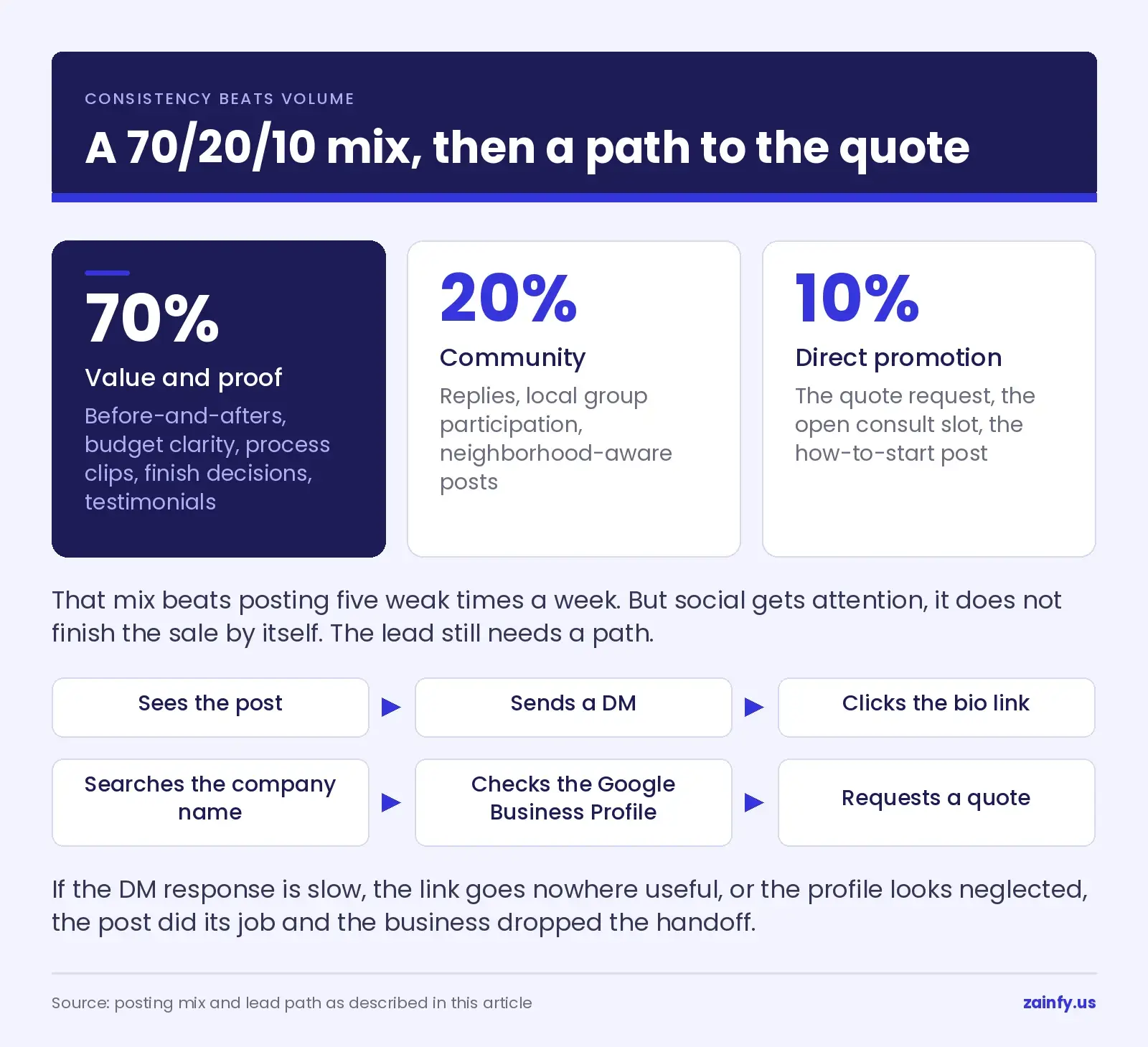
For most remodelers, the better question is whether the feed has a usable mix. A 70/20/10 split is simple enough to keep: roughly 70% value and proof, 20% community, and 10% direct promotion. Value and proof means before-and-afters, budget clarity, process clips, finish decisions, and testimonials. Community means replies, local group participation, neighborhood-aware posts, and useful comments that show you understand Cobb, North Fulton, or intown without forcing it. Promotion is the quote request, the open consult slot, the direct “here is how to start” post.
That mix beats posting five weak times a week.
A lead also needs a path. Social gets attention; it does not finish the whole sale by itself. The homeowner sees the post, sends a DM, clicks the bio link, searches the company name, checks the Google Business Profile, and then decides whether to request a quote. If the DM response is slow, the link goes nowhere useful, or the profile looks neglected, the post did its job and the business dropped the handoff.
This is where cost should be judged from the contractor’s side. Running three audiences properly takes planning, filming, editing, posting, replies, and lead routing. Doing it yourself is possible if somebody owns the system every week. Handing it to a relative with no submarket plan is usually just unpaid drift.
The cadence should also fit the jobs you actually have in progress. A remodeler with one active kitchen and two estimates does not need to manufacture a full media schedule. He needs to document the job well, break that documentation into useful pieces, and make sure the next homeowner has somewhere to go after the post earns attention. That is why the DM-to-quote path belongs in the plan, not as an afterthought.
Measure leads by submarket, not likes by post
Follower count is a weak scoreboard for a metro Atlanta remodeler. The useful question is where the booked estimate came from and which audience the content reached before that estimate happened. A Cobb reveal that starts two East Cobb kitchen conversations is not the same signal as an Alpharetta carousel that sends a Milton whole-home owner to your quote form. A Decatur Reel that starts a DM about an older bath is not the same signal as a generic post that gets likes from other contractors. Track location tags, project-area captions, DMs by neighborhood, quote-form notes, and the answer to one simple intake question: “Where did you first see us?” That is not complicated attribution. It is discipline. For now, keep the measurement local and plain: which submarket saw the work, which platform started the conversation, which kind of proof moved the homeowner, and whether the next estimate came from the work you actually want more of.
Write those answers down by area. Marietta, Alpharetta, and Decatur should not disappear into one “social” column. If the business wants higher-value North Fulton work but every social lead is coming from general Cobb recommendation threads, the feed is giving useful information. It is just not the information the owner hoped to see. Adjust the content before blaming the platform.
Metro Atlanta remodeler social media: quick answers
[wps_faq style=”classic” question=”Does social media actually get a metro-Atlanta remodeler leads, or just likes?”]Yes, social can produce leads for a metro-Atlanta remodeler when the post has a path from attention to quote request. A like is only a signal that someone noticed. A lead starts when a Cobb, North Fulton, or intown homeowner sends a DM, clicks through to a quote form, searches your company, or asks a direct project question. The post has to show the right proof first. For East Cobb, that might be a lived-in kitchen reveal with practical scope notes. For Alpharetta, it may be a tighter finished-project carousel. For Decatur, it may be a short video showing how an older-house problem was handled. The work is not done until the DM reply, bio link, and Google Business Profile support the next step.[/wps_faq]
[wps_faq style=”classic” question=”What’s the best platform for a remodeling business in metro Atlanta?”]The best platform depends on the submarket you want more work from. For Cobb and Marietta, Facebook and Nextdoor usually fit the referral behavior because homeowners are asking neighbors who showed up, communicated, and handled the project well. For North Fulton, Instagram and Houzz fit a higher-income visual shortlist; Alpharetta’s $173,310 median household income and $737,000 median home value tell you that this audience is judging finish, control, and portfolio quality early. For intown Atlanta and Decatur, TikTok and Reels can show the process behind older-home work better than a static image. Pick the platform by buyer behavior, not by what another contractor says is trending this month. A Marietta thread and a Milton portfolio review are not the same buying moment.[/wps_faq]
[wps_faq style=”classic” question=”How often should a metro-Atlanta remodeler post?”]Post on a rhythm you can keep without lowering the quality of the proof. A remodeler does not need a fake daily schedule if the posts are thin. A workable 70/20/10 mix gives the feed enough structure: most posts should show value and proof, a smaller share should participate in the community, and a small share can ask directly for the quote request. The real test is whether a homeowner can land on the profile and quickly understand what kind of work you do in Cobb, North Fulton, or intown. Three useful posts in a week beat seven filler posts that could belong to any contractor in Georgia. If one job is all you have to film, make that one job clear by area, scope, and next step.[/wps_faq]
[wps_faq style=”classic” question=”Should I pay someone to run three audiences, or do it myself?”]Do it yourself only if someone in the business will own the system every week. Three audiences means more than uploading job photos. It means deciding which projects speak to Marietta, which ones speak to Milton, which ones belong in an intown short-form edit, and how every post moves toward a quote request. If you are already selling, estimating, ordering, and managing crews, that work usually slips. Paying someone can make sense when the person understands remodelers and the metro split, not just posting volume. The wrong hire will make one generic Atlanta feed faster. That does not solve the problem this market creates, because Cobb, North Fulton, and intown still judge different proof before they call.[/wps_faq]
Start with the submarket you actually want
Pick one lane for the next 30 days. Not the whole metro. One lane. One Atlanta studio’s numbers, start to finish shows where that discipline ends up.
If you want more Cobb work, document one project so a Marietta or East Cobb homeowner can understand the problem, the decision, and the finished result without needing a sales call. If you want North Fulton work, clean up the visual record before chasing more content. If you want intown work, film the judgement calls that do not show up in the final photo.
Then ask the hard question after every lead: where did this person come from?
Do not skip that question because the lead feels good. A busy calendar can still be the wrong calendar if it pulls the business into smaller scopes, farther drives, or neighborhoods you no longer want to chase.
That answer tells you whether your feed is building the business you mean to build. It also keeps metro Atlanta from becoming a lazy label. Cobb, North Fulton, and intown are different enough that that discipline eventually matters outside the metro too, which is why Georgia-wide social for remodelers has to start with the audience, not the posting calendar.