Your contracting business can cover Wayne, Oakland, and Macomb with one Google Business Profile, and Google's own service-area rules leave enough room to do it. The geography is not the weak point. The weak point is assuming one profile automatically speaks to every market inside Metro Detroit.
The same listing can appear to a homeowner in Dearborn, Royal Oak, or Sterling Heights, but those buyers are not bringing the same house, budget, or expectations to the search. Your profile has one primary category, one service-area list, and one stream of photos and updates. It has to make that shared structure credible across three distinct county markets.
That requires two decisions. First, configure the profile within Google's published limits instead of inventing extra locations. Second, use the parts of the profile you control to show where the company actually works and what kind of work it performs there. Adding more place names is not a substitute for either decision. A clean setup establishes eligibility; current, specific evidence gives the listing something local to say.
What one profile is being asked to carry
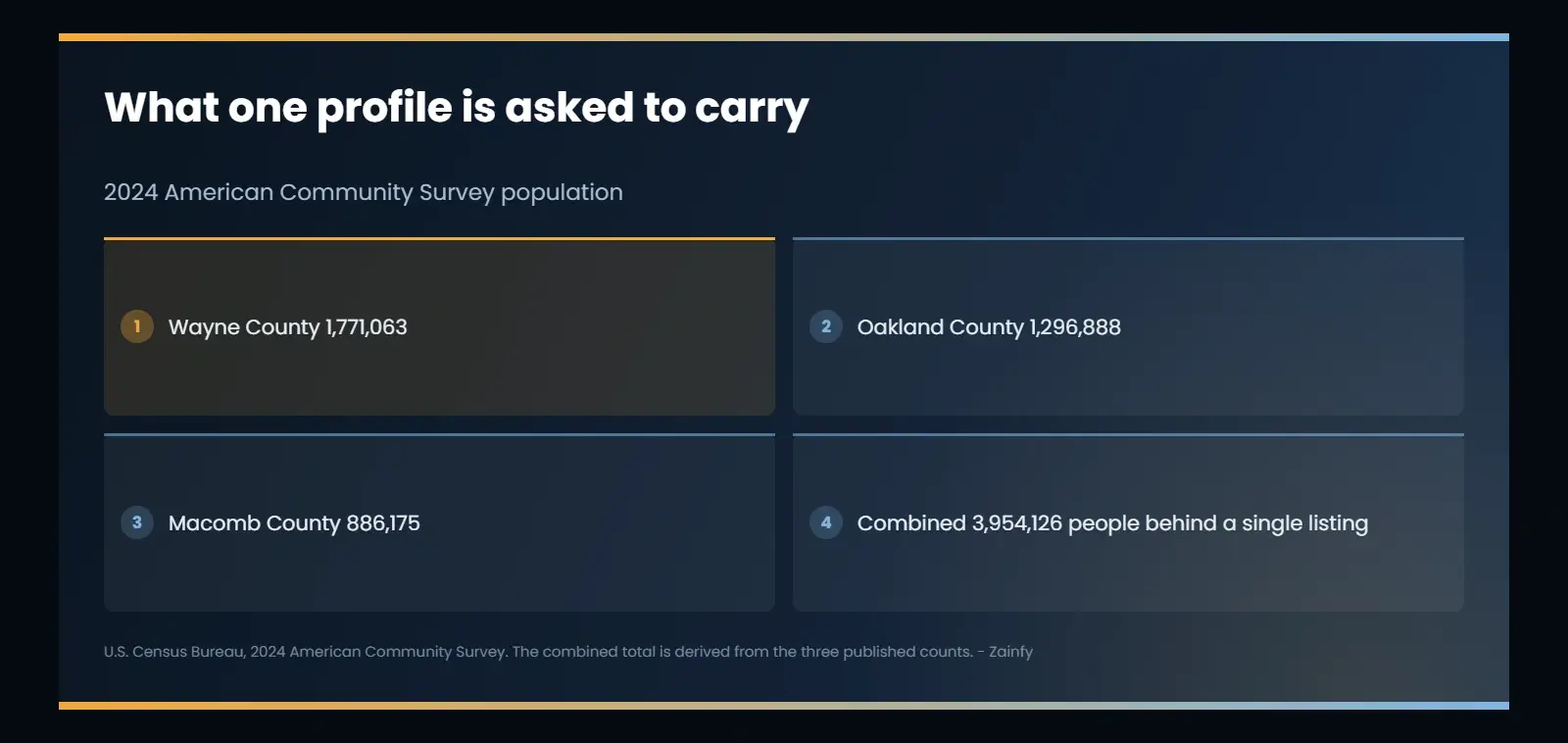
Wayne, Oakland, and Macomb counties contain a combined 3,954,126 people. That total is derived from the U.S. Census Bureau's 2024 American Community Survey counts: 1,771,063 in Wayne, 1,296,888 in Oakland, and 886,175 in Macomb. One profile may be asked to represent a contractor across that entire tri-county market.
The city names make the scale easier to see. Wayne County includes Dearborn, Livonia, Westland, Taylor, and Lincoln Park. Oakland County includes Troy, Royal Oak, Southfield, Novi, Rochester Hills, and Pontiac. Macomb County includes Warren, Sterling Heights, Roseville, and Macomb. These are not interchangeable labels around a single downtown. They are places where the housing stock, buyer budget, travel time, and competitive set change.
Yet Google Business Profile gives the company one public identity. The listing carries one primary category. Its secondary categories apply everywhere. Its description does not turn into a different message by county. Its recent photos and posts enter the same feed. A homeowner may see a service-area name, but the profile itself does not become a Wayne version or an Oakland version.
That is the operating problem. One listing, one category set, and one photo feed are pointed at almost four million people. The service-area settings can describe where the crew travels. They cannot make every location equally competitive, and they cannot prove that the contractor understands the houses behind each search.
Treat the profile as a shared storefront for the whole service operation. Every category, place name, and project photo should survive the question, "Would we genuinely take this call and drive to this job?" If the answer changes by season, crew capacity, or job type, the service-area list should reflect the business that exists now.
Google's actual rules, and the one that surprises people
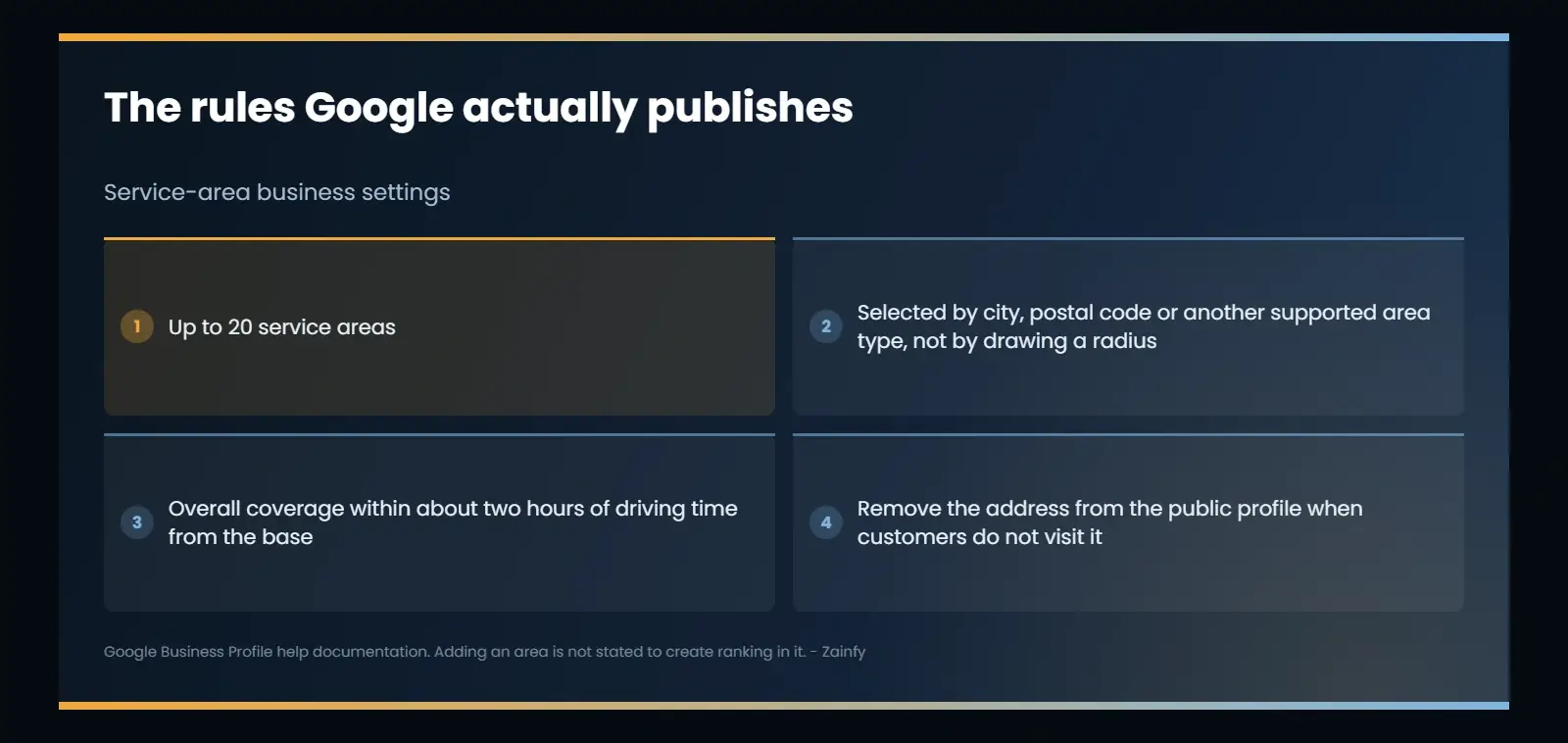
Google's help page is direct. A service-area business can enter up to 20 service areas. Those areas are selected by city, postal code, or another supported area type, not by drawing a radius around the address. Google also says the overall area should stay within about two hours of driving time from the business base.
If customers do not visit the address, remove it from the public profile and enter only the service area. A home office or crew yard is not a storefront merely because the business can receive mail there. Showing an address where customers are not served creates the wrong business type and invites avoidable verification trouble.
Metro Detroit fits comfortably inside the approximate two-hour boundary for a contractor based within the tri-county area. The boundary is not the thing that bites here. The harder limit is deciding how to spend 20 entries without claiming places the crew rarely reaches.
Google's service-area guidance does not say that adding an area makes the business rank there. That silence matters. The list tells Google and customers where the business says it operates; it is not a switch that creates Map Pack visibility in every selected city. Configure it for honest coverage, not as a bag of location keywords.
Three counties, three markets
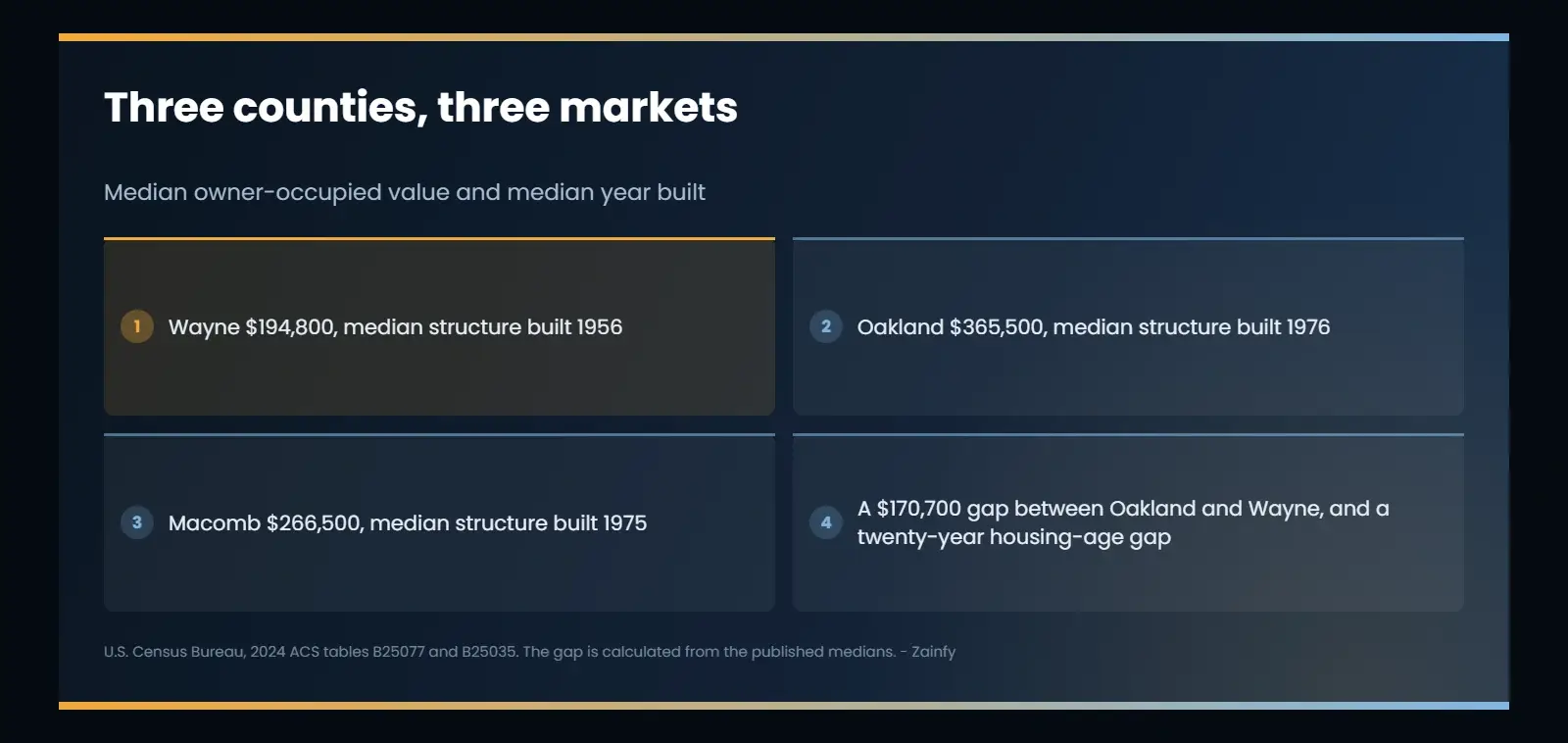
The service-area field looks flat. The market behind it is not. Census ACS 2024 table B25077 puts Wayne County's median owner-occupied home value at $194,800. Oakland County's is $365,500. Macomb County sits between them at $266,500.
The difference between Oakland and Wayne is $170,700, calculated from those published medians. Oakland's figure is about 1.9 times Wayne's. These are not project prices or promises of demand. They describe the budget bands a contractor's shared profile may have to address when it appears across the metro.
The houses differ too. ACS table B25035 gives Wayne County a median build year of 1956, Oakland 1976, and Macomb 1975. The 20-year spread between Wayne and Oakland changes what useful proof looks like. An older Wayne County project may need to show how the crew handled existing conditions and previous alterations. An Oakland or Macomb project may be judged more heavily on how new work fits a later floor plan, finish package, and occupied-home schedule.
That is why how the demand splits across Michigan's metros matters when the profile is expected to cover more than one county. The statewide view gives context; the profile still has to present real work from the market it names.
Proximity remains a major input in who sees a business in the local pack. A contractor based near Livonia can list Rochester Hills, but the selection does not erase the distance or the stronger local competitors closer to that searcher. Coverage is not the same as competitiveness.
Use the county spread to decide what the profile must prove. Wayne, Oakland, and Macomb can share one listing, but a run of photos from only one type of house makes the other two markets look theoretical. The settings establish the claimed territory. The evidence has to make the claim believable.
Categories: one primary, and the ones quietly costing you
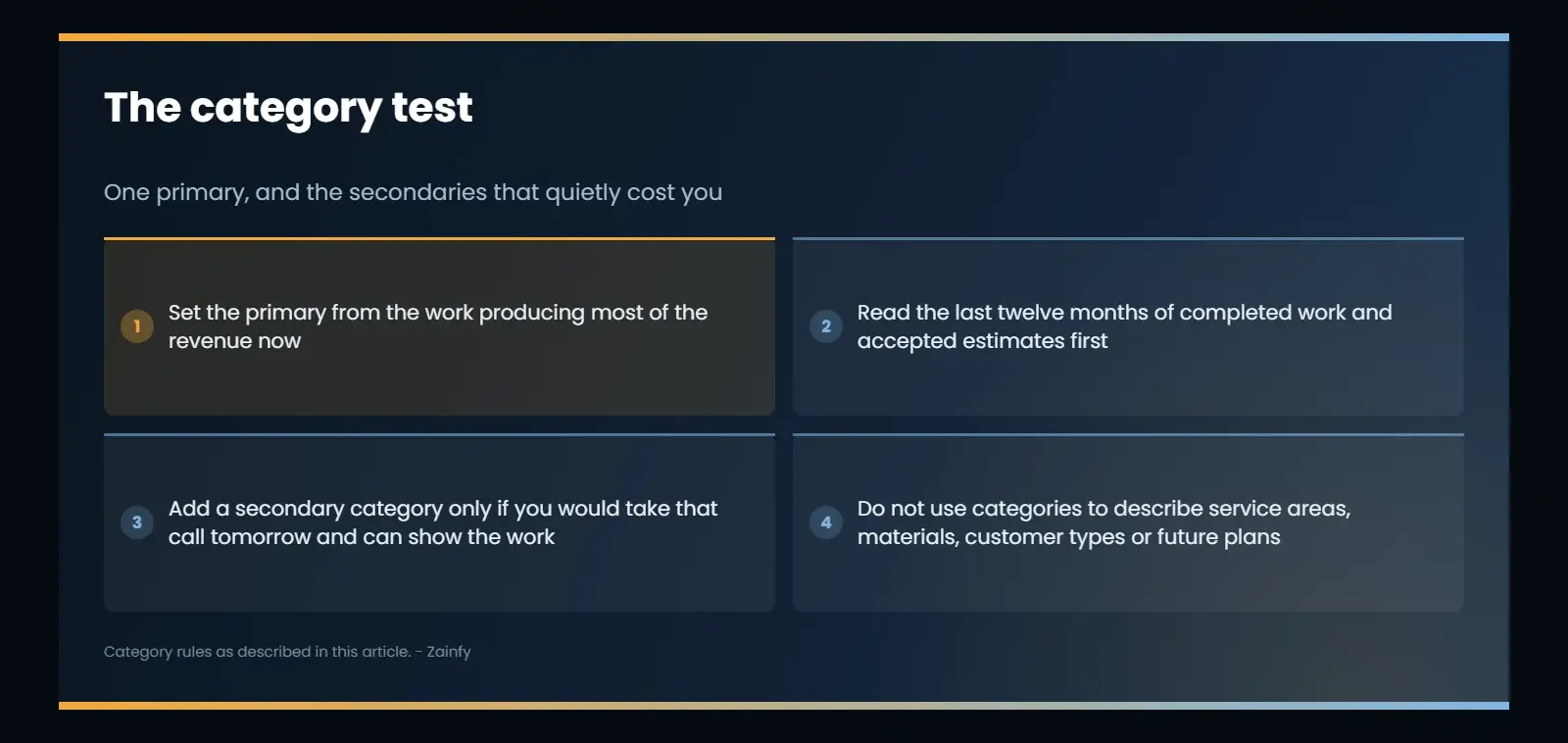
The primary category should describe the work producing most of the company's revenue now. It should not be the broadest phrase available, the most prestigious job the owner hopes to sell, or a category chosen because a competitor uses it.
Start with the last twelve months of completed work and accepted estimates. If kitchen and whole-home remodeling account for most revenue, choose the closest accurate primary category for that business. If roofing, siding, or another trade carries the company, the primary should reflect that reality. The category is a classification, not a positioning line.
Then examine every secondary category with a harder test: would you genuinely take a call for this work tomorrow? Add it only when the answer is yes and the company can show relevant work. A secondary category for a service the crew occasionally subcontracts, no longer prioritizes, or refuses below a certain scope creates inquiries the business does not want and a profile it cannot support.
Do not use categories to describe service areas, materials, customer types, or future plans. Those distinctions belong in the business description, services, photos, and posts where they can be explained honestly. Categories should remain a tight statement of what the company does.
Review them when the revenue mix changes, not every time a new project closes. A stable category set tied to actual work is more useful than constant edits chasing a wider interpretation of the business. The aim is not to qualify for every possible search. It is to make the strongest category unmistakably true across the whole profile.
Don't open a second profile
Do not create a second Google Business Profile for another county just because you want more coverage there.
Without a genuine location that is separately staffed during stated business hours and eligible under Google's guidelines, the second listing is not an expansion strategy. It is a duplicate-profile risk. A rented mailbox, borrowed address, virtual office, or employee's house does not become a legitimate branch because it sits closer to Oakland or Macomb searches.
The same caution applies to the original listing. Service areas stretching far beyond the verified base can trigger scrutiny and suspension risk. A profile that disappears during review loses far more than an honest service-area list ever withheld.
One legitimate profile can serve the tri-county metro. Set its base and business type correctly. Hide the address when customers are not served there. Choose only the areas the crew can support with normal travel and current capacity.
If the company later opens a real second location with its own staff and operating presence, evaluate eligibility then. Until that exists, a second profile is a guidelines problem, not a growth tactic. Do not risk the listing to manufacture proximity the business does not have.
What the profile still has to prove, county by county
The service-area list tells Google where you say the crew works; it does not show a Royal Oak homeowner that you have worked on an Oakland County house like hers. That proof comes through recent, identifiable job-site photos and posts that name the real place and scope without exposing a client's address. A Dearborn kitchen, a Livonia addition, a Troy whole-home renovation, and a Sterling Heights exterior project give the shared feed geographic texture that a list of cities cannot provide. Keep the cadence tied to actual work, not filler updates posted to keep the profile busy. A steady flow of genuine reviews is also a Map Pack input, and reviews that naturally mention a city or project type add location context; the system for requesting and handling those reviews is a separate operating task. The profile still cannot carry the whole ranking job. It has limited room to explain services, projects, and the differences among county markets, which is where what ranking in Detroit takes beyond the profile becomes the next question. Use the listing to show current evidence: a photo sequence from the job, a concise post naming the city and work, and a category set the project supports. Then check the visible feed as a homeowner would. If six months of updates all come from one corner of the metro, the other selected areas read as coverage claims rather than an active service pattern.
How do contractors set up Google Business Profile for multiple cities?
Use one eligible profile, set it as a service-area business, and enter up to 20 areas by city or postal code. Hide the address if customers do not visit it, and keep the total coverage within about two hours' driving time of the base. Do not create a separate profile for every city.
For a Metro Detroit contractor, begin with the places that consistently produce acceptable jobs, not a list of the region's biggest names. Review the last year of completed projects, inquiries, crew travel, and scopes the company wants more of. Give service-area slots to cities that appear in that operating record.
Spend the 20 entries across Wayne, Oakland, and Macomb according to the business, not by forcing an equal county allocation. A contractor based in Livonia may need more Wayne and western Oakland entries. A company based near Warren may logically carry more Macomb and eastern Oakland coverage. Both can serve the tri-county market without pretending every city is equally practical.
Use city or postal-code entries only at the level Google makes available in the profile editor. Do not stack overlapping names to repeat geography. After saving the list, read it back as a route plan. Check whether the farthest entries fit Google's approximate two-hour boundary under workday conditions and whether the crew would accept a suitable project there.
The list cannot create local relevance by itself. Categories must match real revenue, and the visible feed must show current work from the areas being claimed. Service-area setup defines honest reach. It does not override proximity or replace evidence.
Read the list like a February route
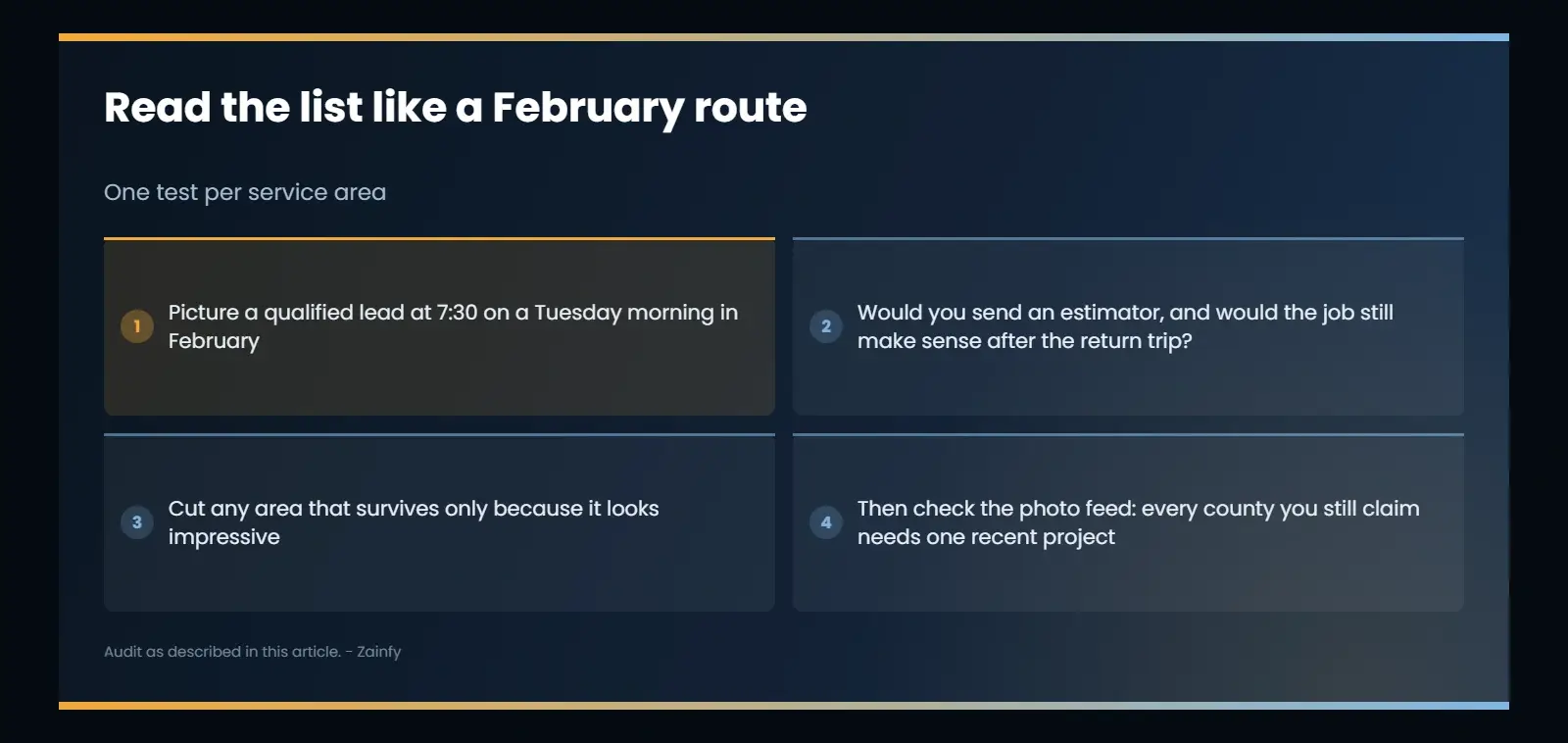
Open the profile and read every service-area entry aloud. For each place, picture a qualified lead arriving at 7:30 on a Tuesday morning in February. Would you send an estimator there? Would the job still make sense after winter travel, crew time, and the return trip? Would you accept it if the scope were good but not unusually large?
Cut any area that survives only because it looks impressive on the profile. Keep the places the company can serve as part of an ordinary week, then check whether the remaining list represents the work you actually want across Wayne, Oakland, and Macomb.
Next, open the recent photo feed. Find one current project that supports each county you still claim. If a county has no recent proof, the first repair is not another service-area entry. It is documenting the next real job there.
The right list is not the longest one Google permits. It is the one your schedule, crew, and project record can defend when a homeowner calls.