A remodeling contractor builds each year’s revenue from households that have never hired him before. A completed project may still produce introductions, conversations, and proof that helps another owner choose you. It rarely produces another purchase from the person who signed the original contract. That distinction matters directly because most advice about how to grow a remodeling business assumes you are adding new sales on top of customers who keep returning. You are not. You finish the kitchen, addition, or whole-home renovation, and that transaction ends. Next year’s additional jobs must come from households that have not bought that work yet or that previously chose another contractor. This article explains why that source matters more than a percentage on a planning sheet, how Genesee County makes the mechanism visible, and what your growth target must identify before it means anything.
A trade with a clock and a trade without one
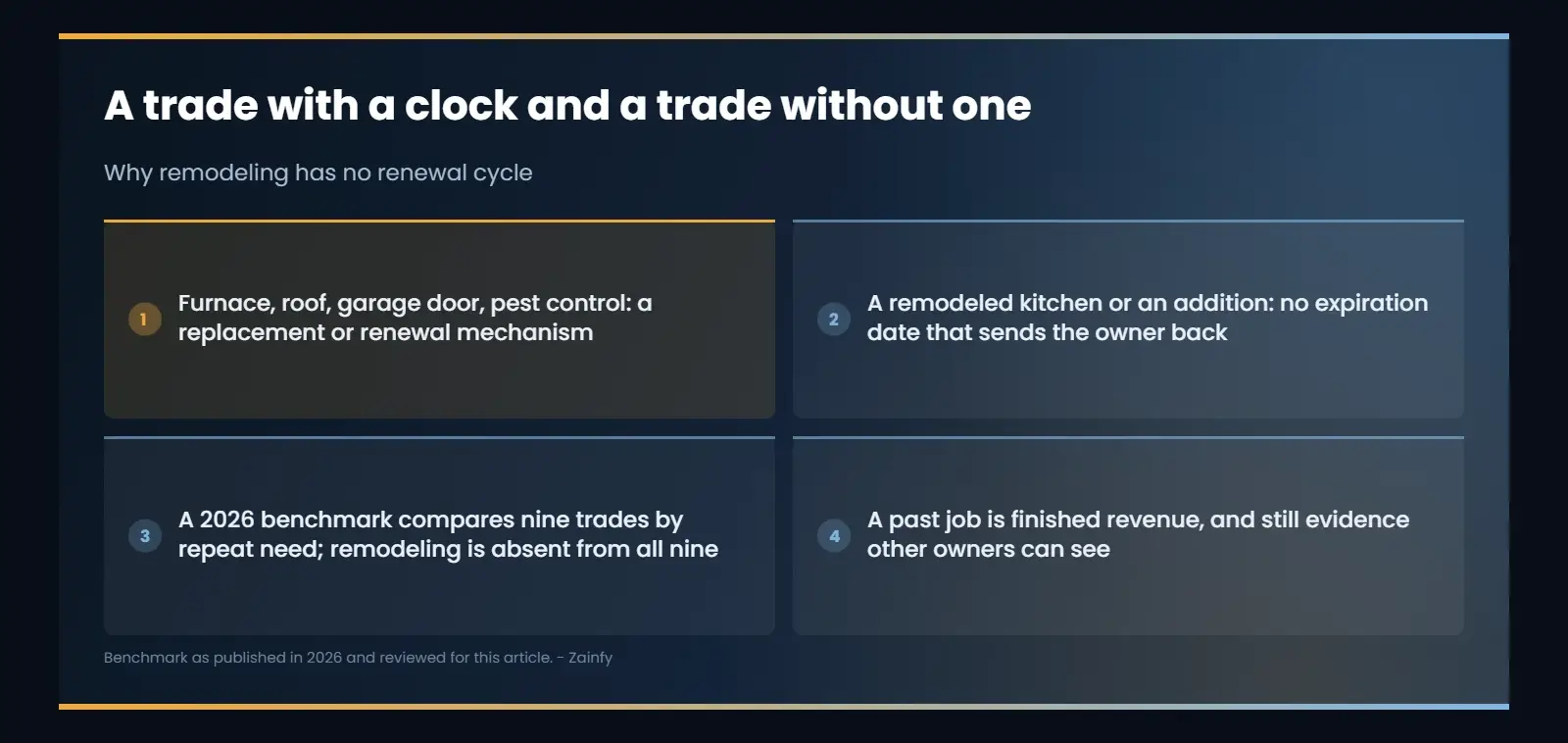
Many home-service trades can look backward and see a useful measure of future demand already waiting inside their customer records over time. Equipment wears out. Components fail. Maintenance returns at a predictable interval. Even if a household changes providers, the category itself will be purchased again. A benchmark published in 2026 compares nine trades by how often an owner household is likely to need each category. Remodeling is absent from all nine.
That absence is the useful fact. A furnace, roof, garage door, or pest-control agreement has a replacement or renewal mechanism. A remodeled kitchen has no expiration date that sends the owner back to a contractor. Neither does an addition. The owner may undertake a different project, but that is a separate decision rather than a scheduled return.
This changes what a past customer represents. The completed project still has value. It can show workmanship, give a former client something worth talking about, and make your name familiar to people around that client. But the transaction does not sit underneath next year’s target as recurring demand. It is finished revenue.
That is why customer-retention language fits remodeling poorly. You can preserve a relationship and remain remembered without creating a purchase cycle. Your contact list may grow while your active buying base resets. The distinction is not pessimistic; it is simply how project businesses work. Once you see it, growth stops looking like an automatic extension of last year’s sales and becomes a question about where the next set of buying households will come from.
There are two places an extra job can come from
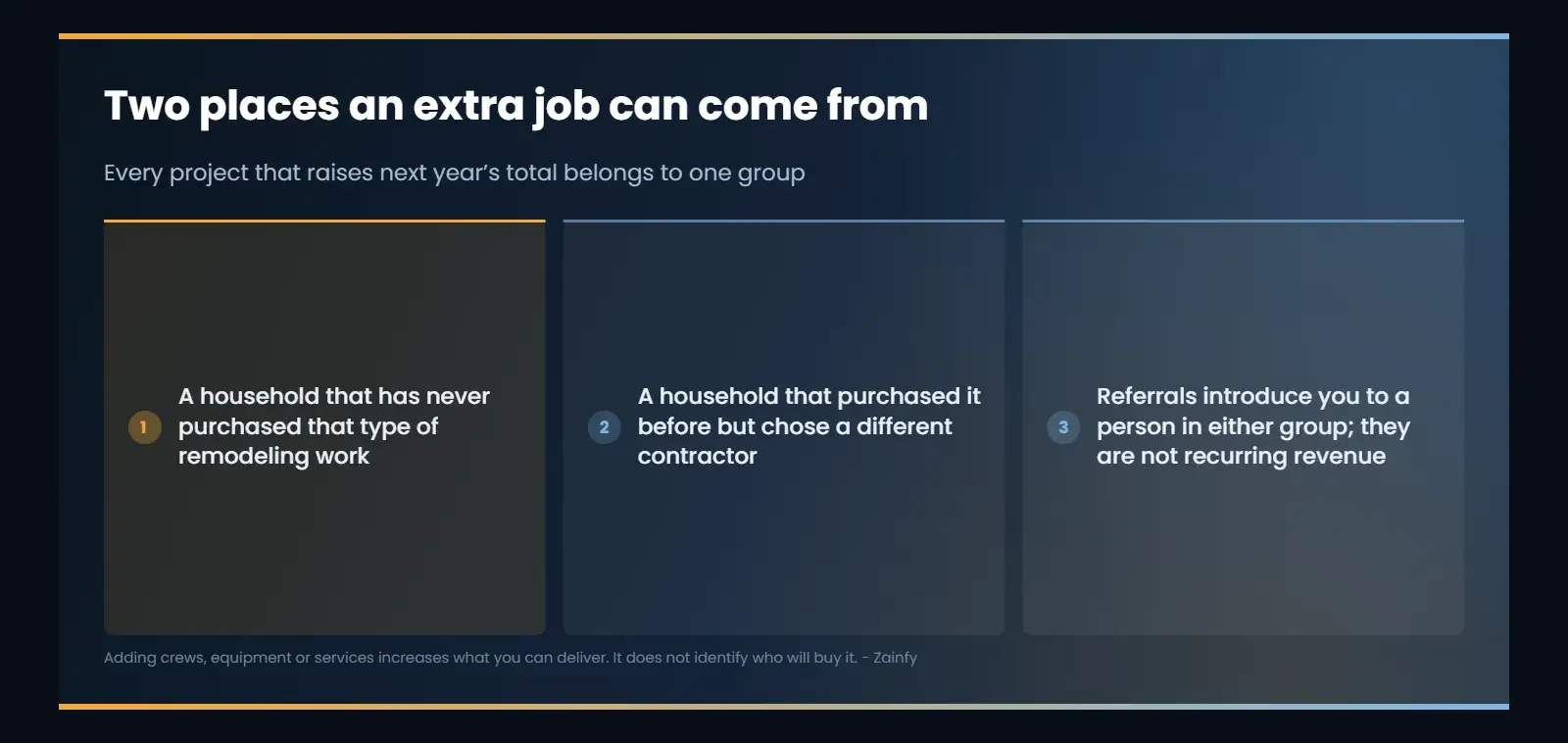
If customers do not return on a schedule, an additional job can come from only two kinds of household. One has never purchased that type of remodeling work. The other purchased it before but chose a different contractor.
That is not an instruction to attack another firm. It is a plain description of the source. Every signed project that raises next year’s total belongs to one of those groups. Referrals matter because they introduce you to a person in either group, not because a former client has become recurring revenue.
This is the missing step in most growth advice. Hiring another crew, adding equipment, or widening a service menu can increase what you are able to deliver. None of those decisions identifies who will buy the added capacity. Before you expand what the company can complete, your plan has to name which households will choose it. Otherwise, capacity grows while the source of the work remains assumed.
The advice assumes somebody just moved in
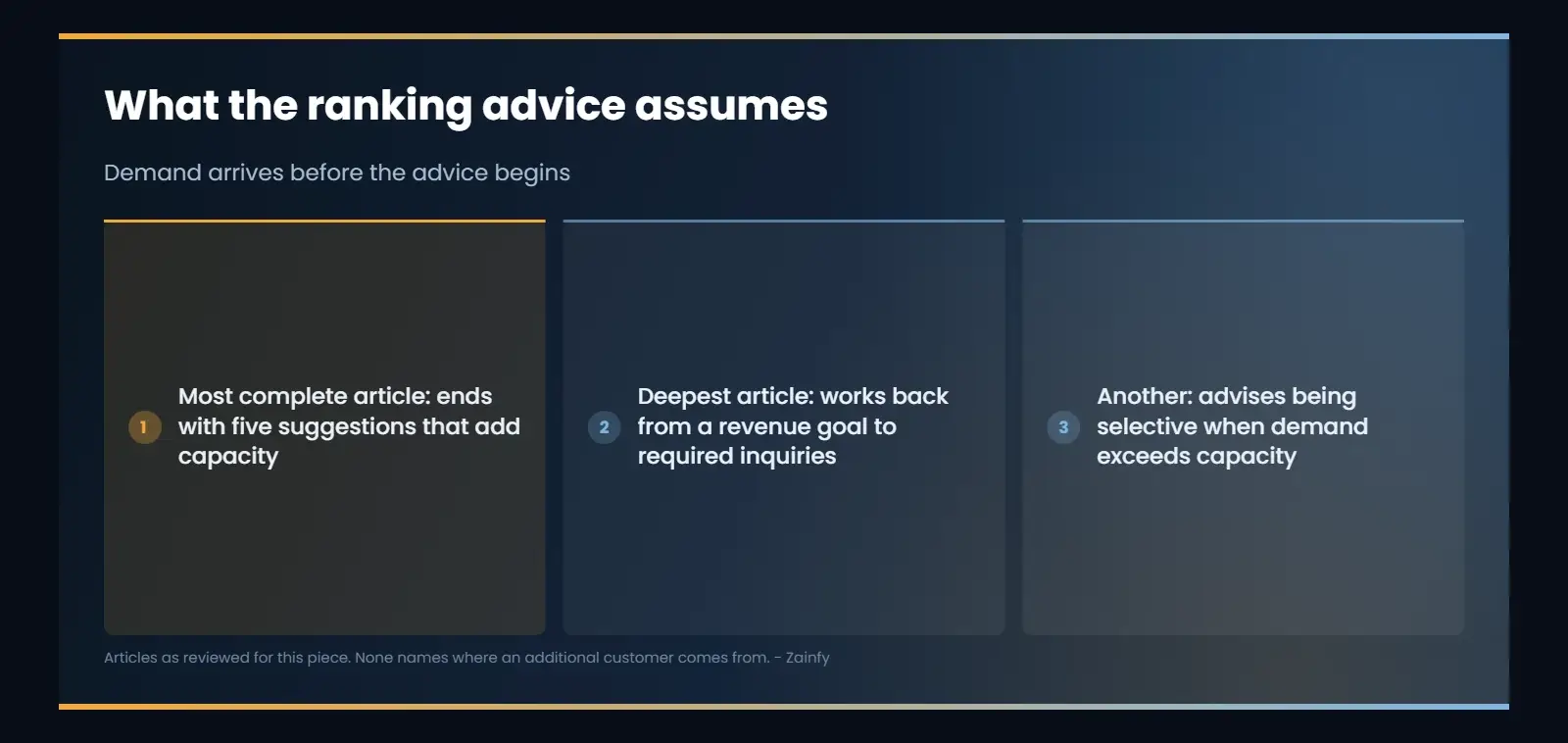
The most complete ranking article on this question ends with five consecutive suggestions that add capacity: hire people, acquire equipment, expand services, enter more markets, and form supplier relationships. Those moves may help a contractor fulfill work. They do not explain where another customer appears.
The deepest article takes the question more seriously. It works backward from a revenue goal to the number of inquiries a contractor would require. That is useful operational thinking, but the calculation travels in one direction. It says how much interest the company needs without asking whether enough households are ready to make the decision or why they would choose that company.
Another ranking article closes from the opposite premise. It treats excess demand as the condition and advises the contractor on being selective when there are more projects than he can handle. That can be sensible in that condition, yet it does not answer the owner’s growth question.
Across all three, demand arrives before the advice begins. Somebody is presumed to need the work, and the contractor’s task is framed as staffing, equipping, or processing it. A remodeling owner cannot build a useful plan on that presumption. He needs to know whether his additional jobs are expected from first-time buyers of the project or from households that once hired another firm. Until that source is named, the advice has described production rather than growth.
What actually changes hands in a year
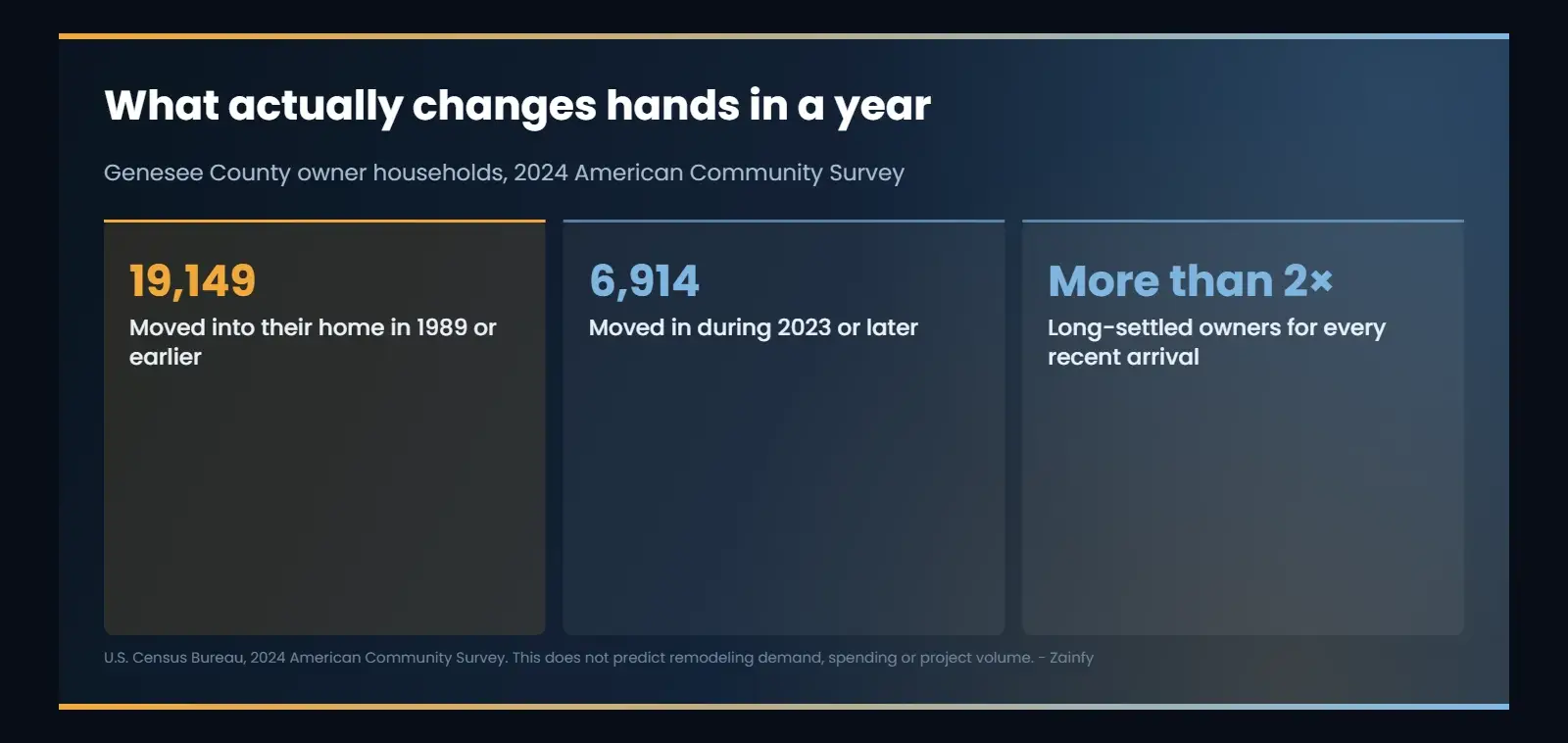
Genesee County shows why the source question is practical. The U.S. Census Bureau’s 2024 American Community Survey reports that 6,914 owner households moved into their home in 2023 or later. It also reports 19,149 owner households whose move-in year was 1989 or earlier. More than twice as many owners belong to that long-settled group as to the recent-arrival group. This does not predict remodeling demand, spending, or project volume. It shows that a large share of next year’s conversations will involve people who were already living in the county, not a fresh supply of owners arriving with every planning cycle. The opportunity sits in a durable homeowner base whose members make project decisions at different moments. Your added job still has to come from one of the two sources: a household buying that work for the first time or a household choosing differently than it did before.
Do not build next year by adding a percentage to this year
Stop setting next year’s target by taking this year’s revenue and adding a percentage. That method looks disciplined because it produces a precise number. For a remodeling business, it hides the hardest part of the plan.
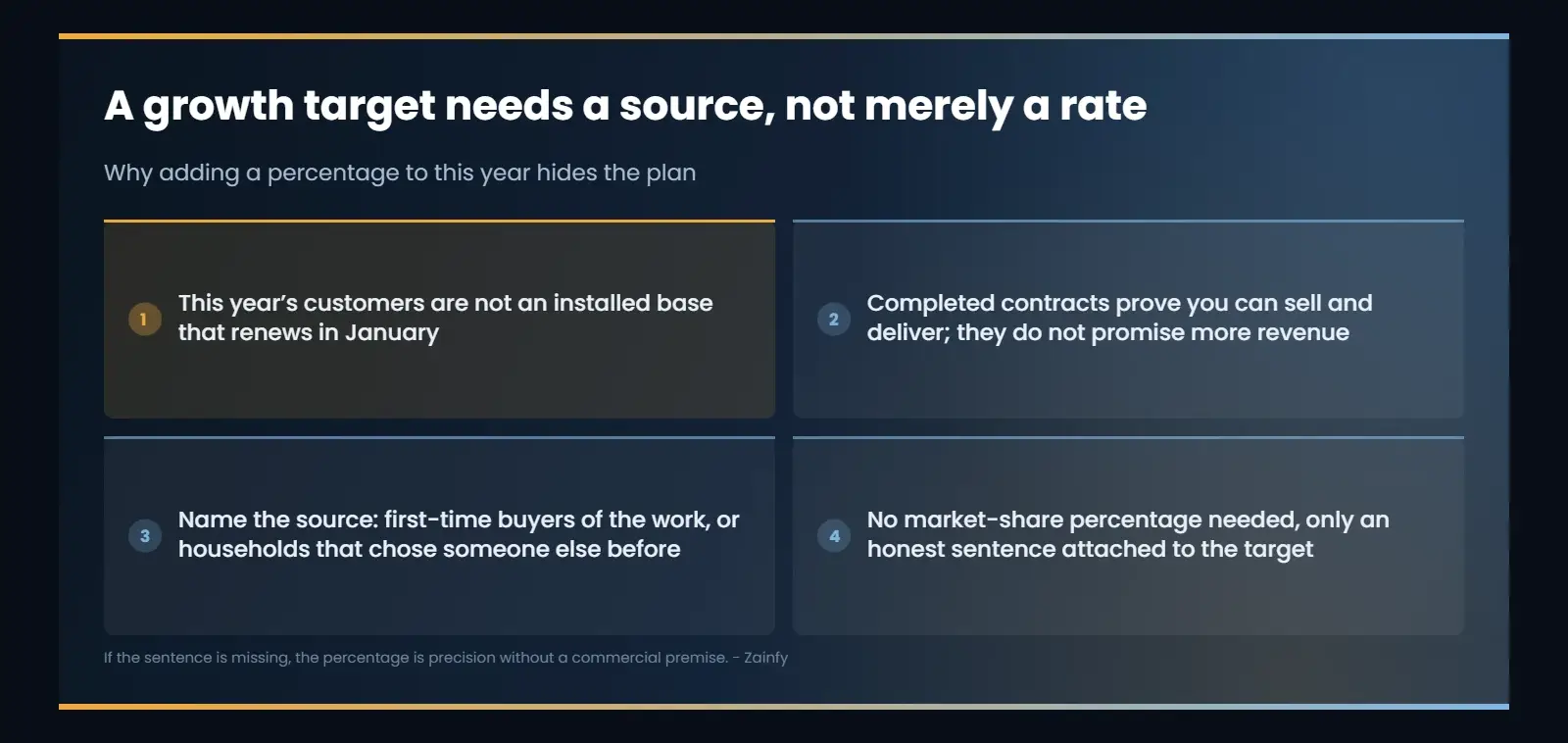
This year’s customers are not an installed base that renews in January. In fact, households that just paid for a major remodeling project are among the least likely people in the county to purchase that project again next year. Their completed contracts prove that your company can sell and deliver. They do not promise another round of revenue.
Adding a percentage treats finished transactions as though they remain underneath the business. The spreadsheet carries them forward even though the purchases have ended. Then it places a larger target on top without identifying who must make the new decisions.
A useful growth target needs a source, not merely a rate. If you want several more projects next year, you should be able to say whether they are expected from households undertaking the work for the first time or from households that will choose you after previously choosing somebody else. You do not need to calculate a market-share percentage to make that distinction. You need an honest sentence attached to the target. If the sentence is missing, the percentage is precision without a commercial premise.
What decides which of you gets the job
When an additional project must come from a household choosing among contractors, the decisive work often begins before that household is ready to request an estimate. Owners notice names long before they need them. They remember completed projects, repeated appearances, clear explanations, and the businesses people around them can identify without hesitation. By the time an owner starts contacting contractors, part of the choice may already be settled: a few names feel familiar, while every unfamiliar company has to earn attention from a standing start. That makes familiarity an asset created between buying moments, not a tactic switched on after a request appears. It also explains why a past project keeps working even when the original customer does not buy again. The job gives other people evidence and gives the former client something concrete to describe. Neither effect promises a future contract, and neither turns that client into recurring revenue. They improve the chance that your company enters consideration before the owner begins comparing options. For a project business with no automatic return cycle, that early familiarity is what connects finished work to a household that has never paid you.
How does a remodeling contractor grow when the market is not adding customers?
A remodeling contractor grows by winning work that would otherwise have gone to another contractor or by serving a household buying that project for the first time. Because remodeling has no regular repeat purchase, growth depends on becoming familiar before an owner decides, not on carrying last year’s customers forward as renewals.
Both sources require patience and careful discipline about where the buying decision begins. A first-time project buyer may spend a long period forming preferences before requesting an estimate. An owner who previously hired another contractor already has a reference point and needs a reason to consider a different name. In either case, added production capacity does nothing until the household has a contractor in mind.
The ongoing work is maintaining recognition between one completed project and the next buying decision. That is where keeping your name in circulation between jobs supports the growth mechanism rather than serving as a last-minute promotion. The point is not constant selling. It is giving owners enough repeated, credible contact to remember who you are before they need to assemble a shortlist.
This reframes the value of completed work. A project is not a future purchase stored in your records. It is evidence that can travel beyond the buyer who paid for it. The additional job arrives when that evidence helps an unfamiliar household put your company into consideration. Growth therefore comes from changing who gets chosen, not from assuming the prior year’s buyers will return.
What Flint remodelers ask about growing
[wps_faq style=”classic” question=”If my customers never hire me twice, are past jobs worth anything?”]
Yes. A past job gives other households evidence and gives the client a concrete reason to mention your company. Its value is not a scheduled second purchase. The work can make your name familiar, demonstrate how you handle a major project, and start a conversation with someone who has never hired you. Staying remembered after completion still matters even when retention language does not fit the trade. Treat the former client as a credible connection to future buyers, not as revenue waiting in next year’s plan. The job keeps earning attention when another owner can see, understand, or hear about what you delivered.
[/wps_faq]
[wps_faq style=”classic” question=”Does a county like Genesee, where owners stay put for decades, change how a remodeler grows?”]
Yes. Growth depends heavily on becoming relevant to an established homeowner base rather than expecting recent arrivals to reset contractor choices. The 2024 American Community Survey counted 19,149 Genesee County owner households that moved into their home in 1989 or earlier, compared with 6,914 that arrived in 2023 or later. That stable base is an opportunity because project decisions keep emerging among owners who know their community and may recognize local contractors. Your task is to enter consideration when their project becomes real. Genesee’s long homeowner tenure makes familiarity accumulated over time more useful than a plan built around constant household turnover.
[/wps_faq]
[wps_faq style=”classic” question=”How do I tell whether my growth came from the market or from me?”]
Your revenue line cannot tell you. A larger total looks identical whether more households happened to be buying or more of them chose you. What you can observe is who you are being compared against. Listen to the estimate conversations. When owners arrive already knowing your name, mention a finished project of yours, or say which other contractors they are weighing, the choice is moving toward you. When the calls come from people who found you last and know nothing about your work, the market did the lifting. Keep a plain note of what each new Flint client says about how your company reached the shortlist.
[/wps_faq]
Take the number you have written down for next year and, before doing anything else, say aloud which households it comes from. Are they owners undertaking the project for the first time, or owners who will choose you after working with somebody else? If you cannot answer, the number is a wish wearing a decimal point. This test does not require a forecast model. It requires you to separate finished revenue from future buying decisions and to name the human source behind the target. Your crews, tools, and delivery capacity matter after the contract is signed. Growth begins earlier, when a household that has never paid you decides your company belongs in the conversation.