Ask what pages your contractor website should have and you will get a number back before anyone asks what work you sell. That order is backwards for a Michigan remodeling owner who already has a site. Your useful question is not how many pages another contractor needs. It is which pages already on your site stand for work your business has actually done and can show.
There is an honest reason the published lists exist. A contractor starting with no site is better off with a six-page starting point than with an empty screen and no direction. But that is not your situation. You already started. You may have six pages or fifteen, including pages added years ago because an article said every contractor needed them. A starting instruction cannot judge those pages for you. Read what is already there, decide what has earned its place, and let the count arrive after the decisions.
Five, seven, nine, twelve
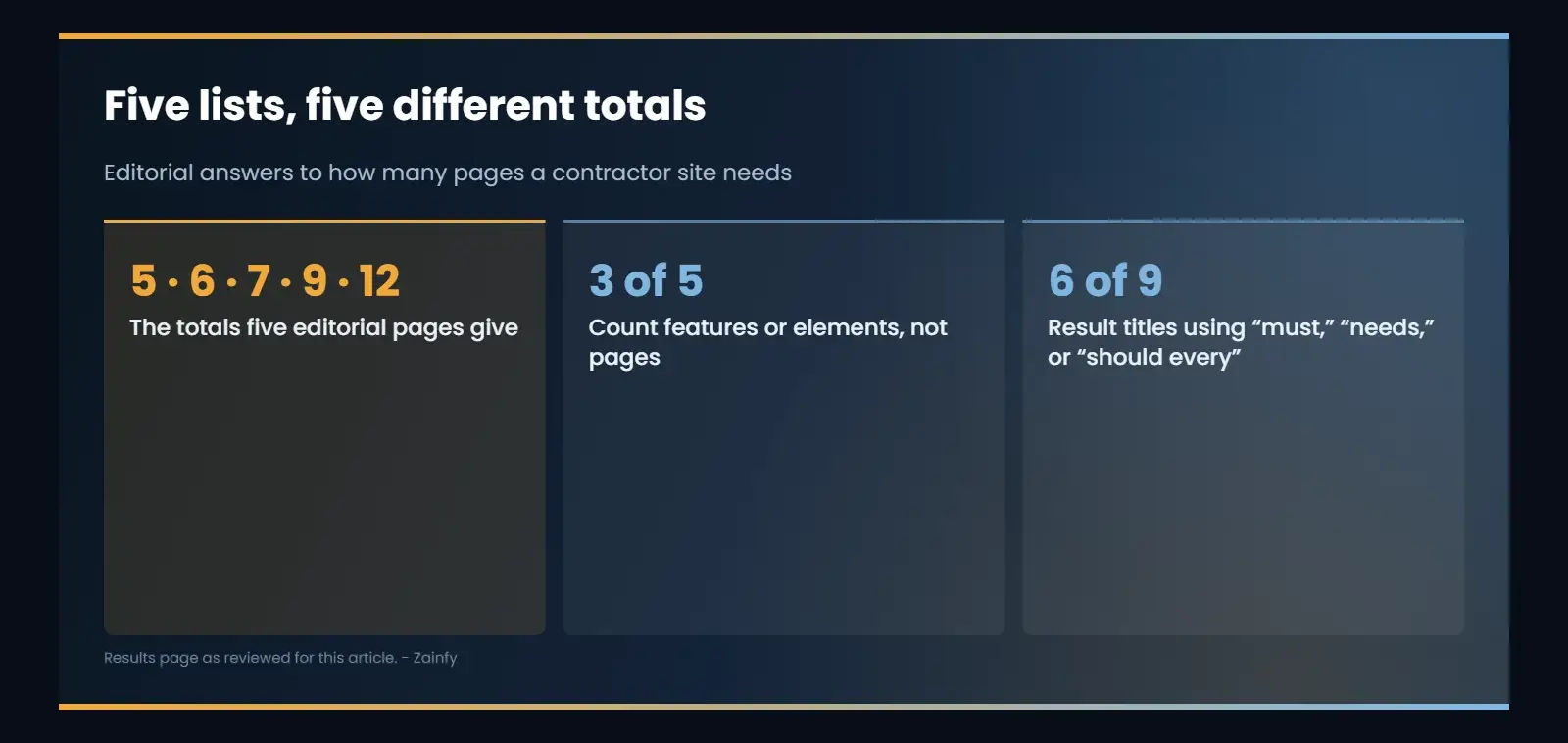
Five editorial pages answer this question with five different totals: five, six, seven, nine, and twelve. Three are not even counting pages. They are counting features or elements and presenting the result as a site structure. Six of nine titles on the results page use words such as “must,” “needs,” or “should every.” Certainty is doing more work than arithmetic.
The disagreement becomes sharper inside one results page. Its most careful guide says to publish fewer pages than the business could name and hold the rest until real material exists. Another result, only 220 words long, says to create one page for every service offered. Those instructions point in opposite directions. One makes material the limit. The other makes the service count the instruction.
Neither answer began with your company. Neither asked which services have produced finished work, which pages already overlap, or which claims have anything behind them. Even the strongest guide gives an existing site one bullet before returning to pages that have not been created.
That does not make every published list useless. It reveals its proper reader: the owner facing a blank site. Handing that list to an owner with years of pages already standing is like giving framing instructions after the walls are up. The first task is no longer addition. It is judgment.
Open the site you already have
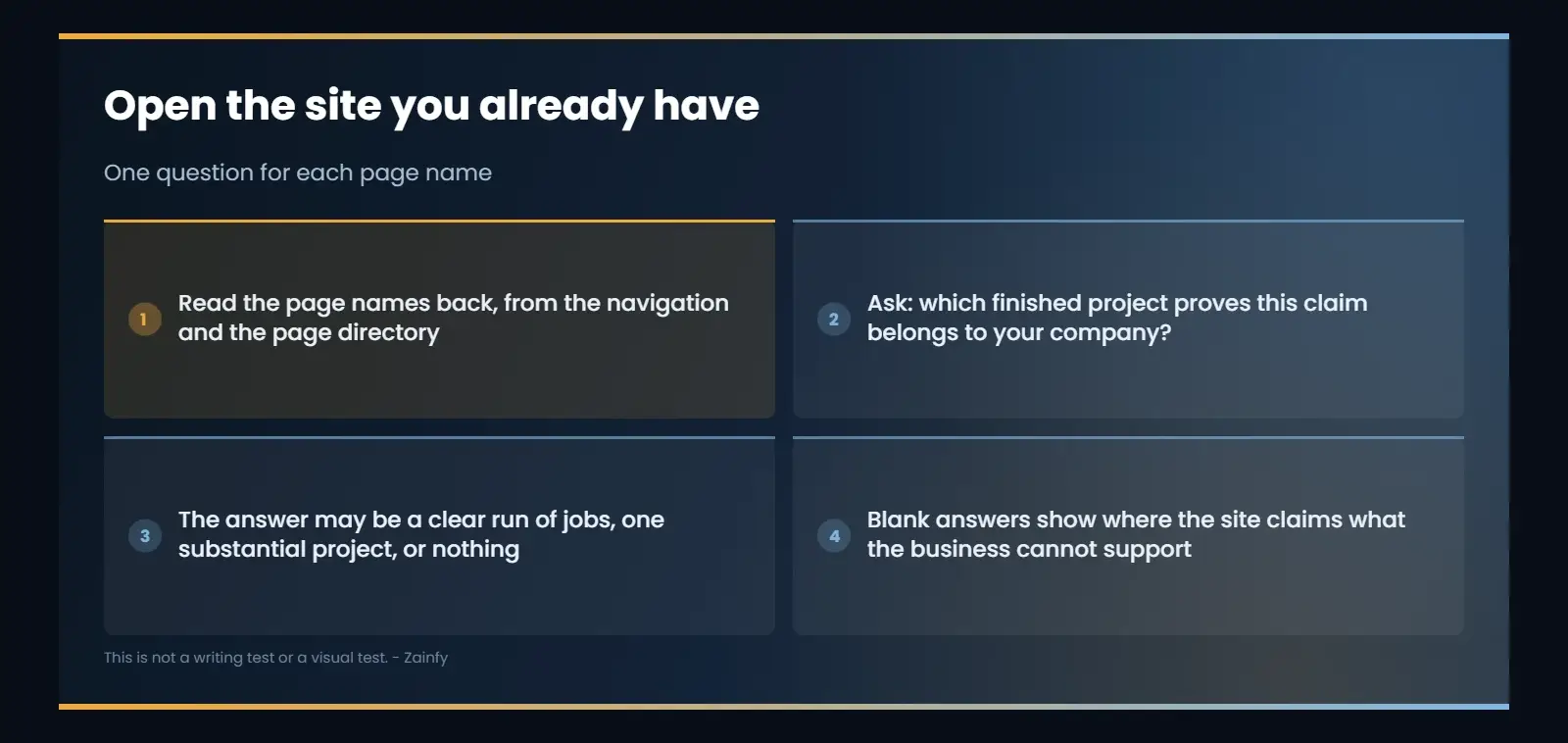
Open your website and read the page names back to yourself. Do it from the navigation and then from whatever page directory the site exposes. Most owners can name the home and contact pages immediately. The rest tend to arrive in pieces: a service the company once wanted to sell, an about page written under an older company story, or a page added because a generic contractor guide treated it as compulsory.
Stay with the pages that exist. Do not sketch a replacement structure. Do not start collecting ideas for pages you might add. The point is to see what your business is already publishing under its name.
Ask one question of each page: which finished project proves this claim belongs to your company? The answer may be a clear run of jobs. It may be one project with enough substance to justify the subject. It may be nothing.
This is not a writing test. A polished page can fail it, and an awkward page can pass. It is not a visual test either. The issue is whether the page represents work that exists outside the website. Read your own page names back, pause after each one, and answer from the company record rather than from what you hope to sell next. Blank answers matter. They show where the site is making a claim the business cannot presently support.
Keep it, fold it in, or take it down
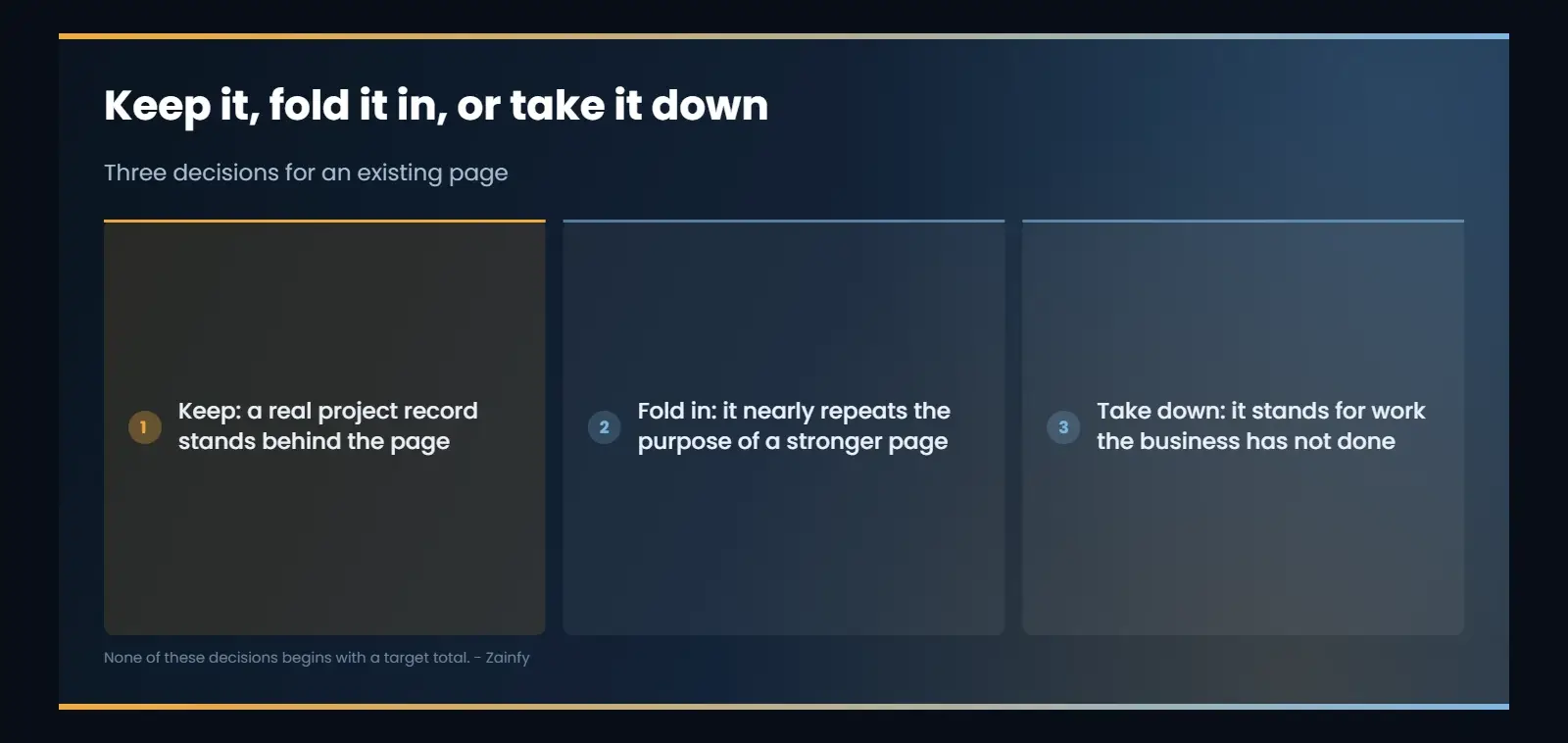
A page with a real project record stays. Its reason for existing does not depend on an article’s recommended total. A page that nearly repeats the purpose of another gets folded into the stronger one. Two thin claims do not become more credible because they occupy separate URLs.
A page standing for work you have not done comes down. That is not an admission that the business failed. It is an ordinary editorial decision: the company no longer publishes a claim it cannot support. Taking a page off a contractor website is an available move, even though the published guides rarely say so.
Those decisions can shorten the site, leave it alone, or expose a genuine gap. None begins with a target total. They begin with a simpler question: does this subject belong to the business as it operates today?
Keep the question at page level. Do not turn this into a critique of buttons, photos, copy, or visual polish. Those details cannot rescue a page with no real work behind it. They also do not condemn a page whose business case is sound. First decide whether the page should exist. Other work comes later, after the site stops carrying claims merely because a standard set once included them.
What “here” has to mean
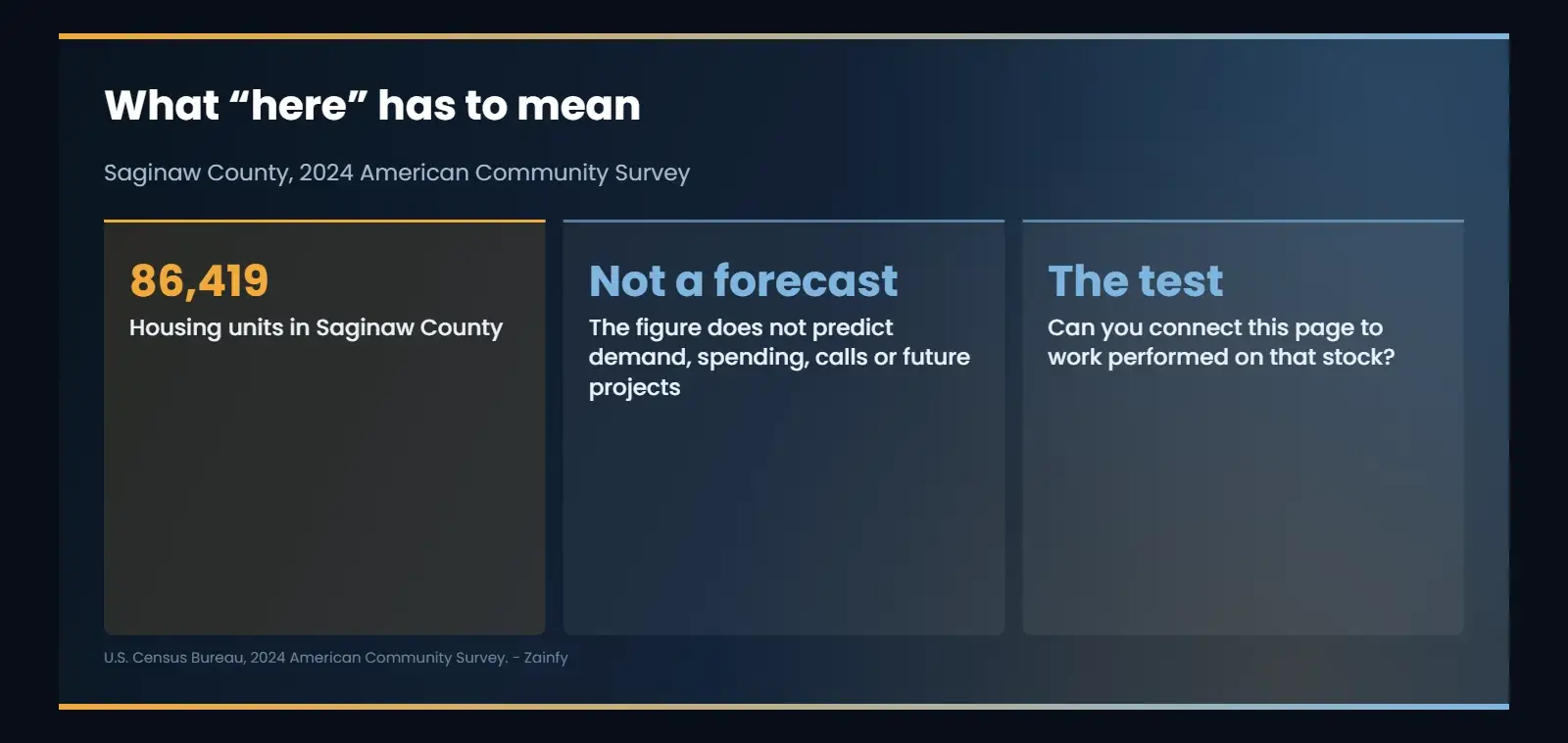
Every service page on a contractor site quietly claims that the company performs that work somewhere real. For a Saginaw County remodeling business, “here” means a county containing 86,419 housing units, according to the 2024 American Community Survey. That figure describes the housing stock. It does not predict demand, spending, calls, or future projects. It sets the ground on which the claim has to make sense. Put the page name beside the Saginaw County jobs you can point to without qualification. If the pairing is obvious, the subject belongs to this business. If every example comes from work the company hopes to win later, the page is describing an ambition. Generic checklists miss that distinction because they treat a trade label as sufficient evidence. A Saginaw remodeler does not operate in an imaginary national contractor market; the company works on identifiable properties inside a defined footprint. Once “here” is concrete, the test stops being theoretical: can the owner connect this page to work performed on the stock the business actually serves?
Don’t build to a number
Never add a page because a list said your trade needs seven of them.
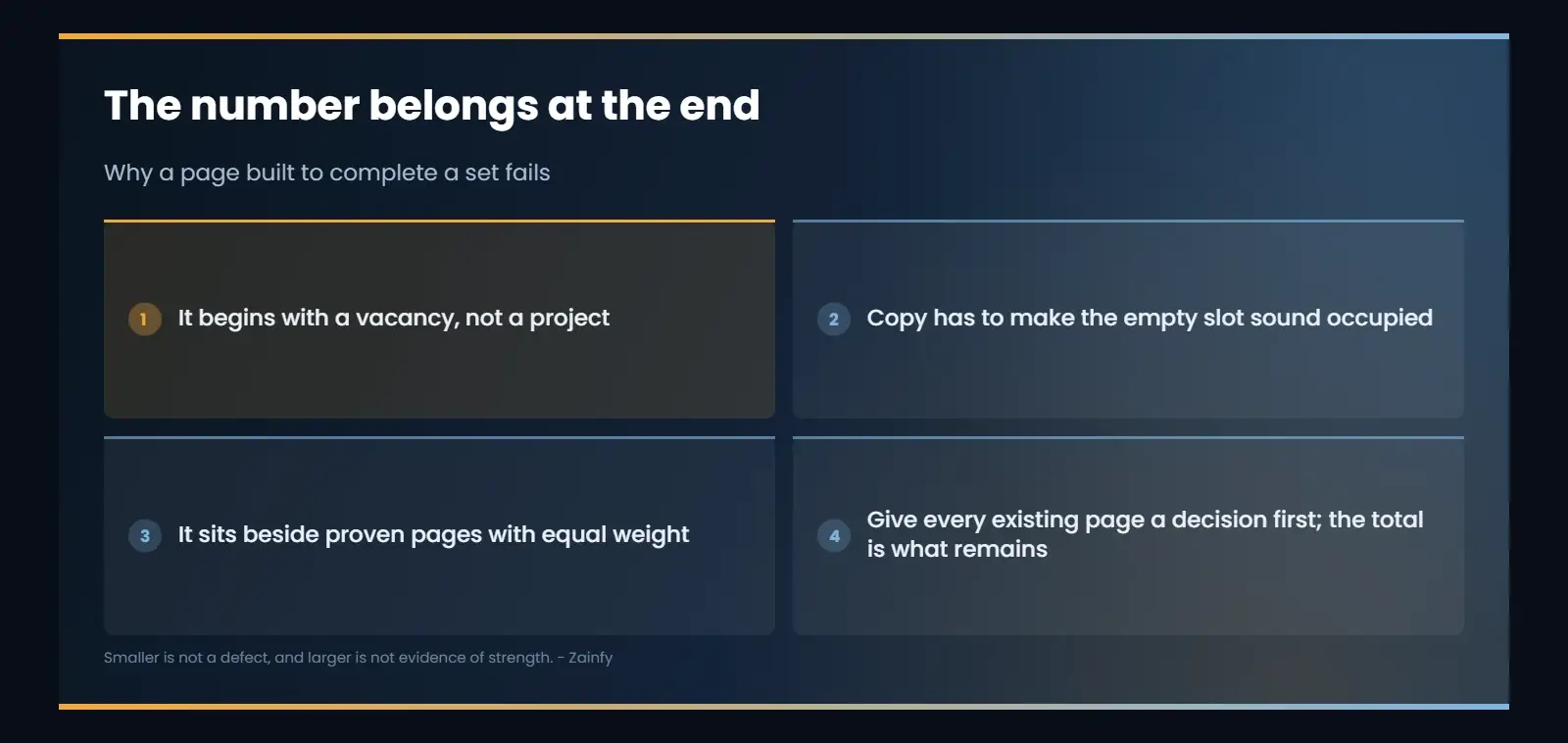
A page created to complete a set begins with a vacancy. The business did not arrive at it through a project; the checklist demanded another slot. Copy then has to make that slot sound occupied. That reverses the relationship between the company and its website. The site starts dictating what the business ought to look like instead of recording what the company can prove.
It also makes the sound pages harder to identify. The page backed by finished work now sits beside a page backed by an editorial quota, and both receive equal weight in the structure. The visitor is left to discover which claim is substantial.
The number belongs at the end. Give every existing page a decision first. If four remain, the site has four. If eight remain, it has eight. Smaller is not a defect, and larger is not evidence of strength. The useful total is whatever remains after unsupported and overlapping claims have been dealt with.
Write the list yourself, before anyone quotes you
This week, write out every page name on your current site. Put one line beside each name identifying the job that makes the subject credible. Use plain project language, not a marketing category. Leave the line blank if answering requires an invented example or work the company has not performed.
The blanks are the finding. They tell you more about the site than another article’s preferred total because they came from your company rather than from a universal template. They also prevent unsupported pages from surviving merely because somebody can rewrite them in a cleaner voice.
Do this before discussing the next version of the site. The useful handoff to Saginaw remodelers rebuilding a site they already have starts with decisions about the current pages, not a larger menu proposed from outside the business.
Keep the sheet. Whoever takes on the next stage should be able to explain what happens to every blank line and why. If each blank returns wearing fresher copy, the underlying decision was skipped. If some pages disappear, some are combined, and the supported ones remain visible, the work began with the business that exists.
How many pages should a contractor website have?
A contractor website should have as many pages as stand for work the business has done and can show. For a small remodeling company, that may be fewer than published lists suggest. The number cannot be known in advance because it is the result of judging existing pages, not an instruction for producing them.
Published answers differ because they start with categories. One publisher counts pages, another counts features, and another divides services before meeting the business. The totals look precise, but they describe the publisher’s framework rather than the contractor’s record.
For an existing site, each page gets one of three decisions. Keep it if real jobs justify the subject. Fold it into another page if the two serve nearly one purpose. Take it down if the claim has no project behind it. These are editorial decisions about current pages, not a prescribed menu for a new site.
The final total could be four, eight, or another number. It should not be treated as a score. A bigger site is not automatically stronger, and a smaller one is not automatically incomplete. What matters is whether every page left on the site has a business reason to be there. The page count appears after that judgment, which is why two contractors doing related work can reach different totals without either being wrong.
What Saginaw remodelers ask about their website pages
[wps_faq style=”classic” question=”What should I do with a service page I can't back up with a job?”]
Fold it into a credible page if the claims overlap; otherwise, take it down. Do not manufacture an example or let polished writing substitute for a real project. Start by naming the job that would justify the subject. If none comes to mind, the site is claiming experience the business cannot demonstrate. Removing that claim is an ordinary editorial choice, not a confession. Preserve accurate material inside the stronger page and discard the rest. The website should end closer to the company record than it was before. A blank beside that page name is enough reason to question its place.
[/wps_faq]
[wps_faq style=”classic” question=”Is a smaller website worse than a bigger one?”]
No. Size alone says nothing reliable about a contractor website. Four pages grounded in real jobs can represent a business more honestly than twelve assembled to satisfy a generic total. The final size follows the page-by-page judgment; it is not a performance score. Ask whether each subject matches the company record. Keep it when the evidence is clear, combine it when two purposes overlap, and remove it when no project stands behind the claim. The process may shorten the site or leave it unchanged. The useful comparison is not four versus twelve. It is credible subjects versus pages an outside list expected.
[/wps_faq]
[wps_faq style=”classic” question=”Does a remodeler working one county like Saginaw need fewer pages than a metro contractor?”]
Not automatically. The count still comes from the work, not from the size of the map. What one county changes is how easy each page is to test. Saginaw County holds 86,419 housing units in the 2024 American Community Survey, and a service page claiming work here can be checked against jobs on that stock. A contractor spread across a metro can let a vague page hide behind territory nobody can picture. You cannot. If a page names a service and you cannot point to a Saginaw County job behind it, the gap shows quickly. One county makes weak pages easier to spot.
[/wps_faq]
Before you sign the next quote for site work, hand over your page list with the blanks left in. Do not explain the blanks or defend them. Then read what comes back. The quote may return with fewer pages on it, because somebody looked at the empty lines and acted on them. It may return with the same number, each blank filled with fresh copy.
That single exchange gives you new information. You learn whether the work begins with what your company can support or with a standard menu waiting for your name. Take that answer seriously before you sign anything.