Your Michigan builders license is one of the few marketing claims a stranger can verify quickly, yet many contractors place it where nobody reads. The credential was earned, tested, and issued by the state. Then it became footer text, a contract line, or a number stored out of sight.
For an Ann Arbor remodeler, that wastes the part of the credential a buyer can use. A homeowner does not have to accept "licensed" as promotional language. He can match the business or individual name, license type, status, and qualified scope against a state record.
That check can confirm the company or expose a mismatch the contractor never noticed. Michigan has already made the credential central to buyer verification. The question is whether your public business name and advertised work make the state record easy to find and understand.
Your license has value after compliance. It is checkable proof, but only when the record and the promise point to one another.
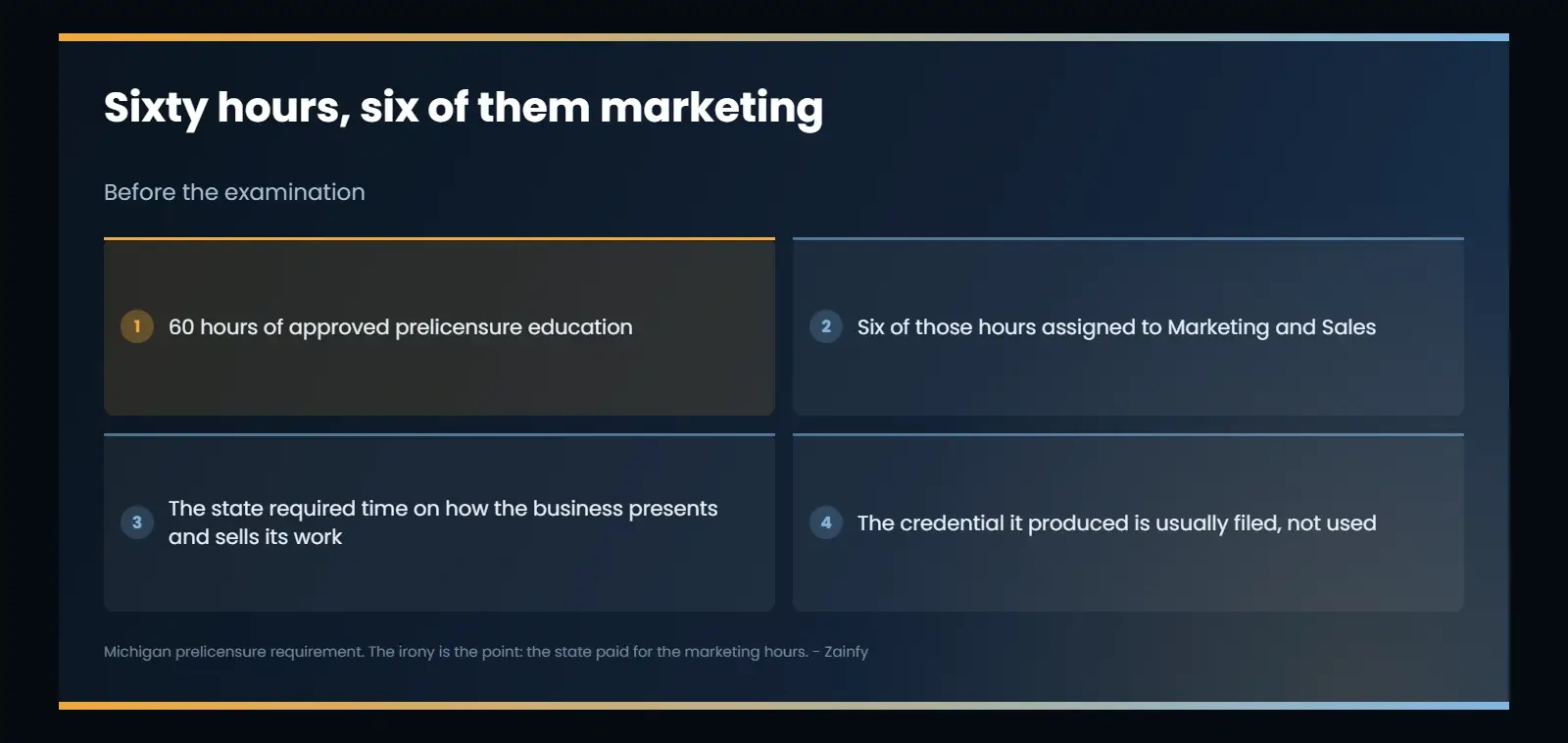
Sixty hours, six of them marketing
Before taking the examination, Michigan required you to complete 60 hours of approved prelicensure education. Six of those hours were specifically assigned to Marketing and Sales.
That is the irony. The state required time on how the business presents and sells its work, yet the credential produced by the process often gets treated as filing material. Contractors study, pass, receive the license, and then bury the number after the hard part is over.
The trade tends to view the license as something earned and occasionally resented: necessary to operate, useful when a contract asks for it, otherwise left alone. That judgment misses the buyer's side. The license is not merely a hurdle the contractor cleared. It is a public record that can resolve doubt without requiring the buyer to trust another claim.
No extra badge or invented trust statement is needed. The state already supplied the credential, the classification, and the record. Marketing begins by making those facts visible where they answer a real question.
The exam belongs in the past. The business value begins when the number, name, and scope help a buyer verify the contractor standing in front of him.
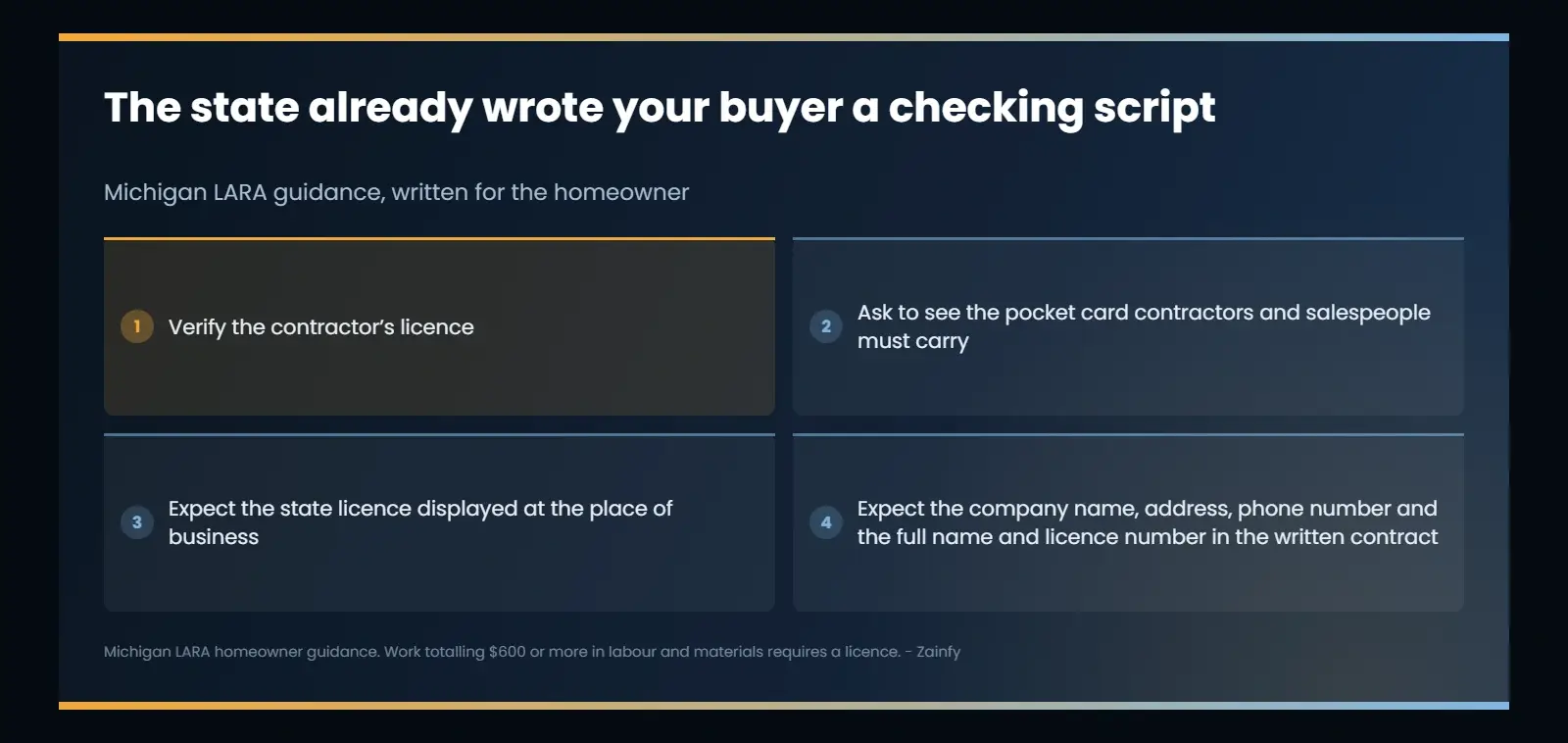
The state already wrote your buyer a checking script
Michigan LARA publishes buyer-facing guidance for residential building work. It tells homeowners to verify the contractor's license, ask to see the pocket card contractors and salespeople must carry, and expect the state license to be displayed at the place of business.
The guidance also says the written contract should contain the company name, address, phone number, and the full name and license number of the builder, contractor, or salesperson. If a contractor cannot produce the license, the page directs the homeowner to the state license database or the Residential Builders' Section.
Work totaling $600 or more in labor and materials requires a license. Almost every remodeling job you seriously quote sits above that line. The state's instructions place licensing inside the basic decision record, not the fine print.
None of this material was written to persuade the contractor. It was written for the person deciding whom to let into the house and whose name belongs on the agreement. That distinction matters because it means verification will happen whether your marketing helps or not.
If the business name on the estimate differs from the name in the license record, the buyer has to solve the difference. If the number appears only after the contract is drafted, the credential arrives after it could have reduced uncertainty. If the salesperson cannot show the pocket card, the buyer has been told exactly where to check next.
This is not a penalty lecture. It is a description of the process your buyer has already been handed. LARA has defined the facts he can request. Your job is to ensure the public business identity and the state record give him a coherent answer.
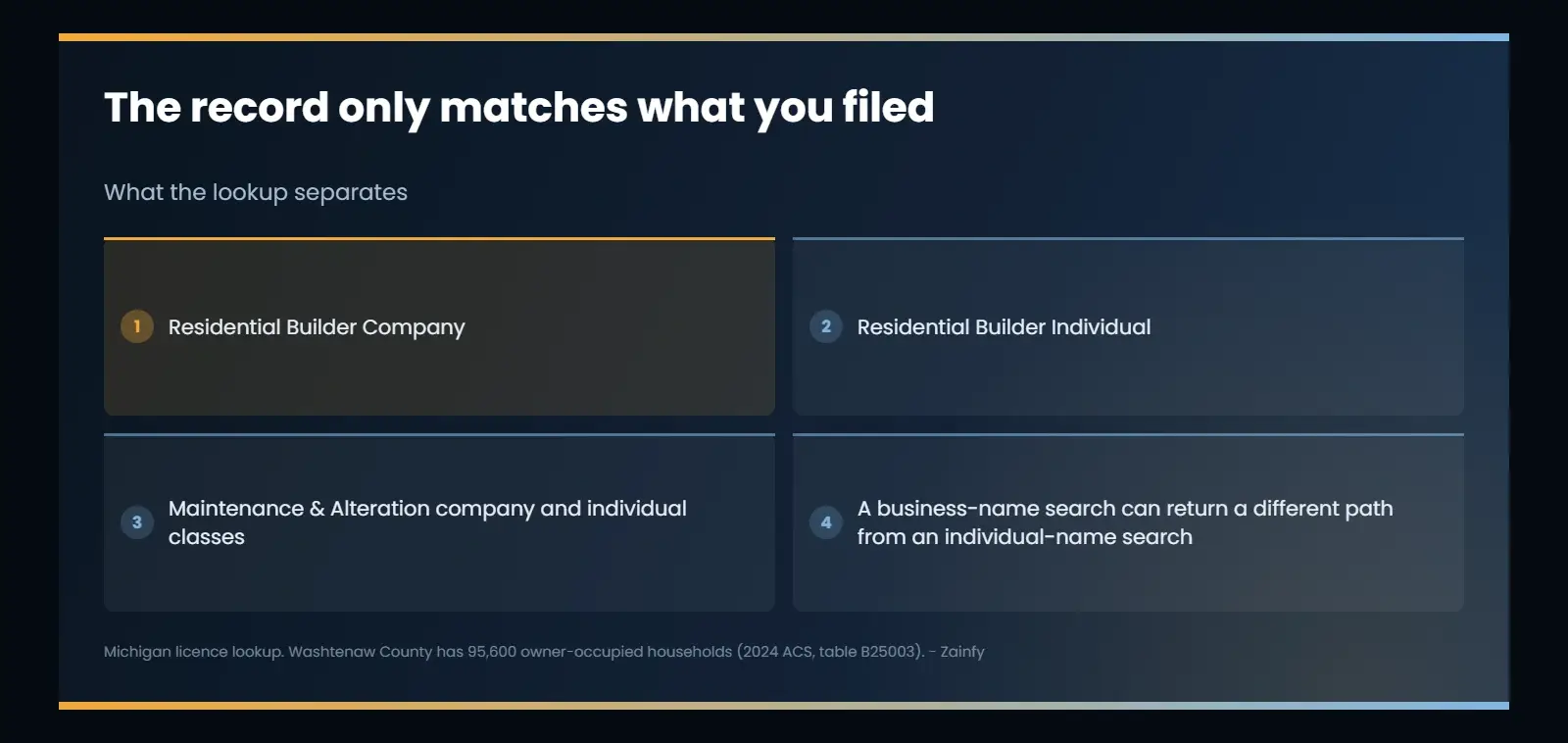
The record only matches what you filed
Michigan's license lookup accepts a person's name, business name, license number, or city. It also separates Residential Builder Company from Residential Builder Individual, and distinguishes both from Maintenance & Alteration company and individual classes. That structure creates a simple marketing problem: the name a Washtenaw homeowner types must lead him toward the record the business is relying on. If he received a company name but the relevant record is found under an individual, the search result may not explain the relationship for him. The safe statement is not that Michigan licenses are usually filed one way or another; the state publishes no verified count supporting that claim. The useful statement is that the lookup separates the records, so your public naming has to account for the distinction. Washtenaw County contains 95,600 owner-occupied households, according to the Census Bureau's 2024 ACS table B25003. That is the scale of the local audience able to test the identity. The Builders and Remodelers Association of Greater Ann Arbor also directs homeowners to ask for a valid license number and verify that the record is active. The check is therefore not theoretical or imported from another state; a named Ann Arbor trade body places it in front of the local buyer. The identity question then moves one layer upward because most people type the name into a general search before reaching the state form, which is where licensed remodelers working Ann Arbor and Washtenaw need the public name to connect cleanly with the credential. The license can be valid while the route to it remains unclear. Your marketing earns trust only when a buyer can follow that route without inventing the missing connection.
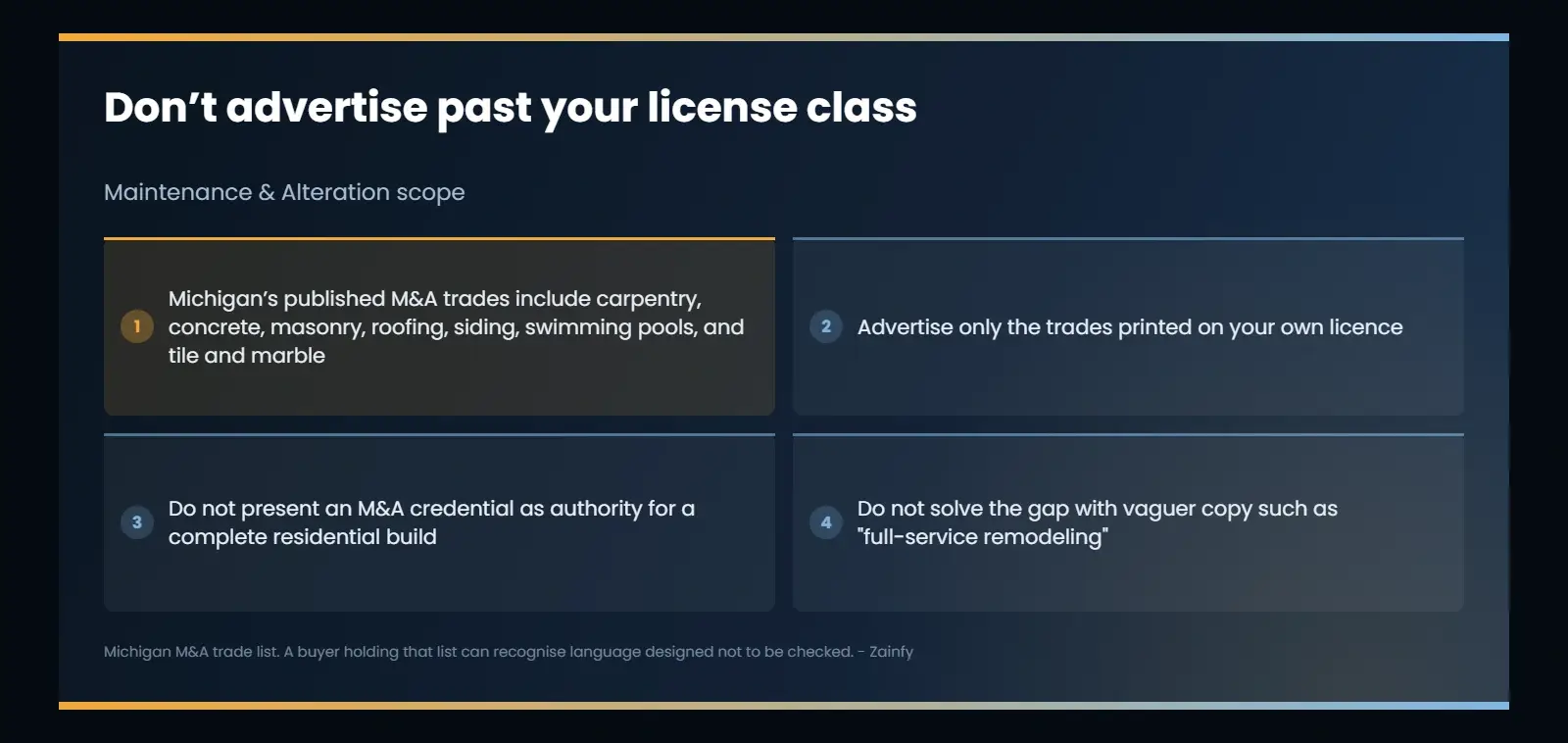
Don't advertise past your license class
If your credential is a Maintenance & Alteration license, the qualified trades are printed on the license. Michigan's published list includes work such as carpentry, concrete, masonry, roofing, siding, swimming pools, and tile and marble. The scope in your marketing should stay inside the trades carried by your record.
Do not present a maintenance and alteration credential as authority for a complete residential build when the class and listed trades provide a narrower answer. That creates more than abstract regulatory exposure. It produces the worst verification result: a buyer follows the state's guidance, opens the record, and discovers that the advertising promised more than the credential shows.
Do not repair that gap with vaguer copy. "Full-service remodeling" is not a useful escape when it avoids identifying the scope the business will actually contract. A buyer holding a published trade list can recognize language designed not to be checked.
Name the work the company is qualified and prepared to perform. If the business holds a Residential Builder license with broader authority, describe that scope accurately. If it holds an M&A license, let the listed trades define the edges.
The license class should make the marketing clearer, not force the buyer to reconcile a larger promise with a smaller record.
Where the number earns its keep
In a footer, the license number behaves like legal furniture. It is available to someone already looking for it, but it does little at the moment a buyer first wonders whether the claim is credible. The number is present without being connected to a decision.
Place the credential where the scope is described. If a page says the company performs residential additions, the relevant license identity should be close enough for the buyer to understand what backs that statement. If the business presents a listed M&A trade, the class and scope should not be hidden behind a generic licensed-and-insured line.
The principle also applies to the business profile a searcher may see before reaching the site, but that profile should not become the whole placement strategy.
This is not a demand to repeat the number across every paragraph. Repetition can make proof look like decoration. The goal is to place the verifiable record beside the business claim that causes the question.
A number buried where nobody was looking proves little. A number presented when the buyer is evaluating scope gives him the shortest route from marketing language to a state record.
That is where the credential earns its keep: not as a footer obligation, but as the least expensive checkable fact on the page.
That is how we place it on the Michigan city pages we build, in the trust block beside the estimate call to action, from Holland to Saginaw, so the number is checkable at the moment the buyer is deciding whether to pick up the phone.
How do I verify a Michigan builders license?
Your buyer can search Michigan's license lookup by business name, individual name, license number, or city. He selects the relevant Residential Builder or Maintenance & Alteration license type, checks that the record is active, and compares the listed trades with the advertised work. He can also ask to see the required pocket card.
Run that process on your own business. The Accela form distinguishes company licenses from individual licenses, branch offices, salespeople, and the M&A company and individual classes. A business-name search can therefore return a different path from an individual-name search without proving that either name is false.
The buyer does not arrive with that background. He sees whether the name he was given returns a record and whether the class makes sense for the project. An active status tells him the record is current. An expiration date shows when it expires. Neither fact expands the trades printed on an M&A license.
Your marketing should remove the interpretive burden. Use the public business name consistently, identify the relevant license number accurately, and ensure the scope described does not exceed the record the buyer will open.
Then search the state form exactly as the homeowner will: first by the business name used in public, then by the license number. The result is not consumer advice detached from your operation. It is a direct test of whether your credential can be confirmed from the identity your business presents.
What Michigan builders ask about this
[wps_faq style=”classic” question=”What does a Michigan Maintenance & Alteration license let me advertise?”]
It supports advertising for the trades listed on your license, not every category of residential construction. Michigan publishes M&A trades including carpentry, concrete, masonry, roofing, siding, swimming pools, and tile and marble. Check the actual trades printed on your credential and make the public scope match them. Do not imply authority for a complete residential build if the record shows only selected maintenance and alteration work. The strongest copy names the qualified work plainly, so the buyer finds no gap between the promise and credential.
[/wps_faq]
[wps_faq style=”classic” question=”Does Michigan require my license number in my advertising?”]
The verified state pages do not establish a general Michigan advertising mandate. LARA's published homeowner guidance does document that the license should be displayed at the place of business, contractors and salespeople should carry a pocket card, and the full name and license number should appear in the contract. Those are the documented facts available from the primary state source. Use the number as checkable proof where it helps, but do not turn an unverified advertising rule into a compliance claim.
[/wps_faq]
[wps_faq style=”classic” question=”What does an Ann Arbor homeowner actually see when he looks my license up?”]
He sees a state form that separates company, individual, branch-office, salesperson, and Maintenance & Alteration license types, then a record tied to the name or number searched. The buyer can compare status, class, and listed trades with the work being advertised. That matters across Washtenaw County's 95,600 owner-occupied households because the local verification instruction is already public. If the marketing name and license identity do not connect clearly, the homeowner sees a question your workmanship cannot answer from the record. That unresolved gap stops trust before contact.
[/wps_faq]
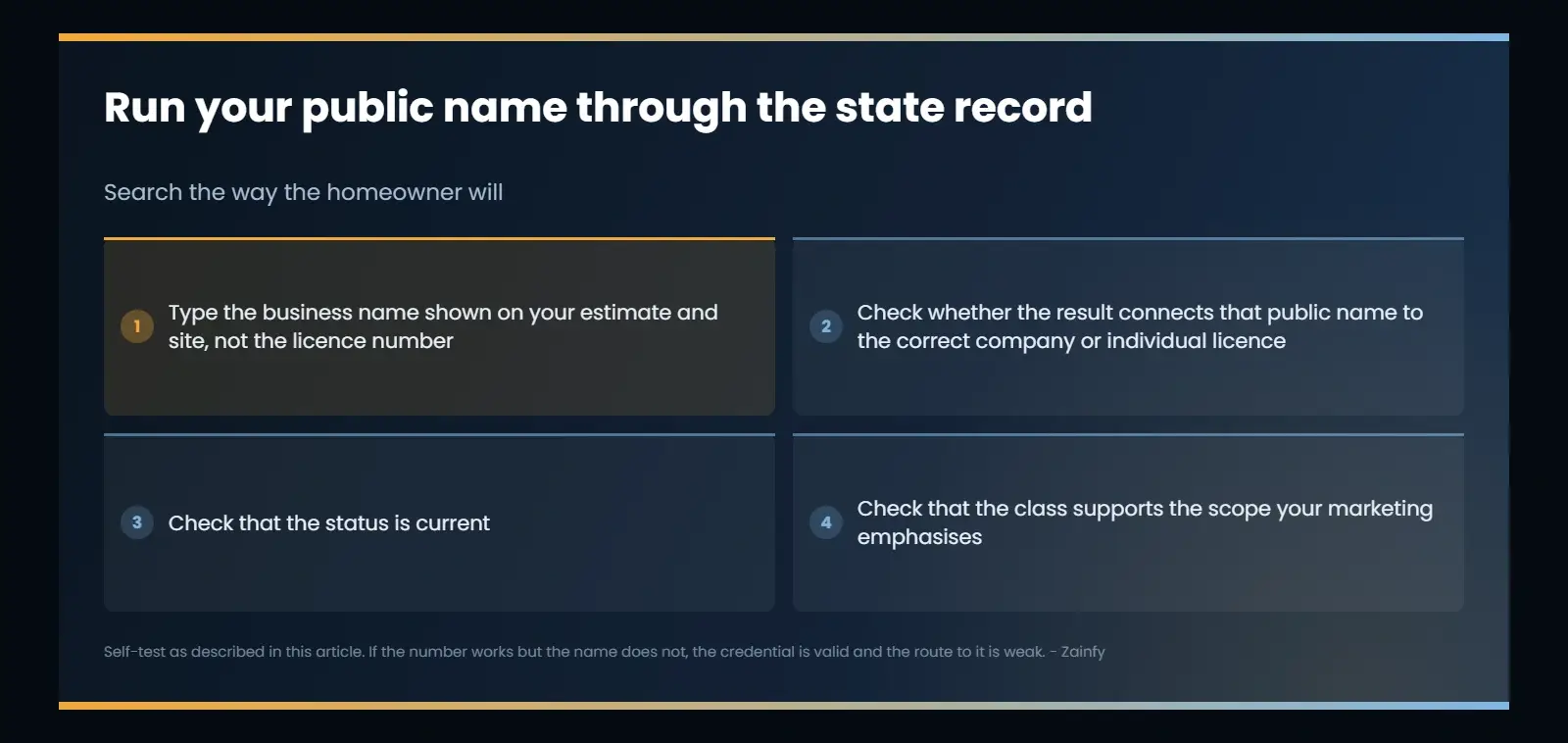
Run your public name through the state record
Open the Michigan license lookup and type the business name shown on your estimate and site. Do not begin with the license number; the buyer may not have it yet.
Read what comes back without supplying context from memory. Does the result connect the public business name to the correct company or individual license? Is the status current? Does the class support the scope your marketing emphasizes?
Then search by license number and compare the two paths. If the number works but the public name does not, the credential is valid while the route to it is weak. Fix the naming connection before adding another trust badge or promotional claim.
The useful test is not whether you know the license exists. You earned it. The test is whether an Ann Arbor homeowner can start with the name you advertise and reach the record that supports the work you want him to buy.