The advice to niche down is sound, but the version most remodeling owners receive is unusable: pick a room, then accept that every other room becomes somebody else's job. There is another axis that narrows the claim without narrowing the service list. It is the age of the house.
For a Grand Rapids remodeler, Kent County's housing stock already defines the market in measurable bands. A contractor can become unusually fluent in the houses built during one period while continuing to sell kitchens, baths, basements, and additions. Nothing has to disappear from the estimate sheet.
This is not a clever label placed over general work. Era positioning only holds when the company's completed jobs and field knowledge support it. The opportunity is to identify the building period already appearing in the schedule, learn what those houses repeatedly require, and describe that knowledge where owners can recognize it.
The niche is not a room. It is the building that contains every room you already remodel.
The Median House in Kent County Was Built in 1976
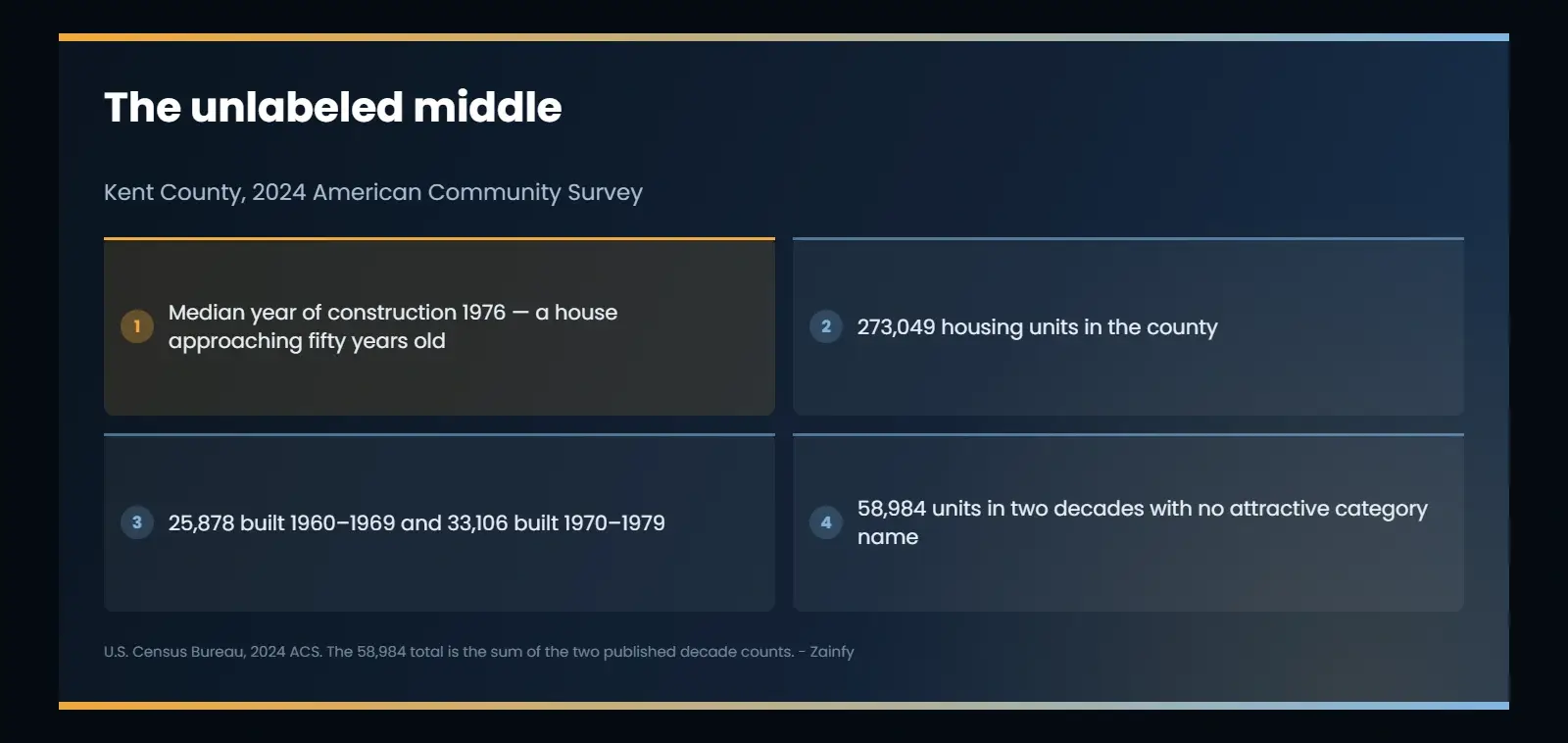
The U.S. Census Bureau's 2024 American Community Survey places Kent County's median year of construction at 1976. The middle of this market is therefore a house approaching fifty years old, not a new build and not a romantic pre-war property. That is more than a statistical midpoint.
That middle is large enough to count. Kent County has 273,049 housing units. Of those, 25,878 were built from 1960 through 1969 and 33,106 from 1970 through 1979. Together, the two decades contain 58,984 units.
Grand Rapids' pre-war neighborhoods receive understandable attention. They have recognizable architecture, visible history, and an established restoration vocabulary. A 1976 house has no equally attractive category name. It is often described only by its room count, subdivision, or floor plan, even though thousands of properties share its period.
That absence is the positioning opening. Houses from the sixties and seventies are old enough to have gone through multiple rounds of repairs and updates. Original systems may sit beside later alterations. A kitchen can carry one decade's structure, another decade's cabinets, and a third decade's appliances. Bathrooms, basements, and additions can expose similar layers.
The contractor who knows this band is not claiming that every house contains identical conditions. He is claiming familiarity with the questions that recur: what was original, what was altered, what can remain, and what has to be reconciled before the new work begins.
The unlabeled middle is valuable precisely because it is neither historic nor new. It is ordinary enough to be overlooked and numerous enough to support a specific claim.
Picking a Room Costs You Jobs. Picking an Era Does Not
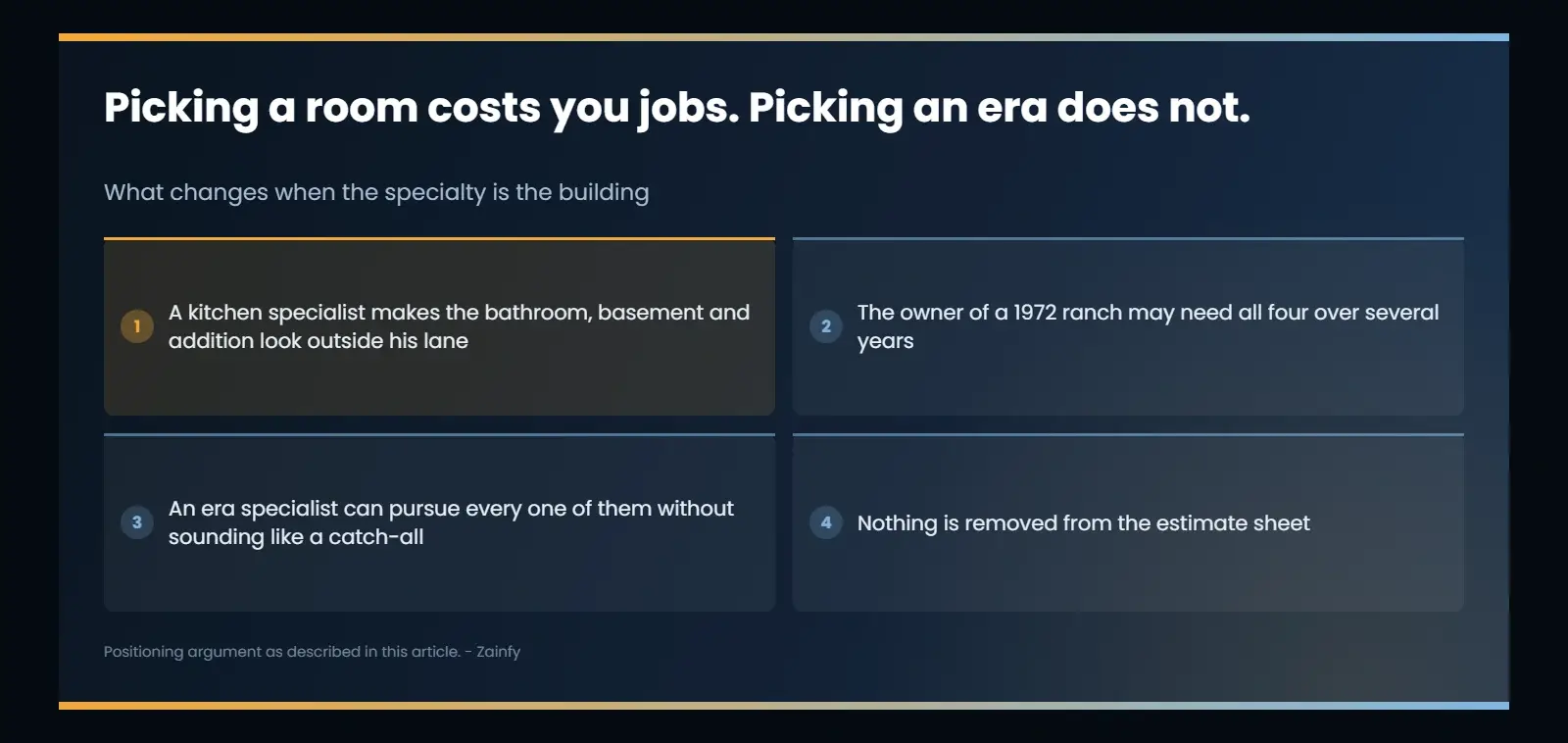
A contractor who markets himself as the kitchen specialist creates a clear promise, but he also makes the bathroom, basement, and addition look outside his lane. That tradeoff is why many owner-operators reject niche advice before testing it. Their companies need several service lines to keep crews productive and schedules balanced.
Era positioning changes the object of specialization. The owner of a 1972 ranch can need a kitchen now, a basement next year, a primary bath later, and an addition when the household changes. A remodeler fluent in that house period can pursue every project without presenting the business as a catch-all.
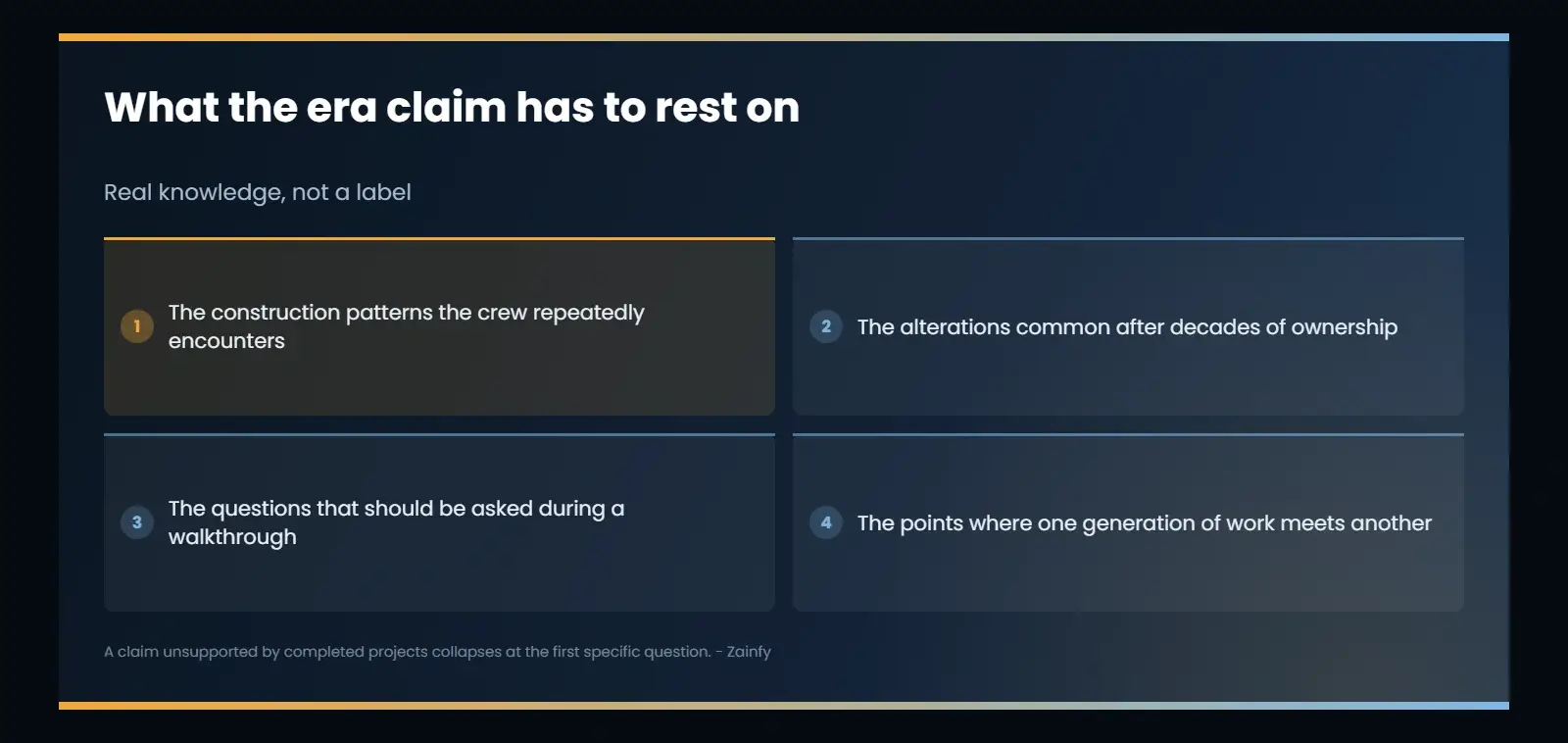
The knowledge has to be real. It includes the construction patterns the crew repeatedly encounters, the alterations common after decades of ownership, the questions that should be asked during a walkthrough, and the points where one generation of work meets another. The walkthrough sounds prepared before demolition because the contractor already knows where uncertainty tends to hide.
That experience also changes the language of the business. Instead of saying only “kitchens and baths,” the contractor can identify the era, describe the conditions found across past work, and explain why those conditions affect planning. The commercial handoff is getting found by the owners of those houses when they are trying to name a problem that generic room language does not capture.
No service has been removed. The company has simply stopped treating every house as if its age says nothing about the work inside it.
“Any Age, Any Style” Is Not Positioning
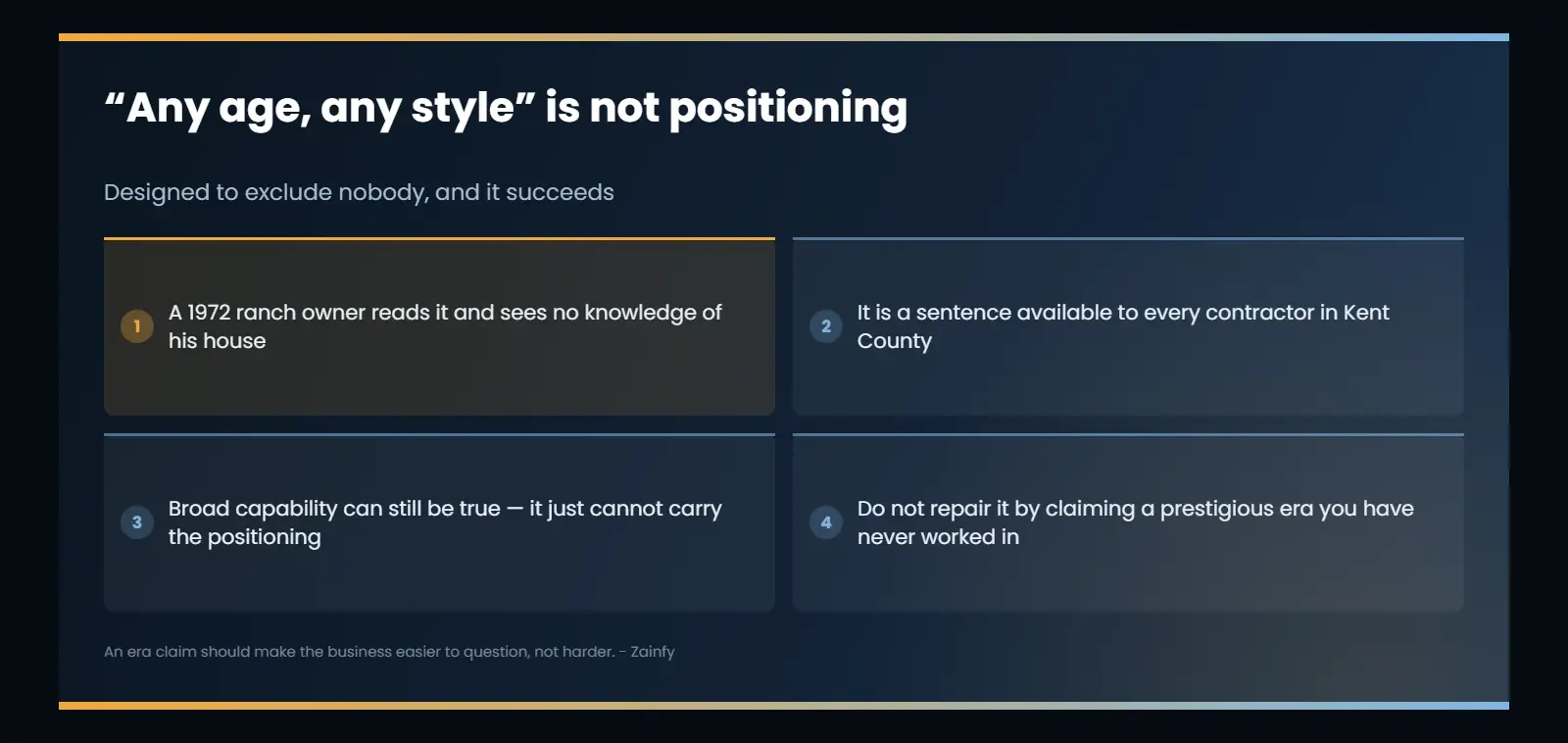
Stop writing “any age, any style, any project” as the business's defining line. It is designed to exclude nobody, and it succeeds by giving nobody a reason to recognize the company. A 1972 ranch owner does not read it and see knowledge of his house. He sees a sentence available to every contractor in Kent County.
Broad capability can still be true. It just cannot carry the whole positioning job. The claim that earns attention must identify something the company understands better than an owner expects from a general description.
Do not solve that problem by inventing an era you do not work in. Pre-war restoration can sound prestigious, but a claim unsupported by completed projects collapses at the first specific question. If the crew has not handled the materials, constraints, and uncertainty of that stock, the label is a costume.
An era claim should make the business easier to question, not harder. It should invite an owner to ask what the contractor has seen in houses like his and allow the answer to come from actual work. Specificity creates a standard the company must be able to meet.
Where the Claim Has to Be Readable
A positioning decision that exists only in the owner's head is not positioning. It has to appear in the words used to describe the business, in the explanation of the work, and in language an owner can connect to his own property. Name the decade. Name the house style when it is relevant. Name the conditions that tend to come with that period without pretending every address contains them. Most remodelers have never written one complete sentence identifying a build decade, which means an owner searching by era meets generic service language instead of informed recognition. Recognition depends on those exact words. The claim does not need to become a technical inventory or a page-building exercise. It needs to be readable wherever the company explains what it knows and whom that knowledge helps. When the owner arrives, he should understand that the contractor is familiar with the building period before he has to translate his house into a generic room category. That is also the boundary between a business claim and buyer judgment: the company names the era and its experience; the buyer decides whether the language feels supported. If the decade disappears from every public description, the positioning disappears with it.
Should a Remodeling Contractor Specialize in a Niche?
Yes, but the axis matters more than the decision. Specializing by room can require turning projects away. Specializing by the age of the house can preserve kitchens, baths, basements, and additions because one owner may need every service. Pick a building era that your county and completed work can actually support.
Most niche frameworks offer project type, process, location, or client type, but often omit the building. Residential remodeling happens inside stock shaped by a construction period and years of changes.
Start with the county rather than a fashionable label. The Census Bureau publishes year-built bands through the American Community Survey. Compare those bands with the last jobs your company completed. If a decade appears repeatedly in both the local stock and your work, there may be a defensible position already present.
Kent County offers a clear example: the median build year is 1976, and 58,984 units were built between 1960 and 1979. That does not prove an owner in the band wants an era specialist. It establishes that the market is real and large enough to investigate instead of guess.
Specialization has an honest cost. A narrower claim will feel irrelevant to more people. The benefit is that the right owner can understand it faster and test it against the company's work. If the county contains little of the era you choose, or your crew has no credible experience in it, the niche will not survive scrutiny. Specificity works only when the market and the evidence agree.
What Grand Rapids Remodelers Ask About This
[wps_faq style=”classic” question=”Does specializing mean turning down work?”]
Not when the specialty is the age of the house rather than a single room. A Kent County owner living in a seventies house can still need a kitchen, bathroom, basement, or addition, so the remodeler keeps multiple service lines. The tradeoff appears in the audience, not the capability: owners outside the chosen era may feel less directly addressed. That is an honest cost, but it differs from refusing the work your crew already performs. Era specialization narrows recognition while preserving the estimate sheet.
[/wps_faq]
[wps_faq style=”classic” question=”Can you specialize by the age of the house instead of the type of job?”]
Yes, if local stock and completed projects support the claim. Kent County contains 181,212 owner-occupied households, and its housing units fall into measurable build-year bands. Compare those bands with the decades represented in your own recent work, then identify the recurring conditions your crew understands. The position must come from evidence, not from choosing a prestigious label. When the market count and job record point toward one period, the house itself can become the specialty without reducing the range of rooms you remodel.
[/wps_faq]
[wps_faq style=”classic” question=”Which era of house is most common in Grand Rapids?”]
The most useful local answer is that Kent County's median structure was built in 1976, while 58,984 units date from 1960 through 1979. The Census figure covers the county rather than only Grand Rapids city limits, so it should be described at that scale. It identifies a substantial middle band that is neither new construction nor the pre-war core associated with historic renovation. For a Grand Rapids remodeler, that band is a measurable starting point for testing whether existing project experience supports an era claim.
[/wps_faq]
Put a Build Decade Beside the Last Ten Jobs
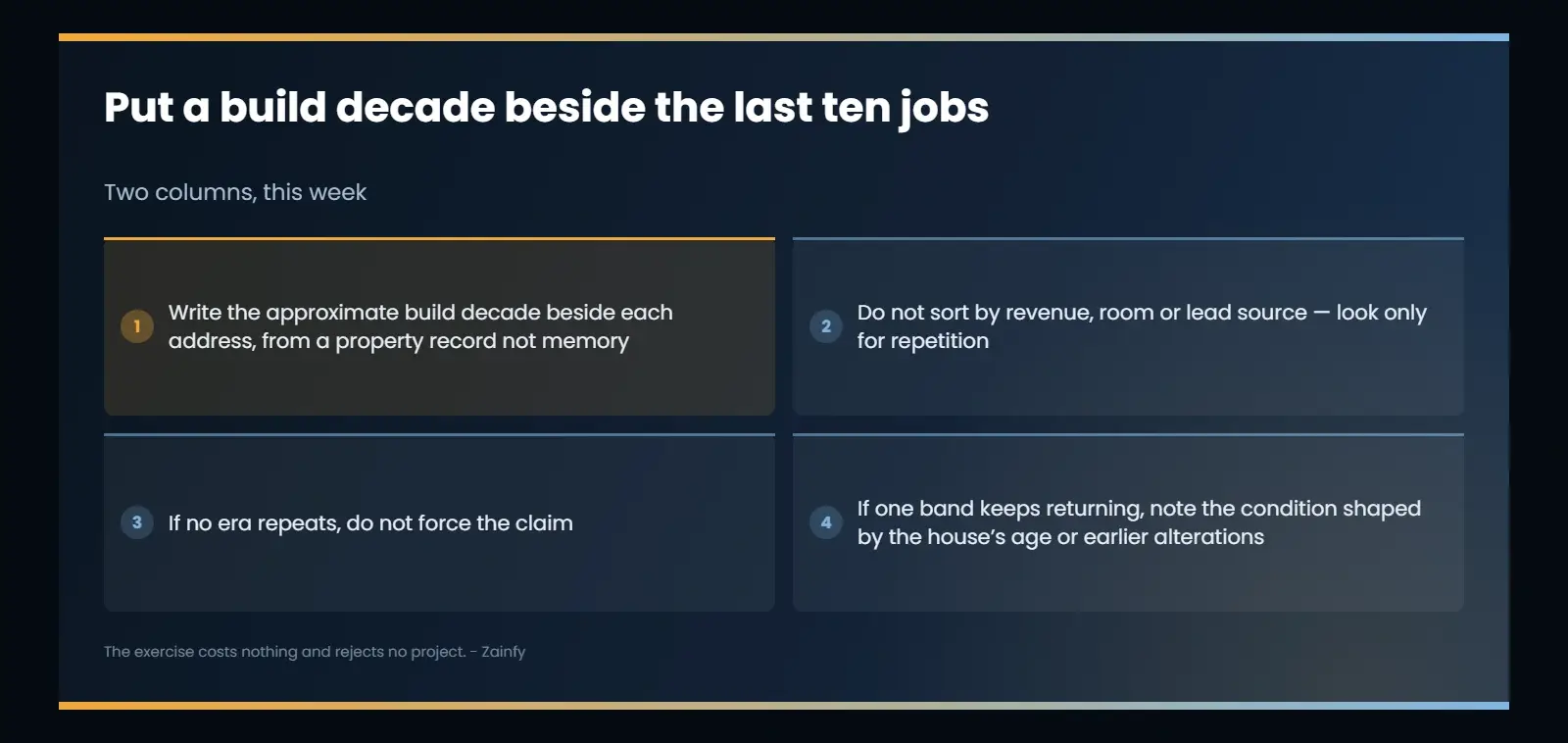
Pull the last ten completed jobs this week. Write the approximate build decade beside each address, using a reliable property record rather than memory. Do not sort the list by revenue, room, or lead source. Look only for repetition in the building period.
If no era appears more than once, you have learned something useful and should not force the claim. If one band keeps returning, add a second note beside each job: the condition your crew encountered that was shaped by the house's age or previous alterations.
Those two columns will tell you whether the specialty already exists inside the business. The exercise costs nothing, rejects no project, and leaves no room for a fashionable label unsupported by work. A defensible niche begins when the county's stock and your completed jobs point toward one period for reasons the crew can explain.
The same test travels down the lakeshore to Holland and inland to Kalamazoo: run your job list against the county's building periods before you claim a specialty, and once the specialty is real, put it where buyers look first, on the website and in local search.