Before you compare what home improvement leads cost from different sources, check which sources will tell you at all. Most of the big residential lead sources publish no price a contractor can read before signing up, and the ones that do aren’t pricing comparable units.
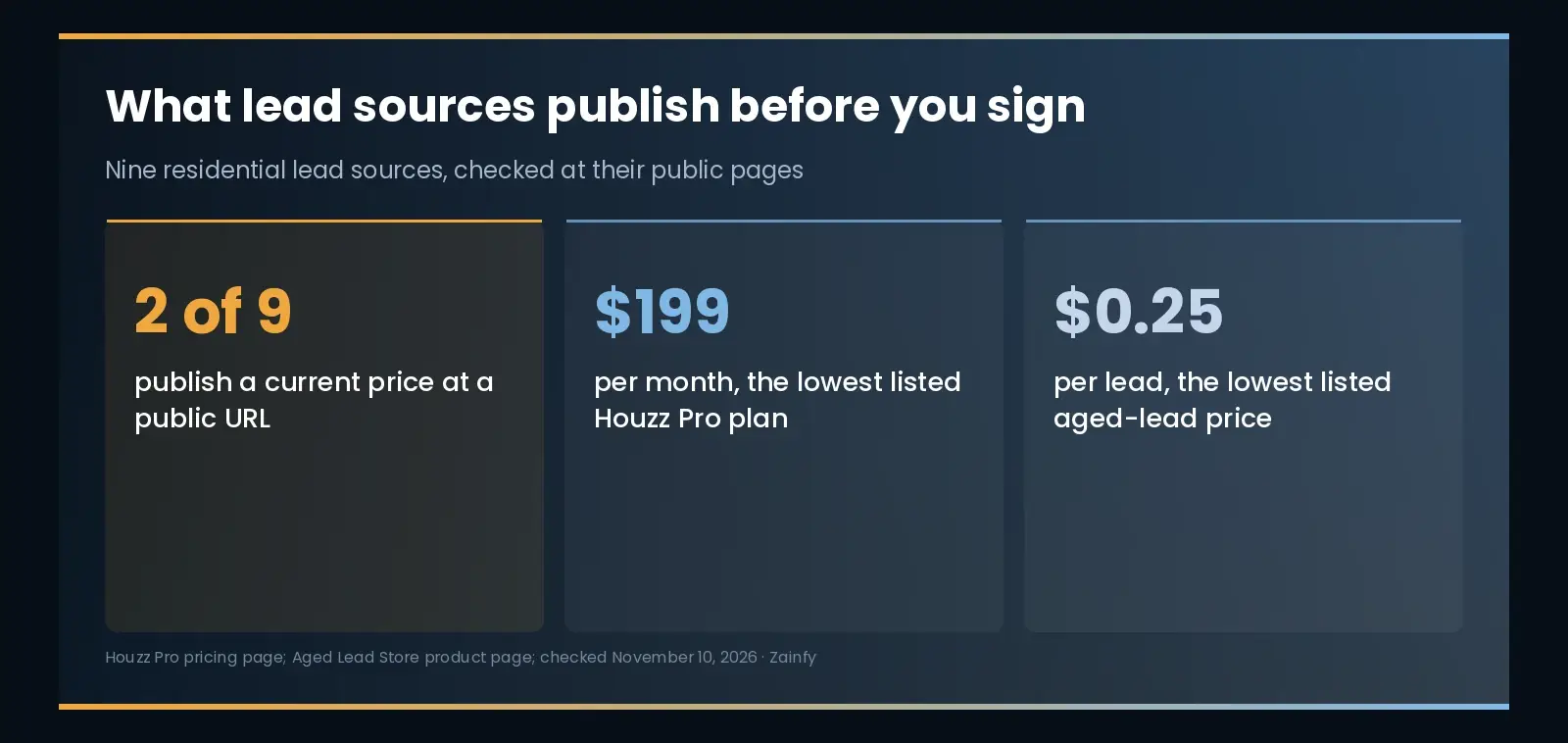
Here is the split as of November 2026. Houzz Pro publishes flat monthly plans. One aged-lead seller publishes a per-lead price. Google publishes a bidding model and its charging rules, but no dollar figure. Angi, Thumbtack, HomeAdvisor, Porch, Modernize and CraftJack publish no per-lead price you can read on a public page before you sign up.
That changes how a contractor should shop. If a price isn’t published, the only number you’ll ever see is the one on your invoice. And if two sources define a billable lead differently, comparing their prices tells you less than it seems to.
This guide goes source by source: what each publishes, where, and what its own terms say you pay for. It ends with a table you can check against your own invoices and a way to decide which source to look at first based on the size of your business.
How much do contractors pay for leads?
Most contractors can’t say what a lead should cost, because most lead platforms don’t publish it. Of the major residential sources, Houzz Pro lists flat monthly plans starting at $199, one aged-lead seller lists leads from $0.25, and Google publishes a bidding model with no dollar figure. Angi, Thumbtack, HomeAdvisor, Porch and Modernize publish no per-lead price on a public page.
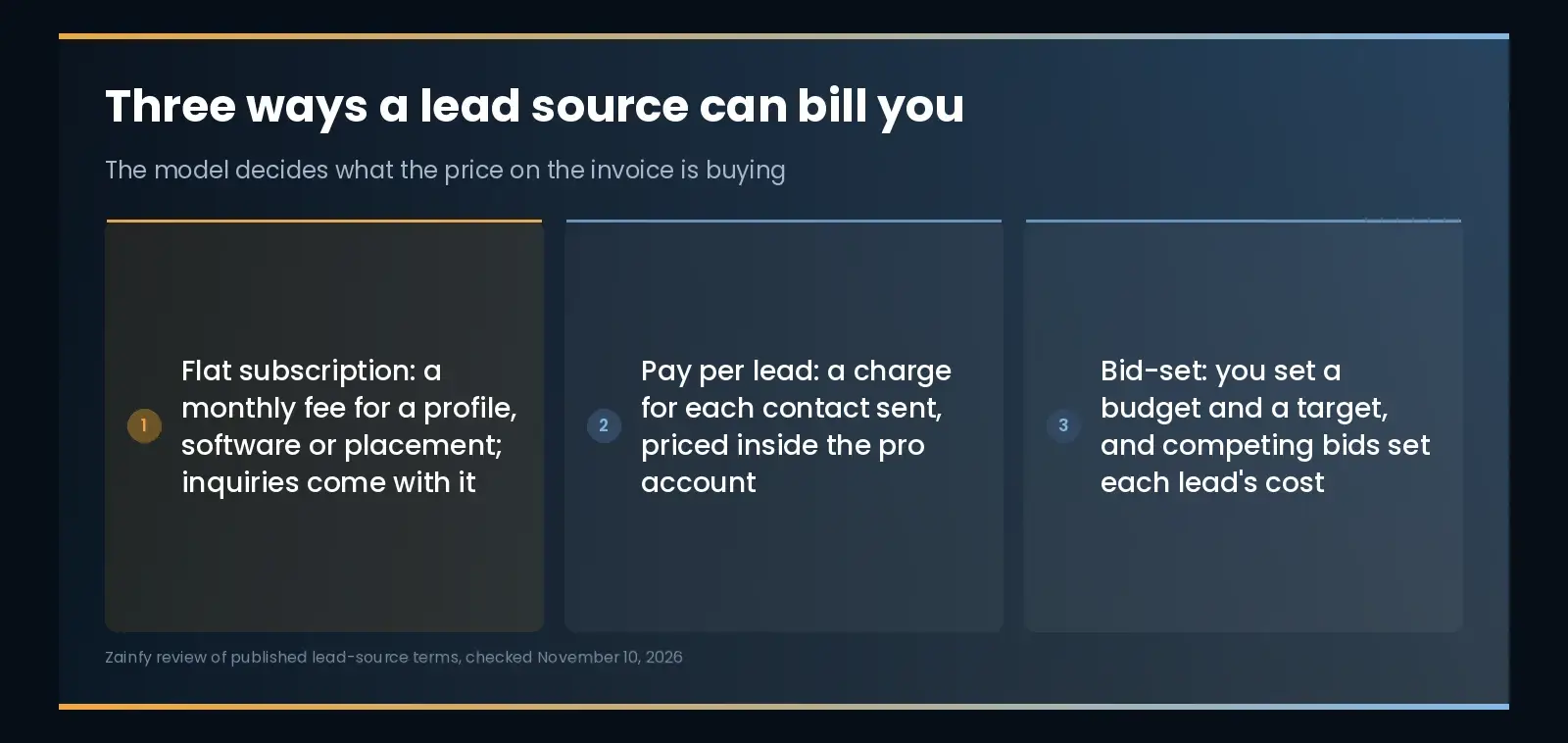
Behind those sources sit three pricing models, and they explain most of the confusion.
Flat subscription. You pay a monthly fee for a profile, software or placement, and whatever inquiries arrive come with it. The price is easy to see. What it buys isn’t, because the number of leads varies month to month.
Pay per lead. You pay for each contact the platform sends. The price is usually shown only inside the contractor’s account, and it can change with the job type, the area and demand. Here, construction leads means a homeowner’s contact details and project request, sold to you whether or not the job ever happens.
Bid-set. You set a budget and a target, and competing bids decide what each lead costs. Google’s Local Services Ads work this way.
Shared vs exclusive leads is a pricing distinction inside the pay-per-lead model. A shared lead is sold to several contractors and priced lower. An exclusive lead goes to one contractor and costs more. The label describes the sale, and it’s worth knowing what exclusivity actually restrains before you pay extra for it.
Marketplaces: what each one will and won’t show you
The fairest way to compare lead marketplaces is on disclosure: what each will tell you before you pay.
Angi, which also owns HomeAdvisor, defines a lead most clearly in its own filing with the Securities and Exchange Commission. In its >annual report for 2025, Angi describes lead revenue as “fees paid by Pros for consumer matches (regardless of whether the Pro ultimately provides the requested service).” That’s the honest answer to “why was I charged for that?” You pay for the match, and the outcome is yours. That filing also says homeowners used an Angi business for about 16 million projects in 2025. The direction is worth knowing too. In its third-quarter 2026 results, Angi reported leads down about 18% from a year earlier, to roughly 4.5 million, while revenue per lead rose about 10% (>Angi investor relations). Fewer leads, each costing more.
Thumbtack, Porch, Modernize and CraftJack publish no per-lead price you can read before signing up. Thumbtack’s pricing pages for pros don’t show a lead price to a logged-out visitor, Modernize’s pricing wasn’t reachable at a public URL, and CraftJack’s pricing page now redirects into Angi’s contractor sign-up.
Networx is the exception that proves the rule. It published a per-lead range in a help article, but that article is dated June 2023 and hasn’t been updated, so it tells you what Networx charged then. What it does publish today is the distribution: a single pay-per-lead lead goes to up to four contractors.
The pattern matters more than any single row. Before judging which of these platforms holds up for remodeling-sized jobs, start by knowing which ones will show you the terms in writing.
Google’s is the only source that publishes its own rules
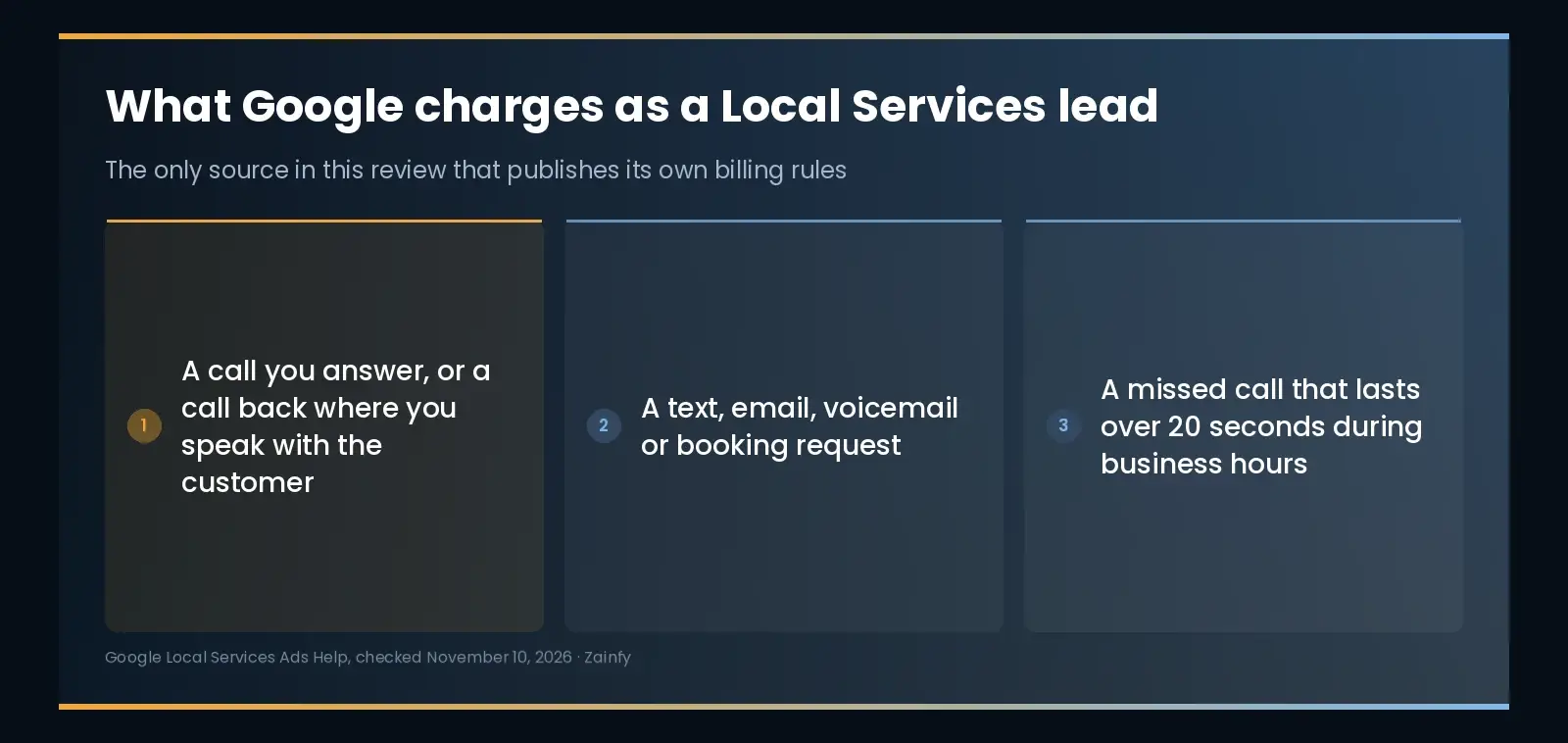
Google’s Local Services Ads publish no lead price, but they do publish >what counts as a charged lead. You’re charged when you answer a call or call the customer back and speak with them, when you receive a text, email, voicemail or booking request, and when a caller stays on the line more than 20 seconds on a call you miss during business hours.
Google reassesses lead quality over 30 days and credits some poor-quality leads automatically. It also says it >no longer supports credits for leads in job types or locations you don’t serve. Its pages describe no dispute process or filing window for a lead charge, so don’t plan around one. Even so, that’s more written detail about what you pay for than any other source on this list gives you.
There’s a dated warning, too. Google is >moving Local Services Ads into Google Ads as Performance Max campaigns with pay-per-lead goals, starting with home services in August 2026. Manual bidding and industry-level target cost per lead are being retired, and your old Local Services Ads performance reports won’t carry over. Google’s own advice is to take screenshots before you migrate. If you’ve been judging this source by its history, save that history now.
Paid social prices attention instead of inquiries
Facebook and Instagram sell impressions and clicks, so there’s no per-lead price to publish and none to expect. The number a contractor ends up paying per inquiry comes from their own targeting, creative and offer, which is why two shops in one town can see wildly different results from one platform. Contractors often report publicly that social inquiries go quiet after the first message. That’s usually a matter of intent: someone scrolling past a kitchen photo is earlier in the decision than someone searching for a remodeler. It doesn’t mean the platform hid the price. It never set one.
The sources that bill you in time instead of money
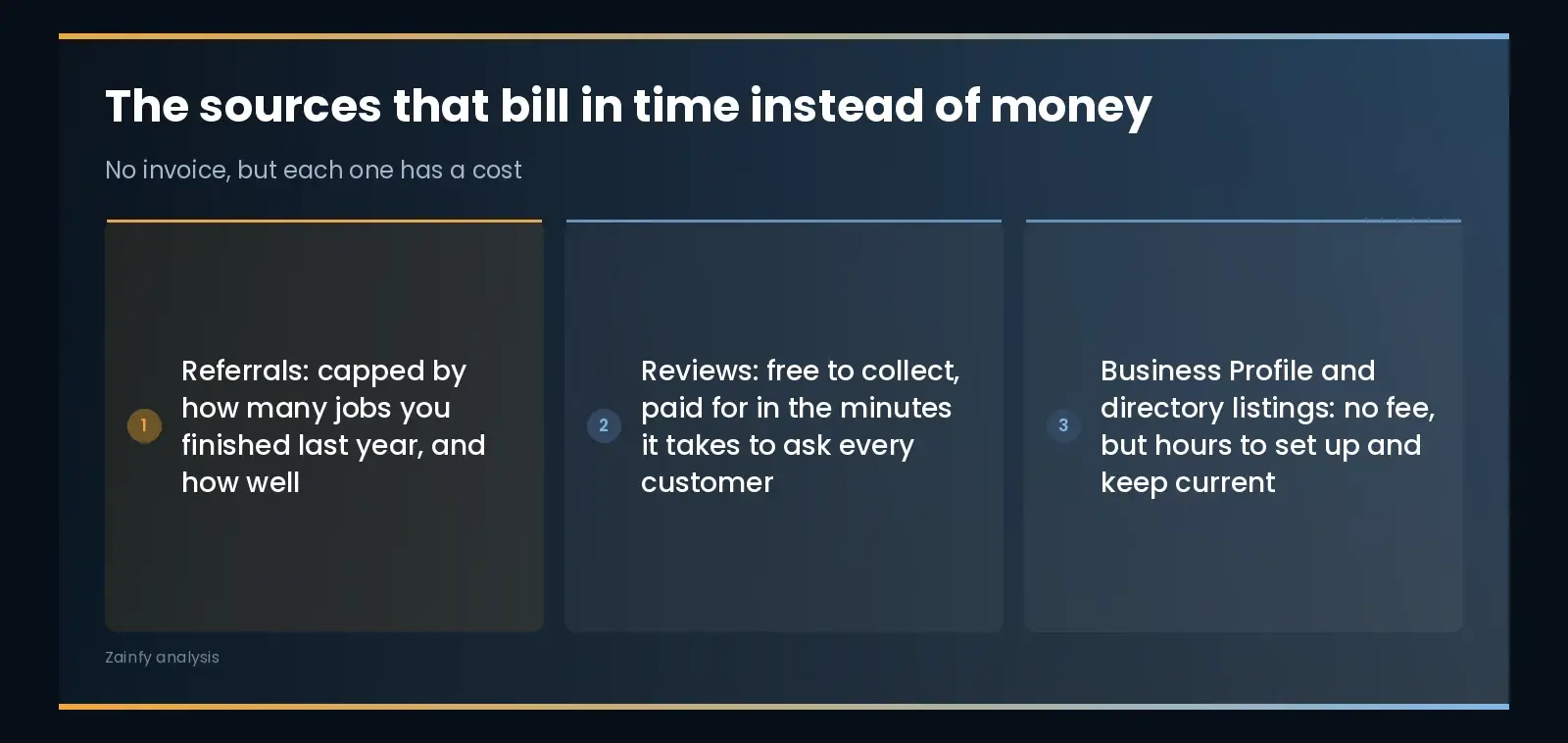
Referrals. No invoice, but they’re capped by how many jobs you finished last year and how well. You pay for them in the quality of past work.
Reviews. Free to collect, paid for in the minutes it takes to ask every customer, every time.
A Google Business Profile and directory listings. No fee, but they cost hours to set up and keep current, and they go stale fast when nobody owns them.
“Free” leads are never free. They’re billed in time, and for a small shop time is the scarcer resource. An owner who spends five evenings a month on listings and posts is paying for leads, just in hours instead of dollars. That’s worth remembering before you dismiss a paid source as expensive.
Organic search has no rate card either, and that cuts both ways
Search engines don’t sell you the inquiry, so there’s no per-lead price for organic search. The cost is time, content and patience, and the inquiry arrives without a third party deciding what counts as billable. That’s the upside.
The downside is lag. Organic search builds over months, and for most of that time it bills you in effort before it sends anyone. Results can move faster than owners expect: NextGen Construction, a Tampa remodeler, went from 56 to 1,730 organic clicks a month in four months. But four months of setup is a long time to wait when the schedule is empty. Any cost comparison that ignores timing is blind to the period when organic search costs the most and returns the least, which is why it pays to understand how remodeling firms source work before search starts paying.
What each source actually publishes
| Source | Publishes a price? | Where, and on what basis | What its own terms count as a billable lead |
|---|---|---|---|
| Houzz Pro | Yes | >Pricing page: Pro $199/mo, Teams from $399/mo, Advertising Package from $499/mo | Flat plans; no per-lead charge shown |
| Aged Lead Store | Yes | >Product page: $0.25 to $2.00 per lead by age and order size | Aged leads, 30 to 365 days old |
| Google Local Services Ads | Model only | Help center: bid-set, no dollar figure | Answered or returned calls, texts, emails, voicemails, bookings, missed calls over 20 seconds in business hours |
| Angi / HomeAdvisor | Not at a public URL | Shown inside the pro account | Any consumer match, whether or not the job happens (SEC filing) |
| Thumbtack | Not at a public URL | Shown inside the pro account | Not published publicly |
| Porch | Not at a public URL | Not published | Not published |
| Modernize | Not at a public URL | Not published | Not published |
| CraftJack | Not at a public URL | Redirects to Angi sign-up | Not published |
| Networx | Dated only | 2023 help article, never updated | A pay-per-lead lead goes to >up to 4 contractors |
Table checked November 10, 2026. Prices and terms change, so check the date on any number before you rely on it.
Read the table by the last column first. The sources that publish the least tend to sell the most expensive unit, a live contact delivered in real time. The second column tells you whether you can see a price. The fourth tells you what you’re actually buying, and that’s the one that decides your bill.
Stop comparing home improvement leads on price per lead
Comparing lead sources on price per lead fails twice. Most sources don’t publish one. And where two of them do, they aren’t selling equivalent units. One platform’s filing says you pay whether or not you ever do the job. Another sells leads that are months old. Google won’t charge a missed call that hangs up in under 20 seconds.
Compare what each source defines as billable first. The price comes second. That’s also why nobody can give you an honest figure for a reasonable cost per lead: two prices only compare when they buy equivalent units.
Which source to open first, by the size of your book
Is it worth paying for home improvement leads at all, and what’s the best company to get leads from? Both answers depend more on the size of your business than on the source, because size changes which part of the table matters most.
Under $500,000 a year: start with the sources that bill in time. A published price you can’t yet afford to absorb isn’t a bargain, and referrals, reviews and your Business Profile carry this size of shop further than any paid source.
$500,000 to $1 million: look first at the one source that publishes its charging rules. At this size, a bill you can understand and check matters more than a cheap one, and Google’s rules let you check every charge against its own terms.
$1 million to $3 million: flat-rate and pay-per-lead models become comparable here, because you have enough volume to divide a subscription across real jobs. Ask every per-lead seller how many contractors receive each lead before you compare prices.
Above $3 million: the question shifts from price to control. Whose contract governs the lead, what happens to your data, and what you lose if you leave. At this size, the fourth column decides almost everything. Read the contract before the rate card, and ask whether you can export every lead and call record if you leave.
Find the last invoice from whichever lead source you pay, then look for that price on the company’s public website. If you can’t find it in five minutes, you’re not buying a priced product. You’re paying whatever the seller decides each month. Write down the date you checked, because on this subject an undated price is the norm, and yours shouldn’t be.
Sources checked November 10, 2026: Houzz, Aged Lead Store, Networx, Google Local Services and Google Ads Help, Angi SEC filings and Q3 2026 investor materials.