Custom home builder marketing starts about a year before the job is yours. A house built by a contractor on the client’s own land takes about 11.9 months from building permit to completion, against about 7.5 months for a house built for sale, according to the U.S. Census Bureau’s Survey of Construction. By the time a custom client types anything into a search box, most of the decisions that will land them with a builder have already been made.
That changes what marketing for custom home builders has to do. Most home builder marketing strategies online, including most digital marketing for home builders, are written for production builders, who sell finished or nearly finished homes to whoever walks into the model. Their problem is traffic. A custom builder’s problem is different: finding people who own a lot, have financing lined up, and are willing to spend a year building one house with one company.
This guide maps where that demand actually starts. It uses public data you can check yourself: the Census Bureau’s building permit and construction surveys, the National Association of Home Builders (NAHB), the National Association of Realtors (NAR) and the American Institute of Architects (AIA). Where no source publishes something, it says so, because a number nobody can trace is worse than no number.
It ends with what a small custom building firm can realistically staff, since most of them are small.
A production builder needs traffic. You need four things to already be true.
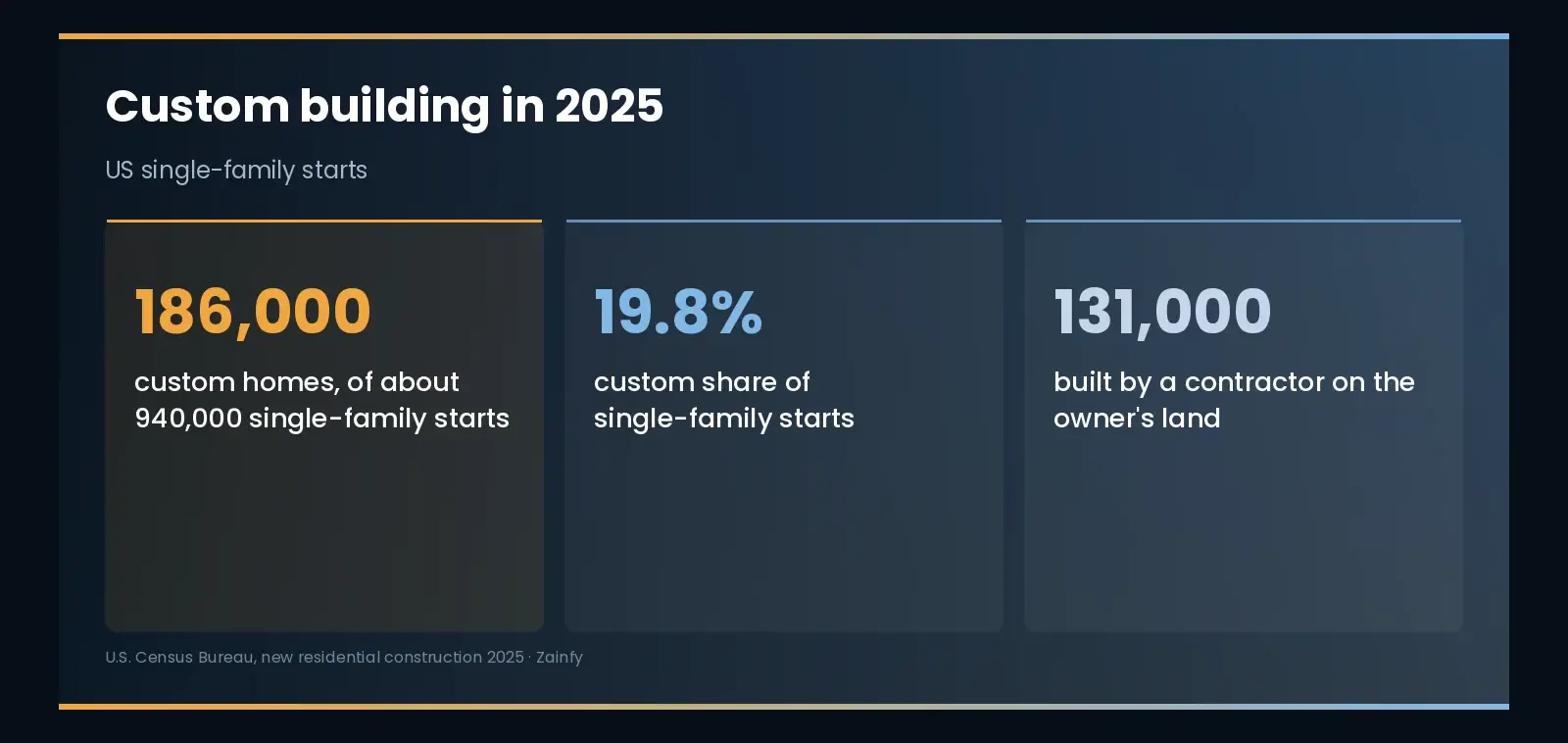
In 2025, about 186,000 of the roughly 940,000 single-family homes started in the US were custom homes, built either by a contractor on the owner’s land or by the owners themselves. That’s 19.8% of single-family starts. Contractor-built homes, the work a custom builder actually sells, accounted for about 131,000 of them.
A production builder sells inventory. It buys land, builds a subdivision, and markets available homes to anyone who qualifies for a mortgage. More traffic means more sales, so its marketing is built around reaching as many buyers as possible.
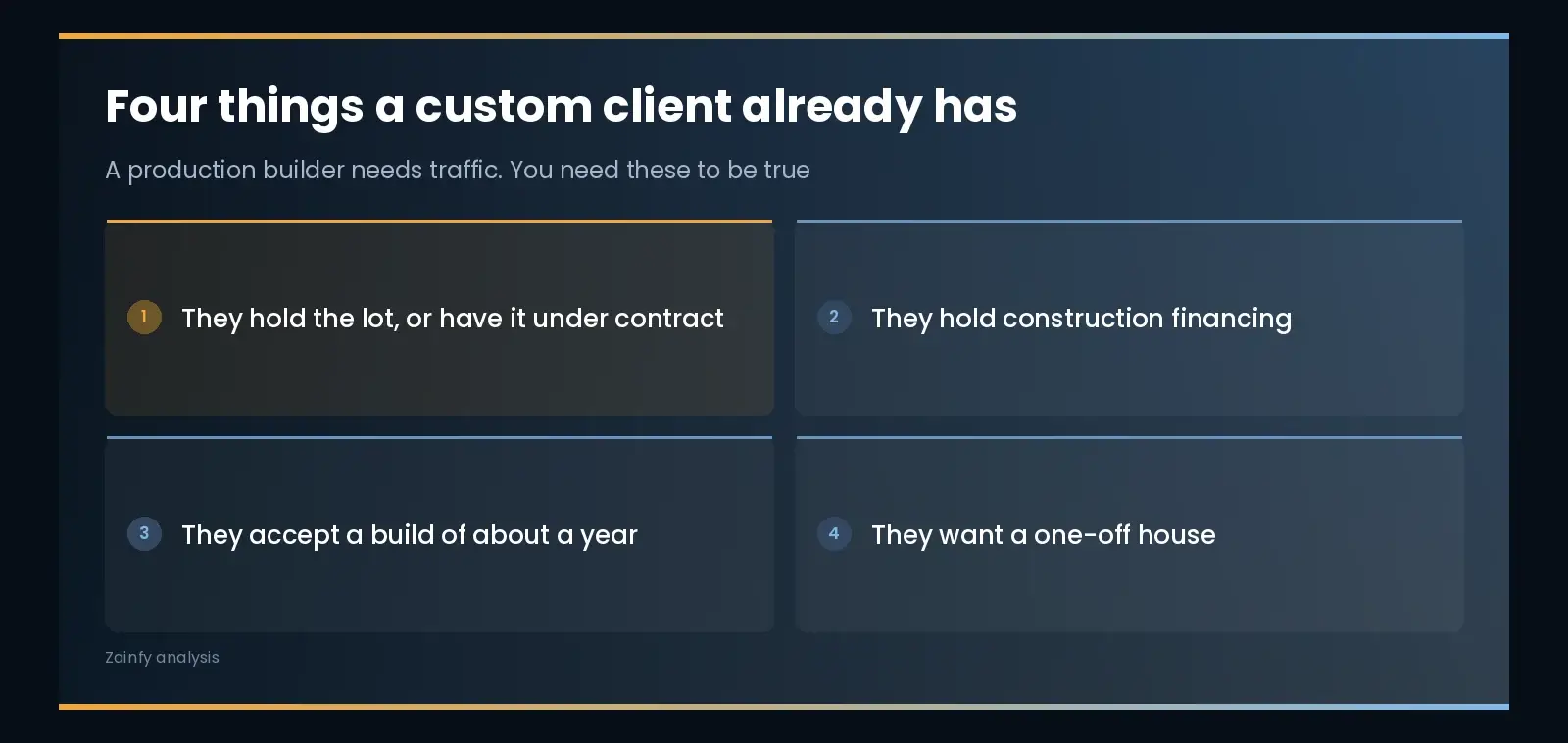
A custom builder sells something else: a year-long working relationship to a client who already has four things in place.
They hold the lot. Custom building on the client’s land starts with land the client owns or is under contract to buy.
They hold construction financing. A construction loan works differently from a purchase mortgage, and a client without one can’t sign.
They accept a build of about a year. Someone who needs to move in three months is a production-home buyer.
They want a one-off house. The design, the finishes and the decisions are theirs.
That’s the difference between marketing for custom builders and production builders in one line. A lead missing any of those four isn’t ready, no matter how interested they sound. That’s why traffic-driven marketing disappoints custom builders. It fills the calendar with people who are a year or more away, or who will never get there. Every meeting with one of them is an evening taken from a client who is ready, and in a firm of four people that trade-off shows up in the schedule within a month.
The firms doing this work are small. In the Census Bureau’s 2022 business-size data for new single-family general contractors (NAICS 236115), firms averaged about 4.0 employees, and 68.6% of them reported receipts under $1 million. That’s the most recent business-size release, and it describes a business where the owner sells, estimates, manages and often swings a hammer too.
So the real question for a custom builder is how to meet more people who already have those four things in place, and how to spot the ones who don’t. That’s the qualification side of a custom build, and it shapes everything else on this page.
The one number in your market that is published before the job exists
For most contractors, building permits are the wrong way to measure demand. A remodeler’s work mostly happens in existing homes, and new-construction permits say little about it. For a custom builder, the opposite is true. You build new houses, and every one of them needs a permit before it can start.
That makes the Census Bureau’s Building Permits Survey the one demand signal published before the job exists. It counts new single-family housing units authorized by building permits, metro by metro, every month and every year.
Here’s what it showed for three metros in 2025 compared with 2024, counted as single-family units authorized by building permit:
Atlanta-Sandy Springs-Roswell, Georgia: 25,773 in 2024 to 22,065 in 2025, down 14.4%.
Tampa-St. Petersburg-Clearwater, Florida: 13,205 to 13,596, up 3.0%.
Detroit-Warren-Dearborn, Michigan: 4,878 to 4,859, essentially flat at down 0.4%.
United States: 981,911 to 911,903, down 7.1%.
The first seven months of 2026 tell a similar story in preliminary data. Atlanta authorized 13,054 single-family units from January through July, down 4.9% from January through July 2025. Tampa authorized 8,202, roughly flat at up 0.3%. Detroit authorized 2,730, down 4.5%.
Nationally, single-family permits ran at a seasonally adjusted annual rate of 845,000 in September 2026 (Census new residential construction).
Two cautions apply. Permits count authorizations, and homes started or sold are tracked separately. And these counts include production builders, who pull far more permits than custom builders do. But a falling permit count in your metro still tells you the pool is shrinking, and a rising one tells you more people are clearing the first legal step.
You can pull your own metro’s numbers from those Census files. Open the annual metro tables, find your metro by name, and read the one-unit column for the last two years. Then check the monthly year-to-date file for the current year. That’s the closest thing to a market-size figure a custom builder will ever get for free, and it takes about ten minutes.
148,000 houses with legal permission to exist and nobody building them
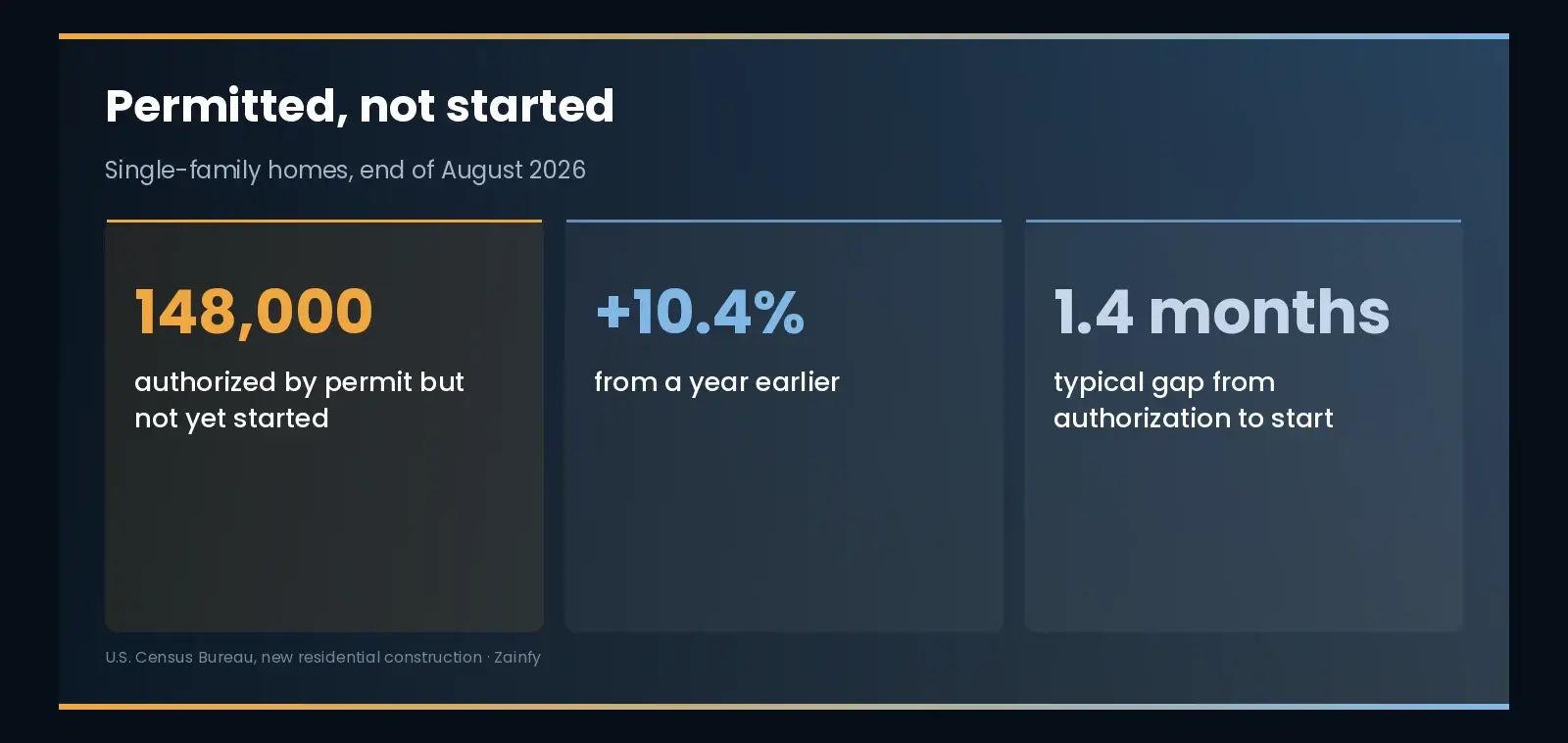
At the end of August 2026, about 148,000 single-family homes in the US had been authorized by a building permit but not yet started, up 10.4% from a year earlier, according to the Census Bureau’s new residential construction data, and the typical gap between authorization and start for a single-family home runs about 1.4 months, so a backlog that size means a large group of projects cleared the legal step and then stalled at the commitment step, whether because of financing, cost, a change of heart or a builder who hasn’t been chosen yet. For a custom builder, that queue is the most interesting number in the federal data, because each of those authorizations represents somebody who owns land, has had plans drawn and has spent money getting a permit, which is most of the way to the four conditions above. The honest limit has to be said right away: nothing published tells you whose permits those are, which of them are custom homes, or whether any of them can be reached. Some will be production builders waiting on a better market. Some will be owners who’ve already hired someone. The figure sizes the question without answering it. What it does tell you is that there’s a population of people with permits in hand and no house going up, and the builders who are already connected to them, through architects, lenders and land brokers, are the ones who’ll hear first when those projects move.
The people who meet your client before you do
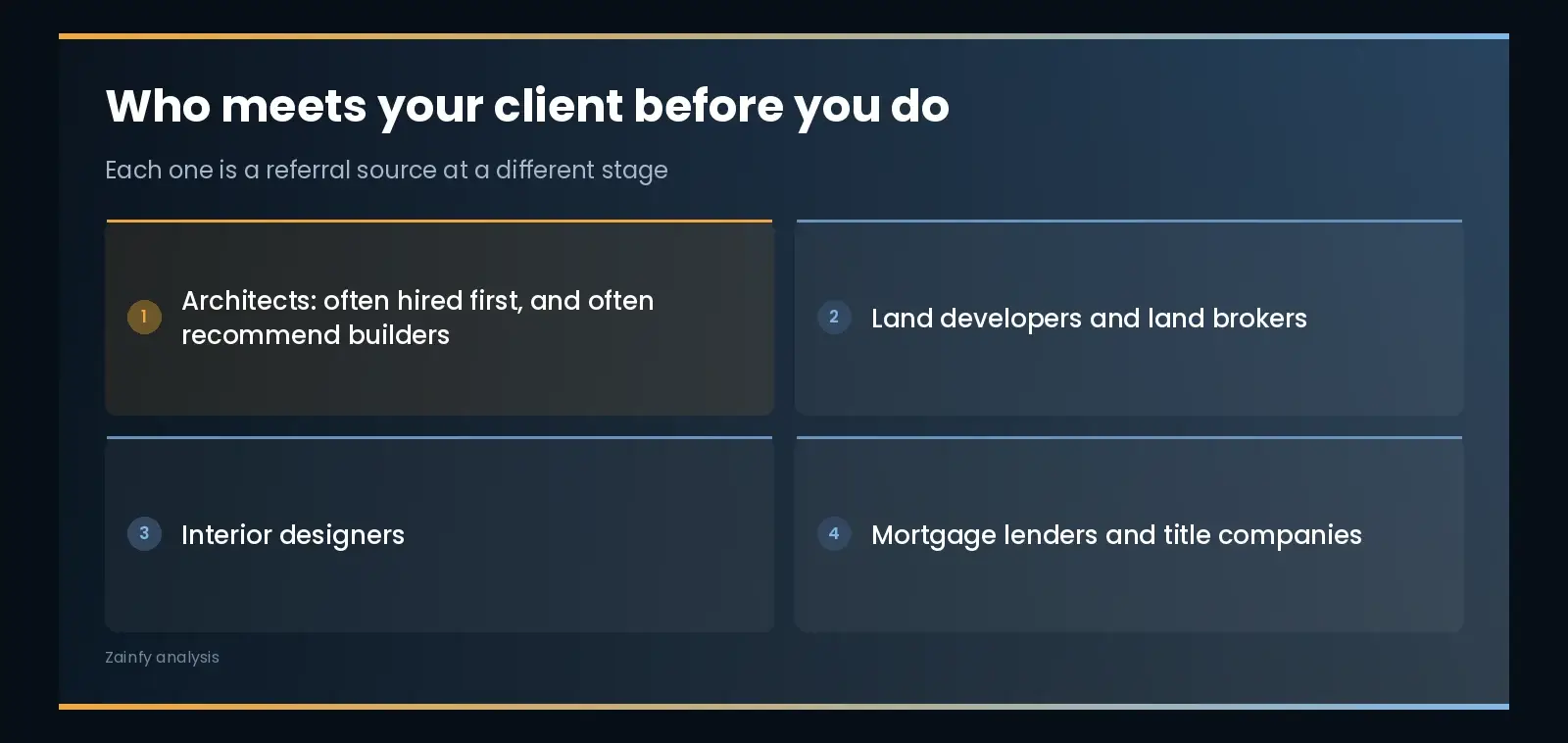
A custom client talks to several professionals before they talk to a builder. Each of those people is a referral source, and each one meets the client at a different stage.
Architects. On a designed custom home, the architect is often hired first and frequently recommends builders, or runs the bid process. A builder who architects trust gets invited to bid on projects the public never sees. Start by asking two local residential architects what they look for in a builder, then send them photos of a finished project that matches their style.
Land developers and land brokers. They know who just bought a lot and needs a house on it. A short list of builders they’re comfortable recommending is worth more than a year of advertising. Let them know which lot sizes, price ranges and areas you build in, so their referrals fit.
Interior designers. On higher-end builds, designers are often involved early and have strong opinions about which builders handle finishes well.
Mortgage lenders and title companies. Construction lenders see clients at the financing stage, which is one of the four conditions. Lenders who know your process and your track record can point approved borrowers your way. A clean draw schedule and on-time inspections are what earn a lender’s trust, more than any pitch.
Local home builders associations. Membership puts you in the room with the lenders, suppliers, designers and developers above, and many associations run events that bring them together.
The Parade of Homes. NAHB offers a Parade of Homes toolkit for local associations, and Parade events put finished homes in front of motivated visitors. Entry costs are real, so they suit builders with a recent, representative home to show.
Every one of these sources is a relationship, and relationships take time to build. They also explain why general advertising rarely works for custom builders: by the time a client is searching, one of these people has often already given them names. A general contractor’s referral network looks different, because it serves both homeowners and other businesses, and it’s worth understanding a general contractor’s B2B and B2C split if you take on both kinds of work.
Nobody publishes where new-home buyers actually find a builder, and the index everyone quotes does not measure you
There’s no named institutional source that publishes where custom home clients find their builder, whether by referral, search, architect, lender or anything else, and the one channel-of-origin figure in circulation for new-home buyers is agency-authored and undated, so it can’t be relied on. The closest honest data comes from NAR’s 2025 Profile of Home Buyers and Sellers: 88% of buyers purchased through a real estate agent, and 16% bought a newly built home. That survey covers homes bought in a market transaction, though, and a custom home built on the client’s own land mostly falls outside it, so even the best data available describes a different buyer. The second correction concerns a number builders often hear quoted as a sign of where design work is heading: the AIA/Deltek Architecture Billings Index, which read 46.6 in July 2026, below the 50 mark that separates growth from decline. It’s a useful index, but its sectors are commercial and industrial, institutional, multifamily residential and mixed practice. It doesn’t track single-family custom homes at all, so a falling or rising ABI tells a custom builder very little about the architects who design single-family work in their town. The honest position is that nobody has measured where your clients come from, and the only way to know is to ask each one and write it down.
Custom home builder marketing you can afford with four employees
Where should you focus first if you have limited resources? Here’s where the size of the firm becomes the deciding factor. No public source publishes how much a home builder should spend on marketing, so the useful limit is people rather than a percentage.
Custom work is high-value. The Census Bureau’s construction data put the median contract price of a contractor-built home at $404,000 in 2025, excluding land, and about 37% of custom homes started that year were above $500,000. One client relationship can be worth a year of revenue for a small firm.
But a firm averaging four employees can only hold so many relationships at once. That shapes what’s affordable.
A model home or Parade entry can be a five-figure commitment before anyone walks through the door. For most small firms, a recent client’s home, shown with permission, does a similar job at a fraction of the cost.
Portfolio and project photography pays off everywhere. Architects, lenders and clients all want to see finished work, and good photos are reused for years.
Jobsite signage costs little and reaches the neighbors of current builds, who are often the next lot buyers on the street.
A steady review process matters because every referral source and client will check your reputation online before they call.
Sorting inquiries by lot status is the most useful habit of all. Ask every inquiry whether they own land, are under contract on land, or are still looking. Those three answers sort your calendar better than any lead score. Follow with two more questions: whether they’ve spoken to a lender about construction financing, and when they’d want to start. A lot owner with a lender and a start date is worth a meeting this week. Someone still looking for land is worth a follow-up call in a few months.
What a small firm usually can’t afford is the full production-builder stack: paid advertising aimed at broad audiences, a sales team, and a model home in every community. Choosing what to add as the business grows is a sequencing decision, and it helps to know what a firm your size should add next before you commit money to the wrong layer.
The current market adds pressure. NAHB’s Housing Market Index for new single-family homes fell to 29 in October 2026, its lowest reading since June 2012, as higher mortgage rates and construction costs kept buyers on the sidelines. In a market like that, the builders with relationships keep working. The ones relying on traffic feel the slowdown first.
Don’t market a custom build the way a production builder markets a subdivision
A subdivision campaign sells available homes to strangers at the moment they search. A custom build sells a year-long working relationship to somebody who already owns the ground.
Run the first play on the second market and you fill the calendar with people who have no lot, no construction financing and no intention of waiting a year. Then the channel gets blamed, when the real problem was a mismatch between the campaign and the client. The fix is cheaper than a new channel: change who the message is for.
If you advertise at all, advertise to the professionals who meet your clients first, and to people who already own land. Every other dollar is competing with production builders for buyers who were never yours. The builders who do well in custom work usually spend less on advertising than you’d expect and more time with the handful of people who send them clients.
How do custom home builders get clients?
Custom home builders get most of their clients through people who meet the client first: architects, land developers and brokers, interior designers, construction lenders and local home builders associations, plus referrals from past clients. Because a contractor-built home takes about 12 months from permit to completion, the relationship usually starts long before any search.
Public building permit data from the Census Bureau shows how many new single-family homes are authorized in each metro, which is the best free measure of the market’s size. No institutional source publishes where custom clients find their builder, so the most reliable method is to ask every client and track the answers. Qualify every inquiry on lot ownership and financing first. Expect this kind of marketing to take months to show results, because the build cycle itself runs about a year.
Pull your own metro’s single-family permit count from the Census Bureau’s annual files for the last two years, and write both numbers down with the date you pulled them. Next to them, write how many of your last ten projects came through someone the client had already paid, an architect, a lender, a designer or a land broker, before they paid you. The gap between those two columns is the custom home builder marketing question in your market, and you’re the only one who can measure it.
Figures checked against the linked Census, NAR, AIA and NAHB sources on November 10, 2026.