The difference between exclusive vs shared leads for contractors comes down to time. A shared lead runs on a clock the platform publishes: for a few hours, you’re one of a small number of contractors the homeowner can reach, and then the limit lifts. An exclusive lead runs on no published clock at all. Not one vendor we checked publishes how long an exclusive lead stays exclusive.
If you’re weighing exclusive contractor leads against cheaper shared ones, that gap matters more than the price difference. When you pay extra for exclusivity, you’re paying for time with the homeowner and nobody else in the conversation. If the seller won’t say how much time that is, you can’t tell what the premium buys.
This guide reads the vendors’ own published terms instead of their sales pages, and asks one question of each: how long is the lead actually yours?
How many contractors does one lead go to?
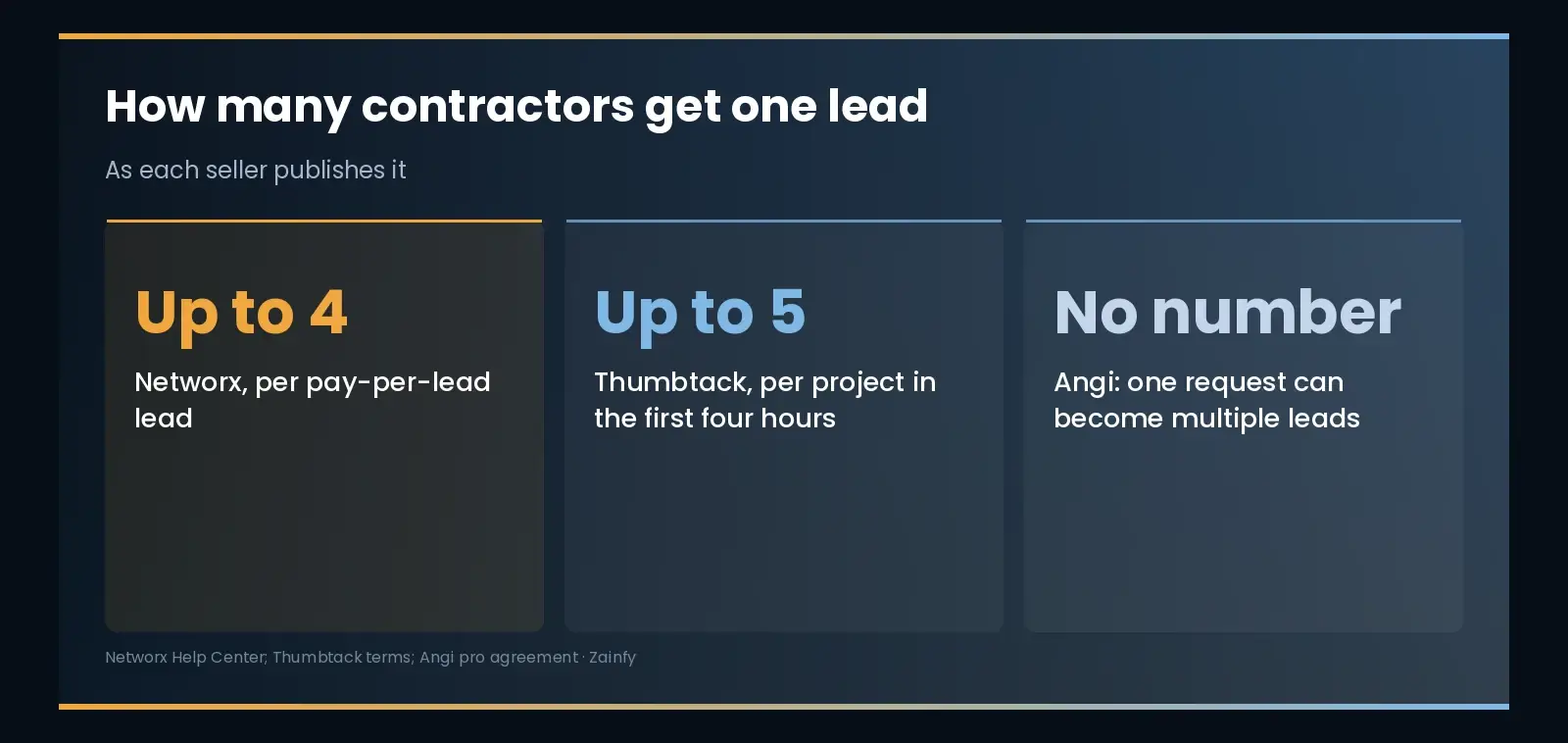
It depends on the seller, and the published answers are four, five or no number at all. Networx says a single pay-per-lead lead goes to up to four contractors. Thumbtack lets a homeowner contact up to five pros per project in the first four hours. Angi’s pro agreement says a lead is “frequently” sent to several pros and publishes no limit.
What are exclusive leads, and what does “exclusive” actually cover? Here’s the correction most buyers need. Exclusivity restricts the seller, and only the seller. An exclusive lead means the seller won’t sell that homeowner’s request to another contractor. It doesn’t stop the homeowner from calling three other remodelers, filling out a form on another site, or asking a neighbor for a name. Networx defines exclusive leads as “leads that are sent to you and no one else,” which describes who receives the lead from Networx, and nothing about what the homeowner does next.
Angi’s own SEC filing shows how one request becomes several sales. It defines a lead as a connection resulting from a homeowner’s service request and notes that “a single Service Request can result in multiple Leads.” In its third-quarter 2026 results, Angi reported about 4.5 million leads from roughly 4 million service requests (>Angi investor relations), so on average each request was sold more than once. Those are platform-wide figures across all home services, and they describe how Angi’s marketplace works rather than how much remodeling demand there is.
The count is the first thing to check before buying from any seller, and it’s worth comparing the number of buyers one inquiry is resold to across the smaller lead companies too.
The shared model runs on a clock, and the platform publishes it
Does Thumbtack share leads? Yes, within limits, and it’s the clearest example. Its quality commitment terms say “customers can contact no more than five pros from search results per project within four hours of making their first contact.” The next sentence is the one that matters: “After four hours, customers can contact additional pros.”
So the cap expires. For four hours, you’re competing with at most four other pros on that project. After that, there’s no limit. A shared lead is worth the most in its first hour, and its value drops once the window closes.
Thumbtack’s terms add three sentences worth knowing before you buy. It says plainly that it can’t promise customers will answer when you call. It says “the faster you respond, the better your chances,” without putting a number on how much. And it won’t refund a lead because the customer hired someone else.
That’s the trade a shared lead offers: a lower price for a shorter, crowded window. Price is only half of that trade, and it’s worth reading each vendor’s published billing basis alongside the clock before deciding a shared lead is cheap.
The exclusive model publishes no clock at all
So how long does an exclusive lead stay exclusive before it can be resold? We searched the published terms for any rule about how long a lead stays yours. Here’s what turned up.
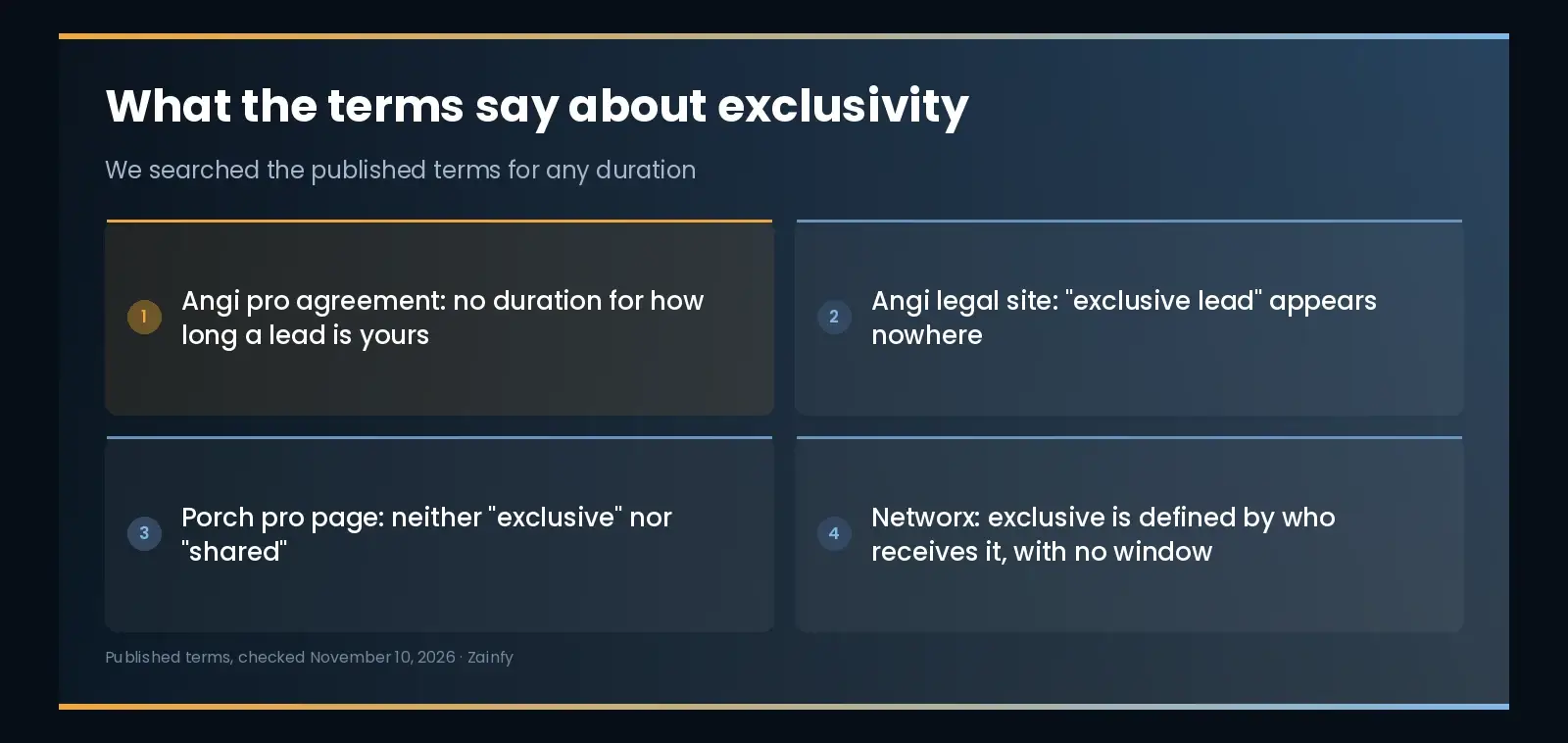
Angi’s pro agreement. The contract and its add-on terms contain no duration that governs how long a lead belongs to the pro who bought it. The only time references cover termination notice, billing, disputes and breach notices.
Angi’s legal site as a whole. The words “exclusivity” and “exclusive lead” don’t appear anywhere in Angi’s published legal documents. The contract states the opposite in plain terms: “Angi is free to contract with other Pros as this is not an exclusive contract.”
Angi’s competition limit. Angi says it limits the number of pros on a lead, and also that you “may be competing against other Angi Approved Pros or non-approved pros.” The limit itself isn’t published.
Porch’s pro page. Neither “exclusive” nor “shared” appears on it.
Networx. It defines exclusive leads by who receives them, with no window, expiry or duration attached.
An absence you’ve searched for is a fact. An absence you’ve assumed is a guess. This one has been searched for.
Exclusive vs shared leads for contractors are both process purchases
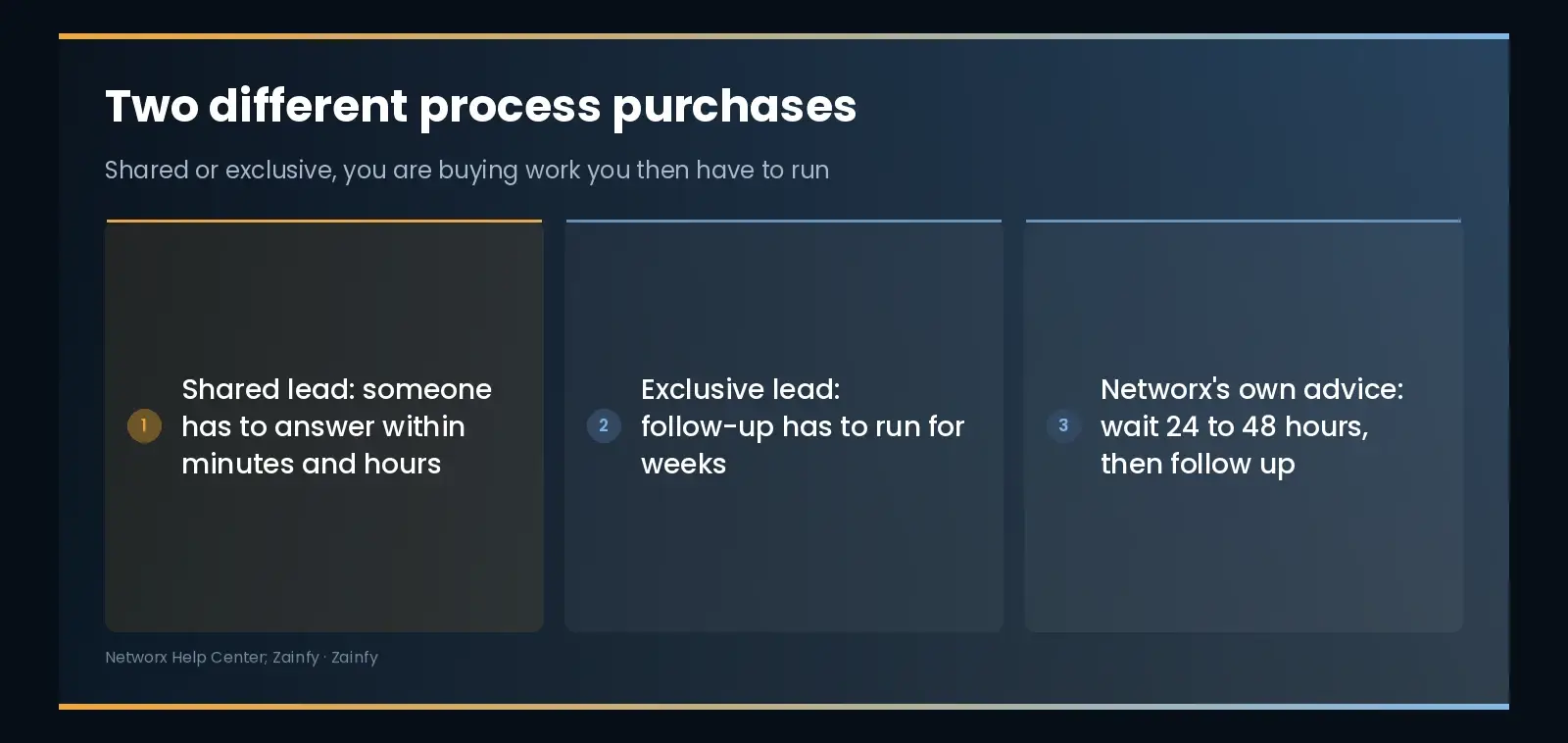
Buying a lead, shared or exclusive, means buying a process you then have to run, and the two models demand different parts of it. A shared lead needs someone who can answer fast, because the window that matters is measured in minutes and hours, and the four-hour Thumbtack cap shows the platform knows it. An exclusive lead needs someone who can follow up for weeks, because without a competitor in the conversation the risk shifts from losing the race to letting the homeowner drift. Networx, a seller of both, puts a number on that second job in its own help center: “If you do not hear from them right away, wait 24-48 hours to follow up on your conversation.” That’s a nurture interval, and it’s the only vendor-published follow-up interval we found, which tells you what the seller expects you to do with an exclusive lead after the first call goes unanswered. If nobody in your business owns that follow-up, the exclusivity premium is buying time you won’t use, which is why the decision to buy leads at all looks different for contractors doing their own selling.
What an exclusive lead is on day thirty-one
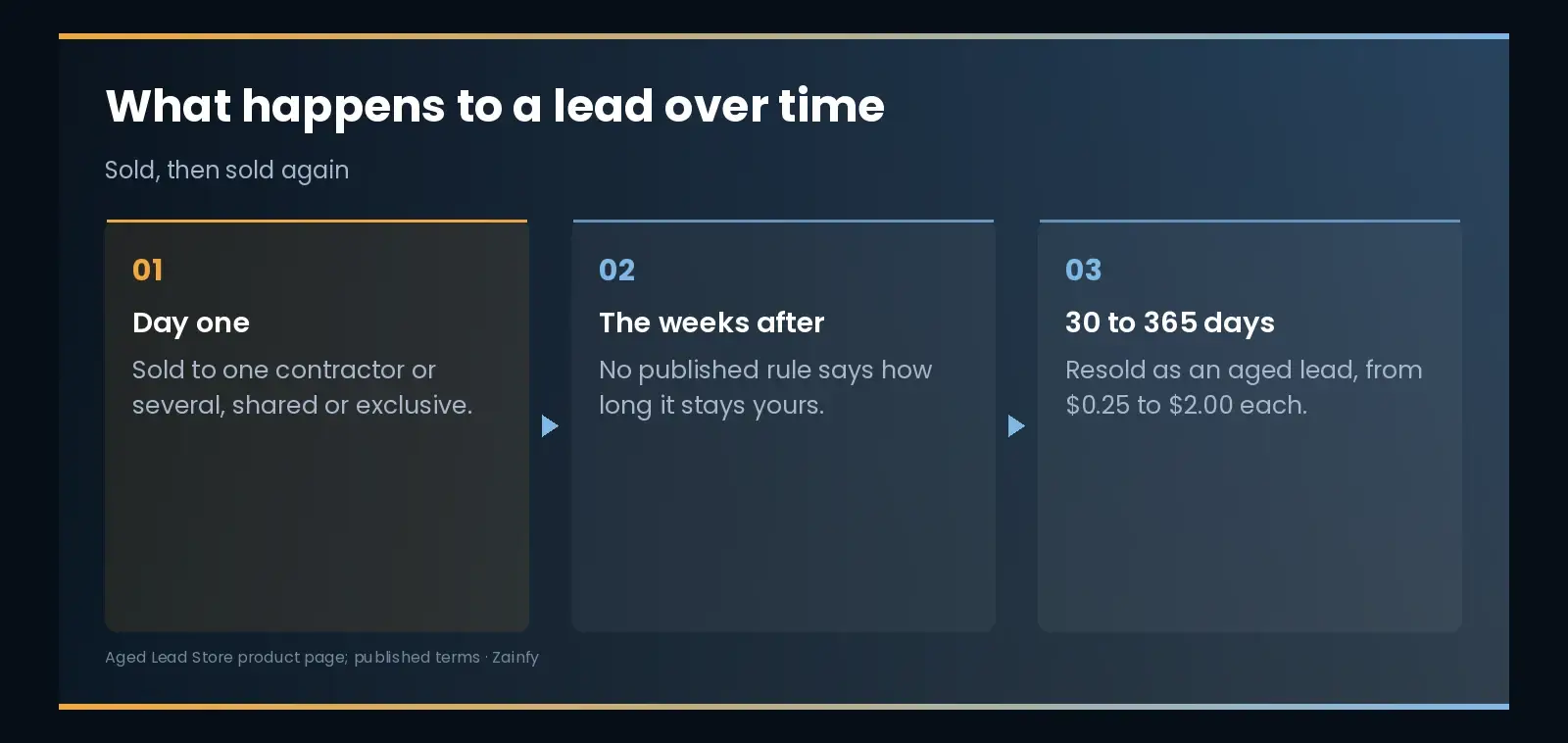
What are aged leads? An aged lead is a homeowner’s request that’s been sold before and is resold later, after weeks or months, at a much lower price. Sellers of aged leads say so openly. One describes its product as “shared Internet leads” and pitches aged leads as “massive savings vs exclusive ‘hot’ leads,” and its published prices start at $0.25 a lead for requests 91 to 365 days old (>Aged Lead Store).
Now compare that with what an exclusive lead promises. If the seller doesn’t publish how long exclusivity lasts, nothing in the terms says the request can’t eventually turn up in an aged-lead list. The exclusive lead you bought last month and the aged lead someone else buys next quarter can be one homeowner. That doesn’t mean any particular seller does this. It means the published terms don’t rule it out, and a buyer should ask in writing.
Don’t buy exclusivity you have nobody to work
Don’t buy exclusive leads without a follow-up system that runs for weeks.
You’re paying a premium for the one thing a shared lead doesn’t give you: time with the homeowner and nobody else in the conversation. If that homeowner gets one call on Tuesday and nothing after, you paid for the time and threw it away.
Shared leads punish a slow phone. Exclusive leads punish a short memory.
Open your lead provider’s terms page and search it for the word “exclusive.” Then search it for a number of days. Write down which one you found, and the date you checked, because these pages change without notice, and one provider has already pulled its pricing off the public web entirely. If the word is there and the number isn’t, ask for the number in writing before your next renewal.
Terms read from Thumbtack, Networx, Angi, Porch and Aged Lead Store published pages and Angi’s SEC filings; current as of November 10, 2026.