Of the four contractor lead companies most often pitched as pay-per-lead alternatives to Angi, two will let you read their terms before you sign and two won’t. Porch publishes its pro terms on a public page. Networx publishes its pricing examples, its distribution cap and its credit policy in a public help center. Modernize and CraftJack publish nothing a contractor can read on a public page before handing over a card.
That split matters more than any feature list. When you sign up with a lead company, you’re agreeing to a contract that decides what you pay for, how bad leads are handled and how you get out. If you can’t read that contract first, you’re buying blind.
This guide sorts the four by how much paperwork each lets you see, then reports what that paperwork actually says. It names prices only where the company itself publishes them.
What you are actually looking for before you sign
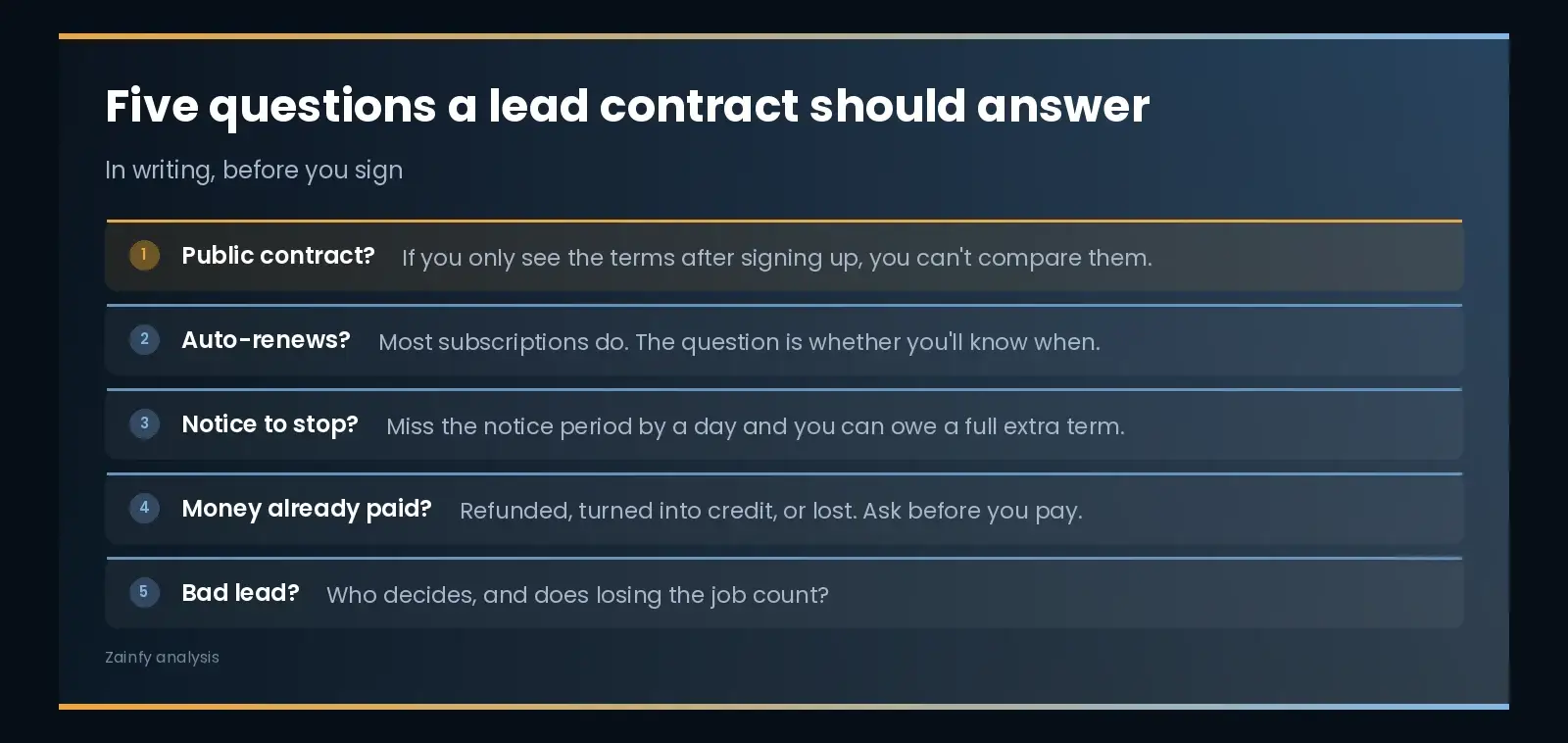
Before judging any of these contractor lead companies, know what you’re checking for. A contract worth signing should answer five questions in writing.
Is there a contract at a public URL? If you can only see the terms after signing up, you can’t compare them.
Does it auto-renew? Most subscriptions do. The question is whether you’ll know when.
How much notice does it take to stop? A notice period you miss by a day can cost you a full extra term.
What happens to money already paid? Prepaid budgets and credits can be refunded, converted to credit, or simply lost. Ask about refunds before you pay.
What counts as a bad lead, and who decides? A credit policy that excludes “you didn’t win the job” means you carry the cost of losing, every time.
Score each company on these five before you take a sales call, and write the answers down with the date you found them. A company that answers all five on a public page has already told you something about how it treats contractors. Whether a lead is shared or exclusive belongs on this checklist too, as one term among five, because it changes how many competitors you face on each lead.
Angi and HomeAdvisor share one contract, and Thumbtack has its own. Those three are the usual reference point, and their terms are worked through in how Angi and Thumbtack’s own contracts treat a remodeling job. This guide covers the four companies contractors get pitched next.
Networx publishes its price, its cap and its refusals
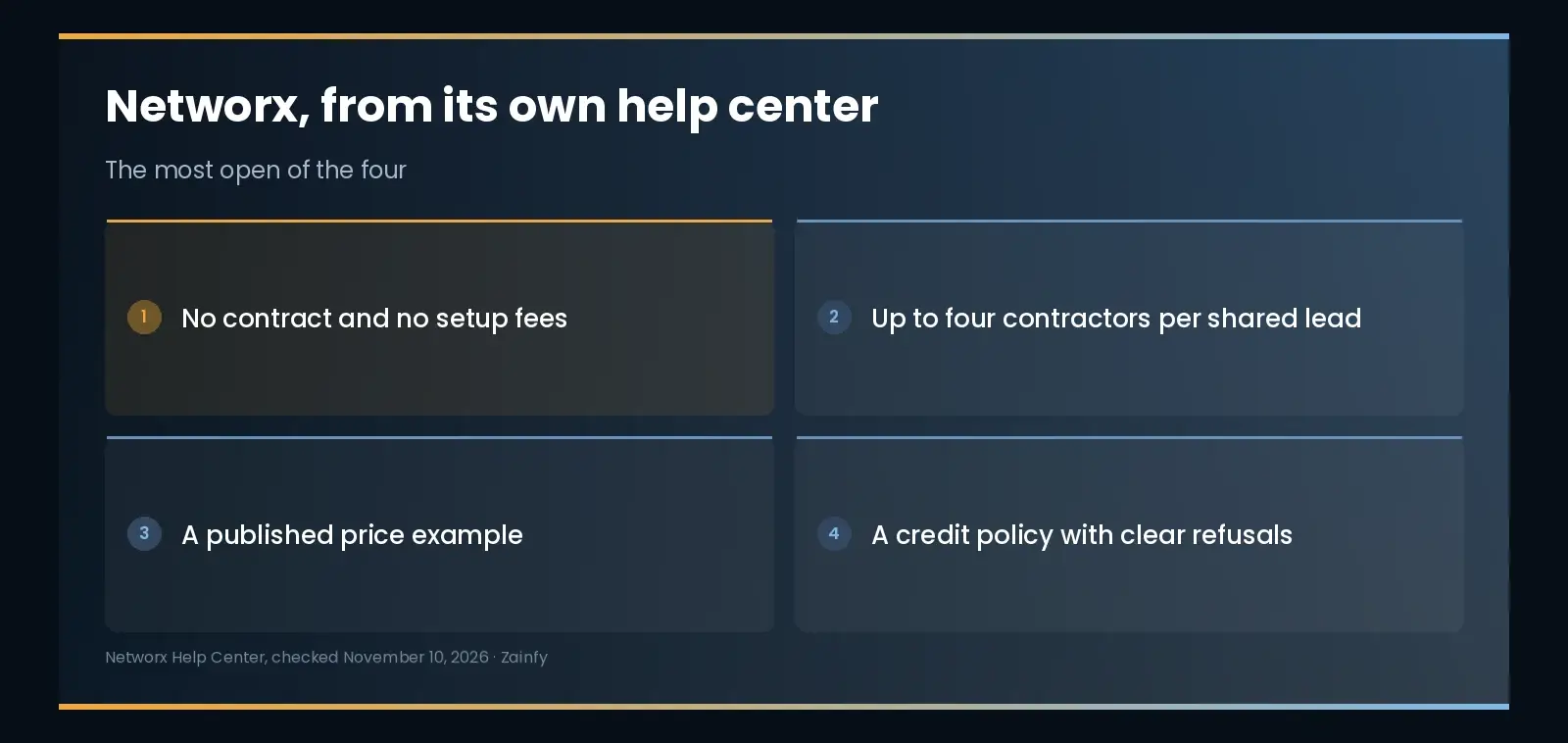
How much does Networx charge for leads? It’s the most open of the four on that question, and its help center answers most of the five questions directly.
No long contract. Networx says it doesn’t require a contract and charges no setup fees.
Up to four contractors per shared lead. Its help center states that “a single Pay Per Lead will go to up to 4 contractors in total” (>Networx).
A published price example. For exclusive leads, Networx gives a worked example: “Concrete lead = $58 per lead. To receive 10 leads per month, $58 x 10 = $580 prepaid budget” (>Networx). Its older pricing article, dated June 2023, gives ranges of $10 to $100 or more per shared lead and $15 to $120 or more per exclusive lead. Those figures are Networx’s own and are three years old, so treat them as Networx’s historical range and nothing broader.
A published credit policy, with clear refusals. Networx’s >lead credit policy lists situations that don’t qualify, including “You did not win the job,” a homeowner who already hired someone else, and a homeowner who’s only shopping around. Credit requests must be made within 14 days of receiving the lead. And “all lead reviews and resolutions are final.”
Pausing has a catch. A lead that arrives within an hour of pausing your account isn’t eligible for credit.
None of this makes Networx cheap or expensive. It makes it readable. Networx is also the one company here selling both shared and exclusive leads, which raises a question this guide can’t settle on its own: how long an exclusive lead stays yours once you’ve paid the premium.
Porch will show you the contract. Read the exit clauses first.
Porch publishes its full >pro terms, effective October 23, 2025. They’re long, and the clauses that matter most are about leaving. Here they are in the order you’d hit them.
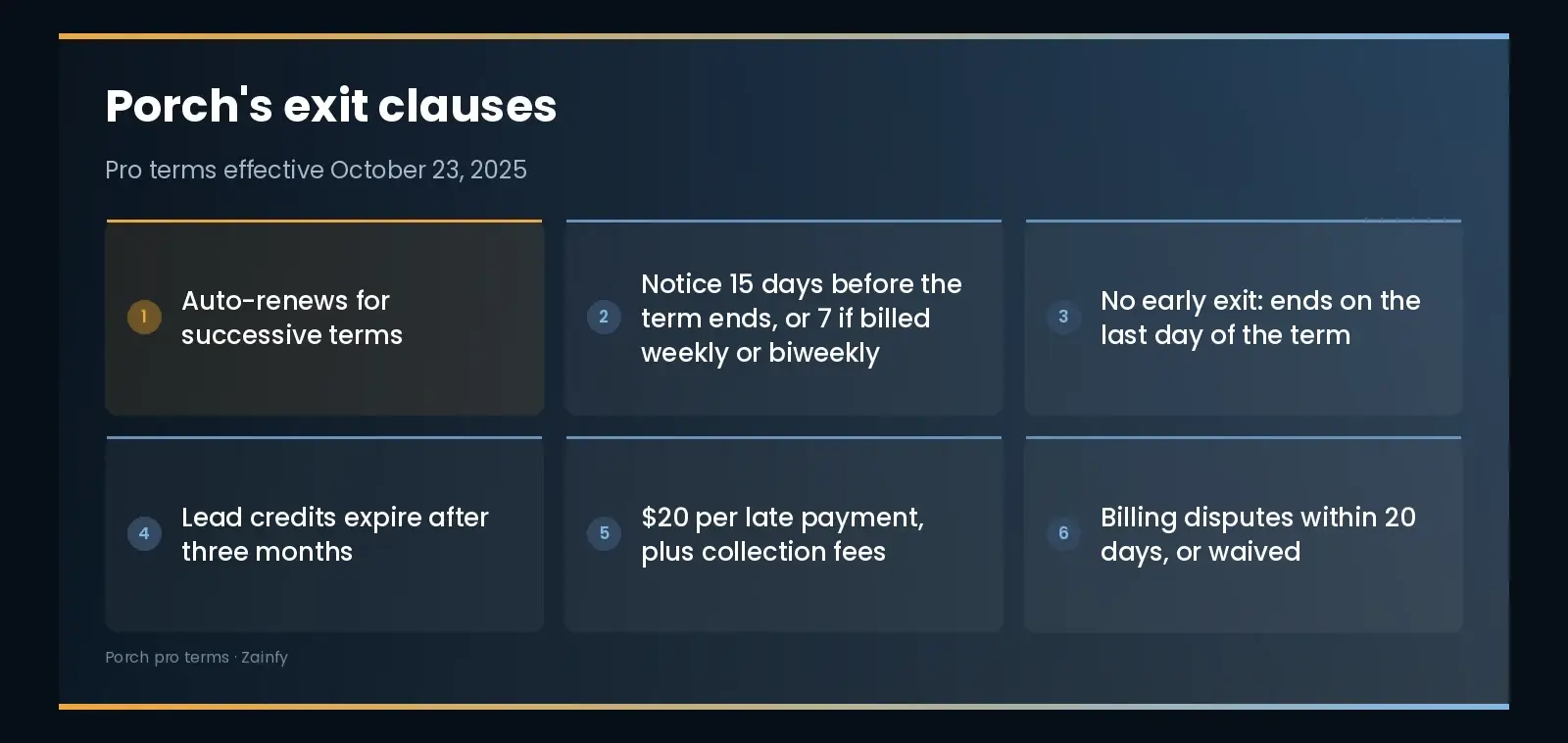
It auto-renews. Subscription products renew automatically for successive terms until you terminate.
Notice is 15 days. To cancel Porch Pro, you must give notice at least 15 days before the current term ends, or 7 days if you’re billed weekly or biweekly. You can do it through the website, by phone or by email.
You can’t leave early. Termination takes effect on the last day of the current term, “not before such date.”
Refunds are rare. For project requests, “No refunds will be given.” There are exceptions: account credit for invalid or duplicate requests, a refund if you cancel a product within three days of its confirmation email, and a pro rata refund if Porch itself terminates for convenience.
Credits expire. Lead credits must be used within three months of issue, and expired credits aren’t refundable.
Late payments cost $20 each, plus collection and attorneys’ fees.
Disputes have a 20-day window. Billing discrepancies must be reported within 20 days of first appearing, or the right to dispute them is waived.
On competition, Porch’s terms say response opportunities on a project request are limited and allocated first come, first served, and that Porch “may impose limits on the type and/or number of Professionals” in particular programs. So the cap is admitted. The number isn’t published, and neither is a per-lead price, so the answer to how much Porch charges for leads is that its public terms don’t say.
Porch deserves credit for publishing all of this. Read the exit clauses before the sales call. Then put two dates in your calendar on the day you sign: the end of your first term, and the date 15 days before it. The second date is the one that matters.
The two that will not show you anything
This section reports a measurement rather than a verdict.
Modernize. Its website wasn’t readable at a public URL when we checked, returning an access-denied error to both automated and browser requests. Its terms for contractors weren’t readable anywhere public. The Better Business Bureau lists Modernize as accredited since January 9, 2024, and, as of November 10, 2026, >Not Rated, with the BBB noting the business is in the process of responding to previously closed complaints.
CraftJack. Its entire domain now redirects to Angi’s contractor sign-up page. Its own terms weren’t readable at a public URL when we checked.
Neither result proves that these two companies have no terms at all. They do, and you’ll see them after you sign up. It means you can’t read them before you sign, which is the only time reading them helps. If a sales rep from either company calls, ask for four things by email before agreeing to anything: the full contractor terms, the cancellation notice period, the refund and credit policy, and how many other contractors receive each lead. A rep who can’t send those in writing is selling a contract you haven’t seen.
Three of these four answer to somebody else
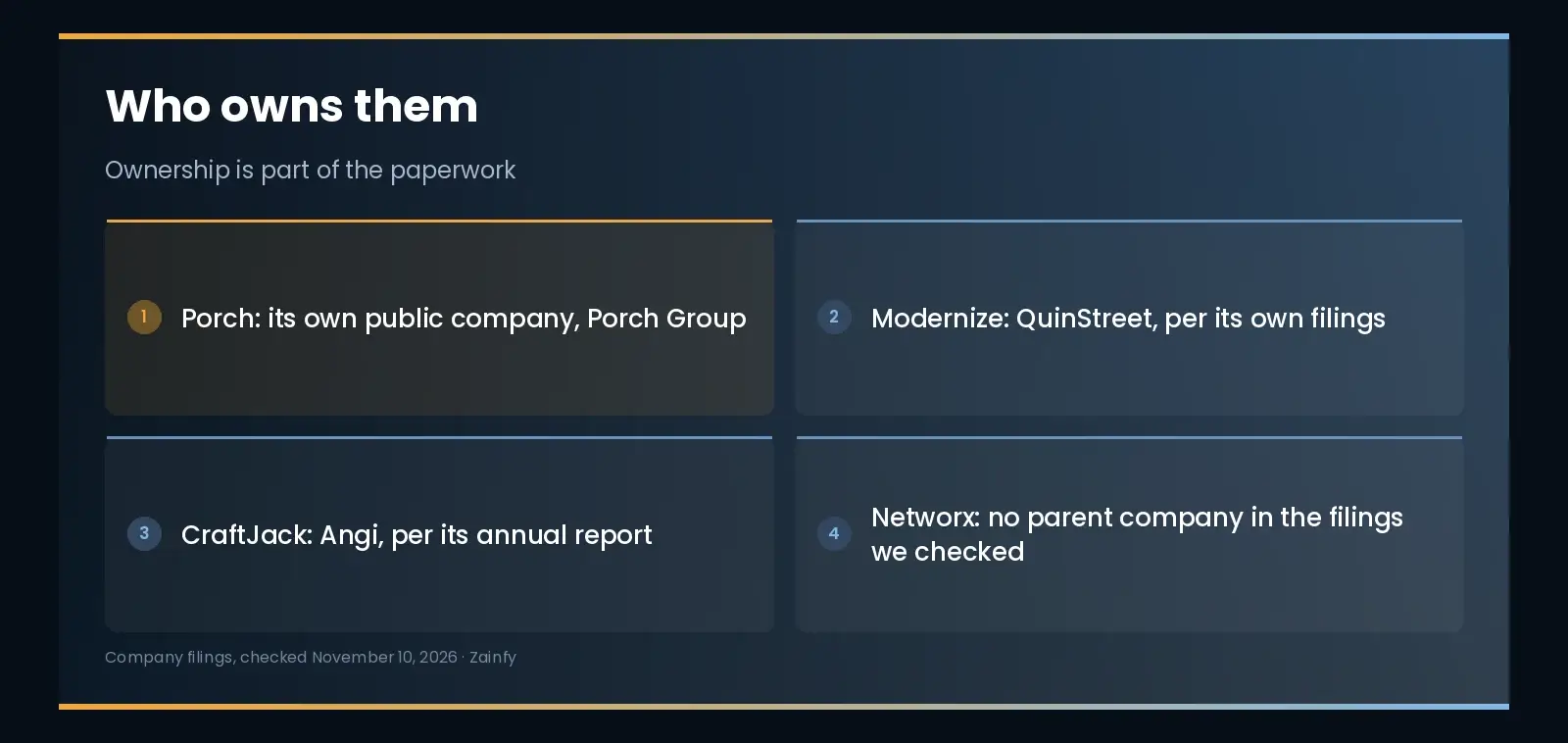
Ownership is part of the paperwork, and it’s rarely on the sales page: Porch is its own publicly traded company, Porch Group; Modernize belongs to QuinStreet, a publicly traded performance-marketing company, according to QuinStreet’s own filings; CraftJack belongs to Angi, listed among Angi’s subsidiaries in its annual report, which means a contractor leaving Angi for CraftJack may be signing with one parent company under another name; and Networx shows no parent company in any of the filings we checked. The quiet result is that the only independent operator of the four is also the only one that publishes a price example and a full credit policy. That’s worth knowing before you treat these companies as genuinely separate options. If you’re leaving one marketplace because of how it handles leads, check who owns the next one first. Ownership also changes over time, so check again at each renewal.
What you still can’t work out about contractor lead companies before you sign
Even after reading everything that’s public, three of the four can’t be fully judged in advance.
Porch publishes its contract but no per-lead price and no number for its competition limit. You can judge how to leave it but not what each lead will cost.
Modernize and CraftJack publish nothing you can read before signing, so there’s nothing to judge.
Networx publishes the most, but its price ranges are three years old and belong to Networx alone. They don’t tell you what any other company charges.
So the honest position is that the only fully evaluable option is the one that publishes the most, and even its numbers need checking against your own results. Every other choice comes down to a sales conversation and a contract you see after committing. If you go ahead anyway, treat the first 90 days as a test: log every lead, mark which ones were real projects in your service area, and note how many turned into estimates. That log is what should decide whether you renew.
That’s the point where many remodelers stop comparing lead companies and look at the routes that let you see the whole cost up front, where you set the budget, own the account and can read every charge.
If you do sign with one, ask for the full terms in writing before giving a card number. A company that won’t send them has answered the question for you.
Don’t sign one to find out what the terms are
Don’t sign with a lead company to find out what its terms are.
It’s tempting, because signing up is fast and reading takes time. But once you’re in, you’re bound by whatever notice period, refund policy and credit rules the contract sets. With Porch, that can mean waiting out a term you can’t end early. With companies that publish nothing, it can mean anything.
If the terms aren’t public, ask for them before the sales call ends. If the company won’t send them, that’s your answer.
How do I cancel my Networx account?
Networx says it doesn’t require a contract and charges no setup fees, so there’s no fixed term to wait out. Contact Networx support to cancel, and pause your account first if you want leads to stop right away. Leads that arrive within an hour of pausing aren’t eligible for credit.
Before you leave, submit any credit requests you need, because Networx only accepts them within 14 days of receiving each lead, and its reviews are final. Ask in writing what happens to any unused prepaid budget. If you’re comparing exit terms, Porch requires 15 days’ notice before the end of a term and doesn’t end a subscription early.
Pull up the sign-up confirmation from every lead company you pay. For each one, find the cancellation notice period, the refund rule and the credit deadline, and write them on one page with the dates. If you can’t find all three for a company, ask for them this week, before the next renewal makes the decision for you.
Terms read from Networx’s help center, Porch’s pro terms (effective October 23, 2025) and the BBB, and checked November 10, 2026. Modernize and CraftJack terms were not readable at a public URL on that date.