Ask what a contractor marketing agency does and the answer arrives as a verb. Get found. Build trust. Generate interest. Support growth.
Those are ambitions. They are not the contents of a month.
A month contains two quantities: working time, and the things created, changed, recorded, or decided during that time. Some of the work leaves an object you can open. Some of it leaves only a judgment: an idea rejected, a fault corrected quietly, an earlier change left alone long enough to be understood.
That work cannot be reduced to a tidy shopping list. It can still be described. Agencies often use that truth to avoid the obligation.
For a remodeling owner paying a recurring invoice, the distinction matters. “Improve visibility” can remain true forever without telling him what happened this month. A published item, a rebuilt asset, a written finding, and a recorded decision have edges. They give the month a shape before anyone argues about results.
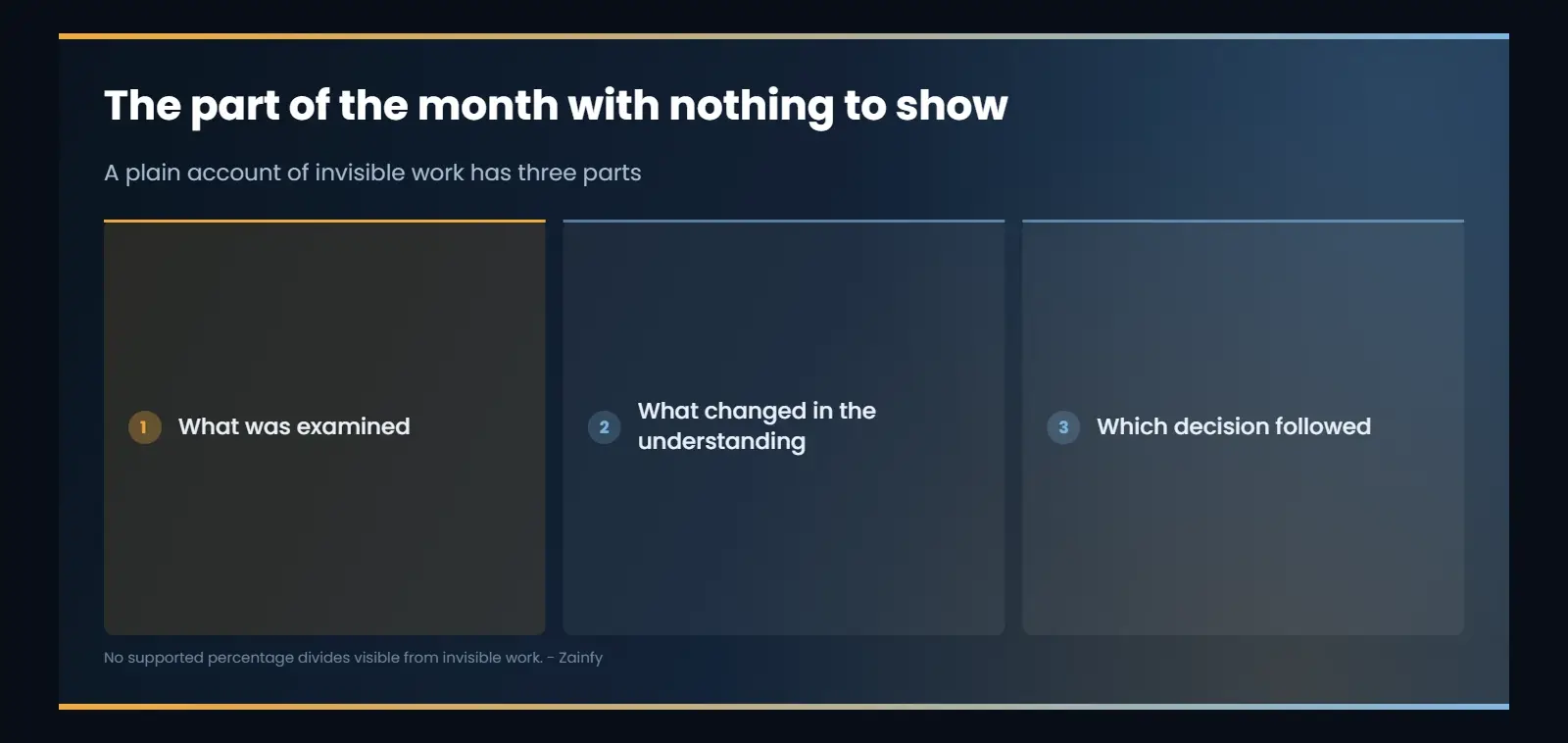
Get found. Get trusted. Get shortlisted.
The current answers are written in outcomes. One page defines a contractor marketing agency through visibility, leads, engagement, and growth. Another says the agency helps construction firms get found, trusted, and shortlisted before a bid. A third explains what good construction marketing looks like through positioning, project stories, and buyer understanding.
Each answer may be reasonable. None uses the unit the contractor is buying: one working month.
The longest page makes the mismatch easiest to see. Its named audience is commercial general contractors, MEP, concrete, steel, design-build, civil, and infrastructure firms with long sales cycles and several decision-makers. It is a detailed answer for companies pursuing bids and procurement shortlists. A Kalamazoo remodeler with a small crew and residential buyers operates a different business.
The form of the answer is the issue. Outcome verbs point in a direction without reaching an edge. Service categories name departments of work without saying what occupied the month. Even a thoughtful explanation can leave the owner unable to finish one sentence: “At the end of this month, these things will exist that do not exist now.”
That missing unit is why a long answer can still feel evasive to the person paying for recurring work.
That sentence does not promise a lead, ranking, or signed job. It describes the service. Results remain uncertain; the work should not.
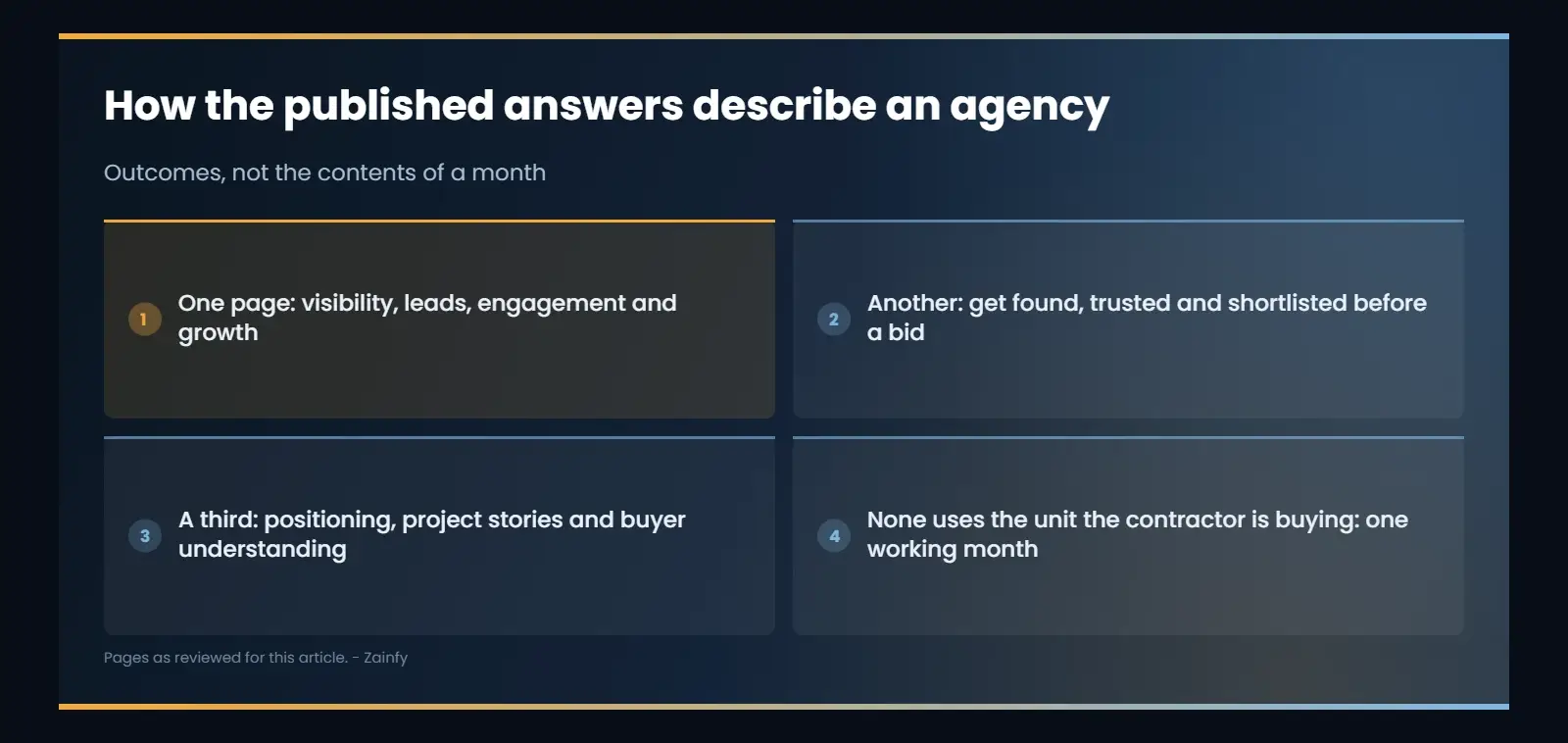
A month is hours and a short list of things
Start with the hours. Not a fabricated benchmark or an ideal number, only the working time available inside the service. Every meeting, correction, review, draft, decision, and piece of production spends from that finite amount.
Put the artifacts beside it. Something may be published. An existing asset may be rebuilt. Project information may be organized into material that can be used. Findings may be written down. A technical fault may be corrected. A weak idea may be killed before it consumes the rest of the month.
These are kinds of work, not a procedure. Their order changes. Some months carry more production; others carry more investigation or repair. A list that never changes is not more accountable merely because it is predictable.
Hours without artifacts can become effort nobody can locate. Artifacts without hours can become production nobody has thought through. The two quantities belong together. Time explains the constraint. Named things explain what changed inside it.
There is room for revision. An agency can name the intended work before the month begins and change it when evidence justifies the change. The revision itself should be describable: what displaced the original item and why. Accountability does not require pretending the month can be predicted perfectly. It requires ordinary nouns sturdy enough to show what the service contained.
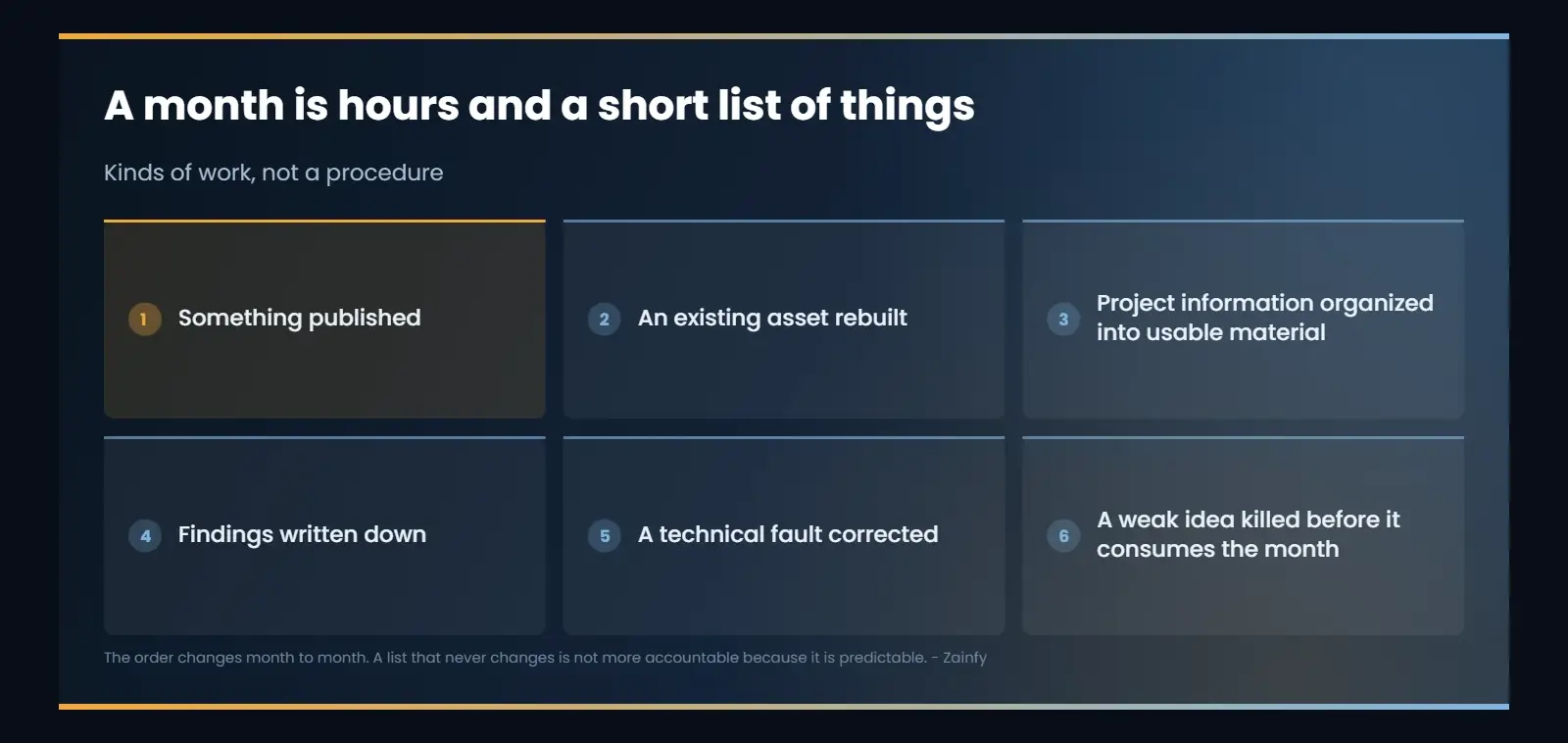
The part of the month with nothing to show
Good agency work often produces nothing you can look at. Someone reads what happened, discovers an attractive idea is weak, checks whether an earlier change held, finds a quiet fault, or decides that more production would add noise. That labor is easy to punish because it does not increase the visible pile. A client counting only finished pieces will push the agency toward making something whether the business needs it or not. The correction is not a longer report or a new dashboard. The invisible work needs a plain account: what was examined, what changed in the understanding, and which decision followed. “Strategy” is too broad if it hides all three. Understanding the weekly work behind a Kalamazoo feed requires the material people see and the judgment deciding what deserves to be made. One side leaves an artifact. The other leaves a reason. Neither is allowed to borrow the other’s name. A written finding is not a published piece; a published piece is not evidence that the right decision preceded it. The month becomes credible when visible production and invisible judgment can be described separately, including the work deliberately not done. Restraint counts only after its reason has been stated.
One county is enough territory to name
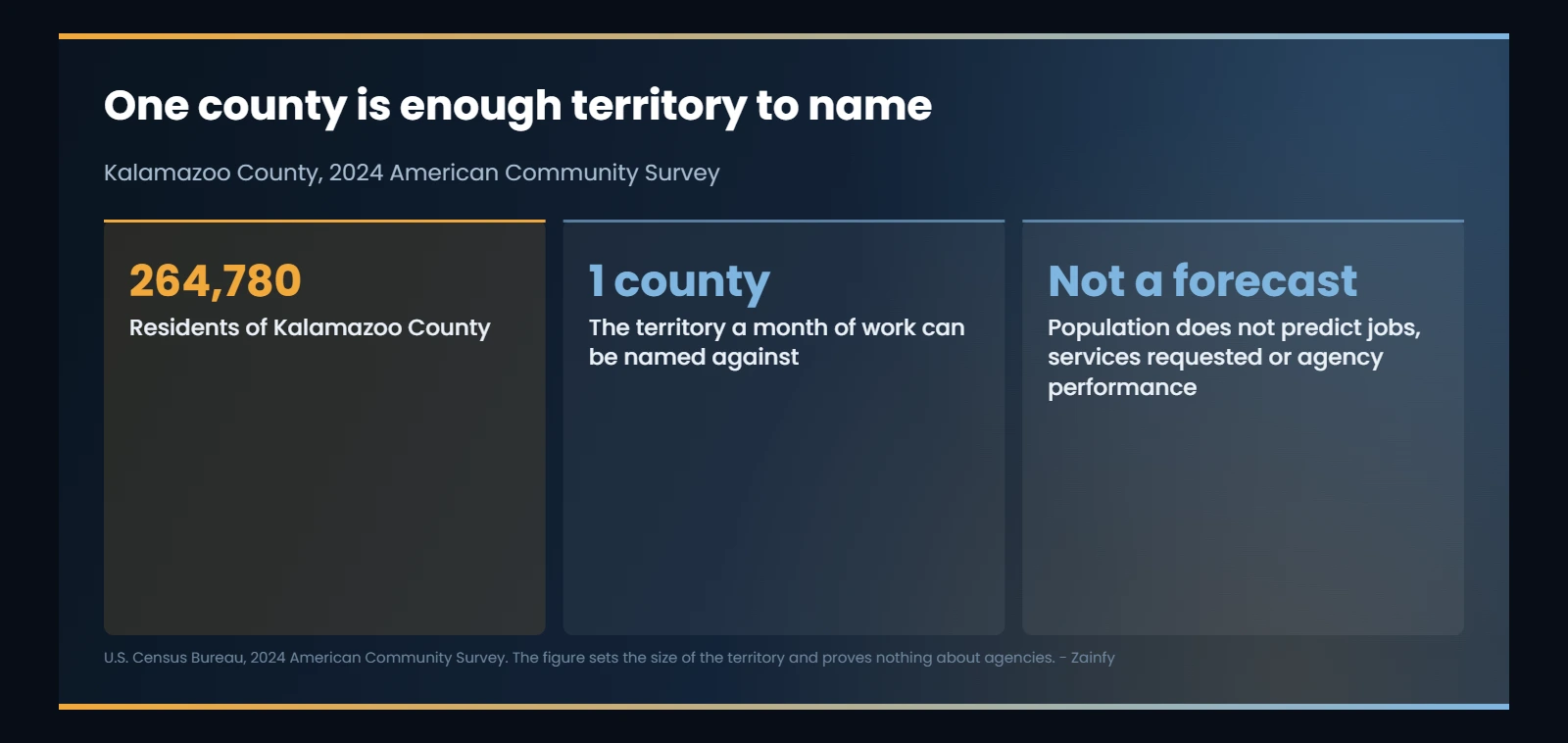
Kalamazoo County had 264,780 residents in the 2024 American Community Survey. The figure sets the size of the territory and proves nothing about agencies.
It does remove one excuse for abstraction. A remodeling company serving one county does not need a month described for every contractor, trade, and buyer in the country. The work has somewhere definite to stand.
Published material has an identifiable local reader. Research concerns services and questions that arise inside a known working territory. Corrections address gaps the contractor can recognize. An idea can be declined because it belongs to another market, another audience, or another kind of construction company.
The county is not a forecast. Its population cannot tell an owner how many jobs will arrive, which service will be requested, or whether an agency performed well. It makes the work finite enough to describe without retreating into “awareness” and “growth.”
A national agency page can speak entirely in outcomes because no single place holds it accountable. A Kalamazoo month cannot use that altitude. The territory is one county. The work should be close enough to the ground to name.
Nobody could describe it, including us
Do not pay for a month nobody could describe before it began.
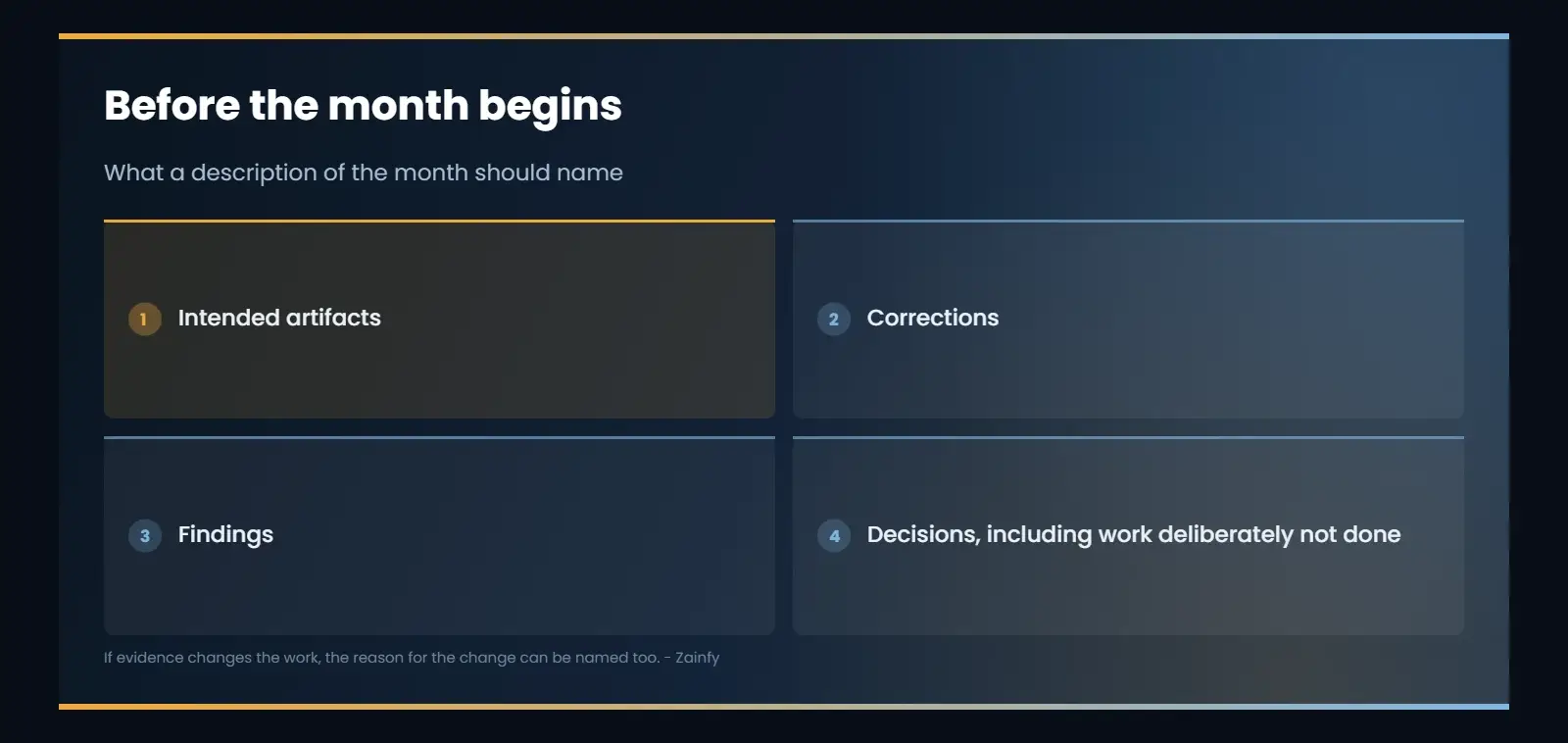
The description does not need to predict every task. It should name a small set of intended artifacts, corrections, findings, and decisions. If evidence changes the work, the reason for the change can be named too. “We stay flexible” is not a substitute for an empty month.
This applies to our agency as much as any other. Agencies answer in verbs because a verb has no natural stopping point. Improve. Grow. Optimize. Support. Each can absorb activity for years without admitting what occupied Tuesday.
A named thing has an edge. It exists, changes, gets delayed for a stated reason, or is replaced by work judged more important. Invisible labor can be named without pretending it produced an object.
When neither side can describe the visible or invisible work, the recurring payment has become a subscription rather than a service. The owner is paying for continuity. The agency is supplying motion. A nameable month is stricter and fairer to both: it stops vague activity from passing as work and stops thoughtful restraint from being mistaken for inactivity.
Write two accounts of the month
Describe the month that just ended in your own words. Keep the account short. Name what appeared, what changed, what was learned, and what was deliberately left alone. Remove verbs that merely restate the ambition.
Have the person doing the work describe the coming month in equally plain language. This is not a hiring test, a threat, or a request for a fixed menu. It is a way to expose two private definitions of the service before they produce another month of quiet disagreement.
The descriptions may differ. Perhaps the owner expected published material while the agency spent the time diagnosing a fault. Perhaps urgent repair displaced planned production. Perhaps neither side had said that an earlier change needed time before more work would be sensible.
The useful finding is not who wrote the better account. It is that the difference had never been written down.
Reconcile the two descriptions into a sentence both sides understand. It will not make the work perfectly predictable. It will make revisions visible and give the month a boundary memory cannot redraw after the invoice arrives.
What does a contractor marketing agency actually do in a month?
It spends a knowable amount of working time and leaves a short set of nameable artifacts, corrections, findings, and decisions. Alongside those things sits judgment that may produce nothing visible but still needs to be described in ordinary words.
Published answers lean on verbs because verbs express direction without defining the service. Visibility, trust, interest, and growth matter. They are conditions the work may support over time, not objects occupying a month.
The invisible portion can include reading results, rejecting a weak idea, diagnosing a fault, checking whether earlier work held, or deciding that more production would be waste. No supported percentage divides visible from invisible work. The balance moves with the business and the problem.
The useful unit is hours plus artifacts and recorded decisions. Hours make the constraint visible. Artifacts show what changed. Recorded decisions explain why some labor produced no object and why some planned work moved.
Anyone should be able to name those categories before the month begins, even when the exact contents later change for a sound reason. That is the difference between describing an ambition and describing a service.
The description does not eliminate uncertainty. It prevents uncertainty from becoming the agency’s entire product and gives the contractor a concrete basis for understanding where the working month went.
What Kalamazoo remodelers ask about agency retainers
[wps_faq style=”classic” question=”What should a marketing retainer produce in a month?”]
It should produce a short, nameable set of artifacts and recorded decisions alongside the working time used to create them. The artifacts might be published material, an existing asset rebuilt, findings written down, or a fault corrected. The point is not to force every month into a fixed menu or attach a result promise to each item. It is to state what will exist or change because the work occurred. Judgment that prevents unnecessary production belongs too, but it should appear as a named decision rather than disappear inside an outcome verb. A useful month leaves work and reasoning that can both be described.
[/wps_faq]
[wps_faq style=”classic” question=”How much of an agency month is work the client never sees?”]
There is no defensible percentage. Reading results, diagnosing a quiet fault, rejecting a weak idea, and waiting long enough to understand an earlier change can consume real effort without creating another visible item. That restraint may be more useful than production added for volume. Invisible work still needs a plain account of what was examined and which decision followed. Otherwise “judgment” becomes a label placed over unexplained time. The absence of a visible artifact can be sensible. The absence of a comprehensible account is a different condition, and the two should not be confused.
[/wps_faq]
[wps_faq style=”classic” question=”Does the answer change in a county the size of Kalamazoo?”]
Yes. A defined local territory makes the work more specific and easier to describe. Kalamazoo County’s 264,780 residents are context, not a count of prospective customers. The number marks one county in which a remodeler serves recognizable homeowners, services, and local questions. Work aimed there can be named against that boundary instead of retreating into national language. A finding should concern the territory. Published material should have an identifiable reader. A declined idea should be irrelevant for a stated local reason. The county does not make marketing simple; it removes the excuse for describing every month in universal abstractions.
[/wps_faq]
Put one sentence above the invoice
Before the coming invoice is paid, write one sentence naming what the month is supposed to leave behind. Send it to the person doing the work. Let that person agree, correct it, or replace it with a more accurate sentence.
Keep the language on the work: what will be published, rebuilt, recorded, corrected, or deliberately left alone. Do not load the sentence with a result nobody can promise.
Save it. Read it when the month ends. It will not capture every judgment made along the way, and it should not try. It gives the service a boundary before urgency, memory, and outcome verbs blur it again.
The sentence is small. The clarity it forces is not.