If you run a kitchen remodeling company in Kalamazoo, every page pricing a lead tells you where the inquiry came from, but none prices the fact that decides whether it books: how far the homeowner had moved from collecting ideas to planning a real project. A marketplace can sell a name, a ZIP code, a phone number, and a channel label. It cannot put a measured room or an agreed start date into the homeowner’s head.
That missing stage explains why two inquiries carrying an identical price can be entirely different jobs. One person may have a number in mind and both decision-makers ready to talk. Another may be saving cabinet photos with no date attached. The form can make those people look alike because it records contact details, not readiness. Before judging whether kitchen leads are worth buying, stop comparing sources for a moment. Read what the homeowner had already decided when the inquiry was created.
A kitchen inquiry carries four facts. The one you bought carries two.
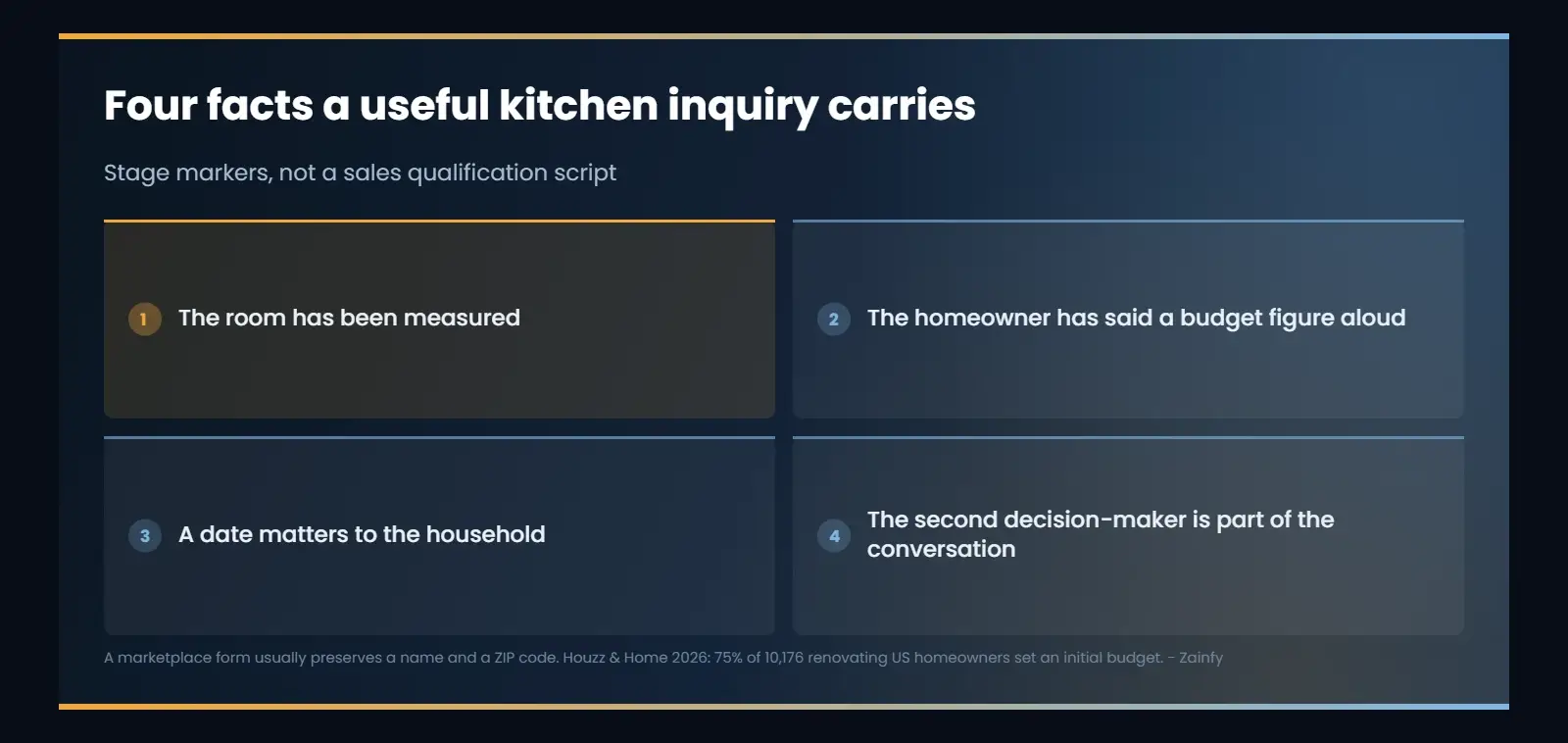
A useful kitchen inquiry arrives with evidence of movement. The room has been measured. The homeowner has said a budget figure aloud. A date matters. The second decision-maker is part of the conversation.
Those are stage markers, not a sales qualification script. They tell you what has happened before your estimator enters the room. A marketplace form usually preserves the person’s name and ZIP code. It may ask for a project type, but a checked box marked “kitchen” does not tell you whether the room has been measured, whether a serious budget has been discussed at home, or whether one spouse is still treating the work as an idea.
Published homeowner research shows that some of this information exists well before a contractor receives an inquiry. Houzz & Home 2026 reported that 75% of 10,176 renovating US homeowners set an initial budget, while 37% exceeded it during 2025. Houzz Kitchen Trends 2026, published January 13, 2026, reported that financial means triggered 33% of kitchen renovations among 1,780 US homeowners. For that group, the project changed when the money became available. A generic form does not record that change.
Houzz also ranked first when the assigned kitchen-lead search was checked, selling access to inquiries while publishing unusually detailed research about how renovation decisions develop. The research describes the decision. The purchased record strips most of that context away.
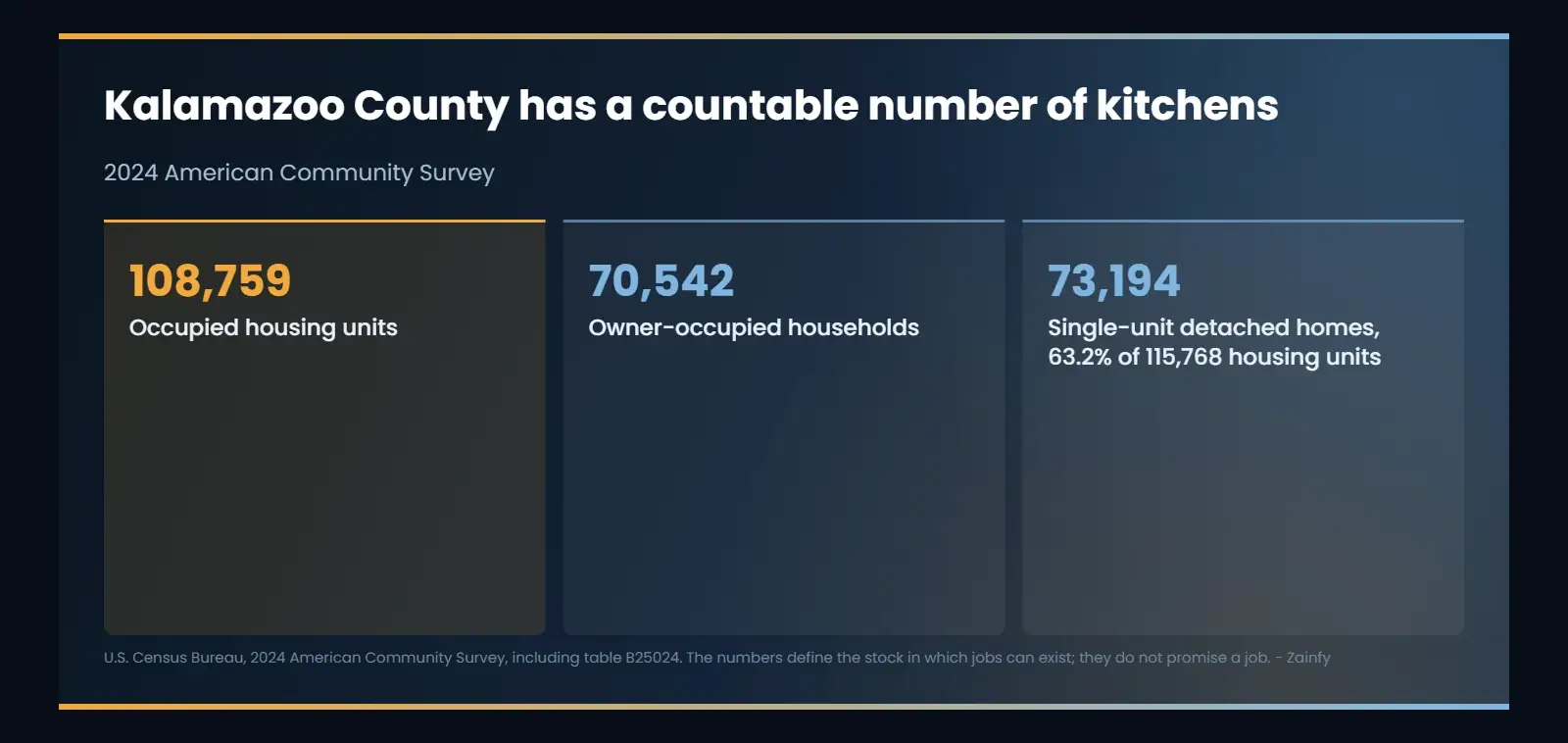
Kalamazoo County has a countable number of kitchens
Start with the whole local buyer set. The 2024 American Community Survey counted 108,759 occupied housing units in Kalamazoo County. Of those, 70,542 were owner occupied. That is the finite group with authority to commission a kitchen project on property it owns.
The county is not an endless stream of new prospects produced by whichever platform has your card on file. Every form fill, referral, direct call, and repeat inquiry comes from competition for attention inside that countable group. Portage adds another city name to the service area, but it remains part of Kalamazoo County and part of that local total.
The housing stock narrows the picture further. ACS table B25024 counted 115,768 housing units in the county, including 73,194 single-unit detached homes, or 63.2%. Those detached properties are the physical base under much of the kitchen work an owner-operated remodeling company can pursue. The number does not promise a job. It defines the stock in which jobs can exist.
That matters when someone sells you a “new” Kalamazoo kitchen lead. The platform did not create another household or another house. It captured one moment from a homeowner already inside this local market, removed most of the stage information, and resold the contact record. The county count stays fixed while access to portions of it changes hands.
Kitchen leads have their own price journalism. Drywall leads don’t.
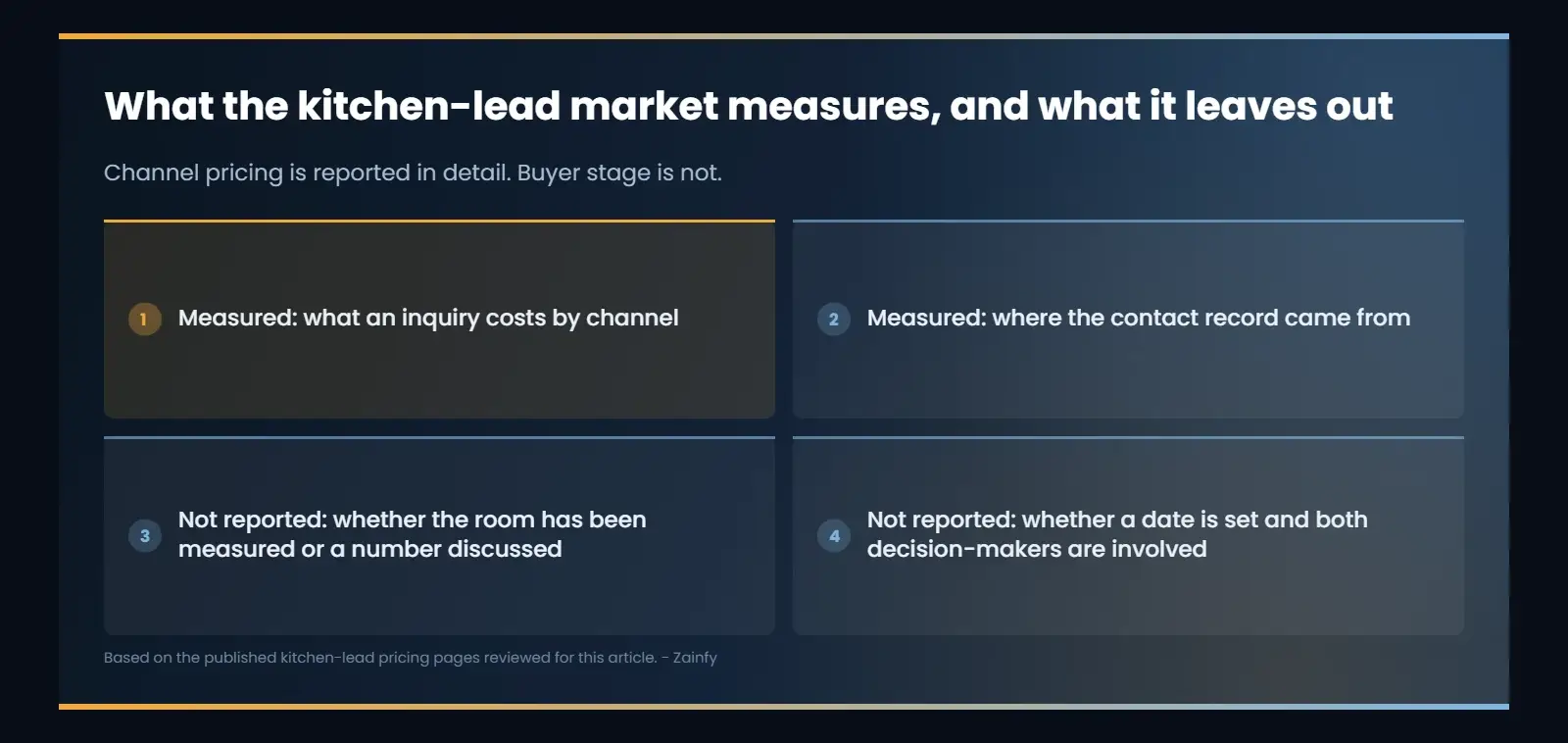
Kitchen lead selling has developed far enough to produce a publishing category around its own prices. Search the subject and you find pages titled “The Best Places to Buy Kitchen Remodeling Leads Online,” “Kitchen Remodeling Lead Generation Cost,” and “What Kitchen Remodeling Leads Really Cost in 2026.” One entire domain is named for the kitchen remodeling trade. The category does not merely sell inquiries. It reports on what those inquiries cost by channel.
Run the cost search for drywall leads and the result changes. Vendors sell those inquiries too, but the reporting stays broad: home-improvement leads by state and service, or what a contractor lead should cost. It does not produce the kitchen category’s trade-specific benchmark articles. The bathroom trade has begun building similar coverage, but kitchen remains a clear example of a high-ticket project supporting a mature resale market for inquiries.
The mechanism is simple. A per-lead price can rise only where the potential job value can carry it. Better-priced kitchen work therefore makes each inquiry more valuable to companies that capture and resell contact information. That market has invested heavily in channel pricing because channel labels help sell the record.
It has not built equivalent reporting around whether the homeowner has measured the room, discussed a number, selected a decision date, or brought the other decision-maker into the process. The market became precise about the invoice while leaving the buyer’s stage largely undescribed. That omission is the risk a Kalamazoo remodeler actually absorbs.
The stage that converts doesn’t produce a form fill
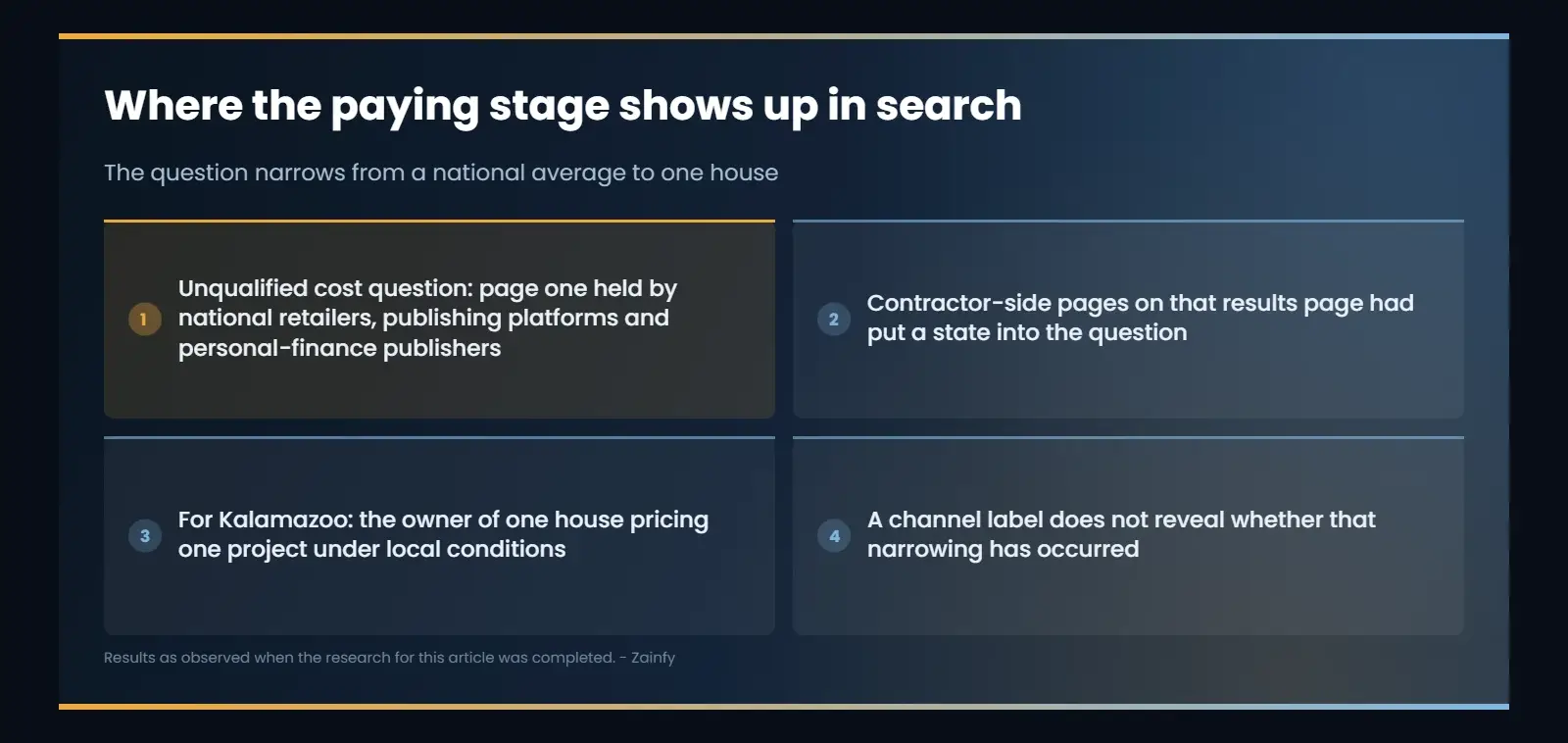
A homeowner moves into the paying stage by narrowing the question. The search stops being a national request for an average kitchen cost and becomes a question about a specific room, budget, and place. The page-one results for the unqualified cost question were national retailers, national publishing platforms, and personal-finance publishers when the research was completed. The only contractor-side businesses on that page had put a state into the question, one for Indiana and one for New Hampshire. That difference is visible without a marketing dashboard: broad research belongs to national publishers, while a contractor can become relevant when the question carries geography and purchase intent. For Kalamazoo, the important inquiry is not the person asking what kitchens cost everywhere. It is the owner of one house in Kalamazoo County trying to price one project under local conditions. A marketplace can identify a contact source, but the source does not reveal whether that narrowing has occurred. That is why channel labels are a weak substitute for stage. The record may say search, social, referral partner, or lead platform. None tells you whether the homeowner has crossed from curiosity into a project with a number and a date. That difference must be discovered before an estimator gives away an afternoon to the quote.
Go and read your last ten kitchen inquiries
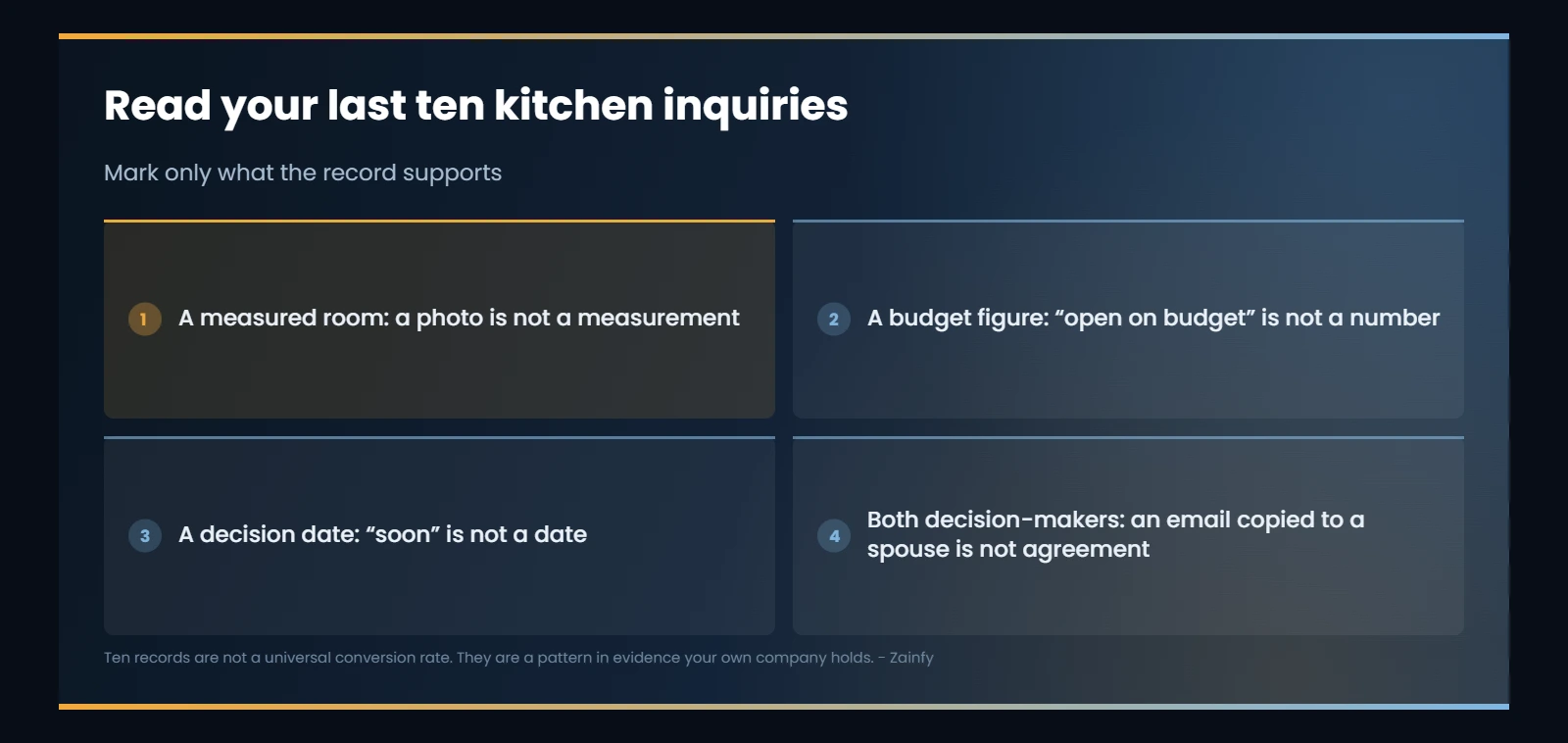
Pull the last ten kitchen inquiries from your records. Ignore what each source charged. Read the message, intake notes, estimate calendar, and final disposition. Mark whether the homeowner supplied a measured room, a budget figure, a decision date, and participation from the other person approving the project.
Then look at which inquiries reached an appointment and which became signed jobs. You are not manufacturing a universal conversion rate from ten records. You are looking for a pattern in evidence your Kalamazoo company owns. If the inquiries that advanced carried more stage information at arrival, you learned something a channel report omitted.
Keep the wording the homeowner used. “Soon” is not a date. “We are open on budget” is not a number. A photo is not a measurement. An email copied to a spouse is not proof that both people have agreed to the project. Mark only what the record supports.
The exercise also shows where this article stops. It identifies the local searches associated with a homeowner who has narrowed the job, but it does not explain how your company becomes visible for the kitchen searches already happening in Kalamazoo County. That work belongs to the search system, not to a lead-source label.
At the next vendor call, ask what the inquiry reveals about stage before asking where it came from.
Two things not to do with this
Do not place an inquiry with no measurement, no stated number, no date, and no second decision-maker in the bucket reserved for a kitchen project. It is a name. Treating it as a mature opportunity distorts your follow-up record and gives the seller credit for progress the homeowner has not made.
The person may renovate later, but the purchased record does not show a project exists today. Keep the contact if you choose; do not let a category label replace evidence.
Do not chase the plain national cost question either. Home Depot, Houzz, and a personal-finance publisher held that results page when it was checked. Their audience can be anywhere, and much of it is still learning what a renovation might involve. A Kalamazoo contractor does not need broad attention from readers months away from choosing a local company.
The useful version has a place in it because place narrows the market and the decision. State-qualified contractor pages reached the cost results where unqualified local pages did not. Pursue the question attached to a local house. Leave the national average to national publishers.
Are kitchen remodeling leads worth buying?
Sometimes, but the deciding variable is not the channel or the quoted price. It is how far into the project the homeowner had moved when the inquiry was created. A purchased lead is useful when its record carries evidence of a real kitchen decision, not merely permission to call someone.
Look for the substance that a standard form often loses: a measured room, a budget figure said aloud, a date the household is working toward, and both decision-makers participating. Each one indicates that work has happened before your estimator spends time on the opportunity. Their absence does not prove the project is false, but it leaves the contractor paying to discover whether a project exists.
Kitchen work attracts a resale market because the job value can support a meaningful acquisition price. That explains why so much published material compares costs across search, social, and marketplace channels. It does not explain why one inquiry books and another stalls.
Stage explains more. A late-stage homeowner has narrowed the room, money, place, and timing. An early-stage homeowner may still be collecting ideas from national cost pages. Both can submit an identical form. Before renewing a lead package, ask the seller what survives in the record besides contact details and a trade label. If stage cannot be seen, price is being attached to an unknown.
Before the next renewal call
[wps_faq style=”classic” question=”What should a kitchen inquiry tell you before you quote it?”]
It should tell you whether a real room, budget, date, and joint decision exist. A measured space gives the conversation physical limits. A number said aloud shows that the household has discussed money. A date reveals urgency, while participation from both decision-makers reduces the chance that your estimate becomes someone else’s research. These are stage markers, not reasons to reject every early inquiry. Read the original message and intake notes before booking the quote. If all you have is a name, ZIP code, and “kitchen” box, schedule a short first discovery call before committing estimator time.
[/wps_faq]
[wps_faq style=”classic” question=”Why do so many bought kitchen leads turn into quotes that go nowhere?”]
They stall because a form fill can arrive before the homeowner has made the decisions needed to buy. One ranking page in the category describes a two-to-eight-week inquiry-to-contract cycle, but that published range does not tell you where a particular contact entered it. The platform may have captured the person near the beginning, while your process treated the record as quote-ready. Check for a stated number and date before assigning an estimate slot to the project. A channel report can identify acquisition; only the conversation reveals whether the household has reached a buying decision.
[/wps_faq]
[wps_faq style=”classic” question=”Does buying kitchen leads work in a county the size of Kalamazoo?”]
It can work, but the local pool is finite. The 2024 American Community Survey counted 70,542 owner-occupied households in Kalamazoo County. Every purchased kitchen inquiry comes from competition for attention inside that group, alongside referrals, direct searches, and previous contacts. Buying another package does not expand the county or create another available kitchen. It changes who captures a homeowner’s details first. Track how much stage information arrives with each record, and compare that with inquiries generated directly by your company. In this market, access matters, but evidence of readiness determines whether that access deserves estimator time.
[/wps_faq]
Before the next renewal call, read your last ten kitchen inquiries and count how many arrived with a real date attached. Do not count “soon,” “this year,” or “after we decide.” Count a month, a deadline, or an event the household is working toward.
That small review will not settle every marketing decision. It will tell you whether the package delivered people already moving toward a project or names that still needed the project created around them. Bring that count to the call. If the seller can report source and price but cannot explain what stage information reaches you, ask why the least useful part of the record is the part measured most precisely.