For a remodeler working out of Muskegon or Holland, the hard part of a short season is not the calendar. It is that a large share of the people you are selling to are not at the property when they decide. They may be comparing contractors while the house is empty, passing your work to another owner, and forming a shortlist without ever meeting you there.
That creates a lakeshore market in which presence cannot be assumed and one person may not control the decision. The house can be local while its decision process is not.
This article will define who the client is, what he must understand before arriving, and why material that works face to face can fail once it travels without you. The issue starts before the first call and follows the job through every person asked to approve it.
Ten thousand homes, and the owner is somewhere else
The Census calls these properties vacant, but that word needs explaining before it is useful. A home held for seasonal, recreational, or occasional use is counted as vacant because nobody occupies it year-round. It is not necessarily abandoned, neglected, or derelict.
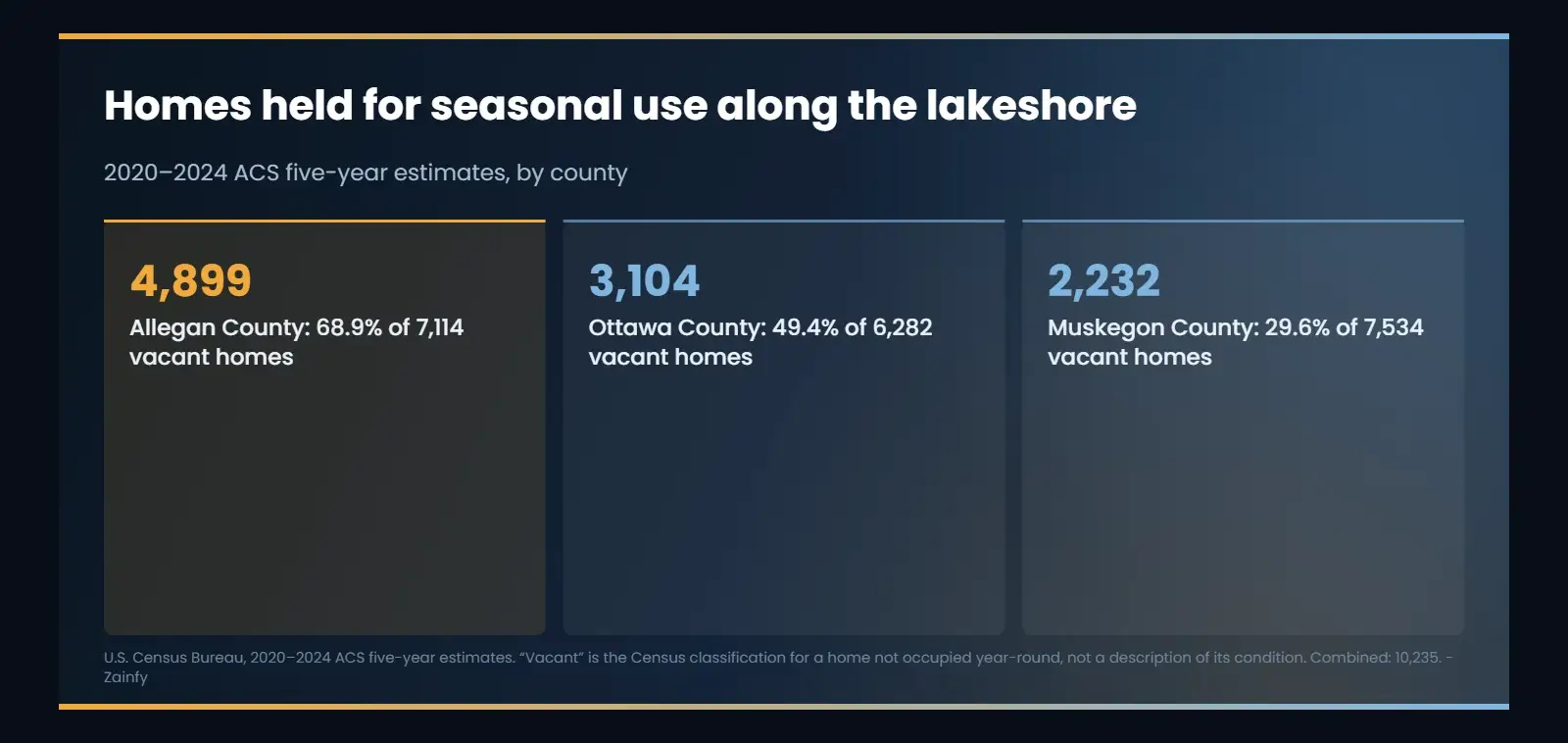
The 2020–2024 American Community Survey five-year estimates show how much this category matters along the lakeshore. In Allegan County, 4,899 of 7,114 vacant homes were held for seasonal, recreational, or occasional use. That is 68.9%, or roughly seven in ten. Holland lies partly in Allegan County, but that county figure cannot be assigned to Holland alone.
Ottawa County recorded 3,104 seasonal-use homes among 6,282 vacant homes, a derived share of 49.4%. Muskegon County recorded 2,232 among 7,534, or 29.6%. The combined seasonal-use count is 10,235: 4,899 + 3,104 + 2,232.
Those figures describe one working radius with two different client structures. On the Holland-and-south end, Allegan and Ottawa counties carry a larger share of properties whose owners are not there year-round. Muskegon County has 2,232 such properties while also carrying a deeper year-round owner base.
Neither end is the weak end. One asks you to reach more absent owners; the other lets you speak to absent and year-round owners in different ways. Treating the whole shoreline as one undifferentiated audience wastes the distinction the Census has already made visible.
Every guide answers when. None answers who.
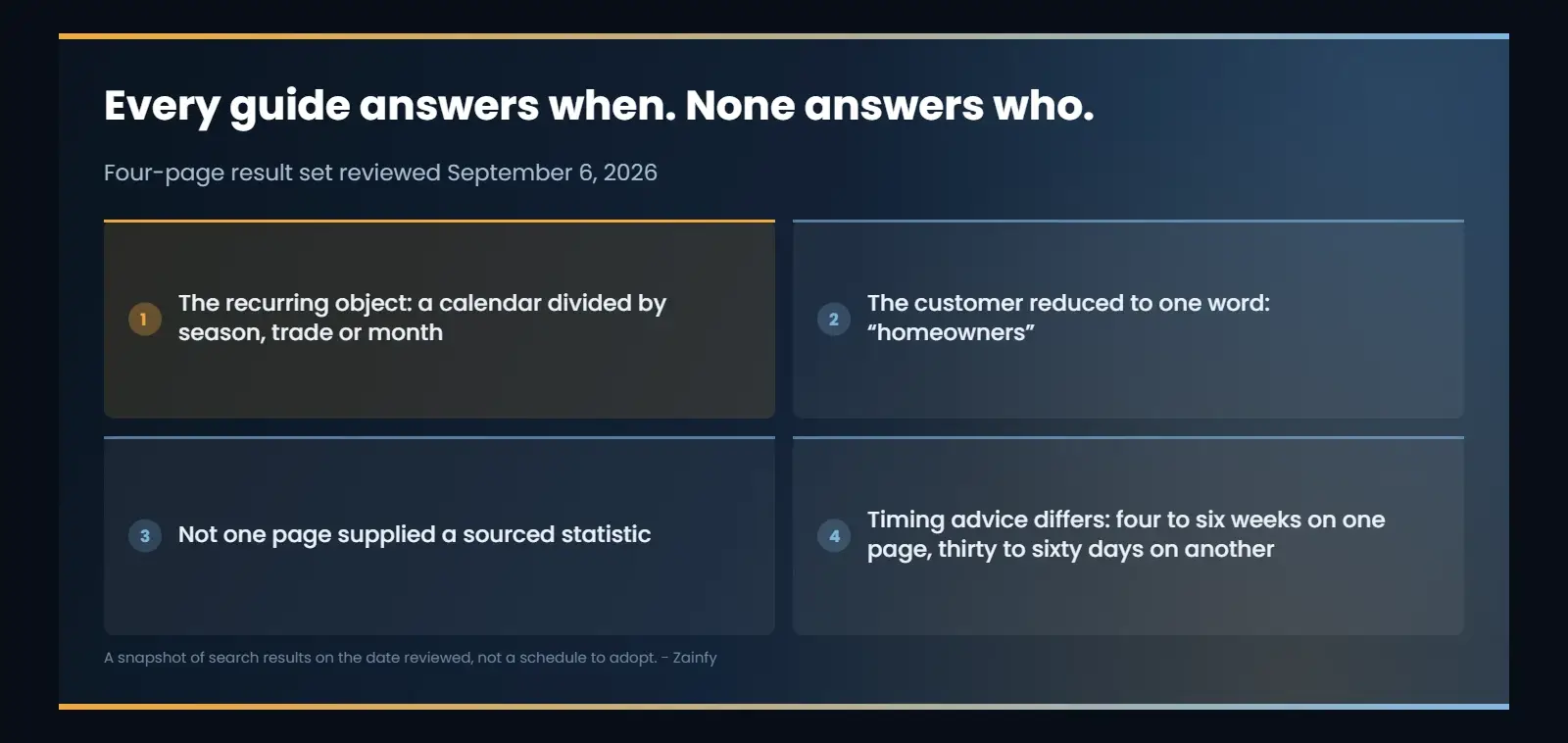
A fresh search still turns up one object again and again: a calendar. Current results divide the year by season, trade, or month. In the four-page set reviewed on September 6, 2026, the customer was reduced to one word, “homeowners,” and not one page supplied a sourced statistic.
Even their hard timing advice does not settle the matter. One page says to begin four to six weeks before peak demand. Another says thirty to sixty days. Neither shows how it reached the number. One of those guides also runs through an HVAC demand cycle under a headline addressed to contractors generally, as if a remodeler and an emergency heating company sell on an identical rhythm.
That snapshot is easy to inspect, but it is not a schedule to adopt. Search instead for the person who owns a seasonal property, and the results lose the contractor question. They drift into scheduling software, short-term-rental advice, or employment listings.
The missing question is not “Which date belongs on the calendar?” It is “Who has to believe this contractor can handle the property?” Along the Lake Michigan shore, that distinction matters before anyone discusses timing. The owner may be absent, the decision may pass between people, and your material has to do useful work without your explanation beside it.
He decides before he gets here
An owner can form a shortlist while the property sits empty. He cannot judge your work by seeing a truck nearby, hearing your name from someone across the street, or meeting you at the house. He has what he can find under your company name and trade. That is his field of view.
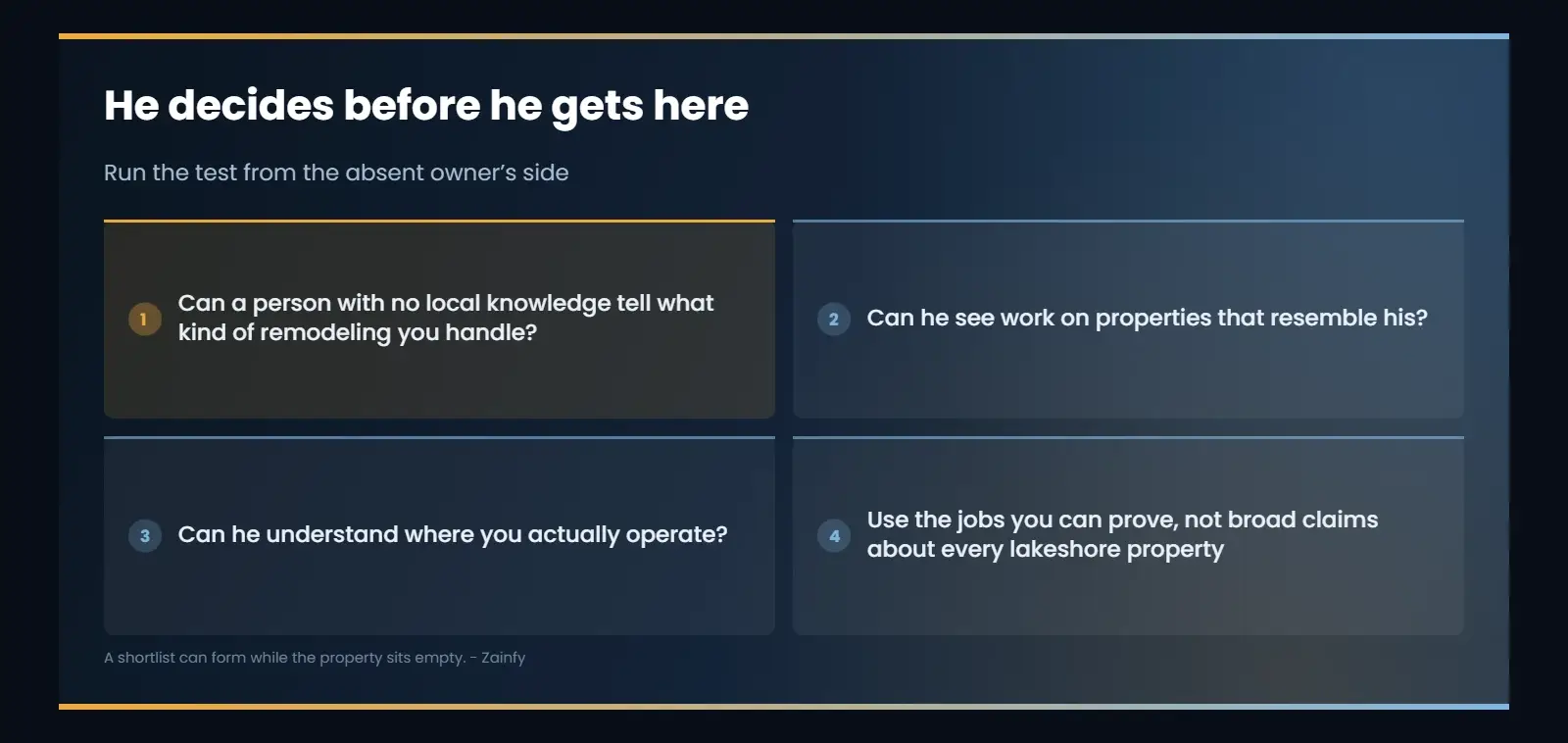
Run the test from his side. Search for your company without filling in the gaps from memory. Can a person with no local knowledge tell what kind of remodeling you handle? Can he see evidence of work on properties that resemble his? Can he understand where you actually operate without already knowing the lakeshore?
Being findable stops being an abstract marketing goal when Holland owners who aren’t there year-round are building that shortlist before they can see your work in person. If your company appears only when someone already knows its name, you have left the first decision to referrals you cannot observe.
Do not solve this by making broad claims about every property near Lake Michigan. Use the jobs you can prove. The question is whether a stranger can connect your name to the kind of work he needs before a conversation begins. If he cannot, the local reputation in your head has not traveled far enough to reach the client.
Written to be forwarded, not just read
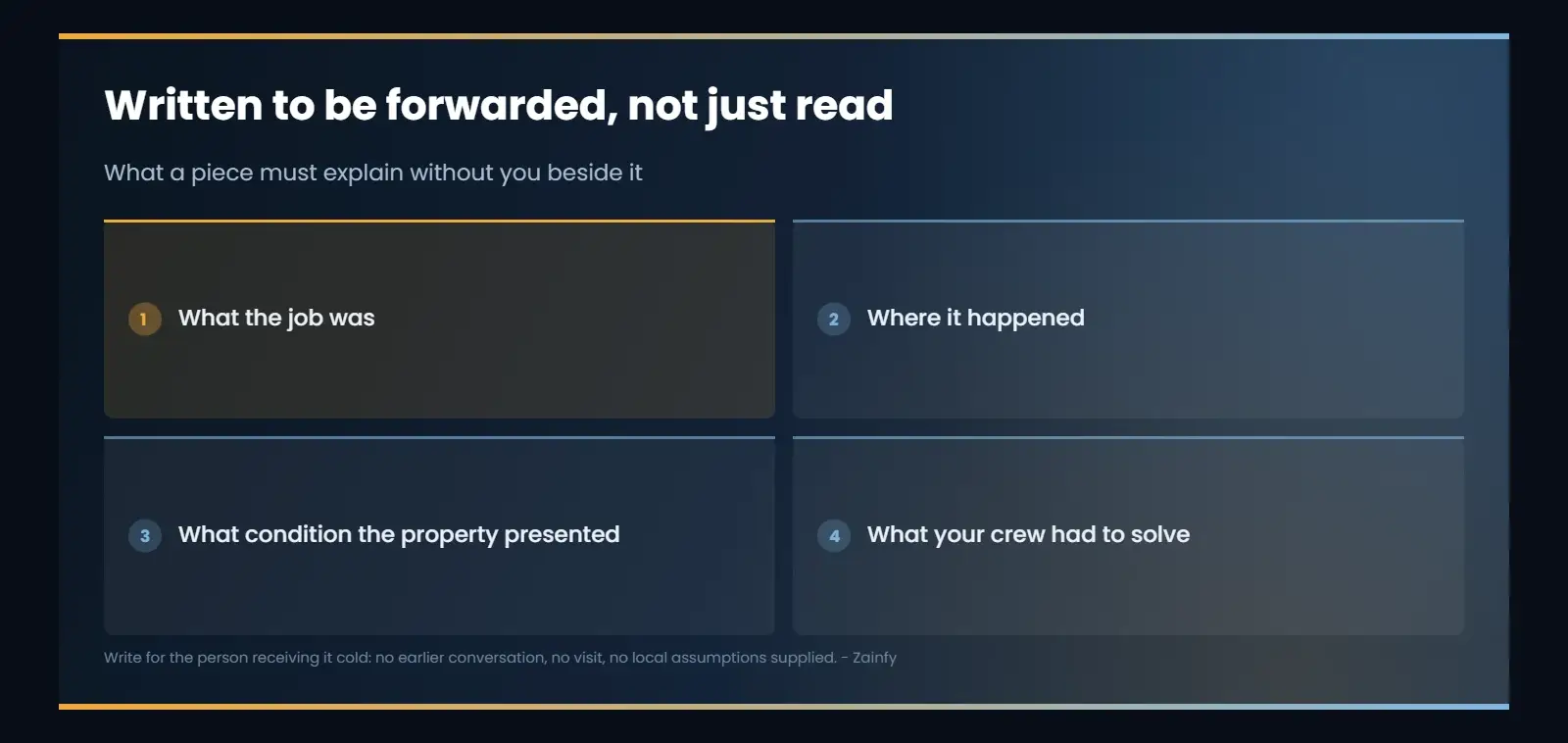
Whatever you publish about a lakeshore job has to survive separation from its original context. It may be opened by one owner, sent to another, and read by someone who was never at the property and never met you. That means the piece itself has to explain what the job was, where it happened, what condition the property presented, and what your crew had to solve. A vague finished-project announcement asks the first reader to supply everything missing, then leaves the next reader with even less. The useful standard is whether the material still makes sense after it leaves the person who first found it. This is where forwarded to whoever else has to agree becomes a business requirement rather than a nice extra. Write for the person receiving the forwarded item cold: no earlier conversation, no visit, no private explanation, and no local assumptions supplied. If he can identify the problem, understand the work, and see why your company belongs in the discussion, the piece can keep moving. If it depends on a caption such as “another beautiful project” and shared local knowledge, it stops carrying meaning as soon as it changes hands.
There is usually a second signature
On seasonal and family-held property, the decision frequently involves more than one person, and those people are not always together. Contractors describe that pattern publicly, and it appears often enough in owner discussions to plan around.
That does not call for a statistic. It calls for a different standard. You are not producing a pitch for one person sitting across a kitchen table. You are giving that person something strong enough to relay while he may still be only partly persuaded himself.
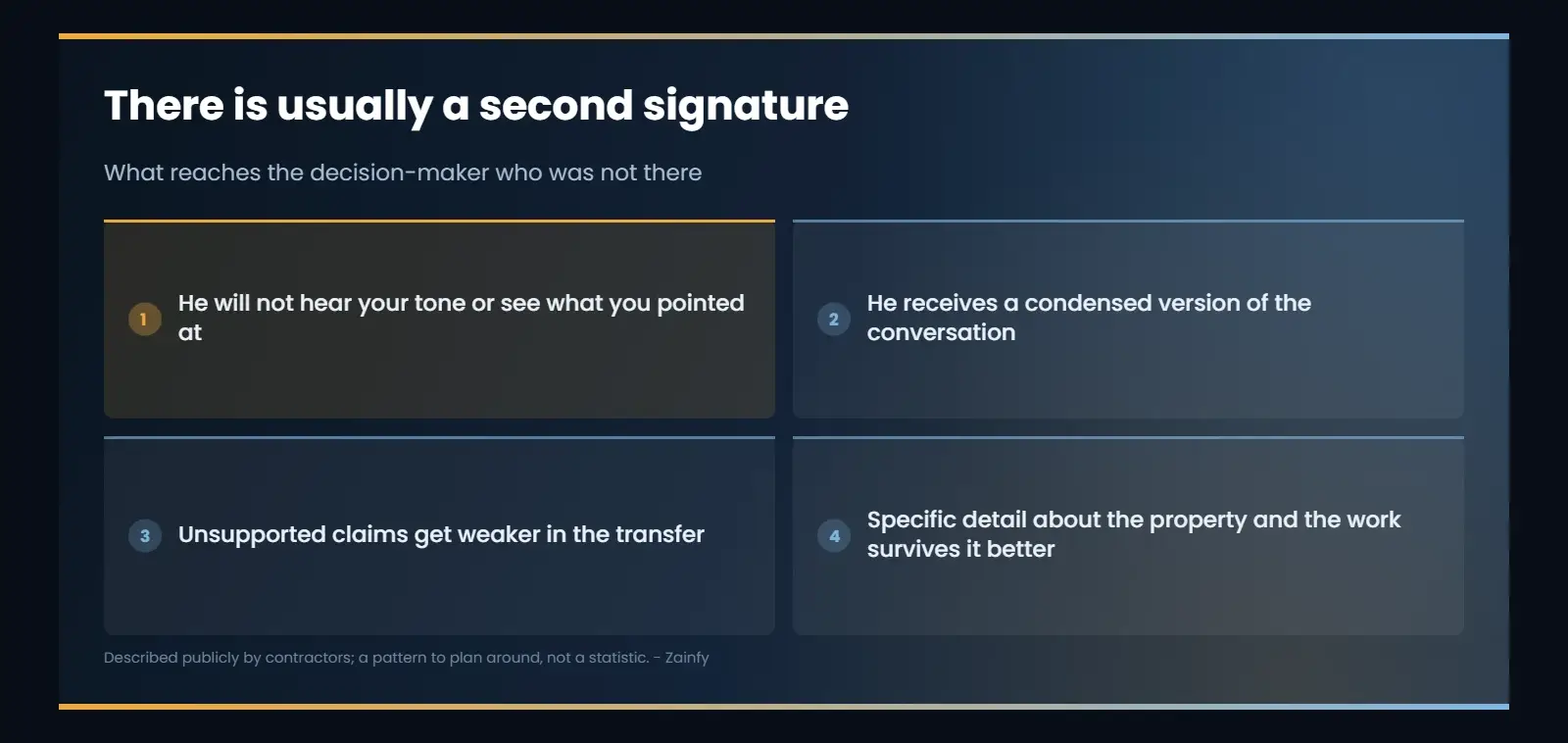
The second decision-maker will not hear your tone, see what you pointed at, or know which objection you answered. He receives a condensed version of the conversation. Every unsupported claim gets weaker in that transfer. Every specific detail about the property and the work survives it better.
Assume the first contact has to carry your case onward. Make the reasoning clear enough that he does not become your salesperson. Keep the work understandable while the decision passes between people who may never evaluate it together.
Stop building around the walk-in
Do not build your whole approach around getting every decision-maker into the room.
That is common contractor-sales advice: insist that both owners attend before you present. It can work when everyone can arrange one meeting. On the shoreline, it can quietly remove you from a job whenever an owner is absent and the other person cannot satisfy your process.
The in-person close is a tactic, not a foundation. Your case should be able to move without you standing beside it. The property problem, the proposed scope, the reasoning behind it, and the evidence that you can do the work all need to remain intelligible after the meeting ends.
Then close in person when the opportunity exists. Just do not make physical presence the admission price for considering your company.
A rigid rule does not usually fail with an argument. The owner simply chooses a contractor whose process can accommodate how the property is actually held. You never see the job you excluded yourself from, so the process can look disciplined while it keeps narrowing the field against you.
How do you market to homeowners who only use the property part of the year?
Market to them as people who are not there. Their shortlist can form before they arrive, and what you publish must explain itself to someone who never saw the property because the decision often passes through more than one person.
The lakeshore numbers show why that answer cannot stay generic. The 2020–2024 ACS five-year estimates counted 4,899 homes held for seasonal, recreational, or occasional use in Allegan County and 3,104 in Ottawa County. Those properties represent 68.9% and 49.4% of each county’s vacant stock, respectively. Again, “vacant” is the Census classification for a home not occupied year-round, not a description of its condition.
Muskegon County adds 2,232 seasonal-use homes, a 29.6% share of its vacant stock, while retaining a larger year-round component. That creates different assumptions inside one lakeshore working radius. An absent owner is more central to the client structure on the Allegan and Ottawa end; around Muskegon, your material may need to work for seasonal and year-round owners without confusing either.
The practical response is not a new calendar. It is proof that travels: work described clearly enough to form a shortlist, retain meaning when forwarded, and support a decision when all owners cannot evaluate the contractor together.
What lakeshore remodelers ask about seasonal clients
[wps_faq style=”classic” question=”What makes marketing on the lakeshore different from marketing inland?”]
The lakeshore differs because seasonal-use homes make absent owners measurable clients. Allegan County’s 2020–2024 ACS five-year estimate counted 4,899 such properties, 68.9% of its vacant stock. It does not describe every buyer or reveal where an owner primarily lives. It does show why presence cannot be assumed. A process built around the homeowner seeing the crew or attending every conversation can miss how the decision forms. Your material must establish relevance before the owner reaches the property and stay clear when another person receives it without you. Along this shoreline, absence shapes the sale before any meeting.
[/wps_faq]
[wps_faq style=”classic” question=”How do you sell a remodel when one of the owners isn't there?”]
Build the decision so it can move without both owners in one room. Explain the property problem, proposed work, and reasoning in language the first owner can pass on accurately. Do not depend on a verbal answer that disappears after the conversation. The absent person needs enough context to judge the work without reconstructing it through somebody else’s memory. Keep the in-person close when available, but do not make it the only route to agreement. Ask what the absent owner needs to understand, then give an answer that stands alone. A relay-ready explanation keeps separation from becoming an automatic rejection.
[/wps_faq]
[wps_faq style=”classic” question=”Are seasonal homes on this shoreline really that common?”]
Yes. Across Allegan, Ottawa, and Muskegon counties, the 2020–2024 ACS five-year estimates counted 10,235 homes held for seasonal, recreational, or occasional use: 4,899 + 3,104 + 2,232. The derived shares were 68.9% of vacant stock in Allegan County, 49.4% in Ottawa County, and 29.6% in Muskegon County. Here “vacant” means nobody occupies the property year-round; it does not mean abandonment. Seasonal use was the largest vacancy category in Allegan and Ottawa, while Muskegon also carried a deeper year-round owner base. Those county splits make the lakeshore’s changing client structure measurable rather than assumed.
[/wps_faq]
Take the last thing you published about a lakeshore job and send it to someone who has never seen the property. Do not explain it first. Ask that person what the project was, where it happened, what problem the owner faced, and why your company was qualified to handle it.
Write down every answer he could not give. Those gaps are the context your next client may also be missing when your work reaches him without you.
Fix that piece before publishing another one. A contractor who makes his work understandable at a distance has a chance to enter the decision. A contractor who relies on being in the room may never learn which jobs ended before the first call.