If you run a remodeling company from Saginaw, Bay City and Midland may sit twenty minutes away, but they are still three separate markets for local SEO. The question is not whether your crew will travel there. It is whether your website has earned a real page for each market.
US-10 and I-675 make the working radius routine. Search does not turn that radius into a single audience. Each city belongs to a different county, carries its own pool of owner-occupied homes, and gives you a different amount of completed work to draw from. A Saginaw contractor may deserve three city pages, two, or only one plus wider service coverage. The answer is already in the jobs the company has completed.
Generic local SEO guides usually begin at “build city pages.” That skips the decision that matters here. Before adding a page, decide whether it will say something true about work in that city after the city name has been covered up.
The map says neighbors. The data says three markets.
Start in Saginaw County, the base for this decision. The 2024 American Community Survey counted 187,714 people there. Bay County had 102,651 people, and Midland County had 84,022. Derived from those ACS counts, the combined population is 374,387: 187,714 + 102,651 + 84,022. That number describes reach. It does not erase the three places inside it.
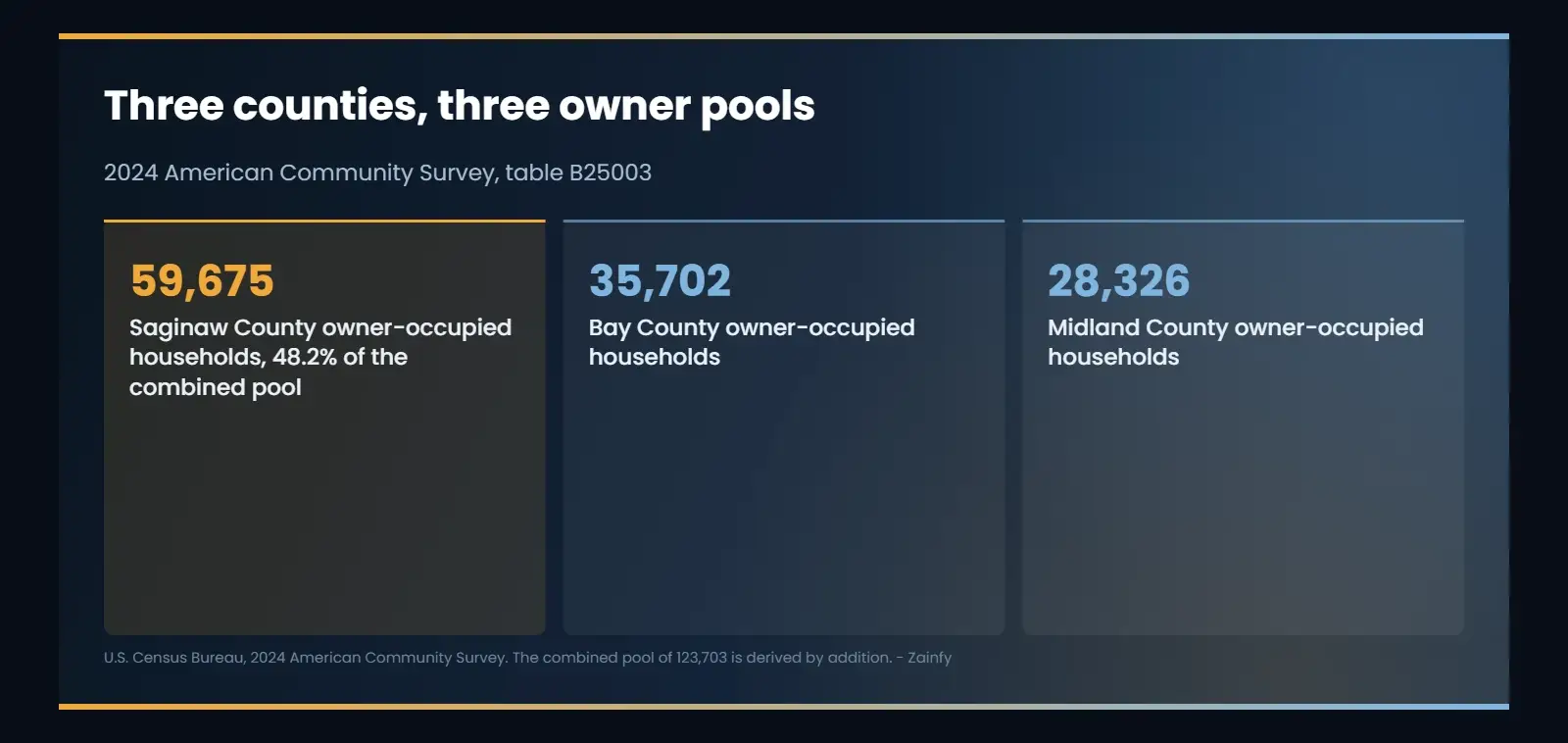
The housing tenure figures make the business decision clearer. ACS table B25003 counted 59,675 owner-occupied households in Saginaw County, 35,702 in Bay County, and 28,326 in Midland County. Derived from those counts, the combined owner pool is 123,703 households: 59,675 + 35,702 + 28,326. Each pool is large enough to fill a crew’s year of remodeling work when approached on its own terms. None is disposable.
That arithmetic puts Saginaw County at 48.2% of the combined owner pool, roughly half. That is why depth belongs in the base market first. Bay City and Midland are not automatic extensions simply because locals call Saginaw, Bay City and Midland the Tri-Cities. They are additional markets whose pages must be supported by additional work.
This is where the map can mislead an owner. A short drive answers whether the crew can take a job. It does not answer whether the company has enough Bay County work to write a Bay City page or enough Midland County work to write a Midland page. Those are evidence questions, and each city gets its own answer.
The advice you’ll find was written for somebody else
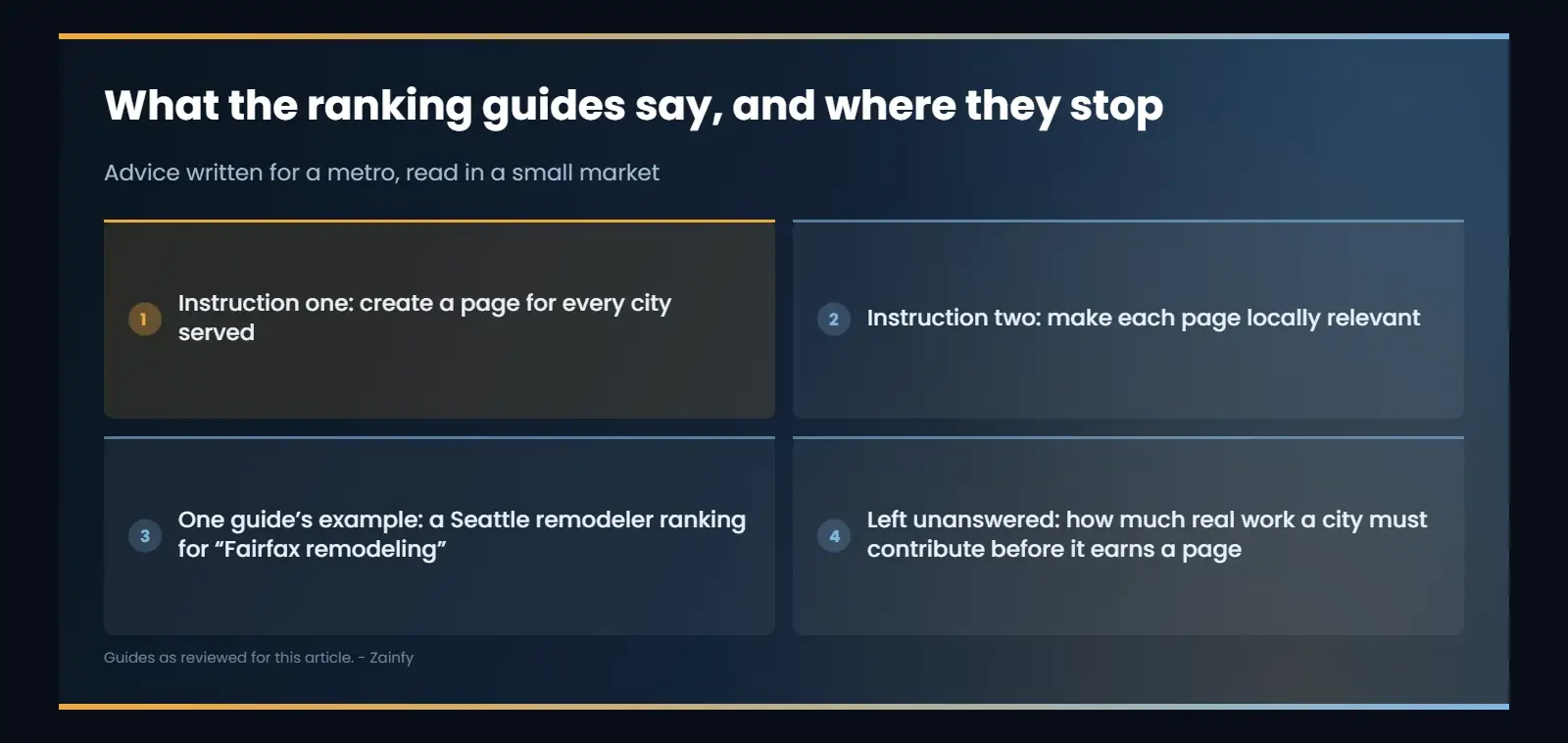
The ranking guides give contractors two instructions: create a page for every city served, then make each page locally relevant. One guide warns against thin templates. Another says a firm targeting four or five towns can create a page for each. The advice sounds usable until you ask how much real work a city must contribute before it deserves one.
The examples show why the question goes unanswered. An exact-intent guide illustrates the method with a Seattle remodeling business ranking for “Fairfax remodeling.” Fairfax is not a Seattle suburb. The location example on a page teaching localization was never localized. Other guides move between Austin, Seattle, and Southern California. The advice was written for a metro and sold to a small market.
That is not the decision facing remodelers whose base market is Saginaw. Here, the base county contains 59,675 owner-occupied households, while the two adjacent county pools contain 35,702 and 28,326. The generic advice runs out before it tells you whether those pools deserve separate pages from your firm.
A city page is not justified by a pin on a service map. It is justified by enough local work to make the page unmistakably about that place. Without that evidence, “create a page for every town” becomes an instruction to manufacture geography.
Google already wrote the line in its spam policy
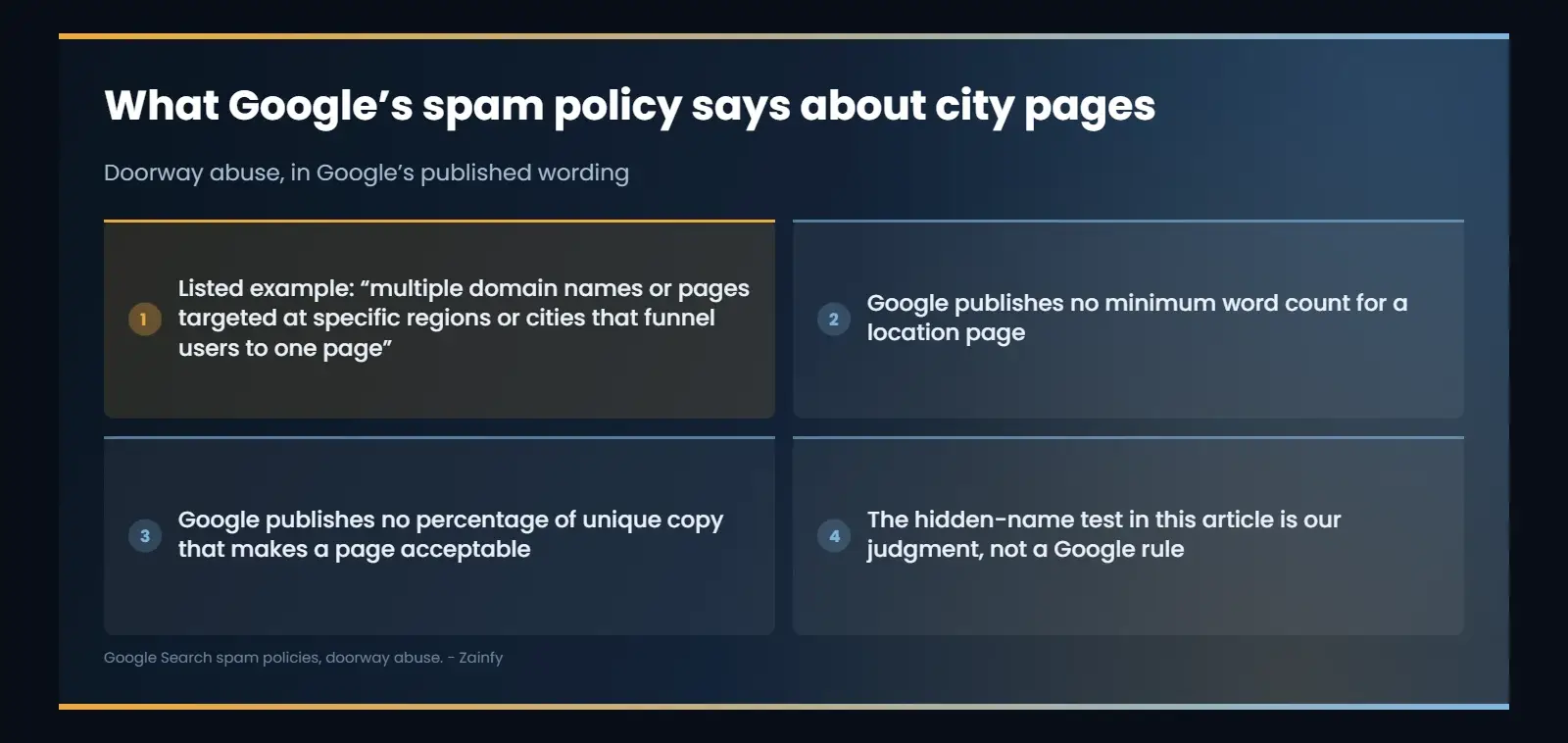
Google calls doorway abuse pages created to rank for similar searches that send people toward a less useful intermediate destination. Its published examples include “multiple domain names or pages targeted at specific regions or cities that funnel users to one page.” That sentence describes the risk in mass-producing location pages more clearly than the ranking guides do.
None of those guides cites the policy while recommending city pages. They warn against thin content, but “thin” is not the whole issue. The policy is concerned with a set of regional pages acting as search entrances to one destination instead of giving each visitor a useful page tied to the place searched.
Google does not publish a minimum word count or a percentage of unique copy that makes a location page acceptable. There is no official threshold separating a passing page from a failing one, and changing an arbitrary share of the text does not make a copied page safe. Do not invent a rule Google has not published.
The practical test in the next section is our judgment based on Google’s stated principle. It is not a Google rule. Its purpose is to expose whether a city page has local substance or merely carries a local label.
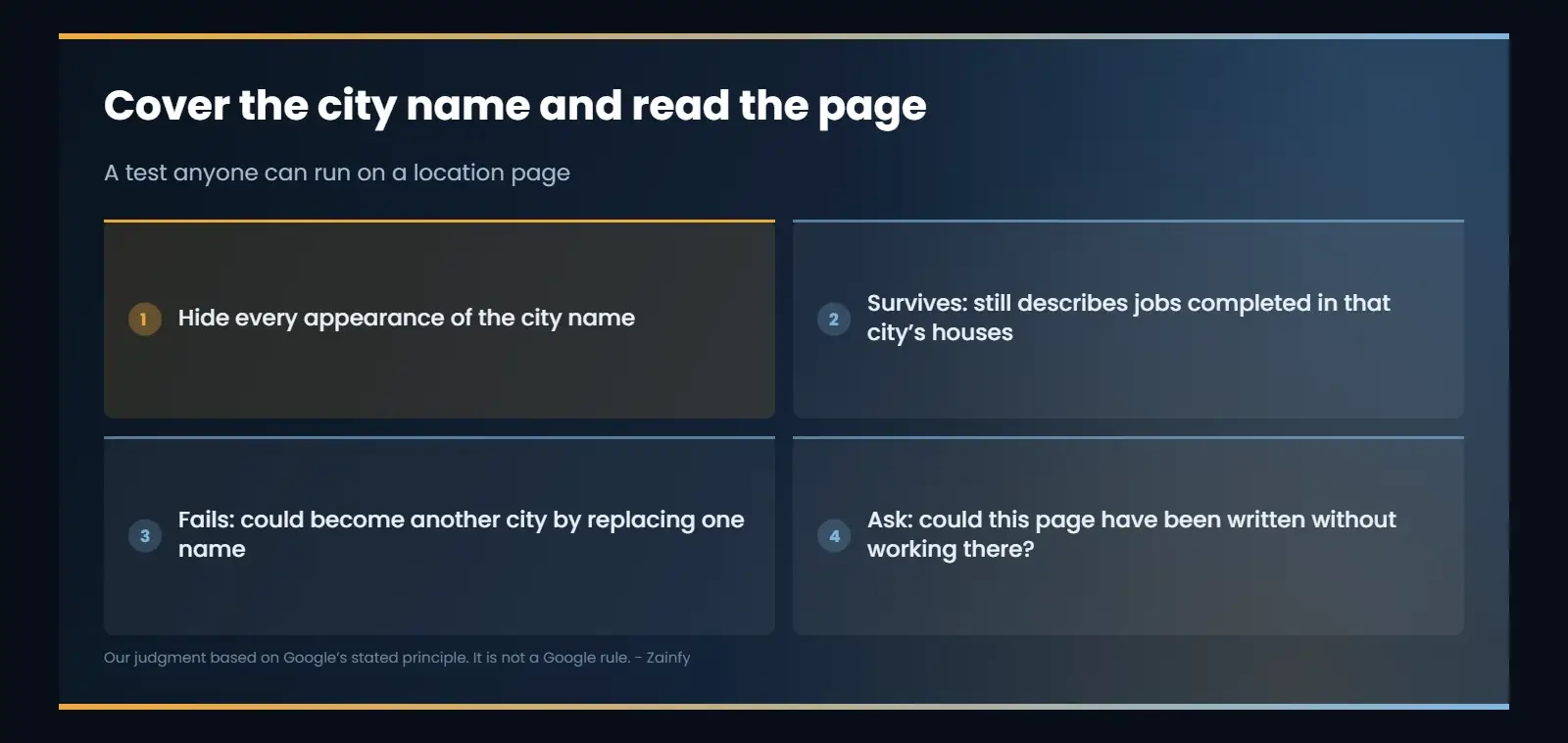
Cover the city name and read the page
Open a Bay City page, cover every appearance of “Bay City,” and read what remains. If the page still describes jobs completed in Bay City houses, parts of the city where the firm has worked, and remodeling conditions that belong to that local housing stock, it survives. The place is present in the substance. If the page could become Midland or Saginaw after replacing a name, it dies under the test because the name was doing all the local work. You can run this test on your own website tonight and then use it on the contractors appearing above you. No private software or invented score is required. Ask whether this is a page you could not have written without working there. The answer should not depend on imagination. This takes Google’s funnel principle out of policy language and puts it against a page anyone can inspect. The profile side is its own question: how one Google profile covers a multi-county metro. Here, the point is narrower: a website page earns a city name through work tied to the city. If hiding the name removes its only connection to Bay City, the page is an entrance built for a query, not a useful account of a market your company serves.
Build the pages from the job list, not from each other
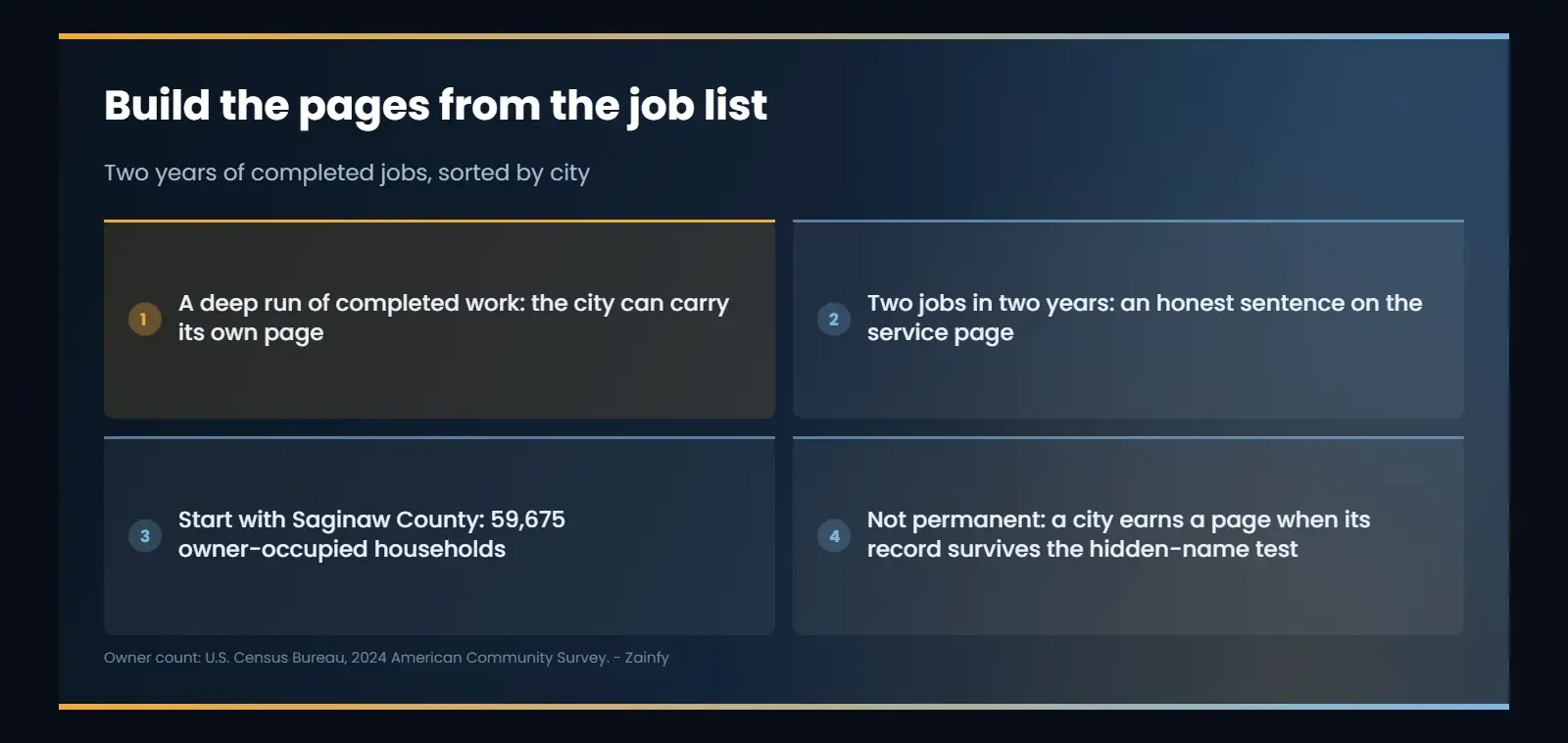
Pull two years of completed jobs. Sort them by city, then read what the piles support.
A city with a substantial run of completed work gives you source material that another city cannot supply. The addresses show where the crew has operated. The project records show what homeowners there hired the company to do and which local houses produced which kinds of remodeling work. That body of evidence can support a page because the city has already shaped the company’s experience.
A city represented by two jobs in two years has not supplied much material. Give it an honest sentence on the relevant service page. Do not force those two records into a standalone page that must be padded with copied claims. A page that cannot be filled from the city’s jobs can only borrow from another place or retreat into generalities.
Start with Saginaw. The ACS owner count puts 59,675 owner-occupied households in Saginaw County, close to half of the three-county total. For a Saginaw-based contractor, that is the logical place to establish depth before multiplying pages outward.
Bay City and Midland earn separate pages when their job piles can carry them. The decision is not permanent. A city that has only a service-page mention today can earn a full page after the completed-work record becomes strong enough to survive the hidden-name test.
The page you should not publish
Do not publish the find-and-replace page.
That is the Saginaw page duplicated for Bay City and Midland, with each place name inserted into unchanged copy. It is quick, tidy, and built around the exact regional-page funnel Google names in its spam policy. Changing a title and a few geographic references does not create local substance.
If your three pages read as one page under three names, keep fewer pages. Keep the pages your job list can fill. Fold the remaining cities into the relevant service page until work in those places gives you something honest to publish.
Trying to disguise the duplication with more synonyms does not solve it. The problem is not that a phrase appears twice. The problem is that Bay City contributed nothing to the Bay City page and Midland contributed nothing to the Midland page.
A contractor does not need a stack of entrances for a three-city working radius. He needs pages that remain useful after their labels disappear. Until your job records can do that work, a shorter site is the more credible site.
Does a contractor need a separate page for every city he serves?
No. A city earns a separate page when the contractor has a real body of work there, not merely because the city appears in his working radius. Cities without that evidence belong as an honest line on a service page because mass-produced regional pages that funnel visitors to one destination match the doorway pattern in Google’s spam policy.
For a Saginaw contractor, the three-county figures show why the answer can differ by city. Saginaw County has 59,675 owner-occupied households, Bay County has 35,702, and Midland County has 28,326. Those are three real homeowner pools, but population alone does not write any page. Completed jobs decide whether the company can speak with local substance.
Sort two years of work by city. If the Saginaw pile is deep, begin there. If Bay City has enough completed projects to produce an account grounded in Bay City work, it can carry a page too. If Midland has only scattered jobs, keep Midland inside the relevant service copy until the record changes.
The job list prevents both extremes. It stops a contractor from treating the whole radius as one undifferentiated place, and it stops him from manufacturing pages for every city name on a map. The number of pages follows the work already completed.
Before you build the third page
[wps_faq style=”classic” question=”What makes a location page a doorway page?”]
A location page becomes a doorway when it exists mainly to capture a city search and funnel the visitor toward one destination. Google lists pages targeted at regions or cities that send users to one page as doorway abuse. There is no word-count threshold that settles the question. Hide the city name and read what remains. If the page loses its only local connection, it was built around the query rather than useful work in that place. A real Bay City page should still be recognizably about Bay City after the label is covered. The hidden-name failure is the warning.
[/wps_faq]
[wps_faq style=”classic” question=”How does a Saginaw remodeler show up in Bay City and Midland searches?”]
He builds a separate page only where completed work gives the company something truthful and local to say. Start by sorting two years of jobs into Saginaw, Bay City, and Midland. A strong Bay City record can support a Bay City page; a thin Midland record belongs as a service-page mention until more work exists. The profile side of multi-city coverage is separate and does not change the website test. A city is not owed a page because the crew drives there. It earns one when that city’s job pile can carry the copy without borrowing from Saginaw.
[/wps_faq]
[wps_faq style=”classic” question=”Is the Tri-Cities one market or three?”]
For a remodeling contractor’s website, it is three markets connected by a practical drive. The 2024 ACS counted 187,714 people in Saginaw County, 102,651 in Bay County, and 84,022 in Midland County. Their owner-occupied household counts also separate cleanly: 59,675, 35,702, and 28,326. Those counties do not share one population base. Saginaw County holds roughly half of the combined owner pool, which makes it the natural depth market for a Saginaw-based firm. Bay City and Midland remain distinct opportunities that must be earned through local work. The local nickname connects the cities; it does not merge their evidence.
[/wps_faq]
Tonight, open every city page on your site and cover the city name. Read each page aloud without supplying the missing place in your head. If a page collapses into generic remodeling copy, take it down or rebuild it from jobs completed in that city before adding another location.
Then pull the last two years of work and sort it by Saginaw, Bay City, and Midland. Let those piles decide what the site can honestly support now. A city with too little work stays on the service page. A city with a deep record earns the next page.
Do not spend tomorrow finding new ways to disguise a copy. Spend it finding the project records that make the location true.