Ask for a review at a fixed point in every completed job, answer every review that arrives, and leave a legitimate negative review in place. That discomfort does not change the rule protecting the profile's credibility.
For a Grand Rapids remodeling owner, reviews should not depend on memory, a rare enthusiastic customer, or a quiet Friday afternoon. They need an operating routine tied to work the crew already finishes. The request happens while the result is visible. The link is ready before the conversation. The reply has an owner and a deadline.
Google's published rules also set firm boundaries. Incentives offered for posting, changing, or removing reviews are prohibited. A review that violates policy may be reported, but disagreement is not a policy violation.
The goal is not a spotless page. It is a current and credible record showing that customers speak, the contractor listens, and one difficult review does not trigger a scramble to hide evidence.
Open the Three Profiles Above You and Count
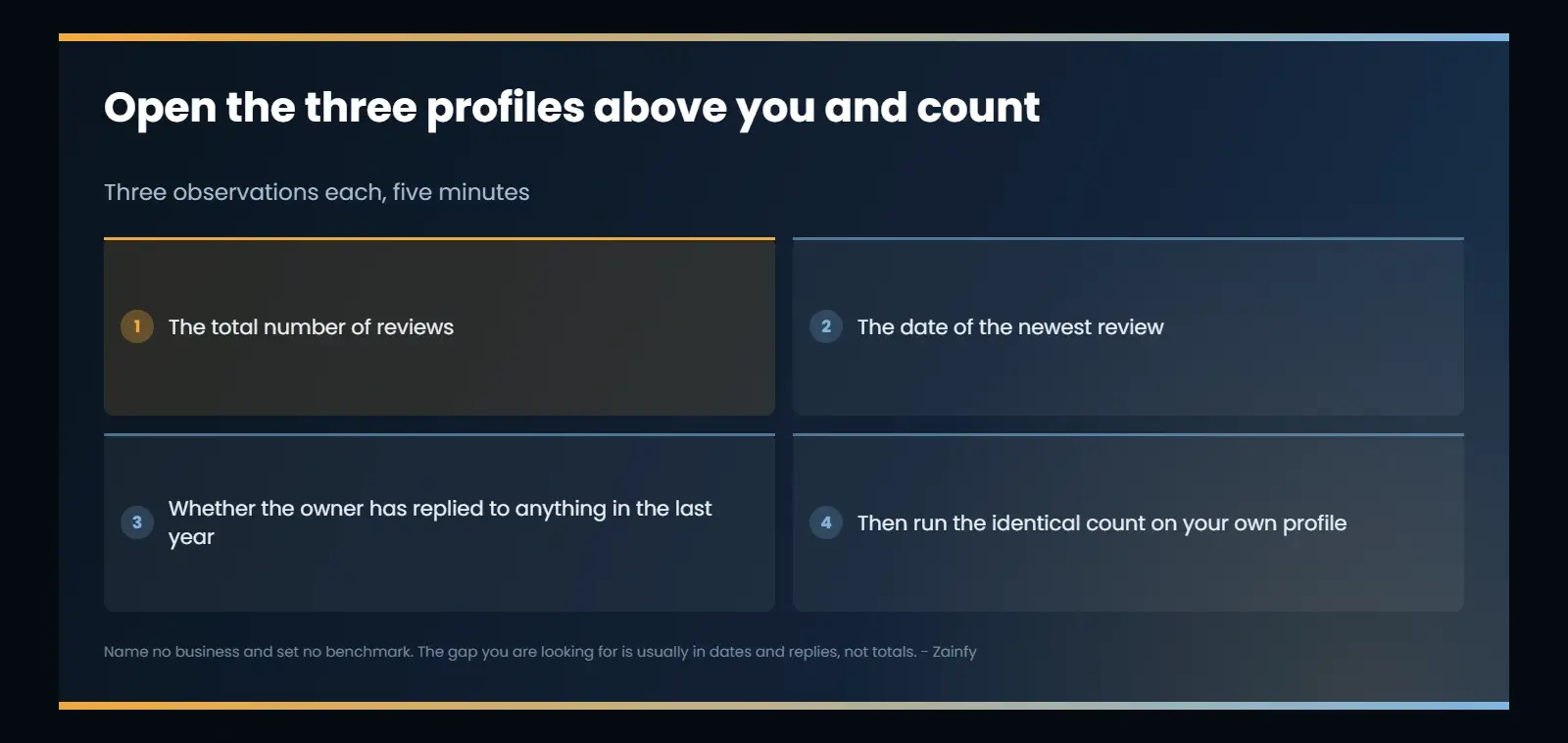
Open Google and search for the remodeling service you most want in Grand Rapids. Ignore the ads and map mechanics. Look at three contractor profiles appearing above yours and record three things for each one: the total number of reviews, the date of the newest review, and whether the owner has replied to anything during the last year.
Do not treat this as a market study. Name no business, invent no benchmark, and infer nothing about position. The exercise is about what a prospective customer can see in five minutes.
The useful difference will often be visible in dates and replies rather than totals. One profile may have collected reviews in a short burst and then stopped. Another may have a smaller history but current customer language and recent owner responses. A third may show years of feedback with no sign that the business acknowledges any of it.
Write down only what is observable. The review count shows volume. The newest date shows whether customers have spoken recently. The reply history shows whether the contractor treats the page as a living customer record or an abandoned archive.
Then open your own profile and run the identical count. Do not set a target based on the largest total you found. Identify the operating gap instead. If your latest review is old, the routine is not producing current evidence. If reviews have no replies, the business is leaving the next reader to interpret every complaint alone.
The Ask Has to Be Part of the Job, Not a Favor
The unreliable version begins with memory. The owner finishes the walkthrough, collects the final approval, drives away, and thinks about a review request three days later. By then the satisfied customer has returned to ordinary life, the emotional high point has passed, and the contractor feels awkward reopening the conversation.
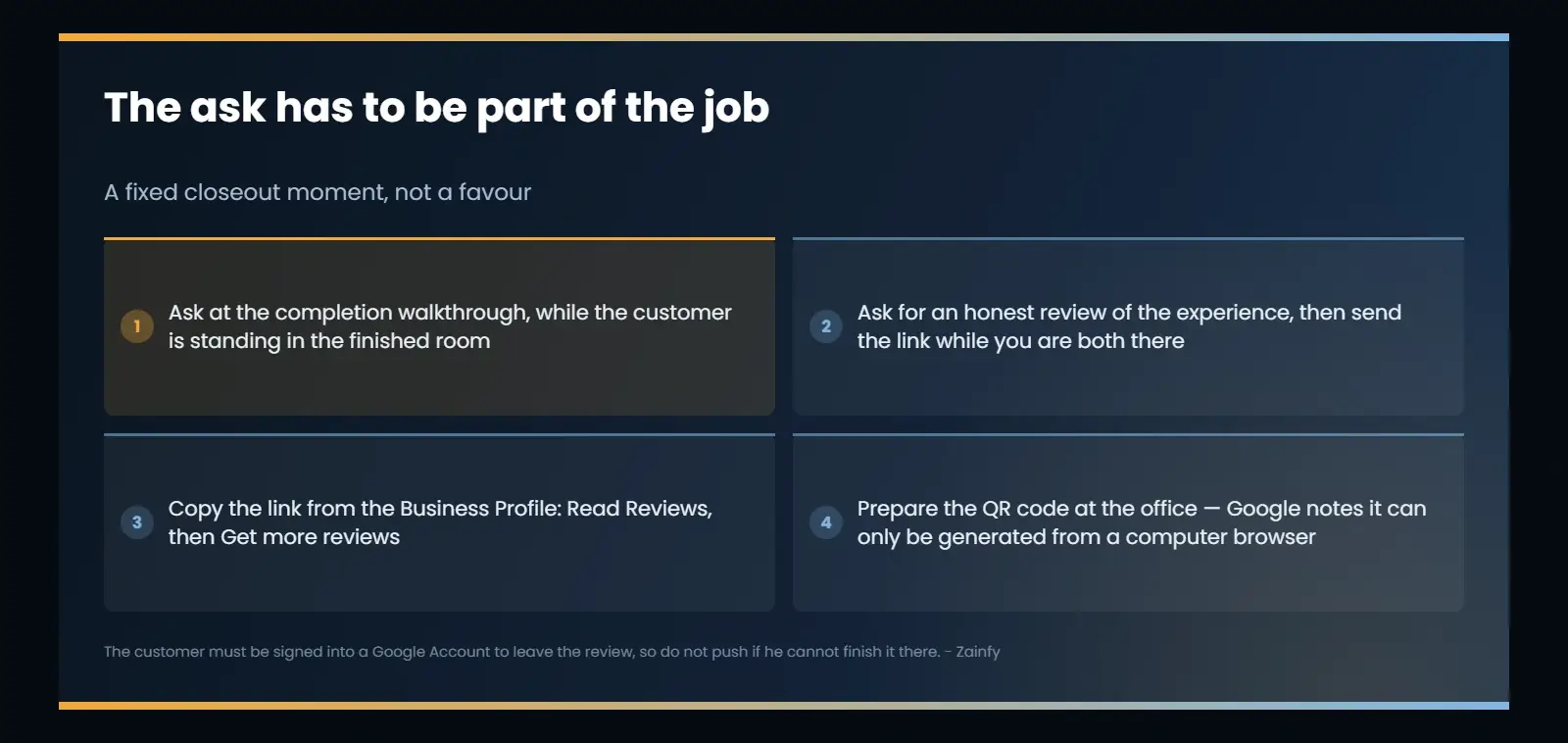
The reliable version uses a fixed moment: the completion walkthrough, while the customer stands in the finished room and agrees the work is complete. The request is direct. Ask for an honest review of the experience, then send the link while both are present.
Google places the request tool inside the Business Profile. Select Read Reviews, then Get more reviews, and copy the review link. Save it in the phone before the next closeout so sending it requires no searching. Google also provides a QR code, but its documentation notes that the code can currently be generated only from a computer browser, not a mobile device. Prepare it at the office rather than discovering that limitation in the customer's kitchen.
One more constraint matters: the customer must be signed into a Google Account to leave the review. That may interrupt an otherwise simple request, so do not push if the customer cannot complete it immediately.
The request is not begging. It is a normal closeout step attached to a completed obligation. Consistency comes from choosing the moment before the job starts, not improvising after it ends.
Don’t Buy It, Don’t Bury It, and Don’t Report It Because It Stung
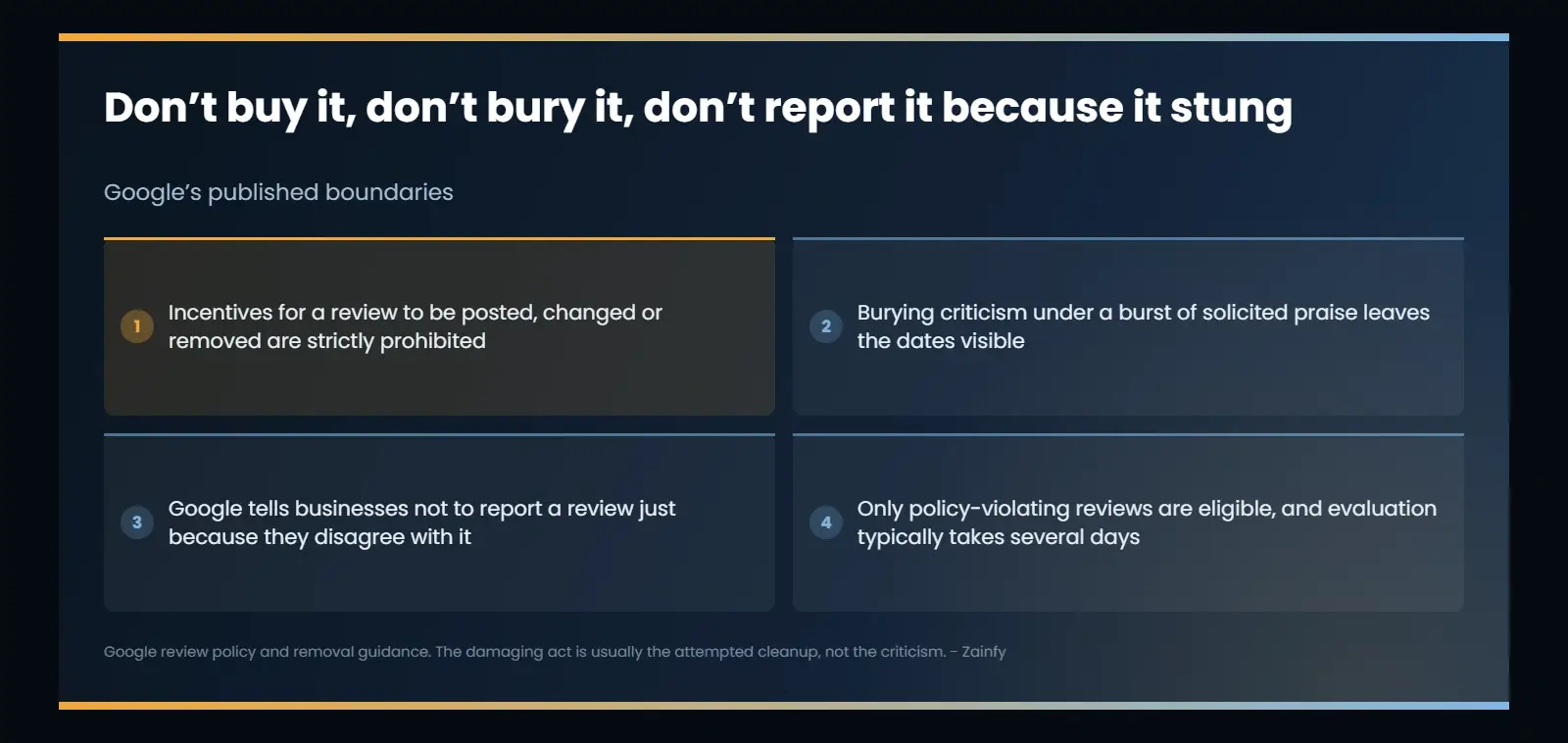
Do not offer money, a discount, free work, or any other benefit for a review to be posted, changed, or removed. Google calls that exchange fake, misleading, and “strictly prohibited,” even when the owner believes the complaint unfair.
Do not try to bury a negative review under a sudden burst of solicited praise. The dates remain visible. A scrubbed-looking profile creates a larger trust problem because the next reader begins questioning the record instead of weighing one unhappy customer against the rest.
Do not report a review simply because it hurt. Google's removal guidance says only policy-violating reviews are eligible and tells businesses, “Do not report a review just because you disagree with it.” The reporting path exists for genuine policy breaches, not ordinary conflict. Google says evaluation typically takes several days, so flagging is neither instant nor a substitute for a reply.
The legitimate route is narrow. If the review includes prohibited content, a conflict of interest, harassment, or another policy breach, report it and let the platform assess it. If it describes a real dispute, answer the substance without exposing private customer details.
Homeowners describe review integrity as a trust issue in public discussions. The damaging act is often the attempted cleanup, not the existence of criticism. A reader who senses that negative feedback was bought off or suppressed does not merely discount one review; he questions the page built around it.
Respond to the review you have. Do not create a second credibility problem while trying to remove the first.
The Reply Is Read More Closely Than the Star Average
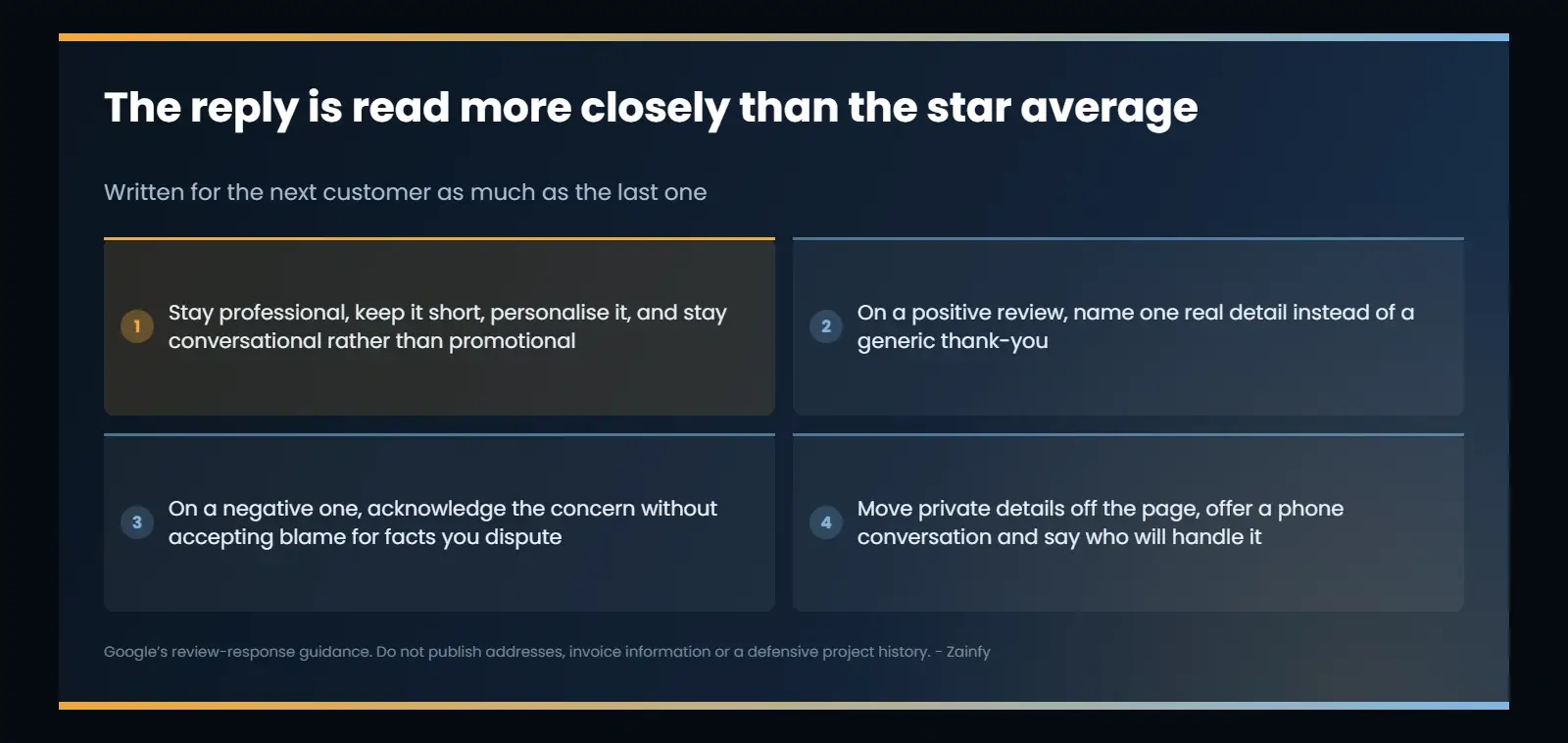
A public reply is written for the next prospective customer as much as for the person who posted the review. It shows how the contractor behaves when praise is easy and when criticism is not. Google's guidance is practical: stay professional and polite, keep the response short, personalize it, and remain “conversational, not promotional.” A reply is not the place to offer a discount or turn a complaint into a sales message. On a positive review, mention one real detail or provide a helpful update instead of pasting a generic thank-you. On a negative review, acknowledge the concern without accepting blame for facts you dispute, explain any genuine limitation, and move private details away from the public page. Offer a direct phone conversation and state who will handle it. Do not publish addresses, invoice information, family circumstances, or a defensive project history. If an apology is warranted, make it plainly. If the account is inaccurate, correct the record calmly and without attacking the reviewer. Timeliness matters because silence leaves the complaint as the only version available. The reply cannot rewrite the original experience. It can demonstrate that the business remains accountable, specific, and capable of handling disagreement without performing for the crowd.
Count the Dates, Not the Totals
Review totals accumulate, but recency answers whether customers are speaking now. Forty reviews ending eighteen months ago describe a history and leave the present unresolved. Current customer language gives the page a usable present tense. The buyer does not know whether the gap reflects fewer jobs, forgotten requests, or a routine that disappeared.
Return to the three-profile count. Look at the newest review on each page, then compare it with yours. No universal interval is established here, and no invented benchmark is needed. The visible question is whether completed work keeps producing current customer language.
A profile should not collect feedback only when someone remembers a campaign or notices a dry spell. Attach the request to every eligible closeout and let the dates reflect the flow of finished work. Recency is not a promise of quality. It is evidence that the customer record remains active enough for a new reader to judge.
The Routine That Survives a Busy Month
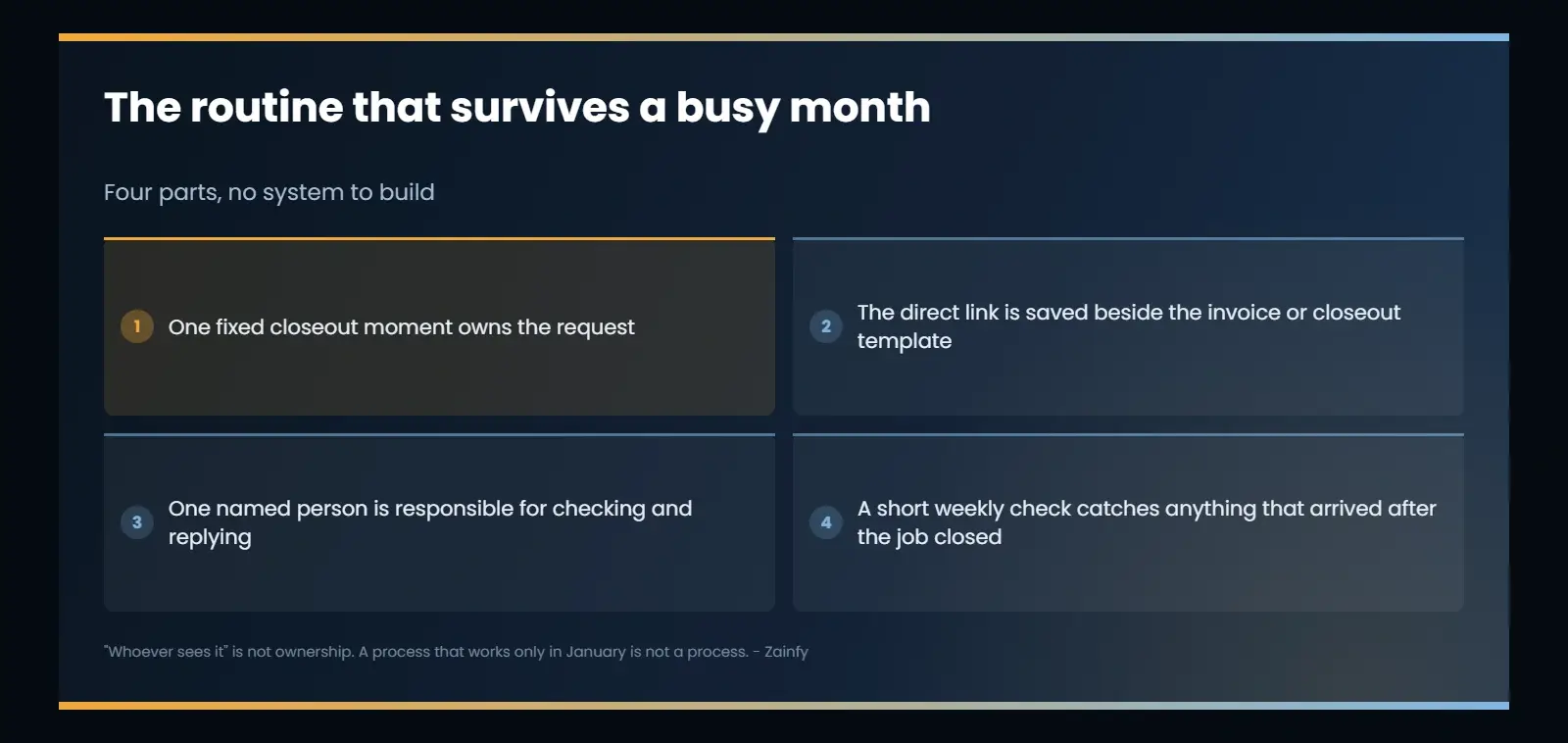
A durable review routine needs four things, but it does not need a complicated system. The request belongs to one fixed closeout moment. The direct link stays saved beside material already used at that moment, such as the invoice template. One person is responsible for checking and replying. A short weekly review catches anything that arrived after the job closed.
The owner should decide responsibility before the schedule becomes crowded. “Whoever sees it” is not ownership. If office staff sends the link, the project lead must still signal that the walkthrough is complete. If the owner writes replies, another person can flag new reviews without drafting them.
For someone to own the weekly follow-up, the assignment has to include both the request and the response, not merely a reminder that reviews matter. That is where this article stops: the operating owner and the ten-minute weekly slot belong to the business.
Keep the routine small enough to survive May, when estimates, production questions, and closeouts collide. A process that works only in January is not a process. The link remains ready, the ask remains attached to completion, and every new review receives a human answer.
How Do Contractors Get More Google Reviews?
Contractors get more Google reviews by asking at a fixed point in every completed job, sending the Business Profile's direct review link while the customer is still with them, replying to every review, and offering nothing in exchange. Google prohibits incentives for posting, changing, or removing reviews.
Timing matters because a satisfied customer is most able to describe the work during closeout. The finished result is visible, the final questions have been answered, and the contractor can make the next step easy without manufacturing urgency. The request should ask for honest feedback, not a five-star rating.
The reply matters because future customers read how the business handles both approval and disagreement. A short, specific response shows attention. A defensive essay exposes private details and magnifies the dispute. A promotional reply turns customer feedback into an advertisement and weakens its credibility.
Removal has an honest limit. Google says only reviews that violate policy are eligible. A business may report prohibited content, and evaluation typically takes several days. It should not report ordinary criticism merely because the owner disagrees. When the review describes a real customer conflict, the appropriate move is a professional public answer followed by a private effort to resolve what can still be resolved.
The system depends on repetition: close the job, send the link, monitor the page, answer what arrives, and protect the record.
What Grand Rapids Contractors Ask About Reviews
[wps_faq style=”classic” question=”Can a business remove a bad Google review?”]
Only when the review violates Google's policies, and removal is not automatic. Google's guidance says policy-breaking reviews may be reported, warns businesses not to report feedback merely because they disagree with it, and notes that evaluation typically takes several days. A legitimate dispute between a contractor and customer usually remains a dispute, not a removal case. Reply professionally, protect private details, correct factual errors calmly, and offer a direct conversation. The flag is a policy tool, not an appeal button for criticism.
[/wps_faq]
[wps_faq style=”classic” question=”Is it against the rules to offer a discount for a review?”]
Yes. Google says incentives such as free or discounted goods or services offered in exchange for posting, changing, or removing reviews are fake and misleading content and “strictly prohibited.” That includes rewarding a positive review and paying to silence a negative one. Ask for honest feedback without prescribing the rating, and never attach the request to a discount. The safest review is voluntary, written by the customer, and left untouched by a bargain that changes what the page appears to prove.
[/wps_faq]
[wps_faq style=”classic” question=”What does a Grand Rapids homeowner comparing three remodelers actually look at?”]
He can see the review total, the newest review date, the mix of feedback, and whether the owner answers customers. In Kent County, the median owner-occupied home value is $325,400, according to the 2024 American Community Survey, so the review page sits inside a substantial household decision. The county figure does not establish how any person chooses. It explains why stale feedback and unanswered complaints deserve operating attention. In Grand Rapids, current dates and credible replies give the reader evidence he can inspect directly.
[/wps_faq]
Save the Review Link Beside the Invoice Template
Open the Business Profile today, select Read Reviews, then Get more reviews, and copy the direct link. Save it in the phone beside the invoice or closeout template used on every finished job. Give it a name the project lead can find without asking.
This small placement removes the friction that breaks the routine. The owner no longer has to search the profile while a satisfied customer waits. Office staff no longer needs to request the link from someone in the field. The closeout conversation can end with a direct, honest invitation while the result is visible.
Do not build an elaborate campaign around the link. Make it available at the moment the job already provides. Then assign the weekly check and answer whatever arrives. The review system starts working when the next action takes seconds instead of three forgotten taps.