A metro-Atlanta remodeling contractor gets found across Fulton, Cobb, and DeKalb by treating each jurisdiction as a real market, not by stuffing every suburb into one Atlanta SEO page. That is the answer most broad contractor guides miss.
If you work in Buckhead, East Cobb, Decatur, Marietta, Sandy Springs, and Alpharetta, your search problem is not one city. It is a service-area business problem across separate counties, separate permit offices, separate homeowner budgets, and separate proof expectations.
The contractor who ranks is usually the one whose website and Google Business Profile make that geography clear. The contractor who disappears is the one whose site says “serving metro Atlanta” and leaves Google to guess what that actually means.
This guide is for the owner who already knows referrals are not enough and wants to understand how multi-location local SEO works when he does not have an office in every city he serves.
Four permit desks, one service area
Metro Atlanta looks like one market from the truck windshield. It does not work that way online.
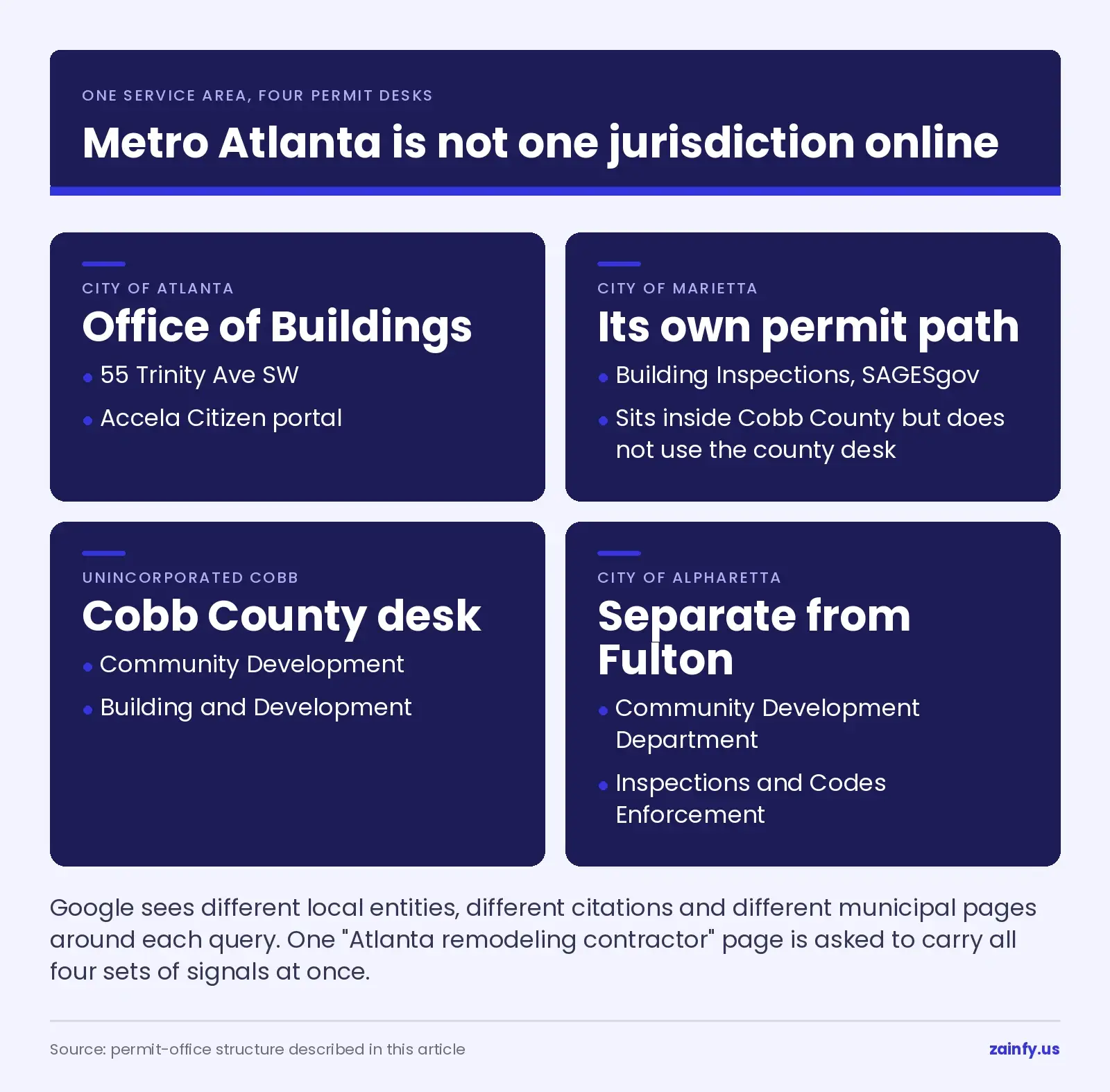
Start with the permit structure. The City of Atlanta issues building permits through the Office of Buildings at 55 Trinity Ave SW and uses the Accela Citizen portal. Marietta issues its own permits through Building Inspections and SAGESgov, even though Marietta sits inside Cobb County. Unincorporated Cobb runs through Cobb County Community Development and Building & Development. Alpharetta has its own Community Development Department and Inspections & Codes Enforcement, separate from Fulton County.
That Marietta/Cobb split is why Marietta contractor SEO has to prove city-level relevance instead of leaning on one generic northwest-metro page.
That split is not just paperwork.
It changes how your site should prove local relevance. A page about intown Atlanta work should not sound the same as a page built around East Cobb or Alpharetta. A Marietta project can sit inside Cobb County while still having a city permit path that differs from unincorporated Cobb. A homeowner may not understand that distinction, but Google sees different local entities, different citations, different municipal pages, and different neighborhoods around the query.
If your website collapses all of that into one “Atlanta remodeling contractor” page, it asks one page to carry too many signals.
That also happens with citations. A contractor listing that makes sense for Fulton County may not carry the same weight when the searcher is in East Cobb or Decatur. Your name, address, phone, service categories, project examples, and review language have to line up with the actual places you work. Not a fake office. Not a rented mailbox. Real service-area evidence.
That is the core difference between a metro SEO plan and a city SEO plan. The authority has to be earned in slices.
One page for the whole metro is the mistake
There are three page types contractors confuse.
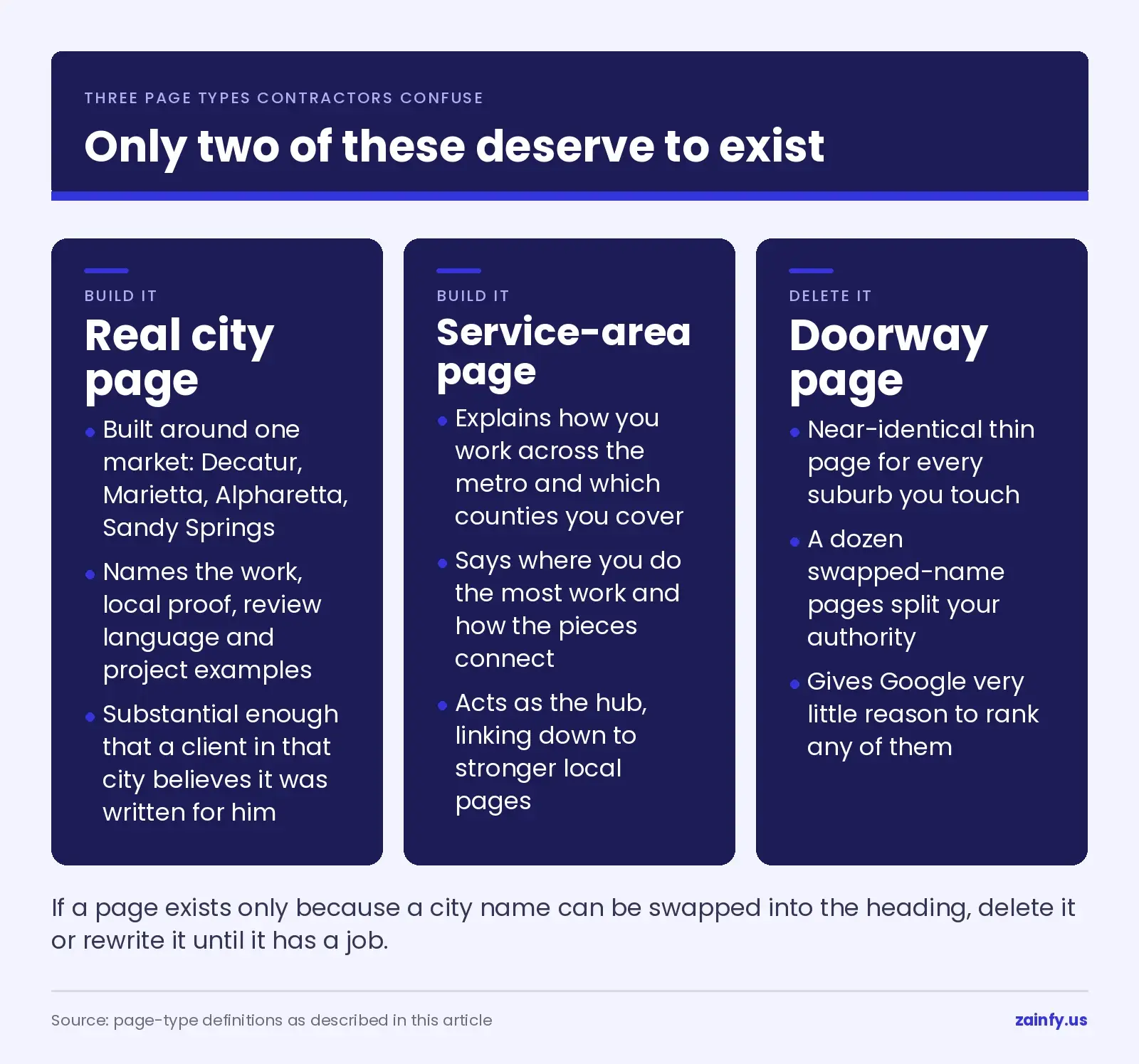
A real city page is built around a specific market: Decatur, Marietta, Alpharetta, Sandy Springs. It names the work, the local proof, the review language, the project examples, and the surrounding service area. It has enough substance that a client in that city would believe the page was written for him.
A service-area page is broader. It explains how you work across the metro, which counties you cover, where you do the most work, and how the pieces connect. That page can act as the hub, with internal links to stronger local pages.
A doorway page is the bad version.
Do not spin up a near-identical thin page for every suburb you touch. A dozen swapped-name pages for Buckhead, Decatur, Smyrna, Roswell, and Dunwoody split your authority and give Google very little reason to rank any of them. That is not a local strategy. It is clutter.
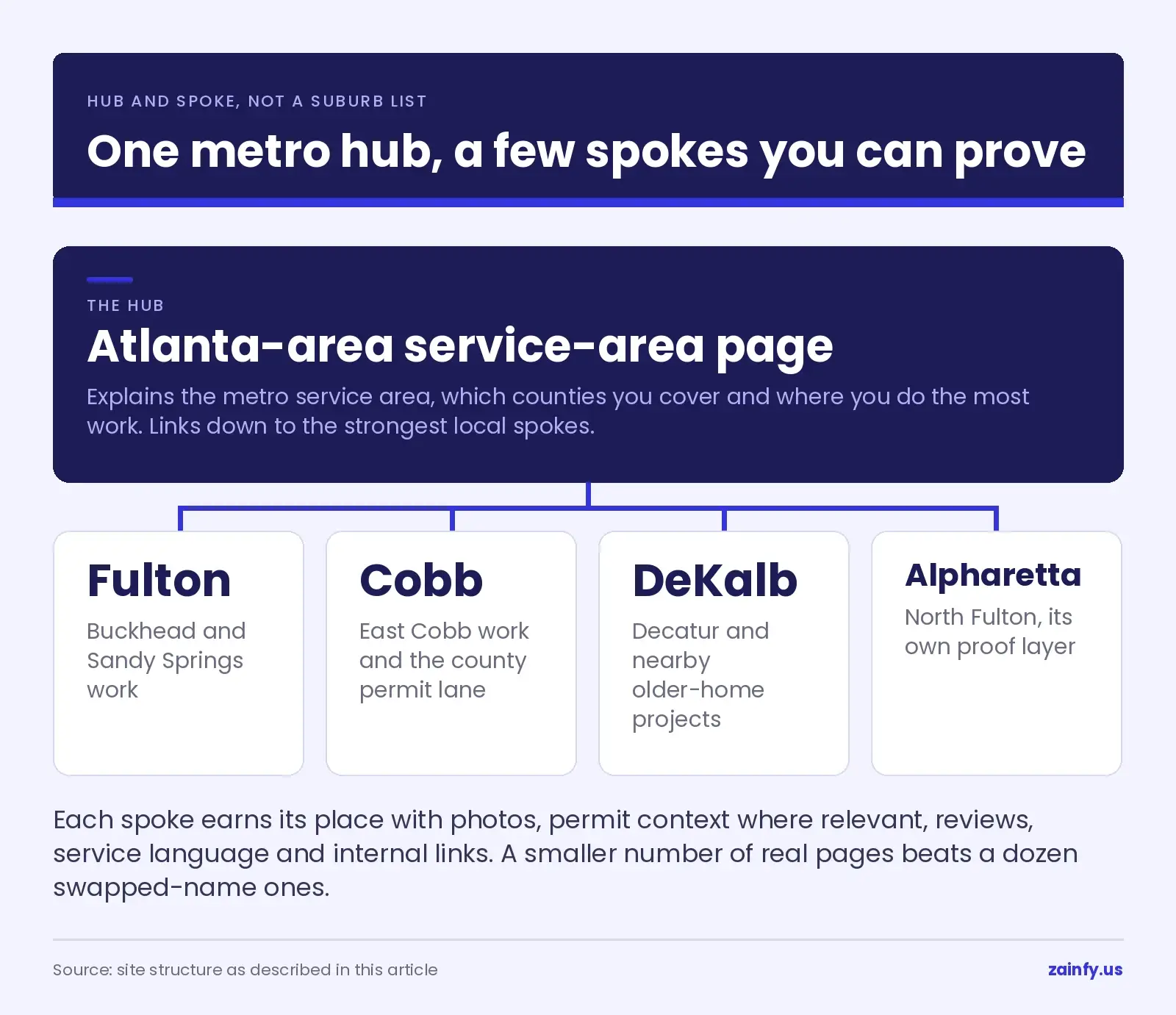
The right structure is hub-and-spoke. One strong Atlanta-area hub explains the metro service area. Then a smaller number of real local pages cover the jurisdictions where you have proof: Fulton or Buckhead work, Cobb or East Cobb work, DeKalb or Decatur work, Alpharetta and North Fulton work. Each page earns its place with photos, permits context where relevant, reviews, service language, and internal links that help the reader move naturally.
For the North Fulton spoke, Alpharetta remodeler visibility needs its own proof layer because Alpharetta is not just another Atlanta keyword.
If a page exists only because a city name can be swapped into the heading, delete it or rewrite it until it has a job.
Ranking where you do not keep a truck parked
Yes, you can rank in a metro city where you do not have an office.
But you have to behave like a service-area business, not like a fake multi-office company.
If clients do not visit your address, your Google Business Profile should be set up as a service-area business. That usually means hiding the address and listing the service areas you genuinely cover. Google allows up to 20 service areas, so the list should be disciplined. Atlanta, Marietta, Alpharetta, Decatur, Sandy Springs, and Smyrna may make sense for one remodeler. A statewide list usually does not.
The Map Pack still has a proximity problem. Distance matters. You cannot erase that by typing a city name into your profile.
Relevance and prominence are where you have room to work. Relevance comes from the profile category, services, photos, reviews, pages, and on-page language matching the search. Prominence comes from reviews, citations, links, mentions, and the broader trust around the business. We have documented that build-up in a multi-county climb we can show the numbers for.
So the answer is not “add more cities.”
The answer is to make each real service area believable enough that Google has evidence beyond your own claim.
The new-build slowdown is your renovation opening
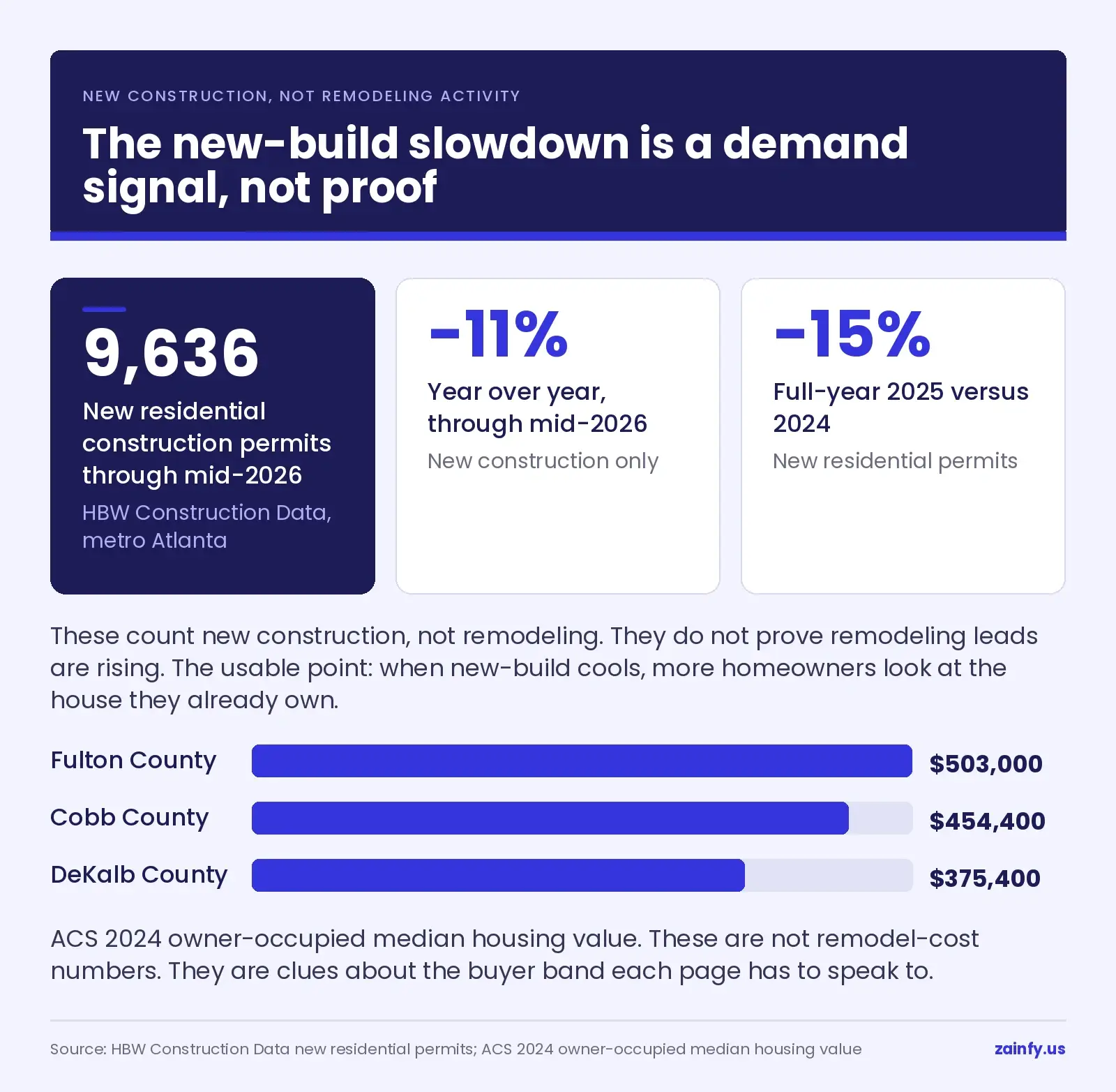
Metro Atlanta’s new-home construction data should be used carefully: HBW Construction Data reported 9,636 new residential construction permits through mid-2026, down about 11% year over year, and full-year 2025 new residential permits were down about 15% versus 2024. Those figures count new construction, not remodeling activity. Do not say they prove remodeling leads are rising. The useful contractor-side point is different: when new-build activity cools, more homeowners tend to look at the house they already own and decide whether to update it, repair it, expand it, or make it livable for another few years. Your SEO has to be ready for that existing-home buyer. The county budgets are not the same either. ACS 2024 shows owner-occupied median housing values of $503,000 in Fulton County, $454,400 in Cobb County, and $375,400 in DeKalb County. Those are not remodel-cost numbers. They are clues about the buyer band your pages have to speak to in Buckhead, East Cobb, Decatur, and the surrounding metro. A page that treats every Atlanta-area lead the same is not matching the market in front of it.
How ranking actually happens across the metro
Ranking across metro Atlanta happens one market signal at a time.
First, your NAP has to be clean. Name, address, and phone should match on your website, Google Business Profile, BBB, Nextdoor, Yelp, Angi, manufacturer profiles, supplier listings, and any local contractor citations that matter for the counties you serve. If the business name is written three ways and one listing has an old phone number, Google has to reconcile noise before it can trust the entity.
Second, the proof has to be location-verified. A project page that says “kitchen remodel” is weaker than a page that explains an East Cobb kitchen, a Decatur bath, or a Sandy Springs addition with photos and scope language that fit the place. Do not fake neighborhood proof. Use the projects you actually have.
Third, reviews should reinforce the markets you want. A steady pattern of recent reviews matters more than a stale pile from three years ago. If the review naturally mentions Marietta, Buckhead, Decatur, or Alpharetta, that language helps connect the business to the place.
Fourth, the site structure has to be clear enough for both readers and crawlers. LocalBusiness schema can identify the business. ServiceArea schema can list the cities, counties, and ZIP areas you serve when the visible page says the same thing. Service pages should connect to location pages, and the Atlanta hub should connect down to the strongest local spokes.
That is where ranking remodelers inside the city of Atlanta fits if you want the commercial page after this guide.
Fifth, outside authority has to make sense. A local supplier mention, county association profile, manufacturer listing, or community feature tied to a real project is worth more than a random low-trust link.
The proof standard is practical. All About Tile LLC, a Georgia tile contractor, saw 400% more leads, a 163% conversion rate increase, 131% page views growth, and an average position of 3.6 over 12 months. Different trade, same lesson: contractor SEO works when page intent, location proof, and conversion paths support the same buyer.
AI search visibility follows that pattern. Clear entities, local proof, and consistent facts are easier to quote than a generic page trying to sound large.
Cobb’s January 2026 rule is a content opportunity
Cobb County gave remodelers a clean example of why dated local content matters.
Effective January 1, 2026, Cobb County’s pool and spa amendment requires anyone constructing a pool or spa to first obtain a Cobb County permit and hold a valid Georgia General Contractor License or a recognized pool-builder certification such as PHTA CBP. The amendment was approved November 20, 2025.
That is not a generic SEO topic. It is a live jurisdiction-specific fact.
A contractor who works in unincorporated Cobb can explain what changed, who it affects, and how it fits into the permit path without pretending to be the county. National templates will not cover that. A broad Atlanta page probably will not either.
That is the opening.
The page does not need to chase every code update. It needs to show that your company understands the local lane where the job happens. For pool, deck, exterior, or addition work in Cobb, that kind of content can separate a real local contractor from a page that only says “licensed and insured.”
How long it takes and what it costs you
Early SEO movement for a metro-Atlanta remodeler usually takes about 3 to 4 months. Compounding often takes 6 to 12 months or longer.
That is the honest answer. It is also why waiting gets expensive.
If you are buying shared leads from Angi or Yelp while your own visibility sits still, the cost is not just the invoice. It is the missed compounding. Every month, another contractor is adding reviews, getting project pages indexed, cleaning citations, and earning Map Pack trust in the cities you want.
SEO cost should be judged against the market you are asking it to cover. Ranking in one town is different from building visibility across Fulton, Cobb, and DeKalb. The work includes site cleanup, Google profile discipline, service-area architecture, project proof, citations, reviews, and ongoing content.
The better question is simpler: how much are you already paying to avoid building the asset you should own?
Lead marketplaces can fill a gap. They should not become your whole pipeline.
Competing with the big Atlanta contractors
The small remodeler should not try to look like the biggest Atlanta firm.
That usually backfires.
Big firms can afford broad pages, brand searches, and large review counts. Your opening is narrower: a real Decatur-DeKalb page with local proof, an East Cobb page that understands Cobb’s permit lane, or an Alpharetta/North Fulton page that shows projects instead of borrowed suburb names.
A broad “Atlanta remodeling” page from a larger company may rank because the company has history. That does not mean the page is useful for every search. A homeowner in East Cobb comparing a five-figure project wants to see whether you have worked nearby, whether your reviews mention similar scopes, and whether the page reflects the market he lives in.
Do not answer broad authority with vague scale.
Answer it with specificity. The big contractor can own the generic phrase. You can own the jurisdiction, the neighborhood, and the proof that matches the job you actually want.
Metro Atlanta contractor SEO: quick answers
[wps_faq style=”classic” question=”Can a metro-Atlanta contractor rank in a city where they have no office?”]Yes, a metro-Atlanta contractor can rank in a city where he has no office, but he needs real service-area evidence. A Google Business Profile can be set up as a service-area business, and Google allows up to 20 service areas. That does not mean you should list every place from Atlanta to Athens. If you want Marietta, Decatur, Sandy Springs, and Alpharetta, the website, reviews, photos, and citations need to support those markets. Proximity still affects the Map Pack, so the goal is to build relevance and prominence where distance is not enough.[/wps_faq]
[wps_faq style=”classic” question=”Should I build a separate page for every metro suburb I serve?”]No, you should not build a separate thin page for every metro suburb you serve. A swapped-name page for Buckhead, Smyrna, Roswell, Dunwoody, and Decatur is a doorway-page pattern, not a serious local SEO plan. Build pages only where you can add real depth: local project photos, county or city context, services that fit the area, reviews, and internal links from the Atlanta hub. If you cannot make the page useful for that suburb’s buyer, fold the location into a stronger service-area page instead.[/wps_faq]
[wps_faq style=”classic” question=”How do I do SEO across Cobb, Fulton, and DeKalb without duplicate content?”]You avoid duplicate content across Cobb, Fulton, and DeKalb by giving each page a different job. A Cobb page can address East Cobb and the county permit lane. A Fulton page can speak to Buckhead, Sandy Springs, or Alpharetta depending on where you actually work. A DeKalb page can focus on Decatur and nearby older-home projects. The copy, project proof, reviews, headings, and internal links should change because the market changes. If only the county name changes, the page is too thin.[/wps_faq]
[wps_faq style=”classic” question=”How long before a metro-Atlanta remodeler sees SEO results, and what should it cost?”]A metro-Atlanta remodeler should expect early SEO movement in about 3 to 4 months, with compounding over 6 to 12 months or longer. Cost depends on the gap: one weak Atlanta page is a smaller cleanup than a full Fulton, Cobb, and DeKalb service-area structure with citations, reviews, schema, and project pages. AI summaries and Map Pack results both reward clear, consistent local entities, so the work has to be built to last.[/wps_faq]
Closing: pick the first jurisdiction
Start with the jurisdiction where you can prove the most.
Not the prettiest suburb name. Not the city with the biggest houses. The place where you have project photos, client language, review history, permit familiarity, and a real reason for Google to believe you belong.
If that is East Cobb, build the Cobb page first. If it is Decatur, build the DeKalb proof first. If it is Buckhead or Sandy Springs, make the Fulton-area content specific enough that it does not read like a copied Atlanta page.
Then connect it back to the metro hub and widen from there. The prior question is whether Cobb, Fulton and DeKalb each deserve a page.
For contractors working outside Atlanta, remodeling search work beyond the metro line explains how the same local-search problem changes across Georgia markets.
Do not make Google guess where you work best. Pick the first jurisdiction and prove it.