Author: Zayn Shah
A Marietta remodeling contractor should expect early SEO movement around month three, meaningful leads around months four to eight, and a more predictable flow around months nine to twelve. That is the honest curve, not a promise that every site moves on the same date. Custom Home Renovations, a Marietta roofing and siding remodeler, produced page-moving results at month four, so the wait is not theoretical here.
Your starting point still matters. A known business with a useful site, current reviews, and clean local listings can move sooner than a new company with a thin domain. The Atlanta metro result field matters too. You are not waiting for Google to notice that remodeling exists; you are asking it to replace companies it already trusts for searches around Marietta and Cobb County.
That distinction is why owners misread the first quiet months. SEO can be working before the phone proves it. The practical job is to know what should move first, what comes next, and when a slow campaign is genuinely off track.
Why SEO makes you wait
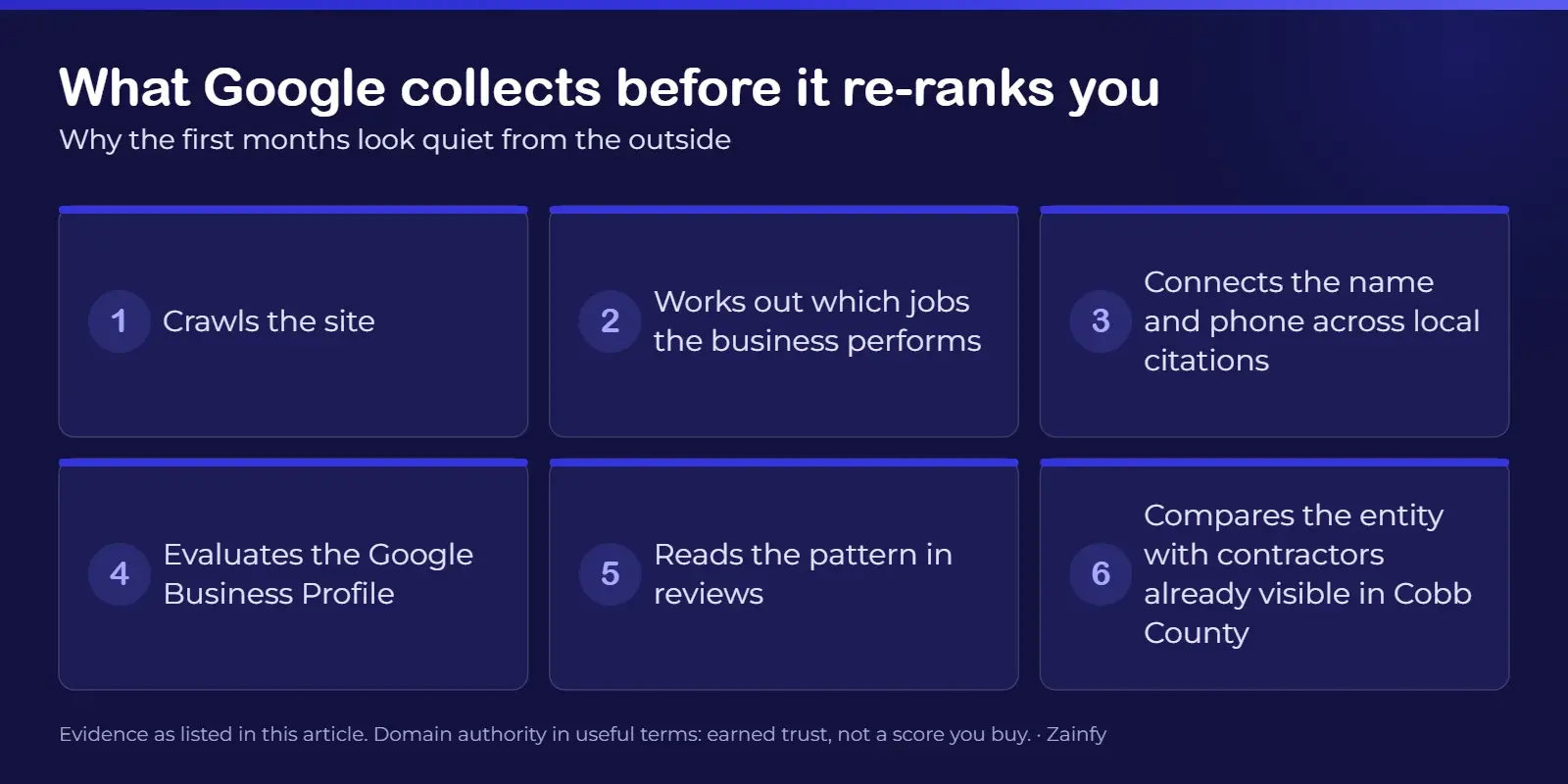
SEO takes time because Google has to collect evidence before it changes a local result that already sends homeowners to somebody else. It must crawl the site, understand which jobs the business performs, connect the business name and phone number across local citations, evaluate the Google Business Profile, read the pattern in reviews, and compare the whole entity with contractors already visible across Cobb County. That is what domain authority means in useful terms: earned trust, not a score you buy or a switch an agency flips. A remodeler serving the Atlanta metro is also competing in a crowded field. The U.S. Census ACS counted 319,153 housing units in Cobb County in 2024, and every established contractor, franchise, marketplace, directory, and lead seller wants a place in front of those owners. Google is cautious because a bad local recommendation sends a real person toward the wrong company. The first month therefore looks unimpressive from the outside. Pages are repaired, location signals are clarified, duplicates are cleaned up, and Google begins recrawling the result. None of that creates a victory screenshot by Friday. It creates the evidence needed for a service page, profile, and project portfolio to move later. An owner who was burned before should ask what changed on the site and profile, what Google has indexed, and whether impressions are rising. He should not accept “SEO takes time” as an excuse with no work behind it. The wait is structural. Silence from the agency is not.
The real Marietta timeline, month by month
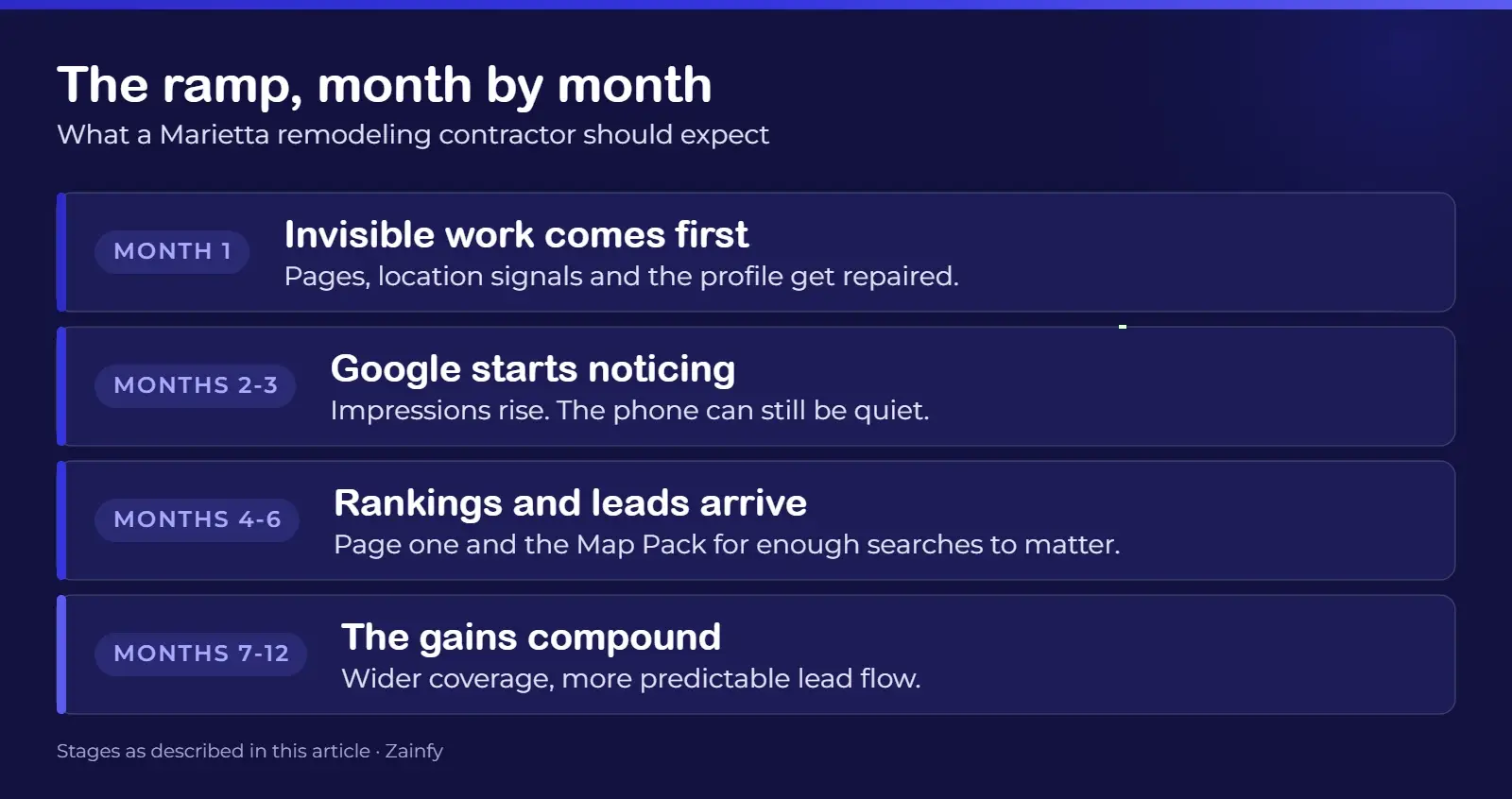
Month 1: invisible work comes first. The campaign should repair the foundation: technical problems, slow mobile pages, weak service copy, Google Business Profile gaps, inconsistent citations, and muddled keyword-to-page mapping. If the City of Marietta and unincorporated Cobb are both real markets, the site has to describe them honestly instead of treating every address as generic Atlanta. The City runs its own permitting through SAGESgov, separate from Cobb County Community Development. That difference is a local-content clue, not permission to manufacture a dozen thin pages.
Months 2-3: Google starts noticing. Search Console impressions rise. Pages begin appearing for a wider set of remodeling terms. Average positions move, branded searches become easier to find, and the profile may show up in more map results. The phone can still be quiet. That is normal because visibility expands before enough of it reaches page one or the Map Pack.
This is the useful expectation behind moving a Marietta remodeler up the rankings: month one establishes the evidence, months two and three reveal movement, and months four through twelve turn that movement into reach and leads.
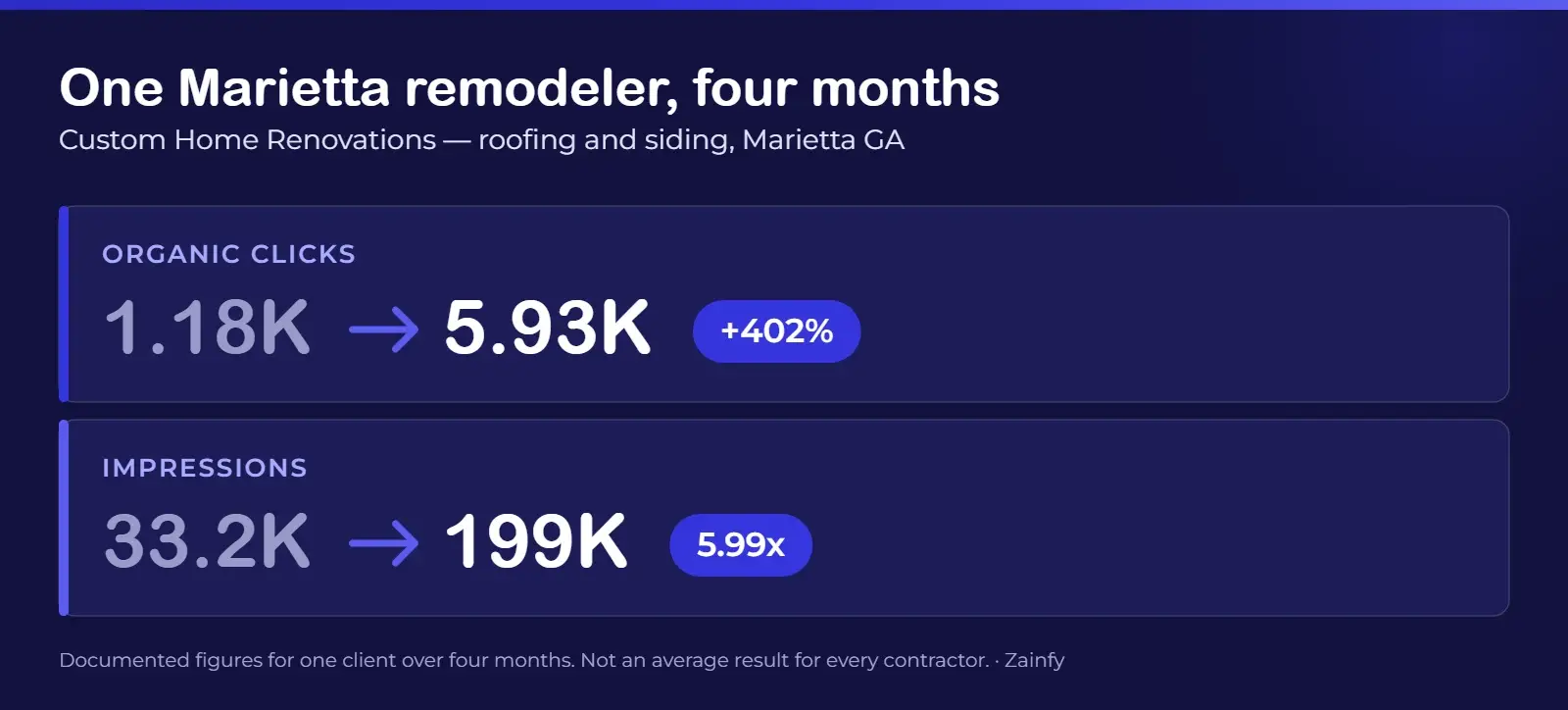
Months 4-6: real rankings and leads arrive. Custom Home Renovations provides the local proof. Zainfy grew its organic clicks by 402%, from 1.18K to 5.93K, and increased impressions 5.99x, from 33.2K to 199K, in four months. Those are documented SEO-performance figures for one Marietta roofing and siding remodeler, not an average result for every contractor. The case shows what can happen when the starting gaps are clear and the work continues through the early curve.
Months 7-12: the gains compound. Pages that have earned positions can hold them while new project proof, reviews, local links, and service-area content add reach. Lead flow becomes easier to forecast because the business is no longer depending on one ranking or one profile view. Month twelve is not a finish line. It is the point where a consistent campaign should own more search ground than it did at month six and have evidence showing which jobs and areas produce inquiries.
By then, the campaign should also reveal which Marietta services deserve more depth and which pages are consuming effort without earning visibility.
What speeds the timeline up or drags it out
An established Marietta site starts ahead if Google has already crawled useful pages, the business name is consistent, and real clients have left recent reviews. A new domain starts with no history. It has to earn every signal while older competitors defend theirs.
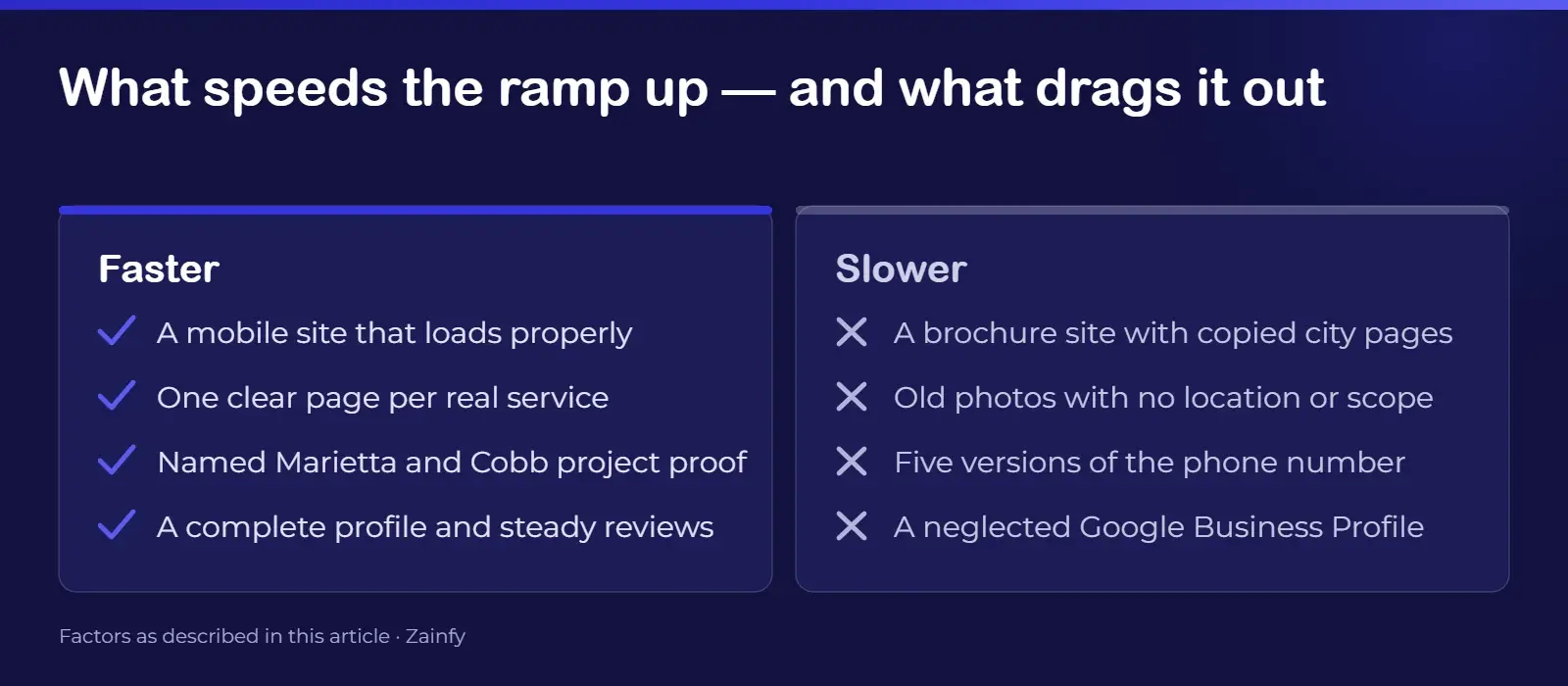
The faster side is specific: a mobile site that loads properly, one clear page for each real service, named Marietta and Cobb project proof, a complete Google Business Profile, steady review requests, accurate NAP citations, and links from organizations or suppliers that know the company. Service-area pages help only when each one carries evidence. A page about East Cobb should show work, reviews, and local detail that could not be pasted onto a Marietta Square page.
The slower side is just as specific: a brochure site with copied city pages, old photos with no location or scope, five versions of the phone number, a neglected profile, and bursts of work separated by months of inactivity. Stop-start publishing makes Google reassess a campaign that should have been accumulating trust.
Cobb County’s size raises the bar. The 2024 ACS count of 319,153 housing units describes a large local market, while the county’s $454,400 median owner-occupied home value describes the budget band many renovation clients are protecting. Those owners have choices, and the contractors chasing them have years of history. A narrow specialty can move faster than a generic “we do everything” page because relevance is easier to prove. Site age alone does not win. A useful older domain with real local evidence does. A neglected one merely has an earlier registration date.
The planned companion post on splitting a service area into county pages belongs here once it is published. Until then, do not invent those pages just to look busy.
Rankings move before the phone does
At month three, judge leading indicators, not just signed jobs. A Marietta build-up measured month by month shows which indicators moved first.
Open Google Search Console. Are impressions rising for Marietta remodeling searches? Are service pages appearing for more queries? Are average positions moving toward the first page? Then check the Google Business Profile: are discovery views and Map Pack appearances increasing around Cobb County?
Those changes matter because a result can move from invisible to page three, then page two, before it produces a call. Branded searches can rise as homeowners see the company in Maps, hear the name elsewhere, and return to Google to verify it. Reviews may also start mentioning specific jobs and areas, which strengthens the same local entity.
Custom Home Renovations’ 5.99x impressions increase is the clearest local example of the signal building before and alongside click growth. Impressions are not revenue, and an agency should not pretend they are. They show that Google is testing the business in more results. If impressions and positions remain flat after the foundation is supposed to be fixed, ask what was published, crawled, and indexed. If they are moving, month three is not failure. It is evidence that the campaign has entered the part of the curve the phone will follow.
SEO or Google Ads while you wait?
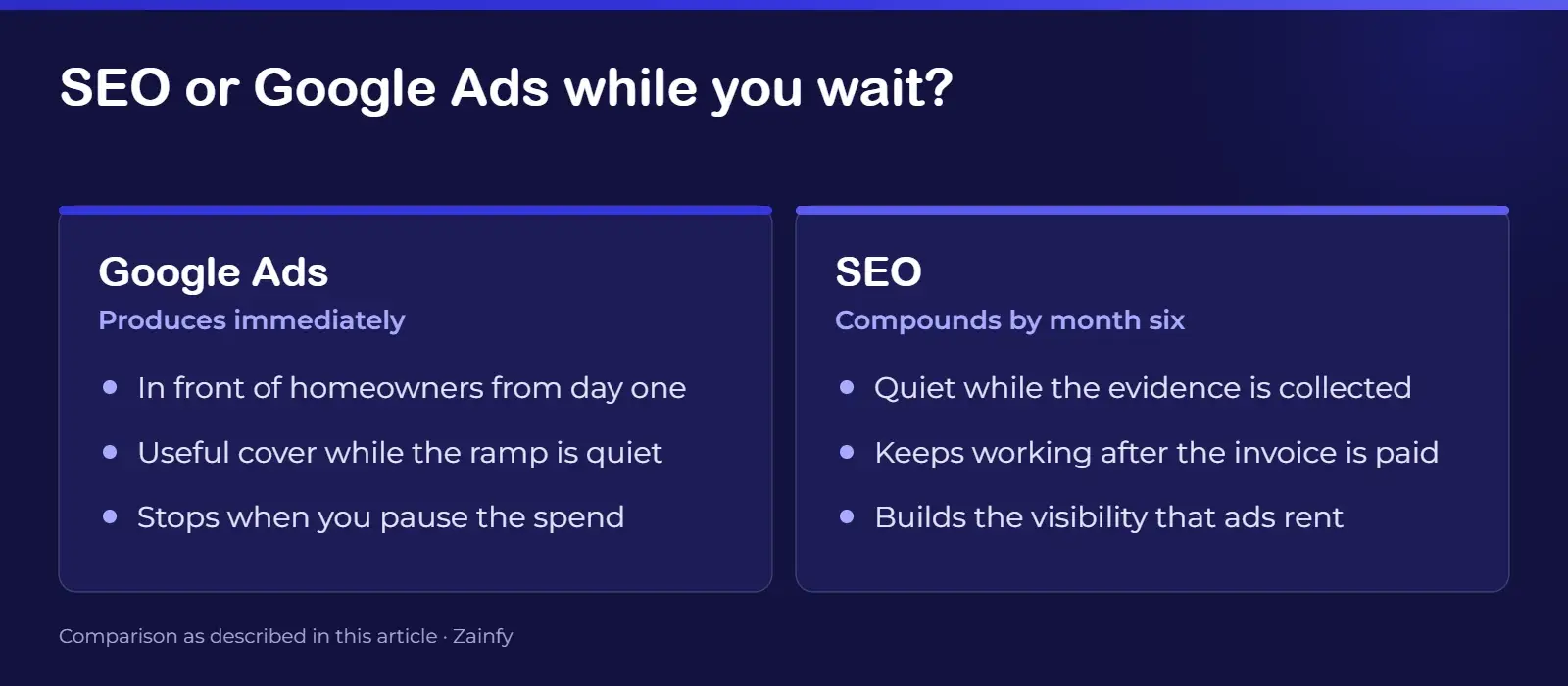
Google Ads for contractors and Local Services Ads can create visibility as soon as a campaign is approved and funded. That speed has a clear tradeoff: the placement stops when the budget stops. SEO starts slowly because it is building an owned body of pages, profile signals, reviews, citations, and authority that can keep producing after the first six months. A Marietta remodeler who needs calls now does not have to pretend the timelines are equal. He can arrange a lean paid-search layer separately during months one through six while SEO earns organic and Map Pack positions, then reduce that spend only when tracked organic inquiries justify it. Zainfy’s work remains SEO, WordPress web design, and organic social media marketing; paid-search management is not a Zainfy service. The sequence is a business decision, not an agency bundle. Angi and Houzz carry a similar speed-versus-ownership problem: they may send leads quickly, but the marketplace controls the audience and the fee. The real SEO cost is therefore not one invoice. It is the commitment to fund useful work through the months when the asset is still forming. Do not drain that work to chase every quick channel, and do not shut off a productive lead source because one keyword moved. Track calls by source, keep the paid layer lean, and let evidence decide when the owned channel can safely carry more of the load.
Don’t cancel in month three
Canceling SEO at month three is the most expensive timing mistake a Marietta remodeler can make here.
That is when Google has started testing the rebuilt pages, but the result may not have crossed into dependable calls. Owners read the quiet phone as failure and stop before the curve can show its value.
Custom Home Renovations reached its documented result at month four. That does not mean every contractor will. It does show why a three-month trial is a bad test. The trial ends during the slowest part and judges work meant to compound before it has had time to do so.
Do not keep paying an agency that cannot show published work, crawl progress, impressions, or position movement. But when the indicators are rising and the local foundation is better, canceling before month four throws away the setup cost. Do not judge a compounding investment on its slowest month.
Marietta remodeler SEO timeline: quick answers
[wps_faq style=”classic” question=”How long does SEO take for a Marietta remodeling contractor?”]A Marietta remodeling contractor can usually expect early movement around month three, meaningful leads around months four to eight, and a more predictable flow around months nine to twelve. Custom Home Renovations reached a documented Marietta result at four months, but that is one client result rather than an average promise. The starting site, Google Business Profile, reviews, citations, and competition change the curve. Judge the first quarter by crawl progress, impressions, and positions. Judge the next two by qualified calls and jobs.[/wps_faq]
[wps_faq style=”classic” question=”How much should a Marietta contractor budget for SEO per month?”]Budget for six to twelve months of consistent work, not a one-month trial. The monthly number depends on what must be repaired and produced: service pages, technical fixes, Google Business Profile work, citation cleanup, reviews, project proof, and local links. Cobb County’s 2024 median owner-occupied home value was $454,400, but that market figure does not set an SEO fee. It describes the client budget band contractors are competing to reach. Ask for a work plan and monthly evidence, then fund a scope you can sustain.[/wps_faq]
[wps_faq style=”classic” question=”Why does SEO take so long?”]SEO takes time because Google must crawl the work, compare it with businesses already ranking, and build enough trust to change a Cobb County result. A repaired page is not promoted when it is published. Google tests relevance through the site, Google Business Profile, citations, reviews, links, and user response. That evidence arrives at different speeds. Marietta also sits inside the Atlanta-metro market, so established competitors bring history that a new or neglected site must overcome. The wait should still produce visible progress: more indexed pages, rising impressions, and stronger positions before dependable calls.[/wps_faq]
Start only if you will stay through the ramp
Before signing an SEO agreement, choose five job-and-place searches you actually want in Marietta and Cobb County. Record where the site and Google Business Profile appear today. Then require a monthly view of impressions, positions, indexed pages, profile visibility, calls, and qualified inquiries.
Commit through month six at minimum if the work and leading indicators are real. That gives the foundation time to be crawled, the pages time to be tested, and the campaign enough runway to separate a slow start from a failed plan. A 30-day experiment cannot answer a 12-month question. If the site itself is the bottleneck, the prior call is whether it needs a refresh or a rebuild.
SEO is not slow because it is weak. It is slow because the result has to be earned and then defended. The Marietta remodeler who starts now, watches the right evidence, and holds through the quiet stretch can own the ranking later. The competitor who keeps buying every click has to pay again tomorrow.