Author: Zayn Shah
A metro-Atlanta remodeling contractor usually should give Cobb, Fulton and DeKalb separate service-area pages, but only when each page can carry proof the other two cannot. The county name alone is not proof. Real projects, permit knowledge, neighborhoods, reviews, housing age, and buyer context are.
That condition changes the answer from a careless “build three pages” to a useful decision. Cobb includes Marietta, East Cobb, Smyrna, and Kennesaw. Fulton stretches from the Atlanta core and Buckhead through Sandy Springs, Roswell, and Alpharetta. DeKalb brings Decatur, Brookhaven, Dunwoody, and Tucker. Those are not interchangeable markets, even when the same crew can reach all three.
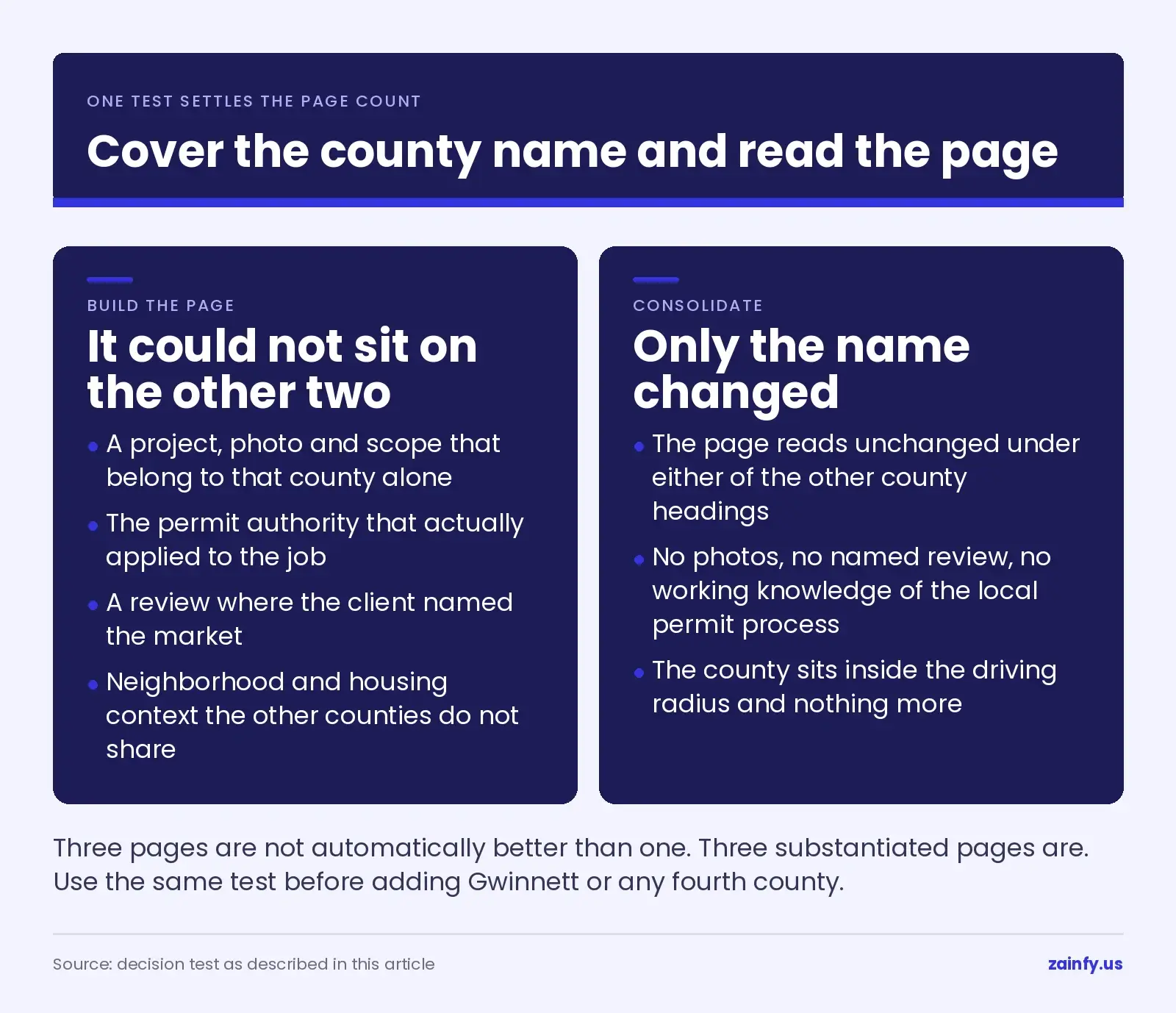
There is a simple test: remove the county name and read the page. If it could sit unchanged under either of the other county headings, consolidate. If the photos, permit path, project scopes, and local language belong to that county alone, the page has a reason to exist.
The page count should follow the evidence already inside the business. It should not follow a map of every place the owner hopes to serve someday.
The short answer, and the one test that settles it
First, use the right term. A location page represents a place customers visit: an office, showroom, or branch with a real address. A service-area page represents a market where the business goes to the customer. Most metro-Atlanta remodelers are service-area businesses. Their crews drive to the house, and the Google Business Profile can list service areas without pretending there is an office in every county.
The website page and the profile setting serve different jobs. The profile defines the operating area; the page proves why the contractor belongs in that county’s results.
That makes the decision test straightforward.
Build a separate county page only when you can publish material that would be wrong on the other two. A Cobb page can show an East Cobb kitchen, a Marietta review, and the difference between Cobb County Community Development and the City of Marietta permit path. A Fulton page can connect Buckhead work with the City of Atlanta process, then distinguish it from Alpharetta’s separate authority. A DeKalb page can show a Decatur bungalow addition, local review language, and DeKalb Planning & Sustainability.
A name swap does not pass.
The homeowner searching “remodeler near me” in Decatur is not seeing the same local result as the owner running that search in Alpharetta. Proximity, the Google Business Profile, local relevance, review evidence, and the page behind the result all change what appears. The site should reflect that difference only as far as the business can prove it.
Use the same test before adding Gwinnett or any fourth county: projects, photos, reviews, local knowledge, and a distinct search case. If one of those is missing, the county can stay on a strong metro service-area overview until the footprint catches up. Three pages are not automatically better than one. Three substantiated pages are. The same test decides how remodeler search inside the city of Atlanta is structured.
Cobb, Fulton and DeKalb are three different markets. Here is the proof
The strongest reason to split the counties is not SEO theory. It is the verified difference in the homes, buyers, and local processes the pages need to describe.
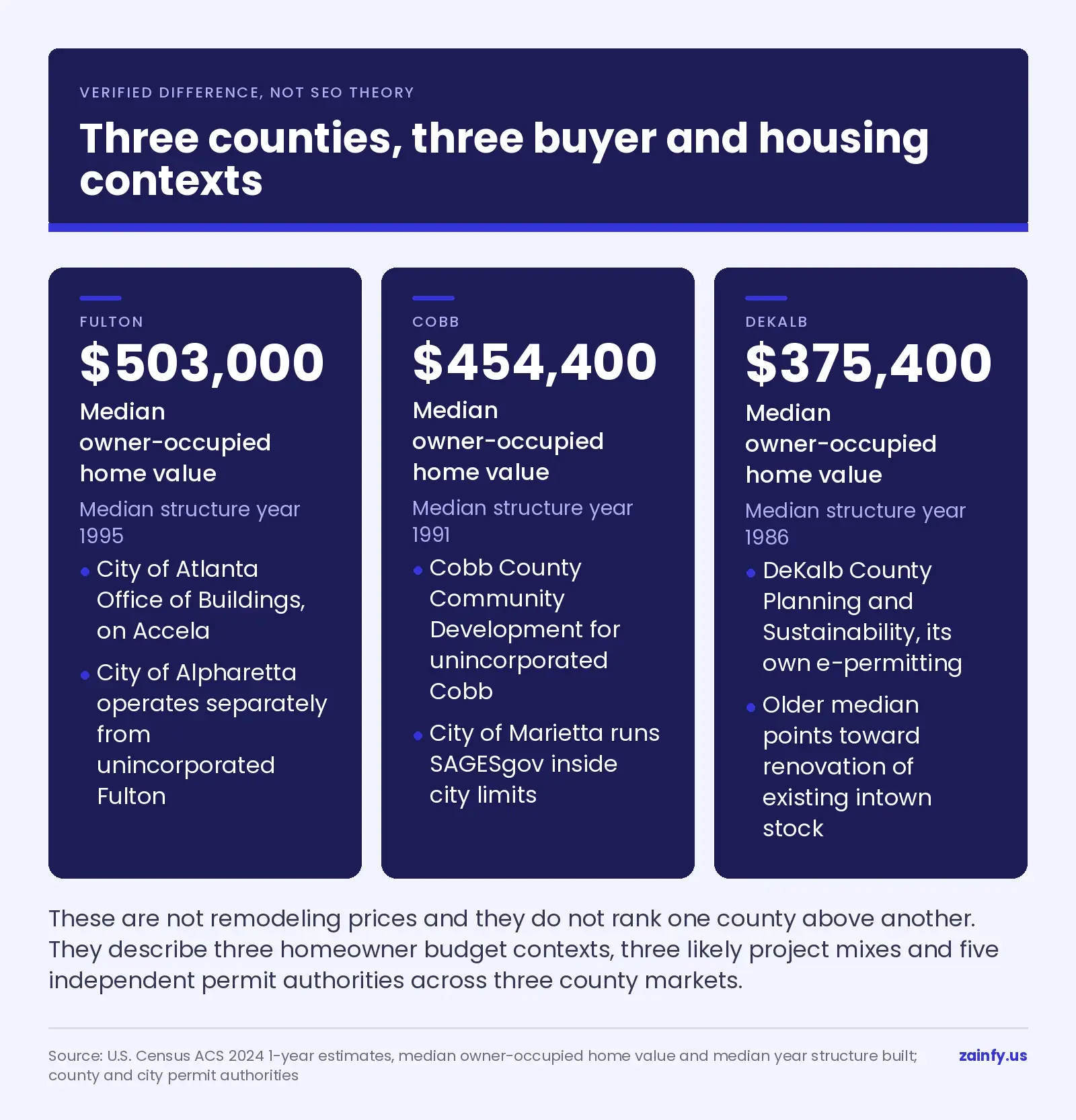
Buyer and budget context. The U.S. Census ACS 2024 1-year estimates put median owner-occupied home value at $503,000 in Fulton, $454,400 in Cobb, and $375,400 in DeKalb. Those figures are not remodeling prices, and they do not rank one county above another. They show three homeowner budget contexts. A Buckhead whole-home prospect, an East Cobb kitchen client, and a Decatur addition client may ask different questions before calling. The county pages can answer those questions without forcing one generic Atlanta message across all of them.
Housing age and likely scope. That ACS dataset gives a median structure year of 1995 for Fulton, 1991 for Cobb, and 1986 for DeKalb. DeKalb’s older median points toward more renovation of existing intown stock, including Decatur bungalows and additions shaped by older layouts. Cobb’s established suburban homes create a different project mix around Marietta, Smyrna, and East Cobb. Fulton spans both older Atlanta-core properties and later North Fulton development around Alpharetta and Roswell.
That starting point should change the evidence on the page. A DeKalb gallery might explain how an addition joined an older Decatur floor plan. A Cobb page might show a kitchen reconfiguration in an established East Cobb subdivision. Fulton may need separate proof from Buckhead and North Fulton because the housing and buyer contexts differ.
Permit path and trust. Five independent authorities sit inside these three county markets: the City of Atlanta Office of Buildings uses Accela; Cobb County Community Development handles unincorporated Cobb; the City of Marietta runs SAGESgov inside city limits; DeKalb County Planning & Sustainability uses its own e-permitting process; and the City of Alpharetta operates separately from unincorporated Fulton. A homeowner screening for a permit-aware contractor in Marietta is checking a different kind of local fluency from a homeowner in Atlanta or DeKalb.
I-285 is useful geographic shorthand here, without pretending the highway creates one universal search rule. Buckhead and Decatur sit in a different part of the metro conversation from East Cobb, Kennesaw, or Alpharetta. Neighborhood-modified searches and the local Map Pack reflect where the searcher stands and which businesses can prove relevance nearby.
The proof also changes the questions worth answering. A Marietta owner may care whether the contractor recognizes the city-limit permit distinction. An Alpharetta prospect can look for evidence from the city’s own process. A Decatur homeowner may want older-stock experience before asking for a quote. Those are useful page sections because they come from the market rather than a keyword template.
That is enough difference to support three real pages. Fulton can speak to Atlanta-core and North Fulton work without flattening them together. Cobb can carry Marietta and established suburban proof. DeKalb can lead with older-stock renovations and its own permitting context. The content does not need decorative city references. The markets already give it distinct work to do.
What Google does to a page that is just the county name swapped
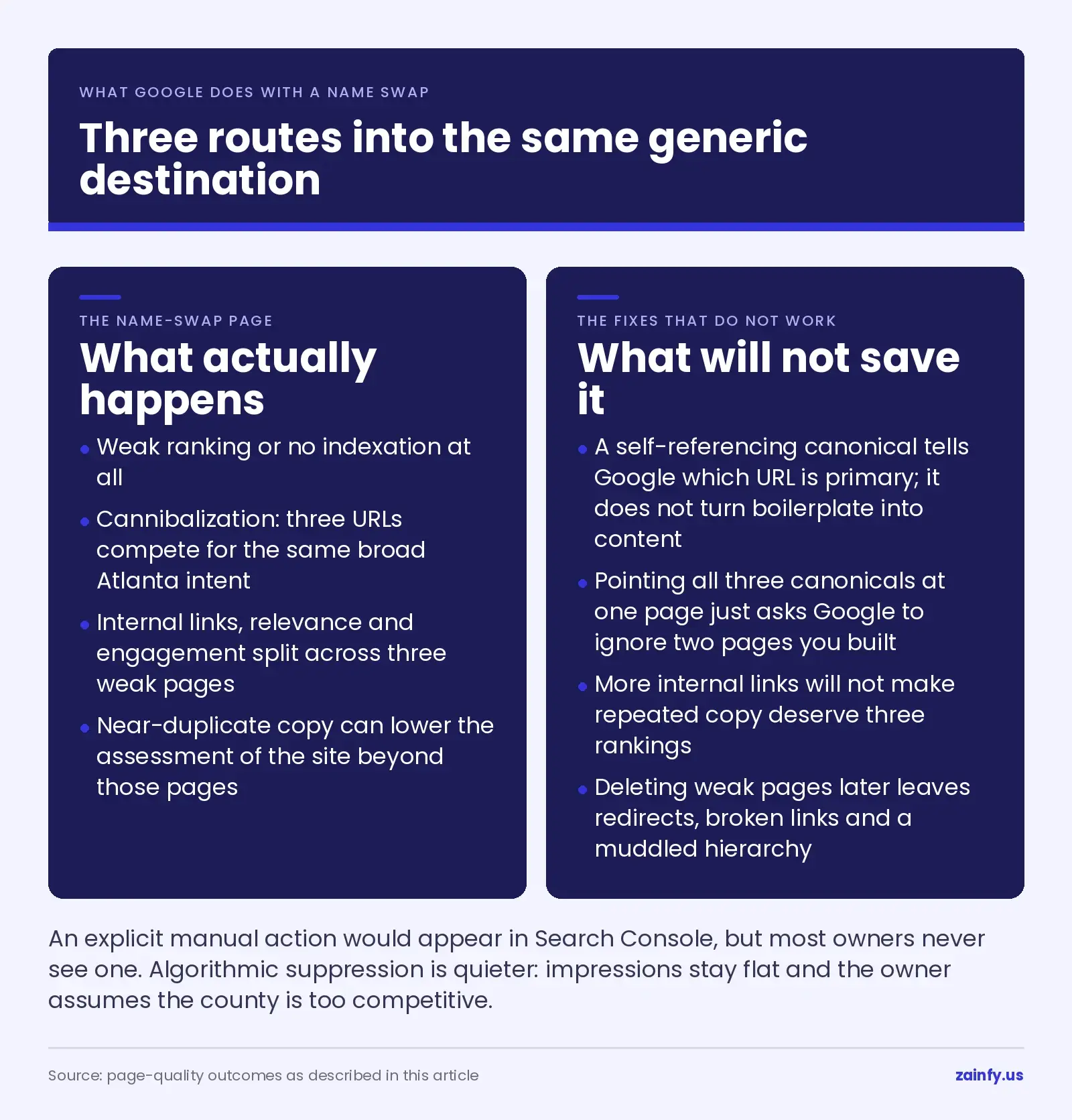
When three “Bathroom Remodeling in [County]” pages reuse nearly all the same text, Google does not see three useful local resources. It sees three routes into the same generic destination. That is the doorway-page problem: each page exists mainly to catch a place name, while the visitor receives no county-specific value after the click. The immediate failure is weak ranking or no indexation. The wider risk is cannibalization. Your Cobb, Fulton, and DeKalb pages can compete against one another for the same broad Atlanta intent, splitting internal links, relevance, and engagement across three weak URLs instead of concentrating them on one credible page. The problem gets worse when all three target the same services, repeat one title pattern, and link from a single navigation label. Google must choose among pages that give it no substantive reason to prefer one for a search in Decatur and another for a search in Marietta. Near-duplicate content can also lower Google’s assessment of the site beyond those pages because the pattern shows that geographic coverage is being manufactured rather than earned. A self-referencing canonical tag does not repair that judgment. It tells Google which URL you consider primary; it does not turn repeated boilerplate into useful content. Pointing all three canonicals to one page merely asks Google to ignore two pages you spent time building. An explicit manual action would appear in Google Search Console, but most owners will never see one. Algorithmic suppression is quieter: pages sit outside the useful results, impressions remain flat, and the owner assumes the county is too competitive. The real problem is the page. A Fulton page needs Fulton proof. A Cobb page needs Cobb proof. A DeKalb page needs DeKalb proof. If the only editable fields are the title, county name, and a neighborhood list, publishing three versions is worse than publishing one strong metro page. Deleting weak versions later can also leave redirects, broken internal links, and a muddled page hierarchy that has to be cleaned up. The canonical tag will not save a thin page, and more internal links will not make repeated copy deserve three rankings.
What actually goes on a real Cobb, Fulton, or DeKalb page
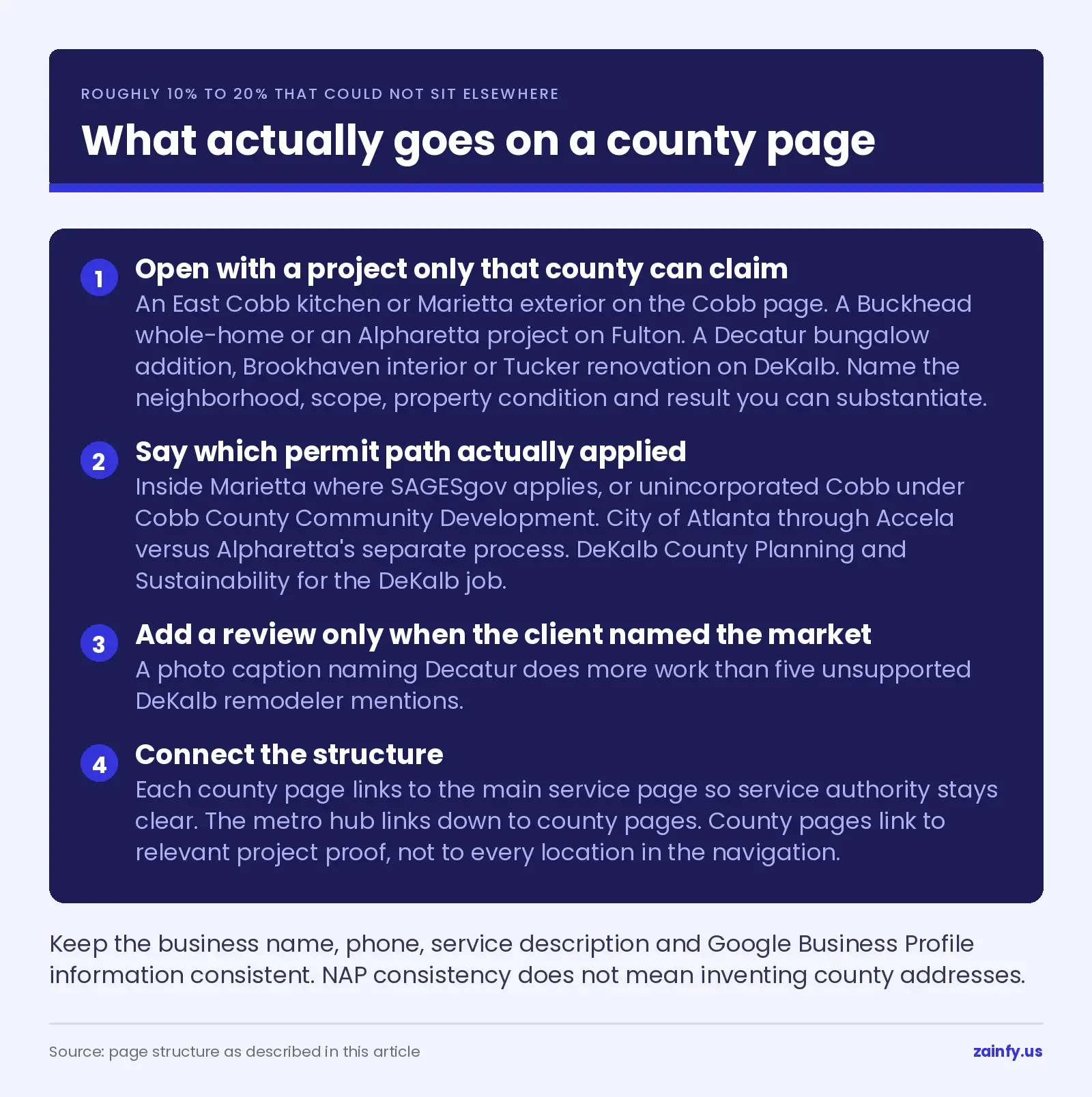
Start with the service. Shared wording is not automatically bad when a kitchen remodel is still a kitchen remodel across county lines. Keep the common service explanation where it helps the reader, then make a meaningful share of each page local. A practical threshold is roughly 10% to 20% material that could not sit honestly on the other county pages. The exact percentage matters less than the evidence.
On the Cobb page, open with a real East Cobb kitchen or Marietta exterior project. Name the neighborhood, scope, property condition, and result you can substantiate. Explain whether the job sat inside Marietta, where SAGESgov applies, or in unincorporated Cobb under Cobb County Community Development. Add a review from that market only when the client actually named it.
Build Fulton differently. A Buckhead whole-home project belongs with City of Atlanta permit context through Accela. An Alpharetta project belongs with the city’s separate Community Development process. Sandy Springs and Roswell add more location texture, but only projects and local knowledge make those names useful. Do not stuff every Fulton city into one paragraph.
The DeKalb page can carry a Decatur bungalow addition, Brookhaven interior work, or a Tucker renovation when those projects exist. Show the older layout problem, the scope your crew handled, and the DeKalb County Planning & Sustainability path that mattered. A photo caption naming Decatur does more work than five unsupported “DeKalb remodeler” mentions.
Then connect the structure. Each county page should link to the main service page so the service authority remains clear. The metro hub can link down to county pages where the reader needs a more precise market. County pages can link to relevant project proof, not to every location in the navigation. That internal linking tells Google which page owns the broad service and which pages answer local intent.
Keep the business name, phone, service description, and Google Business Profile information consistent. NAP consistency does not mean inventing county addresses. A service-area business can state where it works without claiming a branch. That distinction runs through how Georgia service areas are handled.
The final check is severe but useful: cover the county name and read the proof. If the project, permit authority, review, neighborhoods, and housing context still identify the county, the page earns its place. If not, keep building evidence before publishing.
When you should not build the page
Do not build a county page just because the county is inside your driving radius.
If you have completed two DeKalb jobs but have no DeKalb photos, no local review, and no working knowledge of the DeKalb County Planning & Sustainability process, the page will be thin regardless of the phrasing. Adding Decatur, Brookhaven, Dunwoody, and Tucker to the footer does not change that.
In that situation, one strong metro-Atlanta page is the better asset. It can state the honest service area, show the proof you do have, and link clearly to the services you perform. The county can earn a separate page later, after the business has enough work to support it.
That rule applies to Gwinnett, Clayton, or any edge of the map. Do not turn ambition into indexable copy. A weak fourth page can blur the internal-link structure and compete with the three pages that carry real evidence.
Keep that future county in a private content inventory instead. Add photos, reviews, and project notes as the work arrives, then publish when the page is already defensible.
This is also why patience matters after publishing a legitimate page. The county page still needs to be crawled, evaluated, and supported over time; the pending guide on how long Marietta SEO really takes will address that timeline once it is live.
Build the page when you can back it. Consolidate when you cannot. The number of URLs should follow the contractor’s real footprint, not the size of the market he wants to claim.
Service-area pages for metro Atlanta remodelers: quick answers
[wps_faq style=”classic” question=”Do you need a separate service-area page for Cobb, Fulton, and DeKalb?”]Yes, if each county page can carry real local proof; otherwise consolidate. Cobb, Fulton, and DeKalb have different housing values, median building ages, neighborhoods, and permit authorities, so the markets can support distinct pages. The contractor still needs projects, photos, reviews, and working local knowledge for each one. If the DeKalb page would repeat the Cobb page with place names changed, it has not earned a URL. The three-county opportunity is real, but the evidence test decides the page count.[/wps_faq]
[wps_faq style=”classic” question=”Do service-area pages hurt SEO?”]Service-area pages hurt SEO when they are thin, duplicated, or built only to capture county names. Three near-identical pages can cannibalize the same metro-Atlanta intent and resemble doorway pages. A substantive page helps when it answers a local need with project proof, permit context, neighborhoods, reviews, and a clear relationship to the main service page. Search Console may report a manual action in an extreme case, but quiet nonperformance is more common. Judge the page by what only that county can contribute.[/wps_faq]
[wps_faq style=”classic” question=”How many service-area pages should a metro-Atlanta contractor have?”]Build as many service-area pages as the business can support with genuinely different proof. That may be three for a contractor with established work across Cobb, Fulton, and DeKalb. It may be one metro page for a newer firm with projects concentrated around Marietta. Do not build one page per ZIP code or every county within driving distance. List the projects, photos, reviews, and permit knowledge you have by county; the rows with enough evidence become pages. Your actual footprint is the limit.[/wps_faq]
[wps_faq style=”classic” question=”What is the difference between a service-area page and a location page?”]A location page represents a real place customers visit, while a service-area page represents a market where the contractor travels to the customer. A remodeler serving Decatur from one legitimate office does not need a fake DeKalb branch page. The Google Business Profile can define service areas, and the website can publish a DeKalb service-area page supported by DeKalb projects and permit knowledge. Keep the address honest, keep the NAP consistent, and let the page prove where the crew works rather than pretending where it sits.[/wps_faq]
Let the proof choose the page count
Make a simple county inventory before adding another URL. For Cobb, Fulton, and DeKalb, list completed projects, usable photos, named reviews, permit familiarity, neighborhoods served, and the services those projects represent. A county with evidence across the list gets a page. A county with only a place name waits.
Run that test again in six months. Real expansion can create enough material for a page that would be thin today.
Assign one owner to keep that inventory current after every completed project. Once the page set is right, the next question is what that page has to do once the visitor lands.
When the evidence supports the split, how we handle SEO for Atlanta remodeling contractors across separate county service areas shows the commercial work behind that county-by-county execution.
Page count is not a growth lever by itself. Proof is. Three real county pages can earn three distinct search positions; six thin ones spread the same weak claim across more URLs. Build what the business can substantiate now, then let completed work open the next market.