Author: Zayn Shah
Kitchen Design Studio & Remodeling of Atlanta went from 12 Facebook leads a month to 114 and reduced its cost per lead from $98.21 to $35.57 in six months across Facebook, Instagram, TikTok, and LinkedIn. Those are documented results for one metro-Atlanta remodeling company, not a promise that every contractor will reach the same numbers.
The useful part of this case study is not the percentage alone. It is the operating change behind the result. Social stopped being a loose collection of occasional posts and became one content system with distinct jobs for each channel, a clear path from attention to inquiry, and a workflow for responding while interest was fresh.
That distinction matters to an owner who has spent years depending on referrals or buying access to inquiries through Angi, Houzz, or HomeAdvisor. Kitchen Design Studio did not get to 114 monthly Facebook leads by chasing likes or copying the same caption everywhere. It built proof that homeowners could inspect, adapted that proof to the way each platform is used, and made the next step obvious.
Where the 12 leads were coming from
At the start, Facebook produced 12 leads a month and the recorded cost per lead was $98.21. That is not the same as having no visibility. Kitchen Design Studio already had completed work, a recognizable Atlanta-market presence, and material worth showing. The problem was that its social activity did not consistently carry a prospective client from seeing the work to starting a conversation. Occasional project posts could earn attention, but attention without a capture path is difficult to value and almost impossible to improve. Meanwhile, marketplaces such as Angi, Houzz, and HomeAdvisor remained an easy way to reach people who had already raised a hand. The tradeoff is control: a contractor pays for access to the inquiry but does not own the marketplace, the audience, or the rules by which that opportunity is distributed. Competing contractors may receive the same inquiry, leaving the owner to race on response time before the buyer has seen enough proof to distinguish one company from another. The $98.21 starting figure therefore represented more than a line in a report. It exposed a weak transition between reputation and response. Kitchen Design Studio needed a channel where its own kitchens, process, and standards could do the qualifying before someone reached the form or direct-message box. The business was not short of good work. It was short of a repeatable way to turn that work into demand it could cultivate itself.
What changed across four platforms
The six-month results show why this should be read as a system, not a one-platform spike.
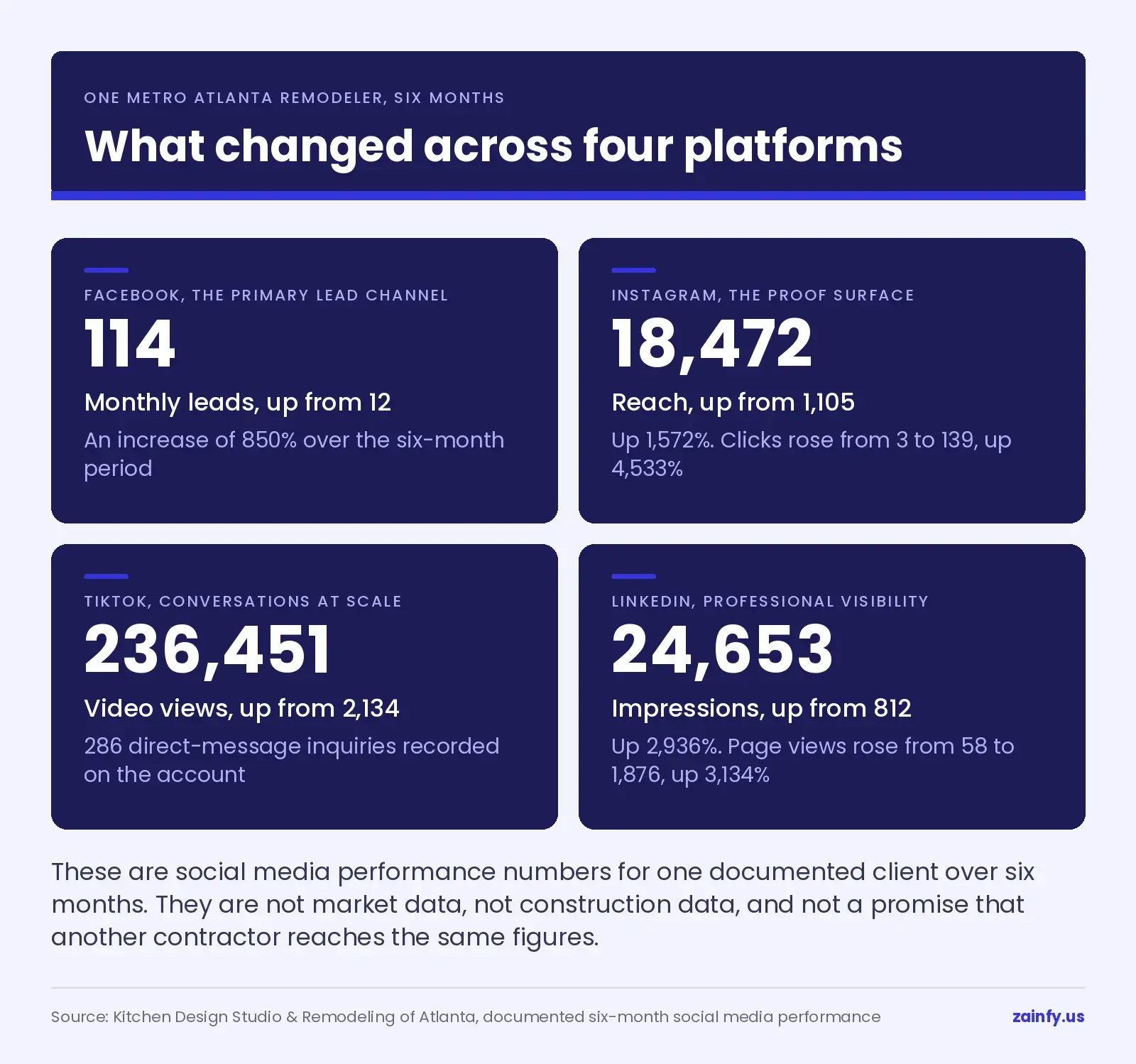
Facebook became the primary lead channel. Monthly leads rose from 12 to 114, an increase of 850%. At the same time, cost per lead moved from $98.21 to $35.57, down 63.8%. More inquiries at a lower recorded acquisition cost is the headline because it connects social activity to the metric an owner can compare with other lead sources.
Instagram widened the proof surface. Reach increased from 1,105 to 18,472, up 1,572%, while clicks rose from 3 to 139, up 4,533%. Reach alone would be a soft result. The movement in clicks shows that more people did something after seeing the work. For a kitchen remodeler, that step can be the difference between someone admiring a reveal and someone inspecting the company behind it.
TikTok created conversations at scale. Video views climbed from 2,134 to 236,451, and the account recorded 286 direct-message inquiries. The practical lesson is not that every contractor needs a viral clip. It is that short process footage and visible transformations can answer questions before a formal consultation, then give interested viewers a low-friction way to start talking.
LinkedIn supported professional visibility. Impressions went from 812 to 24,653, up 2,936%, and page views rose from 58 to 1,876, up 3,134%. Homeowners are not the only people who influence a remodeling pipeline. Designers, real estate professionals, suppliers, and other referral partners also need to recognize the company and understand its work.
All four channels fed the same commercial objective: make the work visible, give each audience the version it is most likely to consume, and provide a direct route into a form or message. The channels differed; the lead-handling standard did not.
Why the cost per lead fell by nearly two-thirds
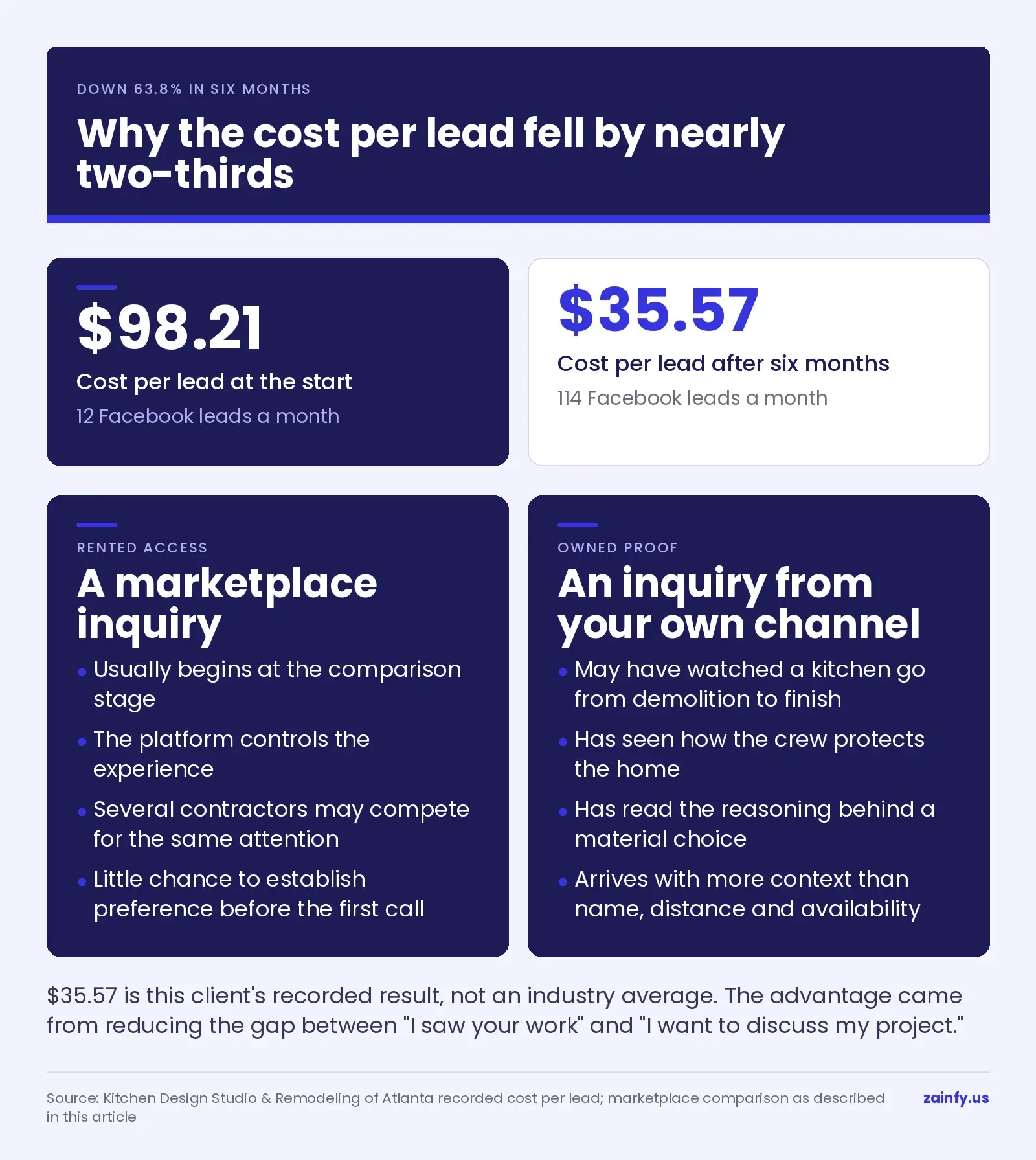
Kitchen Design Studio’s cost per lead fell from $98.21 to $35.57, a 63.8% reduction. The documented result is exact; the useful operational explanation lies in what the prospective client knew before making contact.
A marketplace inquiry usually begins at the comparison stage. The homeowner asks for help, the platform controls the experience, and several contractors may be competing for the same attention. The contractor has little opportunity to establish preference before the first call. Every minute of delay makes the inquiry harder to recover. Closing that gap is what social run properly for Georgia remodelers is for.
An inquiry created through the company’s own social presence can arrive with more context. The person may have watched a kitchen change from demolition to finish, seen how the crew protects the home, read the explanation behind a material choice, and viewed several completed rooms before sending a message. That does not guarantee a qualified project, but it gives the contractor a better starting position than an introduction based only on name, distance, and availability.
The cost reduction should not be turned into a generic benchmark. $35.57 is Kitchen Design Studio’s recorded result, not an industry average. The defensible conclusion is narrower: for this client, replacing disconnected activity with owned proof, clearer capture, and consistent follow-up produced far more Facebook leads at a much lower cost per lead. The advantage came from reducing the gap between “I saw your work” and “I want to discuss my project.”
The content that pulled the right buyer
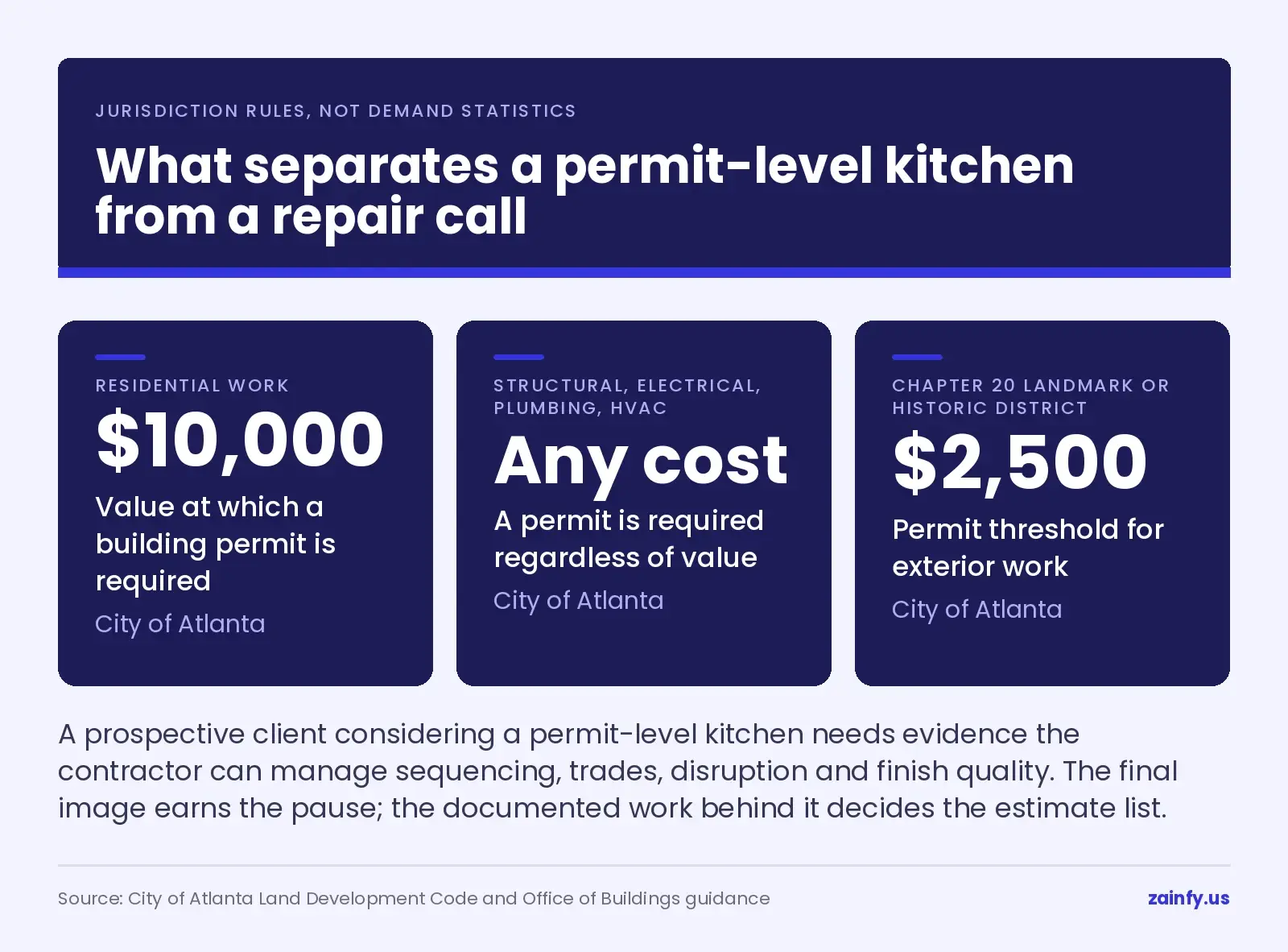
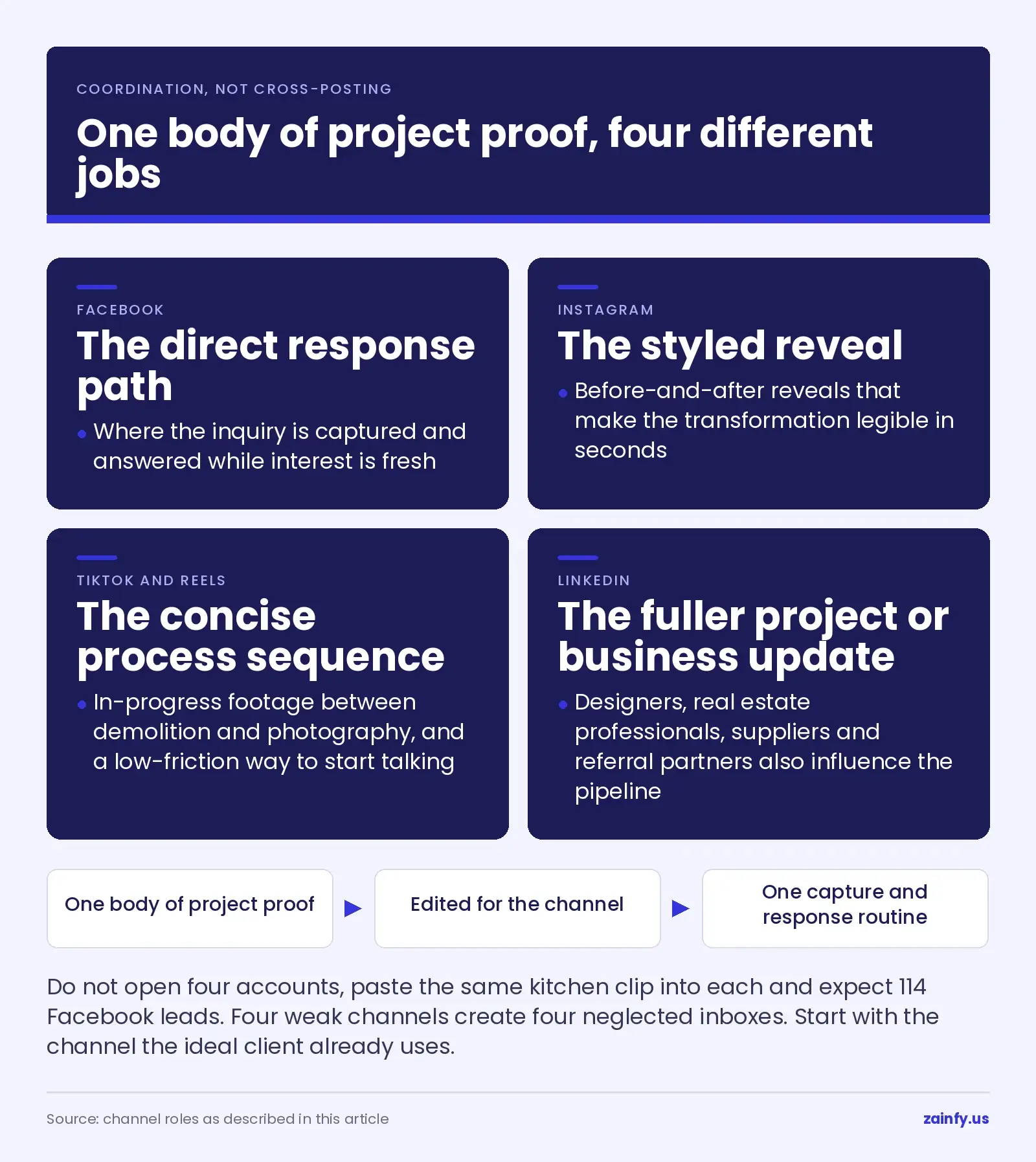
Kitchen Design Studio had an obvious visual asset: completed kitchens. The stronger content system did more than publish a polished final room. Before-and-after reveals made the transformation legible in seconds. In-progress footage showed the work between demolition and photography. Process explanations gave the owner a way to demonstrate judgment, not just taste. The material could then be edited for the context in which it appeared: a styled reveal for Instagram, a concise process sequence for Reels or TikTok, a fuller project or business update for LinkedIn, and a direct response path on Facebook. The source material stayed coherent while the presentation changed. Atlanta specificity also helped define the kind of project worth attracting. Under the City of Atlanta Land Development Code and Office of Buildings guidance, residential work valued at $10,000 or more requires a building permit, while structural, electrical, plumbing, or HVAC work requires one regardless of cost. Exterior work in a Chapter 20 landmark or historic district reaches the permit threshold at $2,500. Those are jurisdiction rules, not demand statistics, but they distinguish substantial remodeling work from a minor repair call. A prospective client considering a permit-level kitchen needs evidence that the contractor can manage sequencing, trades, disruption, and finish quality. That is why process content matters beside the reveal. The beautiful final image earns the pause; the documented work behind it helps the owner decide whether the company belongs on the estimate list. For Kitchen Design Studio, content was useful when it screened for project seriousness and moved the right viewer toward a conversation.
How long it took
It took six months, not six days.
That matters because the 114-lead month sits at the far end of the documented period. It should not be presented as a first-week outcome. The beginning of a social system is operational: collect usable project material, decide what each channel is for, establish a publishing rhythm, connect forms and messages to a real response process, and learn which subjects move viewers from attention to inquiry. The full write-up sits in the Kitchen Design Studio social case study.
The middle of the period is where the team can compare signals. Instagram reach without clicks calls for a clearer next step. TikTok views without useful messages may mean the content entertains the wrong audience. Facebook leads that never answer may expose a follow-up or qualification problem. LinkedIn impressions can support referral recognition even when it is not the primary homeowner lead source.
By month six, Kitchen Design Studio had evidence across all four platforms and a Facebook lead count of 114 for the month. An owner should judge the first month by whether the system is becoming executable, not by whether the end result arrived early. Social media becomes commercially useful when publishing and response can continue through busy project weeks, not only when the owner has spare time.
Do not copy the four-platform tactic
Do not open four accounts, paste the same kitchen clip into each one, and expect 114 Facebook leads. Kitchen Design Studio used one body of project proof, but the channels did different jobs and fed a common capture process. That is coordination, not cross-posting.
The deeper mistake is treating a marketplace listing as the whole growth plan. Angi, Houzz, and HomeAdvisor can introduce a contractor to active buyers, but the contractor still depends on access controlled by another company. A body of social proof works differently: it remains available for the next referral, searcher, follower, or professional contact to inspect.
Start with the channel the ideal client already uses. Build a reliable content and response routine there. Add another only when the first can run without collapsing during a busy week. Four weak channels create four neglected inboxes. One well-run channel with clear proof and a working route to an estimate is a business asset.
The lesson is not “be everywhere.” It is “own the path from project proof to first conversation.”
Facebook leads for Atlanta remodelers: quick answers
[wps_faq style=”classic” question=”Can Facebook produce real leads for a remodeling contractor?”]Yes. Kitchen Design Studio & Remodeling of Atlanta increased Facebook leads from 12 to 114 a month over six months, an 850% rise. That result belongs to one documented client and should not be sold as an average. The practical evidence is that Facebook sat inside a wider system: Instagram expanded reach and clicks, TikTok generated direct messages, and LinkedIn increased professional visibility. The remodeling company gave people real project proof, then provided a direct next step. Facebook produced the headline lead count because it was connected to the rest of the process, not because posting by itself guarantees inquiries. A contractor should measure completed forms, useful messages, response time, and qualified estimate conversations rather than judging the channel by reactions alone.[/wps_faq]
[wps_faq style=”classic” question=”How much did a Facebook lead cost compared with Angi or Houzz?”]For Kitchen Design Studio, the recorded cost per lead fell from $98.21 to $35.57 during the six-month social program, a reduction of 63.8%. The valid contrast is operational: marketplace access is controlled by the platform and an inquiry may be distributed to competing contractors, while the company’s social presence lets a prospective client examine its own work before contacting it directly. Use your actual marketplace invoices, contact rate, estimate rate, and closed revenue to compare sources. The cheapest inquiry is not automatically the best; the useful measure is what it costs to create a qualified conversation your team can convert.[/wps_faq]
[wps_faq style=”classic” question=”How long does social media take to bring a remodeler leads?”]This case reached its reported endpoint in six months. The early period built the content, channel roles, lead form and direct-message workflow, and response habit; the 114-lead Facebook month came at the end, not immediately. A contractor can look for earlier operating signals without pretending they are revenue: more relevant profile visits, clicks into the site, questions in direct messages, and a rising share of inquiries that mention a project post. The timeline also depends on whether the team can supply current jobsite material and answer quickly. Kitchen Design Studio’s TikTok account recorded 286 direct-message inquiries during the program, which shows why inbox handling belongs inside the system. Give the process enough time to produce evidence, then judge it by qualified conversations and estimates rather than an arbitrary posting streak.[/wps_faq]
Build one path you can measure
Pick the platform where your best prospective clients already spend time. Choose one repeatable proof format, such as a before-and-after sequence with a short process explanation. Connect it to a form or direct-message routine, assign who responds, and track every serious conversation for a full quarter before deciding the channel failed.
That is a smaller first move than copying Kitchen Design Studio’s four-platform operation, but it follows that principle: attention must have somewhere useful to go. Once one route works through a busy project schedule, add the next channel with a defined role. Worth reading alongside it: the metro market those leads came out of.
Kitchen Design Studio’s 12-to-114 result shows what a coordinated social system can produce for one Atlanta remodeler in six months. Zainfy’s social media management for Atlanta remodeling contractors is the relevant service path for owners who need that content, channel, and response structure built around real project work.
The judgment is simple: a contractor cannot own a marketplace audience, but it can own the proof and response process that turns attention into a direct inquiry.