An Augusta remodeling contractor gets found across the CSRA by proving both sides of the Savannah River: Georgia in Augusta-Richmond and Columbia County, and South Carolina in Aiken and North Augusta.
That is the market. Not one city. Not one state. Not one generic “serving Augusta” page.
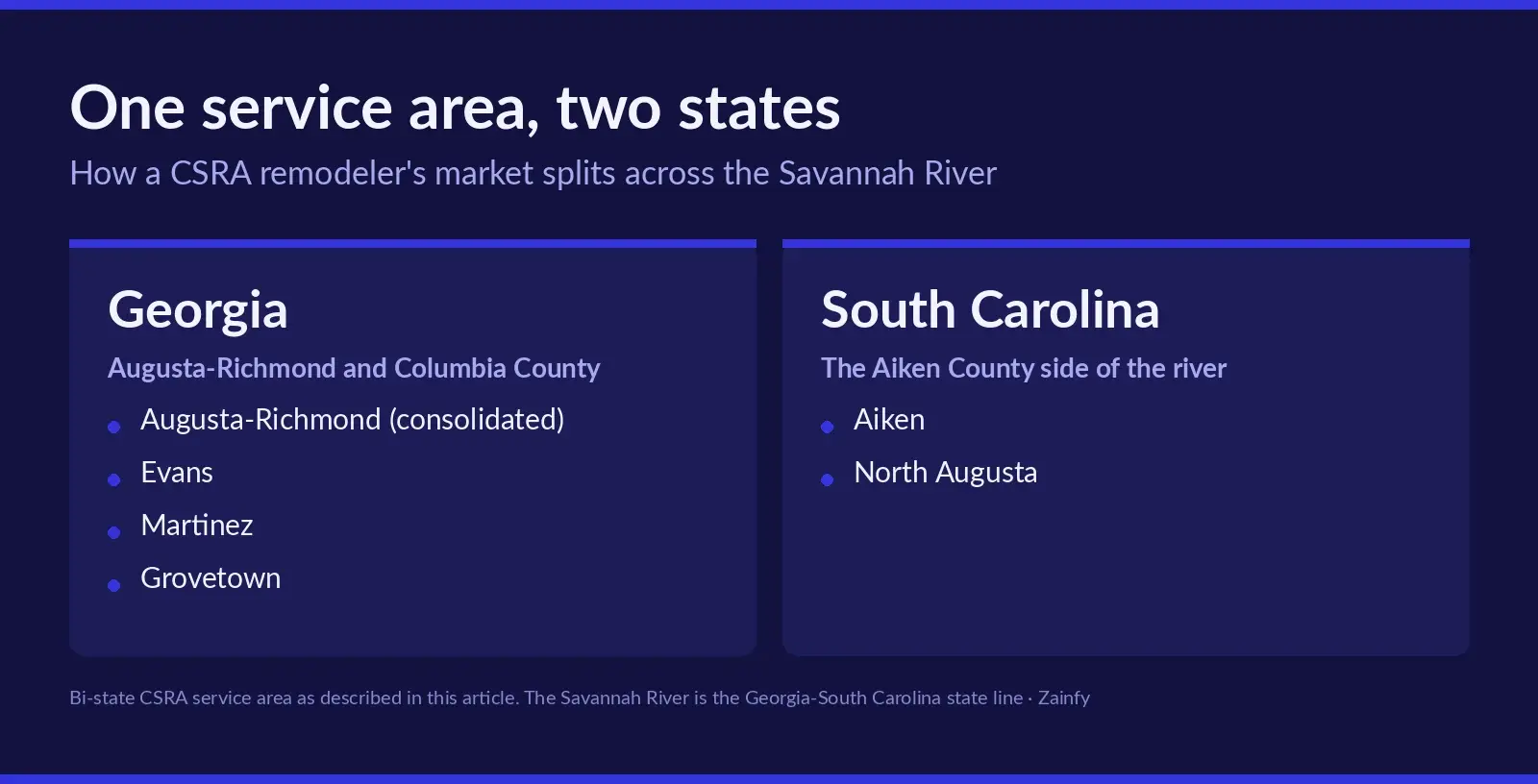
The Savannah River is more than a local landmark. It is the Georgia-South Carolina state line, and Google treats that line as real when it weighs proximity, relevance, citations, reviews, service areas, and local proof. So does the homeowner who wants to know whether the contractor crossing the river is licensed for the work.
This guide is for the CSRA owner who already knows search visibility matters, but has been running one Augusta web presence that quietly stops at the Carolina side. If you work Evans, Martinez, Grovetown, Aiken, and North Augusta, your SEO has to show that clearly before a directory, a lead marketplace, or a better-organized competitor does it for you.
The useful question is not “Can I rank for Augusta?” The useful question is whether the search result can tell which side of the market you actually serve, what proof you have there, and why the buyer should trust you before asking three other contractors.
Your service area crosses a state line – and Google notices
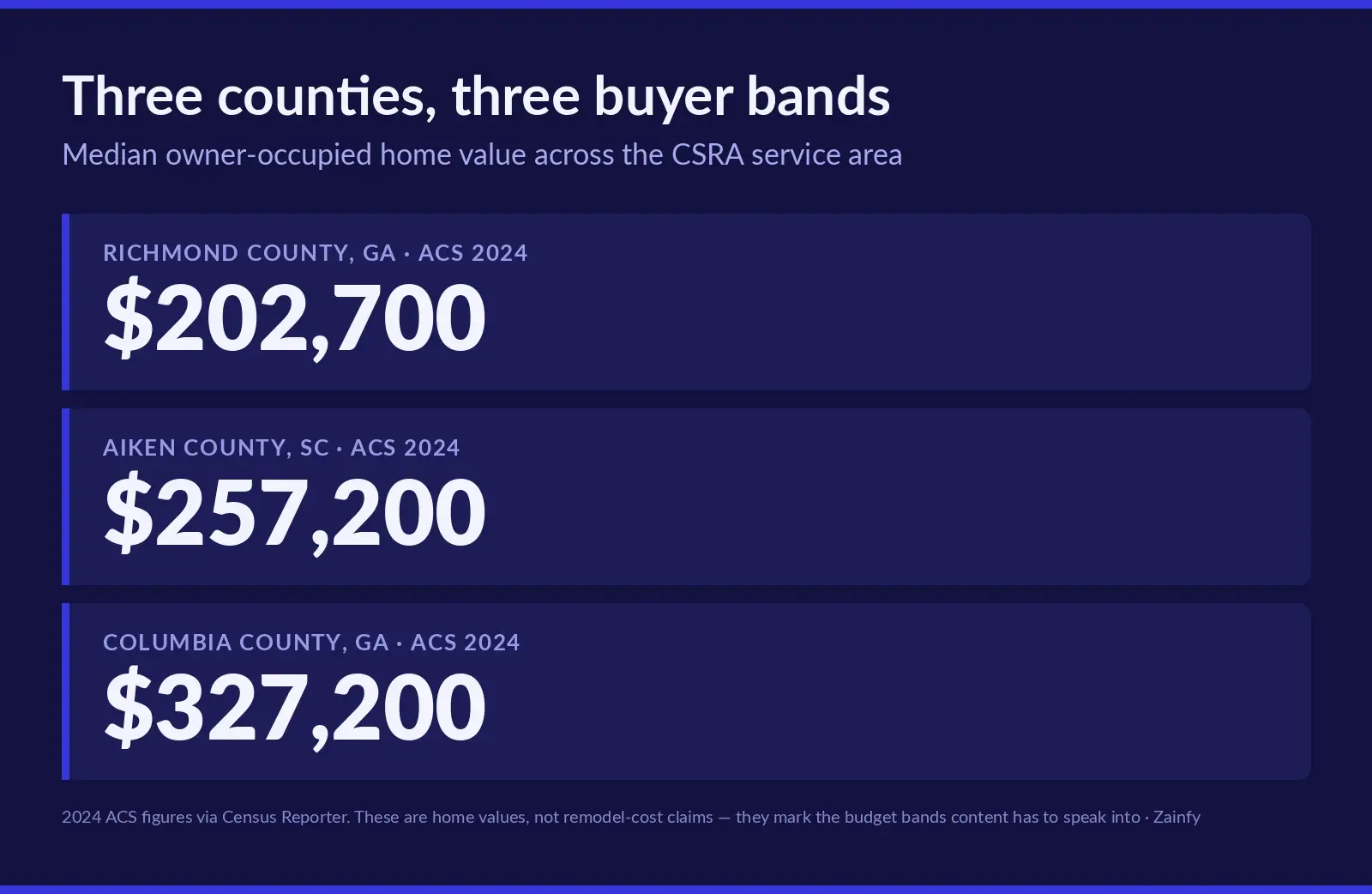
The Augusta metro is a bi-state market: five Georgia counties and two South Carolina counties, with Richmond County, Columbia County, and Aiken County carrying the largest local buyer bands. A remodeler can leave a driveway in Augusta-Richmond, cross the Savannah River, and be in North Augusta in minutes, but the search signals around that job do not blur together just because the truck did. A homeowner in Evans, Georgia is searching inside a different state context than a homeowner in Aiken, South Carolina. Google Business Profile service areas, citations, review language, project captions, license references, and location pages all have to remove that doubt. The 2024 ACS Census Reporter numbers show why the buyer context is not interchangeable: Richmond County’s median owner-occupied home value is $202,700, Columbia County’s is $327,200, and Aiken County’s is $257,200. Those are not remodel-cost claims. They are the budget bands your content has to speak into across the two-state service area. The Columbia County buyer may be comparing a different scope than the Richmond County owner. The Aiken or North Augusta buyer may care less that you “serve Augusta” and more that your site proves South Carolina work, licensing, and local familiarity. Fort Gordon, now back under that name after the Fort Eisenhower period, adds regional growth color, but the real SEO point is simpler: a single Augusta presence leaves the Carolina side weak. A contractor can win referral work across the river and still look invisible online there because the website, GBP, citations, and reviews keep teaching Google “Georgia only.” That is the quiet leak in this market. If a competitor builds the South Carolina proof first, the map pack and organic results do not wait for you to notice.
Two states, two contractor licenses – and that’s a ranking asset
Licensing across the line is not just paperwork. It is searchable trust.
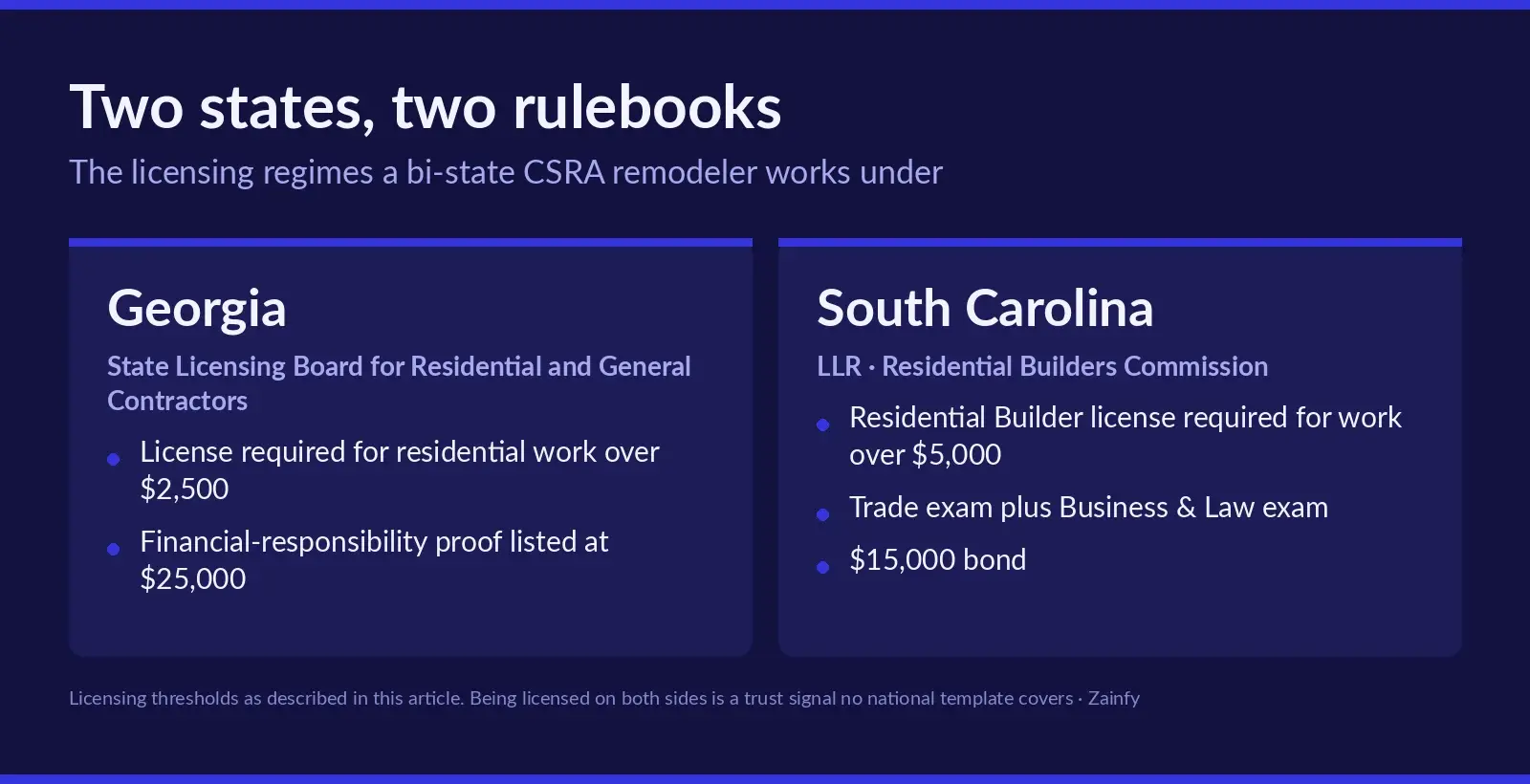
Georgia and South Carolina do not ask the same question of a residential contractor. Georgia routes residential licensing through the State Licensing Board for Residential and General Contractors, with a license required for residential work over $2,500 and financial-responsibility proof listed at $25,000. South Carolina routes the work through LLR and the Residential Builders Commission, with a Residential Builder license required for work over $5,000, plus Trade and Business & Law exams and a $15,000 bond.
That split matters because a North Augusta or Aiken homeowner may not ask “who has the nicest kitchen gallery?” first. He may ask whether the Augusta contractor can legally handle the South Carolina side.
A CSRA remodeler licensed in both states can answer that in public. Not in a buried PDF. Not in a tiny footer badge. On the page.
South Carolina has reciprocity with Georgia, where a Georgia-licensed applicant can waive the South Carolina technical exam. That does not mean every Georgia contractor is automatically ready to claim South Carolina work. It means a serious bi-state contractor has a legitimate path to making the claim cleanly.
For SEO, that becomes content no national contractor-marketing template can fake. A page about Aiken remodeling work can name the South Carolina LLR Residential Builder context. A North Augusta page can explain why crossing the river is different from driving to another Georgia suburb. A Columbia County page can stay Georgia-accurate instead of pretending every permit and licensing question is the same.
Licensed in both states is not a slogan. It is a ranking asset because it gives Google and the buyer a reason to believe the South Carolina page belongs to you.
Location pages that respect the state line
There are two ways to build this.
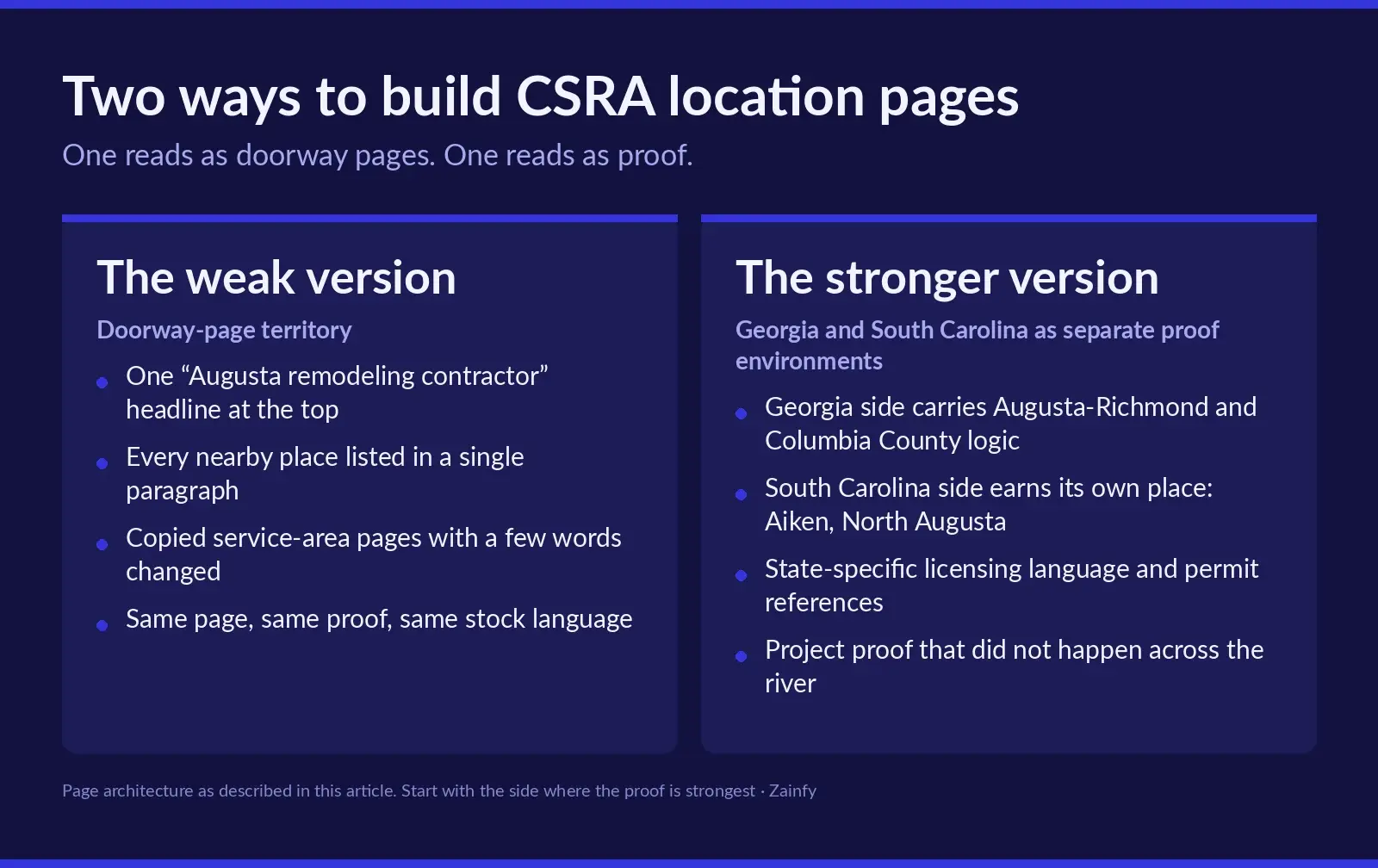
The weak version says “Augusta remodeling contractor” at the top, lists every nearby place in one paragraph, then changes a few words on copied service-area pages. Augusta. Evans. Martinez. Grovetown. Aiken. North Augusta. Same page, same proof, same stock language.
That is doorway-page territory.
The stronger version treats Georgia and South Carolina as different proof environments. The Georgia side can carry Augusta-Richmond and Columbia County logic: consolidated Augusta, Evans, Martinez, Grovetown, Georgia licensing language, Georgia project captions, and county-aware service proof. The South Carolina side has to earn its own place: Aiken, North Augusta, South Carolina licensing language, South Carolina permit references where relevant, and project proof that did not happen across the river.
The page architecture does not need to become huge on day one. It needs to become honest.
Start with the side where the proof is strongest. If you have three strong Columbia County kitchens and no South Carolina work, build the Georgia side first. If you have legitimate North Augusta and Aiken projects, separate them from a generic Augusta page and explain the state-line issue plainly. Aiken County had a 2024 ACS median owner-occupied home value of $257,200; that buyer is not an afterthought to Richmond County or Columbia County.
Each side should answer questions the other side cannot answer cleanly. A Georgia page can talk about Augusta-Richmond and Columbia County without forcing South Carolina licensing into the copy. A South Carolina page can talk about LLR, North Augusta, Aiken, and the reason a cross-river contractor is legitimate there. That difference is what makes the page useful instead of decorative.
For this pillar, the rule is enough: do not make one page carry two states unless the copy, photos, reviews, licensing notes, and service-area signals prove both states.
Citations and GBP when you work two states
A single-state citation profile caps you at one side.
If your name, address, phone, website, categories, and service description all point only to Georgia, do not be surprised when the South Carolina side feels thin. Google Business Profile can list service areas across the line, but the rest of the web has to agree.
That means the basics have to be boring and exact: same business name, same phone, same address where applicable, same website, same primary category logic, and no old directory pages that describe you as only an Augusta, GA contractor when you are asking Google to trust Aiken and North Augusta visibility.
It also means the citation footprint should make sense in both states. Georgia directories, supplier profiles, and chamber references help on the Georgia side. South Carolina references, Aiken or North Augusta business listings, and locally relevant community mentions help the Carolina side. Houzz, Yelp, Thumbtack, and other directories are not the strategy, but they are surfaces Google and homeowners check.
GBP does not override weak evidence.
The profile should name the real service area, point to the right page, use the category that matches the revenue work, and collect reviews that mention the actual area and scope in normal language. Proximity, relevance, and prominence are measured against a map. The river is on that map.
Do not treat the service-area list as decoration. If the profile says Aiken, the site should have Aiken proof. If the profile says Evans, the site should not make the buyer hunt through one gallery labelled “recent work.” The profile and the website need to corroborate each other. When they do, the climb is measurable, and what a defensible ranking climb looks like in Georgia is on record.
How the ranking actually gets built here
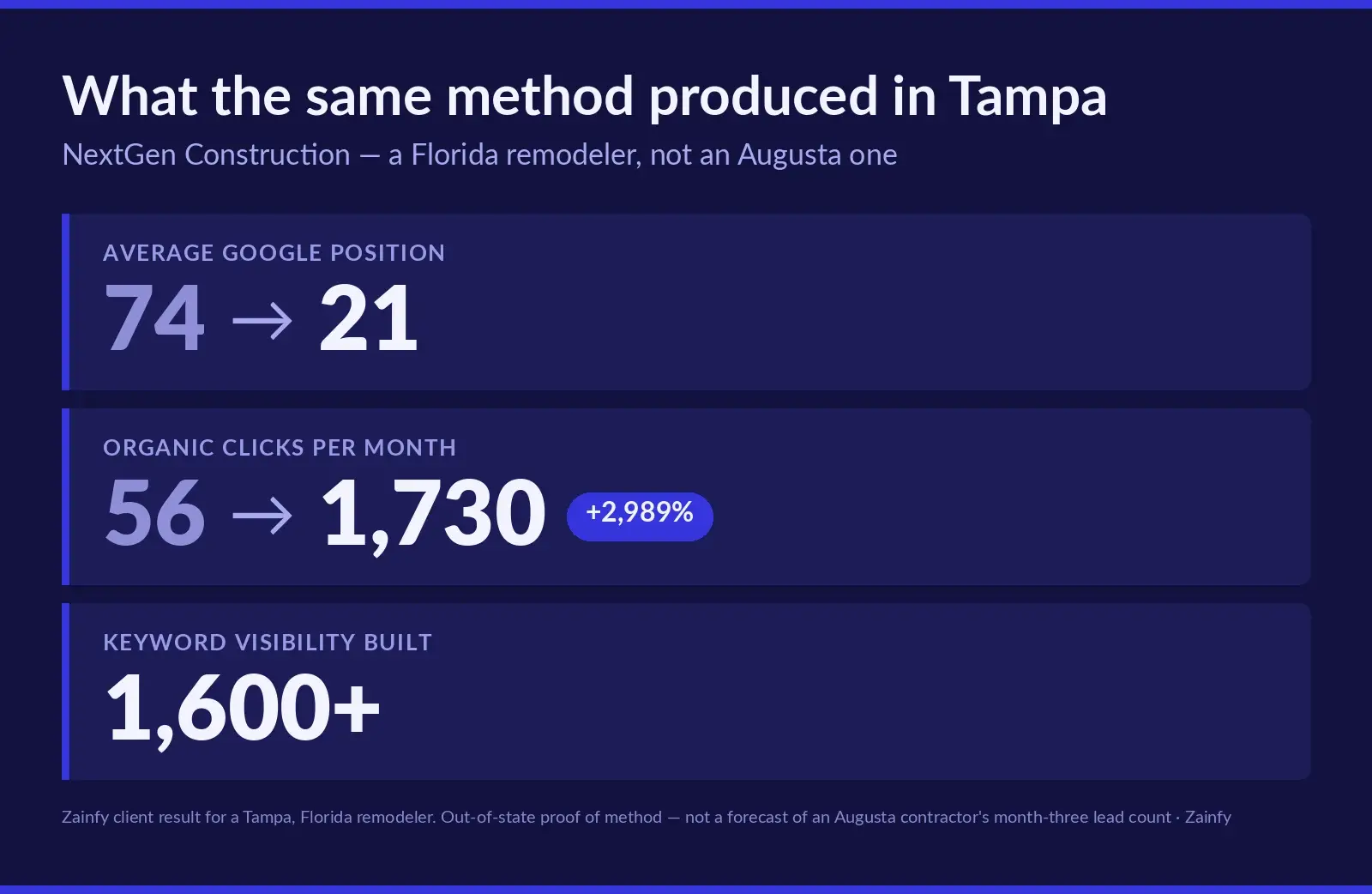
The build starts by cleaning the entity, not by writing twenty city pages. The Google Business Profile category has to match the work you actually want. A remodeler chasing kitchen projects should not drift into a broad category if a more precise remodeler category fits the revenue. Then the citation profile has to prove both sides of the Savannah River: Georgia signals for Augusta-Richmond and Columbia County, South Carolina signals for Aiken and North Augusta, with NAP consistency strong enough that the business does not look like two half-built entities. The site then carries the proof. Location pages should show county-specific projects, real service language, licensing context, and review excerpts that name the place naturally. LocalBusiness and ServiceArea schema can list Georgia and South Carolina cities, but only after the visible page already says them. Schema cannot rescue a site that refuses to mention Aiken until the footer. Reviews need a process too. Ask the client to mention the work and area honestly: North Augusta bath, Evans kitchen, Aiken addition, Augusta-Richmond exterior repair. Local authority comes from both sides as well: a Georgia chamber profile, a Columbia County supplier mention, an Aiken business reference, a North Augusta community source, or any real local relationship that deserves to exist. This is where ranking across the Georgia-South Carolina line fits for the commercial SEO page behind this guide. The proof that the method can move comes from NextGen Construction, a Tampa, Florida remodeler: Zainfy moved average position from 74 to 21, grew organic clicks by +2,989% from 56 to 1,730 per month, and built visibility across 1,600+ keywords. That is out-of-state proof, not an Augusta claim. The lesson is narrower: when the entity, pages, citations, and proof all point the same direction, a contractor can stop relying on shared lead surfaces to explain where he works.
How fast it moves, and what waiting costs you
SEO is not instant. It is also not a vague year-long wait where nothing concrete should change.
In Augusta, the first movement should come from fixing the parts Google can already understand: category fit, citation consistency, state-specific pages, project proof, and reviews that say where the job happened. Those are not mysteries. They are work items.
The NextGen result gives a real reference point without turning it into a promise. Position 74 to 21 is movement. +2,989% organic clicks is movement. It happened for a Tampa contractor, not an Augusta contractor, so do not pretend it forecasts your month-three lead count.
Use it for the right lesson.
Ranking work gets easier when the market has a clear gap. In the CSRA, that gap is often the Carolina side. The contractor who keeps paying a lead marketplace while his own site barely proves North Augusta or Aiken is renting attention in a market he could be building into an asset.
Waiting costs more than time. It lets somebody else teach Google what a bi-state contractor looks like before you do. It lets thin directories sit between you and the buyer. It lets one vague Augusta page keep carrying a service area that actually spans two state systems.
The first 90 days should produce visible assets: cleaner GBP language, corrected citations, one serious Georgia-side page, one serious South Carolina-side page if the proof exists, and review requests that name the real area.
If all you get is a report, the work did not reach the search result.
The cost question should be tied to production. Did the North Augusta page go live? Did the old listings stop saying only Augusta, GA? Did the next review mention the city and scope? Did the site give Google a reason to separate your Aiken work from a copied service-area list? Those are better buying questions than a monthly price with no deliverables behind it.
Don’t stop at the state line – or fake a side you can’t back
Do not run one generic “Augusta” presence that quietly ignores South Carolina.
That hands North Augusta and Aiken to whoever bothered to claim the Carolina side. A contractor working both sides of the Savannah River has too much local proof available to act like the state line is a footnote.
The opposite mistake is just as bad.
Do not fake a South Carolina side you cannot back. If you are not licensed for South Carolina work and do not have real South Carolina projects, thin Aiken and North Augusta pages are not strategy. They are a liability. Homeowners see through them. Google has no reason to trust them. The licensing boards give you a concrete way to explain the difference, so use that difference honestly.
Own both sides properly or concentrate on the side you actually work.
That is the judgement. Not every contractor needs to chase every CSRA county. But if your crews already cross the river, your website, GBP, citations, reviews, and licensing content should not stop at the bridge.
Augusta & CSRA contractor SEO: quick answers
[wps_faq style=”classic” question=”Can an Augusta contractor rank in both Georgia and South Carolina with one website?”]Yes, one website can rank across both states if the site proves both states clearly. A single generic Augusta page is not enough. The page set needs Georgia proof for Augusta-Richmond and Columbia County, South Carolina proof for Aiken and North Augusta, and a Google Business Profile service area that matches the real footprint. The 2024 ACS Census Reporter data shows different buyer bands across the market, including $202,700 in Richmond County and $257,200 in Aiken County. Treat those as audience context, not remodel prices. The site has to make the two-state business entity easy to believe before the buyer compares you on a directory.[/wps_faq]
[wps_faq style=”classic” question=”Do you need a South Carolina license to remodel in North Augusta or Aiken?”]For South Carolina residential work over $5,000, the SC LLR Residential Builders Commission and its Residential Builder license. Georgia uses a different board, with the State Licensing Board for Residential and General Contractors threshold over $2,500. That matters for SEO because licensing is not only a compliance issue. It is a trust answer a North Augusta or Aiken buyer may look for before calling. If you are licensed in both states, say it clearly and accurately. If you are not, do not build pages that imply South Carolina coverage you cannot support, because that weakens the search signal and the sales conversation.[/wps_faq]
[wps_faq style=”classic” question=”Should an Augusta contractor build separate pages for the Georgia and South Carolina sides?”]Yes, if each page has real proof. Georgia-side pages can focus on Augusta-Richmond, Columbia County, Evans, Martinez, and Grovetown with Georgia-accurate licensing and project language. South Carolina-side pages should carry Aiken and North Augusta proof, not copied Georgia copy with the city swapped. The doorway-page test is simple: if the same page works after changing only the place name, it is too thin. Columbia County’s 2024 ACS median owner-occupied home value is $327,200, which is a different buyer context from Richmond County. The page should show that difference in photos, scope, questions, review language, and the next step offered to the buyer.[/wps_faq]
[wps_faq style=”classic” question=”How long before an Augusta remodeler sees SEO results, and what should it cost?”]An Augusta remodeler can often see early movement in a few months when the fixes are concrete: GBP category cleanup, citation repair, state-specific pages, review process, local schema, and proof that names the real CSRA locations. Judge cost by what gets published and corrected, not by the thickness of the report. Aiken, North Augusta, Augusta-Richmond, and Columbia County all need visible evidence if you want two-state ranking. AI search follows that rule: clear entities are easier to cite than vague ones, especially when the service area crosses a state border.[/wps_faq]
Closing: prove the side you want to win
Open your site and look for the river.
If Georgia appears everywhere and South Carolina appears only in a footer list, the Carolina side is not really part of your search strategy. If Aiken and North Augusta pages exist but carry no licensing context, no project proof, and no local review language, they are not assets yet. The social calendar that runs alongside all this is Augusta’s year around one week in April.
Fix the side you can prove first. Then widen.
An Augusta contractor who wants the Georgia side to stay strong while he expands across the CSRA should understand getting found outside your home market before chasing every border-market search at once.
The next step is plain: choose one South Carolina page or one Georgia page, attach real projects to it, correct the citations around it, and make the licensing answer impossible to miss.