A Savannah remodeling contractor gets found on Google by matching his pages, Google Business Profile, reviews, and project proof to how Chatham County clients actually search for historic-district work. That is the short answer.
The longer answer is where most contractor SEO gets lazy. It treats Savannah like any other Georgia city with a few neighborhood names swapped in. That misses the part a serious historic-home client cares about before he ever calls: whether you understand the review path, the Certificate of Appropriateness process, and the difference between a Landmark District project and a Victorian District project.
If your site only says “kitchen remodeling in Savannah,” you are fighting every broad contractor page in town. If it shows that you understand the local preservation structure, you have a narrower and more believable reason to rank.
The two boards most Savannah remodelers can’t name
Savannah historic work is not one generic permit conversation.
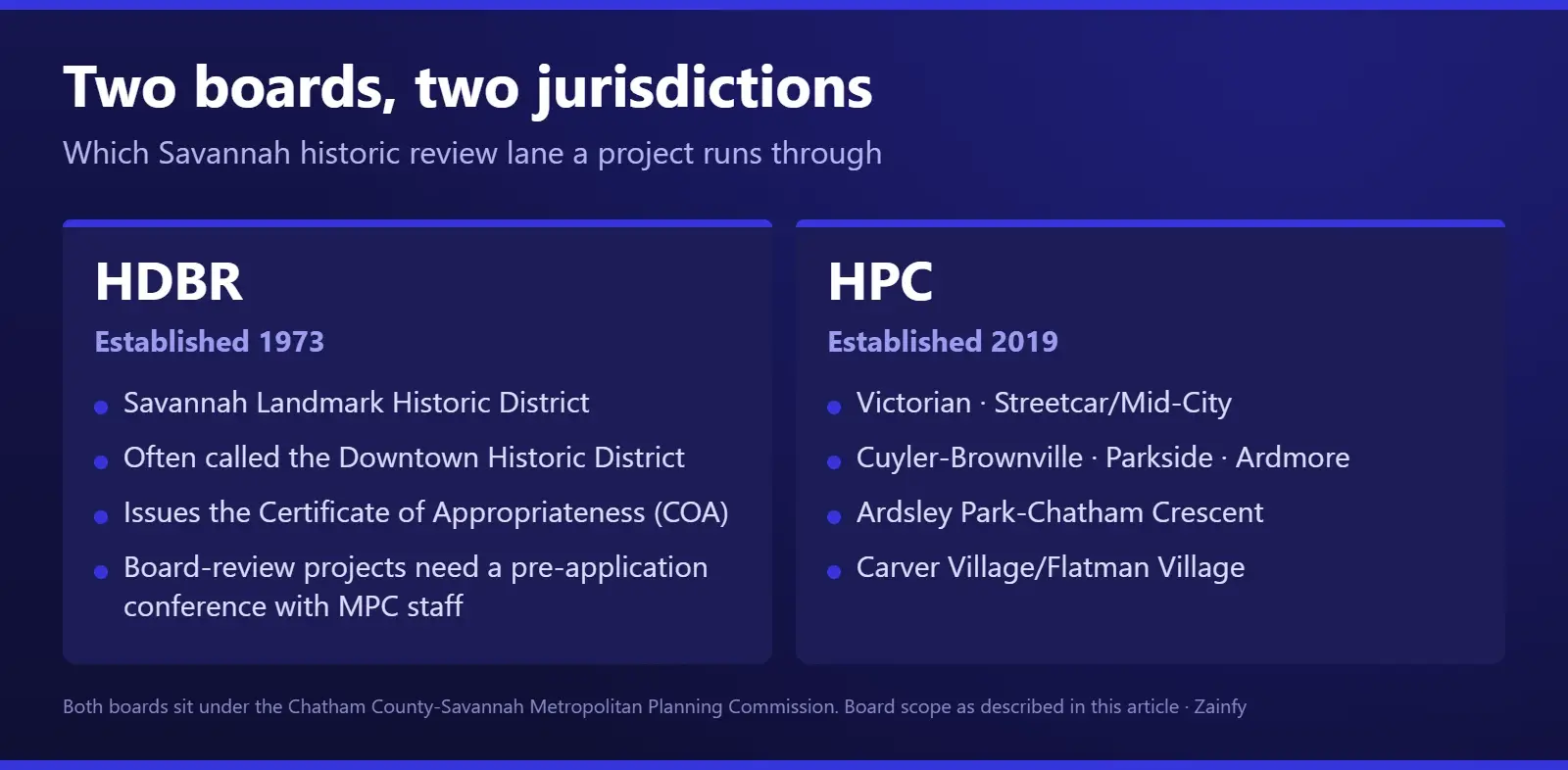
Under the Chatham County-Savannah Metropolitan Planning Commission, the Historic District Board of Review and the Historic Preservation Commission handle different parts of the city. The HDBR, established in 1973, issues Certificates of Appropriateness for the Savannah Landmark Historic District, often called the Downtown Historic District. The HPC, established in 2019, covers districts and overlays including Victorian, Streetcar/Mid-City, Cuyler-Brownville, Parkside, Ardmore, Ardsley Park-Chatham Crescent, and Carver Village/Flatman Village.
That distinction matters for SEO because the homeowner does not always know which board applies. He may search for “historic home remodel Savannah,” “COA contractor Savannah,” “Victorian District renovation,” or “contractor for downtown Savannah historic house” without using the board names at all. Your content has to bridge that gap in plain English.
A COA is not a decorative paperwork detail. The MPC says exterior changes visible from the public right-of-way, including lanes and alleys, require a COA before the building permit can be pulled in the Savannah Historic District. For Downtown HDBR projects that require board review, the MPC also requires a pre-application conference with staff before the application moves forward. The contact path is specific: preservationquestions@thempc.org and 912.651.1440.
That is the kind of detail broad SEO pages skip.
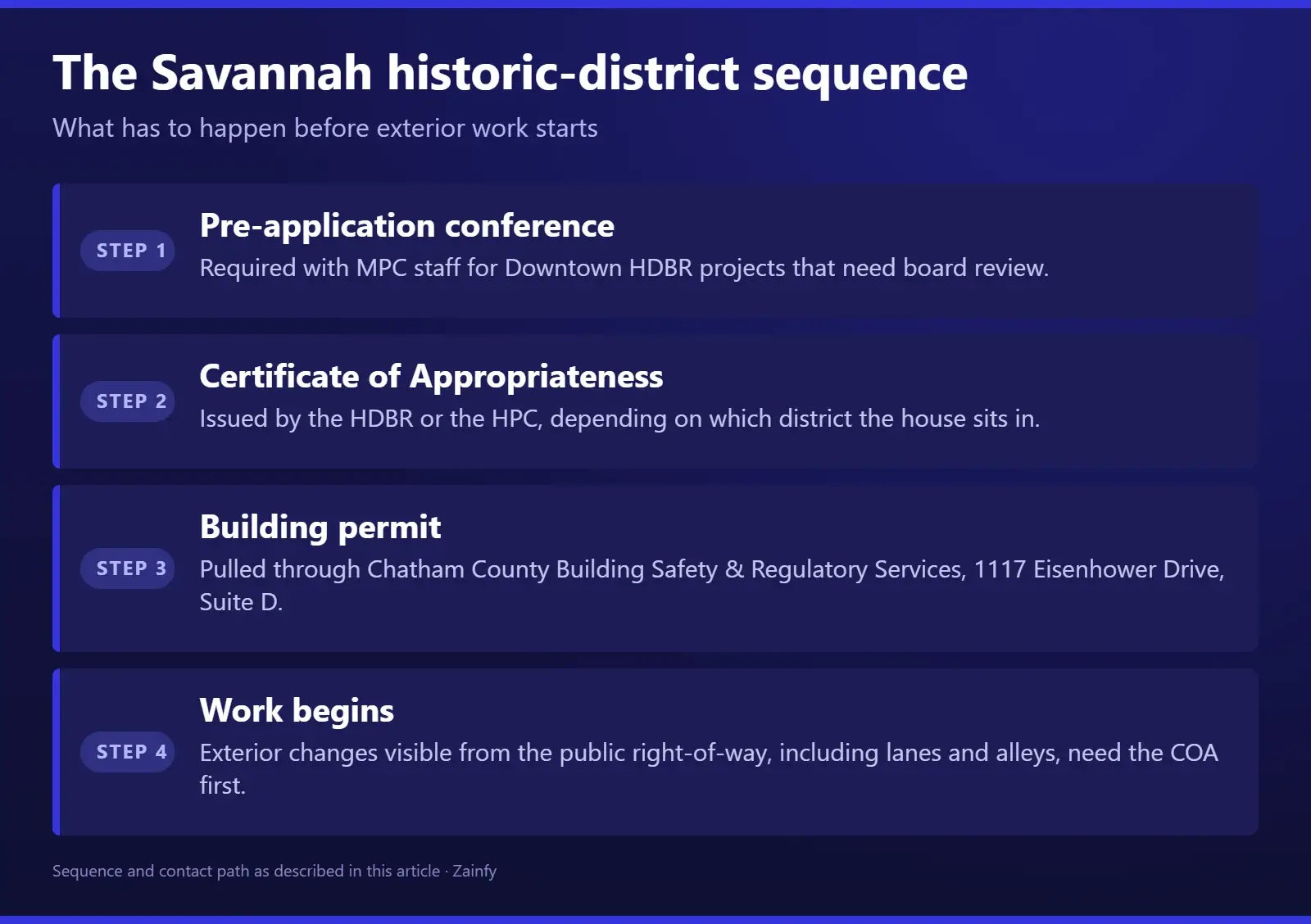
Do not conflate HDBR and HPC. A Landmark District carriage-house addition and an Ardsley Park exterior change do not run through the same local review lane. If your site blurs that, a cautious homeowner can feel it, even if he cannot name the boards himself. A contractor page that explains the difference calmly looks more credible than a page stuffed with broad “Savannah contractor” language.
The point is not to turn your website into the MPC site. The point is to prove you know where your work lives.
What a Savannah homeowner actually types when the house sits in a historic district
There are two searches happening at the same time.
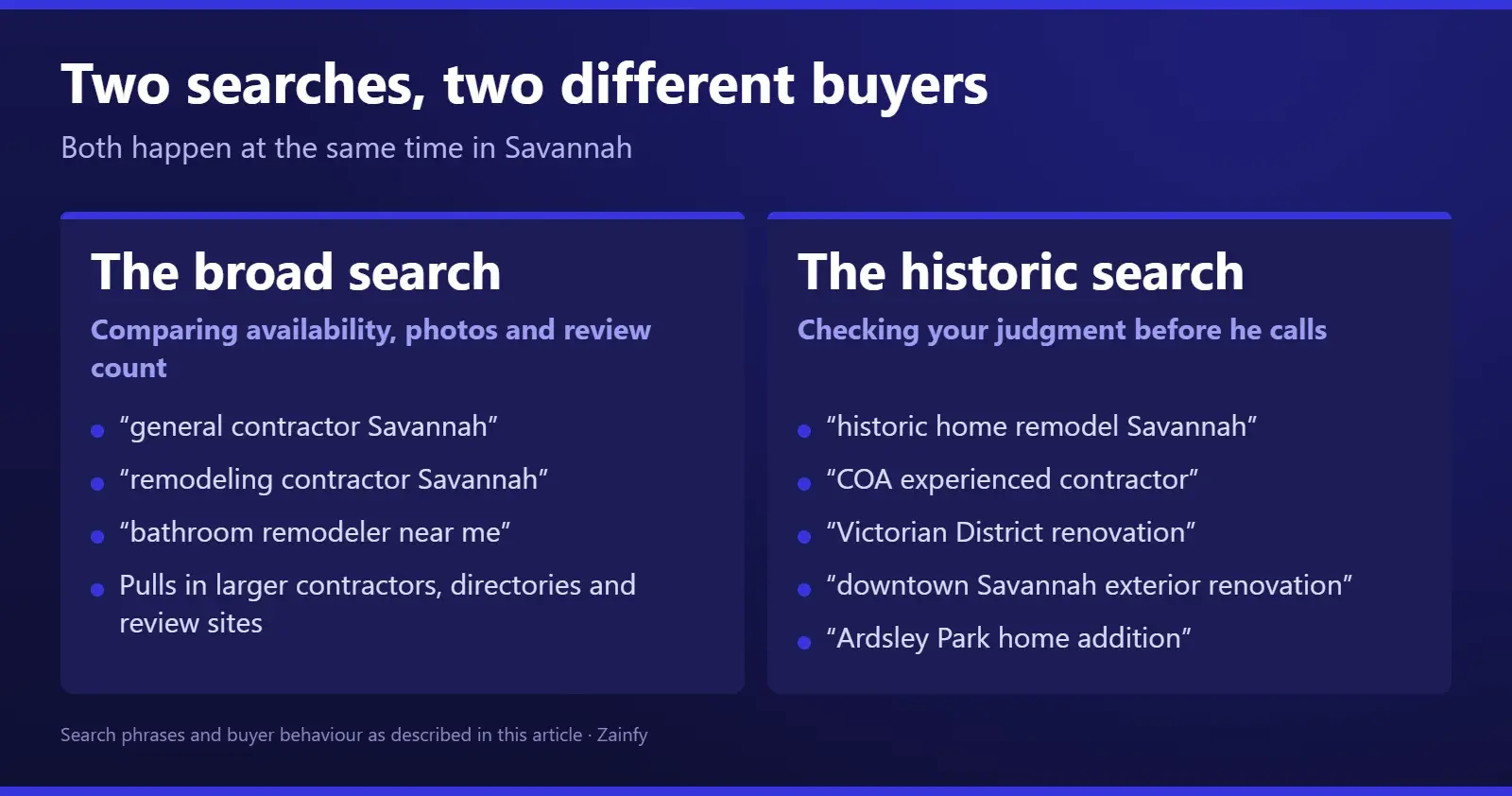
The first is broad: “general contractor Savannah,” “remodeling contractor Savannah,” “bathroom remodeler near me.” Those searches pull in larger contractors, directory pages, review sites, and agency-written service pages that could have been made for any city in Georgia. You can rank there eventually, but the page has to be strong and the local signals have to be real.
The second search is narrower and more useful for historic work: “historic home remodel Savannah,” “COA experienced contractor,” “Victorian District renovation,” “downtown Savannah exterior renovation,” “Ardsley Park home addition.” Those searches are not just different keywords. They come from a different buyer.
The broad-search homeowner is comparing availability, photos, and review count.
The historic-district homeowner is checking judgment.
He wants to know whether you understand why a visible exterior change is different from a hidden interior scope, why the Landmark District is treated differently than the Victorian District, and why an Ardsley Park-Chatham Crescent project may need language that a suburban kitchen page never touches. He may still end up typing a broad phrase into Google, but the content that earns his click has to answer the preservation worry sitting behind that phrase.
This is where most Savannah contractor SEO underperforms. It treats buyer intent as a keyword list instead of a jobsite reality. Residential intent and commercial intent are different. Historic-home intent and general remodeling intent are different. A page about “Savannah remodeling” that never names the COA path, the Landmark District, or the Victorian District is asking Google and the homeowner to trust a claim with no local proof behind it.
The sharper play is not to chase every phrase. It is to own the phrases that prove you belong on the kind of work you actually want.
Why you’re not in the Map Pack yet
You are probably not missing one magic setting.
Google’s local results weigh proximity, relevance, and prominence. A Savannah remodeler can be close to the searcher and still lose if the profile, site, reviews, and outside citations do not agree on what he does and where he works.
Start with the Google Business Profile. The primary category has to fit the core trade. Services should match the work you want, not every job you have ever accepted. Photos should show finished work, process proof, and recognizable Savannah context when it is real. A profile with no recent project evidence feels stale before the homeowner reaches your website.
Then check your NAP consistency. Name, address, and phone should line up across your site, Google profile, Houzz, Angi, HomeAdvisor, Yelp, Nextdoor, and any contractor listings tied to Chatham County Building Safety & Regulatory Services at 1117 Eisenhower Drive, Suite D. If one listing says one business name, another has an old phone number, and another points to a former address, you are making Google reconcile a mess.
Reviews matter too. Not just volume. Velocity, language, diversity, and owner responses all feed the picture. A review that mentions “historic porch repair near Forsyth Park” says more than another bare five-star rating.
Mobile still counts. If the project gallery takes too long to load on a phone, the click can die before the lead form appears.
That is usually the answer: not one missing trick, but weak agreement across the places Google checks.
One page per district, or one page that drowns? – the doorway-page line
Do not build a separate thin page for every Savannah historic overlay just because the list exists. That is the doorway-page pattern Google devalues, and it spreads your authority across pages none of which have enough substance to rank. Build real depth on the two or three districts you actually work, then connect those pages with internal links that make sense to a human reader. If you regularly handle Landmark District exteriors, Victorian District renovations, and Ardsley Park-Chatham Crescent additions, those may deserve distinct treatment because the boards, homeowner concerns, photos, and proof points differ. If you have never worked in Cuyler-Brownville or Streetcar/Mid-City, a templated page with a swapped heading is dead weight. The right district page should explain the scope, show real project proof, name the local review context, answer the buyer’s COA concern, and use LocalBusiness, Service, Review, and FAQ schema only where the visible content supports it. That is on-page SEO with a reason to exist. A page that says “we proudly serve [district]” eight times is not local depth. It is a footprint.
How ranking actually happens for historic Savannah work
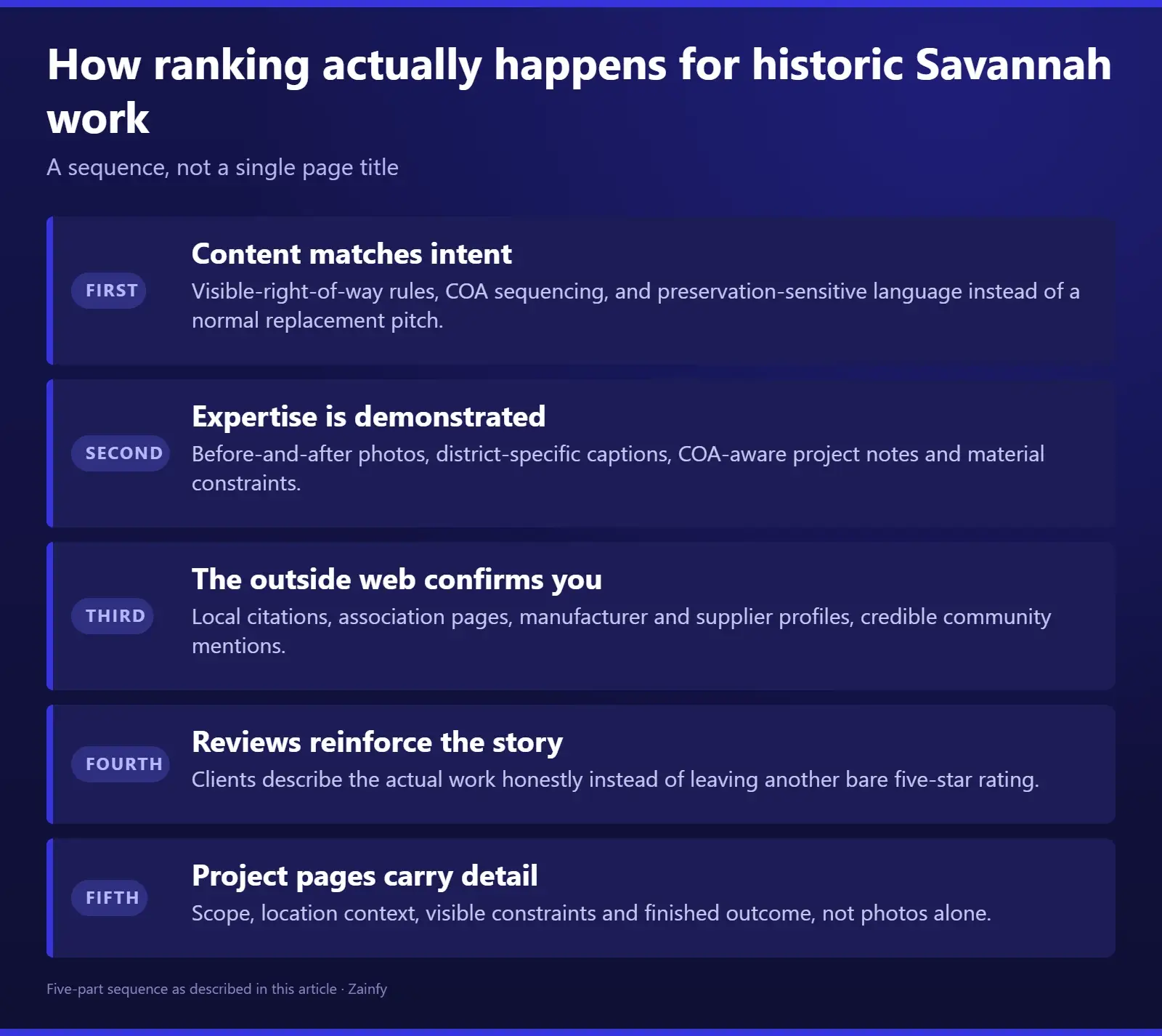
Ranking for historic Savannah remodeling work is a sequence, not a single page title.
First, your content has to match intent. A homeowner with a Landmark District exterior project needs to see that you understand visible-right-of-way rules, COA sequencing, and the difference between preservation-sensitive exterior language and a normal replacement project. That does not mean legal advice. It means your site speaks the same practical language the homeowner is already hearing from the MPC, the Historic Preservation Office, and the review-board process.
Second, you need demonstrated expertise. This is where E-E-A-T becomes less abstract. A page that says “historic remodeling” once is weak. A page with before-and-after photos, district-specific captions, COA-aware project notes, material constraints, and a clean explanation of what happens before the building permit is stronger. The proof sits on the page.
Third, the outside web has to confirm you are a real local contractor. That can come from local citations, association pages, manufacturer profiles, supplier mentions, community pages, and credible local organizations such as Historic Savannah Foundation when there is a real reason to be listed or referenced. Do not chase random links. A cheap link from a site no homeowner would trust does not help the way a relevant local mention can.
Fourth, reviews have to reinforce that story. If your best work is historic-district exterior repair but your reviews only say “great job,” you are leaving relevance on the table. Ask clients to describe the work honestly. Do not script them.
Fifth, your project pages need to carry more than photos. A porch restoration, carriage-house addition, or Victorian District bath remodel can become a search asset when the page explains the scope, location context, visible constraints, and finished outcome. The same method run in a different Georgia market shows what that looks like over a full campaign.
That is also where Savannah’s historic-district remodeling searches fits if you want the commercial service page after this guide.
The proof standard is not theoretical. All About Tile LLC, a Georgia tile contractor, saw 400% more leads, a 163% conversion rate increase, 131% page views growth, and an average position of 3.6 over 12 months. Different trade, same lesson: specific contractor SEO works when the page, proof, and search intent line up instead of sitting in separate buckets.
AI search adds another reason to get this right. Tools that summarize local options are more likely to quote pages with clear entities, specific scopes, and consistent facts than pages built from vague service claims.
How long it takes, and what waiting costs you
SEO movement for a contractor is usually visible in 3 to 4 months. Compounding often takes 6 to 12 months.
It is not a promise, and it is not an excuse to wait.
The cost of waiting is the monthly bill you keep paying somewhere else. If referrals are uneven, you pay with slow weeks. If lead marketplaces are filling the gap, you pay in shared leads and margin pressure. If your Google profile is weak, you pay when a client in the Landmark District chooses the contractor whose proof looked clearer on a phone.
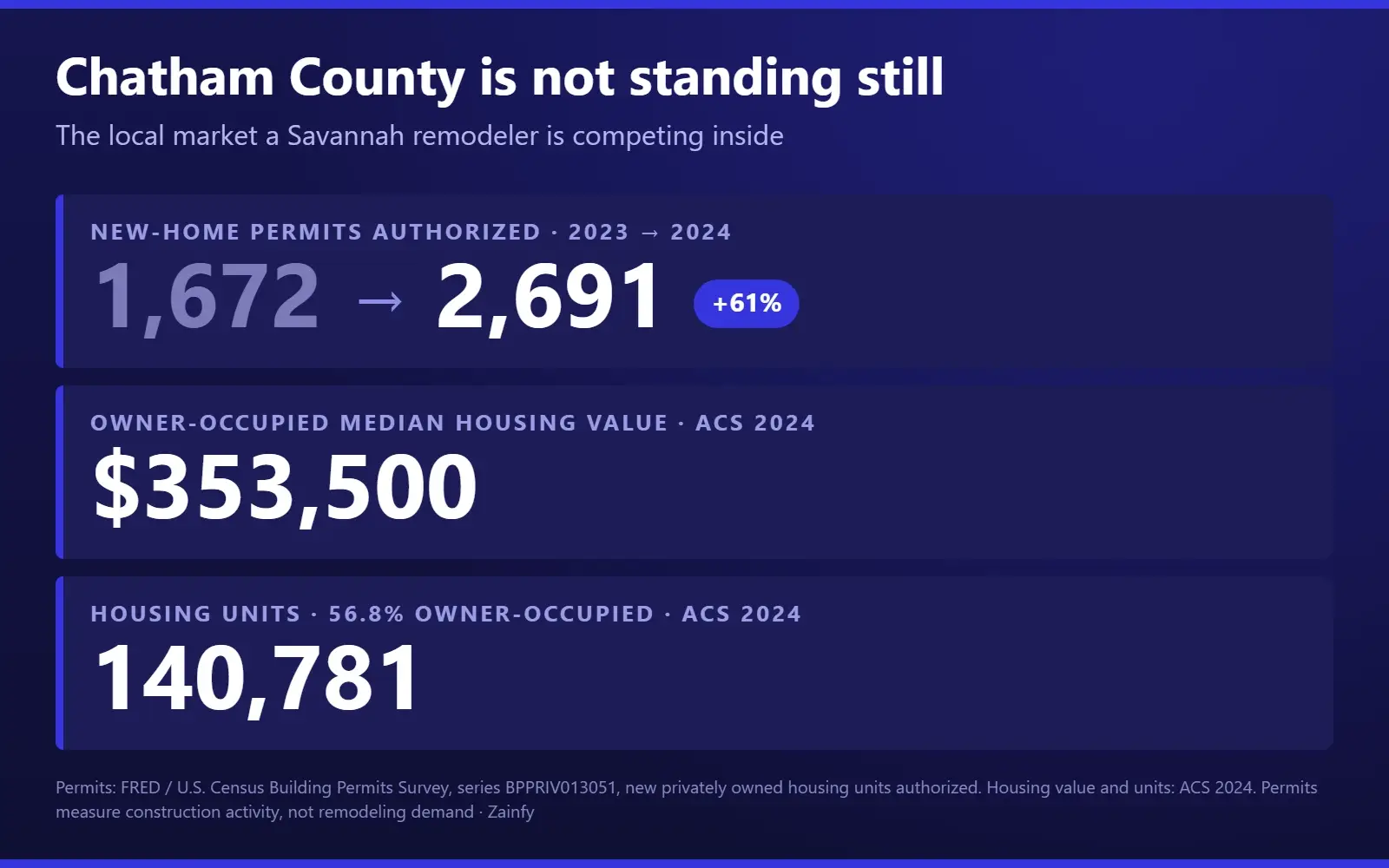
Chatham County is not standing still. FRED and the U.S. Census Building Permits Survey show 2,691 new privately owned housing units authorized by permit in 2024, up from 1,672 in 2023, about a 61% year-over-year increase. That is new-construction activity, not remodeling demand. Say it accurately.
What it does show is a construction market with more activity and more contractors pulled into the local conversation. More activity means more names in the search results, more profiles in the Map Pack, and more homeowners learning to compare contractors online before they call.
Chatham County’s ACS 2024 owner-occupied median housing value was $353,500. For you, that is not a homeowner cost guide. It is the buyer band your content has to speak to when a client is weighing a historic-district project and deciding which contractor sounds careful enough for the property.
Waiting does not keep the market quiet. It just lets another contractor collect the search signals first.
Competing with the bigger Savannah contractors
The small remodeler should not copy the big general contractor.
That is the mistake.
Large firms often win broad terms because they have more history, more mentions, more reviews, and more pages. A smaller Savannah contractor can still beat them by being narrower and more believable. Historic-district work is one of those lanes because it rewards specificity.
Chatham County had 140,781 housing units in the ACS 2024 data, with a 56.8% owner-occupied rate. That is a large enough owner base to support specialized content, but not so broad that every page has to chase the same generic phrase. A homeowner in a historic district is not just buying labor. He is buying confidence that the contractor will not create a review-board problem, a permit delay, or an exterior choice that has to be undone.
So write for that.
Do not present yourself as the contractor for every possible job from Pooler to Tybee to downtown preservation work. If historic Savannah projects are profitable for you, make the site prove that first. The bigger contractor can keep the broad page. Your advantage is the narrow intent the broad page treats as an afterthought.
Savannah contractor SEO: quick answers
[wps_faq style=”classic” question=”How long does SEO take for a Savannah remodeling contractor to see results?”]Most Savannah remodeling contractors should expect early SEO movement in 3 to 4 months, with stronger compounding over 6 to 12 months. The timing depends on your current Google Business Profile, reviews, site quality, local citations, and whether your pages match Chatham County search intent. A contractor with no district-specific content for Landmark or Victorian work is starting behind a contractor whose site already explains the COA path and shows real project proof. Do not judge the work by week-two rankings. Judge whether the signals are building in the right places: profile activity, indexed pages, better local impressions, stronger calls, and cleaner search terms tied to the work you want.[/wps_faq]
[wps_faq style=”classic” question=”How much should a Savannah contractor budget for SEO?”]A Savannah contractor should budget based on the gap between his current visibility and the work he wants, not on a generic price band. The practical way to think about it is contractor-side: what are you already losing to shared leads, slow referral weeks, and searches where another remodeler owns the Map Pack? Chatham County’s $353,500 ACS 2024 owner-occupied median housing value gives the buyer context, but it does not set your marketing budget. The budget should cover the work required: technical cleanup, local pages, Google profile improvement, reviews, citations, project proof, and ongoing content.[/wps_faq]
[wps_faq style=”classic” question=”Does SEO help contractors doing historic-district work in Savannah?”]Yes, SEO can help historic-district contractors in Savannah because the searcher needs proof before he calls. The HDBR handles the Landmark/Downtown Historic District, while the HPC handles Victorian, Streetcar/Mid-City, Cuyler-Brownville, Ardsley Park-Chatham Crescent, and other overlays. A contractor page that explains that split, shows relevant projects, and uses plain COA language can answer a buyer concern that a generic “Savannah remodeling” page misses. The goal is not to rank for government terms as if you were the MPC. The goal is to be the contractor whose content makes the homeowner think, “He has done this kind of work before.”[/wps_faq]
[wps_faq style=”classic” question=”Can a small Savannah remodeling company outrank bigger contractors on Google?”]Yes, a small Savannah remodeling company can outrank bigger contractors for narrower searches when its proof is more relevant. Broad terms are harder because larger firms often have more reviews, links, and brand history. Historic-district intent gives the smaller contractor a cleaner opening. A focused page on Landmark District exterior work, Victorian District renovations, or Ardsley Park additions can carry more useful detail than a large contractor’s general service page. Chatham County’s 140,781 housing units create enough local search surface for specialized pages to matter. The small company still has to earn it with photos, reviews, citations, and consistent local signals.[/wps_faq]
Closing: start with the district you can prove
Pick one district where you have real proof. Not the district you wish you owned. The one where you can show photos, scope notes, client language, and a clear understanding of the review path.
Build that page before you build eight thin ones.
If it is the Landmark District, explain the HDBR context and the COA-before-permit sequence. If it is Victorian or Ardsley Park-Chatham Crescent, write around the HPC lane and the kind of exterior or addition work you actually perform. Add the project proof. Clean up the Google Business Profile. Fix the citations. Ask for reviews that name the work honestly. While that compounds, there is what to post while the search work builds.
Then widen carefully.
For contractors looking past Savannah, Georgia remodeling search past the coast shows how local visibility changes from one Georgia market to another.
The wrong move is pretending every city and every district searches the same. Savannah gives you a sharper position than that. Use it.