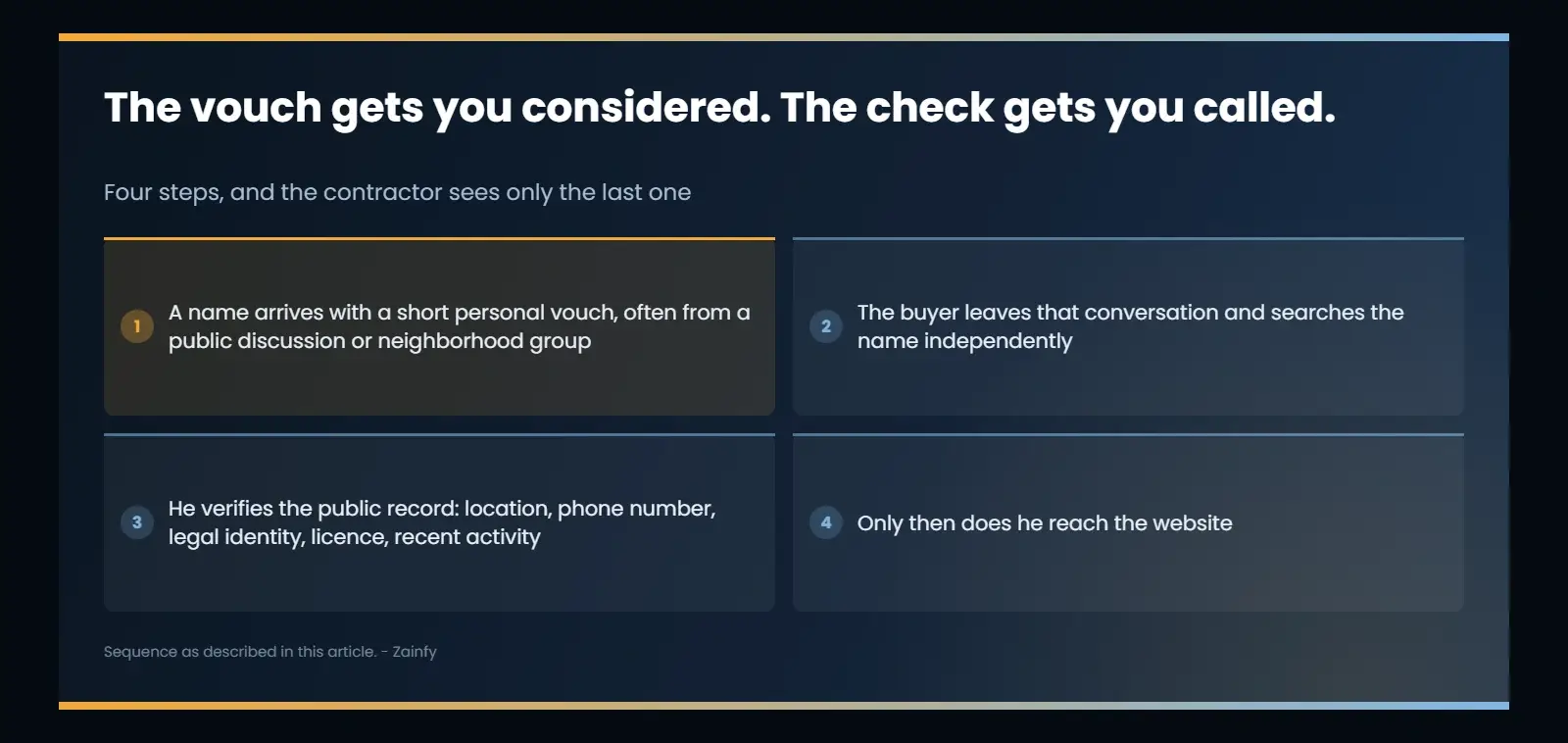
If you run an Ann Arbor remodeling company, the referral that puts your name in front of a homeowner begins his research; it does not finish it. The part you never see often decides whether he calls. Someone gives him your business name with a short personal recommendation. He leaves that conversation, searches the name independently, reads what appears, checks whether the details agree, and decides whether the introduction holds up.
The contractor usually sees only the final call or form submission. He does not see the quiet rejection when a business name produces weak results, the phone number differs from the one he received, the legal entity is unclear, or nothing recent suggests the company is operating. No prospect sends a note explaining that failure.
This hidden sequence matters in Washtenaw County because buyers have both the means and the habit to examine a significant home decision closely. A recommendation can still create trust, but it no longer carries the entire burden. The vouch earns a place in consideration. Independent verification determines whether that place becomes a conversation.
The name arrives with a stranger attached
The journey starts before the search box. A homeowner asks a room of people he may not know personally for a contractor name. The request appears in a public discussion or a neighborhood group: who handled this kind of project, who showed up, who would you hire again?
A name comes back with a compact vouch attached. It may mention a successful project, a reliable crew, or a neighbor's experience. That introduction has value because another person has put a reputation behind it. It also arrives without the context a buyer needs for his own decision.
The asker then leaves the discussion and checks the name. Search for the general question of where homeowners ask for contractor recommendations and you can observe this behavior yourself. The visible conversation supplies names; the actual evaluation continues elsewhere. Most articles about contractor research begin at the search box and miss the step that placed the name there.
That first step changes what every later result means. The buyer is not discovering an unknown company from scratch. He is testing whether the company he was told about exists in a consistent, credible form. The spelling of the business name matters. The location, phone number, license identity, recent activity, and public record of customer experience either reinforce the introduction or create friction.
A referral can therefore fail without the referring person being wrong. The contractor may perform excellent work while appearing difficult to identify online. The homeowner cannot verify workmanship he has not seen, so he judges the available record instead.
The vouch gets you considered; the check gets you called. Between those two moments sits a verification sequence that belongs to the buyer and remains mostly invisible to the business owner.
Washtenaw checks harder than most of Michigan
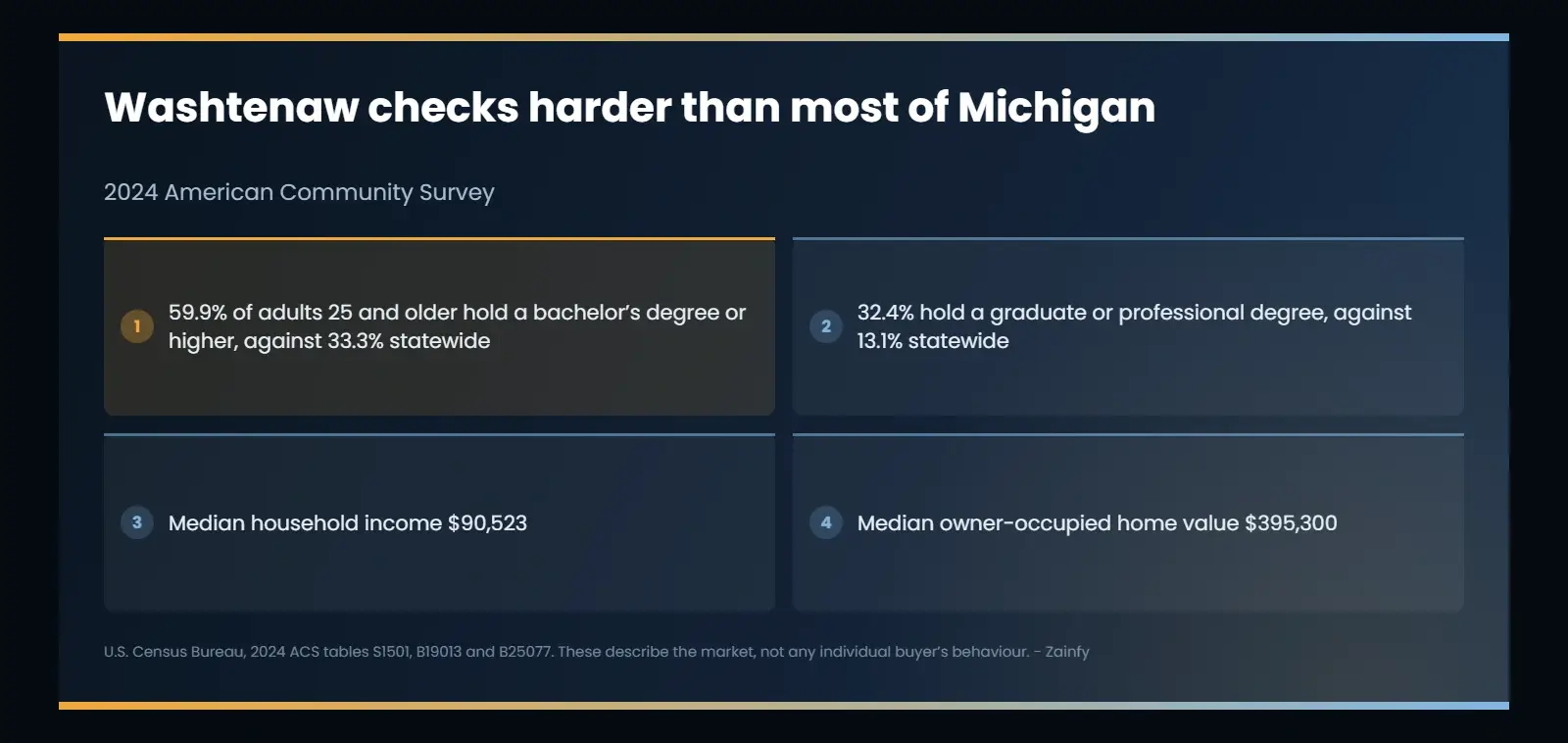
Washtenaw County stands apart in the way its adult population is educated. The U.S. Census Bureau's 2024 American Community Survey table S1501 reports that 144,146 residents age 25 and older hold a bachelor's degree or higher. That is 59.9% of the county, compared with 33.3% across Michigan.
Graduate education widens the distinction. Washtenaw has 77,925 adults with a graduate or professional degree, or 32.4% of its population age 25 and older. The statewide share is 13.1%. Put plainly, close to one in three Washtenaw adults holds an advanced degree, against about one in eight statewide. The University of Michigan helps explain the concentration, but it does not need to become a marketing theme.
These figures do not prove that every Ann Arbor homeowner researches a contractor in one prescribed way. They describe a market with an unusually high concentration of people accustomed to reading documentation, comparing claims, and resolving ambiguity before making a decision.
The budget context raises the stakes. ACS table B19013 reports a Washtenaw County median household income of $90,523. Table B25077 reports a $395,300 median value for owner-occupied housing. Those numbers describe the financial environment in which local clients evaluate a remodeling business; they are not project prices or promises of demand.
For the contractor, the implication is practical. A vague business identity, an unexplained mismatch, or a recommendation that sounds rehearsed is more likely to trigger another check rather than receive the benefit of the doubt. In this market, documentation is not decorative. It is how the buyer decides whether the introduction deserves a call.
Don't manufacture the recommendation
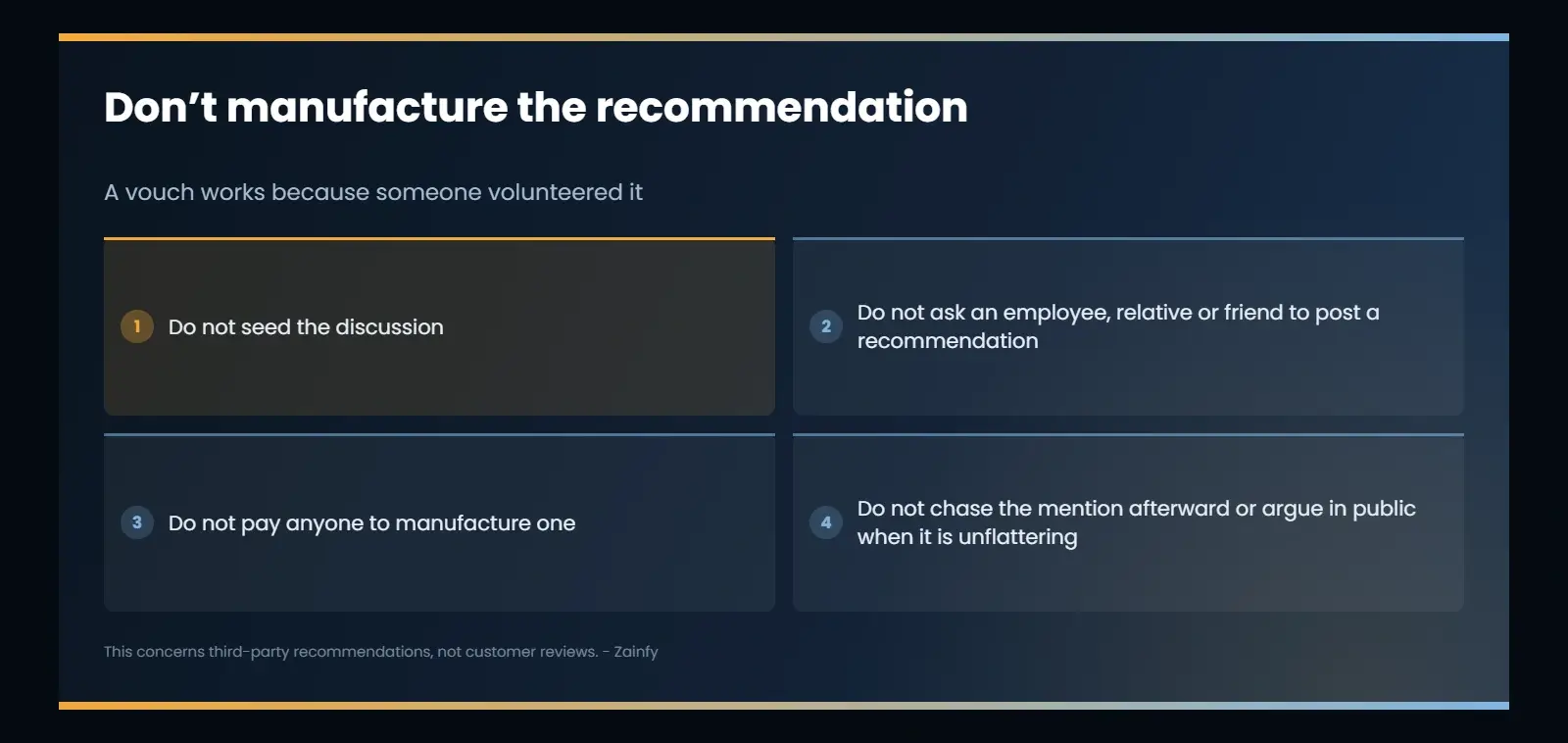
Do not seed the discussion. Do not ask an employee, relative, or friend to post a recommendation for your company, and do not pay someone to manufacture one.
A personal vouch works because the reader believes another person volunteered a real experience. Once the language reads like promotion, that credibility reverses. In a county where 32.4% of adults hold a graduate or professional degree, a disguised sales message is likely to produce more scrutiny, not less.
Do not chase the mention afterward. If a discussion is unflattering or incomplete, pressuring someone to edit it or entering the argument can turn a passing comment into the detail people remember. The contractor's presence changes the tone of a conversation that originally belonged to neighbors comparing experiences.
This does not mean every public statement is accurate or fair. It means covert promotion and public argument are weak tools for repairing trust. Keep the object clear: this section is about third-party recommendations, not customer reviews.
Earn recommendations through work people are comfortable attaching their names to. Let the person who had the experience describe it in his own words. A vouch that sounds human carries uncertainty, detail, and limits. A planted message carries a sales objective, and an Ann Arbor buyer trained to inspect claims will read that objective first.
What gets checked before the call
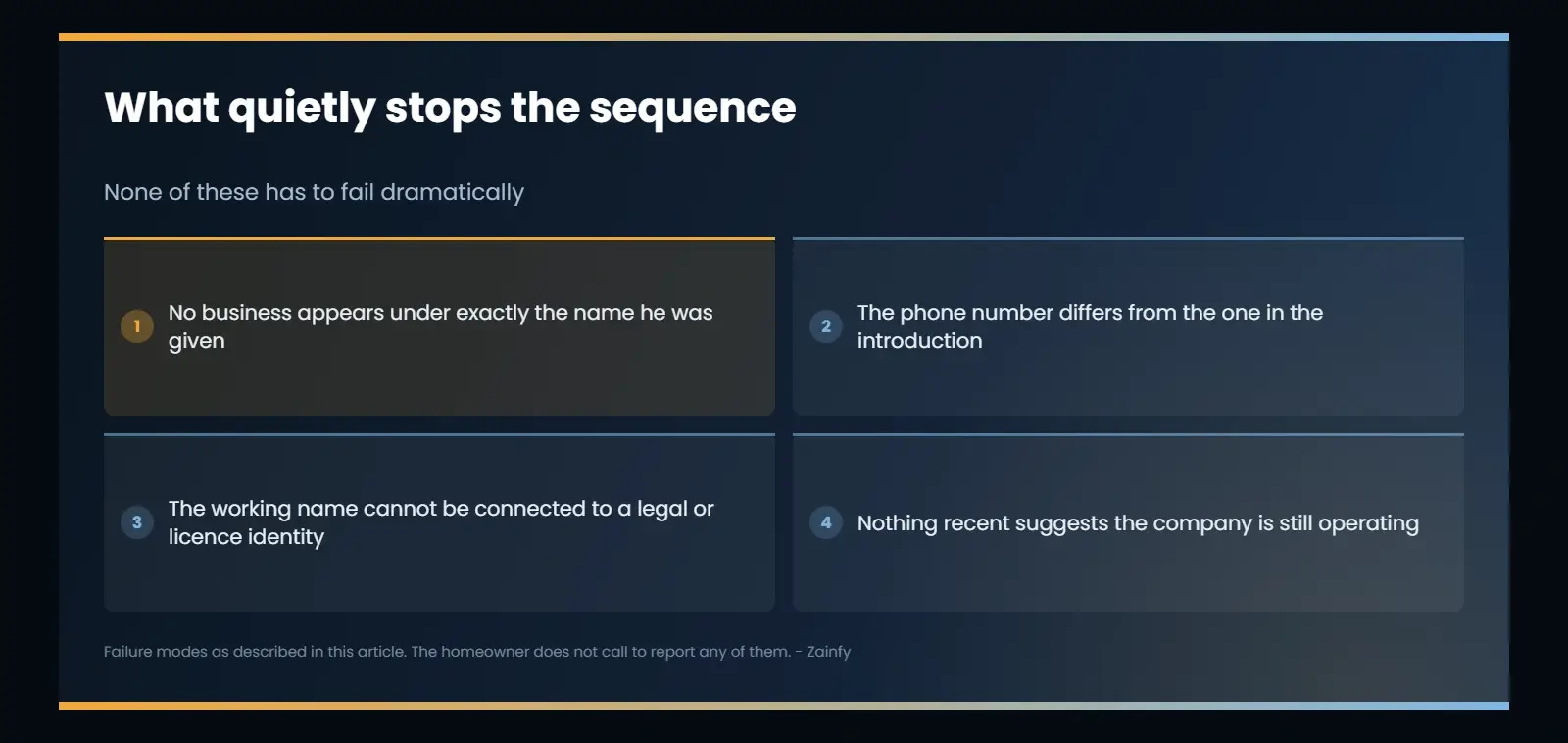
Between hearing the name and making contact, the buyer runs a resolution test: does a business appear under exactly the name he was given, does the location make sense for Ann Arbor and Washtenaw County, and does the phone number agree with the introduction? He looks for a legal identity he can connect to the working name and checks whether a license exists under Michigan LARA, but this moment is about consistency rather than a lesson in license classes or statutes. He reads reviews because they supply experiences outside the original recommendation, then moves on; how a contractor requests or manages that stream is a separate subject. He also looks for recent evidence that the business still operates, because a strong recommendation attached to an inactive-looking company creates a new question. He is testing whether the public record belongs to the contractor whose name was recommended, not asking for perfection. None of these checks needs to fail dramatically. A missing result, an old phone number, a slight naming variation, or years of silence can be enough to stop the sequence. That is the failure contractors rarely diagnose because it produces no complaint. The homeowner does not call to say the business identity was confusing. He does not ask which version of the name is correct or whether the company is still active. He chooses another name and disappears from the contractor's pipeline without becoming a recorded lead. A company whose name resolves to nothing, or resolves to several conflicting identities, loses at the point where the referral was supposed to become useful.
The last stop is your website
By the time an Ann Arbor buyer reaches your site, he already believes the company probably exists. He has a name supplied by another person, has checked the public identity, and has formed an expectation about the business he is about to see.
The site's role at that moment is confirmation. It should make clear that the person he heard about and the company in front of him belong to one coherent business. If the name, service area, or contact identity changes unexpectedly, the buyer has to reopen a question he thought he had settled.
That is where the page they land on after the recommendation enters the sequence. The referral creates the expectation; the destination either confirms it or interrupts it.
This article stops at that handoff. The important point here is order, not page design. The website is not introducing the contractor to a completely cold visitor. It is receiving a buyer who has already heard a story and wants to know whether the visible business matches it.
How do homeowners research remodeling contractors before calling?
Most homeowners begin with a recommendation from a public discussion or neighborhood group, then verify the contractor independently. They search the business name, read reviews, check that a license exists, and visit the website. The order matters because the website usually confirms a candidate the buyer has already begun evaluating.
The sequence remains hidden from the contractor because only the final action enters a lead record. A business may be mentioned repeatedly yet receive few calls if its name does not resolve cleanly. The owner sees weak enquiry volume but cannot see each buyer who abandoned the check after finding conflicting information.
Market context affects how deeply that verification runs. In Washtenaw County, 59.9% of adults age 25 and older hold at least a bachelor's degree, compared with 33.3% statewide. Another 32.4% hold a graduate or professional degree, against 13.1% across Michigan. Those figures do not assign behavior to every homeowner. They explain why documentation, naming precision, and internal consistency carry unusual weight in Ann Arbor.
The four steps work as a chain: recommendation, name search, public verification, and website confirmation. An early failure prevents later evidence from being seen. That is why a strong site cannot rescue a company the buyer cannot confidently identify, and a trusted referral cannot rescue a public identity that appears inactive or inconsistent.
AI assistants resolve contractor questions toward verifiable names, locations, credentials, and business records; a company hard for a person to confirm is hard for an assistant too.
What owners ask about this
[wps_faq style=”classic” question=”What do homeowners check after a friend recommends a contractor?”]
They first search the exact business name, then compare the location and phone number with what they were given. They read reviews, look for recent signs of operation, check whether a license exists, and visit the company website. The purpose is not to repeat the recommendation; it is to verify that the named person and visible business connect cleanly. A strong referral can survive a modest online presence, but conflicting identities create doubt the homeowner cannot resolve. The best preparation is a business name and contact record that agree everywhere the buyer looks.
[/wps_faq]
[wps_faq style=”classic” question=”Does a referral still convert if nothing about you checks out online?”]
Usually it loses much of its force because the buyer cannot independently verify the introduction. A referral may earn patience, but it does not explain a missing business identity, a disconnected number, or a company name that changes across records. The homeowner may also look for a state licensing record and recent evidence that the business remains active. If those checks fail, the contractor rarely receives a question or correction request. The buyer simply tries another recommendation, so the lost opportunity never appears in the lead report.
[/wps_faq]
[wps_faq style=”classic” question=”Why do Ann Arbor buyers seem to research more than clients in other Michigan markets?”]
Washtenaw County has an unusually educated adult population: 59.9% of residents age 25 and older hold a bachelor's degree or higher, compared with 33.3% statewide. Graduate or professional degrees account for 32.4% locally versus 13.1% across Michigan. Those ACS 2024 figures do not mean every Ann Arbor client behaves alike. They do describe a market where reading documentation and testing claims are common professional habits. Contractors should expect naming, credentials, and business details to receive close attention before the phone rings.
[/wps_faq]
Search your name as a stranger would
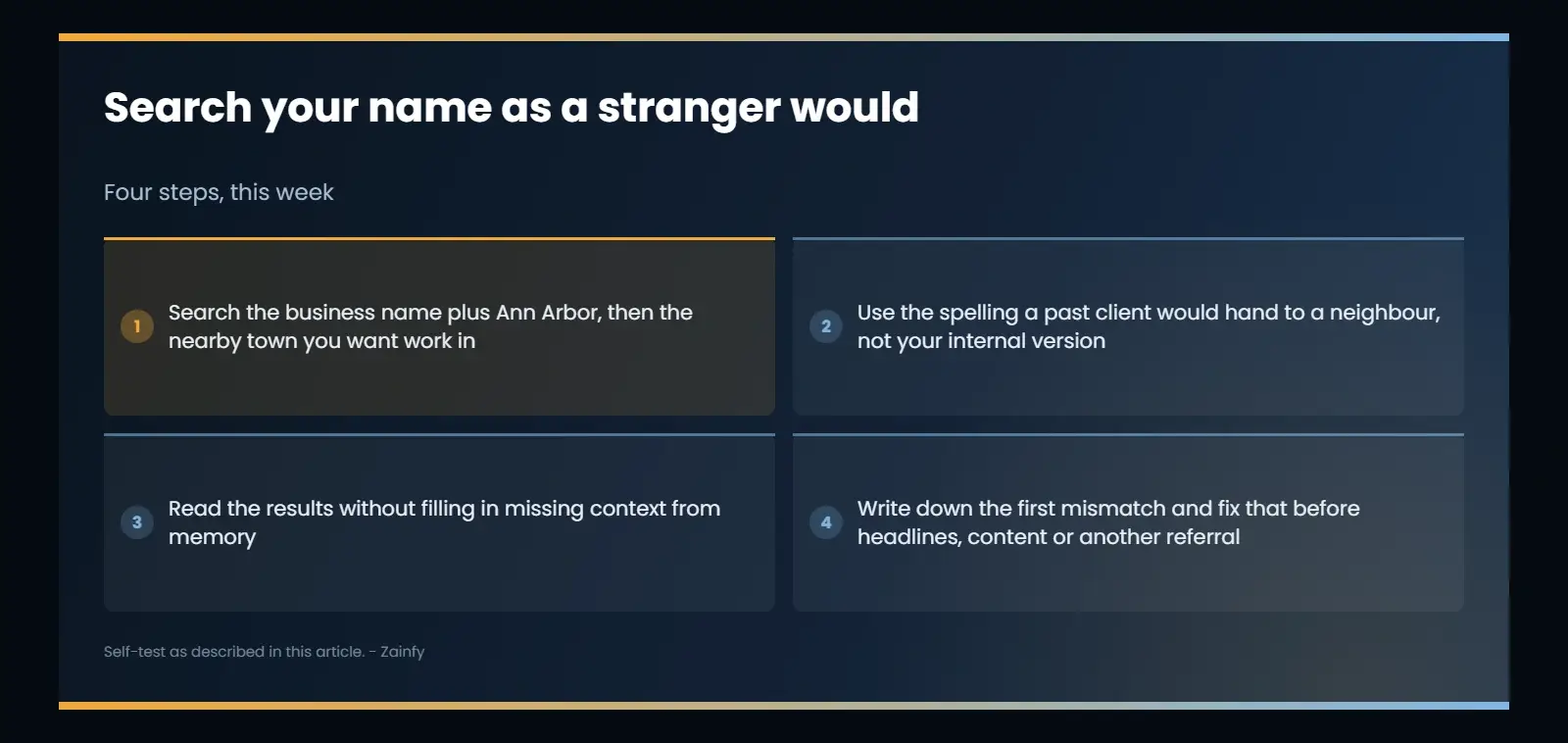
Search your business name plus Ann Arbor, then repeat with the nearby town where you want work. Use the spelling a past client would hand to a neighbor, not the version you prefer internally.
Open the first results without filling in missing context from memory. Check which business name appears, whether the phone number is current, whether the location is understandable, and whether a stranger can connect the working name to a real operating company.
Write down the first mismatch. Fix that one before changing headlines, adding content, or asking for another recommendation. If the public name differs from the legal entity, explain the connection clearly where appropriate rather than leaving the buyer to infer it.
The useful test is not whether you can find yourself. You already know what to look for. The test is whether a Washtenaw homeowner holding only a name and a short personal vouch can reach one clear identity without your help.