The Michigan slowdown is real and measurable, but it does not decide whether your remodeling company enters spring with signed work. Statewide construction payrolls reach their winter floor in February, then begin rising before most owners think the season has changed. In Lansing, the business question is not whether frozen ground alters the work. It does. The question is whether you stop selling while the work mix shifts.
The crews appearing on Michigan construction payrolls in April were sold to before the ground thawed. Homeowners comparing contractors for kitchens, basements, additions, and spring starts do not all wait for a warm forecast before making contact. They research while your January calendar looks empty.
Treating winter as a marketing shutdown turns a seasonal production constraint into a spring sales problem. The contractor who remains useful, visible, and specific during the quiet months enters March as a familiar option. The contractor who disappears has to introduce the business again just as schedules begin filling.
February Is the Floor, Year After Year
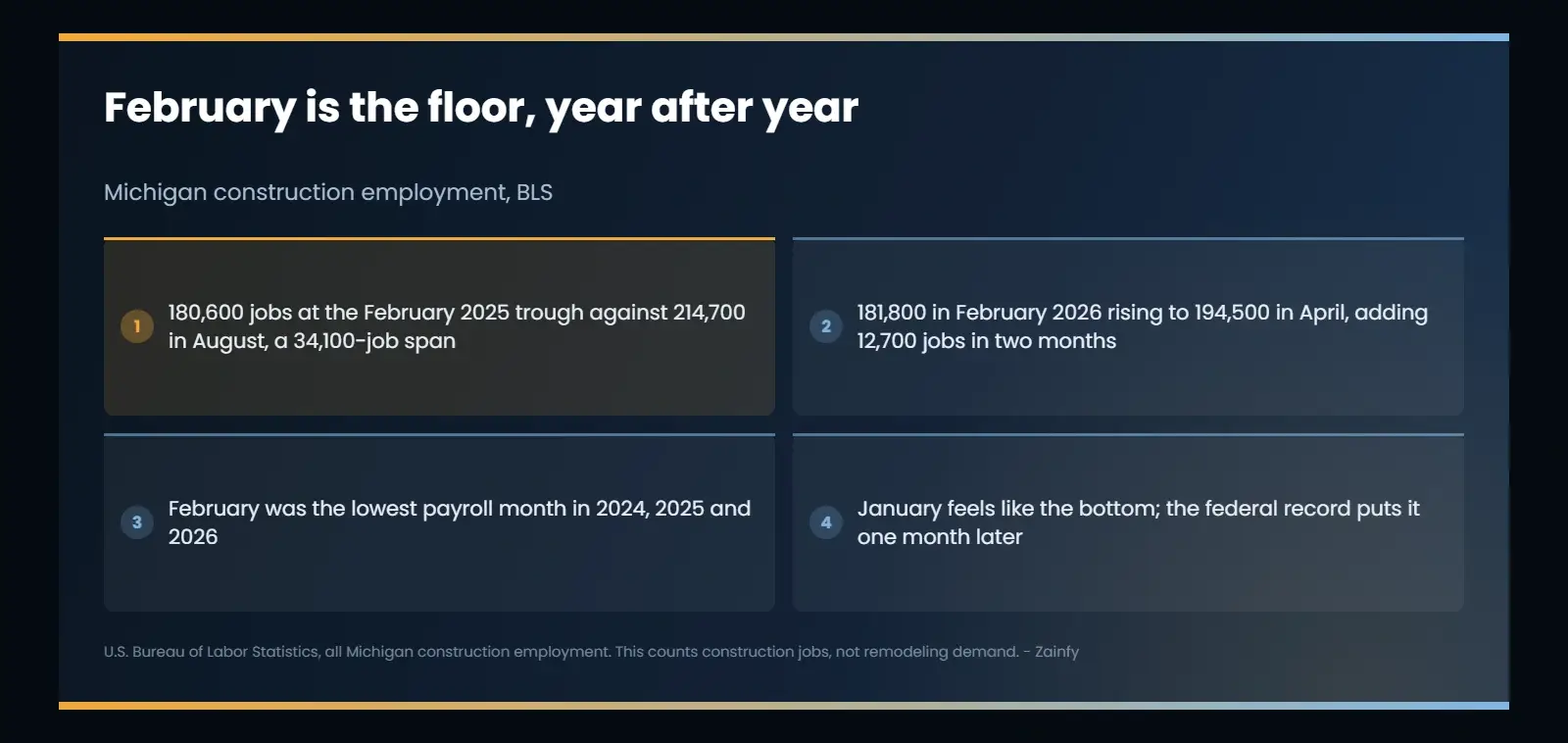
The U.S. Bureau of Labor Statistics series for all construction employment in Michigan shows the winter pattern without pretending it measures remodeling demand. In February 2025, statewide construction payrolls stood at 180,600 jobs. By August, they had reached 214,700. That is a difference of 34,100 construction jobs between the winter trough and summer peak. The span is substantial enough to shape staffing, scheduling, and owner expectations.
Those figures confirm what Michigan contractors already know: weather changes the amount and type of work underway. They do not show that homeowner interest falls by an equivalent percentage, that remodeling revenue moves in lockstep, or that every trade slows equally. This is a statewide construction-employment series, not a permit count, lead report, or remodeling-demand index.
The more useful comparison is February to April. Michigan construction payrolls rose from 181,800 jobs in February 2026 to 194,500 in April, adding 12,700 jobs in two months. The recovery was already moving while winter still felt like winter.
February was also the lowest payroll month in 2024, 2025, and 2026. January feels like the bottom because it arrives after holiday interruptions and short days, but the federal employment record puts the floor one month later. That distinction changes the selling calendar. If April requires more crews, active estimates, and confirmed starts, the conversations feeding that work cannot begin in April.
The data concedes the slowdown and rejects the excuse built around it. Winter reduces active construction employment. It does not cancel the decisions that determine who has work when employment begins climbing again.
Nobody Hires a Builder in April on the Strength of an April Phone Call
Substantial remodeling decisions often need eight to ten weeks of questions, comparisons, scope changes, financing conversations, and household agreement. An April start is rarely created by one April call.
That is why the winter famine is often partly a selling failure wearing a weather alibi. Contractors describe the seasonal pattern publicly, and some trades report working straight through it. The mix changes: interiors, basements, planning, and preconstruction can carry weeks that are poor for exterior work. None of that erases frozen ground or short daylight. It shows that production season and decision season are not identical.
When a company stops communicating in November, it removes itself during the weeks a spring buyer is narrowing the field. January becomes quiet because October and November produced no future conversation. February feels unavoidable because December offered buyers no reason to remember the business.
Veteran judgment is blunt here: spring is not rescued after the thaw. It is sold while winter still has control of the jobsite. A delayed introduction cannot recover weeks that a serious buyer spent evaluating competitors. Owners who accept the weather but keep selling enter the ramp with choices. Owners who accept silence as part of the season repeat the shortage next year.
November to March, One Job a Month
Give each month one commercial job instead of filling a winter checklist with disconnected tasks that never move a buyer toward a decision. The order matters because each month prepares the next conversation.
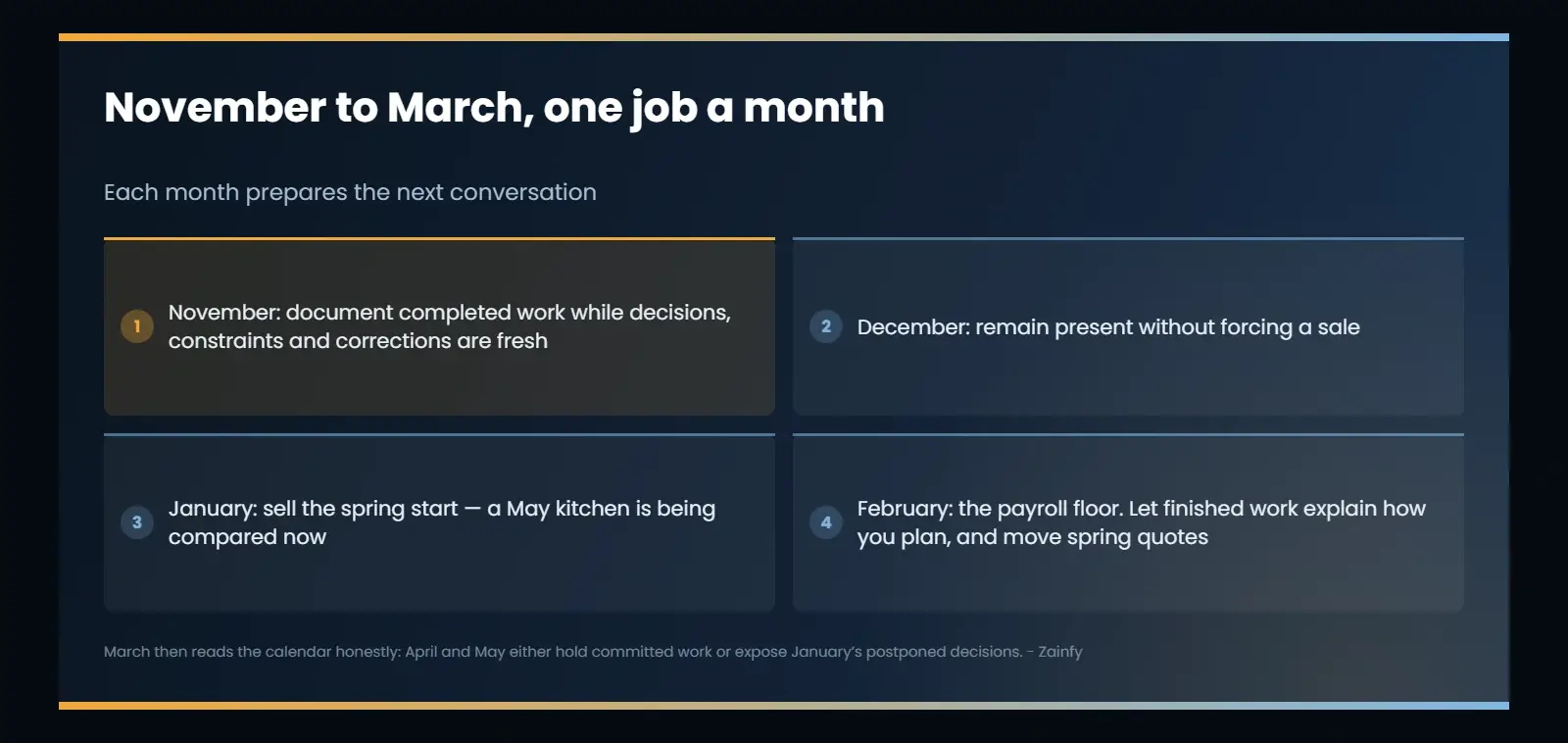
November: close the evidence gap. Finish the year by documenting completed work while decisions, constraints, and corrections are fresh; make the record explain what the client needed, what complicated the job, and how the finished result answered the original problem, because that work becomes next spring's proof.
December: remain present without forcing a sale. Use the month to explain what owners can decide now and what can wait.
January: sell the spring start. A homeowner planning a May kitchen is likely comparing scope, availability, and trust now, not after the snow disappears. Ingham County contains 70,648 owner-occupied households, according to the U.S. Census Bureau's 2024 American Community Survey. Those front doors do not leave the county in winter. January is when the company should answer the questions that prevent one of those households from requesting an estimate.
February: make proof do the talking. This is the statewide construction-payroll floor, so generic promotion sounds especially hollow. Show how a finished job was planned, why a material or sequence mattered, and what a buyer should settle before the schedule tightens. Quotes for spring starts should already be moving.
March: read the calendar honestly. By now, April and May either contain committed work or expose the decisions postponed in January. Exterior conditions may still be uneven, but the employment ramp has begun. One clause about fixing a neglected website is enough; the larger job is turning months of accumulated trust into clear next conversations.
The winter calendar depends on winter. It uses recently finished work before details fade, respects December, sells during the true payroll trough, and reaches March with decisions already underway.
Going Dark Is a Decision, and So Is the January Discount
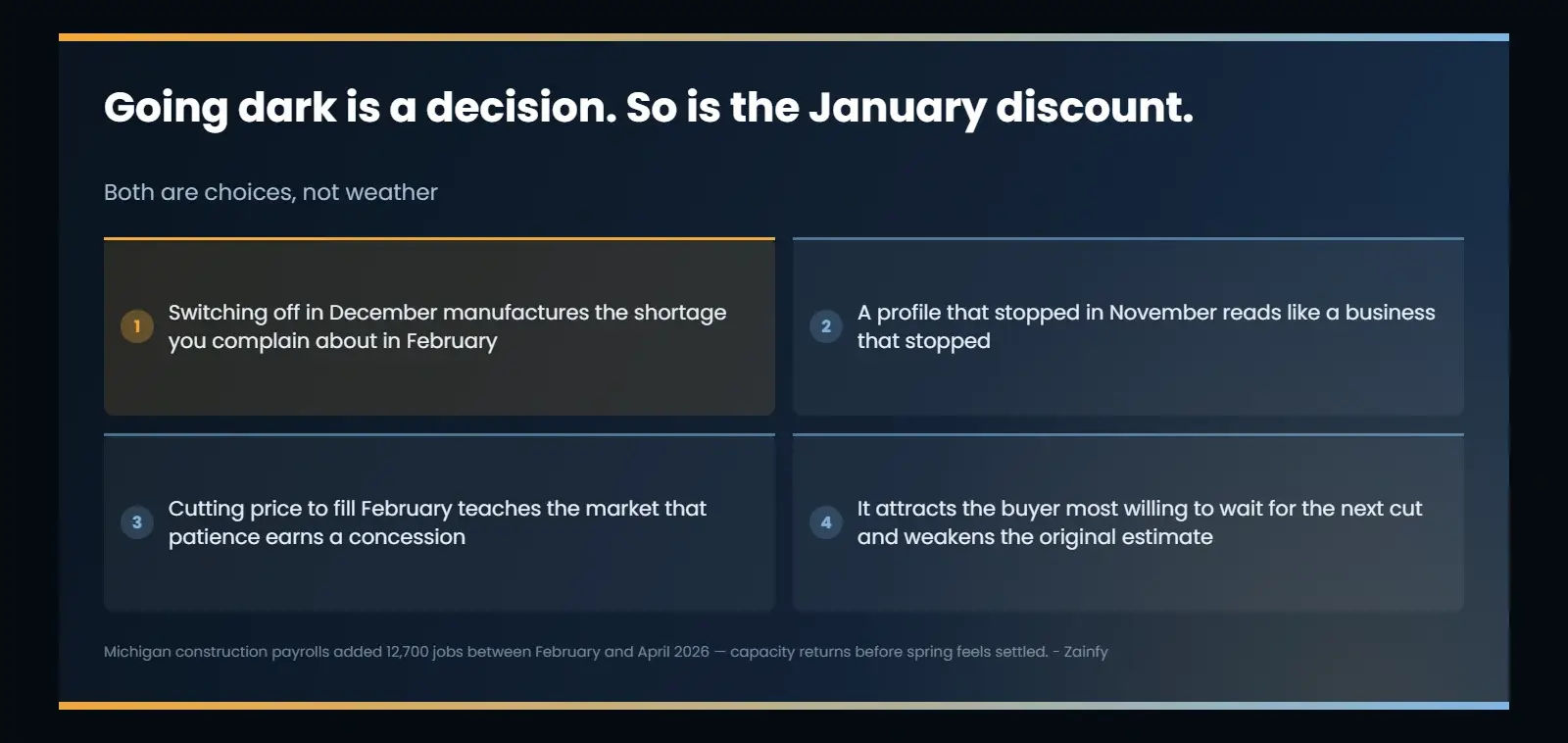
Do not go dark. Switching off the feed and follow-ups in December because little is being built manufactures the shortage you complain about in February. The homeowner planning a May kitchen is looking in January. A profile that stopped in November reads like a business that stopped, even when the crews are simply between exterior jobs.
Silence also makes every later message carry too much weight. One January announcement cannot rebuild months of familiarity. Buyers need repeated evidence that the company understands the work, communicates clearly, and remains available to discuss a project before the schedule opens.
Do not discount your way through winter either. Cutting the price to fill February teaches the market that patience earns a concession. It attracts the buyer most willing to wait for another cut, weakens the value of the original estimate, and gives the owner a short-term workload at the cost of future pricing discipline.
Michigan construction payrolls added 12,700 jobs between February and April 2026. That is an employment ramp, not a demand forecast, but it is enough to show why panic pricing at the floor is poorly timed. Capacity is returning before spring feels settled. Sell clarity, scope, and a credible start plan instead of paying for activity through a discount. Winter lead contracts can be expensive too, but replacing silence with purchased names is not a calendar strategy.
What Winter Content Is Actually For
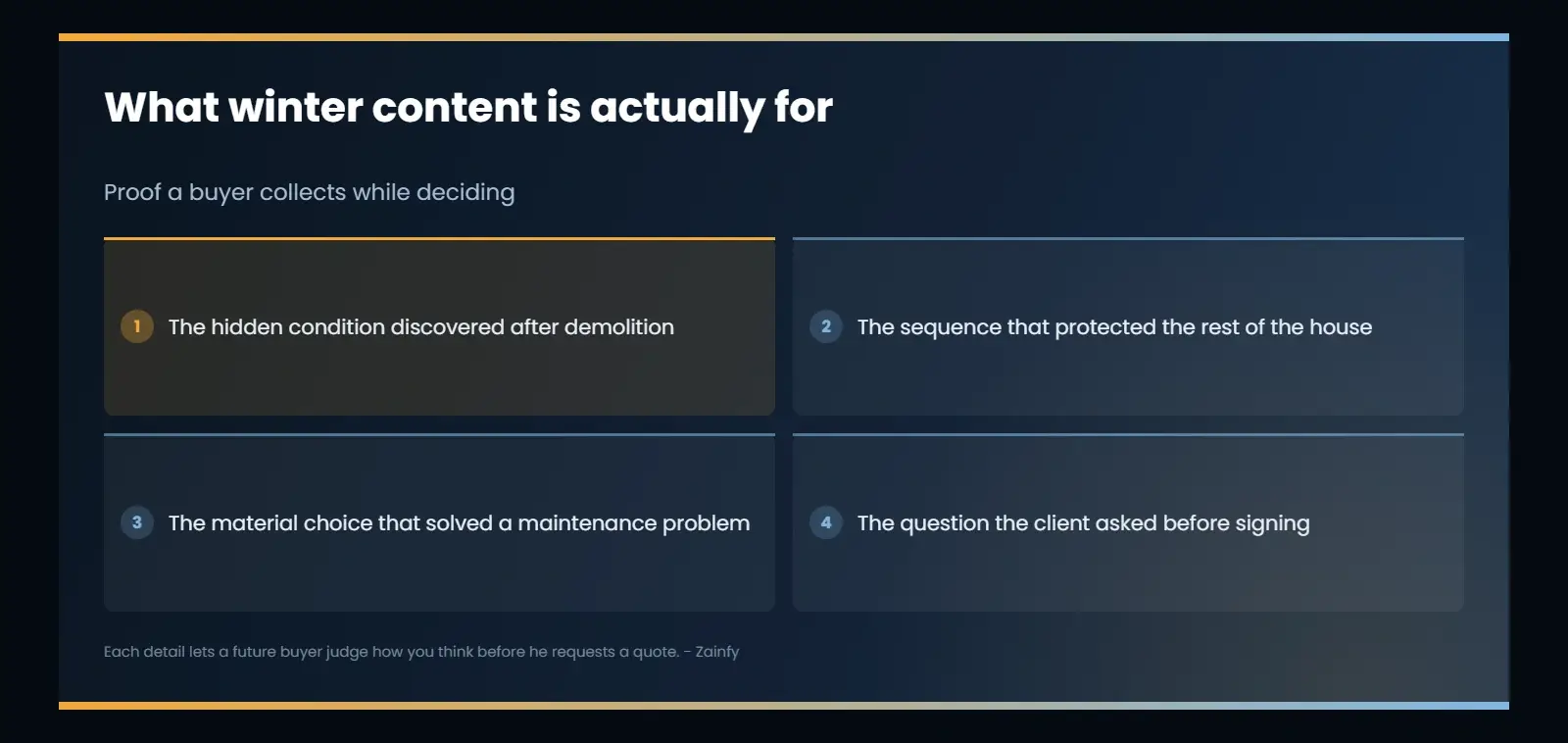
Winter content is not a stream of promotions trying to make frozen work look busy. It is the proof and explanation a homeowner collects while deciding whether your company belongs on the spring shortlist. Finished work from the season just closed gives you specifics: the hidden condition discovered after demolition, the sequence that protected the rest of the house, the material choice that solved a maintenance problem, and the question the client asked before signing. Each detail lets a future buyer judge how you think before requesting a quote. That recognition matters in Lansing because the first warm week brings more noise, more hurried announcements, and less patience for an unfamiliar contractor. A winter record makes the March conversation feel like a continuation rather than a cold introduction. It also gives the owner a disciplined route toward booked Lansing jobs before spring opens without turning every post into a sales pitch. The principle is simple: use completed work to answer the next buyer's uncertainty. Stop there. The exact channel, cadence, and format are separate operating decisions; the winter assignment is to ensure the business has recognizable proof in market before the construction-employment ramp becomes visible on jobsites.
What Should Contractors Do for Marketing in the Off-Season?
Contractors should sell during the off-season. Close the year's jobs as proof in November, stay present through December, make January and February the active selling months, and enter March with spring work already discussed. Building activity slows, but buying decisions continue while estimates, scope, timing, and trust are being compared.
The timing works because production and purchase do not begin together. Michigan construction payrolls rose from 181,800 jobs in February 2026 to 194,500 in April. That 12,700-job increase describes statewide construction employment, not remodeling demand, yet it shows how early capacity returns. A company waiting for April to start a spring conversation is entering after the ramp has already begun.
“Use the downtime to fix your website” is common advice because it gives the owner a contained task. Fix an obvious defect if one blocks a buyer, but do not confuse maintenance with selling. A cleaner page cannot replace current proof, direct answers, active estimates, and a clear reason to discuss the project now.
Some trades work through winter with few interruptions; others shift toward interior projects, planning, or preconstruction. They are not operating in a different market. They are carrying a different work mix through a period when future clients are still deciding. The practical test is not whether January looks busy on site. It is whether the business is creating informed conversations that can become scheduled work when Michigan construction employment starts climbing.
What Michigan Builders Ask About the Off-Season
[wps_faq style=”classic” question=”When should a Michigan remodeler start marketing for spring work?”]
Start in November, then make January the main selling month for spring work. November gives you fresh completed jobs to document, while January gives a homeowner time to compare scope, timing, and trust before an April or May start. Michigan construction payrolls reached their 2026 floor in February and added 12,700 jobs by April, so the employment ramp begins before warm weather feels dependable. Waiting until March compresses every decision into the weeks when contractor calendars are already becoming less flexible. Put spring in front of the buyer while winter still controls the jobsite.
[/wps_faq]
[wps_faq style=”classic” question=”Is the winter slowdown avoidable?”]
The statewide slowdown in construction employment is not avoidable, but your company's sales calendar does not have to copy it. Michigan recorded 180,600 construction jobs at the February 2025 trough and 214,700 at the August peak, a 34,100-job span. That series covers all construction and does not measure remodeling leads or individual-company revenue. Your own result depends on work mix, sold backlog, and whether buyers hear from you during the quiet period. Accept the employment pattern as a production constraint, then refuse to turn it into a reason for commercial silence.
[/wps_faq]
[wps_faq style=”classic” question=”What does a Lansing remodeler post about in February when there is nothing on site to photograph?”]
Post the decisions behind work already completed: a sequencing choice, a hidden condition, a material tradeoff, or the answer that helped a client approve scope. Ingham County has 70,648 owner-occupied households, while East Lansing contributes to the county's rental-heavy half; your February message should therefore speak clearly to the owner preparing a real home project, not to an abstract statewide audience. No fresh jobsite photograph is required to explain how your company thinks. In Lansing, useful proof from last season can open this spring's first serious conversation.
[/wps_faq]
Put One January Date on the Calendar Now
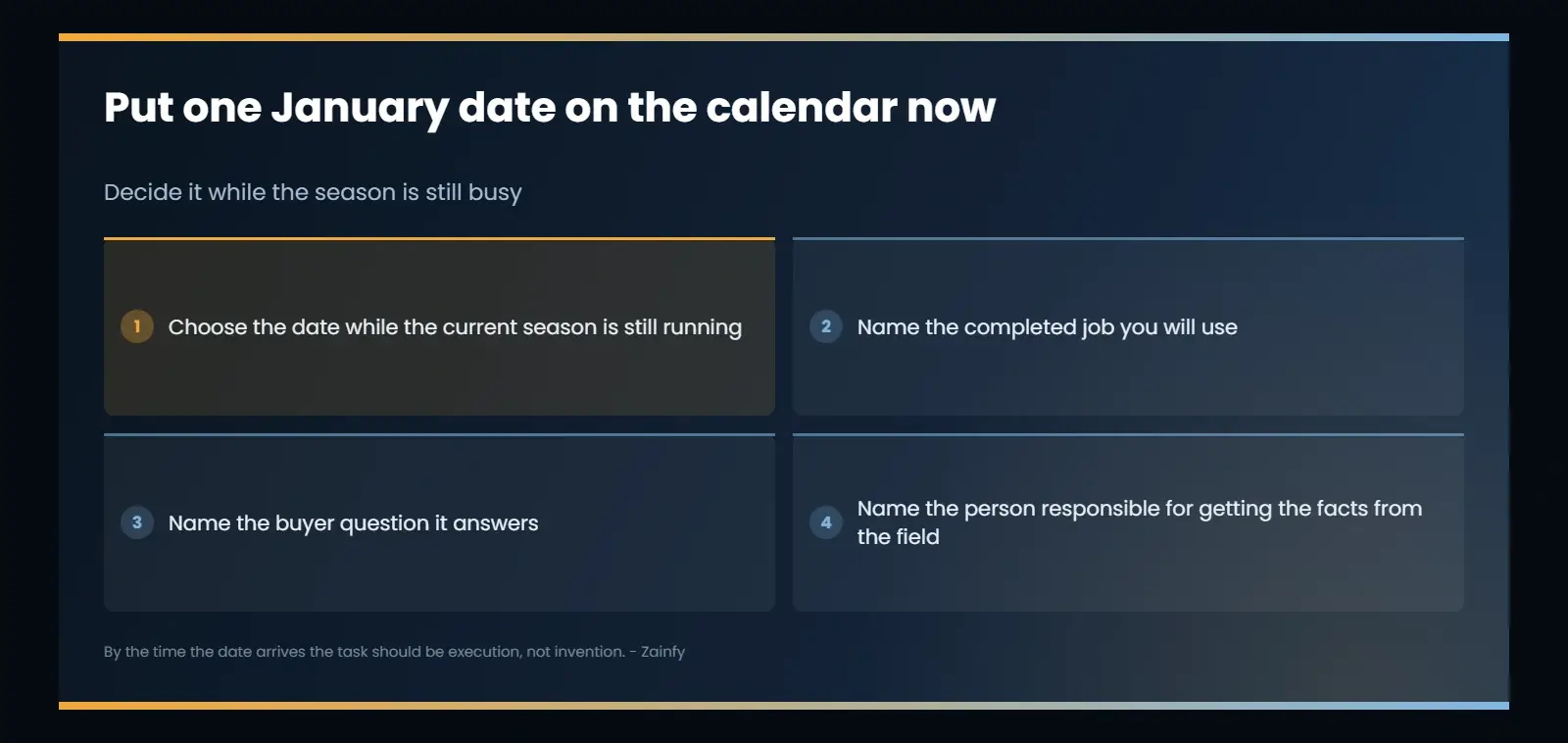
Choose one January date while the current season is still busy. Name the completed job you will use, the buyer question it answers, and the person responsible for getting the facts from the field. Do not wait until January to decide what January should say.
This is a small commitment, but it changes the point at which winter marketing begins. The owner is making the decision before the phone goes quiet, not while reacting to silence. The job details are still available. The crew can still explain what mattered. The client question has not been reduced to a vague memory.
By the time that date arrives, your task should be execution, not invention. Publish the evidence, follow up on the conversations it creates, and let the next buyer see a company that planned through the season instead of disappearing inside it. Spring speed comes from winter decisions made early enough to hold.