This is a three-month teardown of one Detroit account: what it posted, how often it appeared, and what each part of the mix produced. Search results offer a contractor 233 ideas across a handful of ranking pages and almost no measured result. This account provides a narrower answer grounded in its own figures.
The client, Best Network Design, LLC, is not a remodeler. It is a Detroit low-voltage and security integrator handling surveillance, access control, intrusion detection, and related systems for residential, commercial, and government buyers. That trade difference belongs at the top because hiding it would make every result less credible.
The account is still worth studying. Install footage, before-and-after changes, field work, and service explanations are raw materials both trades possess. A remodeler usually creates more visible change in one kitchen tear-out than a security integrator creates during a routine installation.
The useful question is therefore not whether one trade proves another. It is which content format carried most of this account's reach, what supported it, and where the evidence stops.
What the Account Looked Like Before Anyone Touched It
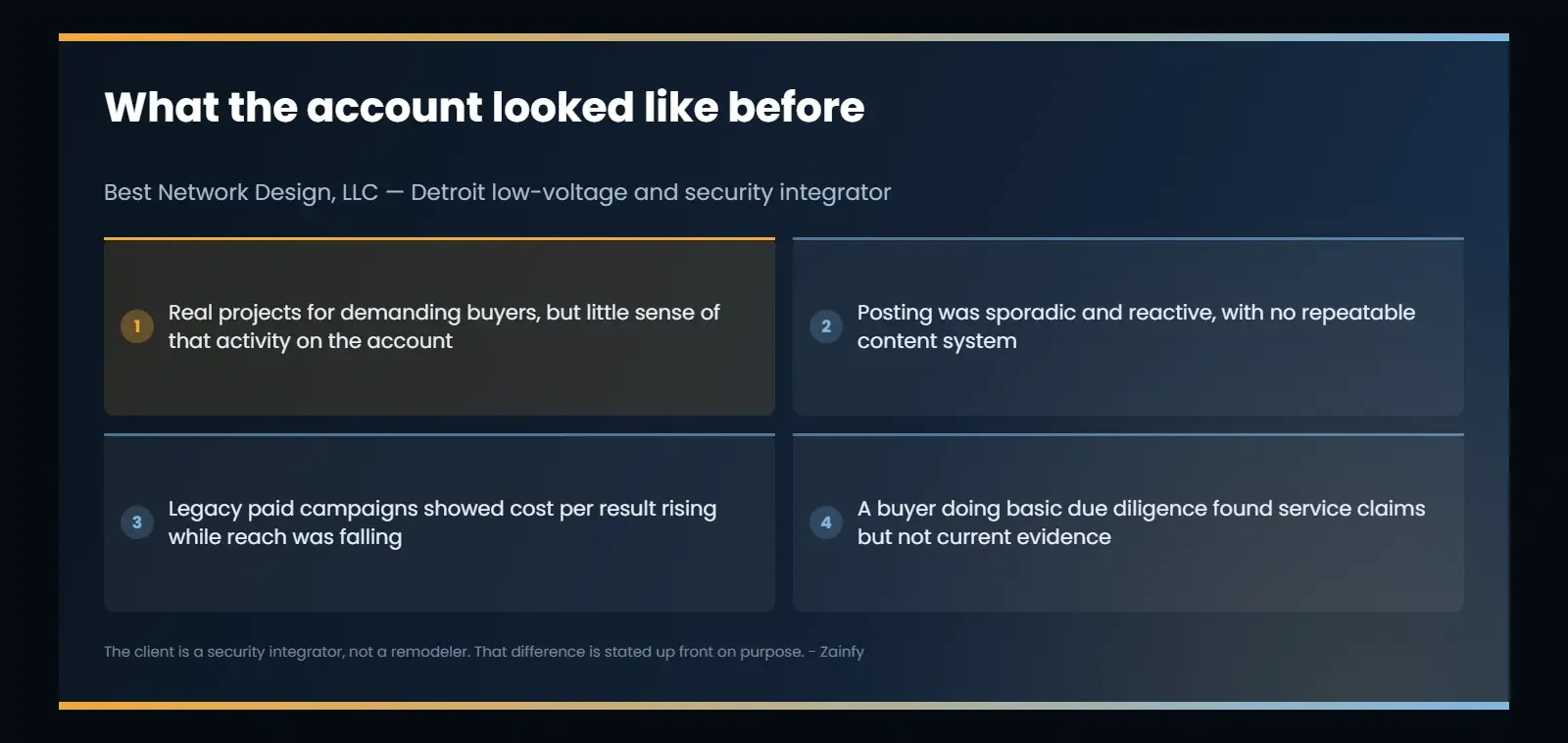
Best Network Design entered the campaign with a mismatch between its work and its public presence. The company was completing real projects for demanding buyers, including a limited number of major infrastructure assignments, yet the account gave a visitor little sense of the activity behind the business. Posting happened sporadically, usually in reaction to whatever image or announcement happened to be available.
There was no repeatable content system connecting field material to a weekly publishing rhythm. Install work was occurring, but the useful moments were not consistently captured. Finished upgrades could have shown visible changes. On-site footage could have demonstrated process and scale. Service-specific explanations could have helped a buyer understand what the company actually installed. Instead, those pieces appeared without a stable pattern or did not appear at all.
The paid side was weak as well. Legacy campaigns showed cost per result moving upward while reach was falling. That combination matters because it can make an owner blame the channel when the account has not established anything worth following. More distribution does not repair an empty proof record.
The starting audit examined the available field material, recent posts, account presentation, audience split, publishing consistency, and campaign performance. It also exposed a credibility gap. A residential buyer, facility manager, or public-sector evaluator doing basic due diligence could see a company name and service claims, but not enough current evidence to connect those claims with the work being completed.
The account needed a format capable of carrying movement, process, and finished change without demanding a studio shoot. Short field video fit that job. The campaign record is best understood as a composition built around that format, with before-and-after posts, behind-the-scenes footage, and service highlights supporting it. This was not a blank account waiting for clever ideas. It was a working company failing to convert existing work into visible proof.
Thirty Ideas, Seventy-Seven Ideas, a Hundred and One Ideas
The contractor-content genre mistakes inventory for judgment. One page gives thirty ideas. Another gives seventy-seven. A third offers a hundred and one. A working owner with two hours a week does not need a larger menu. He needs to know which material deserves those two hours.
The problem is not that before-and-after photos, team posts, tutorials, field clips, and project explanations are useless. Most are reasonable. The problem is that a list treats every option as if the owner has equal access, equal time, and equal evidence that it works.
The highest-ranking advice also repeats two performance claims without supplying a source: before-and-after posts supposedly earn the strongest engagement, and Reels supposedly reach people who do not follow the account. Those statements may sound plausible. Plausibility is not measurement, and neither claim tells a Detroit contractor what happened on an actual account.
A list cannot answer whether one format carried most of the reach, whether weekly publishing was enough to create movement, or whether paid distribution improved after stronger material existed. It also cannot tell the owner which metrics were observed and which business outcomes were never recorded.
What follows is not a universal rule for contractors. It is one documented account's composition: four recurring content types, a weekly cadence, two channels used as facts of the case, and a three-month performance record. That boundary matters. One account can show what happened when its existing work was captured consistently. It cannot prove that every trade, city, crew, or buyer will respond identically.
The Mix, and What the Lead Format Carried
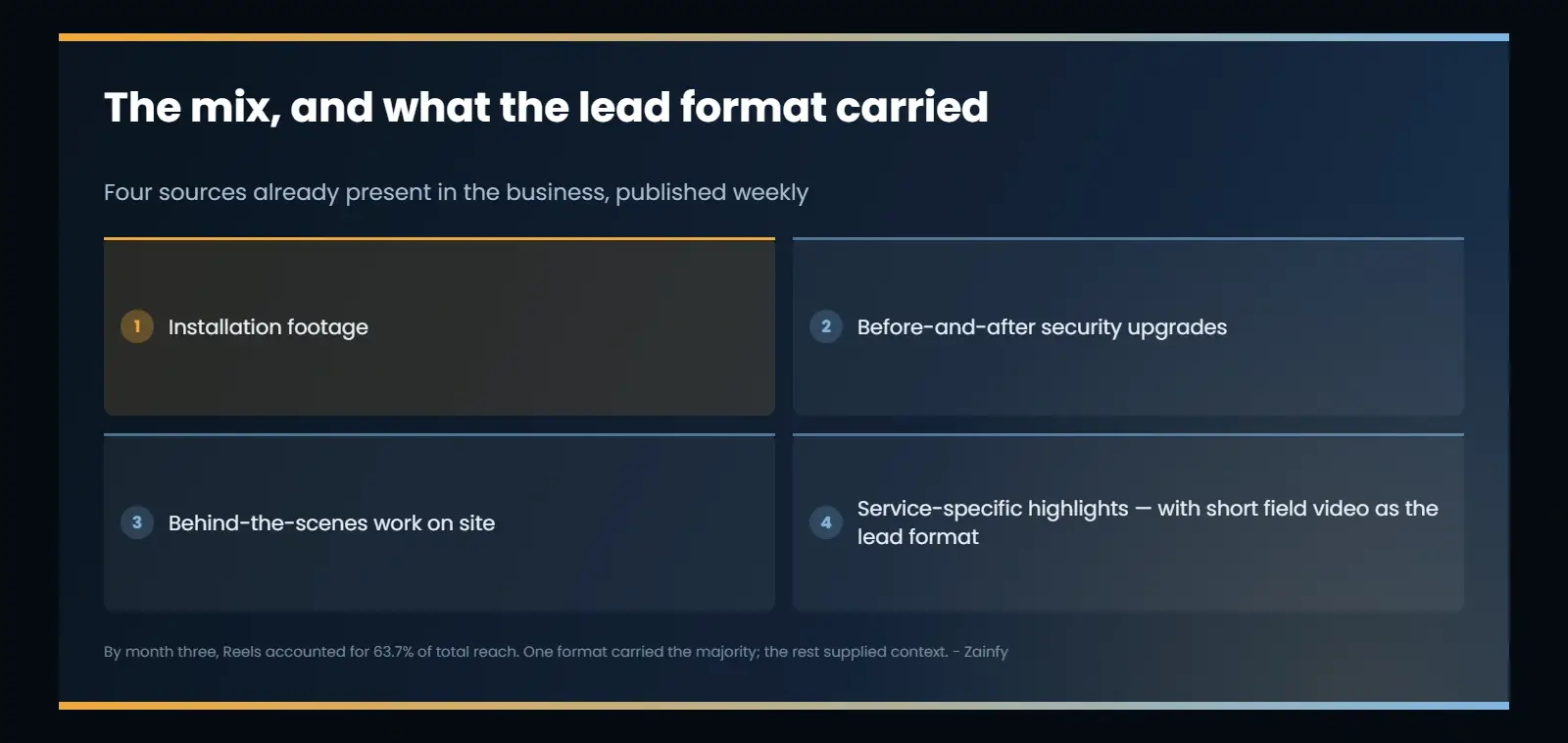
The account's content mix drew from four sources already present in the business: installation footage, before-and-after security upgrades, behind-the-scenes work on site, and service-specific highlights. The material appeared weekly across the company's Instagram and Facebook accounts. Those channel names describe where the case ran; they are not a recommendation or a comparison. The composition was sustained weekly instead of appearing as an isolated project dump.
Short field videos became the lead format. They showed equipment, movement, technicians working, and the visible difference between a condition before installation and the result afterward. Before-and-after posts gave the viewer a quick contrast. Behind-the-scenes footage supplied process. Service highlights explained what a system did and which problem it addressed.
By month three, Reels accounted for 63.7% of the account's total reach. That is the central figure because it identifies where most of the observed reach came from. The campaign did not report five formats contributing evenly. One format carried the majority of reach while the surrounding material supplied context and variation.
For an owner deciding how to use two available hours, that finding is more useful than another list of options. It does not command a fixed posting ratio. It shows that this account's moving field footage did substantially more distribution work than the rest of its composition. A different contractor should test his own material rather than convert one case into a permanent formula.
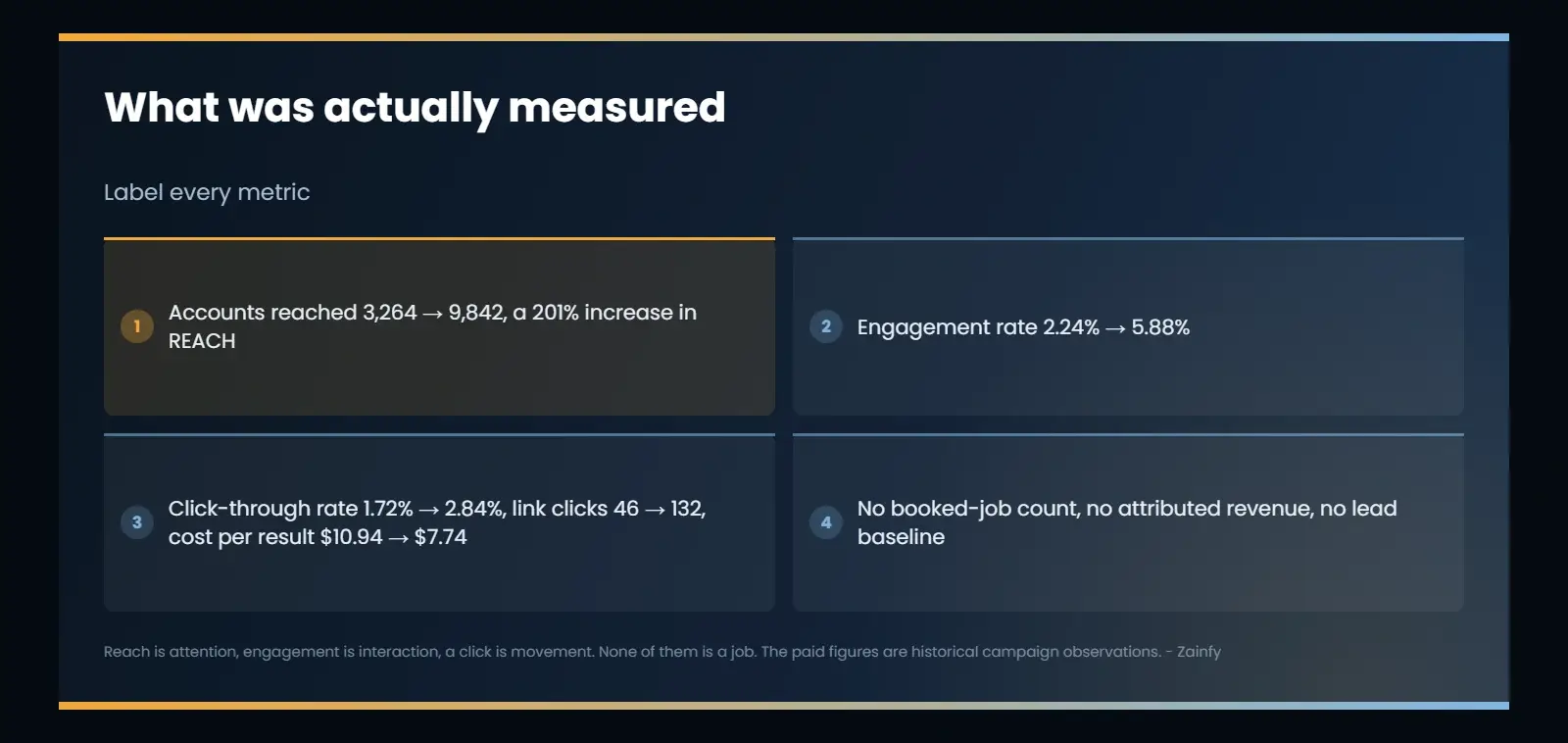
The broader reach result was also measured. Instagram accounts reached rose from 3,264 to 9,842, a 201% increase in reach. The metric is reach, not leads, booked jobs, or revenue. Instagram engagement rate moved from 2.24% to 5.88% during the documented period.
Those figures describe attention around a specific account. They do not establish which post produced a signed contract. Their value is narrower and still important: regular field footage created a recognizable lead format, that format accounted for 63.7% of total reach by month three, and the account's measured reach and engagement increased while the mix was running.
The Ads Did Not Fix the Account. Content Existed Before Spend Worked
The legacy paid campaigns were not proof that the channel had failed. They were evidence that distribution had been asked to carry material without a dependable content system behind it. Cost per result was rising while reach was falling, so adding spend would have purchased more exposure without answering whether viewers found the work worth watching.
The documented sequence ran differently in month two. Legacy campaigns were paused after weekly content was already operating, and a prospecting-to-retargeting funnel replaced them. The historical account data then showed click-through rate moving from 1.72% to 2.84%, link clicks rising from 46 to 132, and cost per result falling from $10.94 to $7.74. Those are campaign observations, not an offer of paid-ad management.
Do not buy reach to compensate for content nobody would choose to watch. Boosting a weak post can buy impressions, but it teaches little about whether the subject, proof, or presentation deserved attention. The useful order is to establish material that earns interest, then decide whether additional distribution has a job.
For the crews filming their own tear-outs, the operating system begins with field capture and a repeatable publishing rhythm, not with a budget switch. That distinction is the commercial lesson available from the case without turning one campaign into a universal ad formula.
The account record supports a sequence between content and distribution. It does not support the claim that paid promotion created the content result, nor does it show that every contractor should run the historical funnel described here.
What Transfers to a Remodeler, and What Does Not
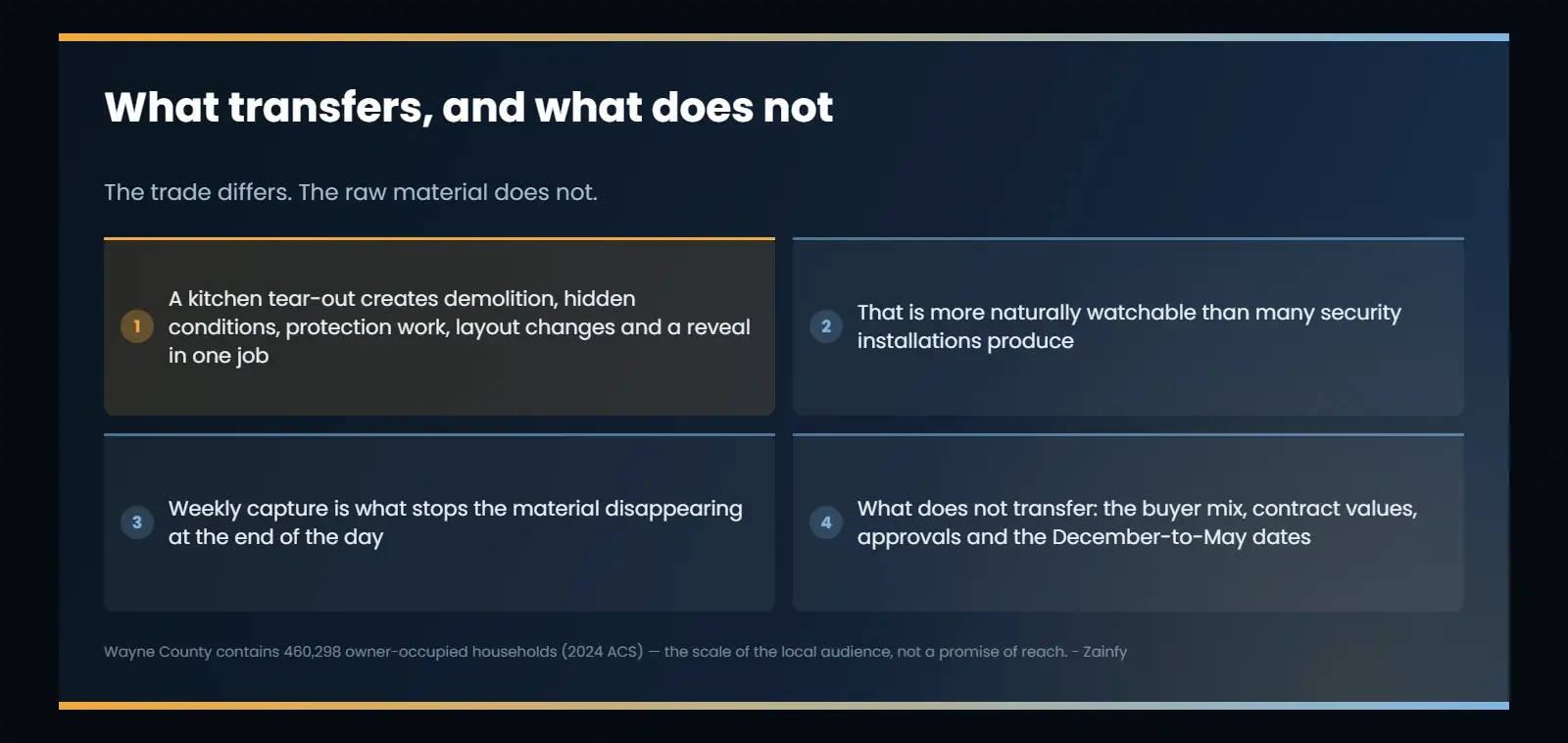
Best Network Design remains a low-voltage and security integrator, not a remodeling company, and the differences are material: its buyer mix includes residential, commercial, and government clients; its contract values, approvals, equipment, and project conditions do not map neatly onto a kitchen or basement job. The campaign's December-to-May dates are simply the period recorded and carry no seasonal lesson. What transfers is the raw material and the discipline of capturing it. A remodeler tearing out a kitchen creates demolition, hidden conditions, protection work, layout changes, installation detail, and a visible reveal within one job. That is more naturally watchable field material than many security installations produce, yet much of it passes without a camera coming out. Wayne County contains 460,298 owner-occupied households, according to the U.S. Census Bureau's 2024 American Community Survey. That is the scale of the local owner audience behind a Detroit feed, not a promise that each household will see a post. The transferable principle is modest: real work supplies movement and proof, weekly capture prevents that material from disappearing, and a lead format gives the account a center. The trade, buyer, and result remain specific to the client; the habit of turning field work into evidence is available to a remodeler immediately.
Does Social Media Work for Construction Companies?
For this account, over three months, yes: one format carried most of the measured reach, and paid distribution improved only after a weekly content system existed. One account does not prove an outcome for every contractor. It does show which part of this effort produced most of the observed attention.
“Works” needs a metric. In this dataset, it means reach, engagement, click-through rate, link clicks, and cost per result. Instagram accounts reached increased 201%, from 3,264 to 9,842, and the engagement rate moved from 2.24% to 5.88%. Reels supplied 63.7% of total reach by month three.
This dataset does not include booked jobs. It does not show a signed-contract count, revenue attributed to posts, or a before-and-after lead baseline that can be checked. Calling the account a proven booking machine would go beyond the record. The honest result is that more people encountered and engaged with the account, and more clicked through during the documented period.
For an owner with two hours a week, the practical reading is not to copy every post or ratio. Choose the field material that shows the work most clearly, capture it repeatedly, and judge whether one format begins carrying more reach and engagement than the others. Keep the metrics labeled. Reach is attention, engagement is interaction, and a click is movement toward another property; none is automatically a job.
The case therefore answers a limited question. Social activity can create measurable attention around construction-adjacent work when the account has proof and a repeatable format. Whether that attention becomes profitable work requires sales data this case does not publish.
What Detroit Contractors Ask About This
[wps_faq style=”classic” question=”What should a contractor post if he only has time for one thing a week?”]
Post the clearest moving proof available from the current job. For Best Network Design, weekly short field videos showed installations, technicians working, and visible security upgrades; by month three, Reels carried 63.7% of total reach. That does not establish a rule for every trade, but it gives a time-poor owner a rational starting test. Capture one process moment or reveal, publish it consistently, and compare its labeled reach and engagement with other material. A single repeatable format is easier to judge than a rotating collection of unrelated ideas.
[/wps_faq]
[wps_faq style=”classic” question=”Is it worth paying to boost contractor posts?”]
Only after the account has material people already choose to watch and a clear purpose for added distribution. In this case, weekly content existed before the legacy campaigns were replaced; afterward, click-through rate moved from 1.72% to 2.84% and link clicks rose from 46 to 132. Those figures describe one historical campaign, not a paid service recommendation or universal forecast. Buying impressions for a weak post hides the content problem. Additional spend becomes informative only when the underlying proof has earned a reason to travel farther.
[/wps_faq]
[wps_faq style=”classic” question=”Does a Detroit remodeler need different content from a Detroit security contractor?”]
Yes, because the work, buyer questions, and visible proof differ, even though the capture habit transfers. Best Network Design installs low-voltage and security systems; a remodeler creates demolition, layout changes, finish details, and room reveals. Wayne County's 460,298 owner-occupied households form the local scale behind a Detroit remodeling audience, but a county figure does not choose the subject. Film the moments that resolve a remodeling buyer's uncertainty: protection, hidden conditions, sequencing, and finish quality. Detroit relevance comes from recognizable work and decisions, not from relabeling another trade's footage.
[/wps_faq]
Film Two Clips on the Next Job
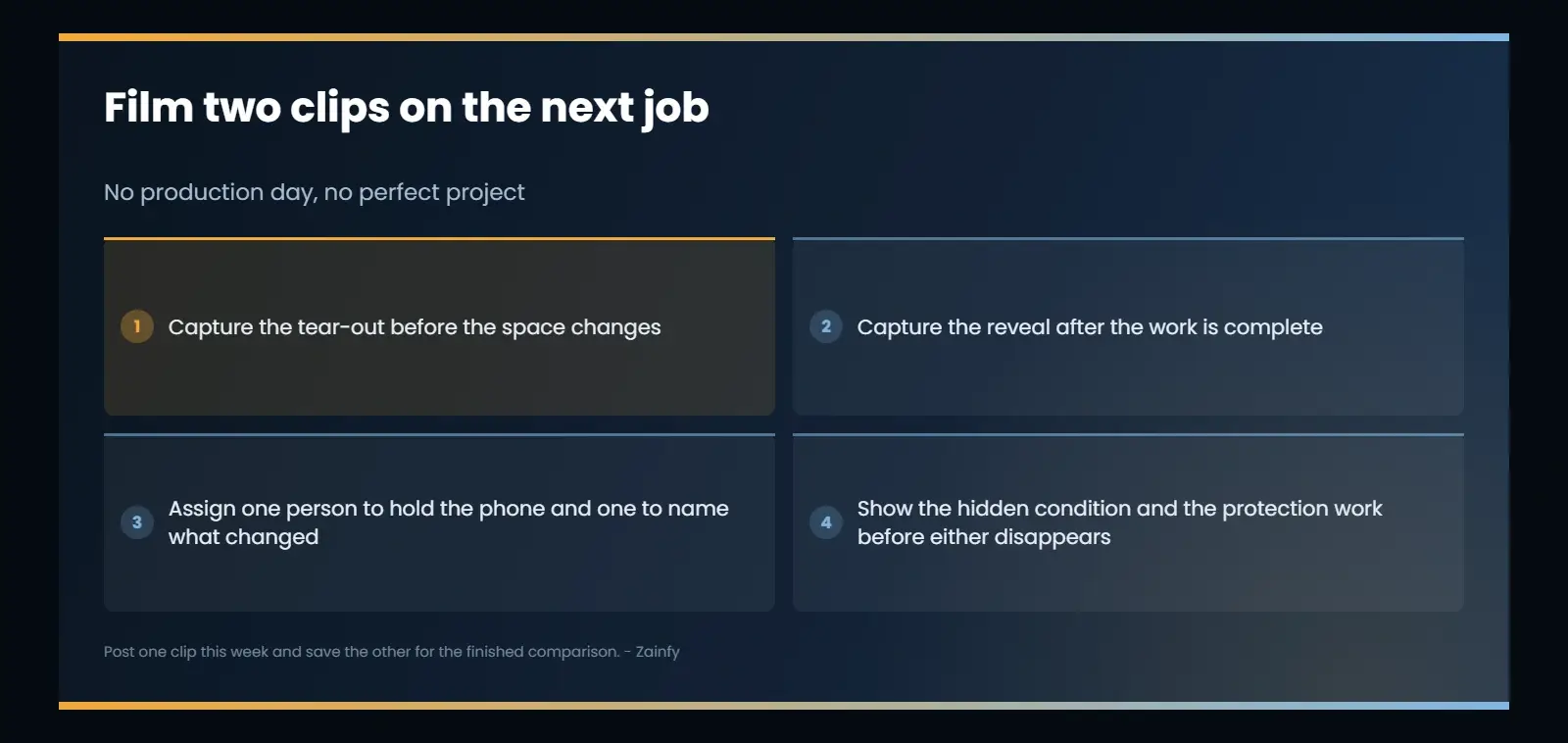
On the next active job, use a phone to capture two short clips: the tear-out before the space changes and the reveal after the work is complete. Do not add a production day. Do not wait for a perfect project. Record the evidence already passing in front of the crew.
Assign one person to hold the phone and one person to name what changed. Keep the explanation specific enough that a future buyer understands why the moment mattered. If there is a hidden condition, show the condition before it disappears. If protection work prevents damage elsewhere in the house, capture that before removal.
Post one clip this week and save the other for the finished comparison. The purpose is not to imitate a security integrator's account or chase a campaign figure. It is to stop useful field proof from vanishing at the end of the day. The next useful content system begins with footage the business was already creating and failing to keep.