A neighborhood platform is not a smaller version of a broad channel for a remodeling contractor. Its unit is one neighborhood, and that changes what you should measure it against. For a Michigan owner working around Holland and Ottawa County, the useful question is how much of the territory producing your jobs you are genuinely present in.
There is an honest case for the platform. It puts a contractor in front of homeowners at the scale remodeling is often bought: close to the property, close to the work, and close to other projects nearby. Few channels begin that locally.
The trouble starts when that local presence is judged with a broad-channel scoreboard. Audience size says how many people might have seen something. It does not say how much of your working ground you cover. Nextdoor hands you places separately. Treating those places as one undivided audience hides the work the channel actually requires.
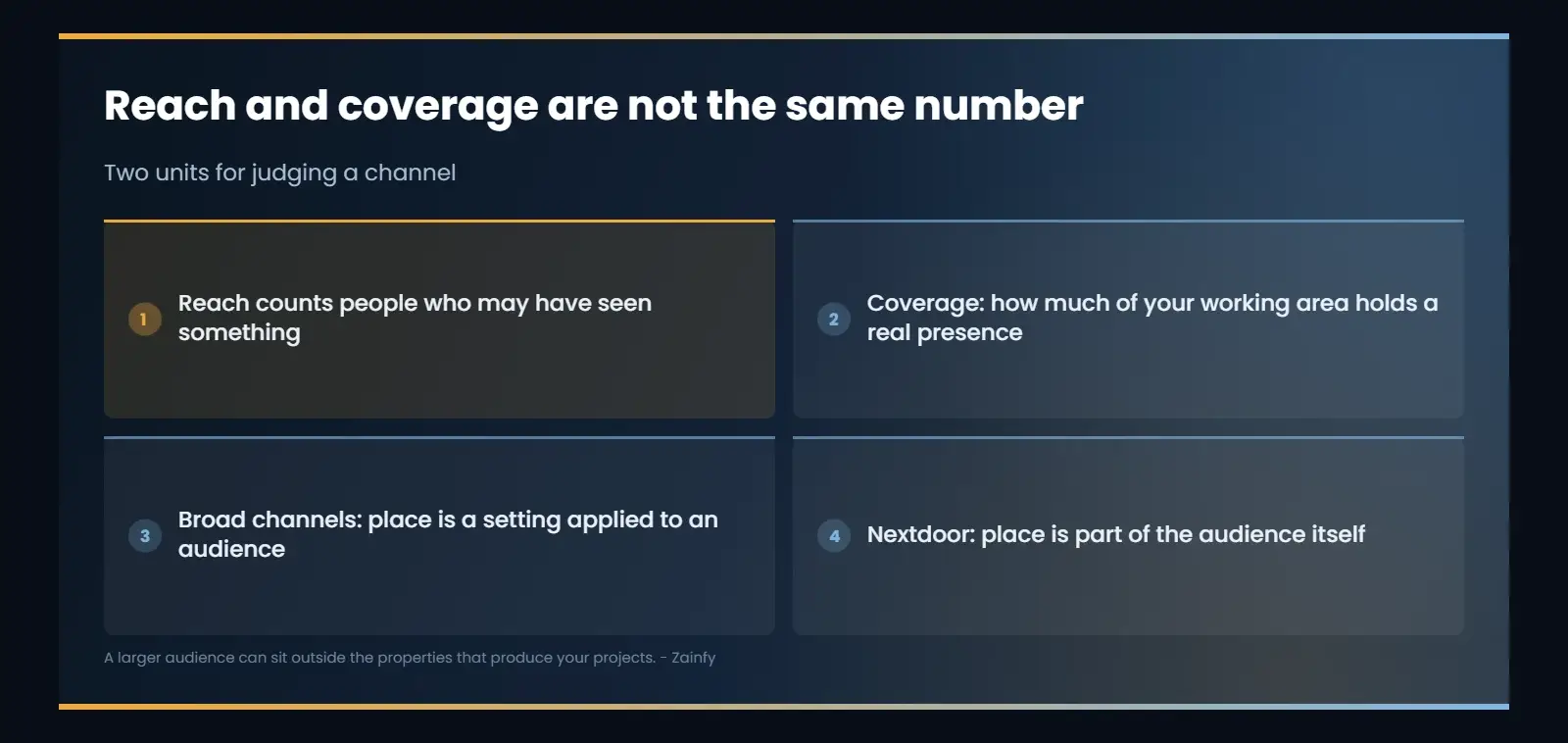
Reach and coverage are not the same number
Reach counts people. Coverage describes how much of the area where you can reasonably take work contains a real presence for your company.
On Facebook or Instagram, the audience is not organized around the place each person lives. Ask where something landed and the answer is usually a setting applied to a broad audience. On Nextdoor, place is part of the audience itself. Ask where you are present and the answer is not one setting. It is a set of individual places.
That difference changes the contractor’s question. A large audience could include homeowners far outside the pattern of properties that produces your projects. A smaller audience could sit directly inside several places where crews, suppliers, and finished jobs already give your name context. The first number may look larger. The second tells you more about usable ground.
The available answers rarely use that unit. Of the two independent editorial articles directly addressing contractors, one is five years old. The current one follows the channel from an initial outlay through to a paid invoice. That is a coherent way to judge an initiative, but it answers an economic question. Area remains outside the instrument.
Neither approach is wrong for what it measures. The problem is carrying either answer into a business whose practical constraint is geographic concentration. A Holland remodeler does not need another audience total. The owner needs to know where the company is becoming familiar and where it remains absent.
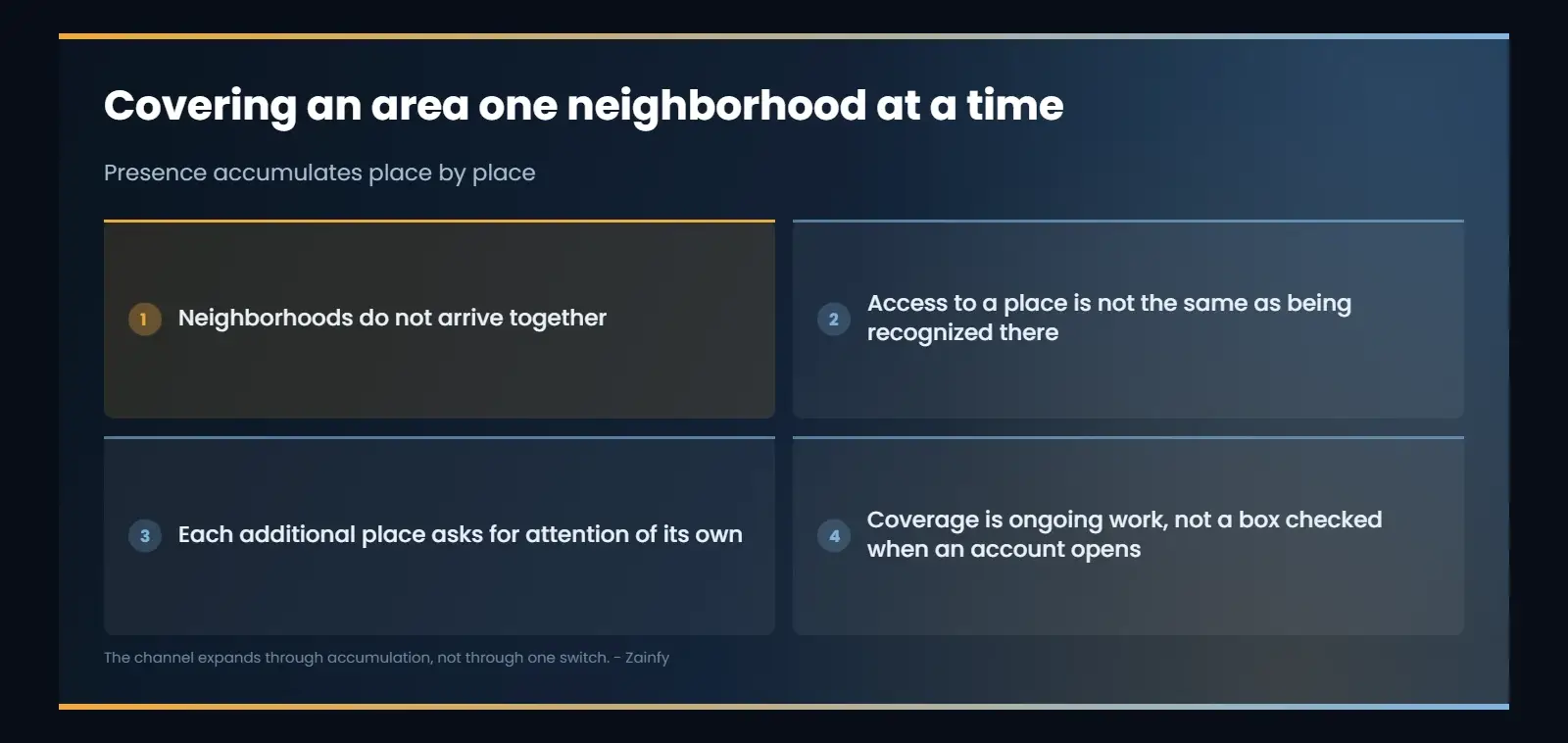
Covering an area one neighborhood at a time
Neighborhoods do not arrive together. Presence accumulates place by place. Your company can become familiar in one pocket while remaining unknown in another part of the ground where it already completes projects.
That makes coverage ongoing work, not a box checked when an account is opened. The work is showing up often enough in one place for the company name to feel established there, then carrying that familiarity into another place that matters to the business. Nothing about that happens everywhere at once.
This is also where a contractor can mistake access for coverage. Being able to appear somewhere does not mean the company has become recognizable there. A place only becomes useful when the business has a sustained, credible presence in it. The practical handoff is to becoming known in the neighborhoods you already work, because opening an account does not perform that work by itself.
The distinction matters across a county-sized operation. Every additional place asks for attention before it contributes meaningful familiarity. Each place carries its own burden of recognition. The channel therefore expands through accumulation. It cannot be understood as one switch that places the company across its entire working ground.
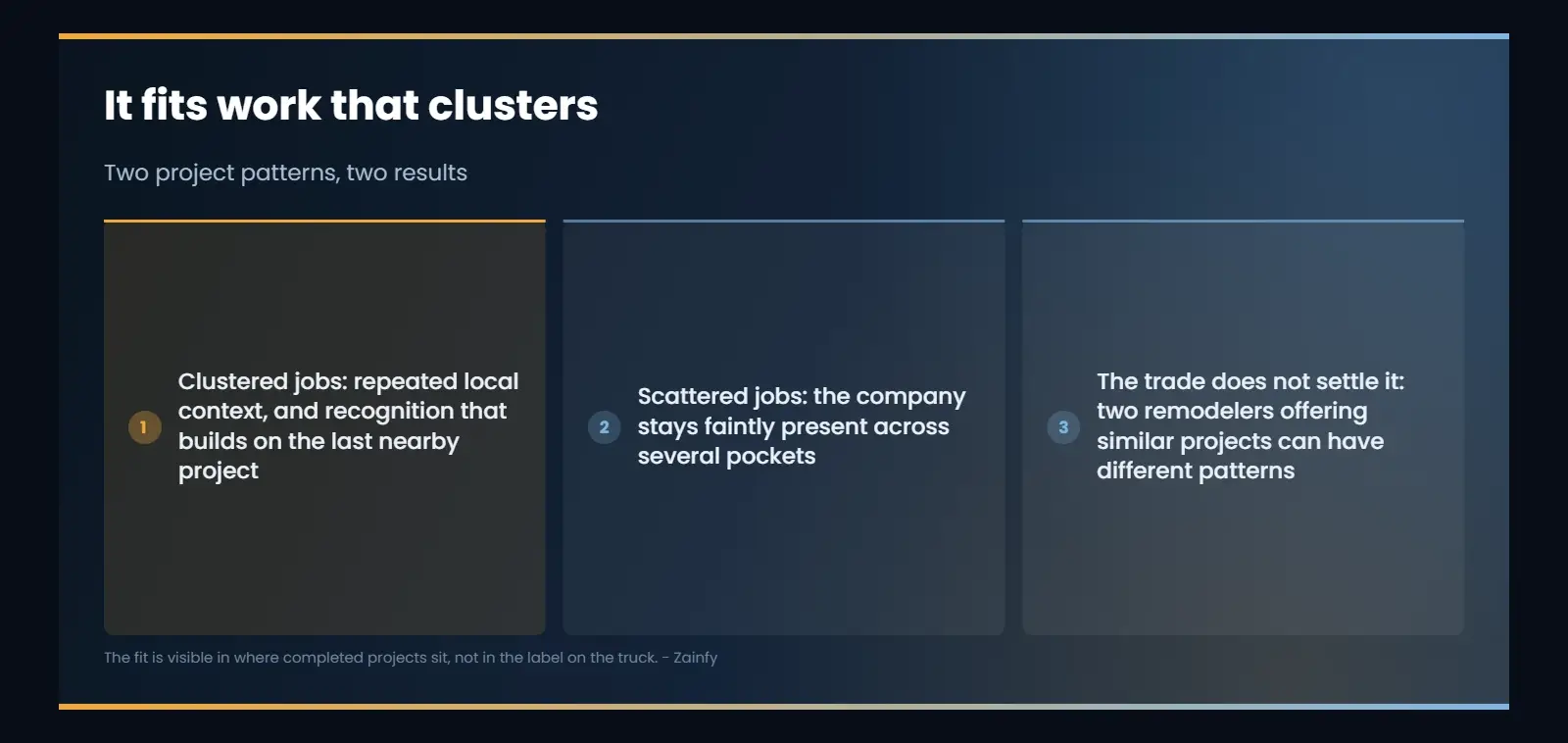
It fits work that clusters
This channel fits most naturally when finished projects cluster. Several jobs in one place give a contractor something broad exposure cannot create: repeated local context. Work nearby makes the company easier to recognize there, and that recognition gives the next nearby project a stronger starting point.
Scattered work produces a different shape. One project in one place, another far away, and a third somewhere else leaves the company faintly present across several pockets. The channel can then appear ineffective even while doing exactly what its structure allows. The mismatch is between the unit of the channel and the pattern of the work.
The contractor’s trade does not settle this. Two remodelers offering similar projects can have completely different patterns. One may have a dense run of jobs across a few adjoining places. The other may pull isolated projects from across Ottawa County. Work that clusters compounds; work that scatters does not. The relevant fit is visible in where the completed projects sit, not in the label on the truck.
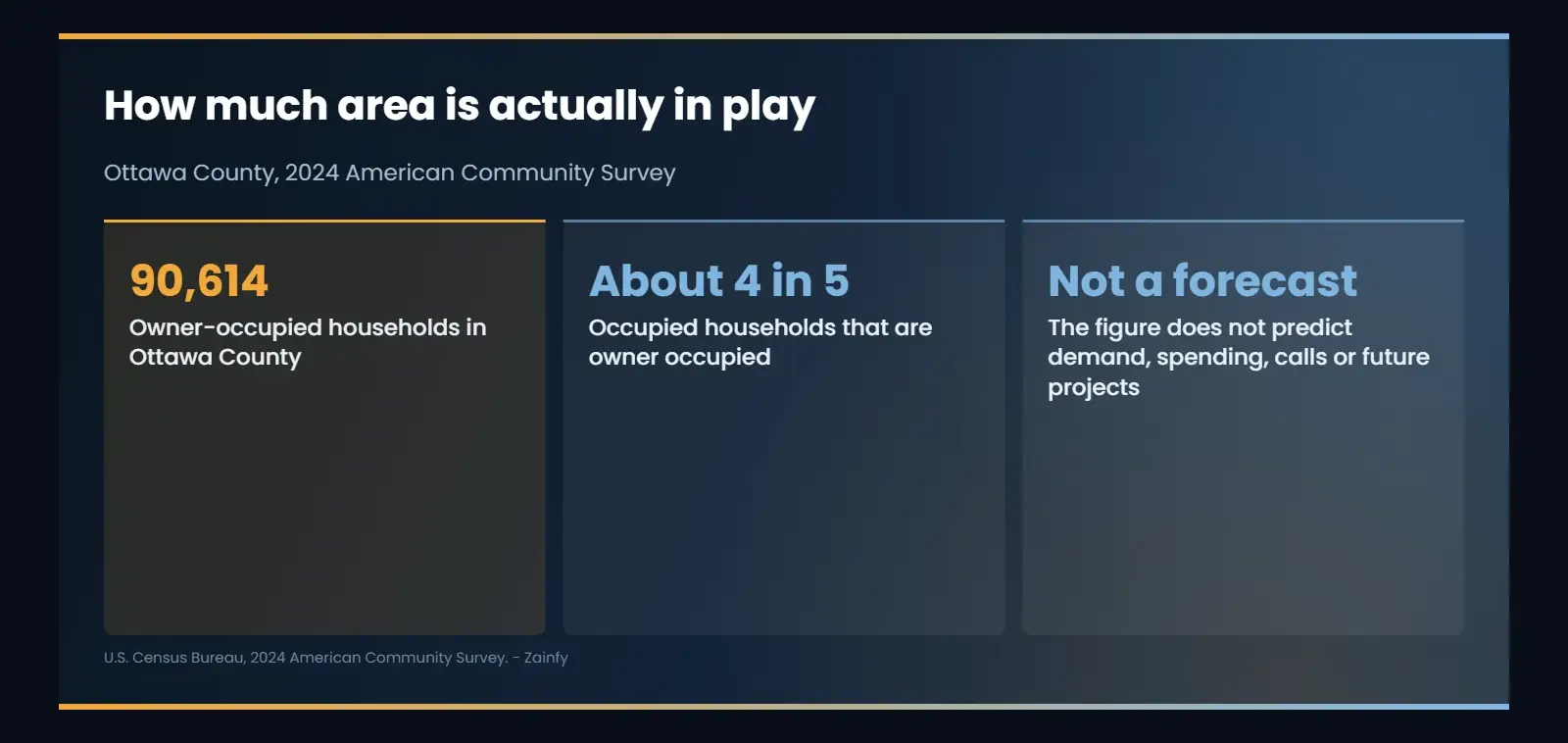
How much area is actually in play
Ottawa County contains 90,614 owner-occupied households, according to the 2024 American Community Survey, and roughly four in five occupied households are owner occupied. That figure is not a forecast of demand, spending, calls, or future projects. It defines the housing stock across which a one-neighborhood-at-a-time presence has to accumulate. The number makes the earlier distinction concrete: a contractor is not deciding whether one channel can touch an abstract audience. The owner is deciding how many of the places within a substantial owner-occupied base matter to the business, and whether the company has become familiar in those places. The local question is therefore about overlap between working ground and active presence, not about the size of an audience reported in isolation.
Don’t judge it on reach
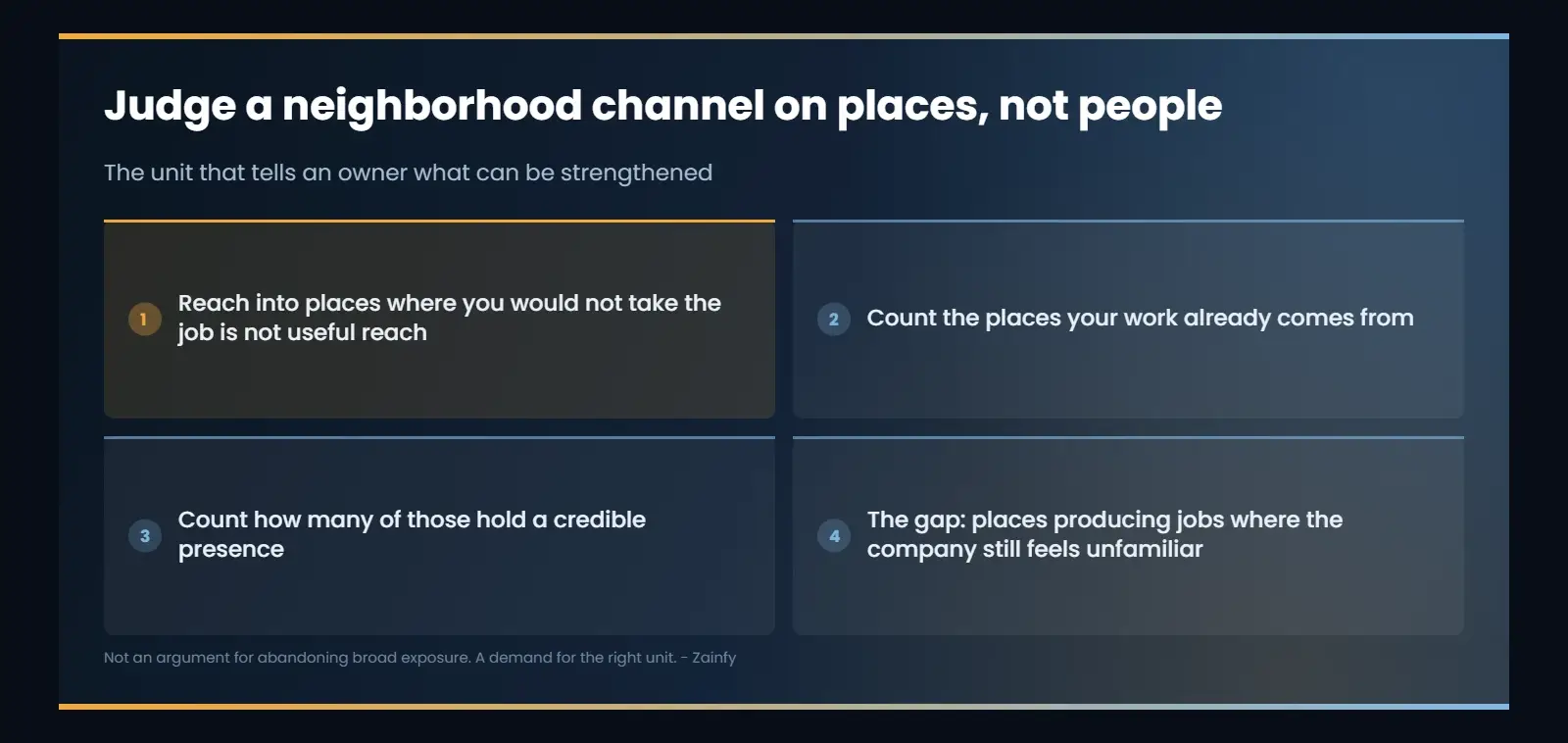
Stop judging a neighborhood channel by how many people it reaches.
Reach into places where you would not take the job is not useful reach. It is a number that rises while nothing the company can act on changes. The larger total can make activity look broad even when the useful presence remains thin.
Judge the channel by how many of the places your work already comes from contain a credible presence for the business. That smaller number tells the owner what can be strengthened: places producing jobs where the company still feels unfamiliar.
This is not an argument for abandoning broad exposure or declaring one channel superior. It is a demand for the right unit. A neighborhood channel can look weak when scored as though it addresses an undivided audience. It is not necessarily underperforming; it is being scored in somebody else’s unit.
Once the unit changes from people to places, the decision becomes more useful. The owner can see whether local familiarity overlaps with the pattern of completed work, rather than admiring a total that says nothing about where the business can act.
Look at where your finished work already sits
Take completed projects and look only at where they sit. Do not sort them by project type, value, or source. Which places contain several finished jobs, which contain one, and which parts of the working ground have produced none?
Then look at the neighborhood channel from the same altitude. Where does the company have a presence that feels established rather than merely available? Put that view beside the project pattern. The overlap is the finding.
A cluster of finished work with no meaningful presence shows where the channel has a relevant job to do. A strong presence in a place that rarely produces work may be visible without being useful. A scattered project pattern suggests that the channel will demand more accumulation before it mirrors the ground the business actually works.
Do not turn this into a score or threshold. No outside article knows how concentrated your project pattern is, and no invented target can settle it. The exercise is simply a comparison between two shapes the owner can already see: where the company has finished work and where the company is locally familiar.
That gap is the only work list this article issues. It comes from the business rather than from a universal formula, and it keeps the decision attached to places the contractor can name.
What is Nextdoor good for if a remodeler works a whole county?
Nextdoor is useful for becoming genuinely known in a small number of places rather than faintly visible across all of them. That suits a remodeler whose work already clusters. It suits a contractor with isolated jobs spread across a county less naturally because the channel’s unit is one neighborhood, while the business operates across many places.
Coverage means the share of relevant working ground where the company has a recognizable presence. Reach means the number of people who may have encountered it. A contractor can have reach without covering the places that repeatedly produce projects, and can have useful coverage without producing an impressive audience total.
The fit therefore comes from the shape of the company’s work. When projects concentrate, repeated local familiarity can build on something already present: jobs, crews, finished properties, and a name that has appeared nearby before. When projects scatter, each place begins closer to zero and asks for attention of its own.
A whole-county operator should not expect one neighborhood-based presence to represent the county as a single unit. The channel breaks that ground into smaller pieces. That can be valuable when the business knows which pieces matter. It becomes demanding when the owner treats every part of the county as equally important.
This does not produce a universal yes or no. It produces a fit question the contractor can answer without borrowing somebody else’s audience total: does the company’s local presence line up with the places where its finished work already concentrates?
What Holland remodelers ask about neighborhood platforms
[wps_faq style=”classic” question=”How much of my working area does a neighborhood platform actually put me in?”]
It puts you meaningfully inside only the places where your company has developed a credible presence. Access to a broader area does not equal covering it. Compare the places containing your recent finished projects with the places where the business is already familiar. The overlap shows useful coverage; the missing places show where presence has not caught up with the work. No publisher can supply that figure because it depends on the geography of your own projects. Treat each place as a distinct unit, and let the business pattern define which units matter.
[/wps_faq]
[wps_faq style=”classic” question=”Does this work for a remodeler covering a whole county rather than one town?”]
It can, but a whole-county operation makes accumulation more demanding. Ottawa County’s 90,614 owner-occupied households sit across many distinct places rather than one undivided audience. A Holland remodeler whose jobs cluster can concentrate local familiarity where the company already has momentum. A contractor whose projects are isolated across the county must establish that familiarity repeatedly, place by place. The county does not make the channel ineffective, and the household figure is not a demand claim. It makes the unit visible: broad working ground contains more separate places that must become familiar before coverage resembles the company’s project pattern.
[/wps_faq]
[wps_faq style=”classic” question=”What should I judge it on, if not followers?”]
Judge it on places. Count the neighborhoods where your finished jobs sit, then count how many of those hold a presence a homeowner there would recognize. A follower total cannot answer that, because it adds people together without saying where they live or whether your crews ever work near them. A Holland remodeler with a modest audience concentrated in three places that keep producing projects is better covered than one with a large audience spread thinly across Ottawa County. Write the places down by name. The list of names, set against where your work sits, is the measure this channel can be held to.
[/wps_faq]
Before you next decide whether this channel is working, name the places your last stretch of work sat in. Say them out loud, by name, without opening a map. If you cannot, the channel was never the thing that needed deciding; the pattern of your own work was.
Once the places are clear, compare them with where the company is locally familiar. Do not begin with the largest number on the screen. Begin with the ground beneath the finished jobs. That single comparison will tell you whether the channel is accumulating presence where it matters or merely producing a total that belongs to a different kind of audience.