Author: Zayn Shah
Gainesville remodeling contractors should treat Hall County’s population growth as a stream of future clients, but growth only helps the company that can be found. A new resident does not arrive with a trusted remodeler’s number saved in his phone. He searches, checks the evidence, and calls one of the businesses visible at that moment.
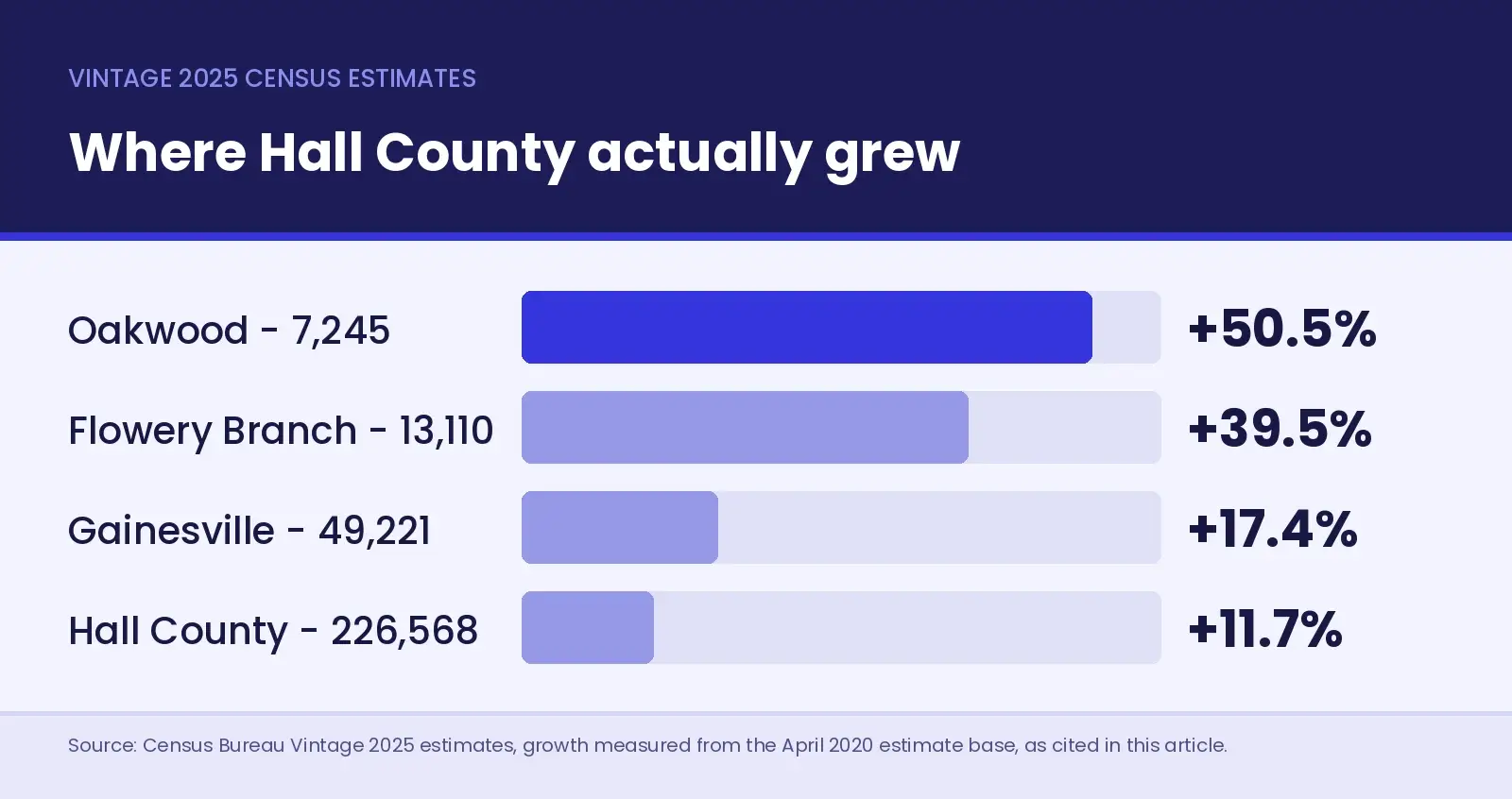
The latest U.S. Census Bureau estimate puts Hall County at 226,568 residents in 2025, up 11.7% from the April 2020 estimate base. Gainesville, Oakwood, and Flowery Branch all grew faster than the county as a whole. That creates opportunity, not automatic jobs.
This article covers the newcomer-capture piece. The full Gainesville remodeling SEO guide across Hall County’s separate permitting cities will cover the wider county structure when its pillar is published. Here, the question is narrower: how do you become the contractor a new arrival finds before he has a referral network?
The growth number that actually matters to you
Hall County added 3,023 residents between the Census Bureau’s 2024 and 2025 estimates, reaching 226,568. That is a population change, not a count of new remodeling buyers, and it includes more than migration. The useful signal for a contractor is the sustained expansion of the client pool.
The growth is especially visible south of Gainesville. Oakwood’s 2025 estimate was 7,245, up 50.5% from its April 2020 estimate base. Flowery Branch reached 13,110, up 39.5%. Gainesville itself reached 49,221, up 17.4%. Those figures come from the Census Bureau’s current Vintage 2025 estimates.
The geography matters. Hall County’s adopted comprehensive plan describes I-985 as a corridor that bisects the area, while the county’s community guide places Oakwood between the interstate and Lake Lanier. That is where a vague “Gainesville area” marketing line starts to fail. The person who just moved into Oakwood searches for Oakwood. The Flowery Branch buyer uses Flowery Branch.
Do not convert a population chart into a claim that remodeling demand rose by the same percentage. The honest conclusion is simpler: there are more residents, the growth towns are identifiable, and a portion of those households will need contractors before they know whom to ask.
A newcomer has no one to ask, so he asks Google
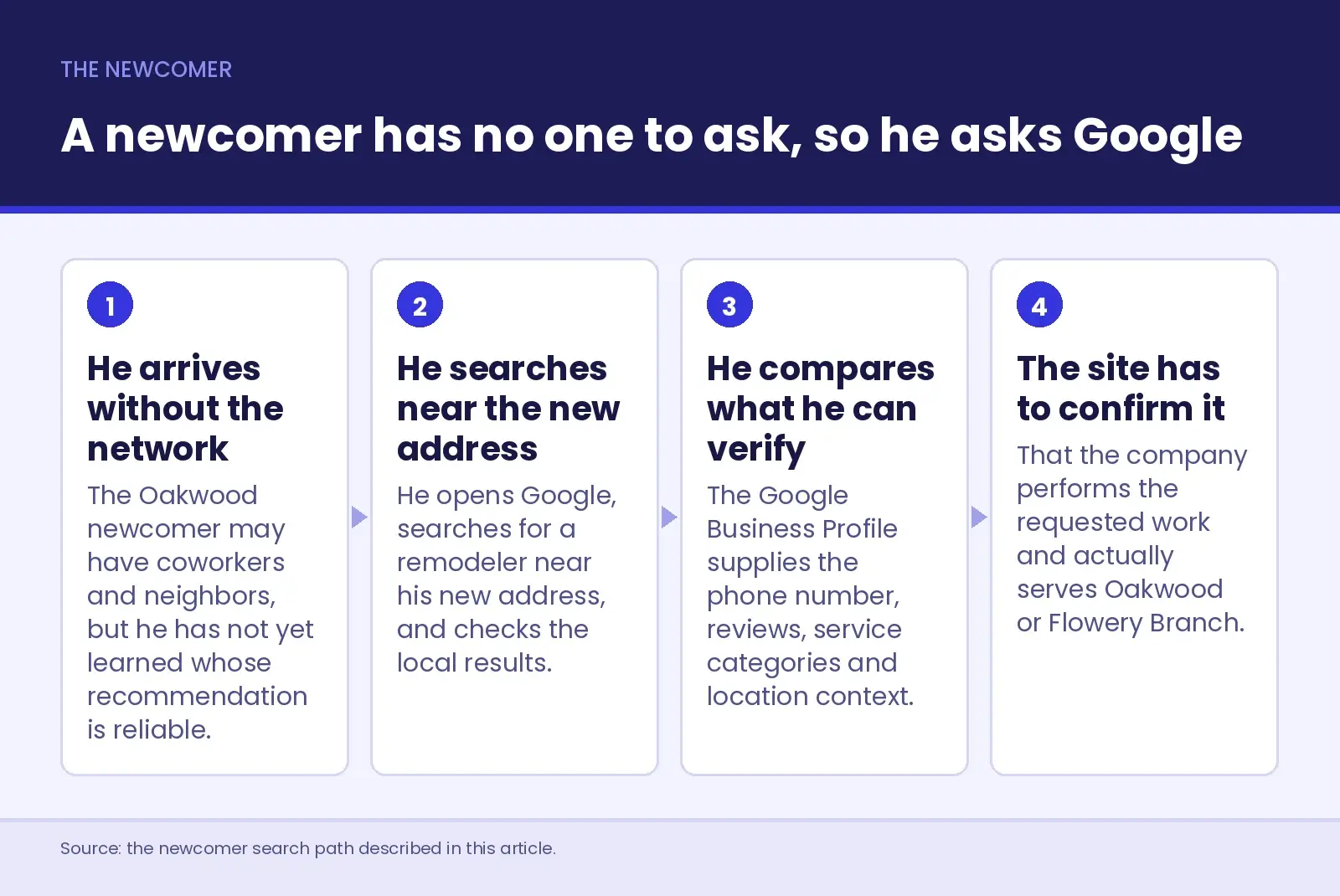
Referrals work when the buyer already has local relationships. The Oakwood newcomer may have coworkers and neighbors, but he has not yet learned whose recommendation is reliable. Search fills that gap.
He opens Google, searches for a remodeler near his new address, checks the local results, and compares what he can verify. The Google Business Profile supplies the phone number, reviews, service categories, and location context. The website has to confirm that the company performs the requested work and actually serves Oakwood or Flowery Branch.
Even a referred buyer often verifies the name online before calling. An outdated profile, stale reviews, or a website that never mentions Hall County forces the prospect to reconcile conflicting signals. A current profile and recognizable project evidence reduce that uncertainty.
This is why the county’s growth changes the value of local search. The incumbent contractor’s referral network is strongest among people who have lived here for years. The incoming resident starts closer to zero. Search visibility gives a Gainesville company access to that buyer before a neighborhood habit forms around somebody else.
The county paused the cranes, not the demand
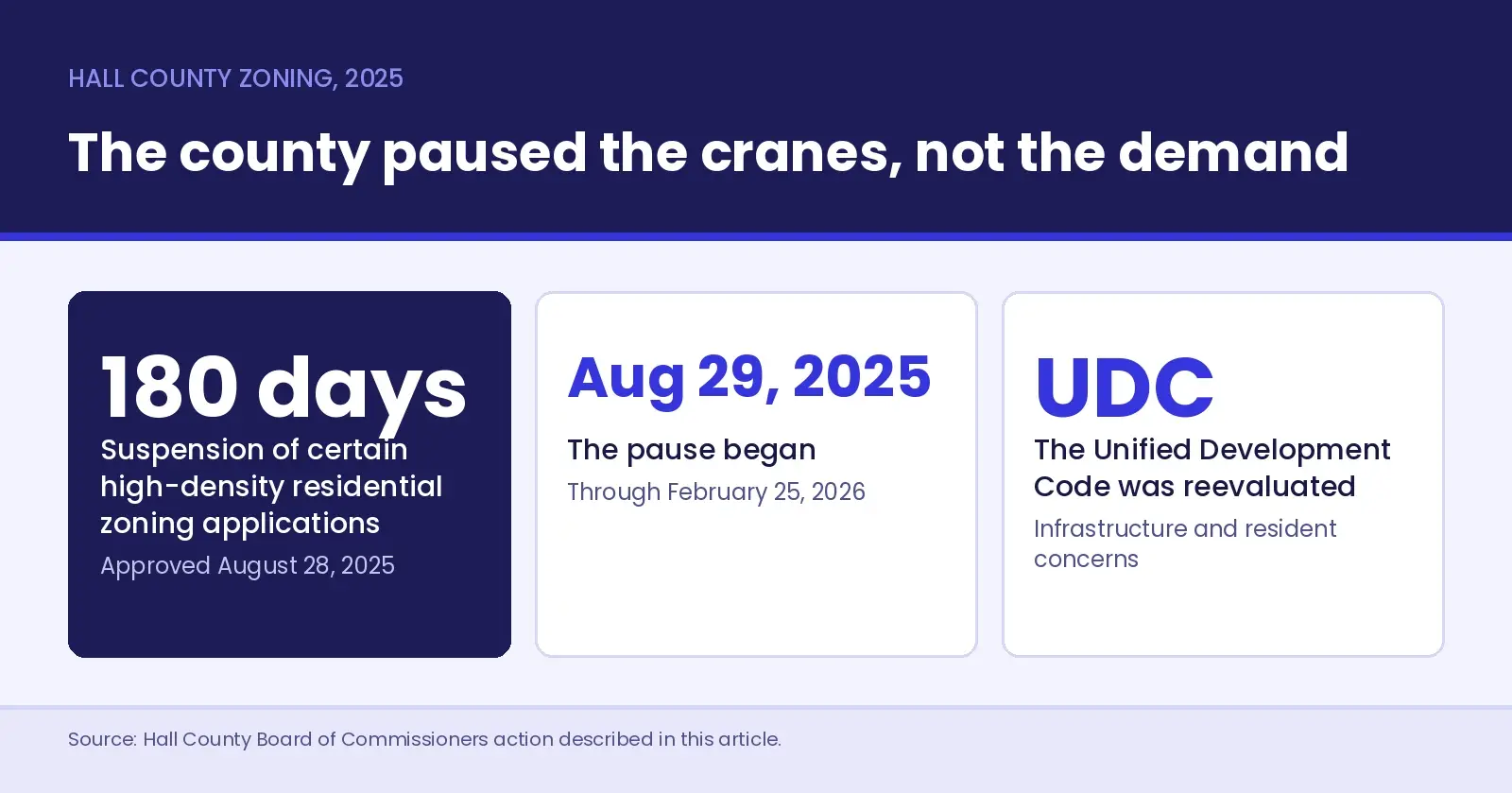
Hall County’s growth pressure became a policy issue in 2025. On August 28, the Board of Commissioners approved a 180-day suspension of certain high-density residential zoning applications. The pause ran from August 29, 2025, through February 25, 2026, while the county reevaluated its Unified Development Code in response to infrastructure and resident concerns.
That suspension has ended. It did not stop all housing construction, and it does not prove that remodeling demand increased. Treating it as a direct lead forecast would be dishonest.
What it does prove is that growth was strong enough to force a county-level response. A remodeler works mainly in the existing housing stock, so the relevant business question is not how many new units received permits. It is whether owners of existing Gainesville and Hall County homes can find the company when they decide to change a kitchen, bathroom, addition, or exterior.
Use the zoning action as market context. Do not put “180-day pause” in sales copy as if it guarantees jobs. The policy record supports the growth story; rankings, reviews, and project relevance still decide whether any of that attention reaches your phone.
How you catch the new arrival before your competitor does
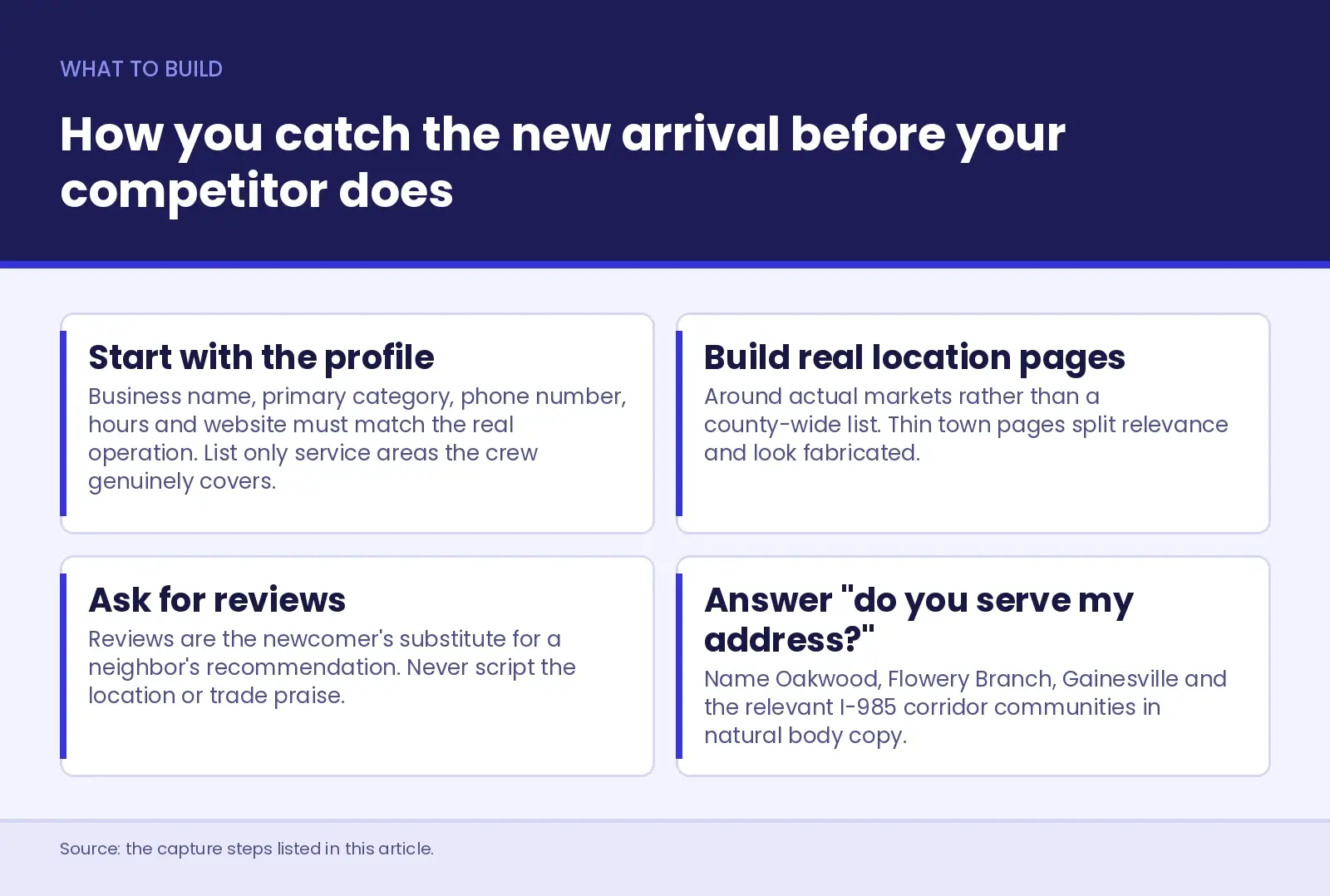
Start with the Google Business Profile. The business name, primary category, phone number, hours, and website must match the real operation. List only service areas the crew genuinely covers. A clean profile will not rank everywhere by declaration, but inconsistent information gives Google and the buyer less reason to trust it.
Next, build location pages around actual markets rather than a county-wide list. An Oakwood page needs Oakwood project evidence and a clear service offer. A Flowery Branch page needs its own purpose. The Gainesville page should remain the central city page instead of being copied and renamed. Thin town pages split relevance and look fabricated. Doing it properly is the whole job in county-by-county remodeling visibility.
Reviews are the newcomer’s substitute for a neighbor’s recommendation. Ask after completed work, make the request simple, and never script the location or trade praise. Fresh reviews tied to real projects help the next prospect judge whether the company is active and credible. One Georgia remodeler tracked from position 74 is what that looked like in practice.
Then make the site answer the question that appears before the call: “Do you serve my address?” Name Oakwood, Flowery Branch, Gainesville, and the relevant I-985 corridor communities in natural body copy. Support the names with projects, travel limits, and service details.
Do not wait for an invented universal “best day after moving.” Local search is valuable because it is present when the need appears, whether that is during the first month or after the first year. This always-on capture system is what it takes to rank in Gainesville: earn the visibility before the prospect forms a preference.
The move that hands the newcomer to someone else
Do not sit on referrals and assume Hall County growth will eventually reach you. The new arrival is already searching. If the business is absent from Gainesville, Oakwood, and Flowery Branch results, somebody else gets the first credible conversation.
Angi and HomeAdvisor can put the company in front of prospects, but marketplace access is rented. The same lead may be distributed to competing contractors, and the cost continues as long as the company depends on the platform. Organic visibility is slower to build, yet the useful page and review history remain attached to the business.
Do not answer that problem by publishing twenty name-swapped town pages. One real Oakwood page is more defensible than a list of thin pages that share the same photos, services, and sentences. If the company has no proof or distinct information for a town, keep it in an accurate coverage block until the material exists.
The rejection is straightforward: rank now or rent the lead later. Referrals should remain part of the pipeline, but they cannot introduce the company to a buyer who has not met anyone in Hall County.
Gainesville growth questions, answered
Make the next arrival find you
Check the business profile this week from the perspective of somebody who just moved near I-985. Does it name the places the crew really serves? Do the newest reviews and photos prove recent Hall County work? Does the website have a useful Oakwood or Flowery Branch page, or only a vague Gainesville paragraph?
Fix the first missing signal before adding another town. Start with accurate coverage, one strong growth-market page, and a review request that the office can repeat after every completed project. The next household does not need a lecture about county growth. It needs a credible contractor result at the exact moment the search begins. Whether the owner can hold that up alone is the honest DIY question.
Hall County added more than 3,000 residents in the latest annual estimate. Your practical next step is smaller: make one search from Oakwood, record what is missing, and repair that gap before the next buyer makes the same search.