A Columbus, Georgia remodeling contractor gets found in a Fort Moore relocation market by proving Georgia, Muscogee County, the base-area buyer, and the neighborhoods around the job before Google has room to confuse him with Columbus, Ohio.
That is it.
Most contractor SEO advice does not touch it. It tells you to tune up your Google Business Profile, build service pages, ask for reviews, and keep listings consistent. Fine. You still have a second fight: an unqualified “Columbus” search can pull Ohio before your Georgia business gets considered.
Fort Moore adds another layer. Families arrive, leave, buy, rent, fix, sell, and compare contractors around a recurring PCS calendar. A remodeler who waits until the phones slow down is already late.
This guide is for the Columbus owner who wants search visibility tied to how this market actually works.
First problem: Google thinks you mean Columbus, Ohio
A generic “Columbus remodeler” page is weak in two directions.
It is weak locally because it does not prove Muscogee County, Fort Moore, Midtown, Wynnton, North Columbus, or the Historic District/Uptown. It is also weak technically because “Columbus” by itself is ambiguous. Google has to decide whether the searcher means Georgia, Ohio, a directory, a map result, or a profile on Houzz, Thumbtack, or Yelp.
The larger city gets more signal.
That does not mean a Georgia contractor should stuff “Columbus GA” into every sentence. It means the page has to remove doubt in every place Google checks.
Compare the two pages.
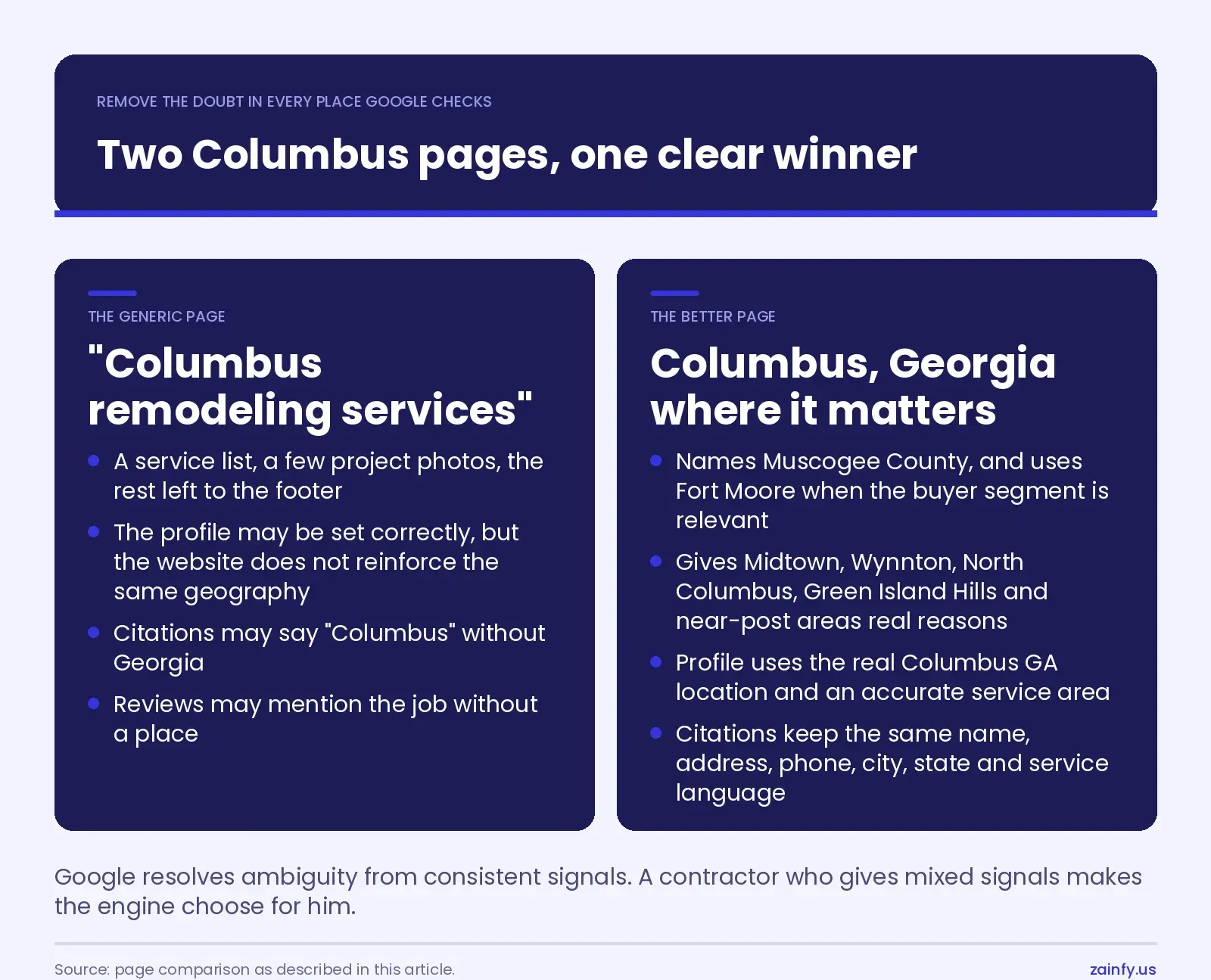
One says “Columbus remodeling services” in the title, adds a service list, drops a few project photos, and leaves the rest to the footer. The profile may be set correctly, but the website does not reinforce the same geography. Citations may say “Columbus” without Georgia. Reviews may mention the job without a place.
The better page says Columbus, Georgia where it matters. It names Muscogee County. It uses Fort Moore when the buyer segment is relevant. It gives Midtown, Wynnton, North Columbus, Green Island Hills, and near-post areas real reasons. The profile uses the real Columbus GA location and an accurate service area. Citations keep the same name, address, phone, city, state, and service language.
Google resolves ambiguity from consistent signals. A contractor who gives mixed signals makes the engine choose for him.
Do not make Google guess Ohio.
Your market moves every PCS season
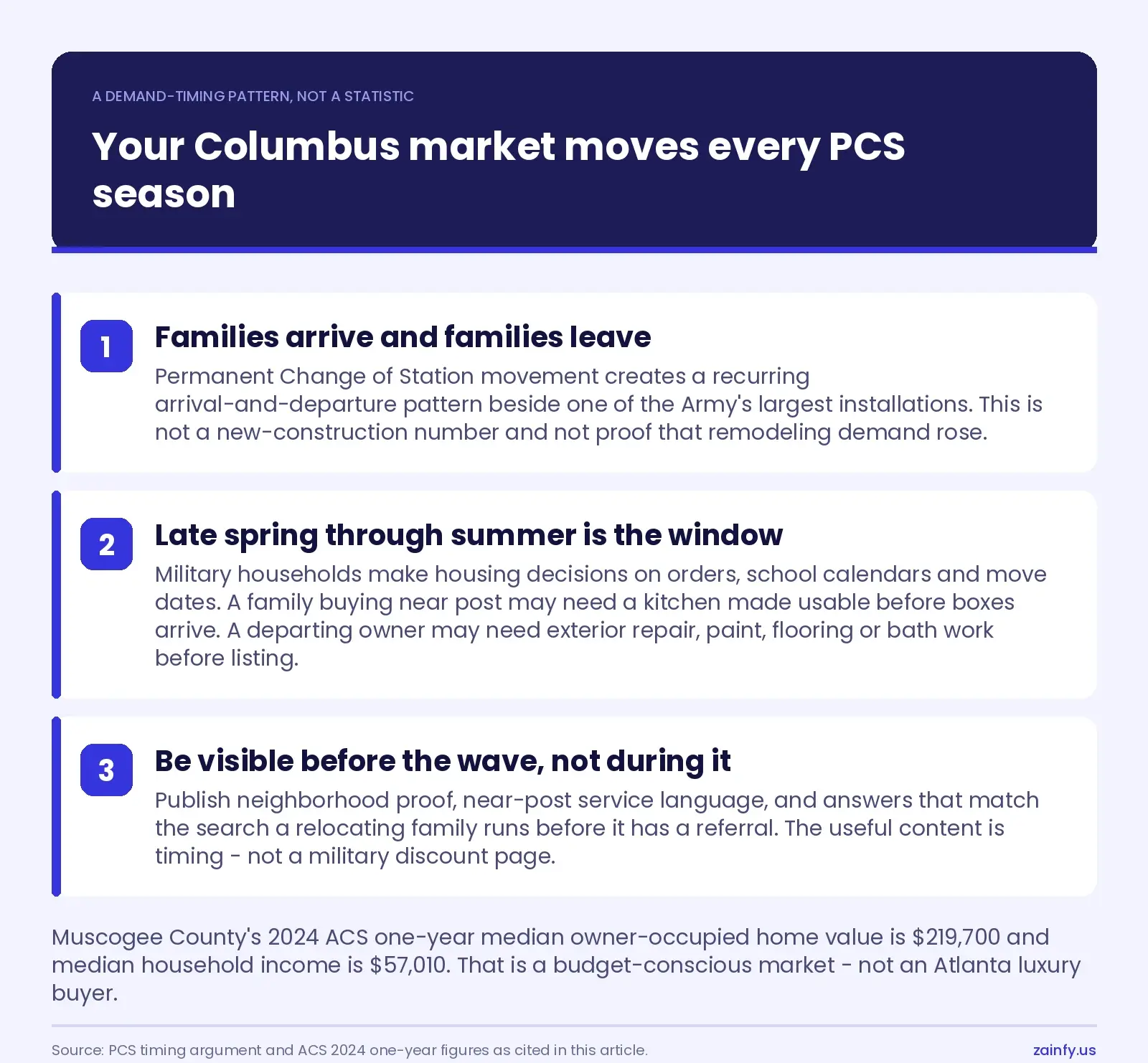
Fort Moore changes the clock. A Columbus remodeler is not only dealing with homeowner research, referral gaps, and directory pressure; he is working beside one of the Army’s largest installations, where Permanent Change of Station movement creates a recurring arrival-and-departure pattern. Treat that carefully. This is not a new-construction statistic. It is not proof that remodeling demand “rose.” It is a demand-timing pattern: families arrive, families leave, homes get bought, rentals turn over, sellers prepare, and the contractor who is visible before the wave has a better shot than the contractor who starts posting after the work is already assigned. The late spring through summer window matters because military households are making housing decisions on orders, school calendars, and move dates. A family buying near post may need a kitchen made usable before boxes arrive. A departing owner may need exterior repair, paint, flooring, or bath work before listing. The Census basis makes the buyer band plain: Muscogee County’s 2024 ACS 1-year median owner-occupied home value is $219,700, and median household income is $57,010. That is a budget-conscious market. Your content has to speak to the scope a Columbus client is weighing, not to an Atlanta luxury buyer, and not to a generic military renter who will never buy a remodel. The useful content is not a military discount page. It is timing: publish the near-post proof before late spring, show move-in repair and pre-sale work plainly, and make the service pages answer the search a relocating family is likely to run before it has a referral. Publish before the PCS calendar gets hot: neighborhood proof, near-post service language, and answers that match how an incoming family searches.
One government, one Columbus market
Columbus is not a sprawl problem.
It is a concentration problem.
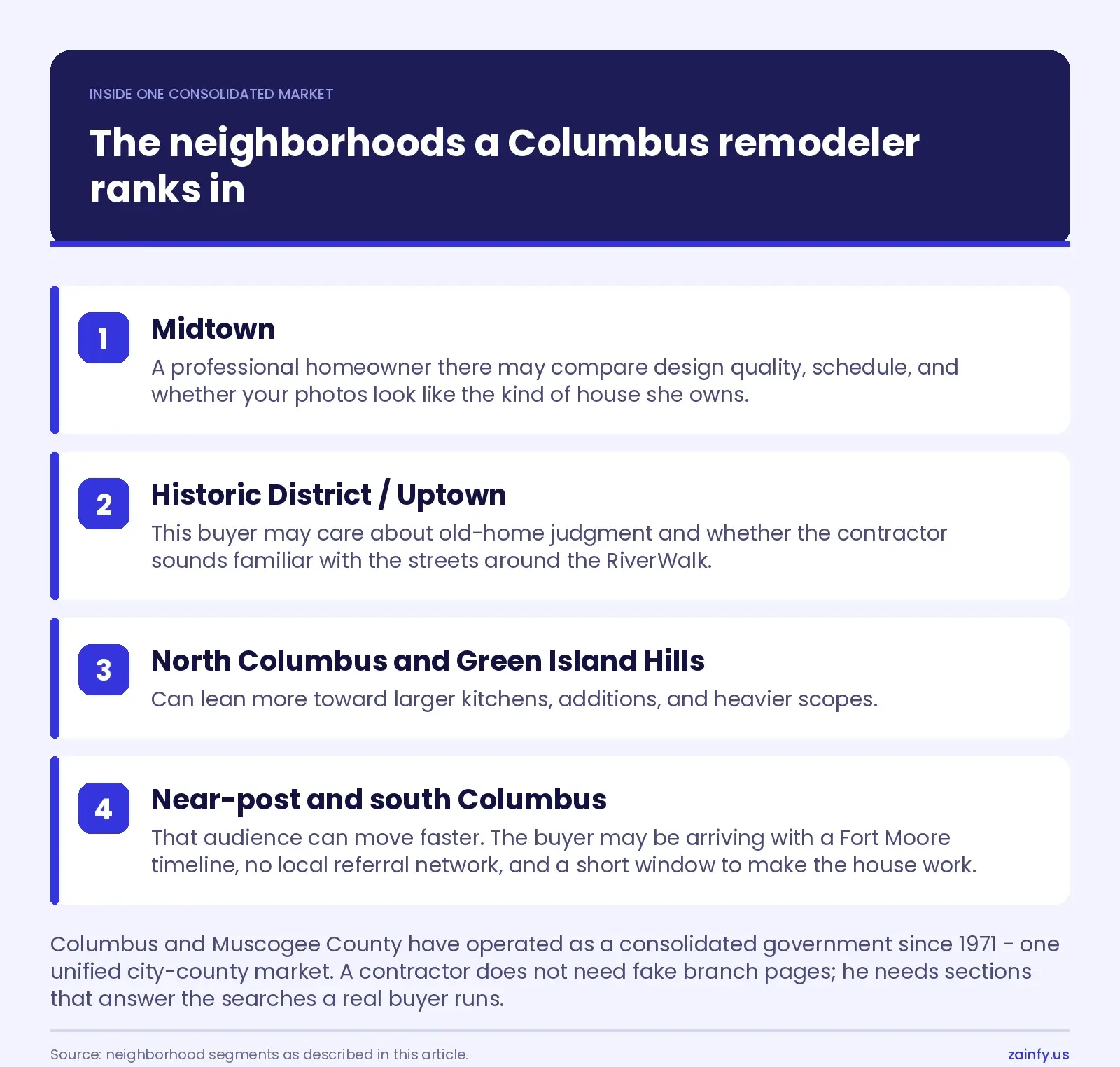
Columbus and Muscogee County have operated as a consolidated government since 1971. For a remodeler, that means one unified city-county market instead of separate city layers sitting on top of county layers. Columbus Building Inspections & Code Enforcement / Development Services is the local authority.
That matters for SEO because the strategy is not “build a page for every permit desk.” Metro Atlanta can push a contractor into separate city and county signals. Hall County can push a Gainesville contractor into several local permitting paths.
Columbus is different.
You concentrate authority around Columbus, Georgia and Muscogee County, then build neighborhood depth underneath it. The main page should make relevance, proximity, and prominence point to the same local entity.
The trap is thinking simple means thin.
One government does not mean one vague page. It means fewer excuses. If the market is unified, your evidence should be deeper: better neighborhood proof, cleaner citations, tighter Google Business Profile language, and less confusion between Georgia and Ohio.
The page set should reflect that. One main Columbus, Georgia authority page can carry the city and county argument. Under it, neighborhood sections should prove the jobs that make sense there, not pretend every street produces the same lead. That is how a single jurisdiction becomes an advantage instead of an excuse for a thin local page.
The neighborhoods a Columbus remodeler ranks in
Inside one consolidated market, neighborhood proof carries the weight.
Start with the areas where the buyer and the project type are not interchangeable.
Midtown is not just a word near the Aflac tower. A professional homeowner there may compare design quality, schedule, and whether your photos look like the kind of house she owns. The Historic District/Uptown buyer may care about old-home judgment and whether the contractor sounds familiar with the streets around the RiverWalk. North Columbus and Green Island Hills can lean more toward larger kitchens, additions, and heavier scopes.
Then there is the near-post and south Columbus side.
That audience can move faster. The buyer may be arriving with a Fort Moore timeline, no local referral network, and a short window to make the house work. That does not mean every military household is a remodeling client. It means the household that buys near post needs different proof from the North Columbus owner.
A Columbus contractor does not need fake branch pages. He needs pages and sections that answer the local searches a real buyer might run: kitchen remodeler near Midtown Columbus GA, bathroom contractor in Wynnton, whole-home remodel North Columbus, exterior repair before selling near Fort Moore. Each page should carry project photos, review language, and scope detail that makes the location believable.
Do not bury every job under “recent projects.”
Name the area when the client allows it. Use alt text that says Columbus, GA and the neighborhood. Put the strongest before-and-after work where the buyer segment will actually see it. A Fort Moore family checking from out of state and a Synovus or TSYS professional are not reading the site alike. The same split decides reaching the same two audiences on social.
They are still both judging whether you belong in Columbus.
How the ranking actually gets built here
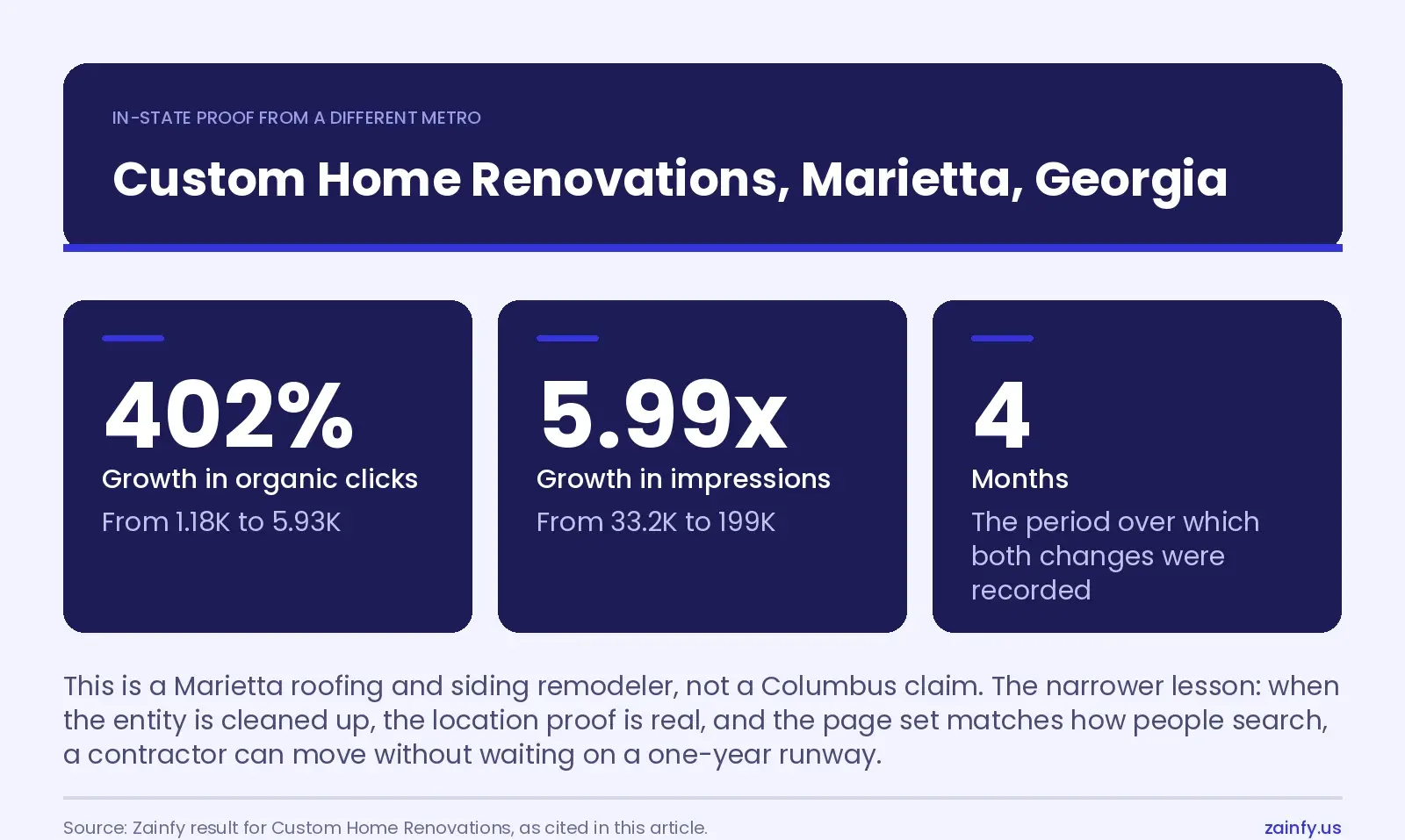
The build starts with category choice because the map pack is not sentimental. A Columbus remodeler who wants kitchen work should not let the Google Business Profile drift into the broadest possible category if “Kitchen Remodeler” matches the jobs he wants most; a broader “General Contractor” position may fit some businesses, but it changes the relevance signals Google weighs. From there, every citation needs to say Georgia clearly. That name, address, phone, service area, and website should appear across the places homeowners and Google check: Google Business Profile, Houzz, Yelp, contractor directories, supplier profiles, the Chamber where relevant, and any local listing that deserves to exist. The purpose is certainty. The site should reinforce the same entity with LocalBusiness and ServiceArea schema naming Columbus GA and Muscogee County, but only after those places are visible in the copy. Schema cannot rescue a page that never says anything local. Reviews should be asked for in plain language, with clients encouraged to mention the real work and area naturally: Midtown kitchen, North Columbus bath, near-post move-in repair. A Greater Columbus Georgia Chamber profile, a Columbus State University connection, a supplier mention, or a local media feature can support the same place-based story. This is where Columbus remodelers in a Fort Moore market fits for the commercial SEO page after this guide. The proof that the method can move fast comes from Custom Home Renovations, a Marietta, Georgia roofing and siding remodeler: Zainfy grew organic clicks by 402%, from 1.18K to 5.93K, and impressions by 5.99x, from 33.2K to 199K, in 4 months. That is in-state proof from a different metro, not a Columbus claim. The lesson is narrower: when the entity is cleaned up, the location proof is real, and the page set matches how people search, a contractor can move without waiting on a mythical one-year runway. That is not an abstract claim. It is a Georgia ranking climb documented end to end.
How fast it moves, and what waiting costs you
SEO is not a switch.
It is also not a year-long fog where nothing concrete should happen.
In Columbus, the first visible movement should come from fixing the confusion and publishing proof. The site says Georgia clearly, the profile matches the revenue category, citations stop muddying the entity, and the page set shows where the work happens.
The proof above gives a real reference point without turning this into a promise. Columbus has fixable problems: the wrong city can steal the search, the profile can send weak category signals, and the site can hide every neighborhood under one vague service page. Those are not mysteries. They are work items.
Waiting has a cost.
If Columbus, Ohio pages, directories, and lead marketplaces hold the search surface while you keep paying for shared leads, you are renting attention that should be turning into your own asset. Every PCS wave that passes without a visible page and neighborhood proof is another cycle where the buyer finds someone else first.
The first stretch should feel practical. Clean the business entity. Publish the Columbus, Georgia page. Add one neighborhood page with real project evidence. Ask the next happy client to mention the area and scope in normal language. If the work happens in Wynnton, say Wynnton. If it is near Fort Moore, say that only when it is true.
Judge the first 90 days by what changed. Did a Midtown or North Columbus page go live? Did the profile category get fixed? Did old citations get cleaned? Did reviews start naming real Columbus work? Did the site give Google fewer chances to guess the wrong city?
If all you got was a report, you did not buy ranking work.
Don’t run a generic Columbus page – or chase the two-year renter
Do not publish one thin “Columbus” page and hope.
In this market, that page goes head-to-head with Columbus, Ohio, national directories, and local contractor profiles that may have stronger review signals. It names none of your neighborhoods. It ignores Fort Moore. It treats Muscogee County like a footer detail.
It ranks for nothing worth owning.
The second mistake is chasing the wrong military audience. Be honest about the base-area market. The family renting for two years while waiting on the next move is usually not your remodeling client. The household that bought near post is different. So is the Aflac or Synovus professional in North Columbus.
Aim the content at the buyer who can actually approve the work.
That means fewer generic service pages and more proof tied to the buying situation: move-in fixes, pre-sale repairs, established-neighborhood upgrades, and photos that show the property type. You are not trying to sound like every contractor who “serves Columbus.” You are trying to make the Georgia buyer believe you have already worked the kind of house he owns.
Columbus GA contractor SEO: quick answers
[wps_faq style=”classic” question=”Why does my Columbus, Georgia business show Columbus, Ohio results, and how do I fix it?”]Your Columbus business can trigger Ohio results because “Columbus” alone is not specific enough for search. Fix it by repeating the right Georgia signals in the places Google trusts: page titles, headings, body copy, Google Business Profile, citations, reviews, and schema. Use Columbus, GA, Georgia, Muscogee County, Fort Moore where relevant, and named neighborhoods such as Midtown or Wynnton. Do not rely on a footer list. A remodeler who says Georgia in the H1 but lets citations, review requests, and project captions drift back to plain “Columbus” is still giving Google two choices. The whole entity needs to point to Georgia.[/wps_faq]
[wps_faq style=”classic” question=”Should a Columbus remodeler build separate pages for Midtown, the Historic District, and North Columbus?”]Yes, if the pages carry real proof. A Midtown page with project photos, client language, and scope detail is useful. A Historic District/Uptown page that explains older-home judgment is useful. A North Columbus page with higher-scope kitchen or addition proof can be useful. A copied page with the neighborhood swapped into the heading is worse than no page. Columbus has 93,004 housing units in the 2024 ACS 1-year Census Reporter profile, but your site does not need to claim all of them at once. Start where the work is strongest, then add another area only when the photos and reviews can support it.[/wps_faq]
[wps_faq style=”classic” question=”Which Google Business Profile category should a Columbus remodeler choose?”]Choose the category that matches the work you most want to rank for, not the broadest label that sounds impressive. If kitchen remodeling is the revenue driver, “Kitchen Remodeler” may send a clearer relevance signal than “General Contractor.” If your work is broader, the category decision should match that reality. The Columbus layer still matters either way: the profile location, service area, website link, and reviews should reinforce Columbus, GA and Muscogee County. A near-post repair lead and a Green Island Hills kitchen lead may start from different searches, but the profile has to make one business entity clear. Category choice helps only when the rest of the entity agrees.[/wps_faq]
[wps_faq style=”classic” question=”How long before a Columbus GA remodeler sees SEO results, and what should it cost?”]A Columbus remodeler can often see early SEO movement in a few months when the problems are clean: Ohio ambiguity, weak GBP category signals, thin neighborhood proof, messy citations, or no Fort Moore-aware content. Judge cost by the assets produced: published pages, citation cleanup, profile work, review process, local schema, and proof that can be indexed. A cheap report that never changes the Columbus page or profile is not progress. AI search visibility follows that rule: clear entities get cited more easily than vague ones.[/wps_faq]
Closing: make Google choose Georgia
Start by fixing the ambiguity.
Before another service page, directory subscription, or month of waiting on referrals, make the site impossible to mistake for the wrong Columbus. Put Georgia in the places that matter. Tie the business to Muscogee County. Build one serious neighborhood page where the proof is strongest. If Fort Moore buyers are part of the work, publish before the PCS season.
Then widen.
A Columbus contractor with local proof can expand without looking like a copied page set. A contractor trying to grow beyond Muscogee County should understand turning statewide visibility into booked work before he starts chasing terms he cannot yet support.
The next task is simple: open your site and count how many times it clearly says Columbus, Georgia before the footer. If the answer is once, Ohio still has room to steal the search.