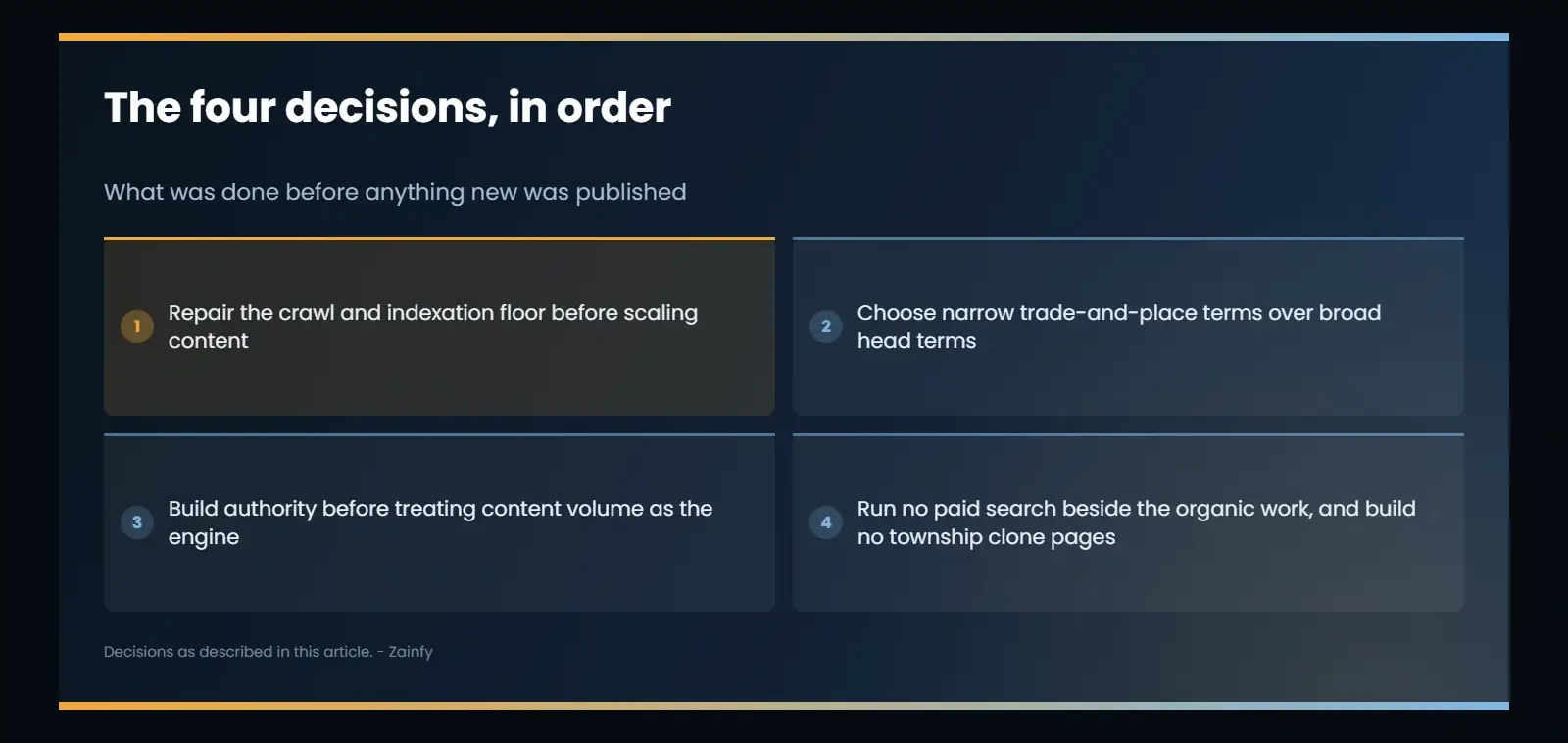
A Michigan remodeling contractor moved from an average position of 74 to 16 in four months because the SEO work followed four decisions in a deliberate order. MBC Building & Remodeling in Flint did not begin by publishing a stack of articles or chasing the broadest remodeling term. The work first repaired the site's reading and indexation floor, then narrowed the keyword target, built authority, and refused two shortcuts that would have made the result impossible to read honestly.
That order produced 2,330 monthly clicks from a starting point of 56, while impressions moved from 7.67K to 138K. Those are MBC's numbers, not a forecast for your company. Genesee County also is not Metro Detroit. The useful question is not whether you can copy a result. It is which decisions still hold when the county, competition, and housing stock change. That distinction is where a useful case study begins.
Where MBC actually started
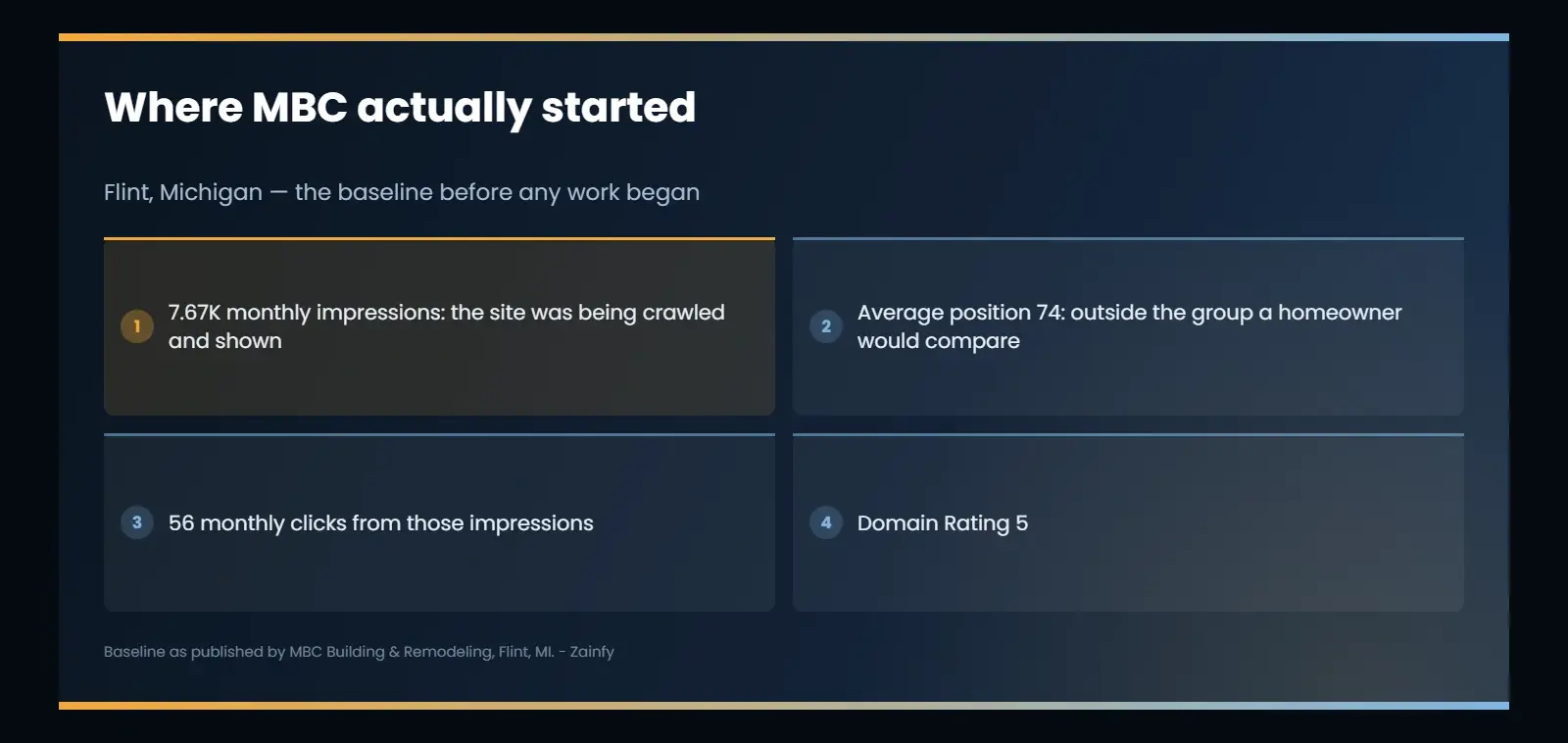
MBC was already visible to Google. Google Search Console recorded 7.67K impressions in a month, so the site was being crawled and shown. But an average position of 74 kept it outside the group a homeowner would realistically compare. It drew 56 clicks. Domain Rating sat at 5.
For an owner, that combination matters more than a report full of green arrows. The site existed in search without earning a place in the buying decision. More impressions alone would not fix that. Nor would a higher post count. The problem was the distance between being indexed and being competitive.
The local context makes that starting point less abstract. As of the 2024 American Community Survey, Genesee County's median owner-occupied home value was $200,400 and its median structure was built in 1968. That is the housing and budget context MBC's customers bring to a remodeling decision. A search plan aimed at a generic national remodeling audience would miss both. It would also make the result harder to transfer honestly, because a local ranking gain only makes sense against the market in which the company earned it.
The baseline is checkable in the numbers as MBC published them: average position 74, 56 monthly clicks, 7.67K impressions, and Domain Rating 5. Without that starting point, the finish means very little. With it, the first decision becomes obvious.
Decision one: fix what Google can read before writing anything new
The first decision was to repair the crawl and indexation floor before scaling content.
The rejected alternative was easier to sell: publish immediately. A new article creates visible activity. A technical repair usually does not. But activity on a site with Domain Rating 5 and weak readability does not compound simply because a publishing calendar says it should. Google still has to reach the page, understand its subject, connect it to the rest of the site, and decide that the domain deserves a competitive position.
So month one went into the floor. That meant making the existing site easier to crawl and index before asking new pages to carry any weight. It was not glamorous work, and it was not a promise that a repair would produce calls on its own. It removed a constraint.
Publishing first would have produced a larger pile of pages sitting behind the original problem. Fixing the floor meant every later page entered a site Google could read more cleanly. It also kept the team from mistaking publication for progress before Search Console showed stronger positions. At MBC's starting point, that was worth more than looking busy.
Decision two: 81 top-three keywords came from choosing narrow
The second decision was a choice between apparent size and useful specificity. One route chased broad head terms such as remodeling contractor. The other joined the trade, service, and place closely enough to match the way a local buyer searches. MBC took the narrower route.
Broad terms look attractive because they describe the whole category. They also put a small Flint contractor into competition with national directories, publishers, larger agencies, and established regional companies. Starting there at Domain Rating 5 would have spent the first four months trying to enter a contest the site had not earned the authority to win. Even a position gain could leave the business far from a click.
Narrow terms changed the unit of competition. A service tied to a real place and a real project type gave Google a clearer page to match and gave the buyer a result that sounded like the job being planned. MBC finished with 81 keywords in the top three and 2,400 organic keywords overall. That footprint did not come from one oversized phrase. It came from many specific points of relevance.
The execution becomes harder across Wayne County because one local map cannot stand in for a metro. That is where remodelers working the Detroit metro need service and place choices built around real coverage rather than a Flint keyword list copied east. The principle travels. The exact terms do not.
The outcome also shows why keyword totals need context. A list of 2,400 phrases can include queries that never bring a qualified customer. The 81 top-three terms matter because they show depth near the visible end of search, while clicks rising from 56 to 2,330 show that somebody acted on that visibility.
Decision three: authority before volume
The third decision was to build authority before treating content volume as the growth engine. MBC's Domain Rating moved from 5 to 17, supported by 578 backlinks from 163 referring domains. Those numbers matter as the shape of the work, not as a score every Michigan remodeler should chase. A site at DR 5 cannot assume each new service page or article will rank simply because it is useful; it needs independent sites giving Google reasons to trust the domain behind the page. That is why authority work came before a larger publishing load. The rejected alternative was to keep adding pages and hope quantity would compensate for a weak domain. It usually produces more URLs competing for a small amount of existing trust. Authority first gave later pages somewhere firmer to stand. The referring-domain count matters here because 578 links from one source would tell a different story from links spread across 163 independent domains. Distribution, relevance, and editorial legitimacy carry the weight; raw link totals alone do not. Michigan adds a separate credibility layer that belongs on the site even though it is not the subject of this article: under MCL 339.2403, residential work at an aggregate contract price of $600 or more in labor and materials requires the appropriate LARA residential builder or maintenance and alteration license, which gives a buyer a credential to verify. Links do not replace that proof, and a license does not create search authority. They answer different trust questions. The sequence worked because MBC stopped asking content to do every job at once.
Decision four: what they chose not to do
No paid search ran beside the organic work. That is important. If an agency sends ads into a site while presenting a four-month organic chart, ask which traffic source produced the calls and which source produced the movement. If the agency cannot separate them, the chart is not evidence for the claim being made.
Do not accept blended proof.
MBC also did not create a near-identical location page for every Genesee County township. Swapping a town name across thin pages is a doorway pattern, not local depth. It divides internal authority, repeats the business claim, and gives the reader no project, service, or local constraint that justifies another page.
The harder choice is to publish fewer location pages and make each one carry evidence: relevant projects, service detail, customer language, and a reason that place changes the work. That takes longer than duplicating a template. It also leaves Google with pages that deserve to exist.
These were not neutral options. Running ads would have blurred the organic result. Township clones would have weakened the site built to earn it. When you evaluate an agency's proof, ask what it deliberately did not run alongside the campaign and request a channel-separated report. Evasion is an answer.
What changes when you run this in Wayne County instead of Genesee
The sequence transfers to Metro Detroit. The operating assumptions do not.
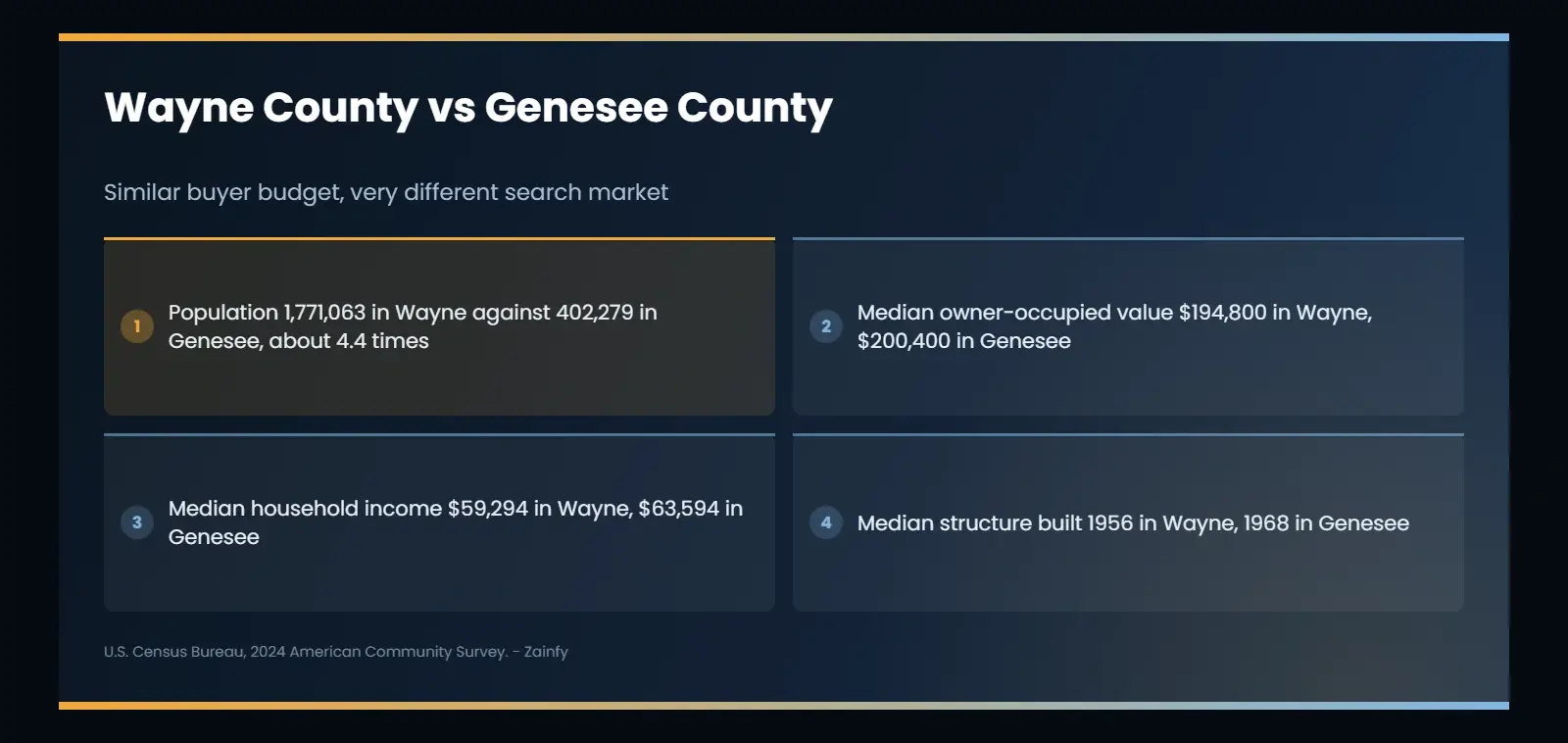
As of the 2024 American Community Survey, Wayne County had 1,771,063 residents against Genesee County's 402,279, about 4.4 times the population. Yet the median owner-occupied values were close: $194,800 in Wayne and $200,400 in Genesee. Median household income also sat in a comparable band, $59,294 versus $63,594. A similar buyer budget does not produce similar search competition when one county contains more than four times the market.
Housing age changes the demand context too. Wayne County's median structure was built in 1956; Genesee County's was built in 1968. By 2026, that puts the median Wayne structure at 70 years old. A Detroit-metro contractor is speaking to an older housing stock and a different mix of project language. Copying Flint's exact keyword set would ignore the buildings the buyer actually owns.
The statewide context behind that difference is where Michigan's remodeling demand actually sits, because the county comparison changes what a result can honestly predict. Readable infrastructure still comes first. Specific terms still beat an oversized head term. Authority still has to support the pages. Paid traffic still should not be used to prop up an organic claim.
What does not transfer is the pace, the number of links required, or the keyword count available in a given period. Contractors report publicly that firms serving the suburbs sometimes decline work inside Detroit proper, which means raw county size can overstate competition in the city for a company that genuinely takes those jobs. That is a positioning fact, not permission to promise a Flint result on a Detroit clock.
What does an SEO agency actually do in the first four months?
An SEO agency should first make the contractor's site readable and indexable, then map specific searches to the right pages, build those pages, and earn authority for the domain. Content volume comes after that foundation. The order depends on the site's starting condition, not on a standard publishing quota.
For MBC, the early work began with the crawl and indexation floor because the site already had impressions but sat at an average position of 74. The keyword map then moved away from broad category language and toward narrower trade-and-place intent. That choice built a footprint of 2,400 organic keywords, including 81 in the top three.
Authority work supported those pages instead of asking publication alone to carry them. Domain Rating rose from 5 to 17 as the referring-domain count reached 163. Only then could a larger content footprint compound on a site with more trust behind it.
Your starting point may reverse the emphasis. A contractor already visible near the first page might need better service pages before deeper technical work. A site with strong local pages but little outside authority may need the opposite. Pull your average position from Google Search Console before an agency meeting. Break it out by query and page so one strong branded term cannot hide weak service searches. It will not diagnose everything, but it tells you whether you are dealing with invisibility, near-page-one opportunity, or a site already being considered. Ask the agency to connect its first block of work to that number.
Straight answers before you call anyone
[wps_faq style=”classic” question=”What does average position 74 actually mean for my website?”]
It means your pages appeared in Google Search Console at an average rank of 74 across the queries and impressions measured, not that every page held one fixed spot. At MBC's baseline, 7.67K impressions produced 56 monthly clicks because the site rarely entered the results a buyer would compare. Open Search Console, set a useful date range, and separate branded queries from service searches before treating the average as a diagnosis. A company-name query can look healthy while kitchen, bath, or location terms remain buried. Use the number to decide what to inspect next, not as a grade by itself.
[/wps_faq]
[wps_faq style=”classic” question=”Do I have to publish blog content to rank as a remodeling contractor?”]
No. MBC's first decision was to repair the site's reading and indexation floor before adding content. A Michigan contractor still needs pages that answer real service and location searches, but those may be core service pages, project pages, or carefully justified local pages rather than weekly articles. If Domain Rating is 5 and Google reads the existing site poorly, another post can inherit the problem. Fix the floor, map the missing buyer intent, and publish only where a new page has a distinct job. A calendar is not a strategy when the domain underneath it cannot support the work.
[/wps_faq]
[wps_faq style=”classic” question=”Can a remodeler in a smaller Michigan county get results like a Metro Detroit company?”]
A smaller-county remodeler can use the sequence, but should not borrow a Metro Detroit forecast. Wayne County's 2024 ACS population was about 4.4 times Genesee County's, so competitive density, query depth, and the authority required to move can differ sharply even when household budgets are comparable. Start with the county you actually serve and the projects your customers call about. Then judge progress against your own baseline in Search Console. The honest transfer is readable infrastructure, specific terms, and authority in that order. The dishonest transfer is attaching another county's pace to your contract.
[/wps_faq]
[wps_faq style=”classic” question=”How do I tell whether an agency's case study is real?”]
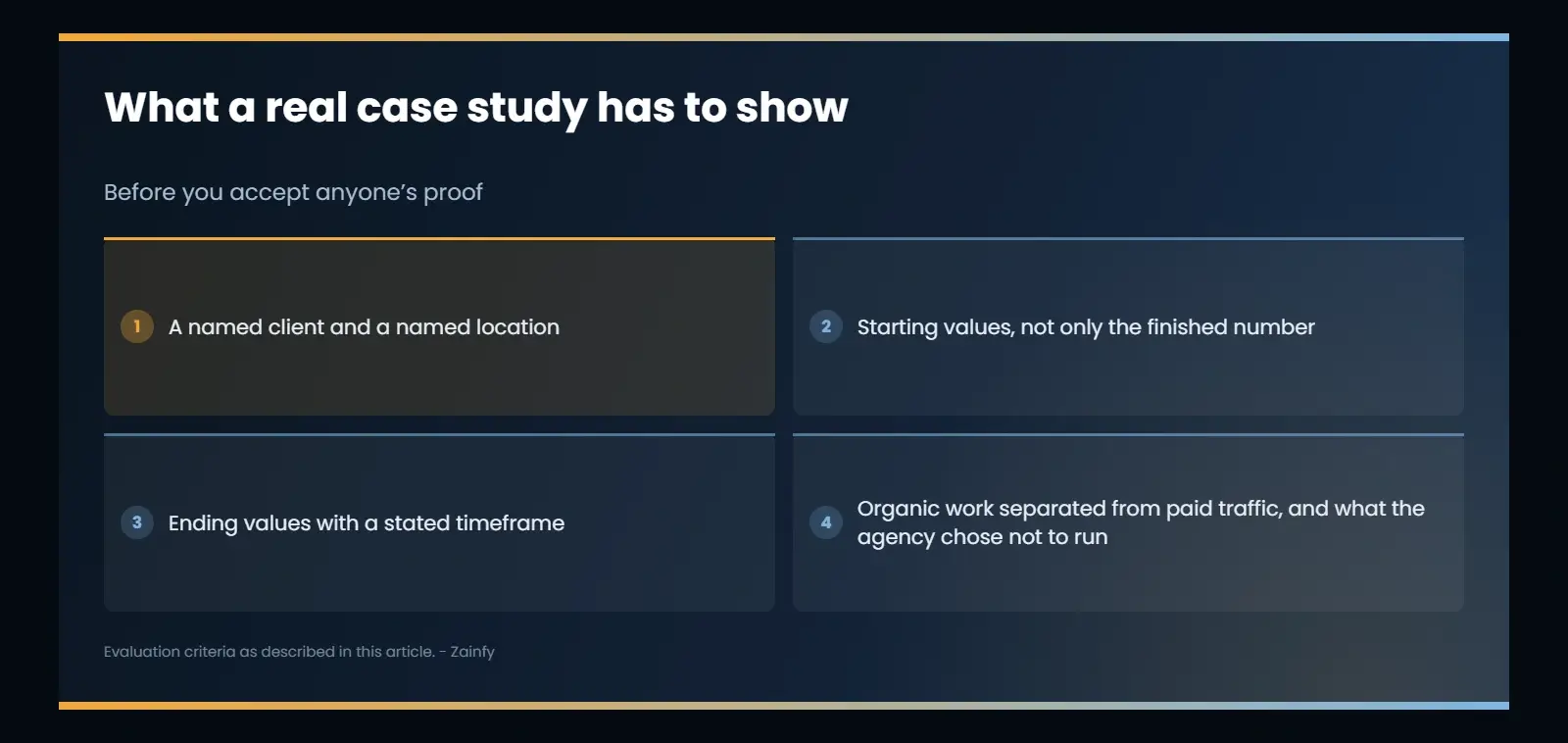
Look for a named client, location, starting values, ending values, timeframe, and a clear separation between organic work and paid traffic. MBC's record gives Flint, four months, average position 74 to 16, and clicks from 56 to 2,330 per month. Then ask what the agency rejected and why; reasoning is harder to fabricate than a percentage tile. Search the client name, inspect the linked proof, and check whether the visible claim matches the body and any AI-generated summary. If the agency hides the baseline or blends traffic sources, you do not have enough evidence to buy its conclusion.
[/wps_faq]
Pull one number before you buy anything
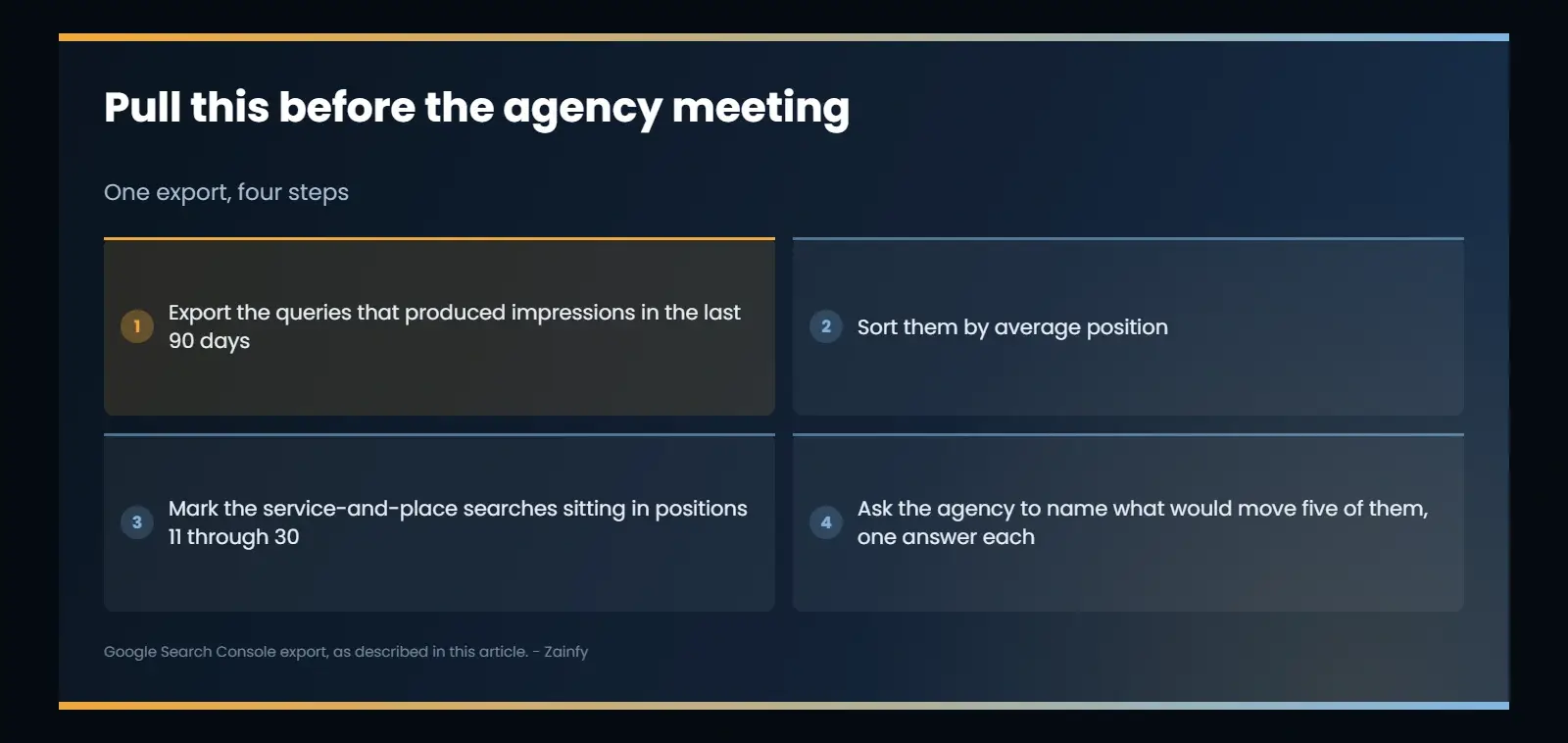
Open Google Search Console this week and export the queries that produced impressions during the last 90 days. Sort them by average position, then mark the service-and-place searches sitting from positions 11 through 30. That is the useful meeting document.
If an agency opens with a package before asking for that export, stop the conversation. It is prescribing work before reading the condition of the site. MBC needed its crawl floor repaired before content scaled. Your site may need a different first decision. The export makes the agency explain why. Ask the agency to choose five queries from positions 11 through 30 and state what would move each one: a stronger existing page, a new page, better internal structure, or outside authority. Do not accept one answer applied to all five. The differences will tell you whether the proposal was built from your data or pulled from a package sheet.