A Gainesville, Georgia remodeler’s website has to prove two things national templates never prove: that you genuinely work the Hall County towns you claim, and that your Lake Lanier waterfront work deserves its own page instead of a thumbnail in a mixed gallery.
That is the job.
If your site says “serving Gainesville and surrounding areas,” it may be technically true. It still does not help the Oakwood homeowner who wants to see Oakwood work, the Flowery Branch buyer comparing additions, or the lakefront owner trying to decide whether you understand a shoreline property.
This is not a homeowner guide. It is for the Hall County contractor owner who knows the current site is too thin, too generic, or too dependent on directory profiles he does not control.
Your service area is a dozen towns – your website acts like it’s one
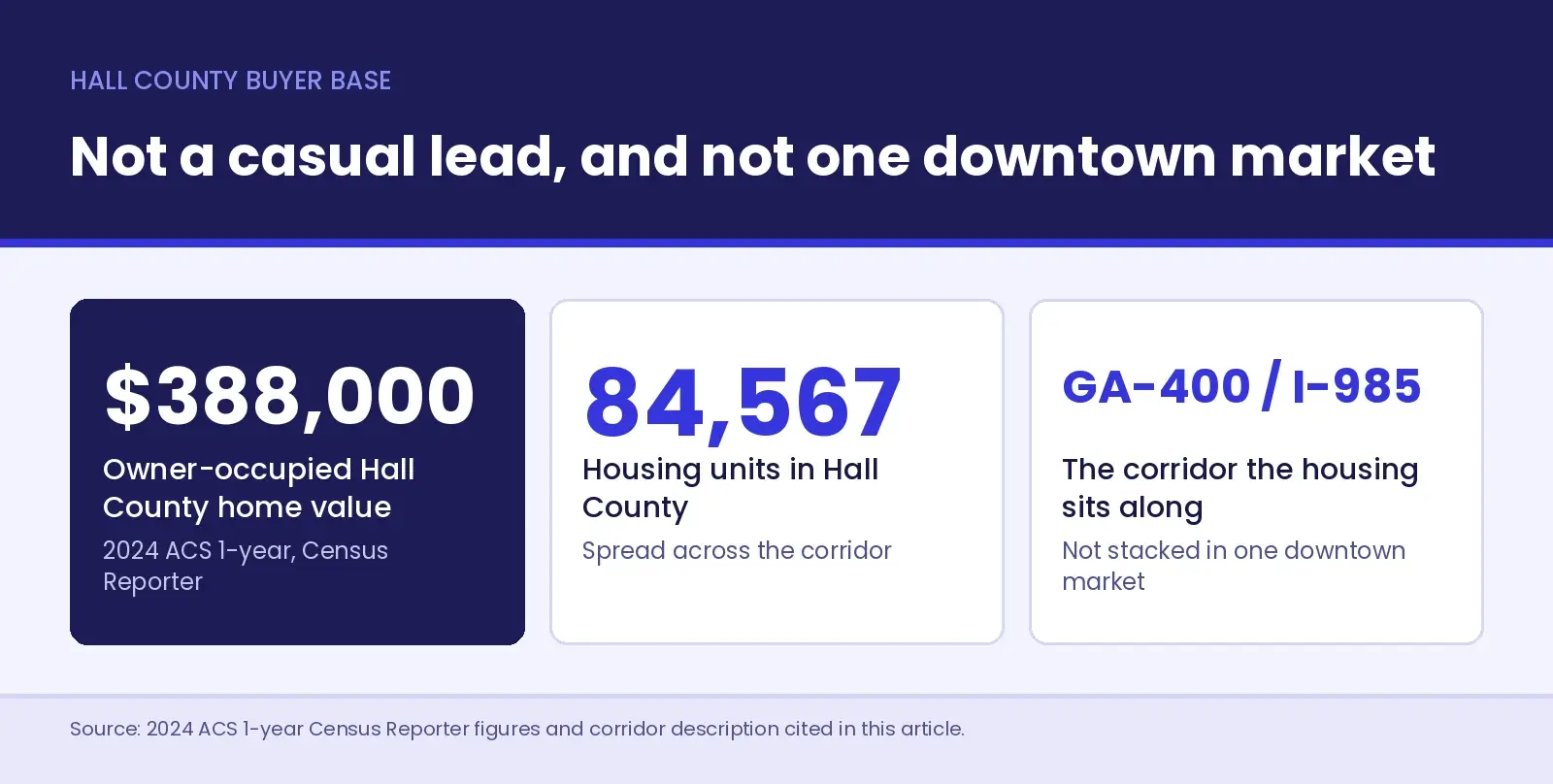
Hall County is not one neat buyer. It is Gainesville, Oakwood, Flowery Branch, Clermont, Lula, Gillsville, Braselton, the Hall side of Buford, unincorporated county roads, and the Lake Lanier edge. Most remodeler websites flatten that into one sentence near the footer. The site says it serves the area, but it never shows the area. That is a problem because a $388,000 owner-occupied Hall County home, using the 2024 ACS 1-year Census Reporter figure, is not a casual lead. That buyer is comparing contractors against the value of the house she already owns. She wants proof that feels close to her job. Hall County also has 84,567 housing units spread across the GA-400 and I-985 corridor, not stacked in one downtown market. A one-page template cannot speak to that footprint. A real site has to show which towns you actually work, what kind of projects you have done there, and where the Lake Lanier work belongs. The opportunity is not to look larger. It is to look specific where the larger-looking site is vague.
A page that proves you work the town, not just a name on a list
The service-area page is where most contractor websites get lazy.
They list Gainesville, Oakwood, Flowery Branch, Clermont, Lula, Braselton, Buford, and every nearby place the owner hopes to win. Then each town leads to the same thin copy, or no page at all.
That does not reassure anyone.
A useful town page has a job. If you claim Oakwood, show an Oakwood kitchen, bath, basement, deck, or addition with real photos and a short scope note. If you claim Flowery Branch, show a project that belongs there. Before/after pairs matter because they let the buyer see what changed. Town captions matter because they prove the project is not stock photography dressed up with a local heading.
This is where remodeler sites built for lakefront buyers fits if you want to see the commercial page after this guide.
Do not build eight pages just because Hall County has eight named cities in the official jurisdiction list. Build the pages you can support. Braselton and Buford need extra honesty because both extend beyond Hall County. If you serve the Hall side, say that. If you do not have proof there yet, do not fake it with a town heading and a borrowed kitchen photo.
The better pattern is simple: home page, services, service-area hub, then real town pages only where the project proof exists. A thinner list may look bigger on launch day. A specific page books better because the buyer can tell it was made for her town.
Lake Lanier is its own landing page
There are two ways a Gainesville remodeler handles lake work online.
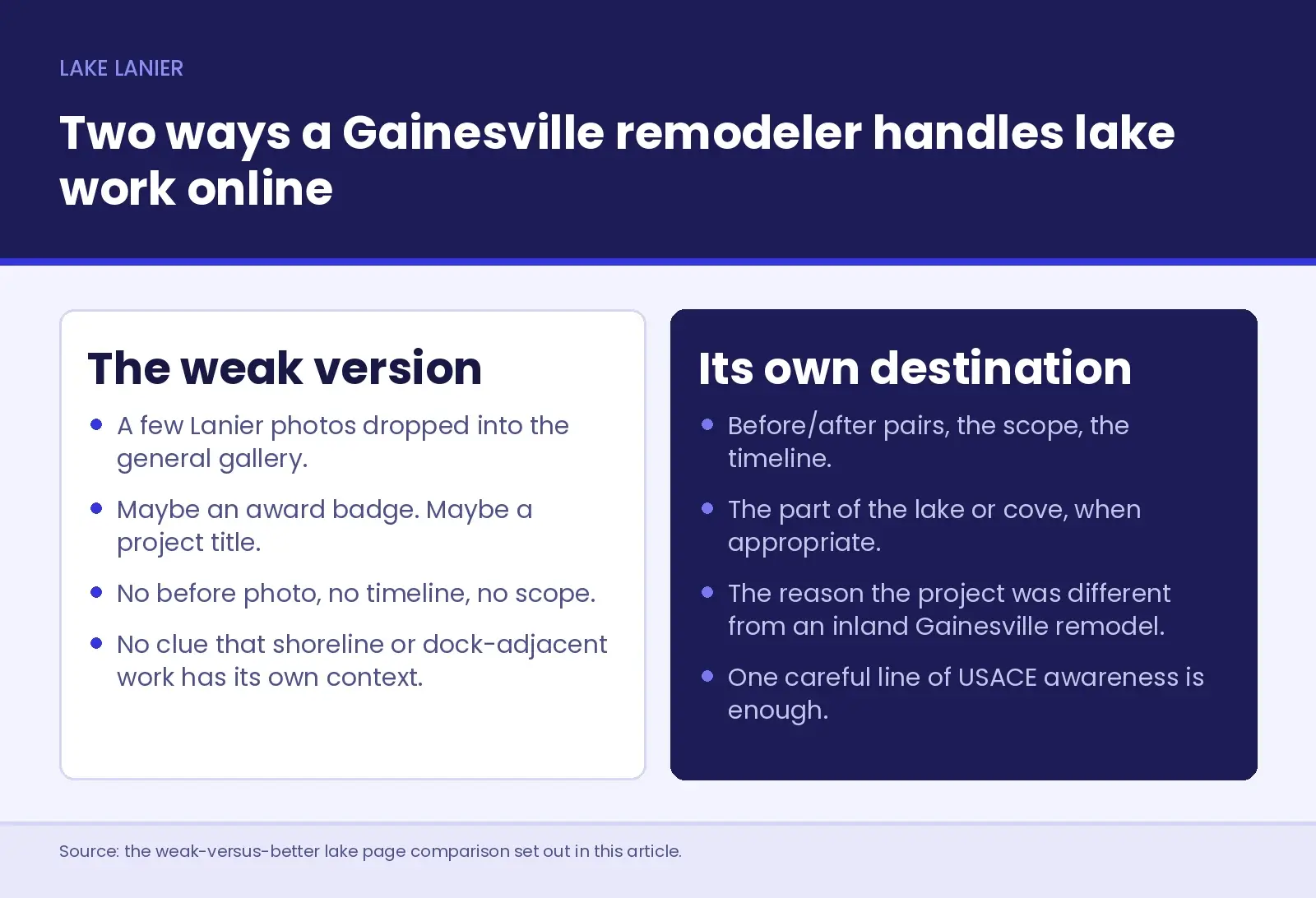
The weak version drops a few Lanier photos into the general gallery. Maybe there is an award badge. Maybe there is a project title. There is no before photo, no timeline, no scope, no explanation of what made the property different, and no clue that shoreline or dock-adjacent work has its own context.
The better version gives Lake Lanier its own destination.
That page is not just “waterfront remodeling” with a pretty view. It shows before/after pairs, the scope, the timeline, the part of the lake or cove when appropriate, and the reason the project was different from an inland Gainesville remodel. A deck near the water, a lake-view kitchen, a second-home update, and a shoreline-adjacent exterior project should not all disappear into a generic gallery.
One careful line of USACE awareness is enough. Lake Sidney Lanier is a U.S. Army Corps of Engineers reservoir, and shoreline or private-dock matters run through the Corps’ Lake Lanier Shoreline Management Program. The 2004 plan capped private docks at 10,615, now fully allocated. Your page is not giving permit advice. It is showing the lakefront buyer that you know the environment where the work happens.
That distinction is the page. The homeowner does not need another contractor saying “quality craftsmanship.” She needs to see that you have handled the kind of lake property she owns.
The five-second screen a Hall County homeowner runs on her phone
Before she reads the page, she judges whether the business looks real.
On her phone.
Fast.
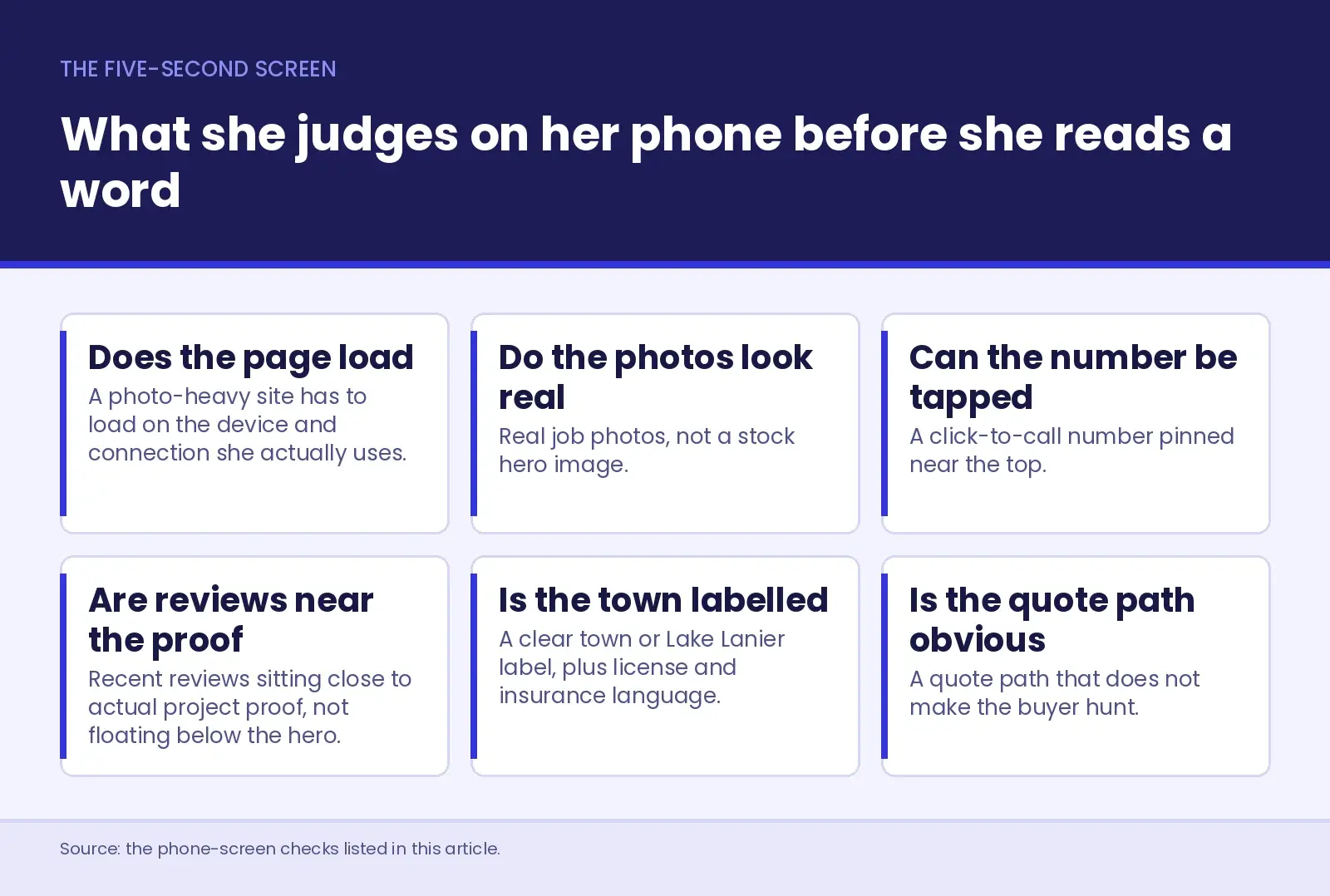
A Hall County buyer comparing a $388,000-home renovation does not owe you a long look. She checks whether the page loads, whether the photos look real, whether the phone number can be tapped, and whether reviews sit close to actual project proof instead of floating somewhere below a stock hero image.
Bad sites ask for trust before showing evidence.
Good remodeler sites show the evidence first: real job photos, a clear town or Lake Lanier label, license and insurance language, recent reviews, and a quote path that does not make the buyer hunt. If the first screen feels like a template, she assumes the rest of the company is just as vague.
The phone screen is not decoration. It is the first sales meeting.
The pages and the form that turn a lake-house lead into a booked estimate
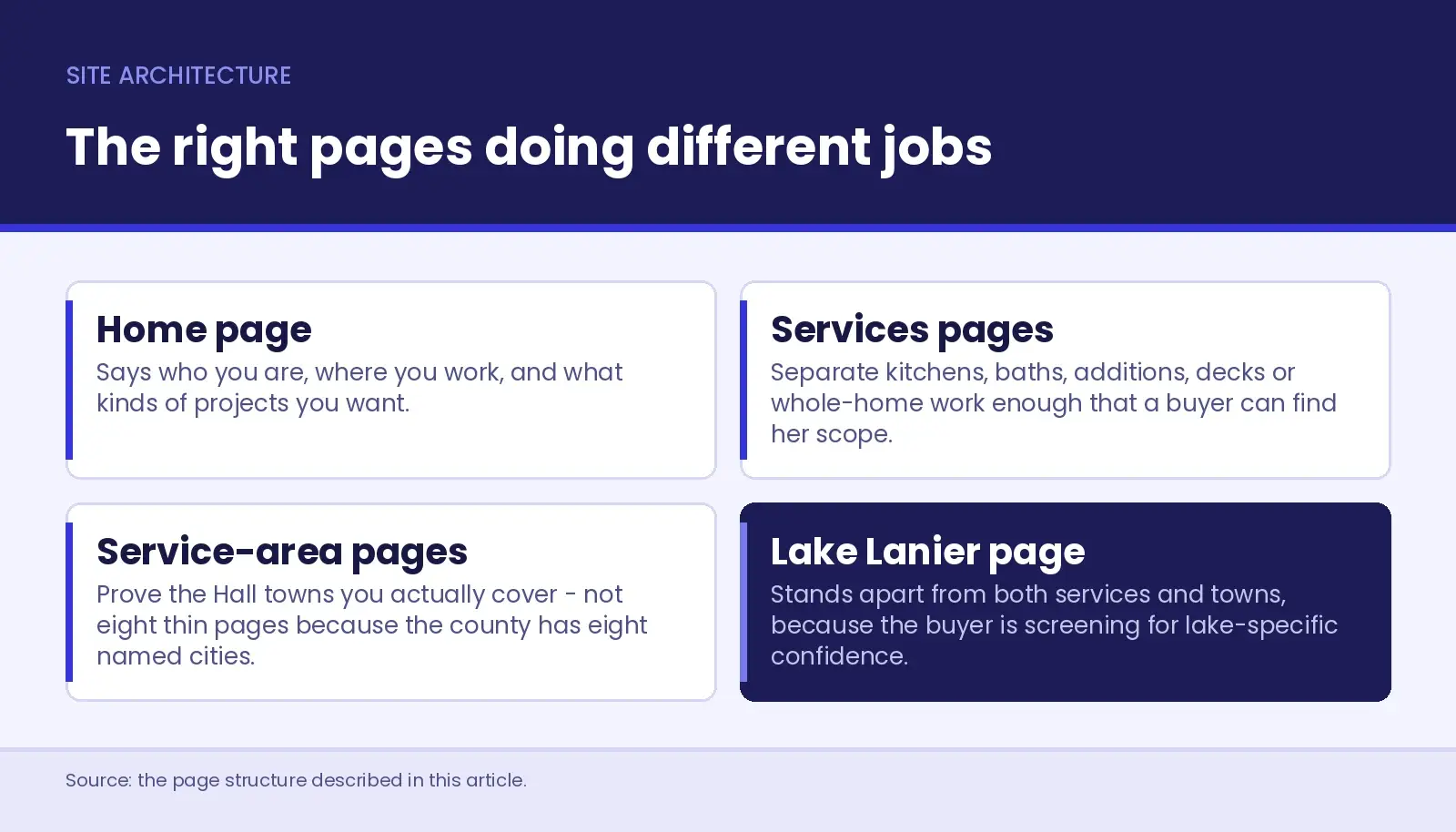
The site does not need fifty pages. It needs the right pages doing different jobs. What that looks like in practice is easier to see beside lakefront galleries, rebuilt.
The home page should say who you are, where you work, and what kinds of projects you want. The services pages should separate kitchens, baths, additions, decks, or whole-home work enough that a buyer can find her scope. The service-area pages should prove the Hall towns you actually cover. The Lake Lanier page should stand apart from both services and towns because the buyer is screening for lake-specific confidence.
Then the form has to match the seriousness of the project.
A two-step estimate form works because the first step is easy: name, phone or email, town, and project type. The second step can ask for timing, budget comfort, photos, or whether it is a waterfront property after the buyer has already committed. Keep it under five fields before the first submit. Put the main CTA in plain language: “Get a quote for a similar project.”
Financing can be offered as a capability if the contractor actually supports it, but do not turn the page into a lender pitch. The quote path still has to be about the project.
Hall County’s 180-day high-density zoning pause in 2025 was a new-construction zoning issue, not a remodeling restriction. Used honestly, it is one more reminder that existing-home owners still need clear paths to improve what they already own.
Speed and mobile decide it out here too
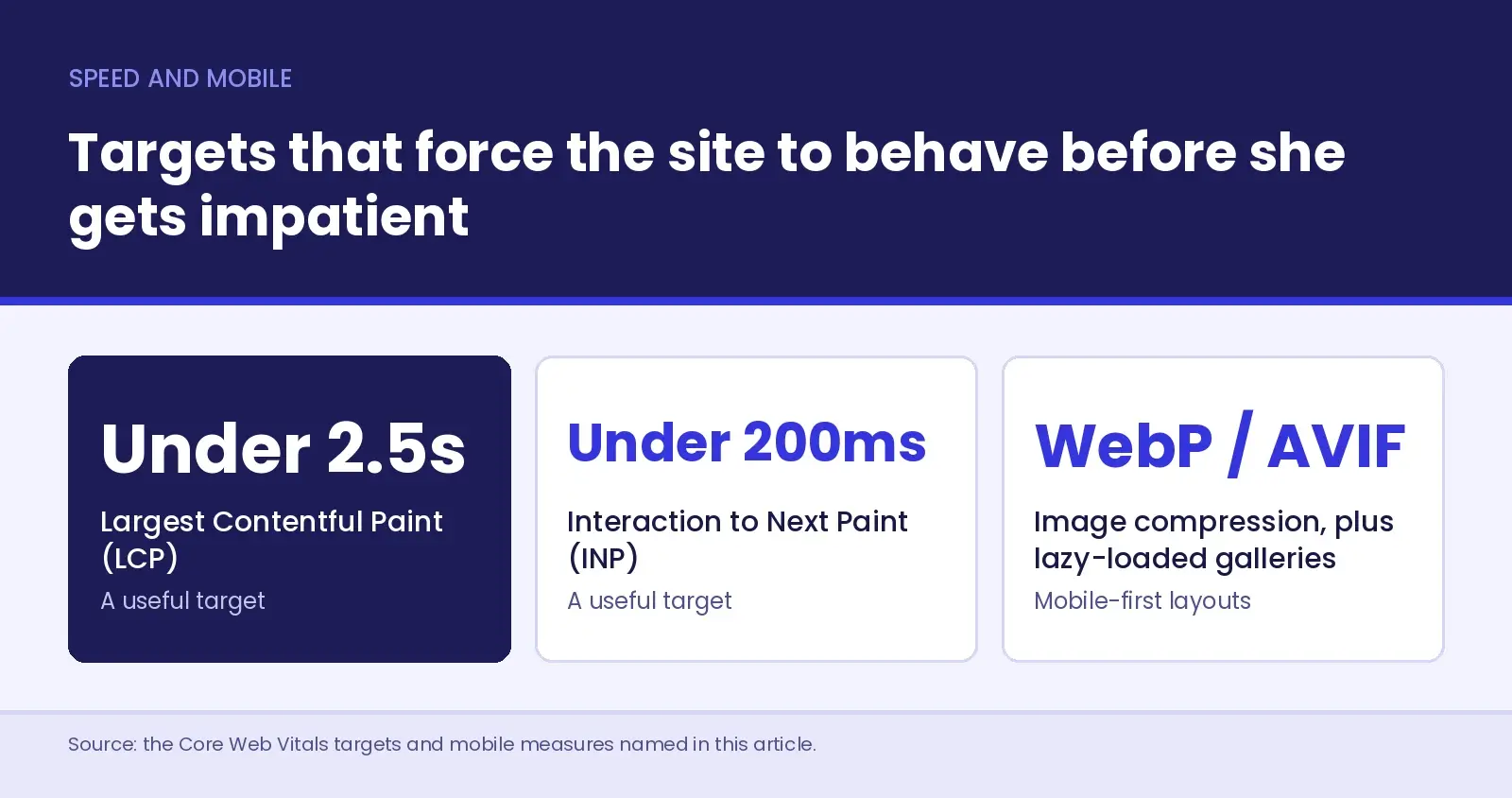
A photo-heavy Gainesville remodeler website has to load quickly on the device and connection the buyer actually uses. That means mobile-first layouts, a click-to-call number pinned near the top, image compression with WebP or AVIF, lazy-loaded galleries, and Core Web Vitals that are not ignored after launch. LCP under 2.5 seconds and INP under 200 milliseconds are useful targets because they force the site to behave well before the buyer gets impatient. This matters even more for a Lake Lanier gallery. Your best photos may be opened from a phone at the lake, not from a desktop on fiber internet. If the page crawls, the design never gets judged. Light schema can help describe the business, service area, and construction category, but only after the visible page already says the truth clearly.
Don’t list a town you can’t prove – or run the lake business off a Facebook page
Do not pad a service-area page with Hall towns you have never worked just to look bigger.
The first Clermont homeowner who clicks through and sees zero Clermont projects is gone. That applies to a Lula page with no Lula work, or a Buford claim that ignores the county-line reality.
Also, do not run your highest-value Lake Lanier work off a directory profile and a Facebook album you do not own. A rented profile can bring attention, but it cannot shape the whole buying experience. It cannot organize before/after proof, build a lake-specific quote path, or keep your best waterfront work from sitting beside every other contractor in the same feed.
Cover the towns you actually work. Own the page the lake buyer lands on.
That is the difference between looking busy and being believable.
What a real multi-town site costs – and what a flat one costs you
A real Hall County remodeler site costs more than a one-page template because it has to hold more truth.
It needs service pages, town proof, Lake Lanier proof, fast photo handling, mobile polish, quote flow, and enough structure that the buyer does not get lost.
The flat site has a cost too. It is quieter, which makes it easier to ignore.
It costs the Oakwood estimate request that never happened because the buyer saw only Gainesville language. It costs the Flowery Branch lead that could not find nearby proof. It costs the lake-house owner who looked at your gallery and could not tell you had ever handled waterfront work.
Judge the website by what it lets the right buyer do. If it cannot prove the town, show the project, and make the estimate request easy, the cheap version is still expensive.
Gainesville & Lake Lanier remodeler websites: quick answers
[wps_faq style=”classic” question=”Does a Hall County remodeler’s website need a separate page for each town he serves?”]No, a Hall County remodeler’s website does not need a page for every town he hopes to serve. It needs real pages for the towns he can prove. Oakwood and Flowery Branch pages make sense if they include real project photos, before/after pairs, reviews, and clear scope notes from those towns. Gainesville can remain the anchor. Clermont, Lula, Braselton, or Buford should wait until the proof exists. A shorter site with believable town pages beats a long service-area list that proves nothing.[/wps_faq]
[wps_faq style=”classic” question=”Should a Lake Lanier waterfront project have its own page on my website?”]Yes, a Lake Lanier waterfront project should have its own page when lake work is a serious part of the business. The buyer is not only judging the finished room. She is judging whether you understand waterfront property, access, decks, shoreline-adjacent work, and the fact that USACE handles Lake Lanier shoreline and private-dock permitting context. The page should show real before/after photos, scope, timeline, and location captions. A mixed gallery does not carry that weight.[/wps_faq]
[wps_faq style=”classic” question=”Do Gainesville contractors still need a website in 2026, or is a Houzz or Facebook profile enough?”]Gainesville contractors still need a website in 2026 because directory and social profiles do not let you control the full proof path. Houzz can show photos. Facebook can show activity. Neither one builds a clean Hall County service-area structure, a dedicated Lake Lanier page, a quote path, and town-specific project proof in one owned place. Use those platforms if they bring attention, but send the serious buyer back to a site that shows the work properly.[/wps_faq]
[wps_faq style=”classic” question=”How much should a Hall County remodeler budget for a website?”]A Hall County remodeler should budget based on the proof the website has to carry, not on a generic page count. A simple Gainesville brochure site is one job. A site with Oakwood and Flowery Branch proof, a Lake Lanier waterfront page, compressed galleries, quote forms, mobile performance, and clear service pages is a different build. Ask what the site must help the buyer decide.[/wps_faq]
Closing: build the page your best buyer needed yesterday
Pick the proof you already have and build from there.
If the best work is in Gainesville, start with Gainesville. If Oakwood and Flowery Branch are real markets for you, give them pages worth reading. If Lake Lanier is where your best projects happen, stop hiding that work in a mixed gallery.
The next step is not a bigger site. It is a more honest one. Then comes getting that site found across Hall County.
For contractors outside Hall County, contractor web design past one county shows how the same website problem changes across Georgia markets.
Build the page the buyer needed before she found you. Then make the estimate request impossible to miss.