A Gainesville, Georgia remodeling contractor ranks across Hall County by proving the towns, the permit lanes, and the Lake Lanier niche separately instead of pretending one Gainesville page covers the whole market.
That is the short version.
The longer version matters if you work from Gainesville into Oakwood, Flowery Branch, Braselton, Lula, Clermont, Gillsville, the Hall side of Buford, and lakefront jobs around Lanier. Google sees a service-area business trying to win searches across small cities, county land, review signals, project proof, and proximity.
Most Atlanta agencies flatten that. They write one generic local SEO guide, swap in Gainesville, and call it a strategy.
This is a guide for the owner who already knows referrals are not enough and wants to understand how search visibility works when one county has nine permit jurisdictions and a lake with its own federal rulebook.
The Hall ring is the advantage
The Gainesville contractor does not need to look bigger than Atlanta.
He needs to look more believable inside Hall County.
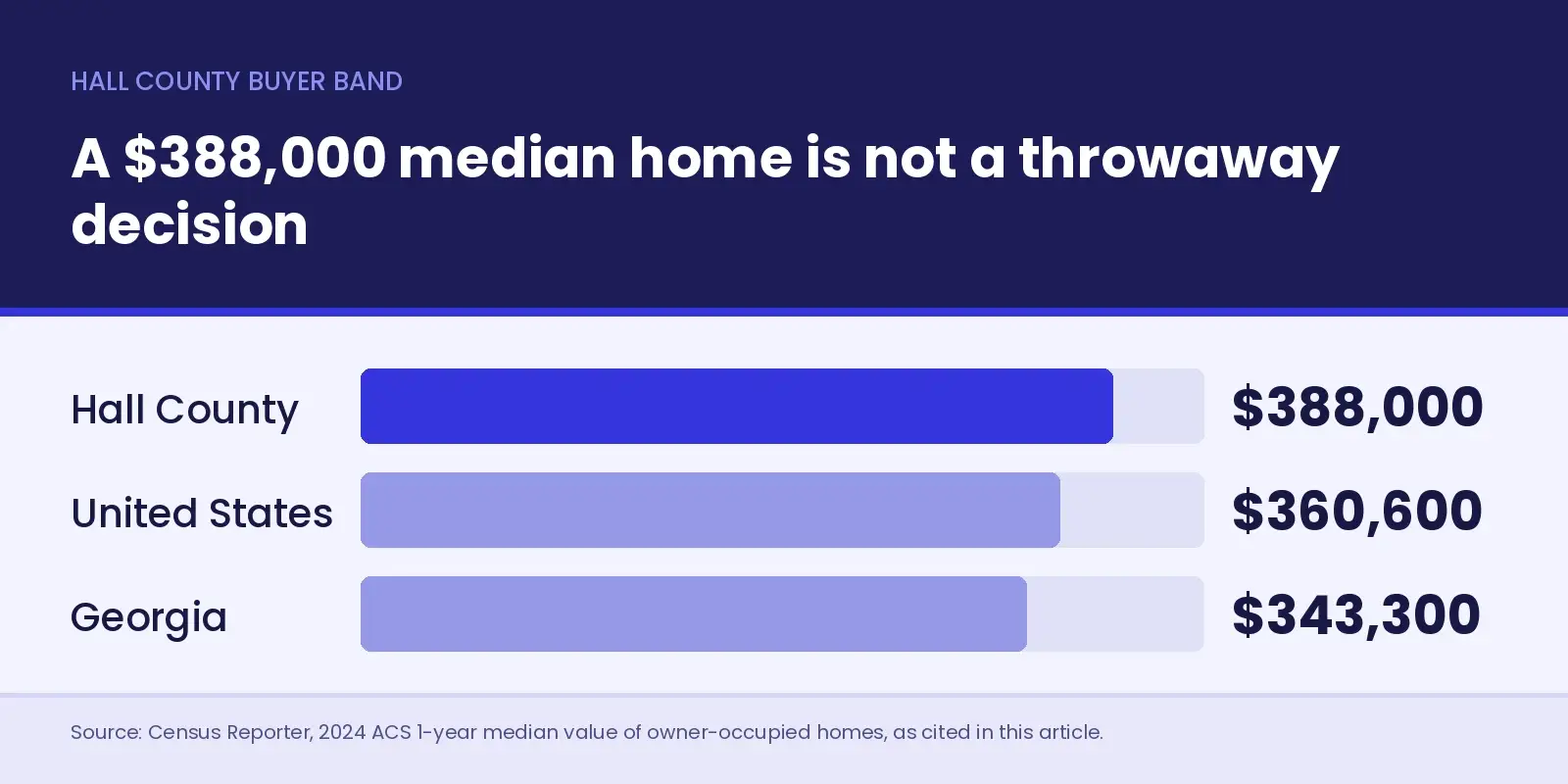
That starts with the buyer band. Census Reporter lists Hall County’s 2024 ACS 1-year median value of owner-occupied homes at $388,000, above Georgia’s $343,300 and above the U.S. figure of $360,600. That is not a remodel-cost number. It is the market context your pages have to speak inside: established owners comparing a kitchen, bath, deck, addition, or whole-home update against the value of the house they already own.
The Atlanta firm usually enters Gainesville with a broad service-area page: North Georgia, Lake Lanier, Gainesville, maybe a few town names in a footer. That page can rank on brand strength, but it rarely proves the ground.
Your opening is different. The Hall ring is compact enough that you can build real local relevance without pretending to serve every metro from Atlanta to the mountains. Gainesville can be the anchor. Oakwood and Flowery Branch can be the first expansion. Lake Lanier can be its own niche. Braselton and Buford need care because both straddle county lines, so the page has to be honest about the Hall-side work you can prove.
That is why a small-market SEO plan can move faster than a metro plan. There are fewer serious pages to beat, fewer contractors building location proof correctly, and a lot of generic directory clutter in the way.
Do not waste that lane by trying to rank for every remodeling term across every North Georgia town at once. The first job is narrower: own the Hall towns where you already work, then widen.
One county, nine building departments
Hall County looks simple on a map. The permit structure is not simple.
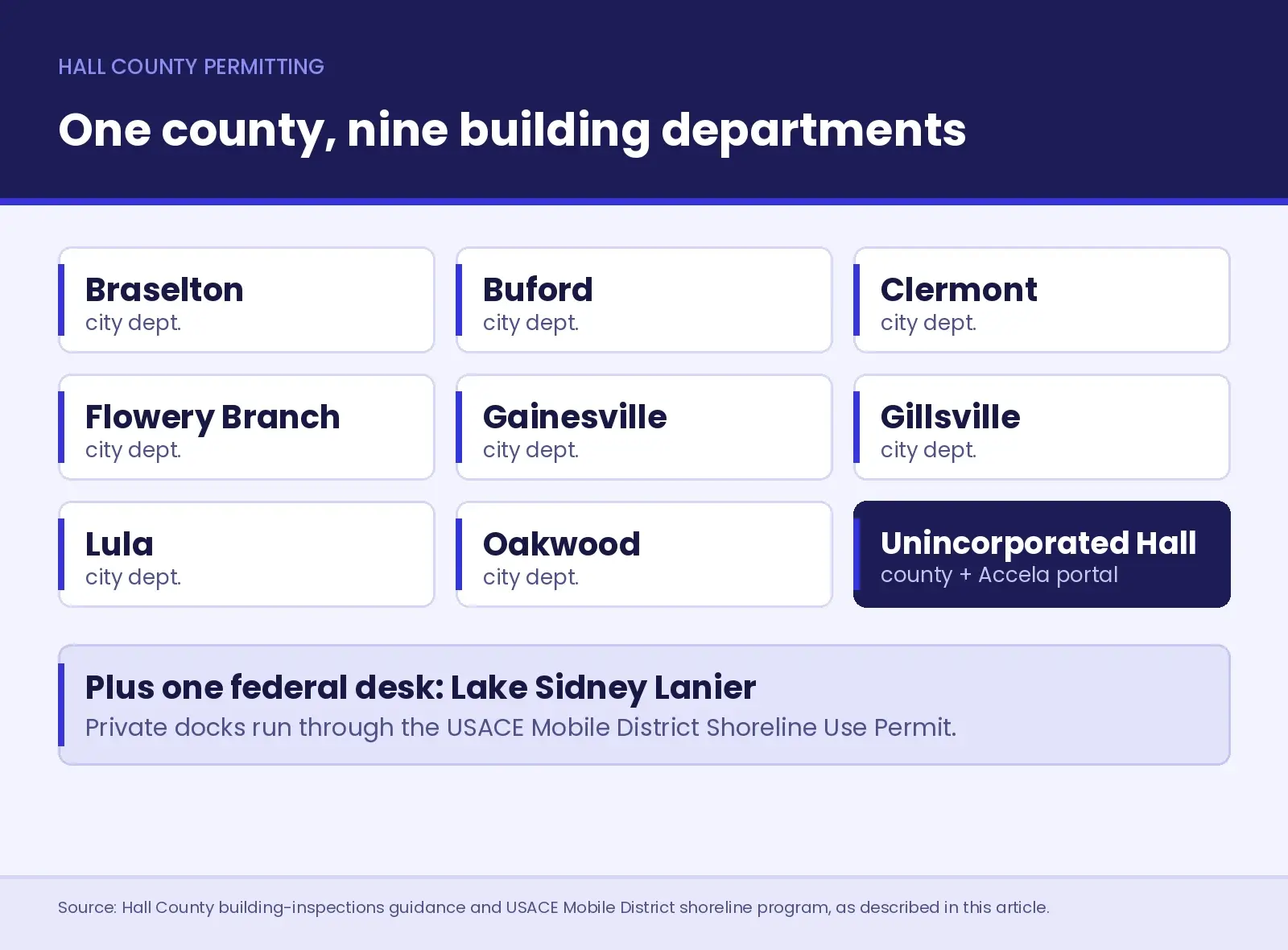
Hall County’s own building-inspections page says properties inside Braselton, Buford, Clermont, Flowery Branch, Gainesville, Gillsville, Lula, or Oakwood use their own city permitting departments. Unincorporated property goes through Hall County Building Inspections and the Accela Citizen Access portal.
That is eight city departments plus the county.
Nine local authority paths in one county.
For SEO, that should change the page architecture. A Gainesville-only page cannot carry every signal. A contractor who wants calls in Oakwood and Flowery Branch needs those towns to appear as more than a comma-separated list. The project proof, review language, citations, service-area schema, and internal links need to tell one story.
This is where ranking across Hall County and Lake Lanier fits for the commercial page after this guide.
The mistake is to build thin pages for all nine jurisdictions on day one. That is still weak, just in more folders.
Start with the towns where you can prove work. If you have Gainesville kitchens, Oakwood baths, and Flowery Branch additions, those can become real sections or pages. If you only have a lead-marketplace profile and a few unnamed project photos, build the proof library first. A location page without local evidence is not a local asset. It is a claim.
Braselton and Buford deserve special handling because both sit across a county boundary. Google cares when local entities and citations get muddy. Say what you actually serve. Tie project examples to the right town.
The contractor who handles this cleanly has a relevance advantage Atlanta firms usually skip. They see “Gainesville.” You can show the permit reality underneath the job.
A Lake Lanier remodel is a different search
Lake Lanier is not just a pretty word to add to the homepage.
It changes intent.
A homeowner searching for a Gainesville bathroom remodel is not always the same buyer searching around a dock-adjacent deck, a shoreline home, a lake kitchen, or a second-home update near Lake Sidney Lanier. The second buyer is often screening for proof that the contractor understands the lake itself, not just cabinets and tile.
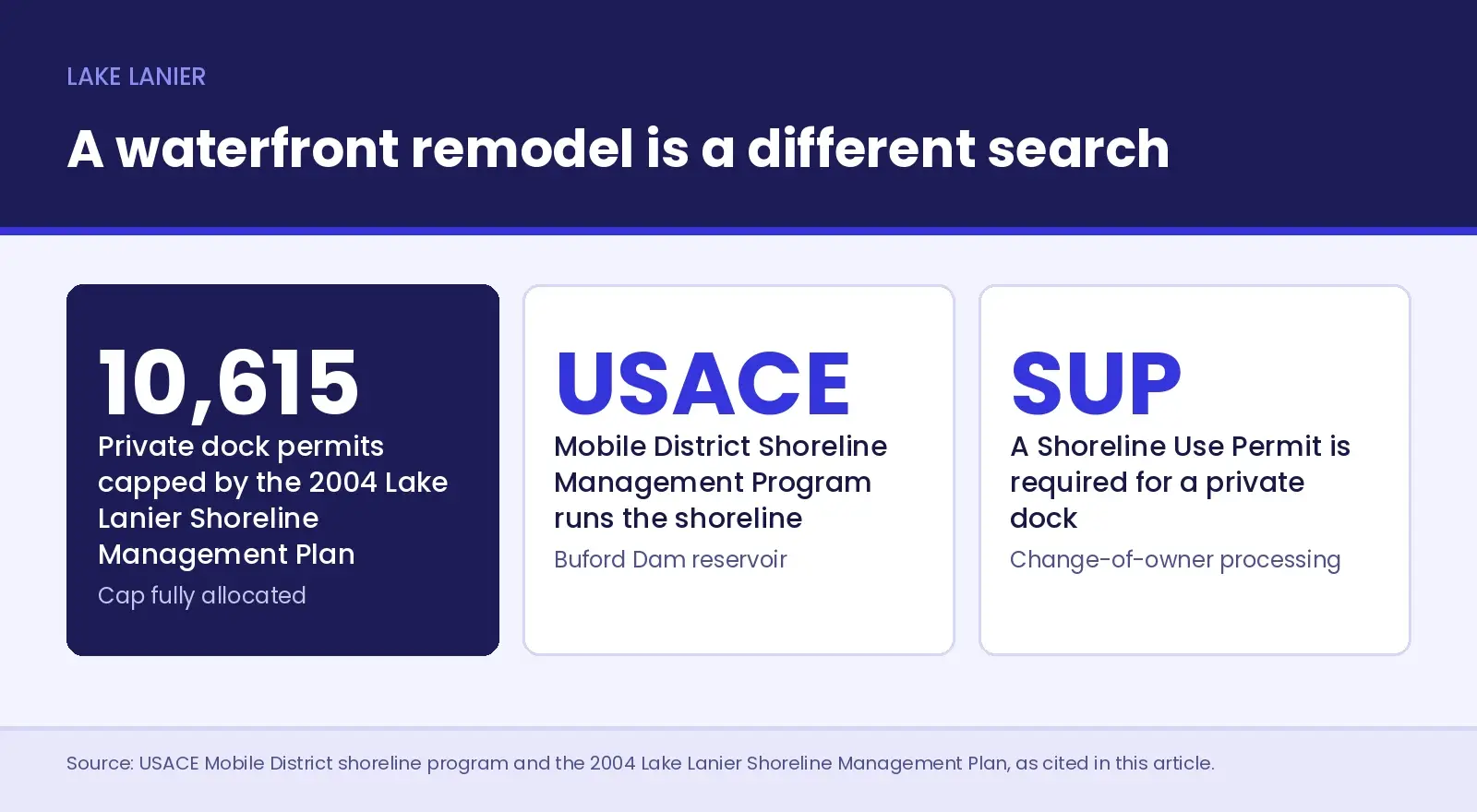
USACE makes that distinction real. Lake Sidney Lanier is a U.S. Army Corps of Engineers reservoir created by Buford Dam. The shoreline and private-dock side runs through the USACE Mobile District Shoreline Management Program. Private docks require a Shoreline Use Permit, and the 2004 Lake Lanier Shoreline Management Plan capped private dock permits at 10,615. The Corps says that cap is fully allocated, with change-of-owner processing when ownership transfers.
That is not a remodeling-demand statistic. It is a credibility filter.
If you do waterfront work, the website should treat it as its own search. A Lake Lanier page can show deck work, shoreline-adjacent exterior projects, lake-view kitchens, second-home timelines, and the fact that shoreline and dock rules are not handled like a normal inland county permit.
Generic contractor SEO guides do not cover that because they cannot. A Gainesville remodeler who actually works around the lake can own the page the national guide cannot write.
Do not bury those projects in a general gallery with filenames like `IMG_4821`. Name the place. Explain the scope. Separate the lake work from the inland work. Make the searcher believe you have handled that kind of property before.
The zoning pause is a content signal, not a scare line
Hall County’s 2025 zoning moratorium should be used carefully.
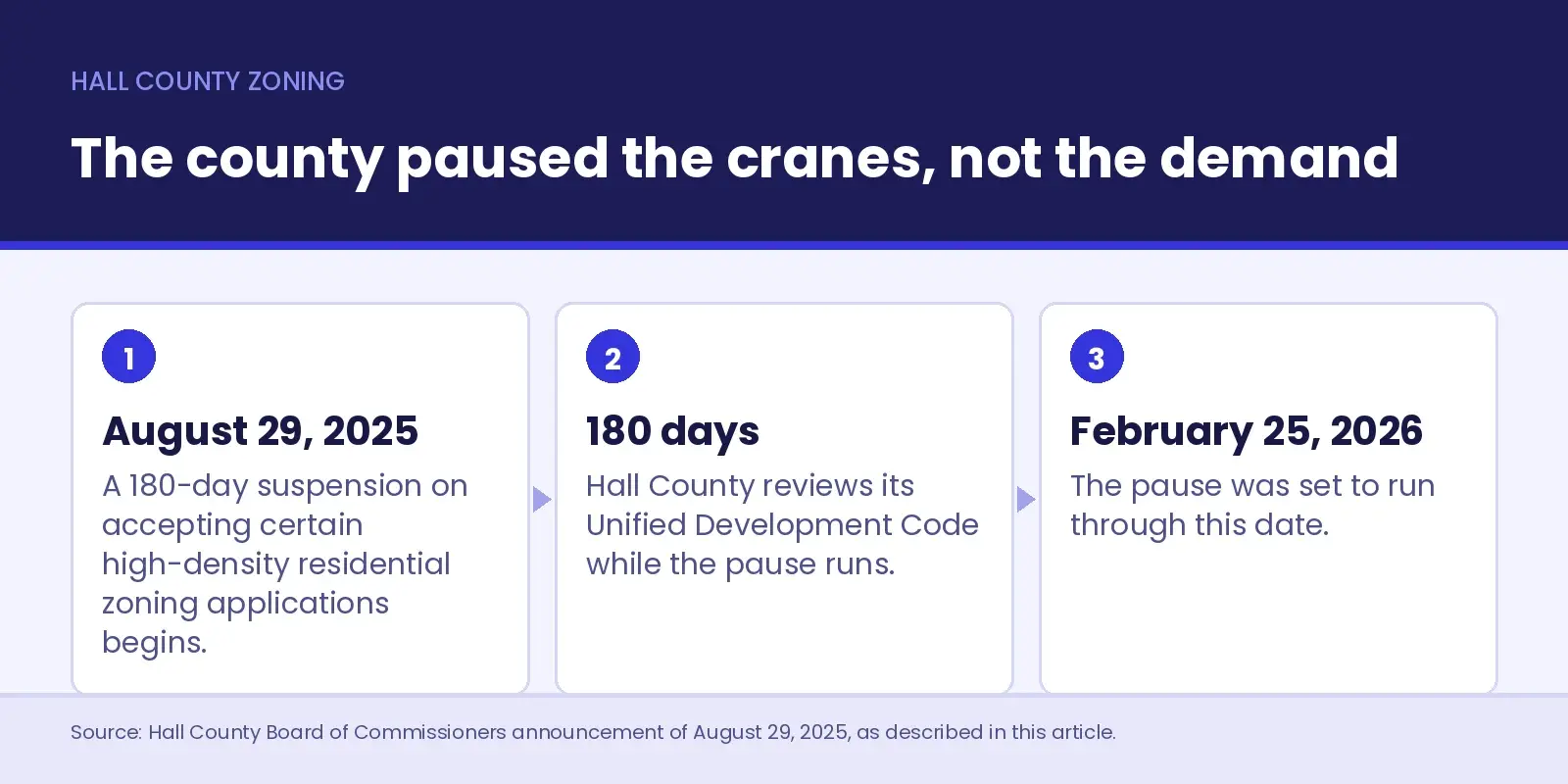
On August 29, 2025, the Hall County Board of Commissioners announced a 180-day suspension on accepting certain high-density residential zoning applications while the county reviewed its Unified Development Code. The pause was set to run through February 25, 2026. It applied to new high-density zoning applications, not to remodeling permits and not to ordinary residential renovation work.
So do not twist it.
Do not write that remodeling demand exploded because of the moratorium. Do not write that permits prove renovation leads are up.
The useful SEO point is cleaner: dated, local, county-specific facts separate a real Hall County contractor from a generic agency page. A contractor working in the county can explain what the pause was and what it was not.
That kind of page does not need to sound dramatic. It needs to be accurate. Accuracy compounds slowly, which is what a county-level climb with the numbers attached actually looks like month by month.
A Gainesville remodeler can use local content like this as part of a broader authority layer. The point is not to become a news site. The point is to show that your business understands the market where the work happens.
National contractor SEO articles cannot do that. They can say “create local content.” They cannot explain Hall County’s UDC review, the 180-day date window, or why an owner in Flowery Branch comparing remodelers might care whether the contractor sounds local.
How the ranking actually gets built here
The build is not mysterious. It is just less generic than most contractors are sold.
First, choose the right primary category on Google Business Profile. A contractor trying to rank for kitchen work should not sleepwalk into a broad category if “Kitchen Remodeler” better matches the revenue he wants.
Second, clean the entity. Name, address, phone, service categories, service areas, and website links should match across the places Google checks: your own site, Google Business Profile, BBB, Houzz, Angi, supplier profiles, manufacturer pages, local directories, and any credible contractor listings. A Gainesville citation set that conflicts with an old number or an old service area slows trust.
Third, make the proof local. A “kitchen remodel” page is weaker than a Gainesville kitchen page with scope, photos, timeline, and review language. An Oakwood bath should say Oakwood. A Flowery Branch addition should not be hidden under “recent work.” Lake Lanier projects should have their own set because that buyer is screening for a different kind of confidence.
Fourth, earn local authority where it makes sense. The Greater Hall Chamber of Commerce is a cleaner local signal than a random backlink. A community sponsorship, supplier mention, or project feature tied to Hall County can support the same entity Google is already trying to understand.
Fifth, mark up the visible truth. LocalBusiness and ServiceArea schema can help when it matches the page copy. Schema that lists towns you never discuss on the page is just noise. Gainesville, Oakwood, Flowery Branch, and Lake Lanier should show up in the content before they show up in code.
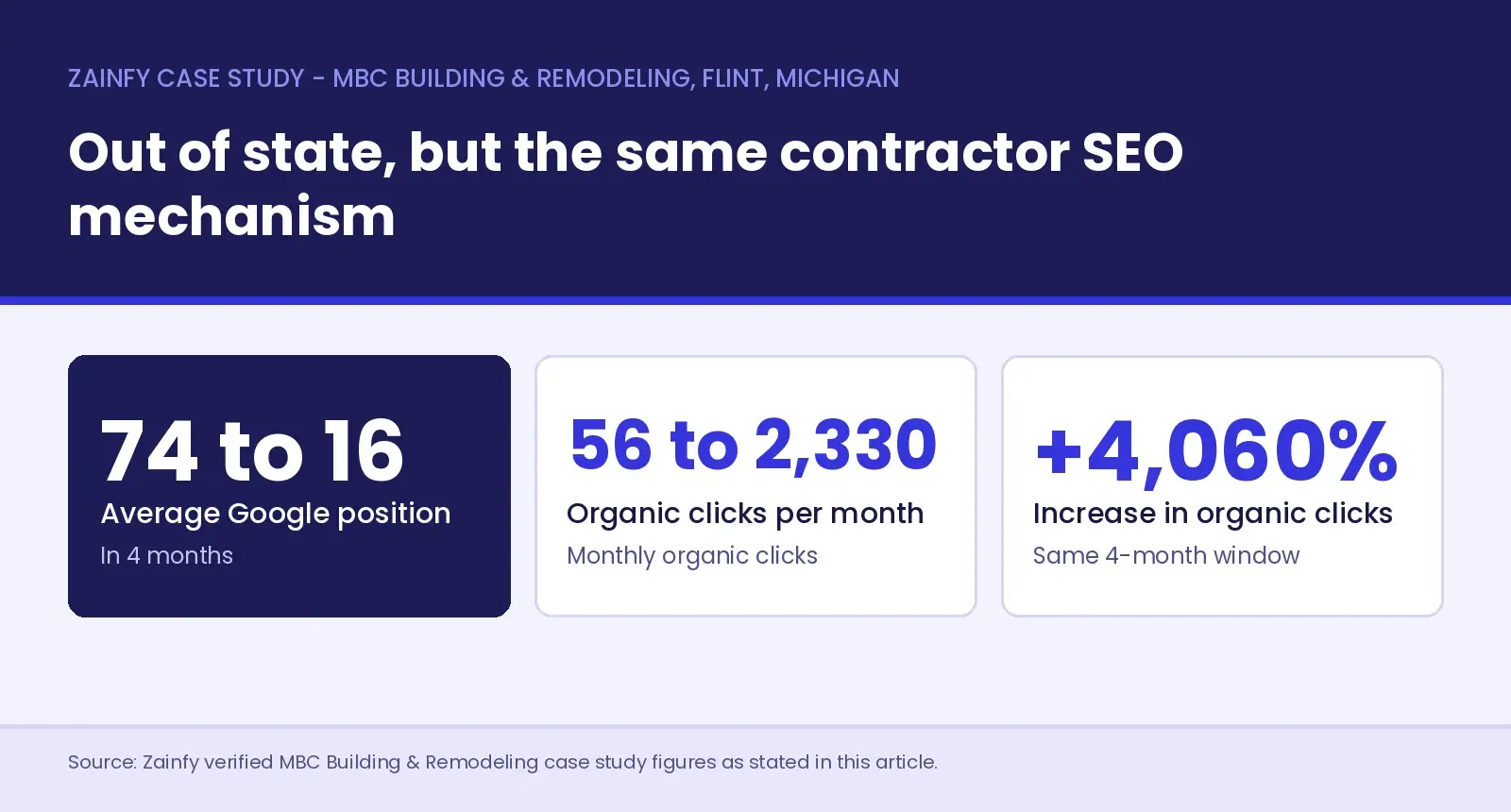
The method can move quickly when the market is under-built. Zainfy’s verified MBC Building & Remodeling case study in Flint, Michigan is out of state, but it shows the same contractor SEO mechanism at work: average Google position moved from 74 to 16, organic clicks went from 56 to 2,330 per month, a +4,060% increase, in 4 months.
How fast it moves, and what waiting costs you
A Gainesville remodeler should not expect SEO to act like a switch.
He also should not accept the lazy answer that “SEO takes a year” when the market is smaller, the competition is thinner, and the proof gap is obvious.
Early movement can happen in months when the foundation is weak and the local page set is better than what already ranks. The MBC example gives a real reference point: 74 to 16 average position in 4 months, with clicks rising from 56 to 2,330 per month. That does not mean every campaign copies the same numbers. It means a remodeler does not have to wait forever to see whether the work is taking.
Waiting has its own cost.
If you are buying shared leads from Angi, Houzz, or another marketplace while your own search visibility sits still, you are paying rent on someone else’s audience. A lead can fill the calendar, but it does not build your asset. The next month, you pay again.
Search visibility compounds differently. A Gainesville page can earn clicks. An Oakwood section can gather proof. A Lake Lanier page can attract a specific buyer.
That is why the first 90 days should not be vague “SEO activity.” They should produce visible assets: cleaned GBP categories, fixed citations, one or two serious location pages, a lakefront proof set if you have the work, internal links, and a review process that asks clients to mention the real town naturally.
If nothing publishable changed after three months, you did not buy SEO. You bought reports.
Don’t chase Atlanta – own the ring you can win
Do not burn your budget chasing “Atlanta remodeler.”
Not from Gainesville. Not first.
The broad Atlanta term belongs to firms with deeper history, bigger brands, more links, and more proximity to the searches happening inside the metro. A Hall County contractor trying to beat that head term usually ends up with weaker pages for the market he can actually win.
The better target is the ring: Gainesville, Oakwood, Flowery Branch, and the Lake Lanier waterfront niche. Add Braselton, Buford, Clermont, Gillsville, and Lula only where you have proof or a real service reason. This is not about thinking small. It is about refusing to dilute the one advantage the Atlanta firms do not have.
Do not spread thin trying to rank every service in all nine jurisdictions at once. Pick the highest-value service lines and the towns where your proof is strongest. Build those pages until they are not interchangeable with any other Georgia city.
That is the work. Not more keywords. Better evidence.
Gainesville & Hall County contractor SEO: quick answers
[wps_faq style=”classic” question=”Should a Gainesville remodeler target "Hall County" or individual city keywords?”]Target both, but give them different jobs. “Hall County” works as the umbrella because the service area is real and the county has 84,567 housing units in the 2024 ACS 1-year profile. Individual cities should carry the closer proof: Gainesville kitchens, Oakwood baths, Flowery Branch additions, and Hall-side Braselton or Buford work where you can verify it. A single county page is too broad to win every local search by itself. A pile of thin city pages is worse. Build the county context, then support it with city proof where the work actually exists.[/wps_faq]
[wps_faq style=”classic” question=”How do I rank in Flowery Branch or Oakwood when my office is in Gainesville?”]You rank in Flowery Branch or Oakwood from a Gainesville office by acting like a real service-area business, not a fake branch office. The Google Business Profile should reflect the service area you truly cover. The website should show Flowery Branch and Oakwood projects, reviews, photos, and citations that support those towns. Hall County says those cities run their own permitting departments, so the page should not treat them as Gainesville suburbs with swapped names. If you cannot show any Flowery Branch work yet, earn the proof before you build a page around the town.[/wps_faq]
[wps_faq style=”classic” question=”Do Lake Lanier waterfront projects need their own page to rank?”]Yes, Lake Lanier waterfront projects deserve their own page if you do that work and can prove it. The search intent is different from a standard Gainesville remodel because shoreline, dock-adjacent, deck, exterior, and second-home projects create a narrower buyer screen. USACE manages Lake Lanier shoreline permits through its Mobile District program, and the private dock cap is 10,615 permits, fully allocated. Your page should not pretend to be a legal guide. It should show project proof, shoreline awareness, lake-specific photos, and the kind of scope language a waterfront owner is already looking for.[/wps_faq]
[wps_faq style=”classic” question=”How long before a Gainesville remodeler sees SEO results, and what should it cost?”]A Gainesville remodeler can often see early SEO movement in months when the site has obvious gaps, but cost depends on how much proof and cleanup the business needs. A contractor with one weak Gainesville page needs different work than one building town pages, Lake Lanier proof, citation cleanup, reviews, schema, and content around Hall County’s nine permitting paths. Judge the investment by the assets produced: pages, citations, GBP cleanup, review velocity, and indexed local proof.[/wps_faq]
Closing: pick the first town and prove it
Start with the town where your evidence is strongest.
Not the biggest keyword. Not the broadest county label. The place where you have photos, reviews, client language, project details, and enough local context that the page could not be copied to another city.
For one contractor, that may be Gainesville. For another, Oakwood or Flowery Branch may be the better first move. If you have real Lake Lanier waterfront work, build that page before another generic bath page. The demand behind those searches is covered in Hall County’s growth and where the new owners come from.
Then widen carefully.
For a contractor looking beyond Hall County, how we run remodeling SEO statewide explains how the local-search problem changes from one market to the next.
The work is not to sound statewide before you are visible locally. The work is to make Google and the buyer believe the same thing: this contractor belongs in the exact Hall County search he is trying to win.