Your Grand Rapids buyers are sorting you against two or three other contractors before they call, and what they need to see depends partly on how old their house is. That matters in Kent County because the local housing stock does not produce one standard remodeling client. A homeowner in a pre-war house is looking for evidence that your crew understands what may be hidden behind plaster. A homeowner in a late-century subdivision is more likely to judge finish quality, disruption, and schedule control.
Both buyers may reach the same homepage within minutes of receiving your name from a referral. Neither wants a long claim about craftsmanship. They want to recognize their house, their concern, and a credible next step. If your site presents every project as the same polished kitchen, it makes both prospects do the work of deciding whether you fit. Most will not ask you to explain the missing proof. They will open the next contractor's site.
Two markets, one county
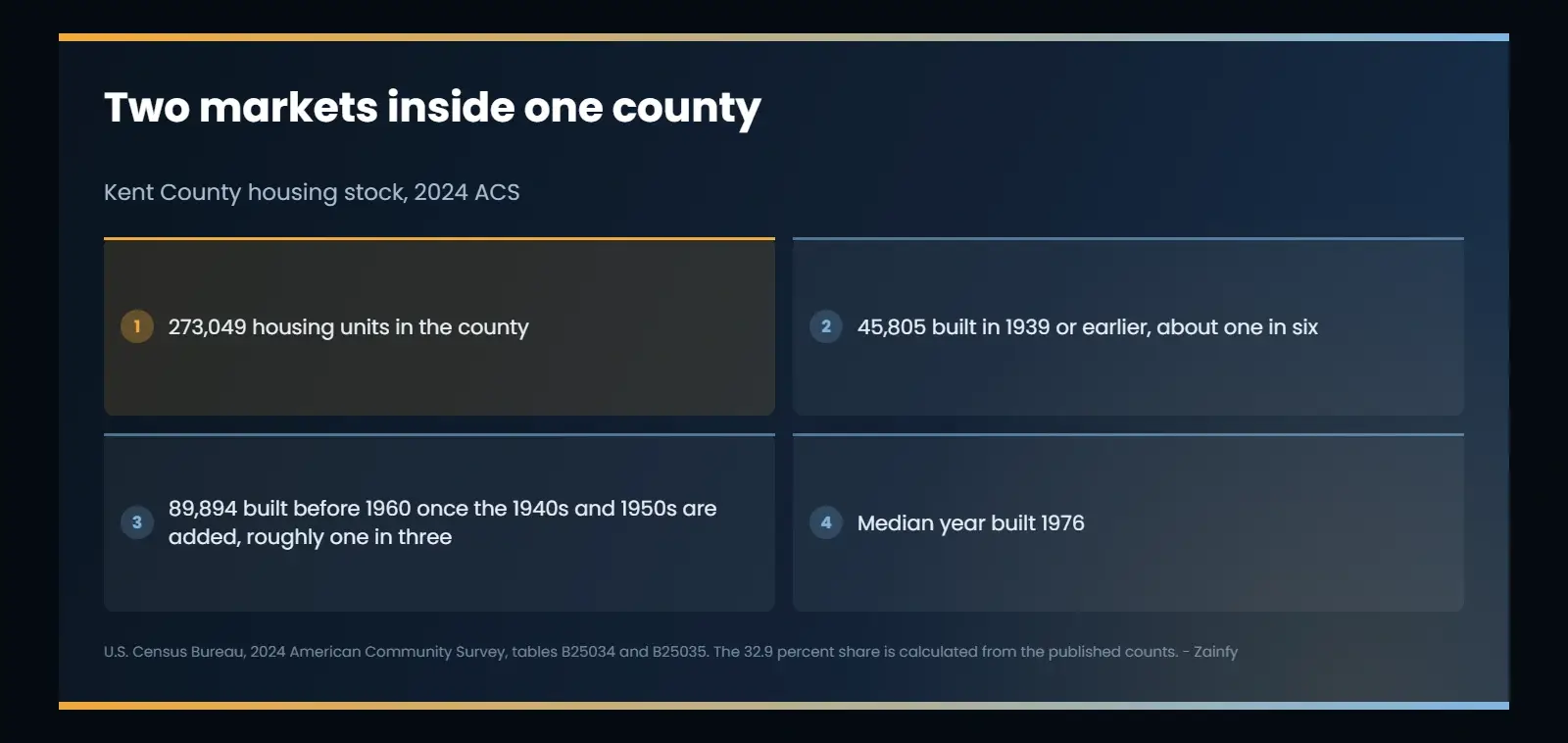
Kent County contains 273,049 housing units, according to the U.S. Census Bureau's 2024 American Community Survey table B25034. The headline number is less important than the spread underneath it.
Of those units, 45,805 were built in 1939 or earlier. That is 16.8%, or about one in six homes, standing before the United States entered World War II. Add 13,942 homes from the 1940s and 30,147 from the 1950s, and the pre-1960 total reaches 89,894. Dividing that count by the county total gives 32.9%, roughly one home in three. That percentage is derived from the published Census counts, not printed as a separate Census estimate.
Now place that beside a second number. Census table B25035 gives Kent County a median build year of 1976. The county is not simply an old-house market, and it is not a new-subdivision market. It contains a substantial pre-war core alongside decades of later construction. A single average hides the exact divide your website has to handle.
The owner of a 1925 house arrives worried about what previous renovations concealed. The owner of a 1998 house may arrive worried about whether the finished room will look deliberate and whether the crew can keep the household functioning. They can request the same kitchen, bath, or addition, yet judge the contractor through different risks.
Your homepage does not need a history lesson. It needs to route those anxieties toward relevant proof. The project gallery, captions, service pages, and trust details should help each buyer find a job that resembles the decision in front of them. When every visitor sees the same generic promise, the site asks local knowledge to remain invisible.
What a 1925 owner needs to see that a 1998 owner doesn't
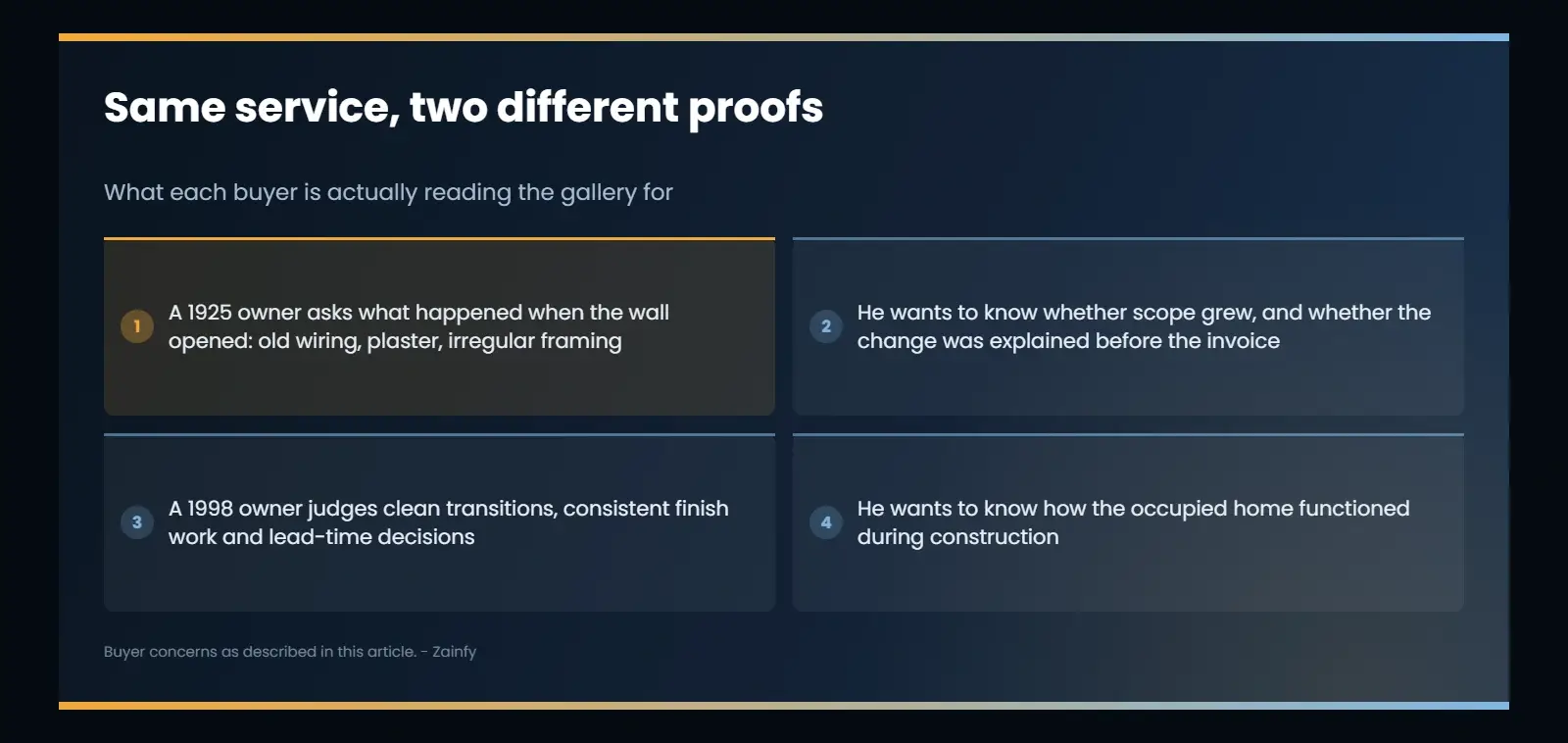
Picture the first buyer standing in a 1925 Grand Rapids house. She is not only evaluating the new cabinet doors in your gallery. She is wondering what happened when the wall opened. Did the crew recognize old wiring? Could it work around plaster, irregular framing, or a layout that had already been altered twice? Did the scope grow, and if it did, was the change explained before the invoice arrived?
For that buyer, a useful project entry shows the starting condition, the constraint, and the decision. A caption such as "1920s kitchen, original plaster retained, service wall rebuilt" does more work than six unlabelled finish photos. It tells her you have met a comparable house and can describe the work without pretending every old property contains the same problem.
The 1998-house owner reads the gallery differently. She may care more about clean transitions, consistent finish work, lead-time decisions, and how the occupied home functioned during construction. Her proof is a documented sequence: what stayed, what changed, how the new work meets the existing space, and whether the result still looks coherent outside the camera's best angle.
This is where remodeler sites built for Grand Rapids' older neighborhoods have to do more than display attractive rooms. The site should let the buyer recognize the type of house, the kind of constraint, and the contractor's judgment. The service may be identical on the estimate. The evidence that earns the call is not.
Do not turn the distinction into two stereotypes. A 1925 owner can care intensely about schedule, and a 1998 owner can uncover serious defects. The point is to give both buyers enough specific work to locate themselves in your experience before they have to ask.
Your gallery is sorted wrong
Stop sorting your gallery by room alone. "Kitchens," "Bathrooms," and "Additions" tell a buyer what you built, but not whether you have worked inside a house like hers. Keep the room categories if they help navigation, then add the context that affects the decision: build era, neighborhood type, starting condition, scope, and the problem the crew had to solve.
Stop using stock photography and stop publishing photos no one can place or date. A polished kitchen without a project name, approximate era, or explanatory caption could belong to any contractor in any city. It proves almost nothing. Stock imagery is worse because it borrows the appearance of experience without supplying any.
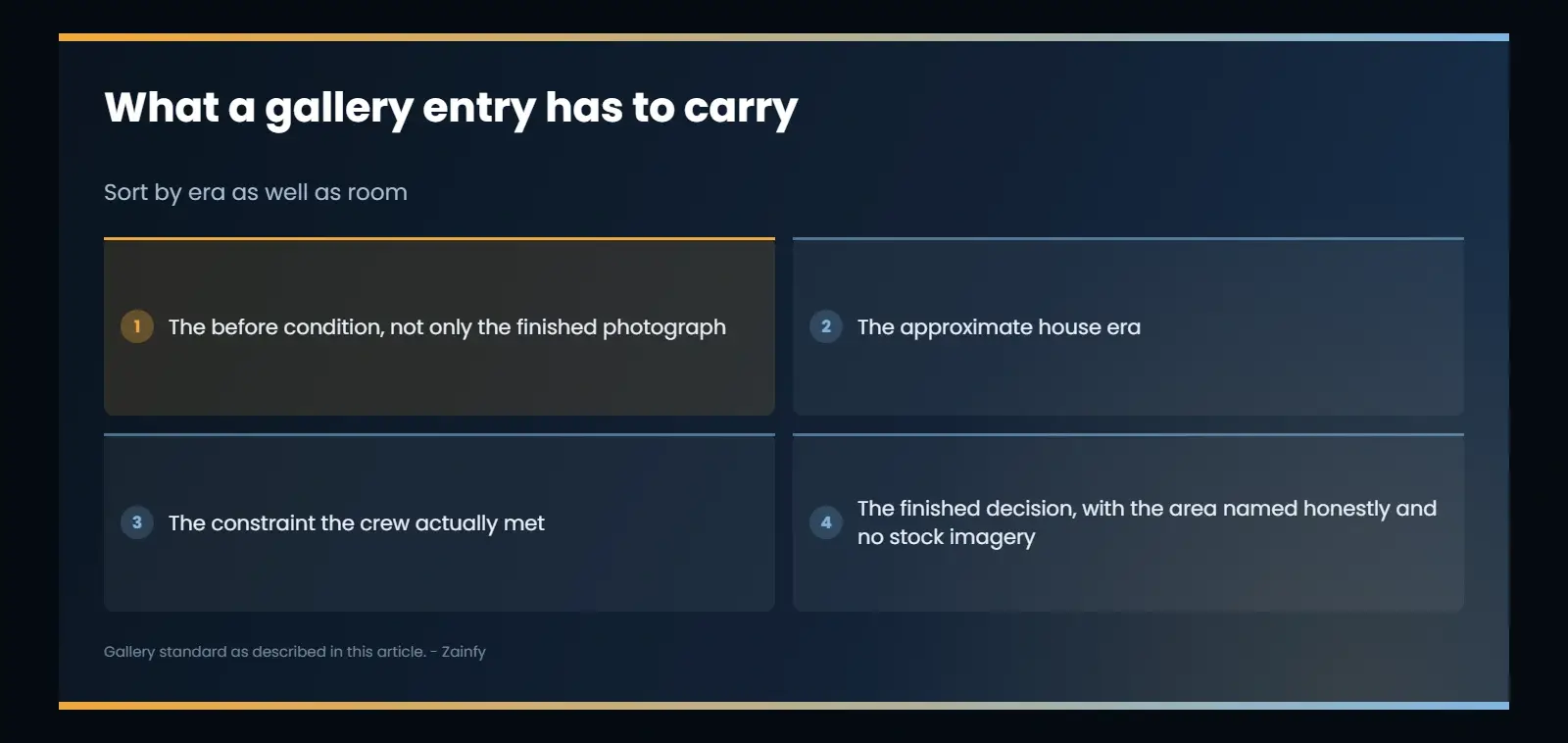
A real gallery entry does not need to become a technical report. Give the buyer the before condition, the house era, the constraint, and the finished decision. Show enough of the sequence to establish that the work is yours. If privacy prevents naming an address, identify the area honestly and omit the street.
The test is blunt: could a homeowner with a 1920s house tell that you have opened a wall in one before? Could a homeowner in a late-1990s subdivision see how your finish work meets the original room? If not, the gallery is decoration, not evidence.
License, insurance, reviews, and where they actually go
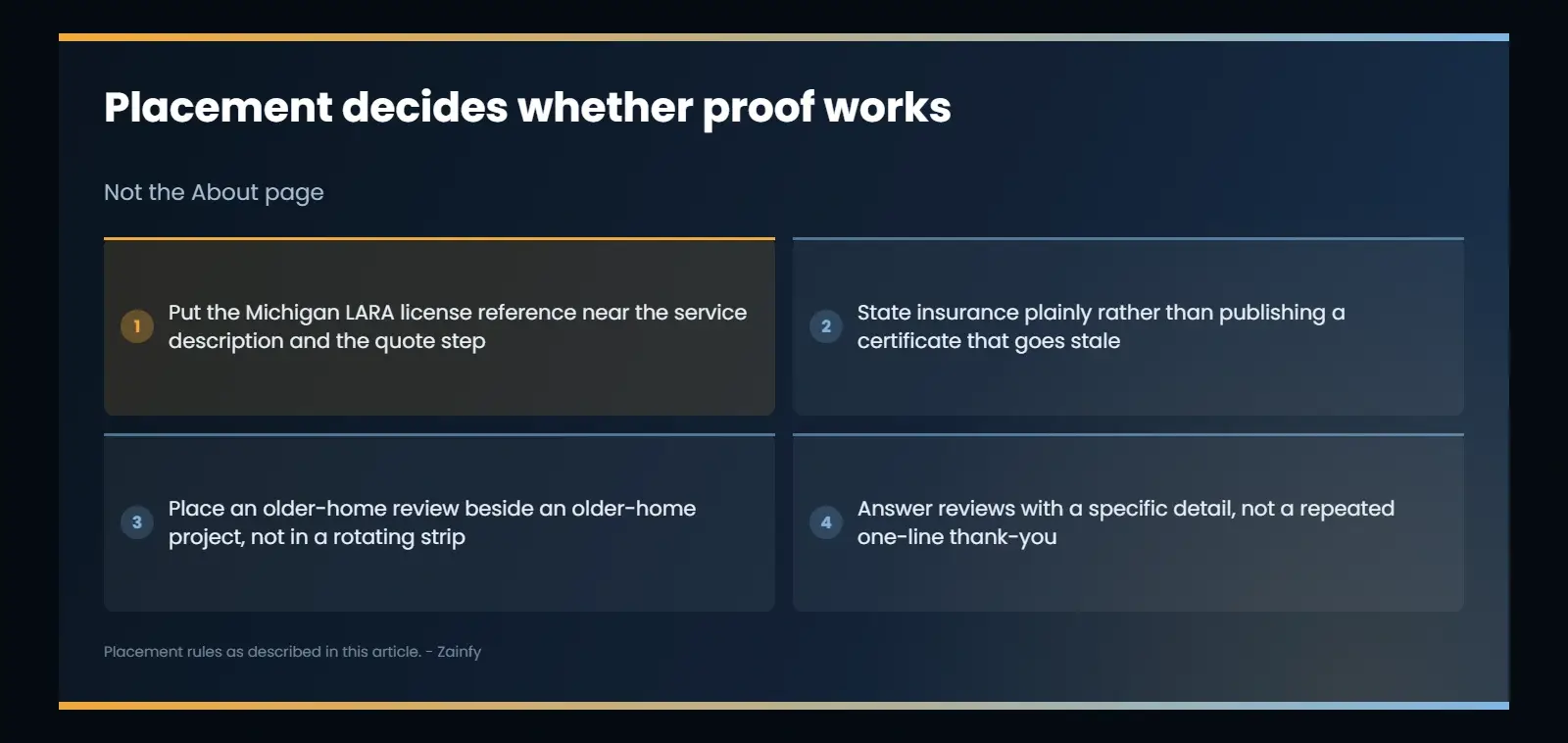
A license number, insurance confirmation, and credible reviews are table stakes, but placement decides whether they reduce doubt. Burying all three on an About page assumes a buyer will hunt for proof while comparing three open tabs. Put the Michigan LARA license reference where the claim becomes relevant: near the service description, beside a documented project, and close to the quote step. State insurance status plainly without publishing a certificate that can go stale. Reviews need similar context. A star average is easy to scan and easy to distrust; the response pattern tells the buyer more. Does the owner answer specific praise with a specific detail, respond calmly when a project had friction, and acknowledge the crew members or scope involved? Repeated one-line thank-yous make every job sound interchangeable. A thoughtful response shows there is an accountable person behind the form. This local proof also has to sit inside a wider view of what Michigan's housing stock means for demand, because the houses and buyer concerns change across the state. On your Grand Rapids pages, keep the evidence close to the decision it supports. Place an older-home review beside an older-home project, not in a rotating homepage strip with no context. Put the license reference near the moment a buyer asks whether the company is legitimate. Trust signals do not become stronger because they are repeated everywhere. They become stronger when each one answers the doubt raised by the page around it.
It has to load on a phone in a driveway
Your buyer may open the referral text while sitting outside the house. The connection is mobile data, one hand is on the steering wheel, and your homepage has seconds to become usable.
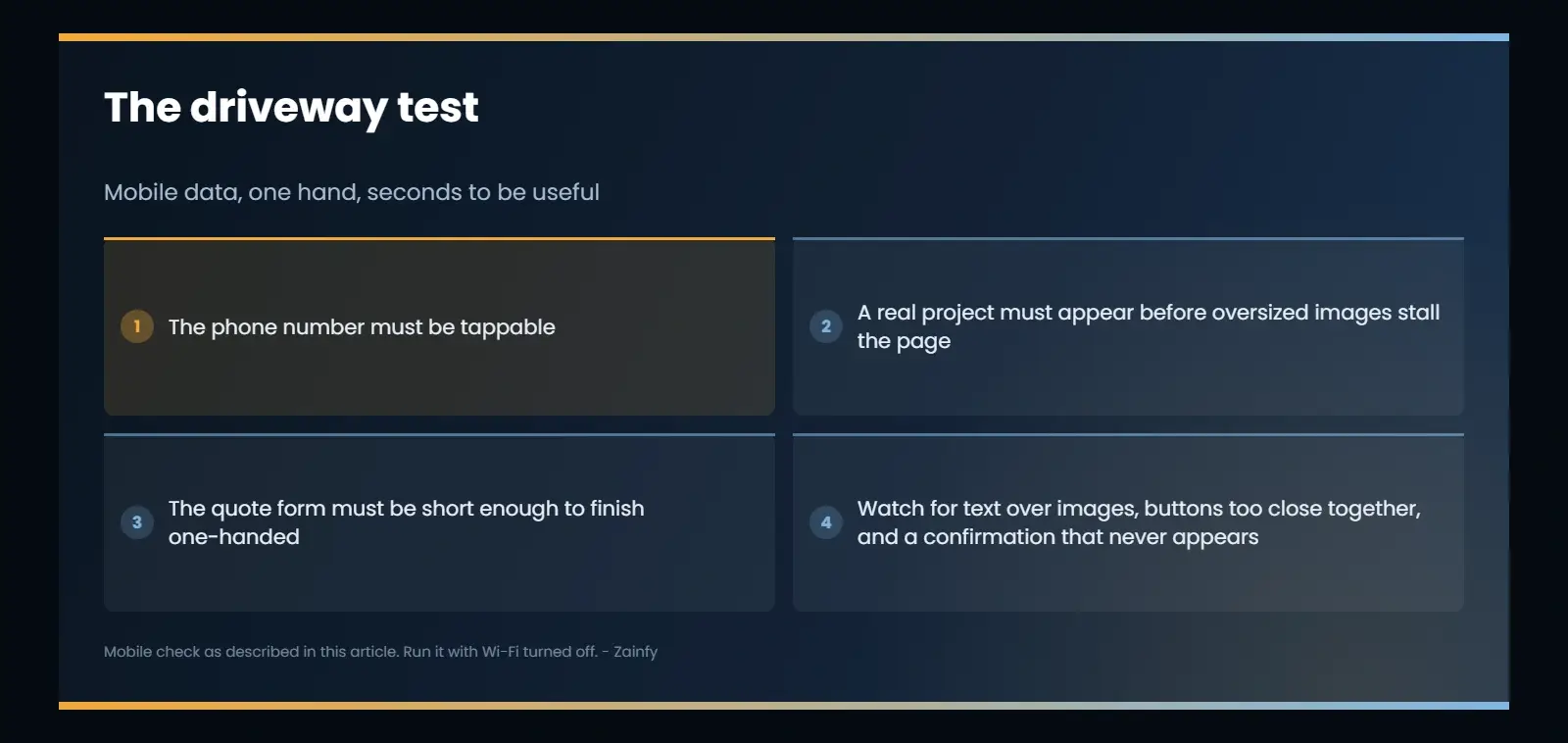
The phone number must be tappable. The gallery must show a real project before oversized images stall the page. The quote form should ask for enough information to route the request, not demand a full scope before the first conversation. Name, contact details, service, location, and a short project note are usually enough to begin.
Test the path on an actual phone. Turn off Wi-Fi. Open the homepage, find a comparable project, tap the number, and submit the form. Watch for the small failures a desktop preview conceals: text layered over an image, buttons too close together, a form field hidden by the keyboard, or a confirmation message that never appears.
Fast is not a decorative score. It is whether a buyer can verify your work and reach you without changing devices. If the proof exists but cannot be reached from the driveway, it might as well be absent.
What should a remodeling contractor's website include?
A remodeling contractor's website should include specific service pages, a labelled project gallery, visible license and insurance confirmation, reviews with owner responses, a clear service area, and one obvious way to call or request a quote. Each element should help a buyer verify fit without searching across unrelated pages.
The service pages define what you actually take on. Separate kitchens, bathrooms, additions, exterior work, or other real trades only when each page can carry its own project proof and useful scope. A thin page that changes only the service name adds no confidence.
The gallery carries unusual weight in Kent County because the local housing stock is split across eras. Credentials, contact details, and service-area language should remain consistent. The project evidence should change. A pre-war renovation needs captions that explain the starting condition and constraint; a later-century project needs the sequence and finish decisions that mattered there.
Reviews should sit near the service or project they support. The quote path should remain visible without interrupting every paragraph. Service-area copy should name places where the company can show real work, not draw the widest possible radius around Grand Rapids.
Buyers who ask an AI assistant for a contractor still get sent toward businesses whose sites state services, location, credentials, and evidence clearly. Plain language helps both the person and the system resolving the question.
The standard is simple: every important claim should be verifiable on the page where the buyer encounters it.
Run this against your own site
Use this check on your live site this week. Do not evaluate the design in a presentation; complete every step as a buyer would, on the published pages.
- Open the homepage on mobile data. Time how long it takes to see a real project, then tap the phone number and send the quote form. Record every point where the path hesitates or fails.
- Review the last ten gallery entries. Mark which ones identify the approximate house era, starting condition, project location, scope, and one constraint. If a stranger cannot distinguish your job from a stock photo, the entry fails.
- Search the site for your license reference and insurance confirmation. Note how many clicks separate each item from a service page and the quote action. Move the proof closer to the decision instead of repeating it in a footer.
- Read the latest ten review responses. Replace generic thank-yous with replies that acknowledge the project, the client's concern, or the crew's work without exposing private details.
- Compare one pre-1940 project with one late-century project. If both pages use the same captions and emphasize the same proof, rewrite them around the different risks the buyers brought to the job.
The result should be a short repair list, not a redesign wish list. Fix the first broken step before discussing colors, animation, or a new homepage concept.
Count the projects a buyer can date
Open your gallery and count how many projects a stranger could place in an approximate decade from the photos and captions. Do not count jobs you recognize from memory. Do not fill in details that never made it onto the page.
If the number is low, choose one completed Grand Rapids project and rebuild its entry before adding more images. State the house era, starting condition, scope, constraint, and finished decision. Remove any stock image occupying space that real work should hold. Then test the entry from a phone and ask whether the homeowner in that kind of house would recognize the risk you handled.
That count is more useful than asking whether the gallery looks modern. A polished gallery can still conceal experience. A specific project record lets the right buyer identify it. Where a 1925 house and a 1998 house can lead to the same contractor search, your evidence should make clear which problems you have solved.