Author: Zayn Shah
Your Augusta contractor website probably does not need a rebuild. It is more likely losing calls through six basic faults: a slow mobile page, a buried phone number, weak project proof, hidden credentials, a broken form, and vague service-area copy.
That matters in a metro the U.S. Census Bureau estimated at 641,231 people in 2025. A buyer relocating around Fort Gordon, formerly Fort Eisenhower, may be vetting you from a phone before reaching Richmond County. The six changes below are the fast-start companion to the full Augusta remodeler website guide. Fix the leaks first. Decide whether the design needs replacing after the site can take a call properly.
If it does not load in three seconds on a phone, you have already lost him
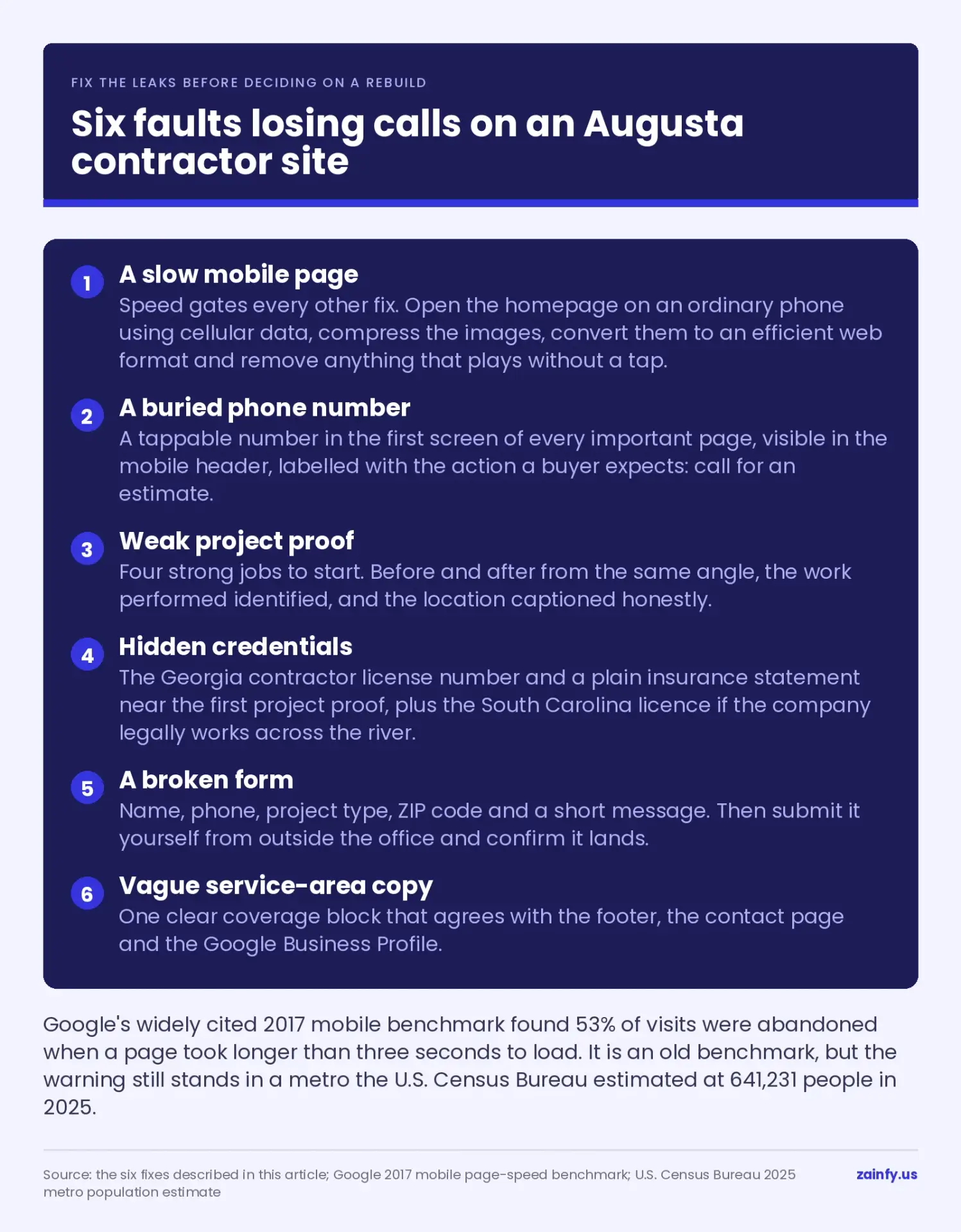
Speed gates every other fix. Google’s widely cited 2017 mobile benchmark found that 53% of visits were abandoned when a page took longer than three seconds to load. It is an old benchmark, but the warning still stands.
Open the homepage on an ordinary phone using cellular data. If the page stalls while a full-screen project photo or automatic video loads, compress the images, convert them to an efficient web format, and remove anything that plays without a tap. Then run a free page-speed test and check the page again yourself. A Fort Gordon newcomer in a hotel will not wait for a desktop-sized gallery to finish downloading.
Your phone number should be one tap, not one scroll
Put a tappable phone number in the first screen of every important page. Keep it visible in the mobile header, and label the button with the action a buyer expects: call for an estimate.
Do not make a Richmond County prospect open the menu, find Contact, scroll past an address block, and copy a number into the dialer. The button should work with one thumb. Test the number on an actual phone before publishing.
Show the work, not stock photos
Replace the generic kitchen hero with a small set of real before-and-after projects. A buyer comparing contractors can spot a catalog image, and it proves nothing about the crew that will arrive at the job.
Start with four strong jobs. Pair the before and after frames from one angle, identify the work performed, and caption the location honestly. A Columbia County kitchen and an Aiken bathroom show two different parts of the CSRA without pretending the company has an office in either place.
Keep the files light enough for mobile. The gallery should prove the crew has handled this type of project at the expected finish level. A clear, real photo carries more weight than a polished stock slideshow. The gap between the two is the whole point of real photos replacing stock, side by side.
The Fort Gordon buyer is verifying you – make it easy
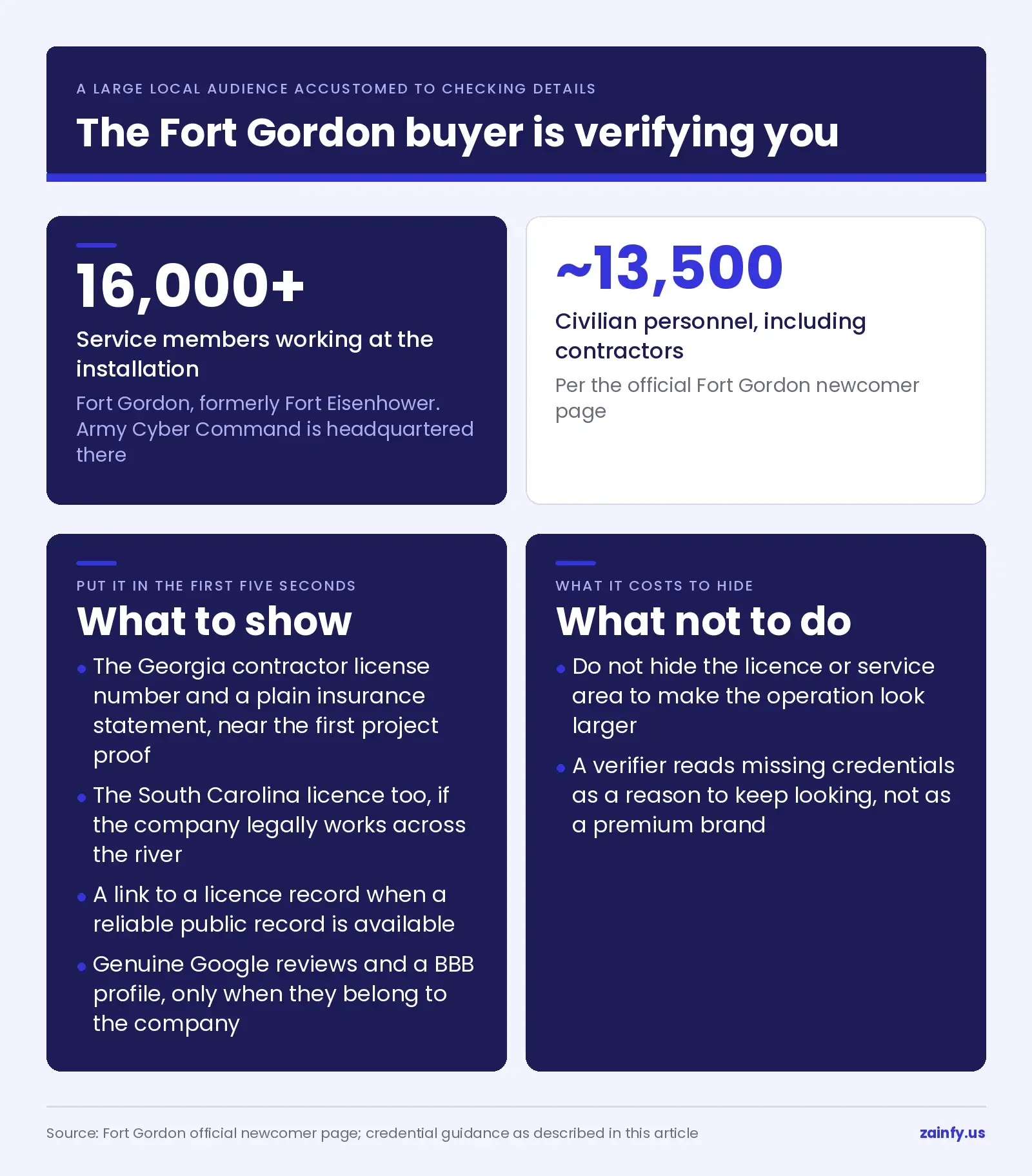
Put the evidence where a cautious buyer can find it in five seconds. Fort Gordon’s official newcomer page says more than 16,000 service members and about 13,500 civilian personnel, including contractors, work at the installation. Army Cyber Command is headquartered there. That does not make every buyer a technical reviewer, but it does create a large local audience accustomed to checking details.
Show the Georgia contractor license number and a plain insurance statement near the first project proof. If the company legally works across the river and holds the appropriate South Carolina license, show that too. Link to a license record when a reliable public record is available. Credential handling like that is part of how contractor sites are built statewide.
Use genuine Google reviews and a Better Business Bureau profile only when they belong to the company. Do not hide the license or service area to make the operation look larger. A verifier reads missing credentials as a reason to keep looking, not as evidence of a premium brand.
A quote form that quietly fails is worse than no form
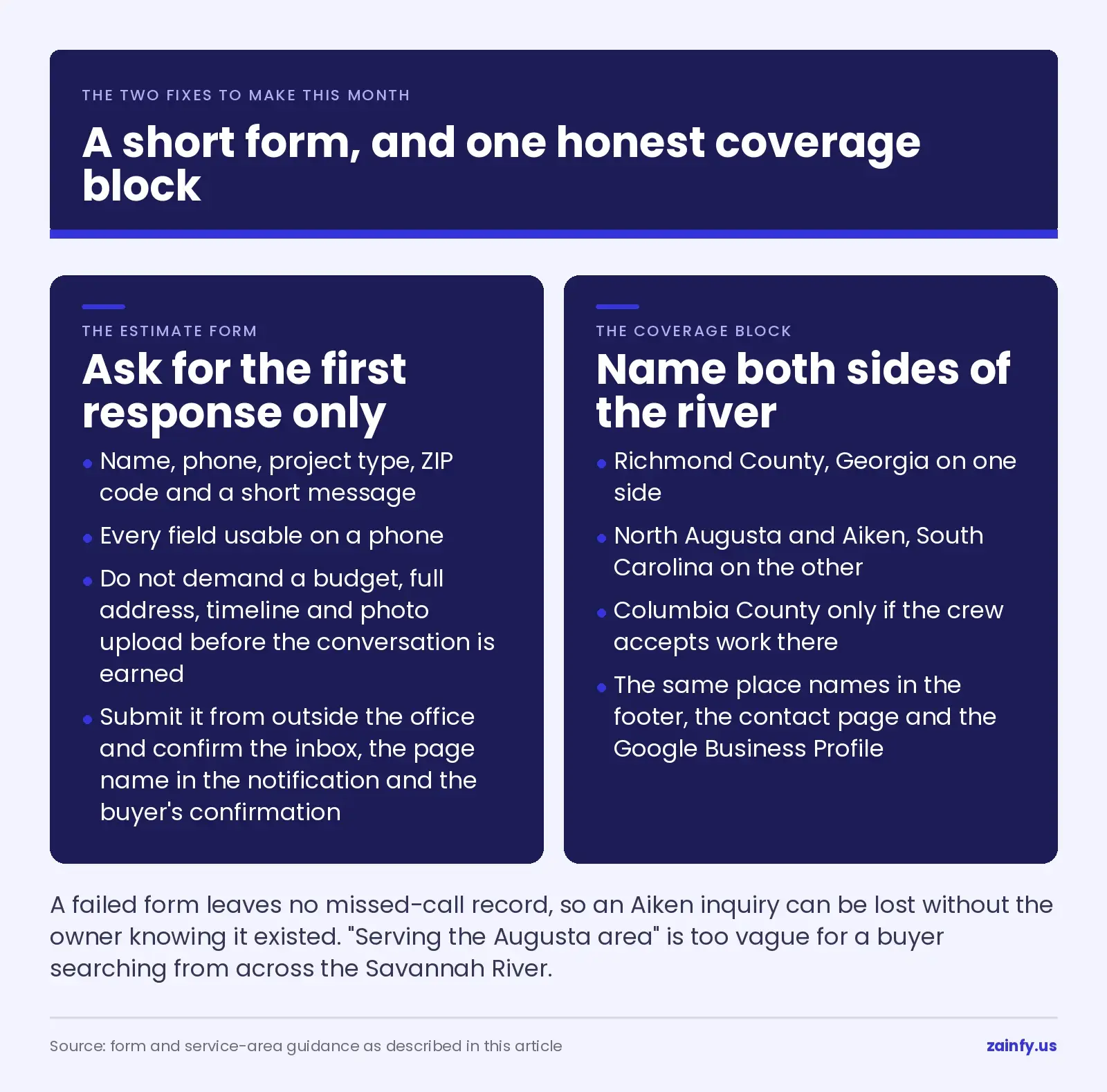
Shorten the estimate form to what the office needs for the first response: name, phone, project type, ZIP code, and a short message. Make every field usable on a phone. Do not demand a budget, full address, project timeline, and photo upload before the company has earned the conversation.
Submit the form from outside the office. Confirm the message reaches the correct inbox, the notification identifies the page, and the buyer sees a useful confirmation. Repeat the test after any website update. A failed form leaves no missed-call record, so the owner can lose an Aiken inquiry without knowing it existed.
One coverage block for both sides of the river
Spell out the actual service area in one clear block. Put Richmond County, Georgia, on one side and North Augusta plus Aiken, South Carolina, on the other. Add Columbia County only if the crew accepts work there. “Serving the Augusta area” is too vague for a buyer searching from across the Savannah River.
The same place names should agree with the website footer, contact page, and Google Business Profile. This tells the visitor where the crew travels and gives each service-area page a consistent geographic structure.
Do not publish a long list of towns the company would not realistically serve. A tight, accurate coverage block is stronger than a statewide claim. When a city needs its own page, build it from real work and local detail rather than duplicating the Augusta page.
If you only touch two items this month, fix mobile load time and submit the quote form yourself. Those are the faults that can stop a ready prospect before the office ever knows he arrived. Then move the phone button, replace the stock gallery, publish the credentials, and tighten the coverage block. Then comes the harder part: getting found on both sides of the river.
Do not start with a full redesign or a slick animated homepage. Start with the working path from visit to call. When that path needs professional rebuilding, Augusta remodeler websites that convert shows the next step. This week, test the site on one ordinary phone and fix the first failure you can reproduce.