An Augusta remodeler has one thing no national social media template accounts for: a fixed date every CSRA homeowner plans around, the Masters in the first full week of April.
That date should shape the whole content year.
Not one golf-week post. Not a few azalea photos. Not a last-minute “Happy Masters” caption while the feed has been dead since October.
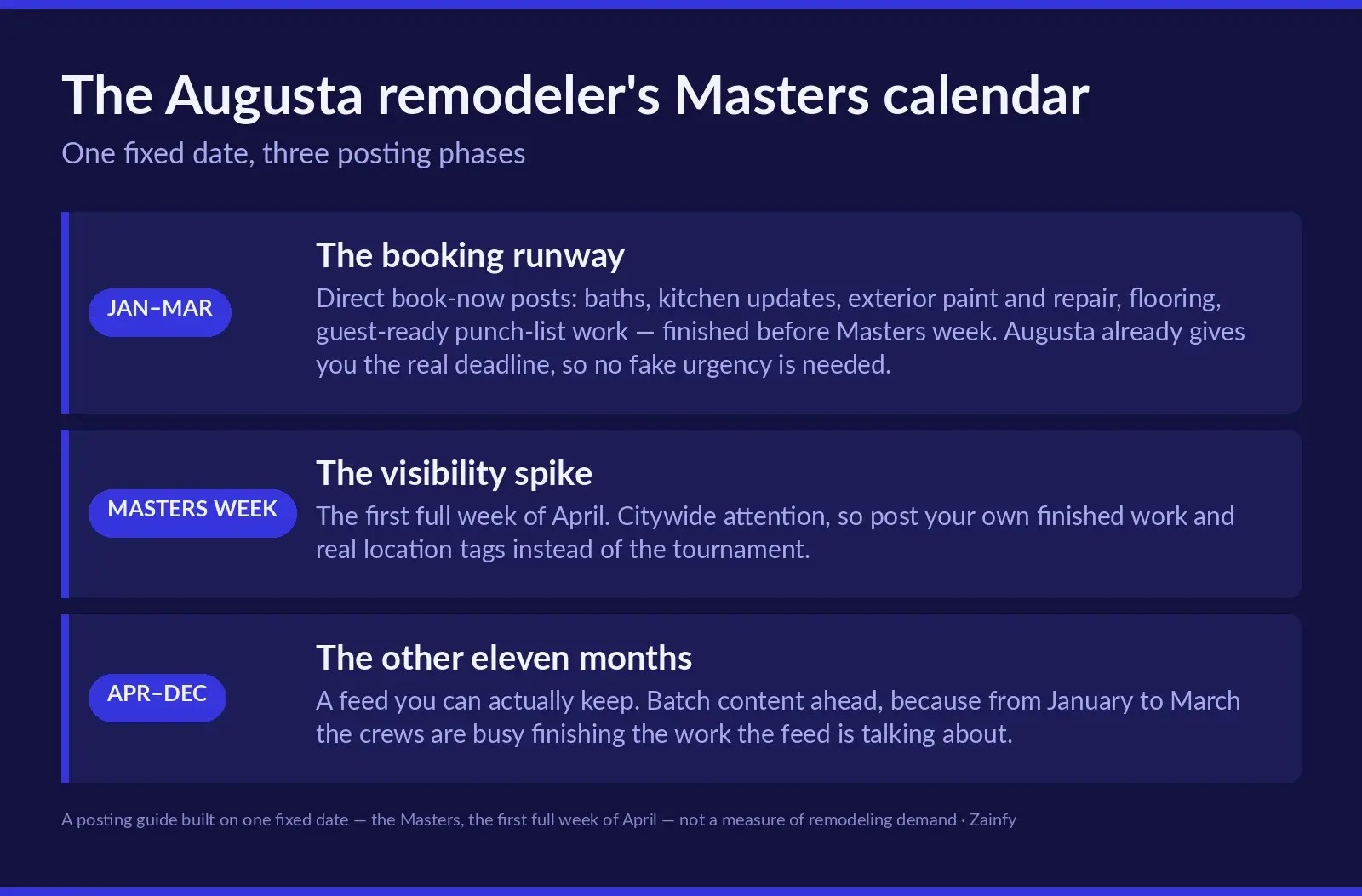
The contractors who get the most from social in Augusta treat the Masters as a calendar system: a January-to-March booking runway, a week-of visibility spike, and a steady feed after the tournament leaves town. The work happens before the attention. The posting needs to start before the work is already booked.
This guide is for the CSRA contractor who already knows he should post more, but has been treating social like a side chore instead of a seasonal sales surface. The point is not to become a golf account. The point is to use the deadline your market already understands.
If your feed cannot tell the difference between January, Masters week, and July, it is not using Augusta’s advantage. It is just posting when someone remembers.
The one date your whole market plans around
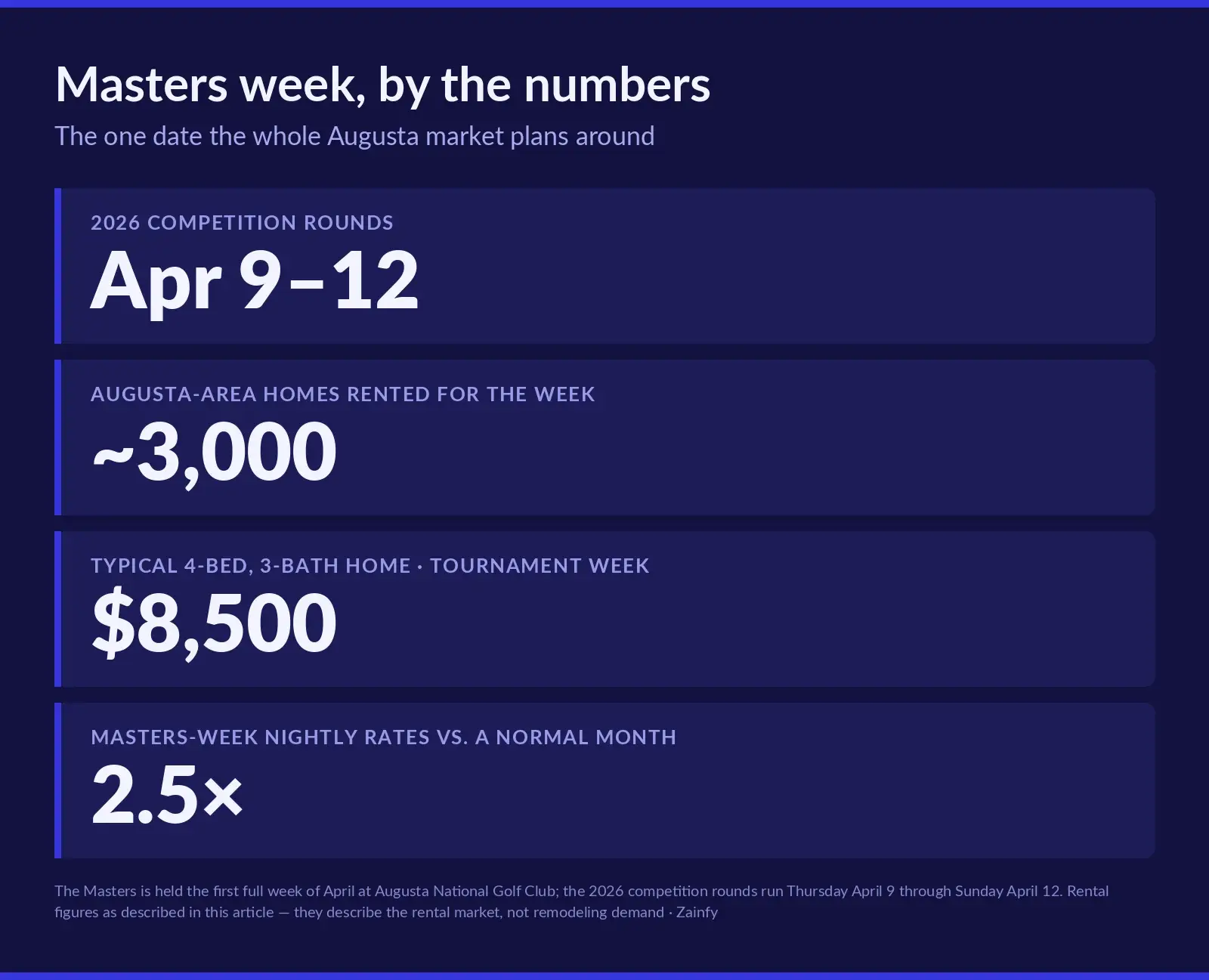
The Masters is held the first full week of April at Augusta National Golf Club; in 2026 the competition rounds run Thursday, April 9 through Sunday, April 12. That date is not like a normal spring season. It reorganizes the local calendar. Augusta-area homeowners who rent to patrons, host guests, or prepare houses for corporate visitors have a finish line that does not move. Roughly 3,000 Augusta-area homes are rented for the week and a typical four-bedroom, three-bath home around $8,500 for tournament week, with Masters-week nightly rates around 2.5 times a normal month. Those figures are verify-before-publish and must be treated carefully: they are the homeowner’s motivation and a demand-timing driver, not a remodel price and not proof that remodeling demand rose. For a contractor, the lesson is practical. Your client does not want the kitchen half-painted, the bath unfinished, or the exterior still torn up when guests arrive. A National Hills homeowner hosting patrons has a different clock from a normal summer inquiry. An Evans client trying to make a guest suite presentable before April has a different patience level from someone casually planning for next fall. That makes the feed more than a scrapbook. It gives you a predictable annual rhythm. In January, the feed should make the deadline visible. In February and March, it should show progress and “done in time” proof. During Masters week, it should point attention toward your finished work. After April, it should keep the company present so next year’s booking cycle starts from recognition, not silence.
The weeks before the Masters are your booking season – say so
January through March is where the feed earns its keep.
That is when the message should be direct: if a homeowner wants a kitchen, bath, exterior, or rental-ready refresh done before Masters week, the calendar has to start now. You do not need fake urgency. Augusta already gives you the real deadline.
Show the kind of work that can be finished in time. A bath refresh. A kitchen update. Exterior paint and repair. Flooring. Guest-ready punch-list work. Then say what the timing means without promising impossible turnarounds.
The useful posts are plain.
“Booking February scopes that need to be finished before Masters week.”
“This Summerville bath was completed before guests arrived.”
“Three things we need before we can tell whether your April deadline is realistic.”
That last one matters because the feed should not train homeowners to expect magic. A serious contractor uses the Masters deadline to qualify better, not to accept every rushed project.
Before and after posts should carry the phrase “finished in time” when it is true. Progress clips should show work moving toward a date. Calendar posts should make scarcity real without sounding desperate. This is where Augusta’s social calendar around Masters week fits after the guide, because the commercial page should turn that calendar into a managed posting rhythm.
The homeowner’s rental income is the motivation, but your feed should not talk like a rental-price blog. Keep it contractor-side: schedule, proof, finish date, and whether the work can be done before early April.
The content also needs a stop rule. If a project cannot be finished cleanly before the tournament window, do not imply that it can. A rushed promise creates a bad job, a bad review, and a bad post. Use social to set honest expectations early enough that the right homeowner calls before the calendar is impossible.
Masters week: post your work, not the tournament
There are two ways to post during Masters week.
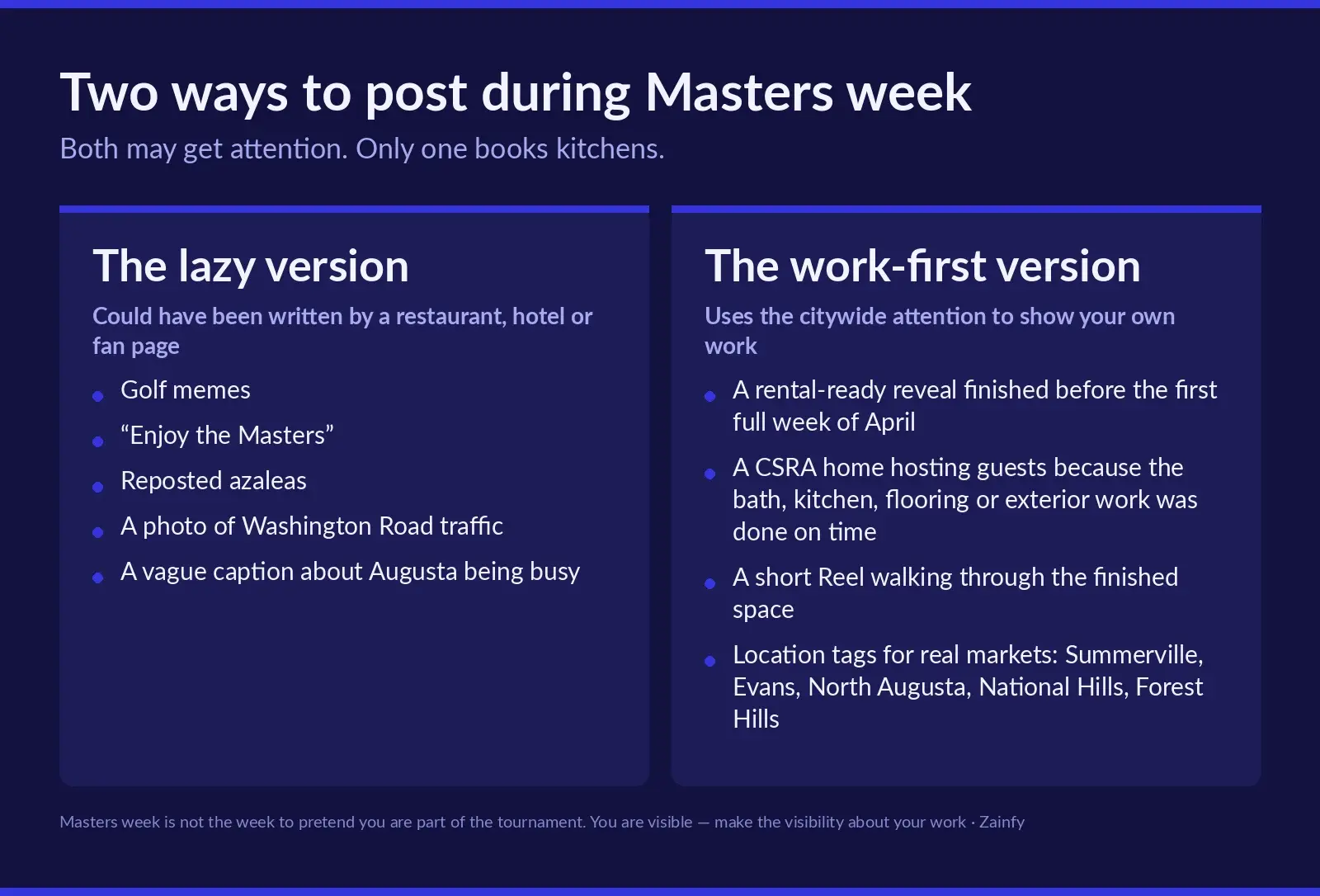
One is lazy. Golf memes. “Enjoy the Masters.” Reposted azaleas. A photo of Washington Road traffic. A vague caption about Augusta being busy.
That may get attention.
It does not book kitchens.
The better version uses the citywide attention to show your own work. A rental-ready reveal finished before the first full week of April. A CSRA home hosting guests this week because the bath, kitchen, flooring, or exterior work was done on time. A short Reel walking through the finished space. Location tags that point to real markets: Summerville, Evans, North Augusta, National Hills, Forest Hills, or wherever the job belongs.
Masters week is not the week to pretend you are part of the tournament. You are not installing a green jacket.
You are visible.
Make the visibility about your work. If the post could have been written by a restaurant, hotel, or fan page, it is not specific enough for a remodeling contractor. If the post shows a finished project that tied to a real deadline, it gives the homeowner a reason to remember you after the patrons leave.
There is room for local tone. You can acknowledge the week without borrowing the tournament as your content. “Finished before guests arrived” is stronger than “Happy Masters.” “National Hills exterior refresh ready for April visitors” is stronger than a stock green graphic. The post should make the homeowner think about his own house, not about the leaderboard.
The other eleven months still need a feed
The Masters is a spike, not a whole strategy.
If your feed disappears after April, the next January starts cold again. That is the mistake.
May through December should keep the business alive in the owner’s mind: steady before and after work, project walkthroughs, crew or jobsite context, reviews, and location-tagged posts that prove the company works the CSRA outside tournament week.
September gives you light anchors. Ironman 70.3 Augusta and Arts in the Heart of Augusta can support local visibility if the post still centers your work. Do not force every event into a sales hook. Use them as timing markers.
A business that only shows up in April reads like a business that only exists in April.
That is not fair to the crews working all year. It is how the feed looks.
The fix is not a daily posting treadmill. It is a maintained pulse. Two useful posts in a normal month beat twelve Masters-week captions and nothing after.
This matters because the best referral often lands months before the project is real. A homeowner may see your September exterior work, save the post, then remember you when the January booking window starts. If the feed goes dark after April, every later touchpoint gets wasted. Social does not need to shout all year. It needs to keep proof available when the next homeowner starts paying attention.
What actually goes in the feed
The content engine is not complicated. The discipline is.
Start with the work you already have.
A Summerville character-home kitchen can become a short progress clip, a before and after carousel, a detail post on cabinet or lighting choices, a testimonial if the client gives one, and a lesson learned about timing before April. An Evans whole-home project can become a different set: exterior-ready post, walkthrough Reel, punch-list image, “what we finished before guests arrived,” and a reminder to book next year’s pre-Masters scopes early.
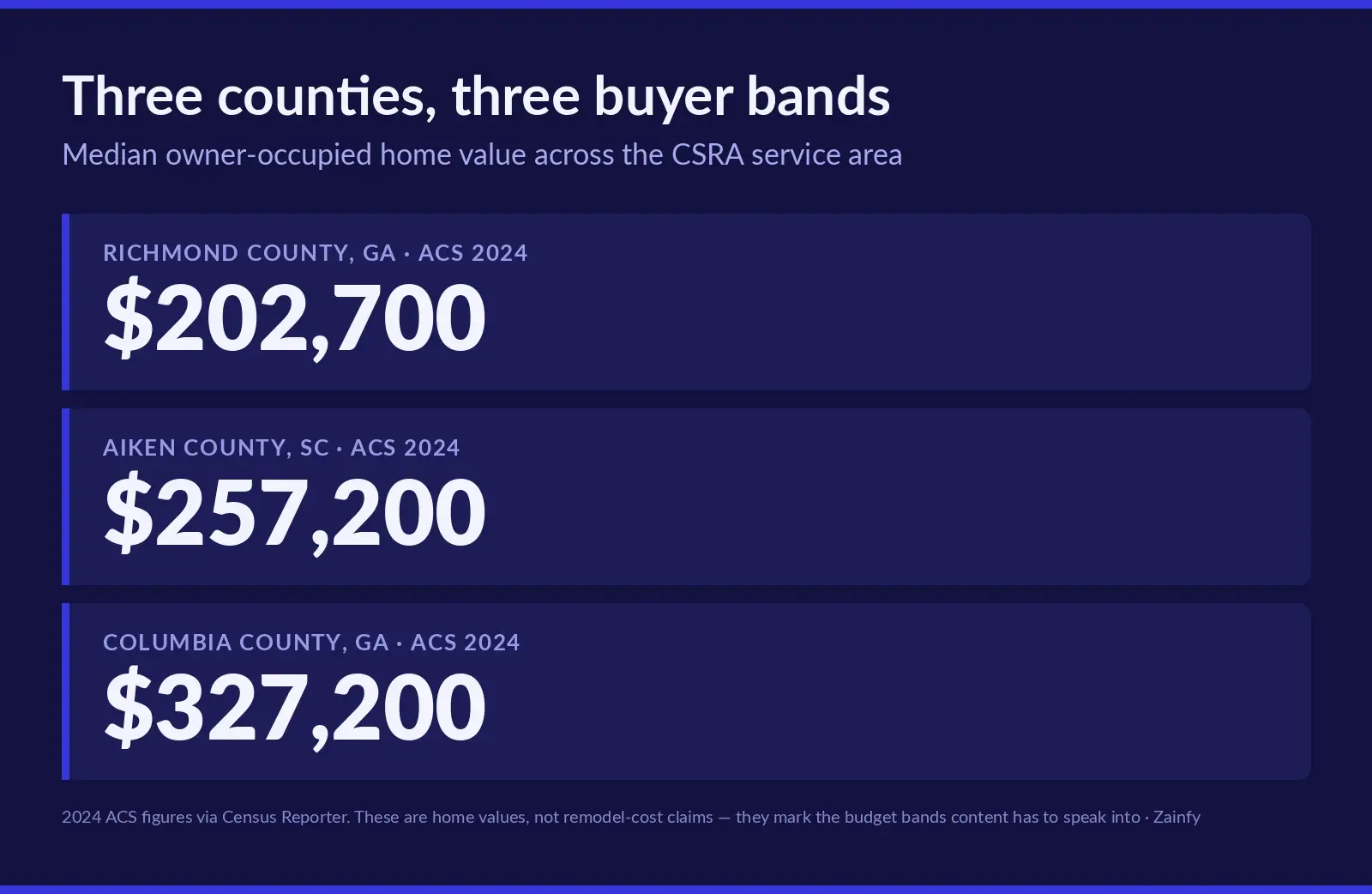
Use county context without pretending it is a project price. Richmond County’s 2024 ACS median owner-occupied home value is $202,700, Columbia County’s is $327,200, and Aiken County’s is $257,200. Those are buyer-budget descriptors. A value-conscious Augusta-Richmond refresh and a higher-budget Columbia County whole-home post should not sound like the same caption.
Before and after reveals work because homeowners understand them quickly. Reels work when they show actual movement: demo day, a problem being solved, a finished walkthrough, or a contractor explaining the decision. Behind-the-scenes posts work only when they prove competence, not when they fill a blank square.
Do not overproduce everything. A phone video shot cleanly, captioned specifically, and posted at the right point in the Masters runway can beat a polished generic graphic.
The rule: one real project should produce several useful posts, each aimed at a real CSRA buyer and a real moment in the calendar.
Do this while the project is still fresh. After the final walkthrough, write down the location, scope, main constraint, timeline, and what the client cared about most. That five-minute note turns into captions later. Without it, every post becomes “another beautiful remodel,” which says nothing an Augusta homeowner can act on.
Which platforms, and how often
Pick the channels your buyer actually uses.
Instagram and Reels carry visual reveals. Facebook and Nextdoor carry neighbor referral in Augusta-Richmond, Columbia County, and North Augusta. TikTok can work for quick clips if you can keep it from turning the business into a content circus.
Do not spray all five because a national blog said so.
For most owner-operated remodelers, two primary channels plus Google Business Profile is already plenty to maintain. The profile matters because social attention often turns into a name search. If a homeowner sees your pre-Masters bath reveal on Instagram, she may still check your business profile before calling.
Cadence is the same. A rhythm you can keep beats a magic daily number. During January to March, batch content ahead because the crews are usually busy trying to finish the work the feed is talking about. If you wait until Friday afternoon to ask for photos, the best content will stay buried on somebody’s phone.
Use local hashtags and location tags like a map, not confetti. Augusta, CSRA, Summerville, Evans, Martinez, Grovetown, North Augusta, and Aiken all mean something only when the post proves why that place belongs.
Cadence should shift by season. In January through March, post more deadline-aware content because the market is closer to decision. In the summer, use finished work and process proof to stay familiar. In September, let Ironman 70.3 Augusta or Arts in the Heart provide a local timing cue if the project angle is real. The platform schedule should follow the work and the calendar, not a generic daily checklist.
Don’t blow your whole year on Masters week
Do not dump the whole social effort into one week of golf-tournament content and call it an Augusta strategy.
Golf-week traffic does not book kitchens by itself. A feed that only wakes up in April is invisible in the January-to-March window when the booking actually happens.
The second mistake is worse: filling Masters week with borrowed tournament content while your own finished projects sit unshot on your phone.
You had the work.
You just did not turn it into proof.
Use the Masters as the runway and the spike. Before April, show booking urgency and finished-in-time proof. During the week, show your own rental-ready work while the city is paying attention. After April, keep posting so the next booking season starts with a familiar name.
That is the judgement. If your social feed is just tournament commentary, it is not a contractor asset. It is noise in a louder week.
That applies to outsourced posting too that does not understand the calendar. A generic agency can schedule spring-cleaning captions for any city. That is not the same as building a pre-Masters proof library around finished CSRA work. If the person running the feed cannot explain why February matters in Augusta, he should not be writing February captions for an Augusta remodeler.
Does any of this get leads – and what it costs
Social does not close every lead inside the post.
It earns attention, then the lead usually moves somewhere else: a direct message, a profile link, a quote form, a phone call, or a Google Business Profile search. The post starts the trust check. The path after the post decides whether it becomes a real consult.
That means the feed has to connect cleanly. If you ask homeowners to DM for April availability, answer fast. If the link in bio goes to a vague homepage, fix it. If Google Business Profile has old photos while Instagram shows fresh work, the confidence leaks.
The cost question should be framed that way. Judge the investment by what the content has to do: capture project proof, write calendar-aware captions, schedule ahead of the January-to-March crunch, answer messages, and keep the profiles consistent.
The quiet cost is the pre-Masters booking rush filling a competitor’s calendar instead of yours.
Nobody calls to report that. They just book someone else.
For an owner-operator, the real cost is usually time before money. Who takes the progress clip? Who asks the client for permission to name the area? Who writes the caption while the job details are still accurate? Who answers the DM when the homeowner asks whether a March finish is realistic? If the answer is always “me, when I get around to it,” the system will fail during the exact months when it matters most. Build a smaller calendar you can actually keep.
Augusta remodeler social media: quick answers
Closing: build the calendar before the week arrives
Open your last ten social posts and mark each one by season.
Pre-Masters runway. Masters-week visibility. Normal-year proof. If most of them land nowhere, the feed is not tied to the market you actually work in.
Fix the next post, not the whole year at once.
Take one finished project and decide where it belongs in the calendar. If it proves work done before April, make that the point. If it is a steady summer or fall project, use it to keep the feed alive after the tournament attention fades.
Augusta is specific because the Masters gives the CSRA one fixed local deadline, but the discipline travels beyond one event; running social past one event-driven calendar belongs after the Augusta calendar is clear.
The next useful move is to write January’s first booking-runway post before January gets loud.