An Augusta remodeler’s website has to satisfy a buyer who verifies systems for a living before he trusts the contractor: the professional relocating to the Fort Gordon cyber mission, comparing Columbia County work before he ever calls.
Fort Gordon, formerly Fort Eisenhower from 2023 to 2025, changed the buyer mix around Augusta. The CSRA still has referral work, local directories, and word-of-mouth crews. That did not disappear. But a higher-budget buyer tied to Army Cyber Command, the Cyber Center of Excellence, NSA Georgia, or a defense contractor does not judge your site like a casual neighbor.
He checks.
He checks whether the site loads. He checks whether the photos look real. He checks whether the license, insurance, address, and project proof are easy to verify. If your site looks like a template with a logo dropped in, he may never tell you why he crossed you off.
This guide is for the Augusta contractor who wants the website to hold up under that kind of buyer.
The site does not need to explain cybersecurity. It needs to behave like a business that understands scrutiny. That means fewer vague claims, more verifiable proof, and a page structure that lets the buyer check the company without turning the first visit into homework.
Who’s actually moving into your market
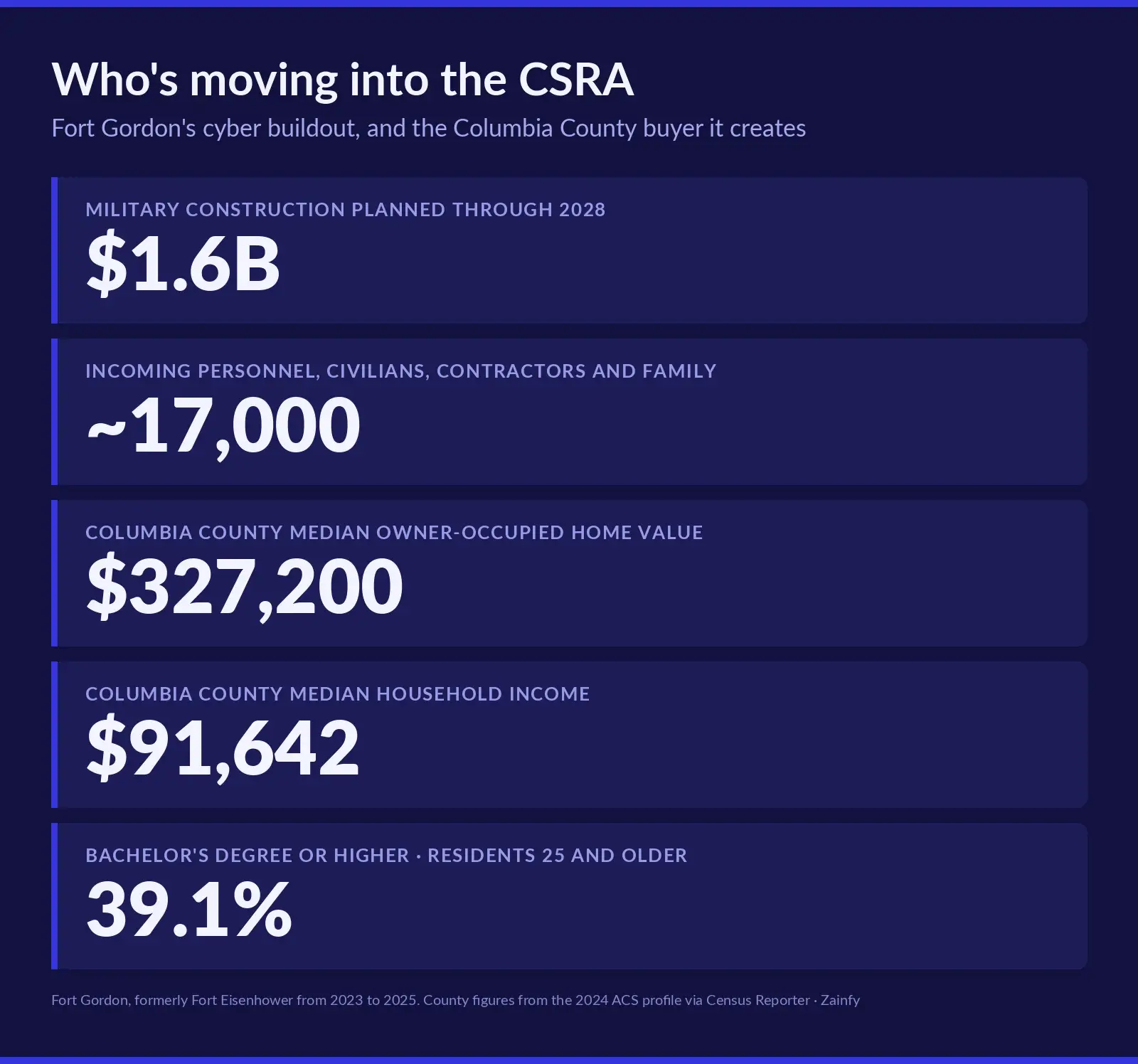
Fort Gordon is not a generic military reference for Augusta contractors. It is home to U.S. Army Cyber Command, the Cyber Center of Excellence, and NSA Georgia, which gives the CSRA a buyer profile most Georgia remodeling markets cannot copy. About $1.6 billion in military construction is planned through 2028, with roughly 17,000 incoming personnel, civilians, contractors, and family members tied to the cyber buildout. Treat those numbers carefully: they are workforce and relocation context, not proof that remodeling demand rose. The useful point for a contractor is the kind of person entering the market. Columbia County is where much of the higher-budget conversation lands, with Evans, Martinez, and Grovetown giving relocating professionals a suburban buying path near Augusta. The 2024 ACS Census Reporter profile puts Columbia County’s median owner-occupied home value at $327,200, median household income at $91,642, and bachelor’s-or-higher attainment at 39.1% for residents 25 and older. That does not mean every buyer is a cyber executive. It means the website has to survive scrutiny from a buyer who is more likely to be technical, documentation-minded, and intolerant of sloppy systems. This buyer is used to forms that must match, systems that must work, and claims that need a source. A contractor website that says “trusted local experts” but gives no license class, no real project depth, and no useful service-area explanation fails that mindset. A glossy hero image is not enough. A page that proves the company, explains the work, and makes credentials checkable is more useful than a prettier brochure. If your best Columbia County lead is comparing you from another state, the site may be the first work sample he sees.
This buyer verifies before he trusts – so let him
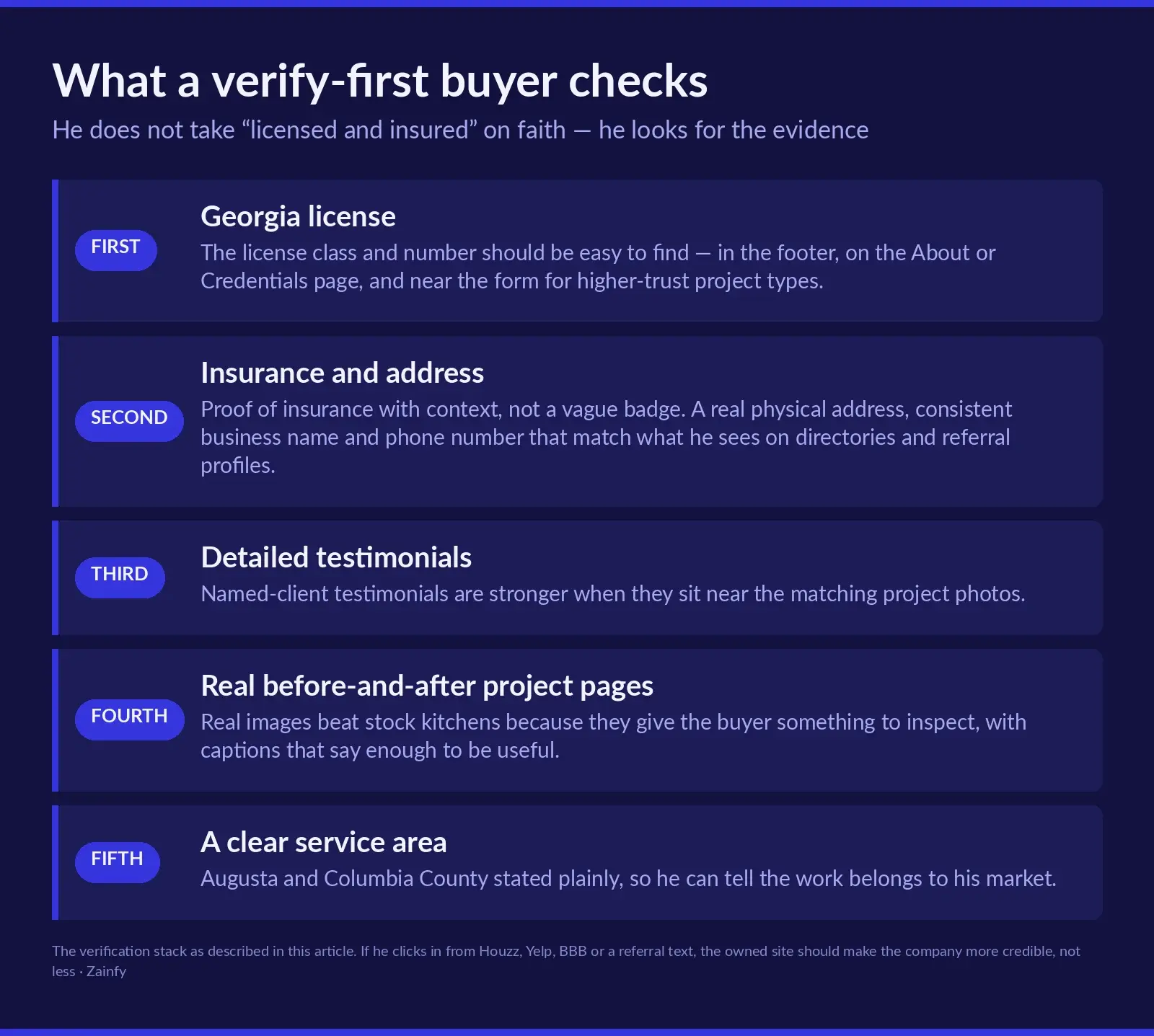
A verify-first buyer does not take “licensed and insured” on faith.
He looks for the evidence.
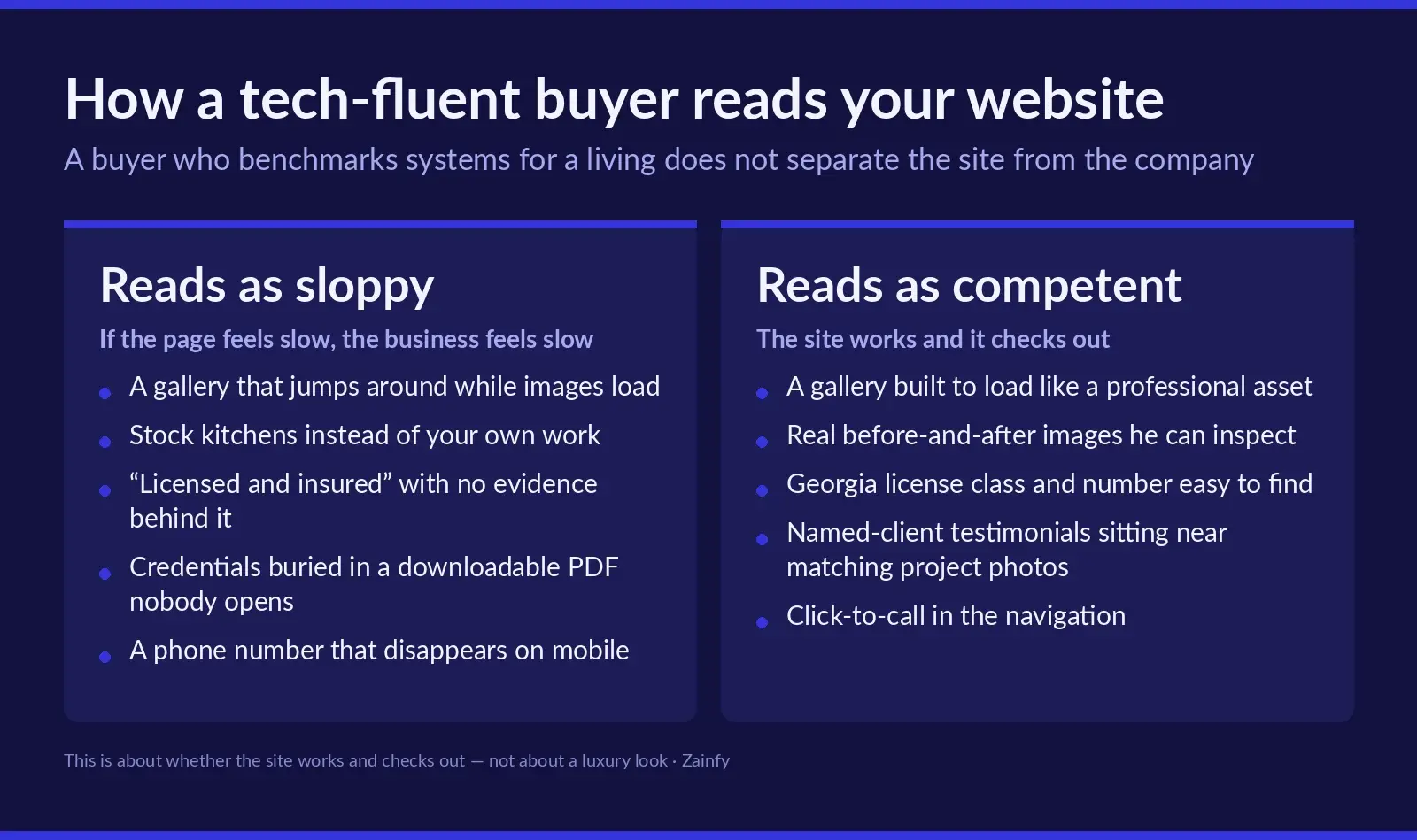
That changes the website structure. The Georgia license class and number should be easy to find. Proof of insurance should not be a vague badge with no context. A real physical address, consistent business name, and phone number should match what he sees on directories, referral profiles, and the contact page. If he clicks from Houzz, Yelp, BBB, or a referral text, the owned site should make the company more credible, not less.
Put the credentials where they belong: footer, About page, Credentials page, and near the form for higher-trust project types. Do not bury them in a downloadable PDF that nobody opens.
Then connect proof to the work.
Named-client testimonials are stronger when they sit near matching project photos. Real before and after images beat stock kitchens because they give the buyer something to inspect. Captions should say enough to be useful: area, scope, timeline, and what changed. If the job was in Evans or Martinez, say so when the client allows it. If the project served a Fort Gordon relocation timeline, describe the timeline without inventing a story.
The phone number matters too. A click-to-call button in the top navigation is not a design flourish. It tells the buyer he can verify quickly.
A Facebook page gives him posts. A template gives him a shape. A serious website gives him things to check.
That is the key difference. Trust badges are easy to paste onto a page. Verification is harder because it forces the site to expose real business details. A buyer relocating to the Fort Gordon area does not need twenty badges. He needs the right few facts placed where his doubts appear: license before the form, insurance before the quote request, project detail before the gallery click, and a phone number before he has to search.
A tech-fluent buyer reads your website as a work sample
A casual local buyer may forgive a clumsy site if a neighbor already vouched for you.
A cyber, IT, or defense professional may read the same site differently.
To him, the website is a system. If the layout breaks on a phone, the company looks careless. If the gallery loads slowly, the business feels dated. If the hero image is stock and the project photos are thin, the buyer wonders what else has been borrowed. If the template has the same sections he has seen on five other contractor sites, he assumes the company did the minimum.
That may not be fair to your craftsmanship.
It is still what the screen says.
The stronger site is not “luxury” because it uses bigger images or darker colors. That is the wrong lesson from generic contractor website advice. For this buyer, professional-grade polish means the site works like someone competent built it. The navigation is clear. The service pages answer real questions. The gallery has real Augusta and Columbia County projects. The form is short enough to use. The credentials are visible. The mobile version feels intentional, not like an afterthought.
This is competence signalling, not decoration.
The site does not need to look expensive for its own sake. It needs to look controlled. A buyer who evaluates systems all day notices control.
Prove work at the level he’s actually renovating
A Columbia County buyer in a $327,200 median home is not convinced by three small bathroom photos and a sentence that says “quality craftsmanship.”
He needs project depth.
Show the work like it matters: before and after pairs, scope, location, timeline, materials category where relevant, and what problem the remodel solved. A whole-home update in Evans should not be displayed like a minor repair in Augusta-Richmond. A kitchen in Martinez deserves more than a gallery tile with no caption.
Do not confuse portfolio depth with price transparency. That is not the point of this article.
The point is expectation. A higher-budget buyer wants to see whether you have handled work near his level of scrutiny. If the site only shows fragments, he assumes the stronger work is missing because it does not exist.
Project pages should do what a showroom conversation would do. They should let the buyer inspect taste, sequencing, finish quality, communication, and whether the company has done comparable work in the CSRA.
One strong project page can carry more weight than a dozen loose gallery photos. Give it a plain title, a location when allowed, a short scope, a timeline, a few constraints, and a clear set of before and after images. If the client would not approve naming the neighborhood, use the county or area honestly. The point is not to expose private details. The point is to prove the work belongs to your company and fits the buyer’s level of decision.
The shortlist happens on your site – before he ever calls
The Fort Gordon buyer may shortlist three contractors from another state before he has a Columbia County address fully settled. That does not make this the same as a PCS pricing page or a virtual-consult article. The job here is simpler: the site has to be legible enough to survive the first shortlist. Above the fold, he should know who you are, what type of remodeling work you take, where you work, and how to start. Augusta-Richmond and Columbia County should be obvious if those are real markets for you. North Augusta and Aiken can appear as coverage context if your company genuinely works the South Carolina side. The service-area wording has to be clear because a relocating buyer is not carrying local shorthand in his head. He may not know whether Evans, Martinez, and Grovetown sit in the same county. He may not understand the difference between Augusta-Richmond and Columbia County. The site has to translate the market without sounding like a geography lesson. The primary call to action should be clean. The lead form should not ask for a full project essay before the buyer knows whether you are worth his time. Put credentials near the decision path, not three pages away. Put project proof near the service it supports. This is where Augusta sites built for cyber-influx buyers fits after the guide, because the commercial page should pick up the same structure: proof first, credential clarity, fast contact path, and service-area language a relocating professional can understand.
Speed and mobile aren’t optional for this buyer
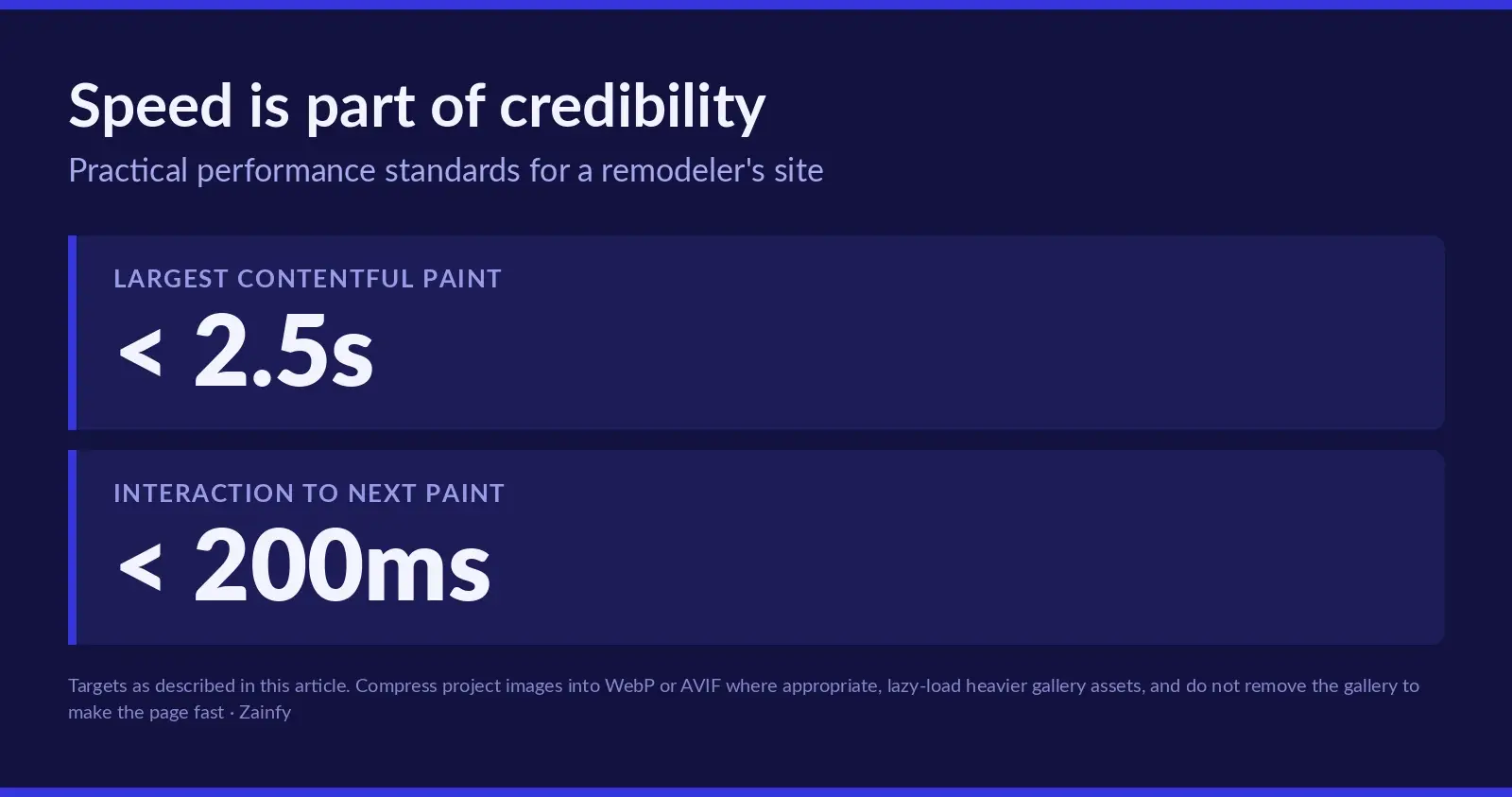
Speed is part of credibility.
A buyer who benchmarks systems for a living does not separate the site from the company as politely as you might hope. If the page feels slow, the business feels slow. If the gallery jumps around while images load, the presentation feels unfinished. If the phone number disappears on mobile, the site has failed the moment it should have made contact easy.
Use practical standards. Largest Contentful Paint should stay under 2.5 seconds. Interaction to Next Paint should stay under 200 milliseconds. Compress project images into WebP or AVIF where appropriate. Lazy-load heavier gallery assets. Stop uploading huge jobsite phone photos straight into a project page.
The site still has to show depth. Do not remove the gallery to make the page fast. Build the gallery so it loads like a professional asset. Both halves of that trade-off are visible in heroes rebuilt to lead with proof.
Click-to-call belongs in the navigation. The primary form should be easy to complete from a phone. The Fort Gordon professional may be comparing contractors between relocation tasks, work calls, and house research. A slow mobile site gives him a reason to close the tab.
Until then, start with the basics: load fast, tap cleanly, show proof without making the buyer wait.
A practical test: open your strongest project page on a phone with normal cell service. If the hero image takes too long, the gallery shifts, or the form is hard to tap, that page is not ready for the buyer this article is about.
Don’t run a template at a buyer who builds software for a living
Do not hand your Fort Gordon and Columbia County buyers a drag-and-drop template, a stock-photo hero, or a rented Houzz or Angi profile you do not control.
A professional who evaluates systems all day clocks it quickly.
He may not know the name of the builder theme. He may not know why the layout feels generic. He just knows the site does not feel like a serious company.
And he will not email you to explain that.
He will choose the contractor whose site looked owned, specific, and verifiable. The one with real project pages. The one with credentials near the decision path. The one whose gallery loads and whose phone number works from the first screen.
That is the blunt judgement. If your site is aimed at the best-budget side of the Augusta market, it cannot behave like a placeholder. Own the site. Prove the work. Surface the credentials. Make it load. Otherwise you keep handing the strongest buyer to the contractor who did.
What a real build is worth – and what a template quietly costs you
The wrong question is, “What should a contractor website cost?”
The better question is, “What should the site do before the buyer calls?”
Cost should be judged by the assets produced: project pages with scope and location, credential pages that are easy to verify, service pages that explain the work, a mobile path that loads quickly, and a form that creates a real sales conversation.
A template can look cheap on the invoice and expensive in silence.
The silent cost is the call never made. The Columbia County buyer who saw no license class. The Fort Gordon professional who saw stock photos. The relocating family that compared three websites and picked the one that felt most legitimate.
Nobody reports those lost leads to you.
That is why the site has to answer before the sales call starts. It is not a brochure. It is the place where the serious buyer decides whether the call is worth making.
A real build should also reduce your own sales drag. The first conversation should not begin with “Are you licensed?” or “Do you work in Columbia County?” The site should already have answered that. Then the call can start with scope, fit, timing, and whether the project is worth pursuing.
Augusta remodeler websites: quick answers
[wps_faq style=”classic” question=”What should an Augusta remodeler’s website show a family relocating to the Fort Gordon area before they arrive?”]An Augusta remodeler’s website should show credentials, real project proof, service-area clarity, and a fast way to start before the family arrives. The first screen should make the company, work type, and Fort Gordon or Columbia County relevance clear. The site should include Georgia license information, proof of insurance, real before and after projects, and a phone or form path that works from mobile. The 2024 ACS profile puts Columbia County’s median owner-occupied home value at $327,200, so the buyer expects depth, not a thin gallery. Put the strongest proof before the buyer has to dig through menus.[/wps_faq]
[wps_faq style=”classic” question=”How can a homeowner verify an Augusta or Columbia County remodeler is licensed and legitimate from the website?”]The website should surface the Georgia license class and number, proof of insurance, physical address, phone number, and named project proof in places a buyer can find quickly. A verify-first buyer should not have to hunt through a Facebook page or directory profile to confirm the business is real. Put credentials in the footer, About or Credentials page, and near the quote path. For Evans, Martinez, Grovetown, and Augusta work, pair testimonials with real project photos so the proof is specific, not decorative. If the site makes verification difficult, the buyer assumes the company is hiding weak details.[/wps_faq]
[wps_faq style=”classic” question=”Does an Augusta contractor still need a website if most work comes from referrals and directory listings like Houzz or BBB?”]Yes, because even a referred Augusta contractor gets checked online before the call. Houzz, BBB, Yelp, and referral texts can start the search, but they cannot organize your credentials, Columbia County project proof, service-area clarity, and lead path the way an owned site can. A Fort Gordon professional may use directories to compare names, then use the website to decide who feels legitimate. If the site is weaker than the profile, the referral loses force at the exact moment it should become a conversation. Your owned site is where the buyer should stop doubting and start narrowing the scope.[/wps_faq]
[wps_faq style=”classic” question=”Is a custom website worth it for an Augusta remodeler, or is a template fine?”]A custom website is worth it when the buyer you want is technical, verify-first, and comparing higher-budget work around Fort Gordon or Columbia County. A template may be fine for a placeholder, but it should not be the main sales surface for a contractor trying to win discerning renovation clients. The issue is not fancy design. The issue is whether the site loads quickly, displays real projects, surfaces credentials, and makes the company easy to trust. A buyer who evaluates systems notices the difference, and he may decide before your salesperson gets a chance to explain.[/wps_faq]
Closing: make the site pass inspection
Open your website on your phone and inspect it like a Fort Gordon buyer with no local loyalty. If that inspection turns up problems, start with six fixes worth doing first.
Can he verify the license without searching elsewhere? Can he see real Columbia County or Augusta project work? Can he tell where you work before the footer? Does the gallery load cleanly? Does the first screen make the next step obvious?
Fix those before you change colors.
Augusta has a specific buyer pressure because the Fort Gordon cyber mission brings technical, documentation-minded professionals into the CSRA, but that standard matters beyond one local growth story; this is where websites that win work outside one city belongs after the Augusta-specific structure is clear.
The next useful task is small: add the license, insurance, and service-area proof to the first screen path. If that feels uncomfortable, the buyer already feels the gap.