Author: Zayn Shah
For a Columbus, Georgia remodeling contractor, longer days on market can create work from three directions: sellers improving a house before listing, buyers converting inspection findings into projects, and owners choosing to renovate instead of moving. The number does not measure remodeling demand directly. It measures how long listed homes remain exposed to comparison and negotiation.
That distinction matters in Muscogee County because several market sites quote different clocks. A contractor who treats one dashboard number as a demand forecast can aim at the wrong work.
The useful question is not whether “60 days” sounds good or bad. It is which 60 days you are quoting and what that sale friction makes homeowners do next.
Which 60 days? Get the Columbus GA number right first
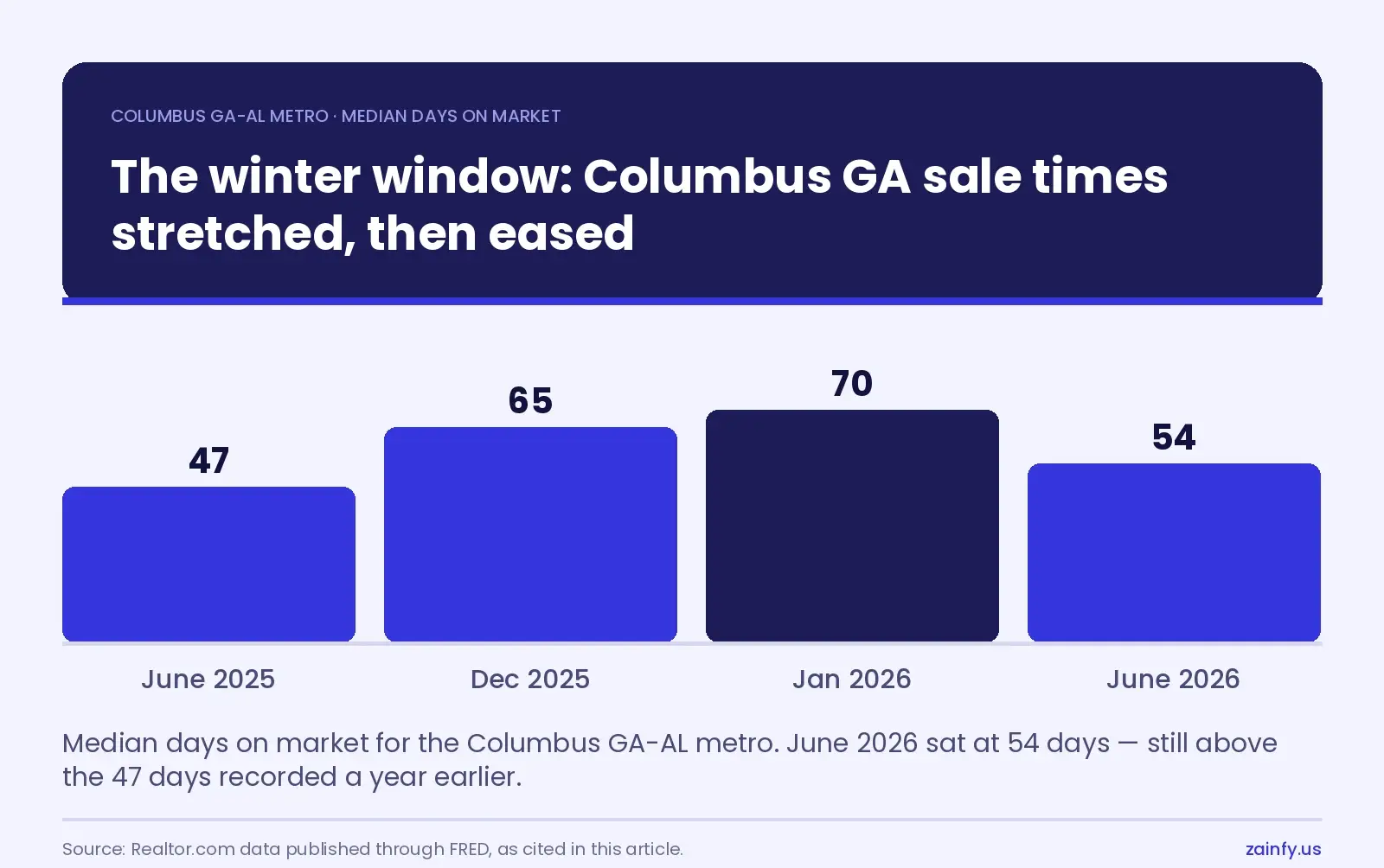
The cleanest series comes from Realtor.com data published through the Federal Reserve Bank of St. Louis. For the Columbus GA-AL metro, median days on market reached 65 in December 2025 and 70 in January 2026. It eased to 54 by June 2026, but that was still up from 47 in June 2025.
Muscogee County tells a similar spring story at a slightly different level: 61 days in February, 54 in March, 52 in April, 51 in May, and 55 in June 2026. The county has therefore been below 60 since March. The title’s 60-day frame describes the winter window and the broader slow-sale condition, not a claim that every current Columbus listing sits for exactly two months.
The confusing number is 28 to 29 days. Redfin used that range for city-level days to pending, which starts and stops a different clock. Days to pending measures how quickly a listing reaches an accepted contract. Active days on market measures how long the listing remains exposed before leaving active status under the source’s method. They should not be swapped in a sales conversation or a marketing plan.
Taken together, the FRED direction suggests a more buyer-leaning Columbus GA market than a year earlier. That does not prove remodeling demand increased. It means listings had more time to reveal condition problems, collect buyer objections, and pressure sellers to improve the property or negotiate.
A Columbus GA listing that sits can land work on your desk
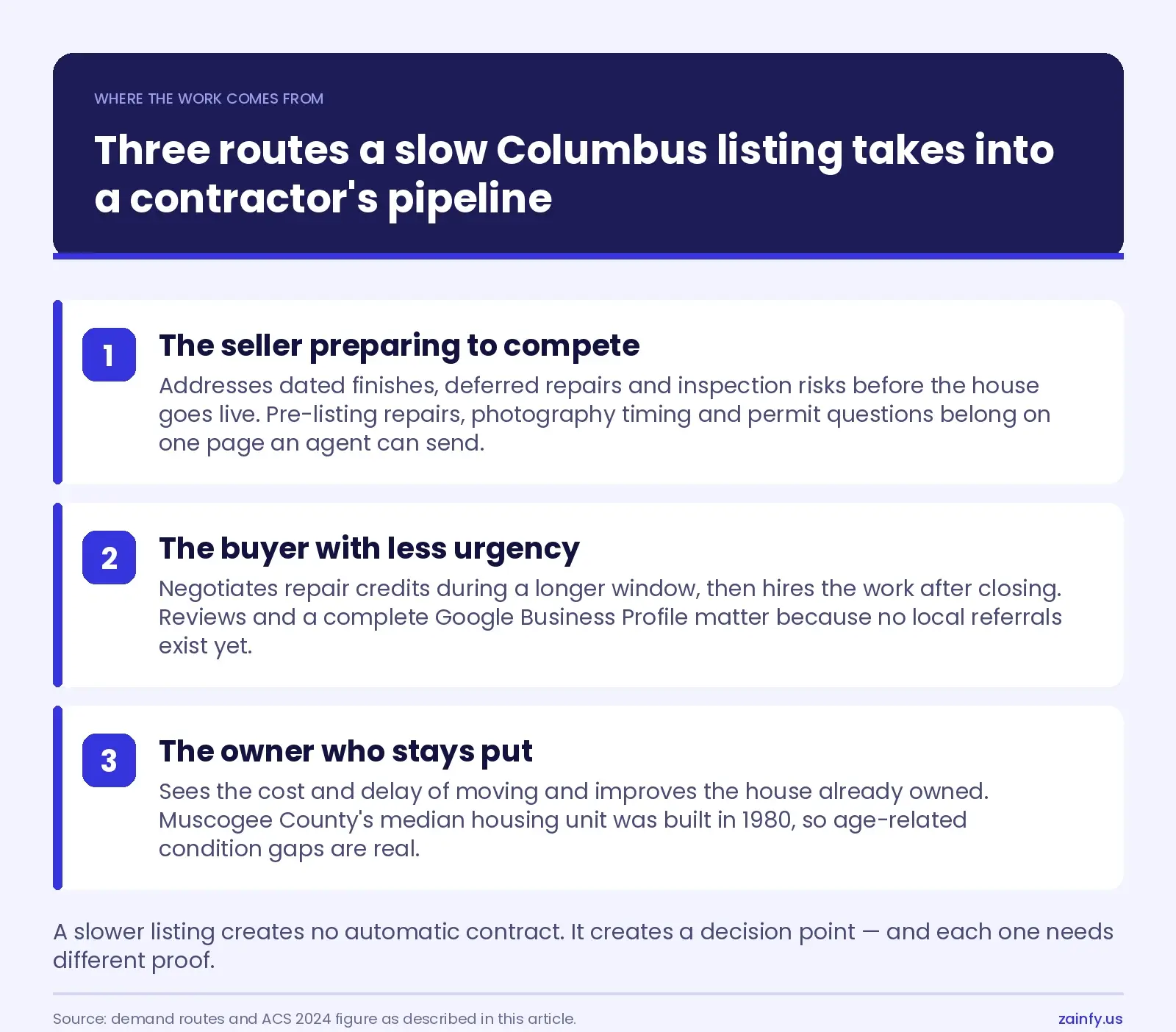
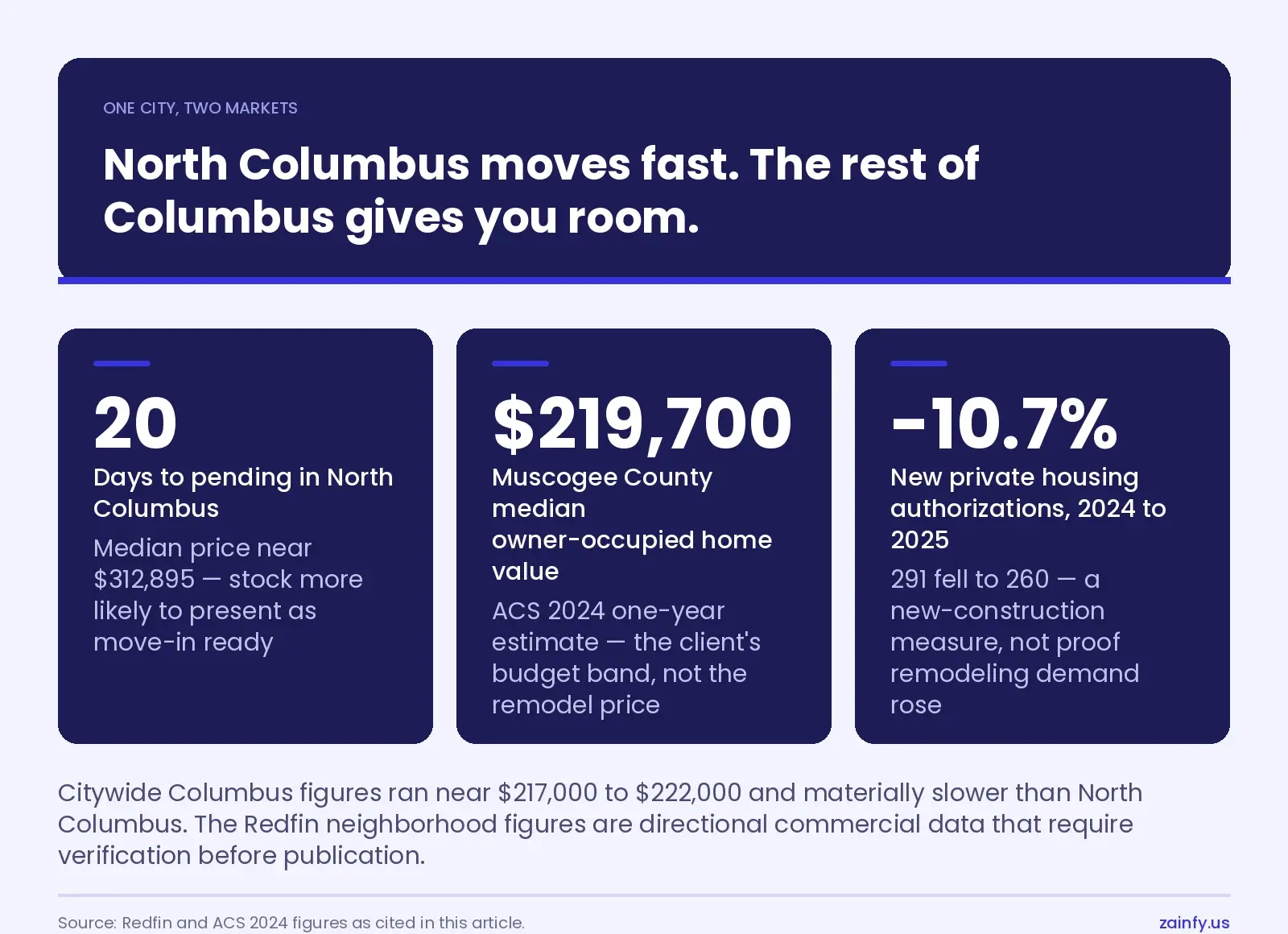
A slower listing creates no automatic remodeling contract, but it opens three practical routes into a contractor’s pipeline. A seller preparing to compete can address dated finishes, deferred repairs, or inspection risks before the house goes live. A buyer facing less urgency can negotiate repair credits, then hire the work after closing. An owner who sees the cost and delay of moving may withdraw the plan and improve the house already owned. Muscogee County’s median housing unit was built in 1980, according to the ACS 2024 one-year estimate. A roughly 46-year-old median structure gives those condition gaps somewhere to exist. That ACS source places the county’s median owner-occupied home value at $219,700 as of 2024, which describes the budget band around the average client, not the price of a remodel. New private housing authorizations also fell from 291 in 2024 to 260 in 2025, a 10.7% decline. That is a new-construction activity measure, not evidence that remodeling demand rose, but fewer authorized new units can limit the fresh alternatives available to an owner weighing a move. Fort Benning (renamed from Fort Moore in March 2025) adds a recurring PCS turnover pattern. The contractor opportunity comes from reading each decision point correctly, not from calling every slow listing a renovation lead.
North Columbus, Georgia sells in 20 days. Treat that as a map
Commercial portal data points to a sharp internal split. Redfin reported North Columbus around $312,895 and roughly 20 days to pending, while its citywide Columbus figures were near $217,000 to $222,000 and materially slower. Those figures are directional commercial data and require verification before publication, but the contrast is useful.
Fast-moving North Columbus stock is more likely to present as ready for the next owner. The seller has less reason to fund improvements when the listing already attracts quick contracts. Slower stock elsewhere in Columbus can carry more visible condition gaps and more negotiating room, which is where pre-listing repairs and post-close projects enter.
That is a service-area map, not a reason to abandon North Columbus. Market polished portfolio work to the buyer who expects move-in condition there. Build separate proof around aging systems, practical updates, and repair-driven projects where listings sit longer.
Across the Chattahoochee River, Phenix City is in Alabama. Treating the GA-AL metro as one audience does not erase the state line or licensing requirements. Keep Columbus, Georgia explicit in the content even when the market conversation crosses the river. The same rule holds when the work runs wider than one city, which is what remodeling search across Georgia has to account for.
How the slower Columbus GA market finds a contractor
Match the visibility to the reason the work appears.
For pre-listing renovation, publish a clear page that answers what can realistically be repaired before photography, how scheduling works, and which improvements need a permit. Real estate agents belong in that channel because a stale listing with condition objections can become a contractor referral. Give the agent a page worth sending rather than a generic services menu.
For the buyer using an inspection credit, show the path from report to scoped project without promising that every item belongs in one contract. Current reviews and a complete Google Business Profile matter because the new owner is comparing companies before local referrals exist.
For the owner staying put, build service content around the actual age and problems of Muscogee County housing. A page about renovating a 1980-era Columbus home is more useful than another paragraph claiming “quality craftsmanship.”
Fort Benning’s PCS cycle creates timing windows for sellers, buyers, and landlords, but do not invent a transfer count. Use the verified local process instead: after the January 1, 2026 portal shift, Residential Alteration permits remain among the applications accepted in person by the Columbus Consolidated Government Inspections and Code Department at 1111 1st Avenue. That detail proves local fluency better than broad market language. Local fluency compounds, and a Georgia remodeler who kept at it for four months is the record of what that adds up to.
Do not pick the Columbus GA market by the fastest number
Do not turn a listing portal dashboard into a contractor-demand forecast.
The 20-day North Columbus figure looks healthier because the homes reach contracts quickly. That speed can also mean fewer seller-funded improvements and less negotiating room for the buyer. The stock that sits longer has more time to expose dated condition, failed systems, and presentation problems.
Quote the right series, then pursue the condition gap. Use FRED’s active days-on-market trend for sale speed. Treat portal days-to-pending figures as a separate signal. A fast number is not automatically the best remodeling territory, and a slow number is not automatically a weak pipeline.
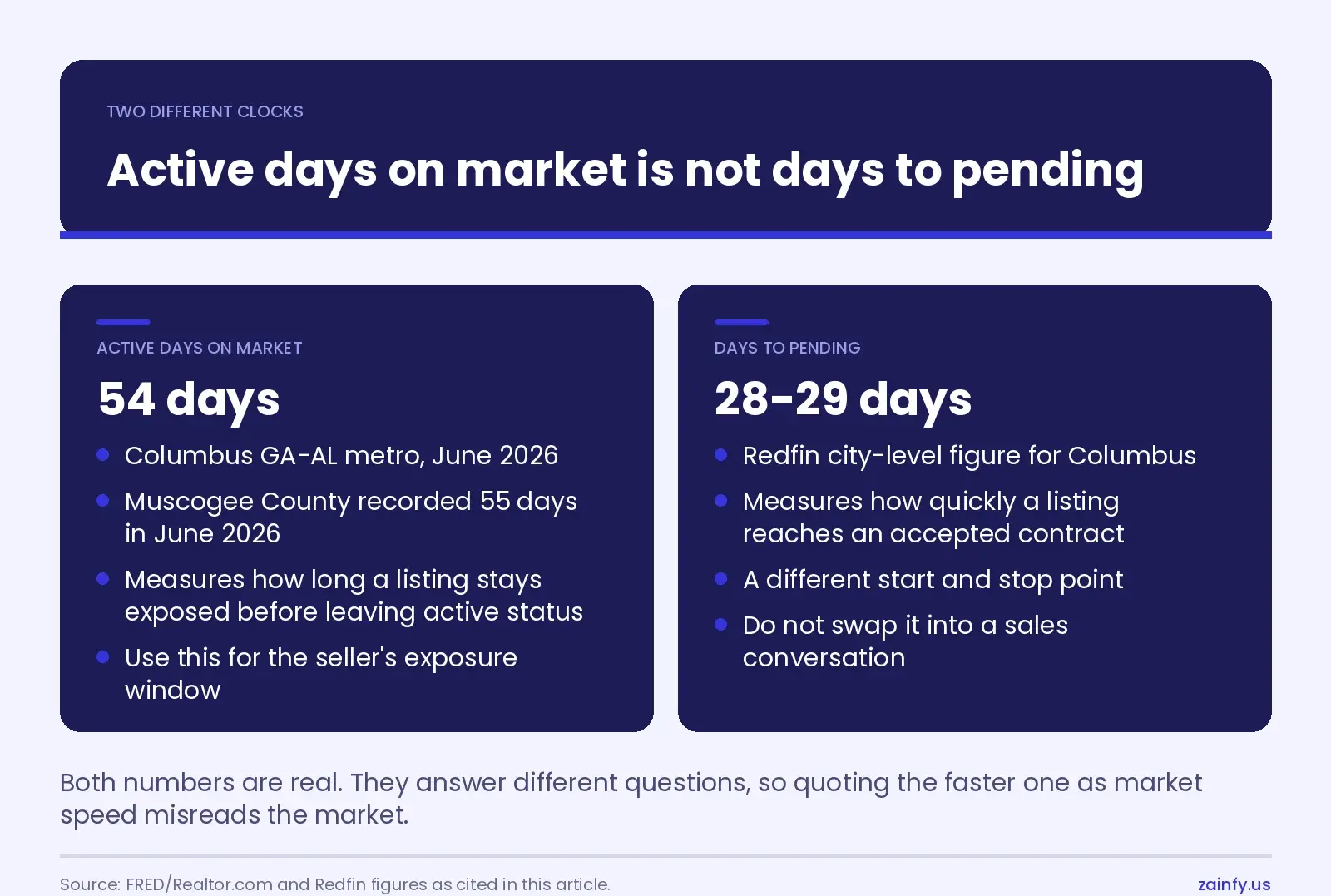
The contractor who understands the difference can market to the work created by friction instead of chasing the neighborhood with the cleanest dashboard.
Columbus GA market speed: quick answers
[wps_faq style=”classic” question=”Is Columbus GA a buyer’s or seller’s market in 2026?”]Columbus, Georgia leaned more toward buyers in June 2026 than it had a year earlier, based on the FRED/Realtor.com sale-speed direction. Metro median days on market rose from 47 in June 2025 to 54 in June 2026. That does not settle every listing or neighborhood, and it does not measure remodeling demand. For a contractor, the longer window matters because buyers have more time to inspect, negotiate repair credits, and compare condition. Sellers also have more reason to address visible problems before listing. Read the direction as greater sale friction, then look for the projects that friction creates.[/wps_faq]
[wps_faq style=”classic” question=”How long do homes sit on the market in Columbus GA?”]The Columbus GA-AL metro reached a 70-day median in January 2026 and stood at 54 days in June, according to Realtor.com data published through FRED. Muscogee County recorded 55 days in June. A portal may show a much shorter number because it reports days to pending rather than active days on market. Those clocks answer different questions. Contractors planning content or referral outreach should use the active DOM series for the seller’s exposure window and label it clearly. The accurate answer changes by month, geography, and metric, so “60 days” is a useful winter-era frame rather than a fixed current reading.[/wps_faq]
[wps_faq style=”classic” question=”What does 60 days on market mean for a Columbus remodeling contractor?”]It means sale friction can produce three project paths: a seller improves the house to compete, a buyer converts inspection findings into post-close work, or an owner stays and renovates. The connection is an interpretation, not a statistic. Muscogee County’s median housing unit dates to 1980, so the local stock has real age-related condition gaps for those decisions to uncover. A contractor should build separate proof for pre-listing fixes, inspection-driven scopes, and stay-put renovations. The useful lead is not “a slow market.” It is the specific owner decision that turns a listed or withdrawn property into a defined scope.[/wps_faq]
Build visibility before the next Columbus GA listing stalls
Choose one demand stream this month. Create a Muscogee County page for pre-listing repairs, build a short intake path for inspection-driven projects, or publish proof for owners improving a 1980-era home. Then give local agents and prospects one useful URL instead of the homepage. Building that visibility is ranking in a Fort Moore market.
Competitors may still be quoting a days-to-pending number as if it describes the whole market. Use the correct clock and make the contractor-side interpretation easier to find.
For owners ready to turn that market reading into search visibility, SEO help for Columbus remodeling contractors is the commercial next step. The work is not hidden in the slowdown; it is hidden behind the wrong query and the wrong explanation.