A Columbus GA remodeler is marketing to Fort Moore military families and Aflac/TSYS/Synovus professionals; one undifferentiated feed reaches neither well.
That is the Columbus social problem.
Generic contractor social advice treats every follower like one buyer with the same patience, same trust filter, and same reason to act. Columbus, Georgia is not that flat. A family tied to Fort Moore may be moving on orders, asking for local recommendations inside base-town circles, and trying to decide quickly who is safe to call. A professional homeowner tied to Aflac in MidTown, TSYS / Global Payments, Synovus downtown, Piedmont Columbus Regional, or Columbus State University may be settled, rooted, and judging whether your work looks serious enough for a larger home project.
Same contractor. Same city. Different proof.
This guide is for the remodeling business owner who already knows he should post more, but has been posting as if “Columbus homeowner” were one person. The goal is not to turn you into a full-time content creator. It is to stop wasting good project proof on captions that ignore who is actually reading.
Two buyers, opposite life situations
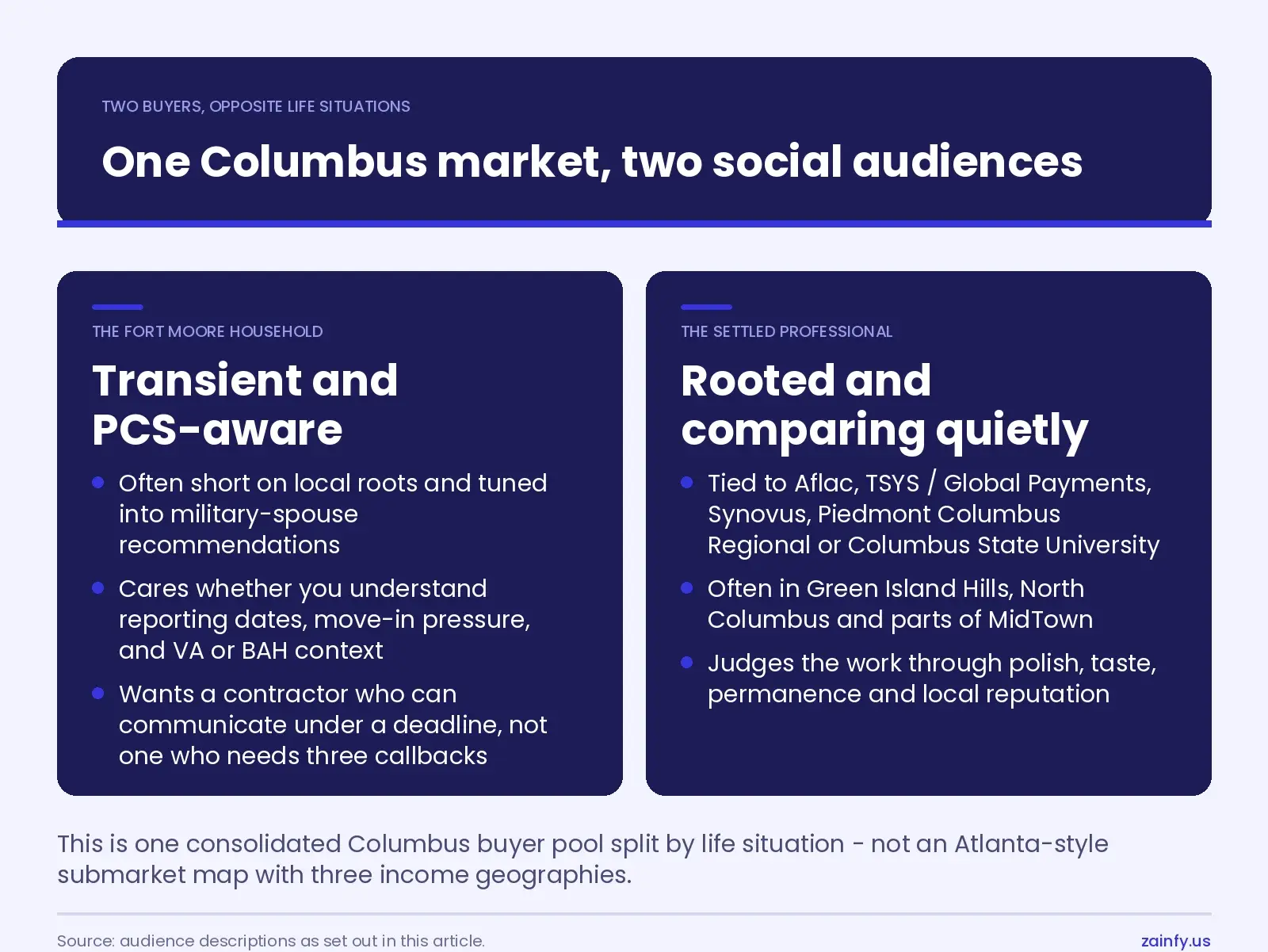
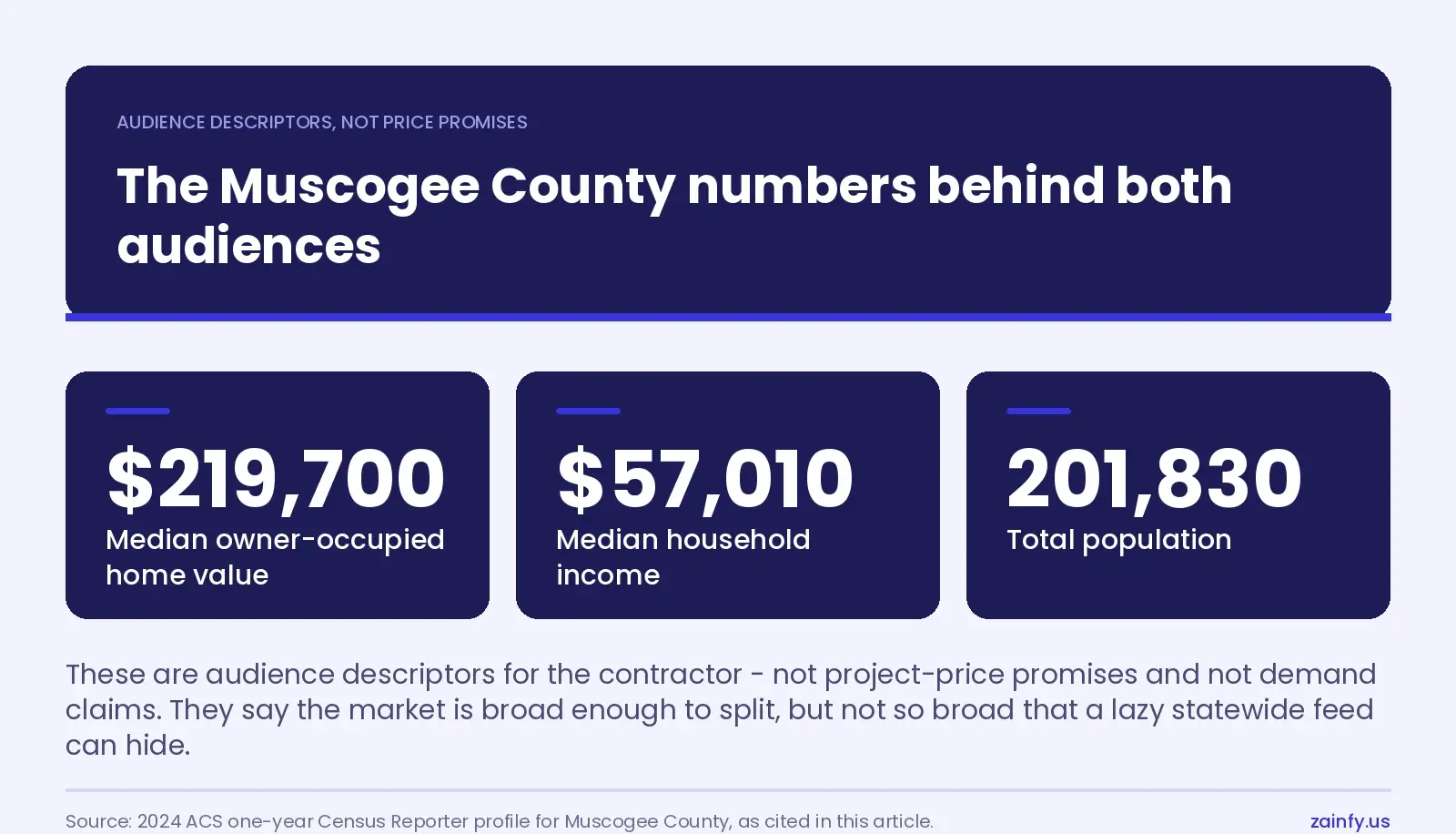
Columbus gives a remodeling contractor two social audiences inside one city-county market, and they do not read the same post alike. The Fort Moore household is often transient, PCS-aware, short on local roots, and tuned into military-spouse recommendations because that is where the practical base-town knowledge moves first. That buyer may care less about a perfect portfolio sequence and more about whether you understand reporting dates, move-in pressure, VA or BAH context, and the difference between a contractor who can communicate under a deadline and one who needs three callbacks before anything is clear. The professional buyer is different. Columbus has major white-collar anchors in Aflac, TSYS / Global Payments, Synovus, Piedmont Columbus Regional, and Columbus State University, and that settled segment often lives in places like Green Island Hills, North Columbus, and parts of MidTown where the work is judged through polish, taste, permanence, and local reputation. The 2024 ACS 1-year Census Reporter profile gives Muscogee County a $219,700 median owner-occupied home value, $57,010 median household income, and 201,830 total population. Those are audience descriptors for the contractor, not project-price promises and not demand claims. They tell you the market is broad enough to split, but not so broad that a lazy statewide feed can hide. This is not an Atlanta-style submarket map with three income geographies. It is one consolidated Columbus buyer pool split by life situation: the family moving through a military network and the professional who expects a business to look established before she trusts it with her house.
The military spouse network runs the referral
A Fort Moore family usually does not start with your carefully arranged grid.
They start with the people who already know the base-town reality.
Location-specific military-spouse Facebook groups and PCS-oriented networks are useful because they answer the questions a new family cannot get from a directory. Who showed up? Who finished before move-in? Who understood the lender, inspection, or VA-related timing? Who left the house clean enough for kids to sleep there the first week?
That is the channel.
Not a billboard. Not a place to barge in. A protective referral network.
For a Columbus contractor, the useful content is practical and specific: a before-and-after bath that explains the scope, a small kitchen update framed around move-in timing, a short post about what photos you need before giving a first-pass consult, or a calm explanation of what you can and cannot promise when a report date is close. The tone matters. A Fort Moore spouse asking for help is not asking to be sold to by ten vendors. She is trying to protect a household move.
Your role is to be useful before you are asked for a quote.
That can mean answering a basic project question without dropping a pitch. It can mean posting real local work only when the group allows business recommendations. It can mean making your own page good enough that another spouse can share it for you without apologizing for it.
That is where reaching both Columbus audiences on social becomes different from generic posting: the military segment needs evidence that you understand the Fort Moore clock, while the professional segment needs evidence that your work and business will hold up after the reveal.
The military side moves through trust faster than a normal cold audience. That is useful only if you respect the room.
A useful rule: if the post would make sense in any base town without changing a word, it is too thin for Columbus. Fort Moore should not be decorative. It should shape the example, the timing, the way the homeowner asks for help, and the way the contractor answers without sounding like he is harvesting the group.
The settled professional wants polish and proof you’ll stay
The Aflac, TSYS, or Synovus homeowner is not usually looking for the fastest contractor who can squeeze in a quick repair before orders change.
She is looking for a business that looks stable.
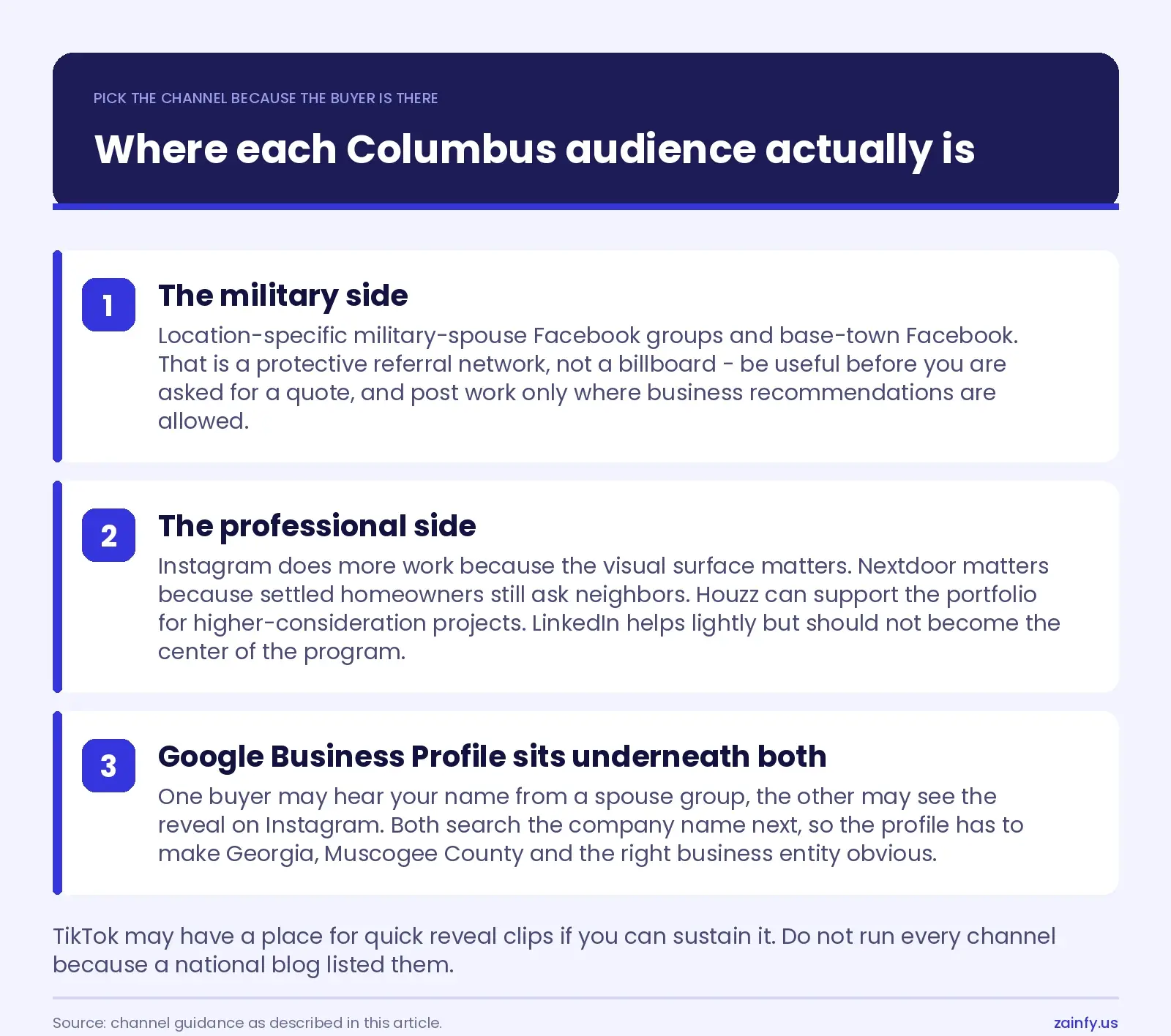
That changes the social feed. A Green Island Hills kitchen reveal can take its time. A North Columbus bath can show tile decisions, lighting, cabinetry, punch-list discipline, and the finished-room feeling. Instagram does more work for this buyer because the visual surface matters. Nextdoor matters because settled homeowners still ask neighbors who did the work and whether the company was tolerable in the house. Houzz can support the portfolio for certain higher-consideration projects. LinkedIn can help lightly when the audience overlaps with Columbus’s professional employers, but it should not become the center of the program.
The professional buyer is asking a different question: “Will this company still be here if something needs attention later?”
So the content should carry permanence. Named Columbus neighborhoods when appropriate. Reviews that sound rooted, not anonymous. Photos that show whole-room judgment instead of only a close-up faucet. Captions that explain why a finish, layout, or storage decision mattered. A business profile that feels alive, not abandoned between busy seasons.
The military family may reward speed and clarity. The professional may reward finish and restraint.
Both can be good clients.
The mistake is making one post pretend to court both at once. “Fast turnaround before move-in” speaks to a PCS household. “Designed for a long-term North Columbus home” speaks to a settled professional. Put those messages on the platforms where each buyer actually pays attention.
That also means the professional feed should not be all finished glamour shots. A settled buyer wants to see judgment before the reveal: dust control, sequencing, supplier decisions, how you handled a change, and what the final room solved. The more expensive the scope feels, the more the caption should prove that the company can manage details after the first pretty photo.
What each buyer is actually checking for
The Fort Moore buyer is checking for speed, clarity, and community trust.
She wants to know whether you can work inside a PCS timeline, whether you understand the pressure around report dates, whether your first response is organized, and whether another military spouse would put your name in a comment without hesitation.
She is also checking whether you sound real.
The settled Columbus professional is checking for taste, depth, and staying power. She wants to see enough portfolio evidence to believe the finish level matches the house. She wants proof that you have worked in neighborhoods like Green Island Hills, North Columbus, or MidTown when the post allows that level of detail. She wants reviews that show communication, care, and follow-through.
These are not the same trust signals.
For the military buyer, a useful post might say what information you need from an incoming family before a first consult. For the professional, a useful post might explain the design decision behind a finished kitchen wall, storage plan, or lighting choice.
Same company. Different question.
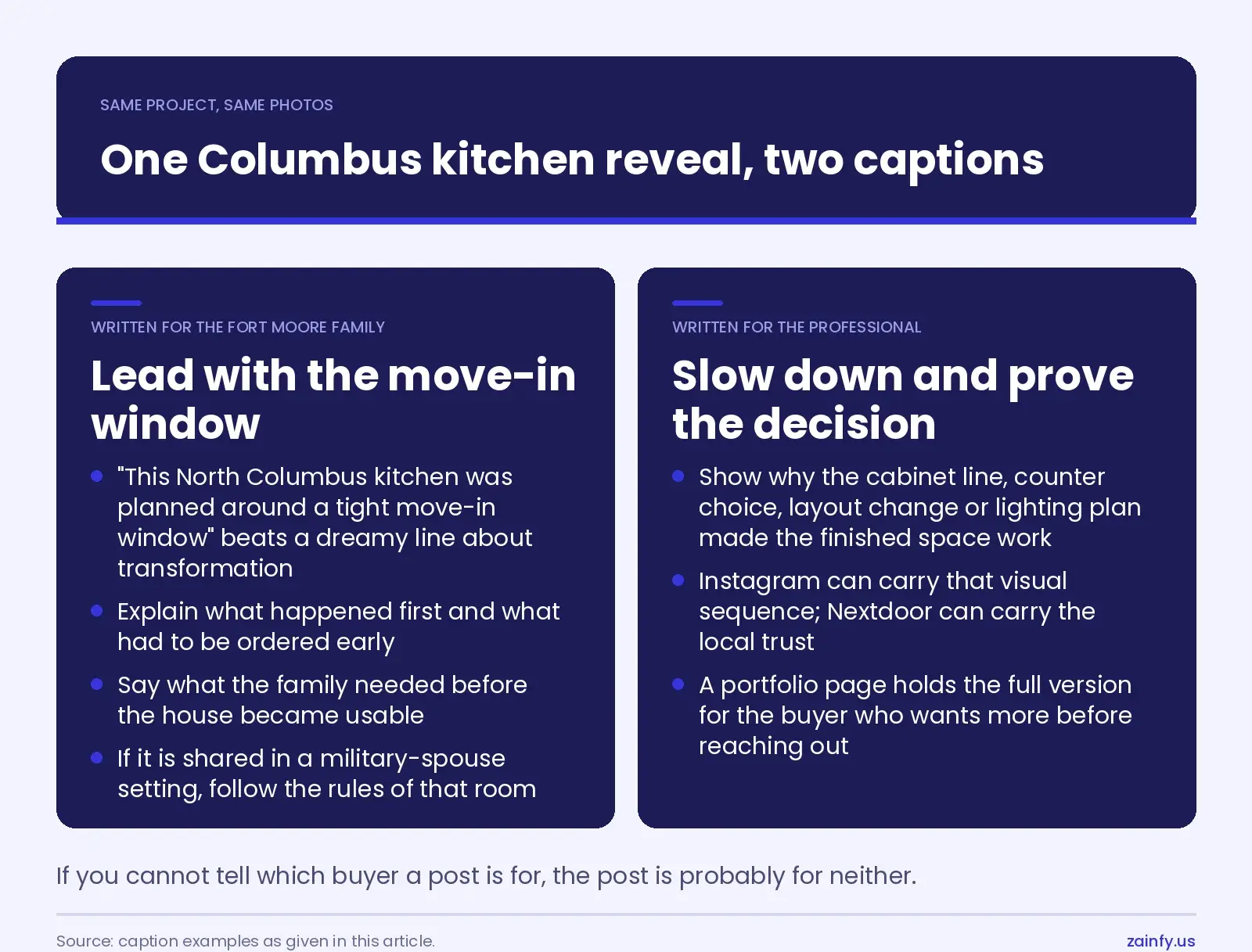
If you cannot tell which buyer a post is for, the post is probably for neither.
One reveal, two captions — and the platforms each buyer is on
Use the same project twice without making it feel recycled.
Take a Columbus kitchen reveal. The photos are the same. The message is not. That is the whole discipline behind one feed, two very different buyers.
For the Fort Moore audience, the caption should read like a contractor understands a moving household. “This North Columbus kitchen was planned around a tight move-in window” is more useful than a dreamy line about transformation. Explain what happened first, what had to be ordered early, and what the family needed before the house became usable. If the post is shared in a military-spouse setting, follow the rules of that room. Better yet, let the quality of the post make someone else willing to recommend you.
For the professional audience, that reveal can slow down. Show why the cabinet line, counter choice, layout change, or lighting plan made the finished space work. Instagram can carry that visual sequence. Nextdoor can carry the local trust. A portfolio page can hold the full version for the buyer who wants more before reaching out.
Google Business Profile sits underneath both. One buyer may hear your name from a spouse group. The other may see your reveal on Instagram. Both may search the company name next, and in Columbus that profile should make Georgia, Muscogee County, and the right business entity obvious.
That last step is easy to ignore because social feels like the public part. It is not the whole path. A homeowner who saves a post on Tuesday may search the contractor on Friday from a phone. If the profile looks stale, if the business name is inconsistent, or if the photos do not match the feed, the confidence built in the post leaks out before the call.
Do not try to run every channel because a national blog listed them.
Facebook groups and base-town Facebook matter for the military side. Instagram, Nextdoor, and a serious portfolio matter more for the professional side. TikTok may have a place for quick reveal clips if you can sustain it without turning the business into a content circus.
Pick the channel because the buyer is there, not because the platform is fashionable.
Cadence, timing, and where each lead closes
Posting frequency is not a magic number; it is a promise you have to keep when the crew is busy, the owner is estimating work, and nobody remembered to photograph the job before demo. A Columbus contractor is better off with a rhythm he can maintain than a calendar that looks impressive for three weeks and then dies. The military side needs timing discipline because Fort Moore PCS movement clusters attention around the warmer months, school calendars, orders, and move-in pressure. Be present before that wave, not after families have already asked the group and written down three names. The professional side is steadier. Aflac, TSYS, Synovus, Piedmont, and Columbus State homeowners do not all move on one clock; they compare quietly, save posts, ask neighbors, and return when the project feels real. Leads from both audiences usually close somewhere other than the post itself. A direct message should move quickly into a quote path. The profile link should not dump people onto a vague home page. Google Business Profile should clear the Columbus, Georgia identity so a searcher does not land on the wrong city, stale listing, or unrelated business. The post starts the trust check. The DM, profile, phone path, and follow-up decide whether that trust turns into a real consult.
Build a simple capture habit around that. After every jobsite photo set, tag the project internally as military-timing, professional-polish, or both. Save one version of the caption for Facebook and one for Instagram or Nextdoor. When a message comes in, reply with the same clarity the post promised: project type, area, timing, and the next step. Columbus contractors lose discipline here because the workday gets loud. The buyer does not see that. She only sees whether the business stayed easy to deal with after she raised her hand.
Don’t run one feed for both — or pitch the spouse network
Do not run one generic Columbus feed and assume both audiences will translate it for you.
They will not.
The polished permanence post that reassures a Green Island Hills professional can read slow to a family trying to make a house livable before a report date. The fast-turnaround PCS post that sounds helpful to a military household can read thin to a settled professional comparing finish quality.
That is not a small wording problem. It is an audience problem.
The second mistake is worse: treating the military-spouse network as a place to extract leads.
Show up only to sell and the room will know. Tight communities protect themselves. A contractor who ignores group rules, comments like a vendor, or pushes himself into every recommendation thread can burn trust faster than he builds it.
Be useful. Answer what you can answer. Share work where business posting is allowed. Let a good reputation travel through people instead of forcing the post to do every job.
For the professional side, stop hiding behind generic before-and-after captions. Say why the work matters. Show enough detail to be judged.
One feed for both is not efficient. It is lazy.
There is a practical way out: write for one buyer at a time. If the next post is for a Fort Moore family, let it be direct about timing, move-in pressure, and what you need to know before quoting. If the next post is for the professional owner, let it slow down and prove finish, process, and staying power. The feed can hold both voices. A single caption cannot do both jobs cleanly.
What it costs to serve two audiences
The cost is not only the monthly work of posting, writing captions, organizing photos, replying to messages, and keeping the profile current.
The quiet cost is the work you never hear about.
A military family asks a Fort Moore spouse group for a contractor, and the name that comes back is the one people trust because it has been visible and useful. A Synovus or Aflac professional compares two remodelers, and the one that looked more established gets saved, followed, and called later. Nobody sends you a note saying you almost made the list.
That is why a fabricated social-management price band would be useless here. A national average would not tell a Columbus owner what his feed has to do.
Judge the investment by the jobs the content performs. Does the military side have PCS-aware posts, practical replies, and clear next steps? Does the professional side have polished project proof, local permanence, and enough detail to look serious? Does the $219,700 Muscogee median owner-occupied value remind you to speak to the actual Columbus budget band instead of pretending every follower is an Atlanta luxury buyer?
Serving two audiences takes more thought than copying one caption across every platform.
The waste is pretending it does not.
For an owner-operator, the real budget question is time. Who takes photos before the room is clean? Who writes the caption while the job is still fresh? Who answers the message when it comes in after dinner? If the answer is always “me, when I remember,” then the plan has to be small enough to survive the week. Two good segment-aware posts beat a month of vague updates that never name the buyer.
Columbus GA remodeler social media: quick answers
[wps_faq style=”classic” question=”How does a Columbus remodeler reach Fort Moore military families on social media?”]Reach Fort Moore military families by becoming useful inside the base-town referral path before you ask for anything. Location-specific military-spouse Facebook groups and PCS-oriented networks are where incoming families ask who showed up, who communicated, and who understood a compressed local move. Post real Columbus work, frame the caption around timing, and explain what information you need before a first consult. Do not name unverified private group names in public copy, and do not treat the group as a dumping ground for sales posts. A contractor who respects the room earns the kind of recommendation a relocation directory cannot manufacture.[/wps_faq]
[wps_faq style=”classic” question=”Which platform is best for a Columbus remodeler — and does it depend on the client?”]The best platform depends on which Columbus buyer you are trying to reach. Fort Moore military households lean toward Facebook groups and base-town Facebook because the referral is tied to PCS life and other spouses’ experience. Aflac, TSYS, and Synovus professionals are more likely to judge project polish through Instagram, Nextdoor, and a portfolio they can revisit. Google Business Profile matters for both because each segment may search your name after hearing it somewhere else. Do not pick a platform because it is popular nationally. Pick it because the buyer you want has a real reason to trust you there.[/wps_faq]
[wps_faq style=”classic” question=”Do Columbus contractors get leads from social media, or just likes?”]Columbus contractors can get real leads from social media when the post connects to a quote path instead of stopping at attention. A Green Island Hills kitchen reveal with no next step is only a nice post. A reveal that names the scope, links to the right profile path, and gets a fast DM response can become a consult. That is also true for a Fort Moore family asking about move-in timing. Likes are weak by themselves because they do not prove buyer intent. The better test is whether the post made the next action easier for the segment it was written for.[/wps_faq]
[wps_faq style=”classic” question=”How often should a Columbus remodeler post, and how much does it cost?”]A Columbus remodeler should post at a pace he can sustain and budget for the work behind that pace, not chase a made-up universal frequency. A practical rhythm needs project photos, captions for both audiences, message handling, profile updates, and enough consistency that the feed does not go quiet during busy weeks. Muscogee County’s 2024 ACS profile shows a $219,700 median owner-occupied home value, which is budget context for the contractor, not a project price. Cost should be judged by whether the content keeps producing usable trust signals.[/wps_faq]
Closing
Open your last ten social posts and label each one.
Military family, professional homeowner, or neither.
If most land in the third pile, the problem is not that Columbus is quiet. The problem is that the feed is asking two different buyers to decode the same vague message. Fix one post at a time. Take the next real project, decide which buyer it should reach first, and write the caption for that person without apologizing to the other one. If you are not sure the channel is worth it at all, start with whether Columbus contractors need social media.
Then write the second caption.
Columbus is specific because Fort Moore and the corporate-professional base sit in the same local market, but the discipline travels; how this runs across more than one market belongs to the wider state program only after the Columbus feed proves it can separate the people in front of it.
The next useful move is not another platform. It is deciding who the post is for before you publish it.