In a market the size of Gainesville and Hall County, social media is not a billboard for a remodeling contractor – it is your word of mouth made visible.
That is the whole game.
This is Gainesville, Georgia, not Gainesville, Florida. Your real market is the Hall County town ring, the Lake Lanier community, the neighbor thread, the local group post, the client who tags you, and the feed a homeowner checks after she hears your name.
If the feed backs up the referral, you look like the local contractor who is active and real. If it is quiet, generic, or full of stock-looking posts, the referral gets weaker before the buyer ever calls.
This guide is for the owner who already knows referrals matter and wants social to make those referrals easier to trust.
In a small market, your feed is the word of mouth
Hall County is big enough to feed a serious remodeling business and small enough that a contractor’s name travels fast. Census Reporter lists 221,745 people and 84,567 housing units in the 2024 ACS 1-year profile. That is not a remodeling-demand number. It is the audience your feed is talking to: Gainesville, Oakwood, Flowery Branch, Clermont, Lula, Gillsville, Braselton, the Hall side of Buford, and the roads between them. The $388,000 median owner-occupied value tells you the buyer is not making a throwaway decision. She is comparing you against the house she already owns. The old referral still matters, but the way it moves has changed. A neighbor asks who did the kitchen. Someone answers with a name. Then the buyer checks the feed. Does she see Oakwood projects, lake-house work, crew faces, and comments from real clients, or does she see three posts from last spring and a holiday graphic? Newcomers moving along the GA-400 and Interstate 985 routes do not always have a cousin, builder, or church friend to ask. They use the public proof they can see. In a market this connected, your feed is not extra marketing. It is the referral record.
The local groups where the referral actually happens
The small-market referral does not usually start on a polished Instagram grid.
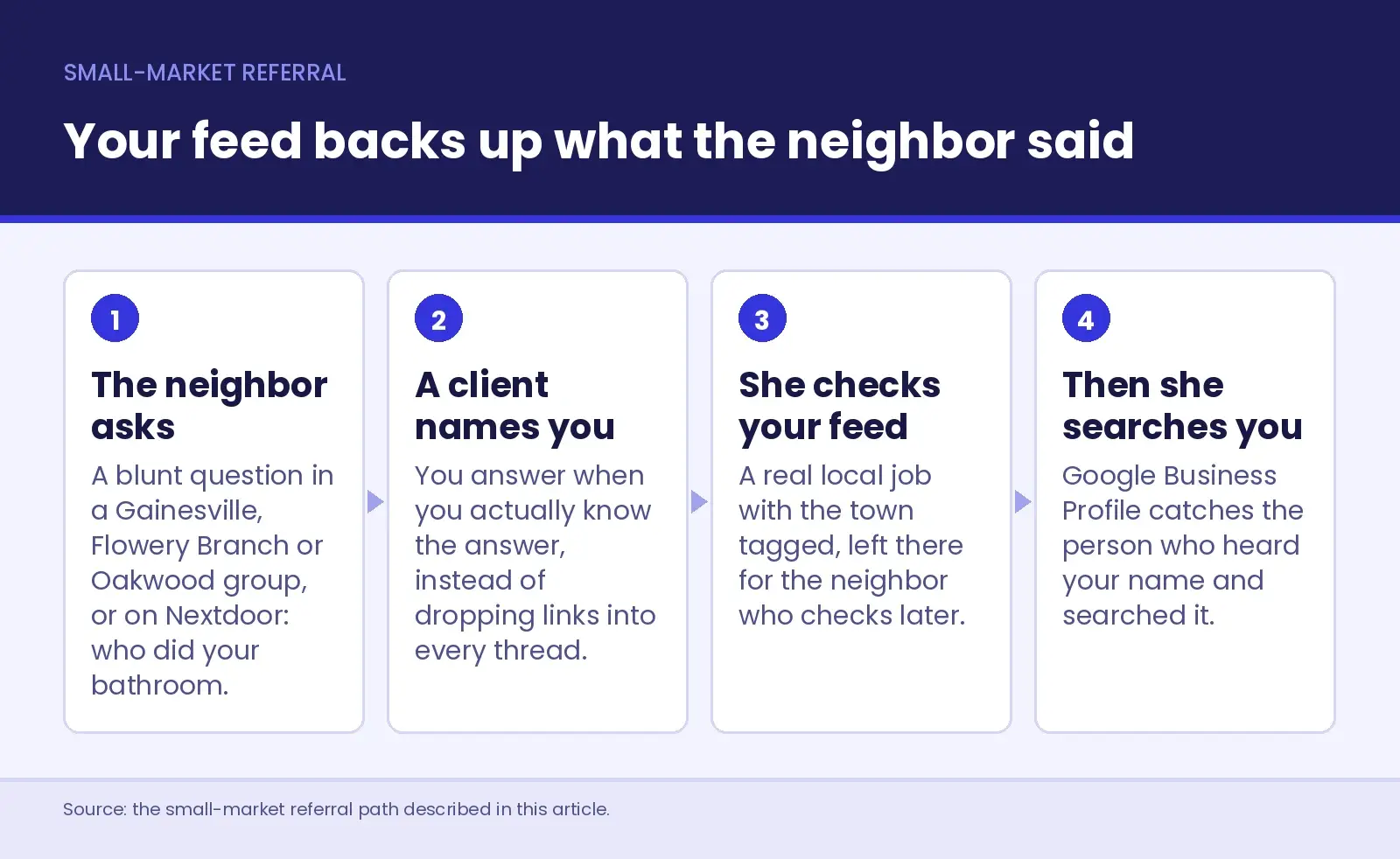
It starts where neighbors ask blunt questions.
In Gainesville, Flowery Branch, Oakwood, and nearby Hall County groups, the thread sounds simple: who did your bathroom, who can handle a deck, who showed up, who would you call again. Nextdoor works the same way at neighborhood scale. A remodeler who wants those referrals has to behave like a useful local business, not a salesperson dropping links into every thread.
Answer when you actually know the answer. If someone asks about planning a kitchen timeline, give a practical point. If someone asks for a contractor recommendation, let happy clients name you. Post a real local job with the town tagged, then leave it there for the neighbor who checks later.
That is where social that works at Gainesville’s scale fits if you want the commercial page after this guide.
Google Business Profile matters here as a lead-catch surface. A homeowner hears your name in a Facebook group, searches it, sees recent posts, photos, reviews, and a phone path. That is not a ranking argument; it is a trust path.
Be careful with town tags. Braselton and Buford extend past the county line, so do not pretend every job there is a Hall County job. Tag the town you genuinely worked. Local people notice sloppy claims faster than an algorithm does.
Post like the lake is the town’s identity – because it is
A generic remodel post says, “Here is a kitchen.”
A Gainesville post with a pulse says, “Flowery Branch lake-house kitchen, wrapped before the family came back for summer.”
Those are different posts.
Lake Sidney Lanier is not a decorative backdrop for this market. It is part of how Gainesville and Hall County talk about themselves. Lake Lanier Olympic Park gives the community a real gathering point, not just a name on a map. Food Truck Fridays, the downtown Chicken Cook-Off, Jingle Mingle, Mutts on Main, and the farmers market give a contractor a calendar of local context that an Atlanta firm cannot fake from a content template.
That does not mean turning your feed into event coverage.
It means your project content should feel like it came from here. A crew grabbing lunch after a job near Lake Lanier Olympic Park. A short clip from a Flowery Branch outdoor-living project before lake season. A downtown event post where the business shows up as a neighbor, not a vendor shouting into the crowd.
The difference is place.
This is different. This is social content: the local identity, the human moment, the proof that your company is part of the market it serves.
In a market this small, showing up is the strategy
Most Hall County remodelers do not post consistently.
That is the opening.
You do not need to out-produce a metro agency. You need to be the contractor who shows up every week with real work, real people, and a real town attached to the post.
One short Reel from an Oakwood kitchen. A before/after from a Gainesville bath. A crew clip from a Flowery Branch deck. A quick answer in a local group when someone asks about planning a project.
That beats a silent feed with better photography.
It also beats the two-week burst. Contractors get busy, post five times, disappear for three months, then wonder why the feed never helped. In a small market, silence is information. The homeowner may not say it out loud, but a dead-looking feed makes the business feel less active.
Consistency beats polish here.
Short-form video helps because few local remodelers use it well. A basic walk-through, a reveal, or a “here is what changed” clip can make you look present without pretending to be an influencer.
What to post when the whole county already knows your name
Start with finished work, but do not post it like a portfolio dump.
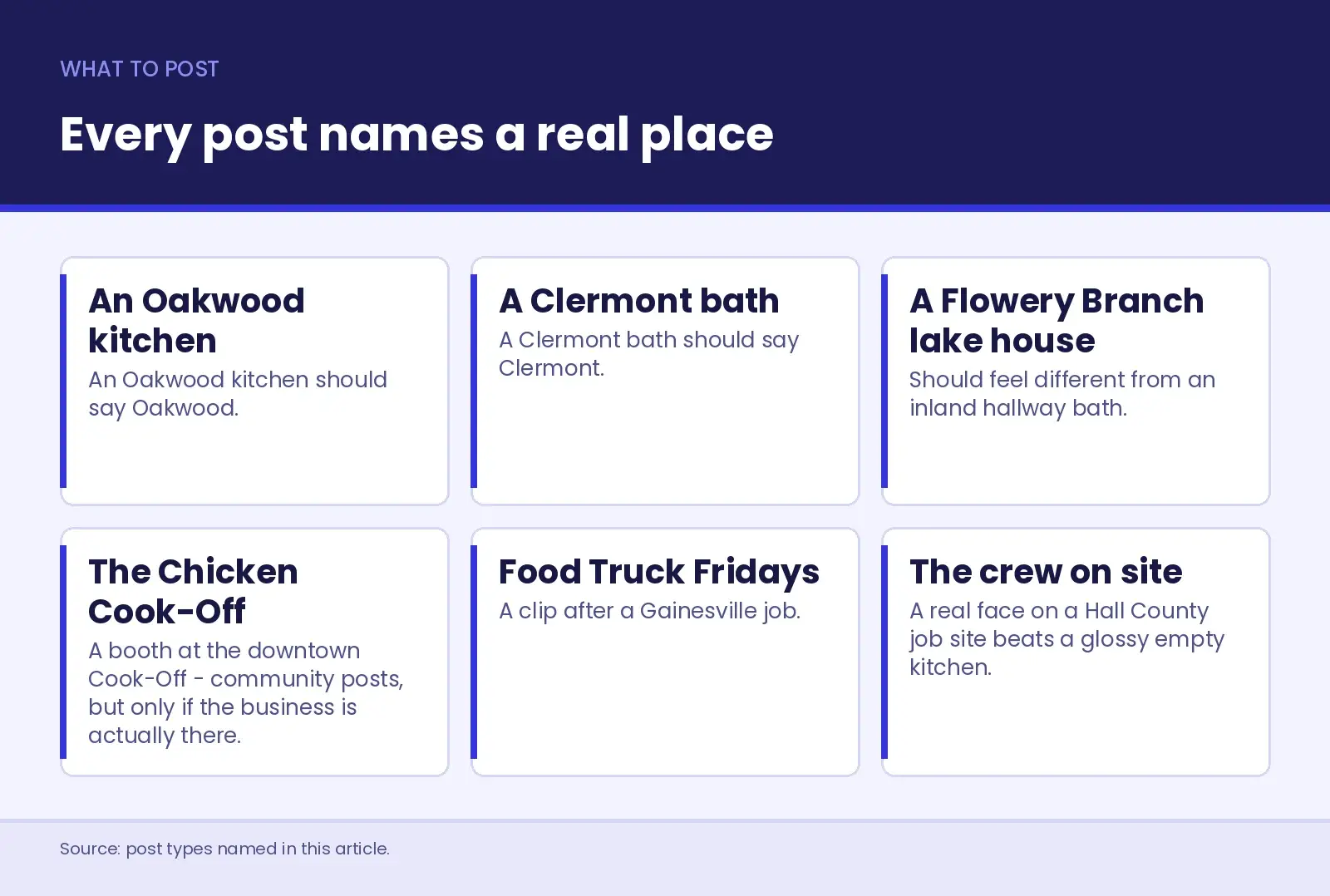
An Oakwood kitchen should say Oakwood. A Clermont bath should say Clermont. A Flowery Branch lake-house project should feel different from an inland hallway bath. The town tag is not a gimmick; it tells the viewer the work happened near her.
Before/after posts still matter because remodeling is visual. The mistake is posting the reveal with no story. Show what changed. Say the scope in plain language. Mention the town. If a review says the family was in Flowery Branch, use that language when the client approves it.
Post the crew too.
In a small market, people hire the company they recognize. A real face on a Hall County job site can do more trust work than a glossy empty kitchen. Behind-the-scenes posts work when they show process: protecting floors, solving a cabinet layout problem, fixing an old framing issue, cleaning up before the homeowner gets back.
Community posts belong in the mix, but only if the business is actually there. A booth at the downtown Chicken Cook-Off. A local team sponsorship. A Food Truck Fridays clip after a Gainesville job. That content says the company is present in the same places its buyers live.
One project can become a few posts: progress, reveal, review, lesson learned. Do not turn that into a content machine. Keep it honest and specific. Sustained over a year, that habit is what consistency looks like over a year.
Which platforms, how often, and where the lead actually closes
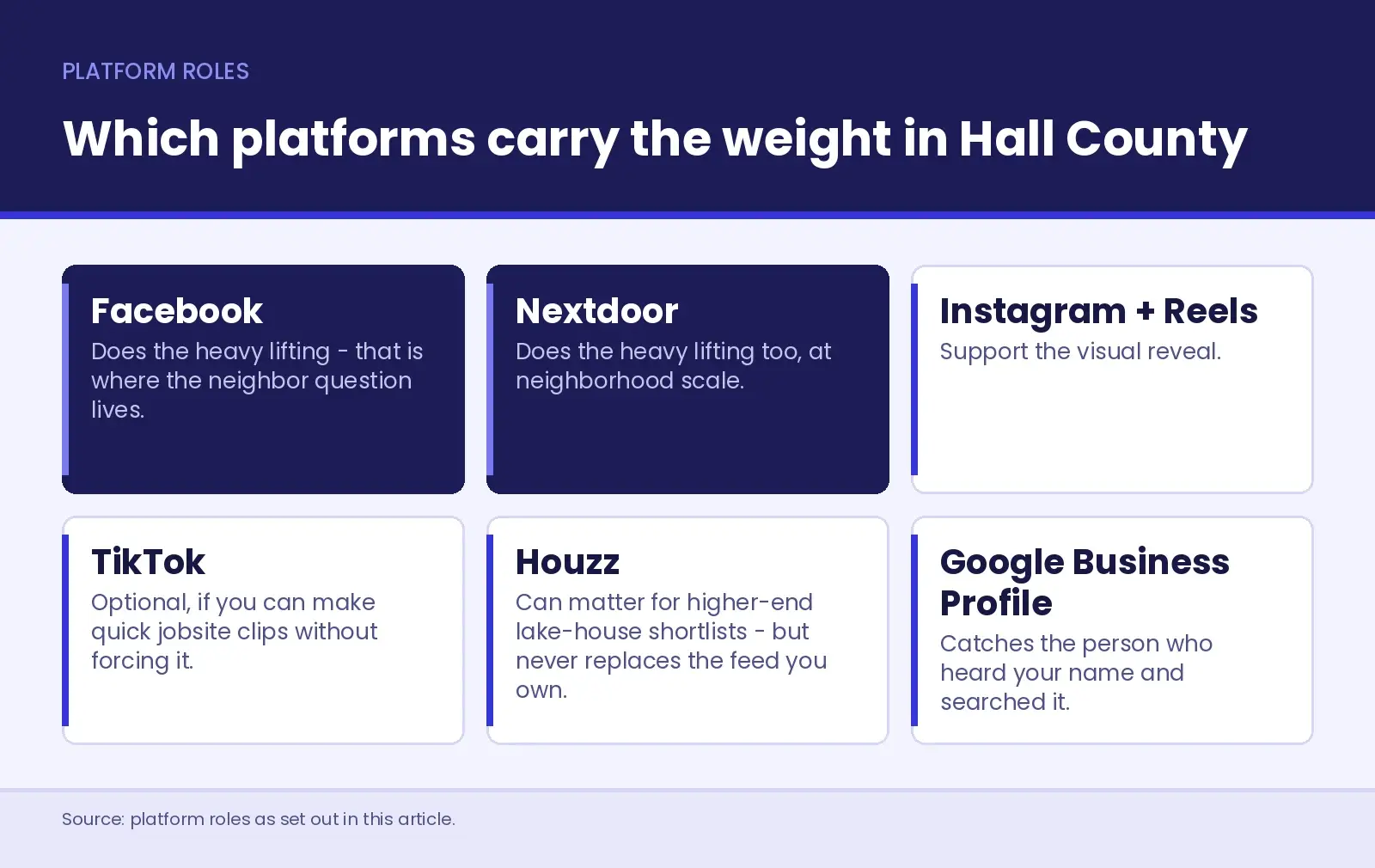
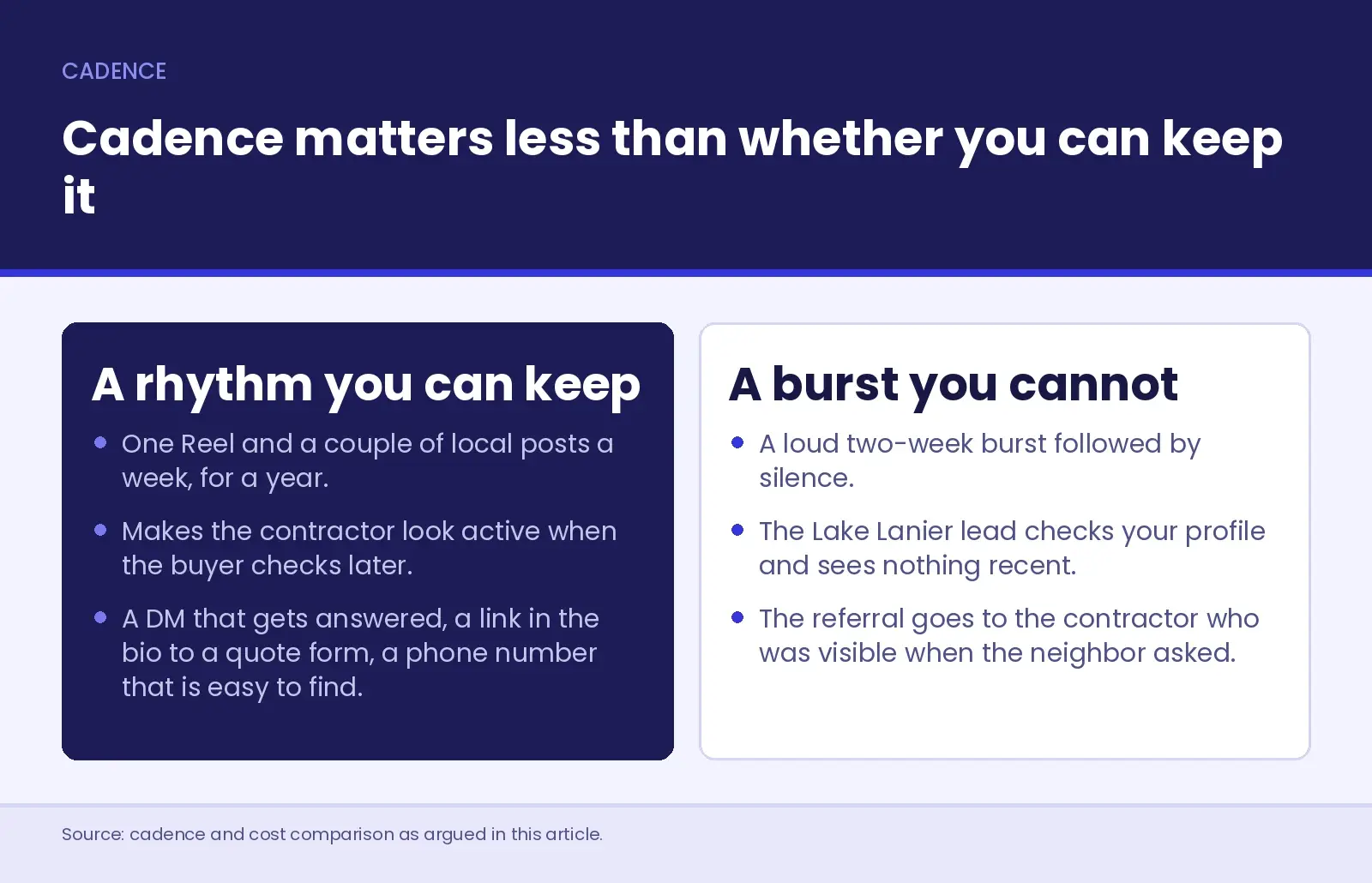
Pick the platforms that match how Hall County referrals move. Facebook and Nextdoor do the heavy lifting because that is where the neighbor question lives. Instagram and Reels support the visual reveal. TikTok is optional if you can make quick jobsite clips without forcing it. Houzz can matter for higher-end lake-house shortlists, but it should not replace the feed you own and maintain. Google Business Profile should catch the person who heard your name and searched it. Cadence matters less than whether you can keep it. One Reel and a couple of local posts a week for a year beats a loud two-week burst followed by silence. The lead usually closes after the post, not inside the post: a DM that gets answered, a link in the bio to a quote form, a phone number that is easy to find, and a profile that makes the contractor look active when the buyer checks later. All of it eventually points at the site all that social traffic lands on.
Don’t run a big-city feed in a small town
Do not try to look like a glossy metro-agency feed.
A grid of over-polished rooms with no local faces reads cold in Hall County. The buyer wants to see the crew, the job, the town, and the kind of work that looks like it happened near her.
Stock-looking content makes you look out of town.
Do not buy followers. Do not chase vanity metrics. A follower list full of strangers does not impress a Gainesville homeowner who is asking whether her neighbor has used you. It can even make the business feel less local.
And do not let the feed go quiet.
In a connected market, a feed that has been dead for three months gets interpreted. Maybe the company is too busy. Maybe it is slowing down. Maybe nobody is paying attention. You do not control which version the buyer chooses.
Be the real local business. Show the actual work. Keep showing up.
That is not glamorous advice. It is the part most contractors fail to do.
What it costs to keep a local feed alive
A consistent local feed costs either time, attention, or money.
A Gainesville contractor posting his own phone clips every week is solving a different problem than a contractor who needs planning, captions, editing, scheduling, and DM follow-up.
The silent feed has a cost too.
It costs the referral that goes to the contractor who was visible when the neighbor asked. It costs the Lake Lanier lead that checks your profile and sees nothing recent. It costs the Oakwood homeowner who would have trusted you if she had seen three local projects instead of a generic holiday graphic.
The $388,000 Hall County median owner-occupied value is the buyer band your content is speaking into. That does not mean every job is large. It means the audience is careful, and the proof has to look current.
The feed is not a hobby if referrals are part of the business. It is maintenance on your public reputation.
Gainesville & Hall County remodeler social media: quick answers
[wps_faq style=”classic” question=”Does social media actually get a Gainesville remodeler leads, or just likes?”]Social media gets a Gainesville remodeler leads when the feed supports the referral and gives the buyer a clear next step. Likes alone do not matter. A Flowery Branch homeowner may see a lake-house project, ask a question in the comments, then move to a DM or phone call. The post starts trust; the lead closes when the business answers quickly and sends the buyer to a quote path. Treat every serious comment like a front-door conversation, not a vanity signal.[/wps_faq]
[wps_faq style=”classic” question=”Which platform is best for a small-market Gainesville remodeler?”]Facebook and Nextdoor usually matter most for a small-market Gainesville remodeler because local referrals happen where neighbors already ask for recommendations. Instagram and Reels are useful for before/after visuals, especially for kitchens, baths, decks, and Lake Lanier projects. Google Business Profile should stay current because buyers search your name after hearing it. Pick two platforms you can keep alive before adding more. A quiet five-platform presence looks weaker than two active local channels.[/wps_faq]
[wps_faq style=”classic” question=”How do I get referrals from local Hall County Facebook groups without spamming?”]Get referrals from Hall County Facebook groups by being useful before you ask for anything. Answer renovation questions when you know the answer. Do not paste the same pitch into every Gainesville or Oakwood thread. Post real work with the town tagged, let clients mention you naturally, and keep your profile current so people can verify the business. If a group allows business posts, follow the rules exactly. The contractor who sounds like a neighbor lasts longer than the one dropping links.[/wps_faq]
[wps_faq style=”classic” question=”How often should a Gainesville remodeler post, and how much does it cost to keep it up?”]A Gainesville remodeler should post on a rhythm he can sustain, not on a magic number. One useful Reel and a couple of local posts most weeks is stronger than a short burst followed by silence. Cost depends on whether the owner captures content himself or pays for planning, editing, scheduling, and response management. Budget for consistency first, because the quiet feed is what loses the referral.[/wps_faq]
Closing: start with the next real job
Do not start with a content calendar.
Start with the next real job worth showing.
If it is an Oakwood kitchen, capture the before, the messy middle, the reveal, and the client’s words when the job is done. If it is a Flowery Branch lake project, show why the location matters. If the crew is at a Gainesville event, document it like a local business, not a brand trying to look busy.
Then repeat next week.
For contractors outside Hall County, Georgia remodelers in smaller markets shows how the same local-social problem changes across Georgia markets.
The first useful post is probably already on the jobsite. Capture it before it disappears into your camera roll.