Author: Zayn Shah
Marketing a historic-district remodeling business is different because the buyer is not comparing price alone. The buyer is looking for proof that you understand old materials, review-board expectations, and the cost of getting irreversible work wrong.
In Savannah and Chatham County, that proof can become a position a general remodeler cannot copy with a new headline. A record of Certificate of Appropriateness approvals, preserved original features, and work inside named districts tells the client that you have already handled the risk keeping her awake.
That changes the marketing job. You are not trying to look broadly capable to every renovation buyer. You are helping a cautious historic-home owner rule you in before the call. The opportunity is bounded enough to understand, large enough to pursue, and connected to a preservation network that works differently from ordinary lead marketplaces.
This buyer is vetting you, not comparing you
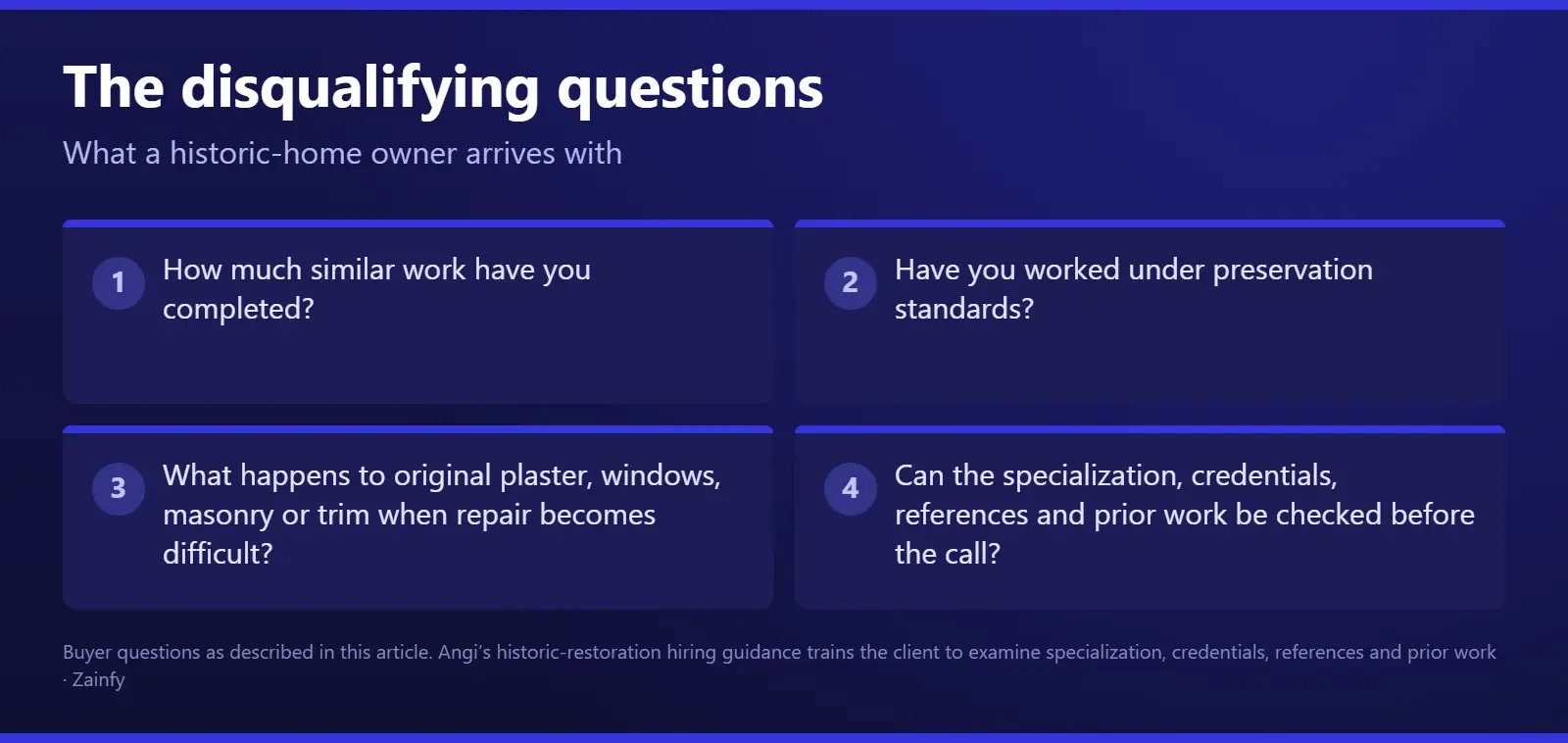
The historic-home owner arrives with disqualifying questions. How much similar work have you completed? Have you worked under preservation standards? What happens to original plaster, windows, masonry, or trim when repair becomes difficult? Guidance for old-house owners often recommends several years of comparable project experience, and the material answer can function as a pass-or-fail test. Tell a preservation-minded buyer that sound original plaster should automatically be replaced with drywall and the conversation may end there. Angi’s own historic-restoration hiring guidance trains the client to examine specialization, credentials, references, and prior work before choosing a contractor. Old-house communities make the frustration visible: a r/centuryhomes thread about how hard it is to find qualified contractors drew more than 100 comments. That is not proof of a market size, but it is clear buyer behavior. The person is not struggling to find any company with a truck. She is struggling to find someone whose public proof answers the old-house questions. Your marketing should therefore pre-answer the interrogation: name the type of historic work, show the original element that was retained, identify the approval context when appropriate, and explain the judgment behind the repair. A general portfolio says you can transform a room. A historic portfolio must show that you know what should not be transformed.
Your COA file is a sales document
Most contractors treat a Certificate of Appropriateness as paperwork to survive. A Savannah historic-work specialist should treat the completed file as evidence.
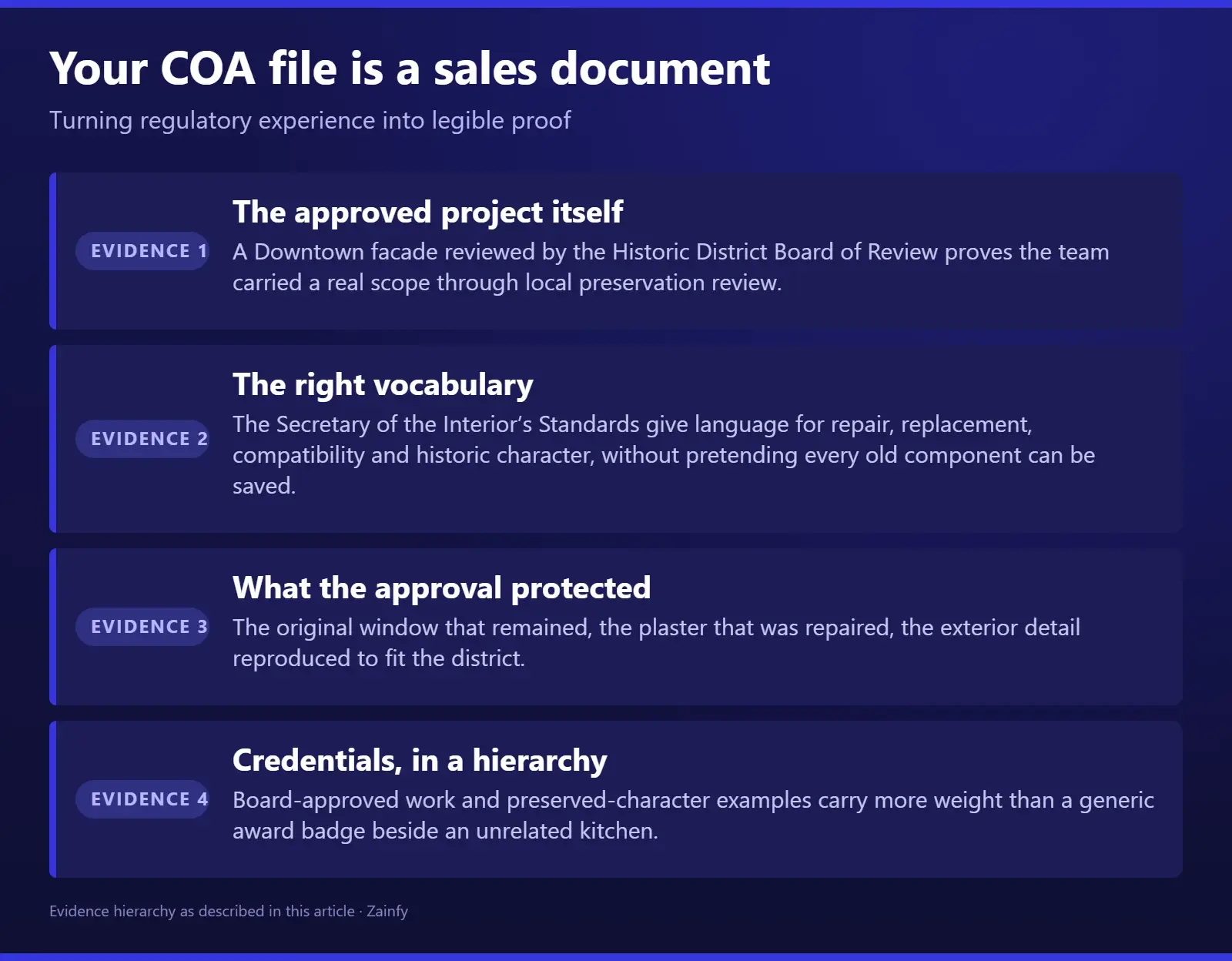
Start with the approved project itself. A Downtown facade reviewed by the Historic District Board of Review proves something a general “licensed and insured” line cannot: the team has carried a real scope through local preservation review. Familiarity with the Secretary of the Interior’s Standards gives the contractor the right vocabulary for discussing repair, replacement, compatibility, and historic character without pretending every old component can be saved.
Then show what the approval protected. A useful before-and-after does not merely make the finished work look newer. It identifies the original window that remained, the plaster that was repaired, or the exterior detail that was reproduced to fit the district. The image needs enough context for a buyer to understand the restraint.
Credentials still matter. Licensing, insurance, a preservation track record, and relevant local recognition can support the position. But they need a hierarchy. Board-approved work and preserved-character examples carry more weight in this niche than a generic award badge floating beside an unrelated kitchen.
The strategy is to turn regulatory experience into legible proof before the buyer asks for it. The precise page structure belongs to the website plan; the positioning decision comes first. If your last five COA projects are buried in a filing cabinet, your strongest sales evidence is invisible.
How big is the niche? One in seven houses
Savannah has enough old housing stock to make specialization credible.
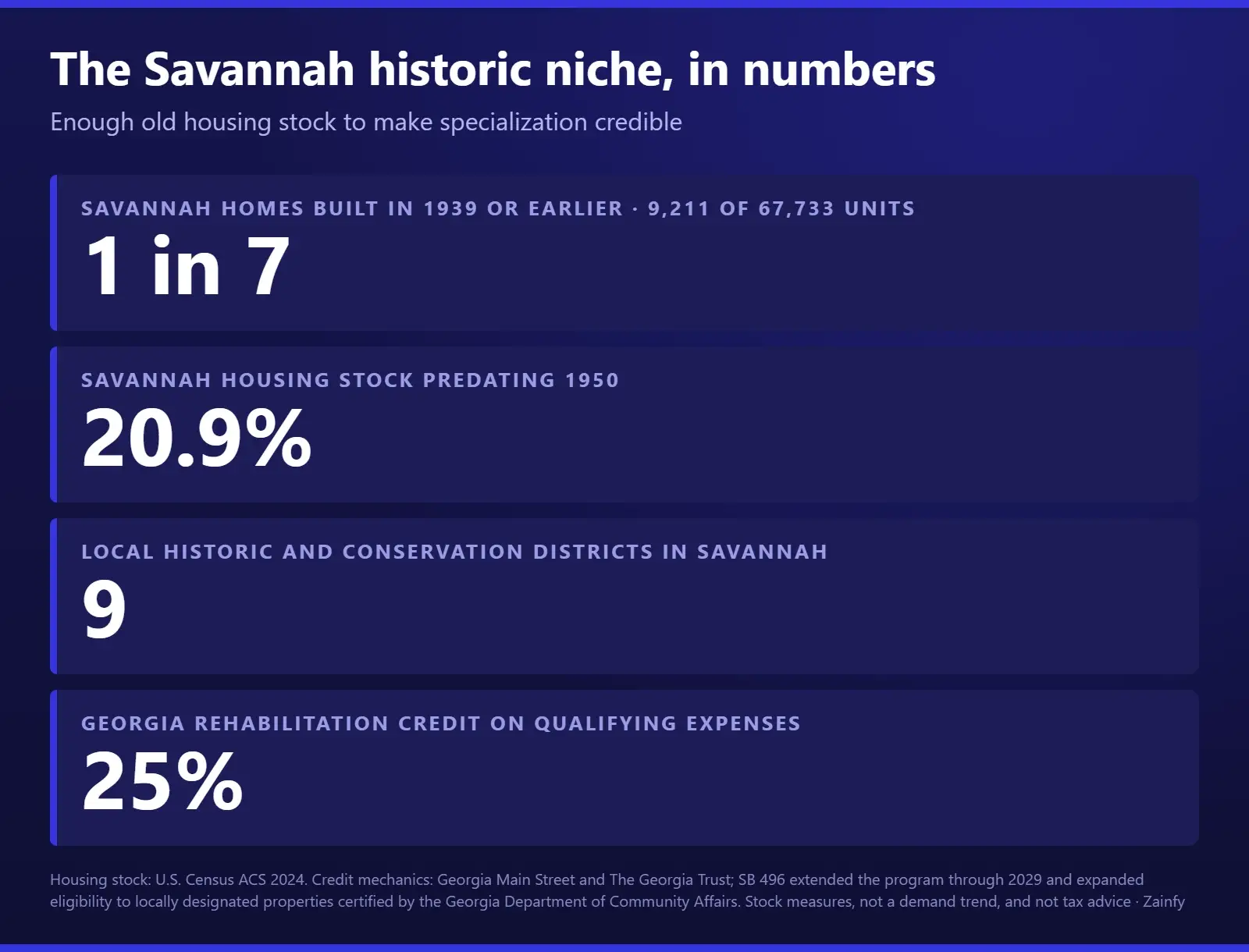
U.S. Census ACS 2024 data shows that 9,211 of the city’s 67,733 housing units were built in 1939 or earlier. That is 13.6%, or roughly one in seven. Include the 1940s and 20.9% of Savannah’s stock predates 1950. These are stock measures, not a claim that demand is rising.
The geography is equally concrete. Savannah has nine local historic and conservation districts, including Downtown, Victorian, Streetcar, Cuyler-Brownville, Parkside, Ardmore, Ardsley Park-Chatham Crescent, Carver Village/Flatman Village, and Kensington Park-Groveland. The Downtown district was designated a National Historic Landmark District in 1966, and Historic Savannah Foundation describes it as one of the country’s largest.
There is also an incentive a specialist can name without giving tax advice. Georgia’s rehabilitation credit equals 25% of qualifying expenses, up to $100,000 for a personal residence. SB 496 extended the program through 2029 and expanded eligibility to locally designated properties certified by the Georgia Department of Community Affairs. The project may qualify; the contractor’s marketing can show that the company understands the conversation.
Where this buyer actually looks
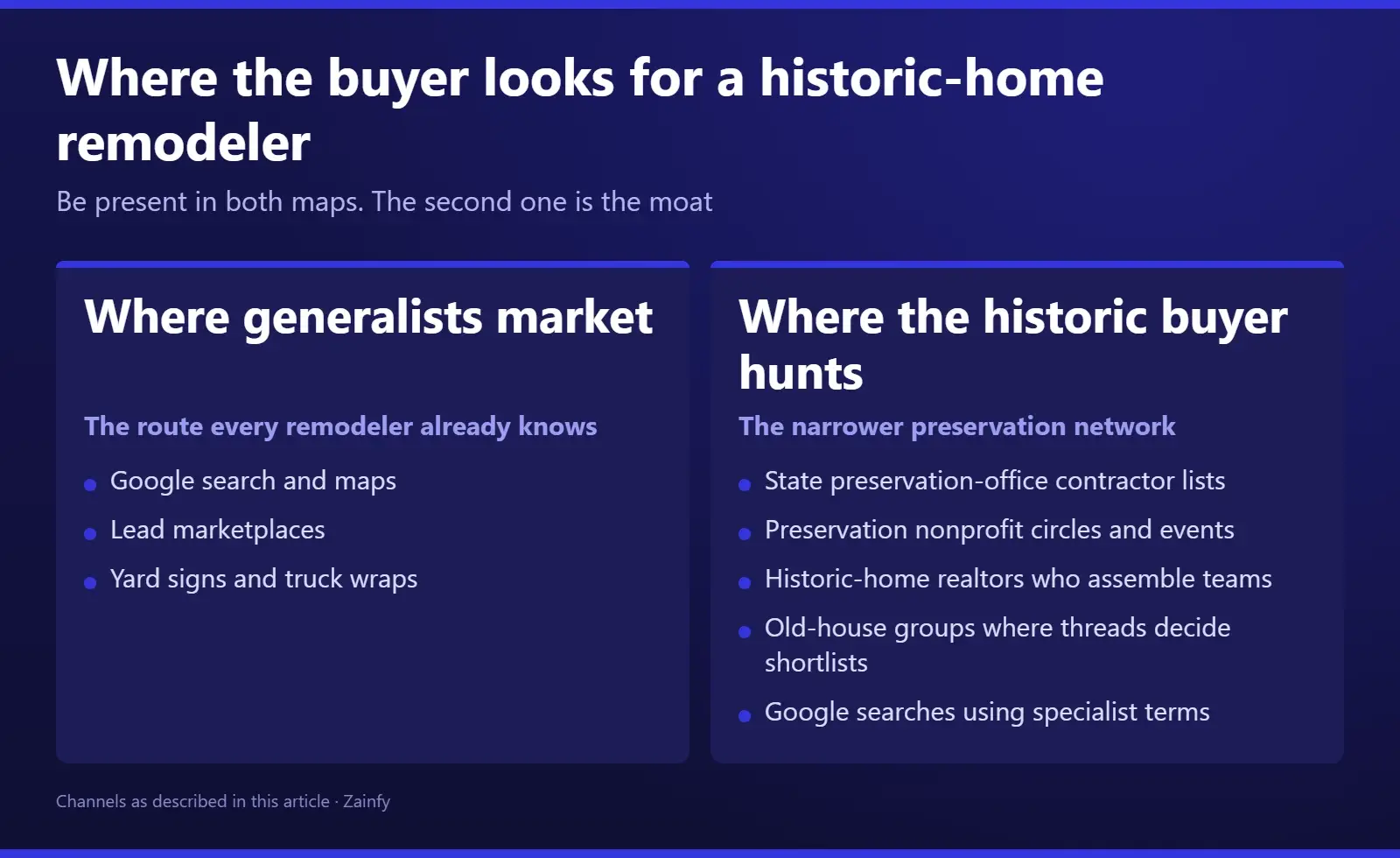
A general remodeler can build visibility around Google, marketplace listings, yard signs, and a truck seen in the right neighborhood. The historic-home buyer uses those routes too, but the shortlist often forms inside a narrower preservation network.
The Georgia Historic Preservation Division, the state’s SHPO, belongs in that network because national preservation guidance directs owners toward state preservation offices when seeking qualified professionals. Historic-home realtors assemble teams for buyers who need more than a standard inspection and closing. Preservation architects know which contractors understand old assemblies. Old-house Facebook groups turn one detailed recommendation thread into a shortlist.
Historic Savannah Foundation is another local center of gravity. Founded in 1955, its Revolving Fund has helped save more than 400 endangered historic buildings since the early 1960s. A contractor does not earn trust in that orbit by inserting a logo into a brochure. Trust comes from visible work, participation, and referrals grounded in actual preservation outcomes. The search side of that trust is how remodeling visibility is built across Georgia.
The existing Savannah field understands this. Specialists visible around historic work often present long track records and dedicated preservation evidence. A generalist competing only for “remodeling Savannah” may never enter the same consideration set.
Search still matters, but it is one part of the map. The strategic point is immediate: be findable where preservation-minded owners and their advisers already exchange names.
Stop hiding behind word of mouth
“The best contractors do not advertise” is poor advice for historic work.
Word of mouth reaches the Savannah neighbors who already know your name. It misses the buyer who just closed on a Victorian, moved into Chatham County, and has no preservation contractor in her phone. Buyer-side old-house threads show that person actively failing to find the specialist.
Do not answer by marketing yourself as a company that does everything. The historic buyer reads an undifferentiated service list as more risk to investigate. Say what you know, where you have worked, and what approvals or materials you have handled.
Specialist scarcity can support pricing power, but there is no verified percentage for a “historic premium.” Do not invent one. The defensible advantage is that a qualified specialist is harder to substitute, and preservation-minded owners may wait or pay more for the right fit. Own that position in public or leave the shortlist to firms that do.
Marketing the historic niche: quick answers
[wps_faq style=”classic” question=”Should a remodeling contractor specialize in historic-district work?”]Yes, when the contractor has real preservation experience and operates in a market with enough relevant housing. In Savannah, 13.6% of housing units predate 1940 and the city recognizes nine local historic or conservation districts. That gives the niche a defined stock of properties and a vocabulary buyers already use. Specialization turns COA approvals, material knowledge, and district work into a position a generalist cannot claim honestly. It does not require rejecting every modern project. It requires making the strongest defensible work easy to recognize, so the right Savannah buyer knows why this company belongs on the shortlist.[/wps_faq]
[wps_faq style=”classic” question=”What do historic-home owners ask before hiring a contractor?”]They ask about similar-scope experience, preservation-board approvals, references, and how the contractor handles original material. The answer to a plaster question can matter more than a broad claim about craftsmanship: automatic replacement with drywall may signal that the company does not understand the owner’s priorities. A Savannah contractor should answer with specific evidence, such as a COA-approved project, a repaired original feature, or work completed under the Secretary of the Interior’s Standards. The buyer wants to know how you make decisions when preservation and construction convenience pull in different directions. Show that judgment before requesting the estimate.[/wps_faq]
[wps_faq style=”classic” question=”Is historic restoration a profitable niche for a remodeling business?”]It can be, because specialist scarcity reduces direct substitution and the buyer is screening for competence rather than price alone. No reliable source establishes a numeric Savannah “historic premium,” so a contractor should not build projections around one. The stronger demand-side fact is Georgia’s rehabilitation credit: 25% of qualifying expenses, capped at $100,000 for a personal residence. That incentive can help an eligible owner fund the correct scope, but the Georgia Department of Community Affairs determines certification, not the contractor. Profitability still depends on estimating old-house uncertainty correctly and selling expertise without promising tax outcomes.[/wps_faq]
Put the proof you already paid for to work
Pull the files for your last three board-approved projects this week. For each one, record the district, the approved scope, the historic feature retained, and the person who can verify the result. That gives you raw material for a specialist position without inventing a claim or staging another project. That position gets proved on the credentials page that market checks first.
Then review every public description of the business. If “full-service remodeling” is doing all the work, replace that fog with the preservation evidence you can defend. In a city with nine local districts, the generalist label can be the most expensive thing a qualified Savannah remodeler owns.
The search side of claiming that position runs through remodeling SEO in Savannah, but ranking cannot manufacture credentials that never appear in the business’s message. Put the proof in order first. Search visibility can then carry a position worth finding.