In Savannah, your remodeling website has to prove to a Chatham County historic-district client that you know how Certificate of Appropriateness work is handled before she ever calls. That is the job most national contractor templates miss. They can show a clean kitchen, a phone number, and a license line, but they do not explain why a Landmark District owner should trust you with a board-reviewed exterior change or an older-home addition.
That matters because Savannah is not a one-note remodeling market. A homeowner near the Downtown/Landmark Historic District is not only asking whether you do good work. She is asking whether you understand the local preservation path well enough that she will not have to educate you during the first estimate.
This guide is for the contractor owner who already has the work history but has never made the website carry that proof.
The goal is not to turn your website into a preservation manual. It is to make the right proof visible early enough that the client keeps reading.
The client is screening you before she calls
A general renovation client looks at your website and asks a simple set of questions: does the work look clean, do the reviews feel real, is there a phone number, and can she tell what you build?
A Landmark District or Victorian-district client adds another screen on top of that. She wants to know whether you have handled older homes, public-facing exterior details, district expectations, and COA paperwork before. She may not know the names of the boards yet. She may not understand the whole Chatham County-Savannah MPC process. But she does know that a careless contractor can turn a straightforward improvement into a drawn-out approval problem.
That changes what the website has to do in the first few seconds on a phone.
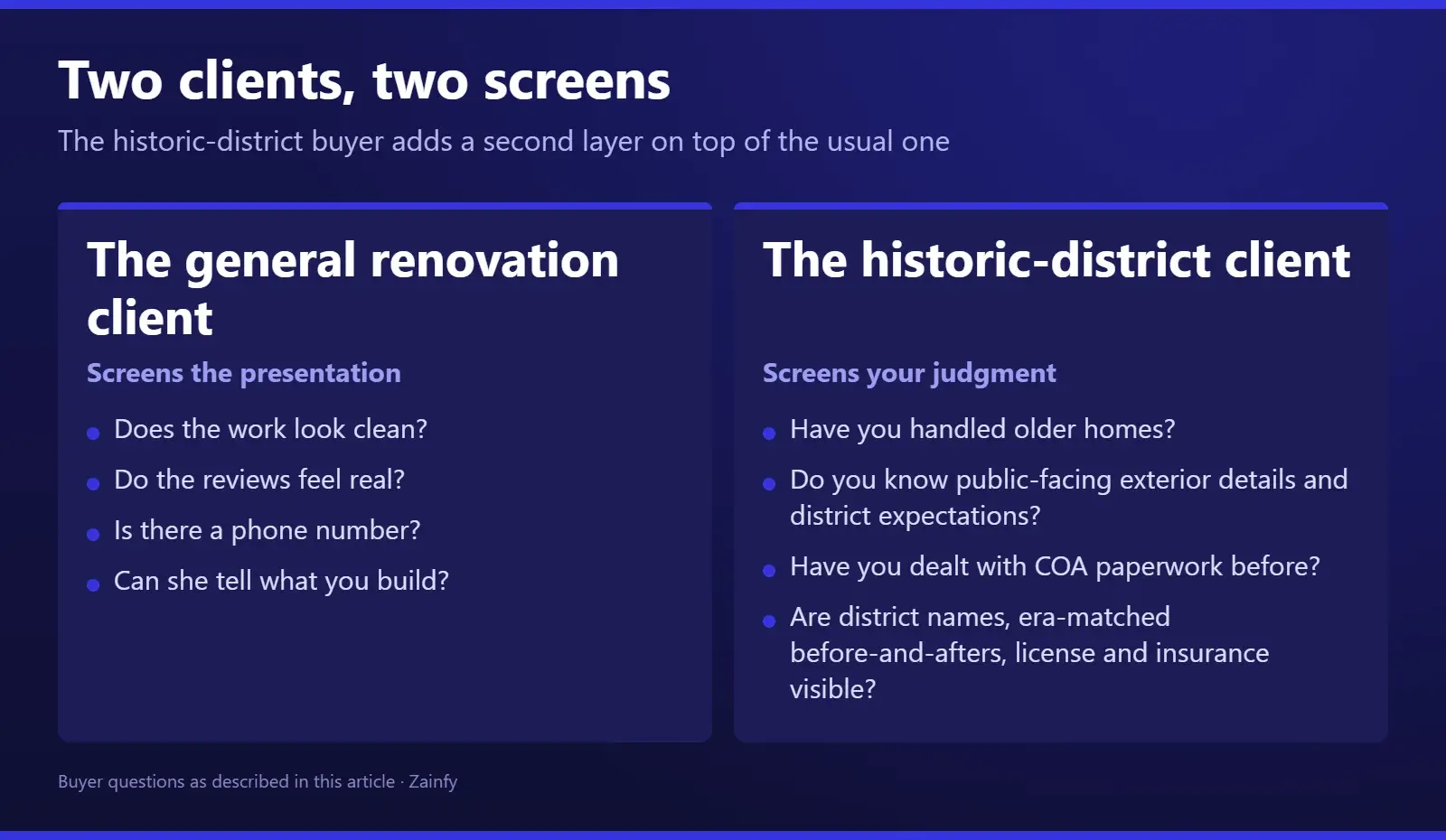
The generic buyer can be reassured by a polished homepage. The historic-home buyer is looking for signs of judgment: district names, before-and-after work on houses like hers, visible license and insurance, and language that shows you know preservation review is part of the job. National preservation directories train these owners to look for affiliations, preservation-office familiarity, and projects from a similar era. Your site does not need to sound institutional, but it does need to answer that standard.
If the homepage looks like every other remodeler site in Georgia, she has to assume the rest of the process will be generic too. That is the problem.
For Savannah historic work, trust is not just design taste. It is evidence that you understand what a COA-sensitive project requires before the first appointment.
The credentials a Savannah historic-district client screens for
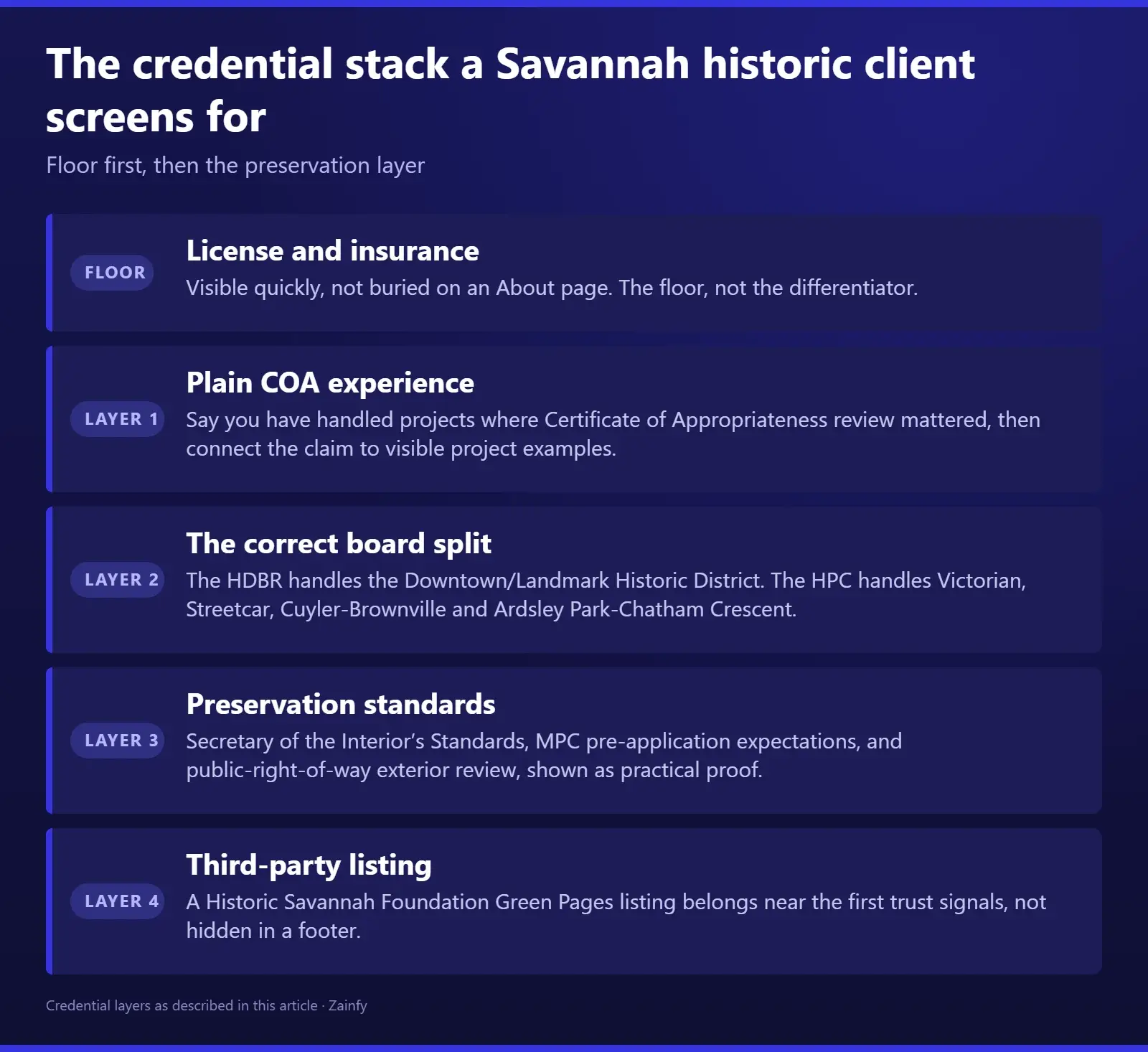
License and insurance belong where a client can see them quickly. They are the floor, not the differentiator. If those details are buried on an About page, the site is making a careful buyer hunt for basic reassurance before she even gets to the preservation question.
The preservation layer is where the site starts doing Savannah-specific work.
Start with plain COA experience. Do not turn it into a vague “historic renovation” claim. Say that you have handled projects where Certificate of Appropriateness review mattered, then connect that claim to visible project examples.
Next, separate the review boards correctly. The Historic District Board of Review handles the Savannah Downtown/Landmark Historic District. The Historic Preservation Commission handles local historic and conservation districts such as Victorian, Streetcar, Cuyler-Brownville, and Ardsley Park-Chatham Crescent. A contractor site that blurs those two together sounds careless to the buyer who has already been reading MPC pages.
Then show the preservation standards you work around. Familiarity with the Secretary of the Interior’s Standards, MPC pre-application expectations, and public-right-of-way exterior review should appear as practical proof, not as a wall of credentials. If you are listed in the Historic Savannah Foundation Green Pages, that belongs near the first trust signals, not hidden in a footer. A formal qualifications statement can help on larger projects, but only if the rest of the page is readable.
This is exactly where remodeler websites for the Historic District has to differ from a standard contractor brochure: the site must present preservation credentials as buying evidence, not decoration.
Use that discipline on service pages. If a kitchen page mentions older homes, it should point the reader toward a project that proves the claim. If an exterior page touches visible changes from the public right-of-way, it should make the COA context easy to find. The credential layer should feel built into the site, not pasted beside the logo.
Your portfolio is where COA experience proves itself
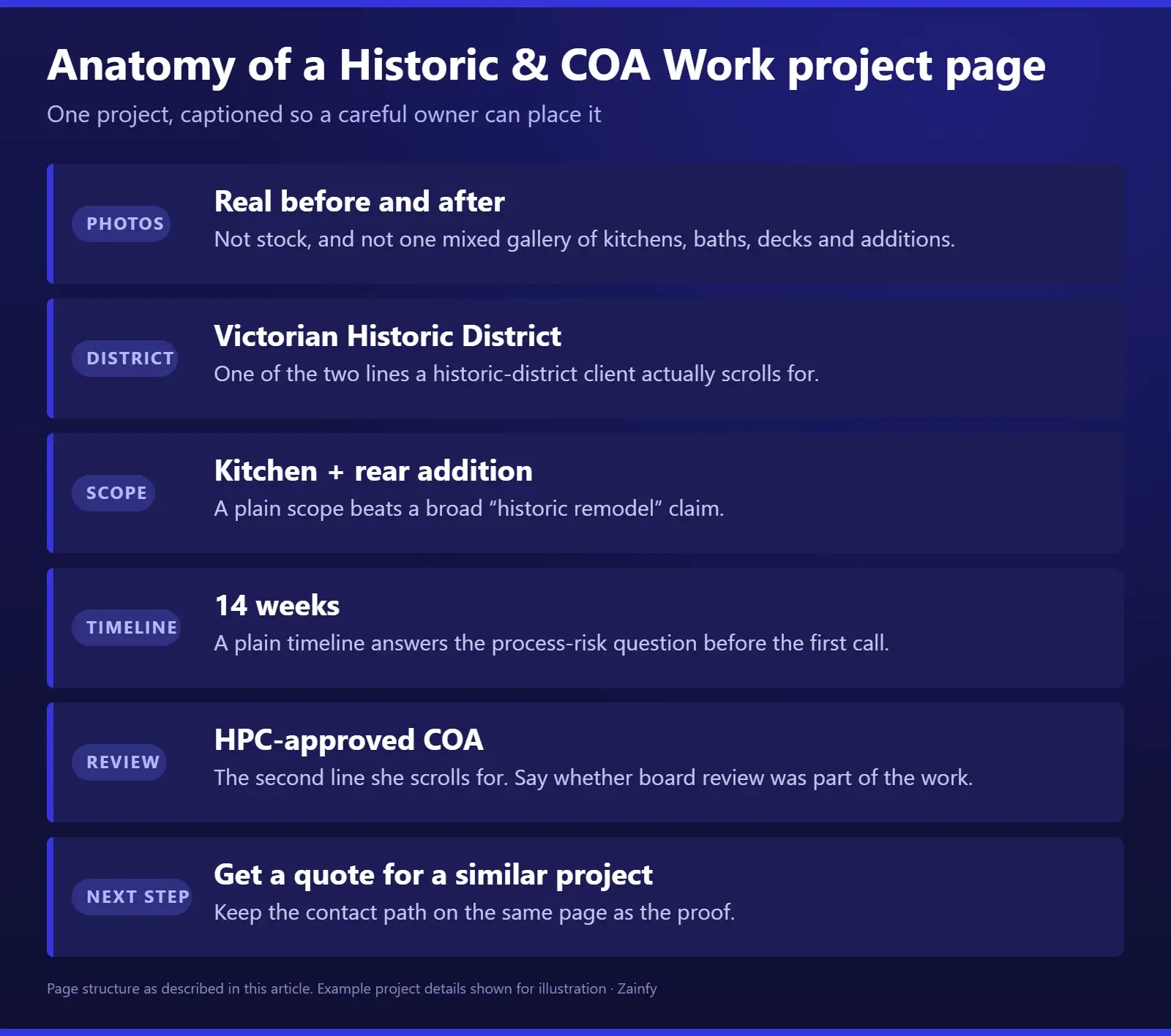
Credential claims do not carry much weight until the portfolio backs them. A Savannah remodeler who wants historic-district work should not send every visitor into one mixed gallery of kitchens, baths, decks, and additions. Build a dedicated “Historic & COA Work” page and let it do one job. Each project should name the district, show real before-and-after photos, state the scope, give a plain timeline, and say whether board review was part of the work. A Victorian-district kitchen should not sit beside a suburban bath with no context. A Cuyler-Brownville porch should be captioned differently from an Ardsley Park addition. The point is not to make the page longer. The point is to help the owner see work that feels close to her house and close to the process she is trying to survive. “Historic remodel” is too broad on its own. “Victorian Historic District kitchen, rear addition, HPC-approved COA, 14 weeks” is proof. If you have a preservation award, show it beside the relevant project. If you do not, do not fake the posture. A strong project page can still work with only the facts: the district, the visible condition before work began, what you changed, what had to stay, what review body mattered, and what the finished exterior or interior now shows. That is the difference between a gallery that says “we have photos” and a portfolio that answers the COA question.
Where the proof sits, and where it dies
The credentials only work if they are seen.
Put the first proof above the fold: licensed, insured, COA-experienced, and locally specific. A persistent trust bar can carry those cues across the homepage and the project pages without forcing the client to dig.
Do not make the About page carry the whole burden.
The About page still matters. It can explain your origin, your crew, your preservation work, and why you understand older Savannah homes. It can show team photos and a more complete qualifications story. But it is not where the buying decision begins.
That decision starts on the homepage and continues through the first project page she opens on her phone.
Era-matched references help here. A testimonial from a Landmark District exterior project answers a different fear than a general five-star line about clean work. A reference from an older-home kitchen in Ardsley Park can support a kitchen page. A Cuyler-Brownville porch comment belongs near porch or exterior work.
Keep the reference close to the thing it proves. A client reading about rear additions should not have to click to a separate reviews page to find out whether you have worked through an HPC-sensitive project before. The supporting quote, the district caption, and the contact path belong in the same decision flow. You can see the same blocks rebuilt across credential blocks rebuilt to be believed.
The closer the proof sits to the decision point, the less the client has to infer. In Savannah historic work, inference is expensive. If she has to guess whether you have dealt with review-board issues before, the site has already made the sales conversation harder. The next question is whether that credential page can be found at all.
The historic-work market you’re building this site to catch
This is not a niche made up by a marketing department.
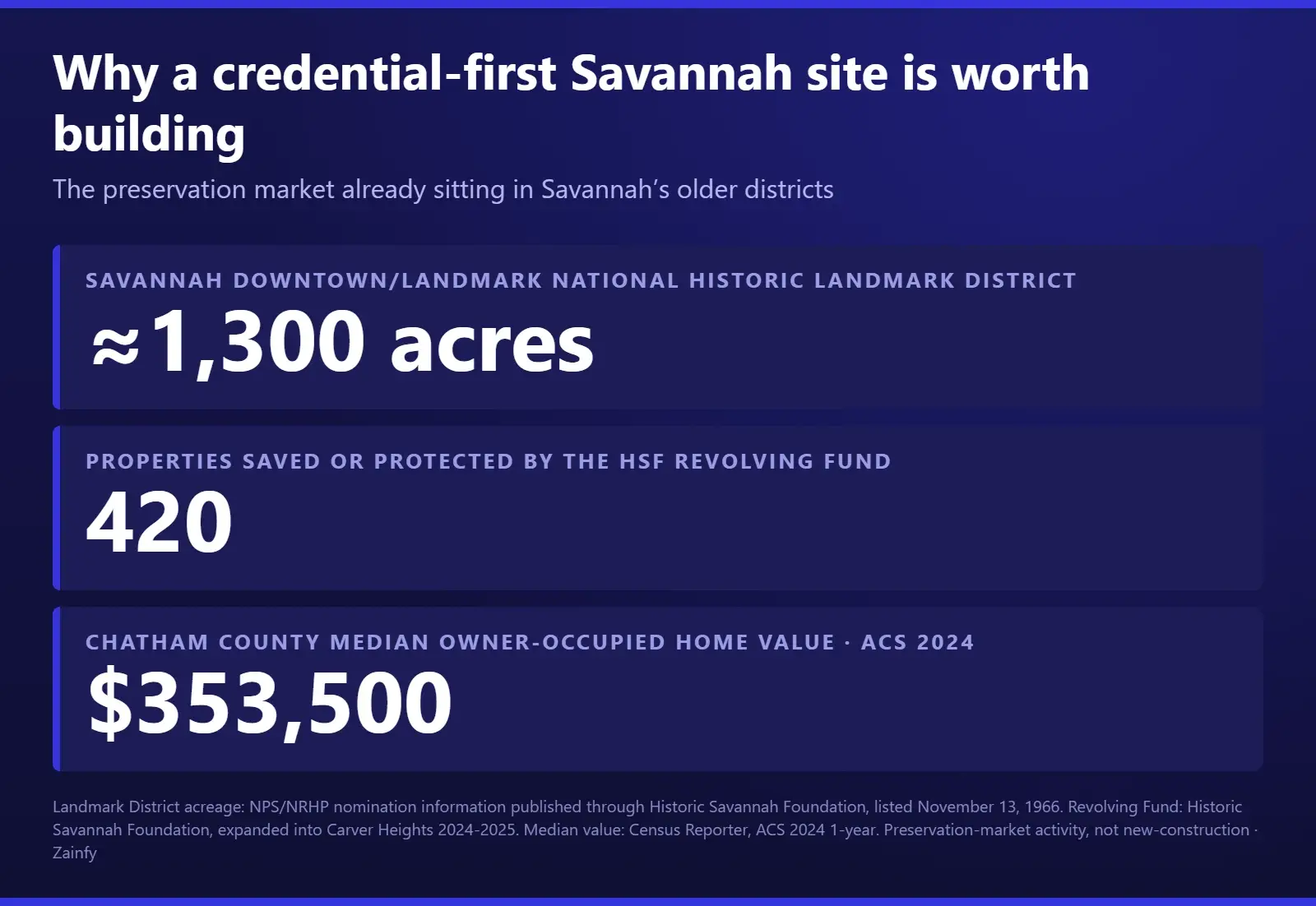
The Savannah Downtown/Landmark Historic District covers about 1,300 acres and was listed on the National Register on November 13, 1966, according to the NPS/NRHP nomination information published through Historic Savannah Foundation. That scale alone gives preservation work a local gravity most Georgia cities do not have.
Historic Savannah Foundation’s Revolving Fund has saved or protected 420 properties, and the program expanded into Carver Heights in 2024-2025. That is not a vanity detail for your website. It is proof that preservation activity is still moving through real neighborhoods, real properties, and real rehab conversations.
Then there is the Chatham County buyer. Census Reporter, using ACS 2024 1-year data, reports a $353,500 median owner-occupied home value, a 56.8% owner-occupied rate, 140,781 total housing units, and $75,063 median household income. For you, those figures are not homeowner price advice. They describe the budget band and ownership base your site has to reassure.
Chatham County also authorized 2,691 new private housing units in 2024, up from 1,672 in 2023, according to FRED’s Building Permits Survey series. That is new-construction context only. It does not prove remodeling demand. The stronger reason to build a credential-first site is the preservation market already sitting in Savannah’s older districts and HSF-backed activity.
The site still has to convert, not just credential
A credentialed dead-end site is still a dead-end site.
It can prove you understand COA work and still fail the owner who is ready to talk. That happens when the phone number disappears on mobile, the contact page asks for too much too early, or the project gallery loads so slowly that the best proof never appears.
The better version is simple and firm. Click-to-call sits in the top navigation. The quote form starts as a two-step path and asks for fewer than five fields at the first pass. The main page set is clear: home, services, Historic & COA Work gallery, service area, and contact. If you serve both the Landmark District and nearby Chatham County neighborhoods, the site should make that service area plain without pretending every page is a separate specialty.
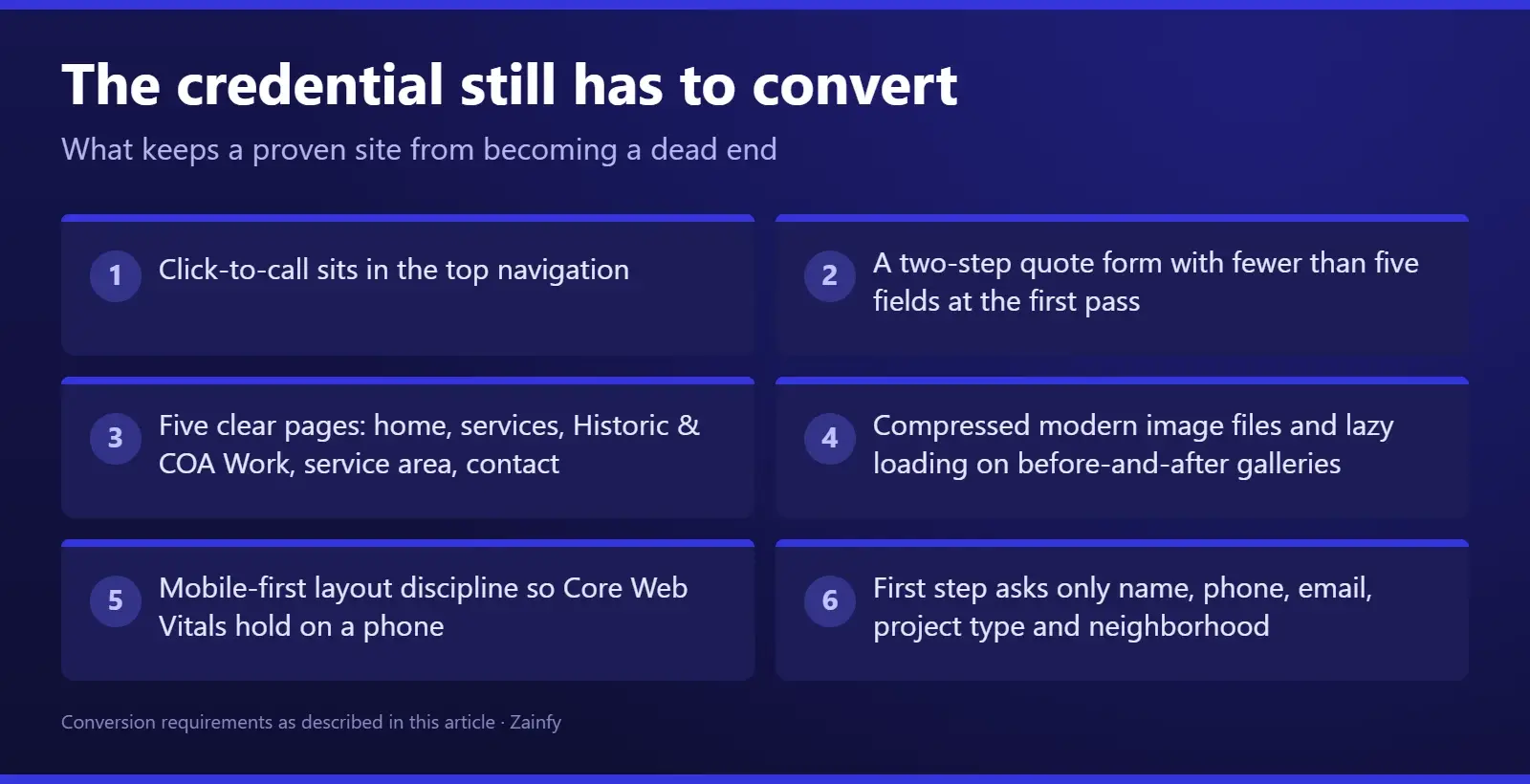
Photo-heavy historic work creates its own technical problem. Before-and-after galleries need compressed modern image files, lazy loading, and mobile-first layout discipline. Core Web Vitals are not an abstract score when a client is standing in a kitchen and comparing two contractors on a phone. If your Victorian-district project photos stall, the credential never gets a chance to persuade.
Structured business details can help search engines understand the company, but the visible page still has to do the hard part: show proof, make action obvious, and let the buyer request the next step without friction.
Do not let the form ask for the whole project story before trust has been earned. Name, phone, email, project type, and neighborhood are enough for the first step. The longer scope conversation can happen after the client has seen that you understand COA-sensitive work and after you know whether the property sits in a Landmark, Victorian, or other local district context.
Don’t claim preservation experience you can’t show
Do not paste “we do historic renovations” on a generic template if you cannot show named, board-reviewed projects behind it.
That is worse than saying nothing.
A Landmark District client vets harder than a quick-flip buyer. The first time she asks for a COA reference and you cannot produce one, you have lost the job and the credibility that might have led to the next one. She is not being difficult. She is protecting a property in a district where visible work can trigger review and where the wrong detail can slow the whole project.
The reverse mistake is just as costly. If you have done the work, do not bury it in one paragraph on an About page or let a drag-and-drop template flatten it into a generic gallery. Own the site structure enough to show the project, the district, the scope, and the review context.
Show real district projects or do not claim the niche.
That is the standard. Not because the wording sounds stronger, but because Savannah’s historic-home client can test the claim in one question.
What a credible historic-remodeler site costs, and what a flat one costs you
A credible historic-remodeler site costs more than filling a template with a logo, a few service blocks, and a contact form. It has to organize proof by project type and district, carry credentials into the first screen, keep a photo-heavy gallery fast on mobile, and turn preservation experience into clear buying evidence.
That is the investment side.
The silent cost is harder to see because it never shows up as a line item. It is the Landmark District estimate never requested because the client could not tell whether you had COA experience. It is the Victorian-district kitchen inquiry that went to a contractor with weaker work but better project captions. It is the Carver Heights rehab conversation you never entered because your site looked like a general handyman page.
Do not invent a conversion rate to justify the rebuild. You do not need one. Historic Savannah Foundation’s 420-property Revolving Fund activity, the 1,300-acre Landmark District, and Chatham County’s $353,500 median owner-occupied value are enough to explain the business case.
The site is not expensive because it has more pages. It is expensive when it fails to prove the one credential this buyer is actively trying to verify.
That is the cost conversation worth having with yourself before a rebuild. Not “how cheap can I get a contractor website?” but “what proof must this site carry so a careful Savannah owner does not leave with unanswered preservation questions?” Those are different projects.
Savannah remodeler websites: quick answers
[wps_faq style=”classic” question=”Do Savannah contractors still need a website in 2026, or is a social profile and business listing enough?”]Yes, Savannah contractors still need a website because a social profile and business listing cannot carry historic-district proof in a controlled way. A Landmark District owner can see photos on a profile, but she cannot easily verify COA experience, HDBR familiarity, insurance, district-specific project captions, and a complete service-area story in one place. Your website is where those pieces belong together. It should show the project, name the district, explain the review context, and give her a direct path to request an estimate. Profiles can support that trust, but they should not be the only place your preservation credentials live.[/wps_faq]
[wps_faq style=”classic” question=”How much should a Savannah remodeler budget for a website?”]Budget for the level of proof the site has to carry, not for a generic contractor-page count. A Savannah remodeler pursuing historic-district work needs more than home, services, and contact. The site has to handle COA-experience signals, a Historic & COA Work gallery, fast-loading before-and-after photos, and trust cues tied to districts such as Victorian or Ardsley Park-Chatham Crescent. The practical question is whether the site can help a Chatham County buyer understand why your preservation experience is real before she calls.[/wps_faq]
[wps_faq style=”classic” question=”What should a Savannah remodeler’s website show to prove historic-district or COA experience?”]It should show named project proof, not a loose claim. Start with license and insurance, then add COA-experience language, the correct HDBR and HPC distinction, and visible references to the Secretary of the Interior’s Standards where relevant. Project pages should name the district, scope, timeline, before-and-after photos, and whether board review was involved. A Victorian Historic District kitchen and a Cuyler-Brownville porch should not be captioned identically. The stronger the project caption, the less the client has to ask during the first call. Savannah buyers looking at older homes are trying to reduce process risk, not just admire finished photos.[/wps_faq]
[wps_faq style=”classic” question=”What pages does a historic-remodeler website need to actually generate leads?”]A historic-remodeler website needs a homepage, service pages, a dedicated Historic & COA Work gallery, a service-area page, and a contact page with a short quote path. The gallery is the difference-maker in Savannah because it lets a client compare her Landmark, Victorian, or Ardsley Park concern against work you have already completed. The contact path matters too: click-to-call in the top navigation and a two-step form with fewer than five first-step fields keeps the next action clear. Historic Savannah Foundation’s Revolving Fund activity shows that preservation work is active; your website has to turn that attention into a real estimate request.[/wps_faq]
The next page to fix is the one a careful client actually reads
Start with one project page.
Pick the historic or older-home job that best proves your judgment. Rewrite it with the district, scope, timeline, review context, and photos that show what changed. Then make sure the homepage points to that page before it asks the client to believe a broad claim about historic renovation.
After that, check the first screen of your site on a phone. If the client cannot see license, insurance, COA experience, and a clear way to call without hunting, the page is underbuilt for Savannah.
The same principle applies beyond Chatham County, but Savannah makes the weakness easier to see: preservation credentials have to be part of the website architecture, not an About-page afterthought. For the broader Georgia view, read how we build remodeler sites statewide and compare that against the proof your own site shows today.