A Savannah remodeling contractor needs social media content built around two advantages he already has: the historic districts he works in and a Chatham County calendar that keeps giving him real moments to post around.
Most contractors waste both.
That is why social media content ideas for remodeling contractors in Savannah should not start with generic design memes, canned tips, or a random photo of River Street. The useful material is already in the job: a porch being rebuilt in Cuyler-Brownville, trim being matched in the Victorian District, a kitchen reveal that still respects the Landmark District house it sits inside.
Savannah also has timing built into it. Hurricane season runs from June 1 through November 30, and the St. Patrick’s Day cycle can pull the city’s attention into one giant local conversation. That does not prove remodeling demand. It does tell you when your feed should stay visible.
If you own the company, the job is not to become a full-time content creator. The job is to turn the work you already paid your crew to produce into proof a Savannah buyer can recognize.
Your best content is standing in the historic district
Savannah gives a remodeler visual material that most national contractor-social guides cannot understand because they are not built around a place like this. The Savannah Downtown Landmark Historic District covers about 1,300 acres, and the wider preservation map includes Victorian, Streetcar/Mid-City, Cuyler-Brownville, and Ardsley Park-Chatham Crescent overlays governed through the Metropolitan Planning Commission. That is not trivia for a caption. It is the reason your feed should look different from a contractor in a newer inland suburb. A reworked iron rail, a porch column repaired instead of replaced, a salvaged newel post, a brick opening brought back into proportion, or trim matched around a modern kitchen tells a stronger story than another polished after-photo with no context. Historic Savannah Foundation and MPC Historic Preservation already understand this visually; preservation photos work because they give people something specific to notice. Your own projects can do the same if you treat the district work as content while the job is happening, not after the dumpster is gone. If exterior work involved HRB or MPC review, do not turn that into a lecture. Use it lightly: “approved exterior repair,” “period detail preserved,” “porch rebuilt to match the block.” Get client approval before posting the address, the facade, or any detail that makes the home too identifiable. Then use the project as the spine of the feed. That is the difference between posting “beautiful remodel” and showing a Savannah homeowner that you understand the house type, the district, and the care required. It is also the way content that fits a historic coastal market should be understood: not as a pile of random posts, but as a steady record of real work shaped by the city around it.
The before/after is the post – shoot it like it matters
Before-and-after content fails when the “before” is an afterthought.
On a Savannah project, take the first photo before anyone starts moving tools. Stand in the same corner you will use later. Hold the phone at the same height. If the room has tall windows, exposed brick, plaster lines, old flooring, or a stair detail, frame the shot so those features are visible from the start.
Then shoot the work in layers.
Get the wide before and wide after, but do not stop there. Film the salvaged newel post before it is cleaned up. Shoot the re-milled trim on the bench. Take a short clip of a Cuyler-Brownville porch rail being fitted. Capture one behind-the-scenes job-site moment that shows care without turning the crew into performers. The point is not to make the project look busier than it was. The point is to record the decisions a higher-trust client actually cares about.
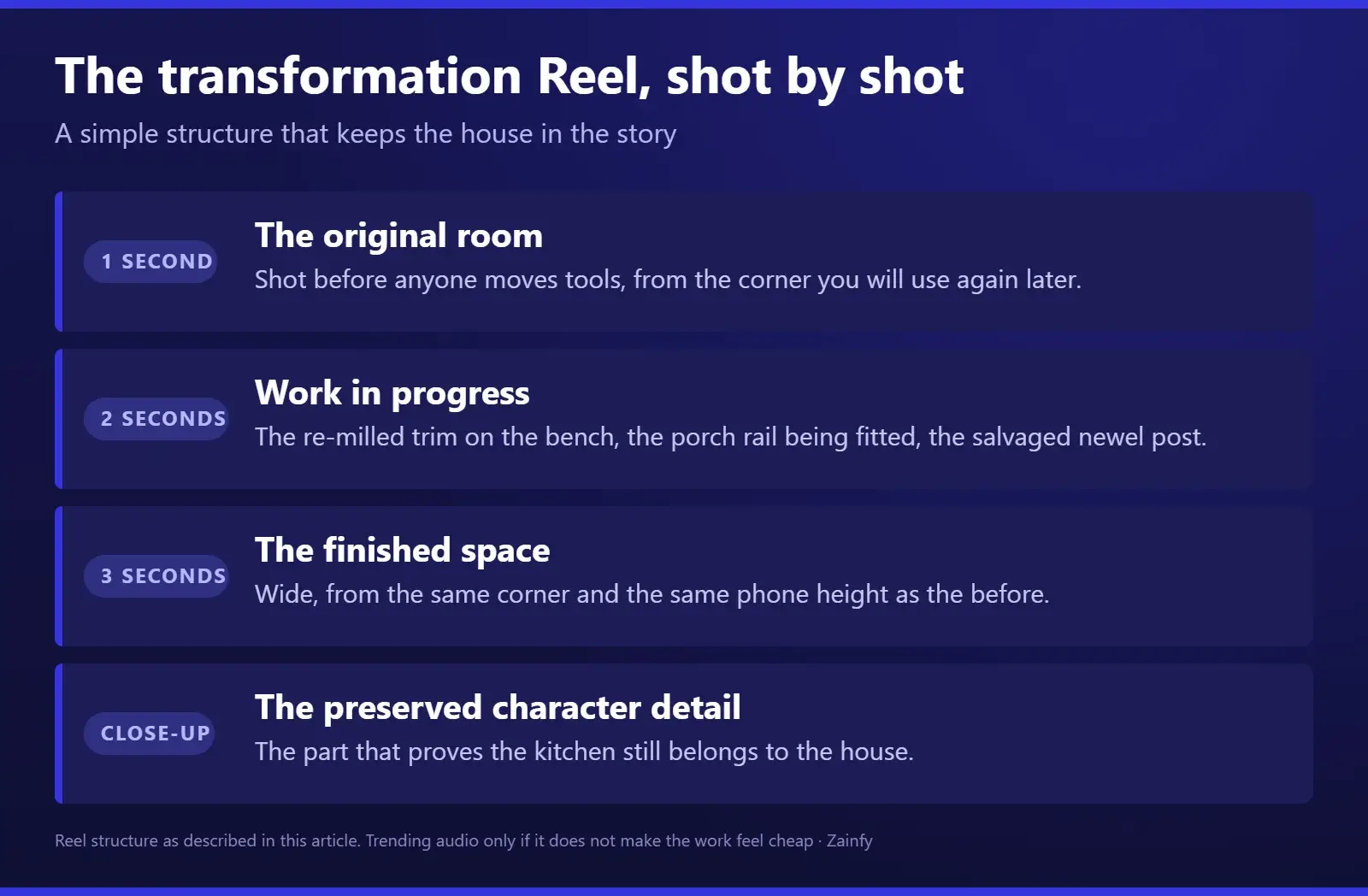
A transformation Reel can be simple: one second of the original room, two seconds of work in progress, three seconds of the finished space, then one close-up of the preserved character detail. Trending audio is fine if it does not make the work feel cheap. If the sound makes a Victorian-district kitchen feel like a joke, skip it.
Time-lapse works best on contained scopes: a porch repair, tile wall, cabinet install, or exterior detail. Do not film twelve hours of messy movement and hope it becomes interesting. Pick the part of the job where the viewer can understand progress.
The contractor instinct is to show the new kitchen because that is where the money went. In Savannah, the stronger post often shows how the kitchen still belongs to the house.
Shoot the character, not just the kitchen.
Which platform actually fits a Savannah remodeler
Not all of them.
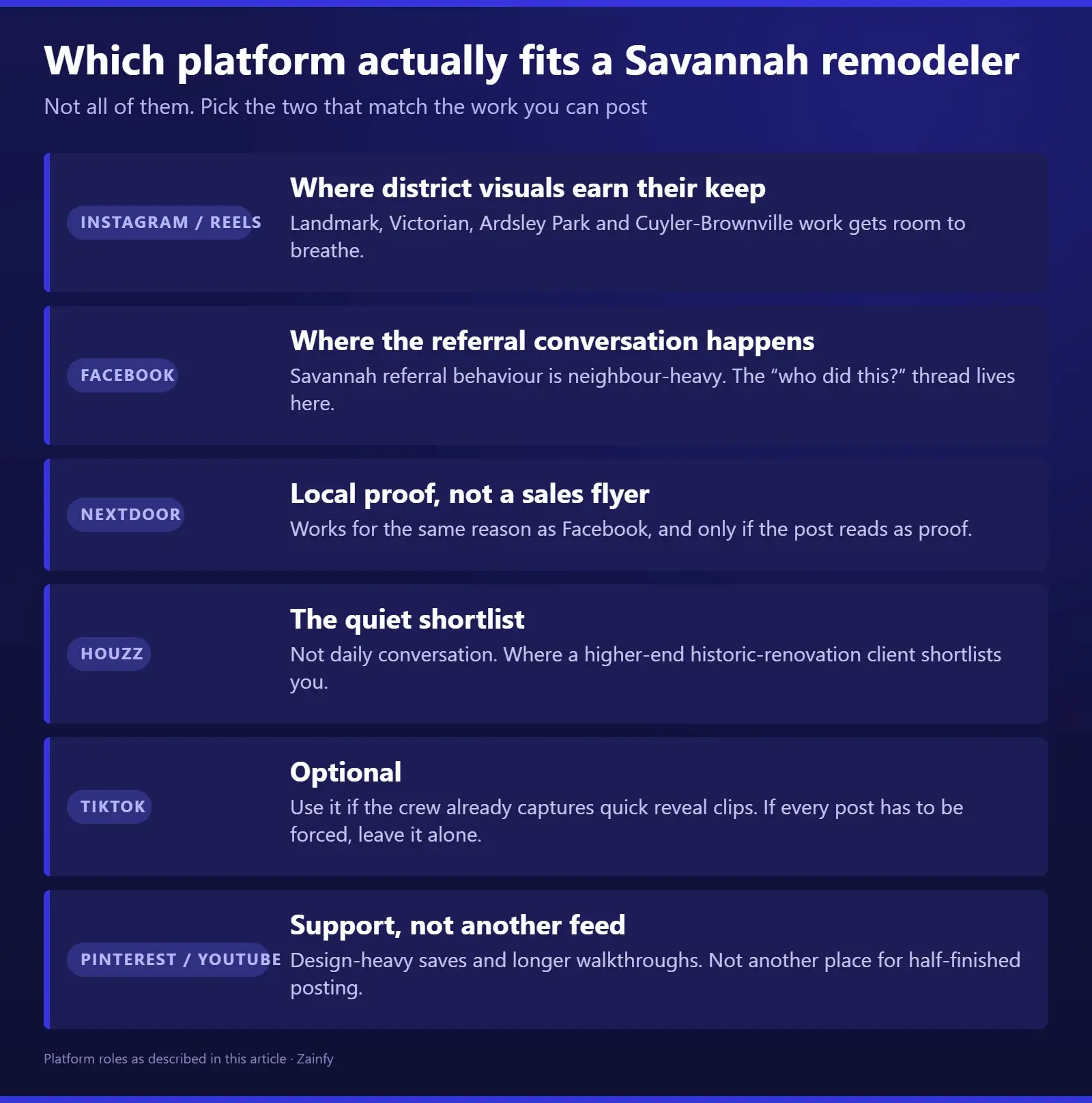
Instagram and Reels are where historic-district visuals earn their keep. If your work photographs well in the Landmark District, Victorian District, Ardsley Park, or Cuyler-Brownville, those channels give the project room to breathe.
Facebook still matters because Savannah referral behavior is neighbor-heavy. A homeowner may see the Reel on Instagram, but the “who did this?” conversation often happens in a neighborhood thread, a local group, or a private message.
Nextdoor can work for the same reason, but only if the post feels like local proof instead of a sales flyer.
Houzz is different. It is not where you build daily conversation. It is where a higher-end historic-renovation client may quietly shortlist you after seeing enough finished work to believe you can handle the house.
TikTok is optional. If your crew already captures quick reveal clips and you are comfortable with a younger audience, use it. If every TikTok post has to be forced, leave it alone.
Pick the two platforms that match the work you can actually post. A Savannah contractor with strong district visuals and referral-heavy clients is usually better off doing Instagram/Reels and Facebook well than pretending to feed five channels.
Pinterest and YouTube can support specific project types, especially design-heavy saves or longer walkthroughs. They should not become another place for half-finished posting.
The Savannah calendar decides what you post, and when
Savannah’s social calendar is not a blank twelve-month grid.
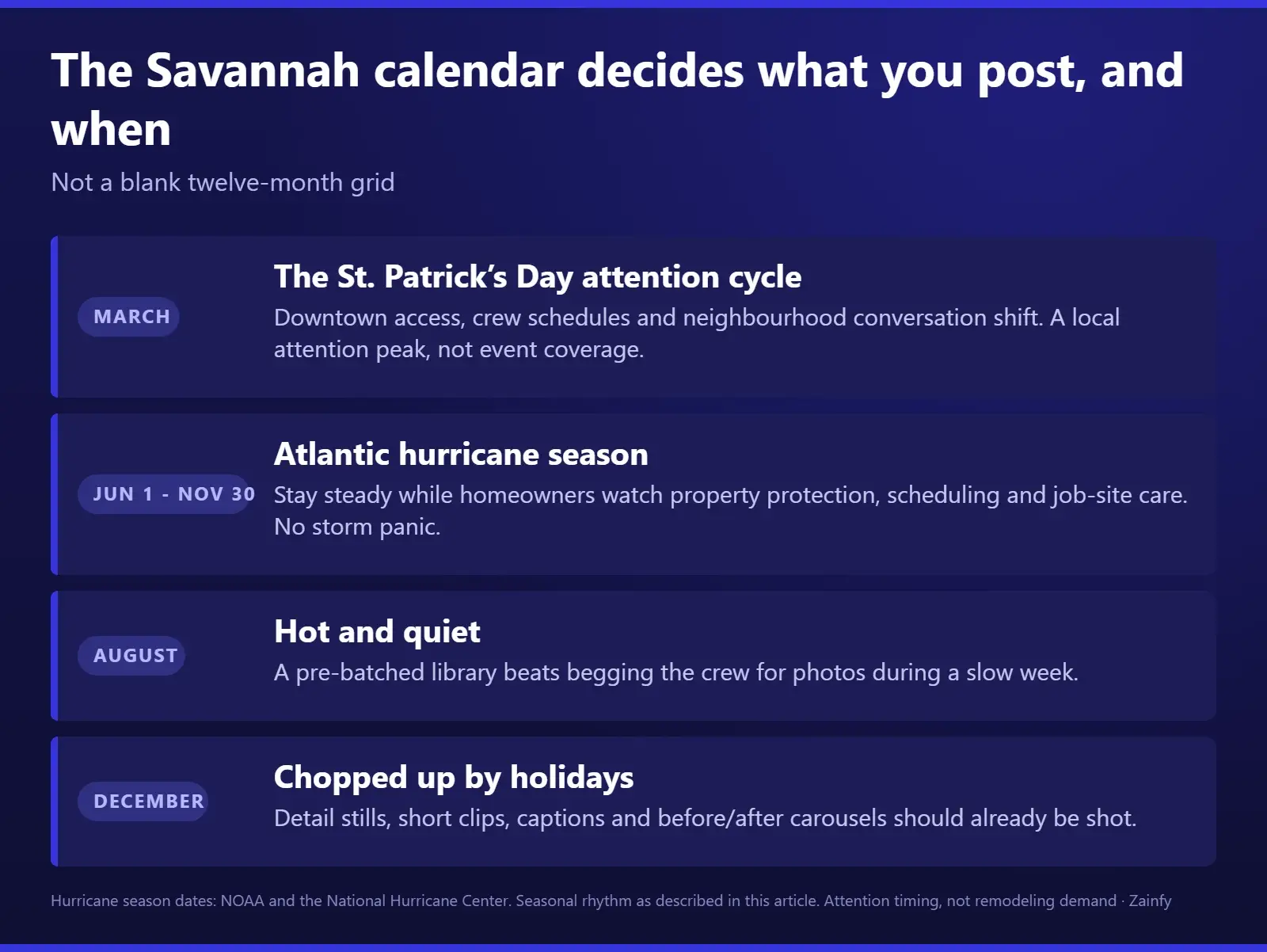
Start with the coastal reality. Atlantic hurricane season officially runs June 1 through November 30, according to NOAA and the National Hurricane Center. For a contractor, that does not mean posting storm panic or pretending every weather event creates renovation work. It means the feed should stay steady when homeowners are paying attention to property protection, scheduling, job-site care, and whether local companies are still operating cleanly.
That content can be practical without becoming homeowner how-to. Show how you protect an in-progress porch repair before a storm week. Show materials stored off the floor. Show a wrapped opening on a historic exterior. If you mention Tybee Island, CEMA, or Hurricane Matthew, keep the point narrow: the coast has real exposure, and a contractor’s online presence should not disappear when the season gets tense.
Spring has a different rhythm. Savannah’s St. Patrick’s Day cycle pulls local attention toward downtown, access changes, crew schedules, and neighborhood conversation. That is not remodeling data. For your feed, it means March is a local attention peak. A location-tagged project post, a crew culture photo, or a “working around downtown access this week” update can ride the moment without pretending to be event coverage.
Then there are the quiet months.
August is hot. December gets chopped up by holidays. A storm month can interrupt calls. Those are the months when a pre-batched library saves you. If you shot three projects properly in spring and early summer, you are not begging the crew for photos during the slow week. You already have detail stills, short clips, captions, and before/after carousels ready.
Use location tags when the place is real: Cuyler-Brownville, Ardsley Park, Victorian District, downtown Savannah, Tybee-adjacent exterior work. Use local hashtags sparingly. A tag cannot carry a weak post, but it can help a strong local post land in the right feed.
One district project, a month of posts
The weak version is one-and-done: finish the porch, post one after-photo, write “another happy customer,” and move on.
That wastes the job.
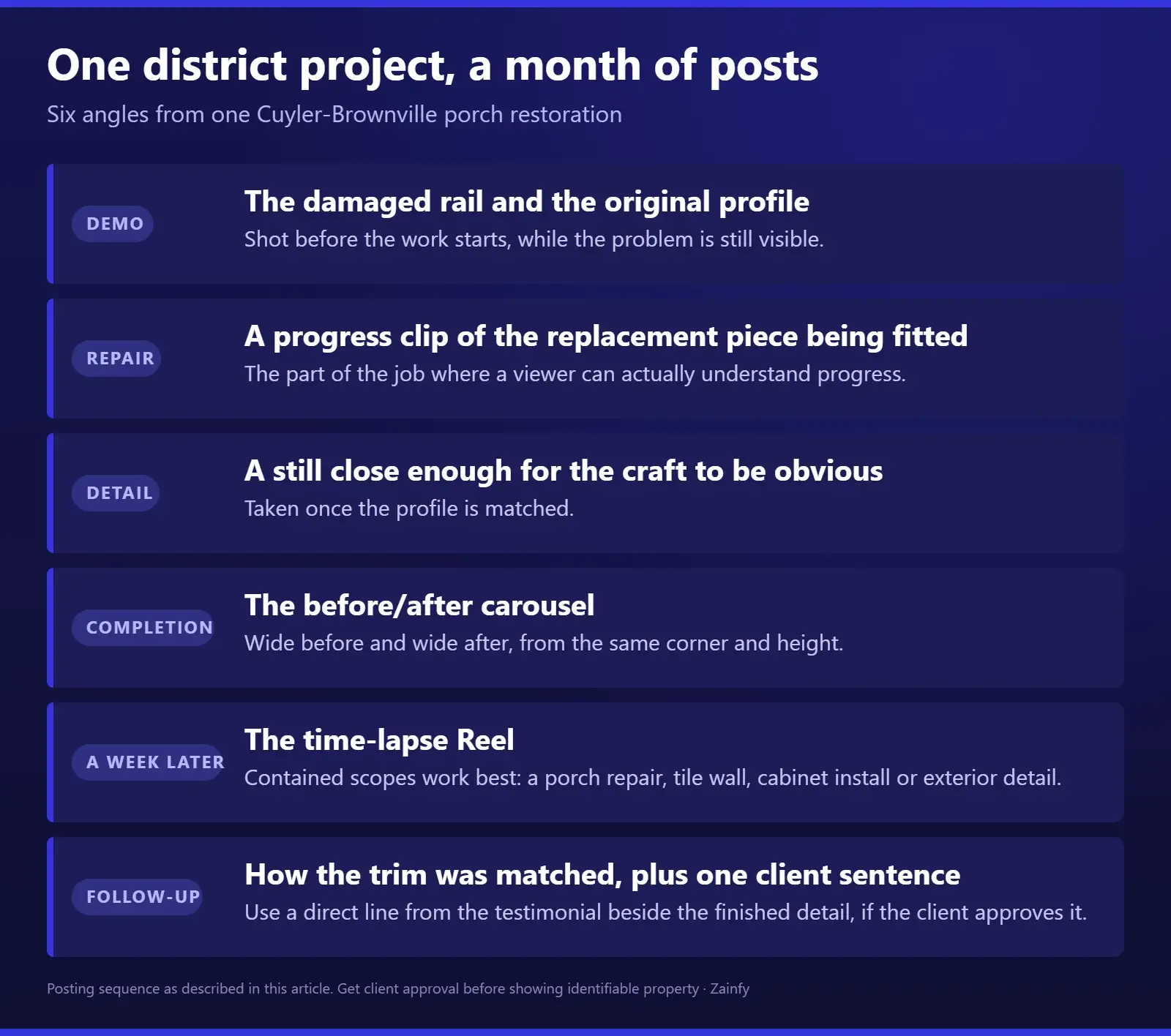
A single Cuyler-Brownville porch restoration can produce a month of useful social without becoming repetitive. During demo, shoot the damaged rail and the original profile. During repair, film a progress clip of the replacement piece being fitted. When the detail is matched, take a still photo close enough for the craft to be obvious. At completion, post the before/after carousel. A week later, use the time-lapse Reel. Then post a short explanation of how the trim was matched. If the client approves a testimonial, use one direct sentence from it beside the finished detail.
That is not six versions of the same post. It is six angles from one real job. A Georgia studio posting to a design-literate audience built a year of content on exactly that habit.
That method works for a Victorian-district kitchen, an Ardsley Park bath, or a downtown exterior repair. The difference is the center of gravity. A modern suburban kitchen may lead with layout and finish. A Savannah district project should also show restraint, preservation, and the parts of the house that were kept alive.
Add one crew post only if it says something useful. A carpenter shaping a replacement porch piece is stronger than a smiling group photo in front of a truck. The owner reading this knows the difference. The homeowner does too.
Does any of this get leads, or just likes?
Social earns attention. The lead closes in the message thread and off-platform.
That distinction matters for a Savannah contractor because a pretty Ardsley Park Reel can get saved, shared, and discussed without producing a clean form fill right away. The buyer may tap your profile, send a DM, look for the quote link, check your Google Business Profile, then ask a neighbor whether they have heard of you.
Make that path obvious.
Your profile needs a clear quote route. Your DMs need a simple reply process: project type, neighborhood, timing, and whether the client owns the property. Your captions should tell the viewer what they are looking at, not beg for engagement. “Cuyler-Brownville porch rail matched to the existing profile” is more useful than “What do you think?”
Cadence should be boring enough to survive. One solid Reel a week for a year beats a two-week burst followed by silence. Add one carousel or progress post when the project gives you material. Use location tags when they are true. Put the finished photo where a searcher can still find it later, including your Google Business Profile photo feed when appropriate.
Do not judge this only by likes. Judge it by saved posts, DMs with project details, quote-form visits, repeat profile views, and whether real Savannah neighborhoods keep showing up in the conversation.
Stop posting other people’s Savannah
Do not fill your feed with reposted downtown scenery, generic design memes, and trending-audio filler while your own historic-district projects sit unshot on your phone.
Borrowed Savannah gets tourist likes, not homeowner leads.
That sentence is harsh because the mistake is expensive. A photo of Forsyth Park may get attention from people who like Savannah. It does not prove you can repair a porch in Cuyler-Brownville, protect a job during hurricane season, or finish a bathroom in a house with old framing and uneven floors.
Your feed should show your work. Real projects. Real details. Real neighborhoods when the client allows it.
Get permission before posting identifiable client property. Be careful with addresses, family details, and interiors that reveal too much. But do not use privacy as an excuse to post nothing. You can show hands, materials, close-ups, process, and finished detail without turning the client’s home into a public tour.
Also, do not let the feed go dark through August, December, and hurricane season. Those are exactly the windows when a Savannah owner needs a bank of posts ready. An inactive feed in the months buyers are actually planning reads as a business that’s gone.
Show your own district work, and keep showing it.
What it costs to run this properly
The cost is not just what you spend to keep the feed moving.
The hidden cost is the referral drought when August, December, and a storm month line up and the phone gets quiet. If your only marketing habit is waiting for the next referral, a silent feed gives a cautious buyer nothing to check when your name finally gets mentioned.
Do not invent a monthly number because another contractor-marketing article gave one. The right investment depends on who captures the job-site material, who writes the captions, how many platforms you keep alive, and whether the owner has to approve every post.
The useful comparison is simpler: can you maintain a historic-content and coastal-season calendar without distracting the crew or producing weak filler?
Chatham County’s median owner-occupied home value is $353,500, according to the 2024 ACS figure. Frame that from your side of the table. Your Savannah clients are making renovation decisions inside a serious budget band, and your content has to look like it belongs in that conversation. A half-dead feed, a few reposted tourist shots, and no visible proof of district work do not match the buyer you are trying to win.
Savannah remodeler social media: quick answers
[wps_faq style=”classic” question=”Does social media actually get a Savannah remodeling contractor leads, or just likes?”]It can get leads when the post creates a clear path from attention to a real conversation. A Landmark District before/after may start as a save or share, but the lead usually appears later through a DM, quote-form visit, profile check, or neighbor referral. Build for that path. Show the project, name the district only when appropriate, explain the scope in plain contractor language, and make the next step easy to find. Likes are a weak scoreboard by themselves. A message from an Ardsley Park owner asking about timing, budget range, and exterior constraints is worth more than casual reactions from people who only like Savannah scenery.[/wps_faq]
[wps_faq style=”classic” question=”What should a Savannah remodeler post to show historic-district work?”]Post the proof that the house kept its character while the scope got done. In the Landmark, Victorian, Cuyler-Brownville, or Ardsley Park-Chatham Crescent areas, that means before/after carousels, close-ups of matched trim, porch repairs, preserved brick, progress clips, and finished shots that show restraint. If exterior work touched review-board or COA-sensitive details, keep the wording simple and accurate. Do not turn the caption into a code seminar. Get client approval before showing identifiable property, then use the project to show judgment. A Savannah buyer should be able to see that you know the difference between replacing old material and keeping a historic house legible.[/wps_faq]
[wps_faq style=”classic” question=”How often should a Savannah remodeler post, and does the tourist and storm calendar change it?”]Post at a pace you can hold when the job schedule gets ugly. One useful Reel per week, supported by a carousel or progress post when you have material, is stronger than daily posting for two weeks and silence afterward. Savannah’s calendar does change the rhythm. Hurricane season runs June 1 through November 30, so coastal-preparedness and still-operating updates matter during that window. March brings the St. Patrick’s Day attention cycle, when downtown access and local conversation shift for contractors working nearby. August and December need batched posts ready before the slowdown hits. Put those posts in the job folder before the busy crews scatter.[/wps_faq]
[wps_faq style=”classic” question=”How much should a Savannah remodeler budget for social media management?”]Budget around the amount of real work required, not a fake price band. A useful Savannah feed needs project capture, caption writing, scheduling, light community response, owner approval, and enough local judgment to avoid tourist filler. If you work in Chatham County’s $353,500 median owner-occupied value market, the feed has to speak to buyers making serious renovation decisions, not people casually liking downtown scenery. The owner should decide who collects job-site photos first, especially on Landmark District or Ardsley Park jobs where details disappear fast. If no one is responsible for capturing the work, no monthly spend fixes the hole. The cheapest broken system is still broken.[/wps_faq]
The next step is a photo habit, not another blank calendar
Start with the next active job.
Before the crew begins, decide what the post will need: one wide before, one matching after, three detail shots, one progress clip, one note about the decision that made the work better. Put that in a shared folder before the project disappears into memory. Those posts need somewhere to land — five signs the site is losing coastal clients.
For the next four weeks, do not chase every platform. Pick the two that fit the work and the buyer. If the job is a Cuyler-Brownville porch or a Victorian-district kitchen, Instagram/Reels and Facebook are enough to prove the habit. If you serve a wider Georgia contractor market and need the Savannah approach to fit into a broader organic social system, study how we handle social for Georgia remodelers and keep the local proof intact.
A Savannah feed does not need more scenery. It needs evidence that the owner knows what is worth shooting before the crew covers it up.