If you own a Flint remodeling company, this is the SEO work MBC Building & Remodeling went through, in order, with a clear test for what “finished” meant at each stage. MBC is a Flint kitchen remodeler, and its record makes this more useful than a generic collection of ranking factors. The checklist is short: four blocks. First, record the starting numbers. Then make the site readable, map search terms to live pages, resource the off-site work, and pull the original numbers again.
Order is the part most contractor checklists leave out. They treat every task as if it can be opened at once, then count activity as progress. That leaves an owner with pages half fixed, terms attached to content that does not exist, and link work pointing at a site Google cannot read cleanly. Here, every block has a stopping point. The next one opens only after the current one can be checked from outside the business.
Write these four numbers down before anything else happens
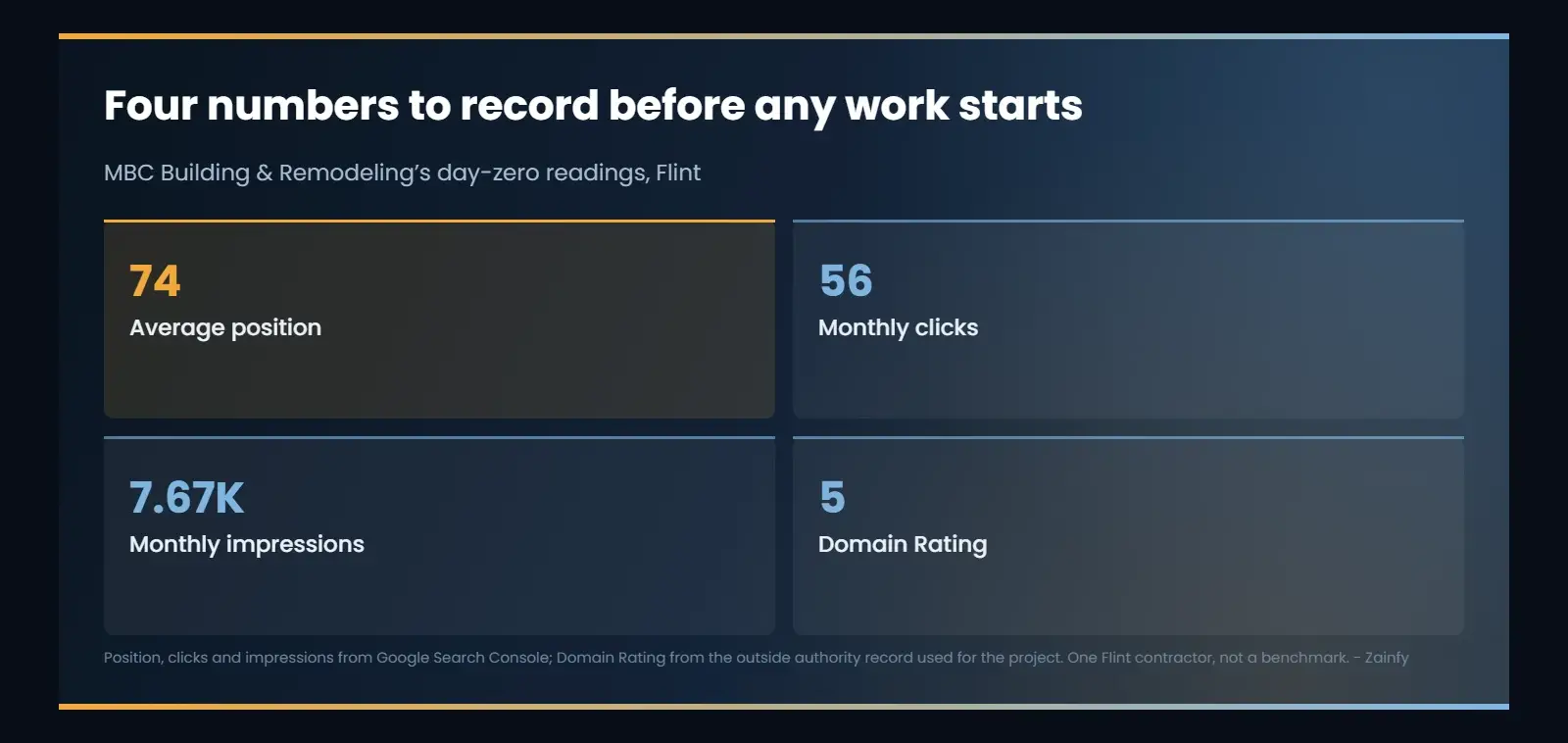
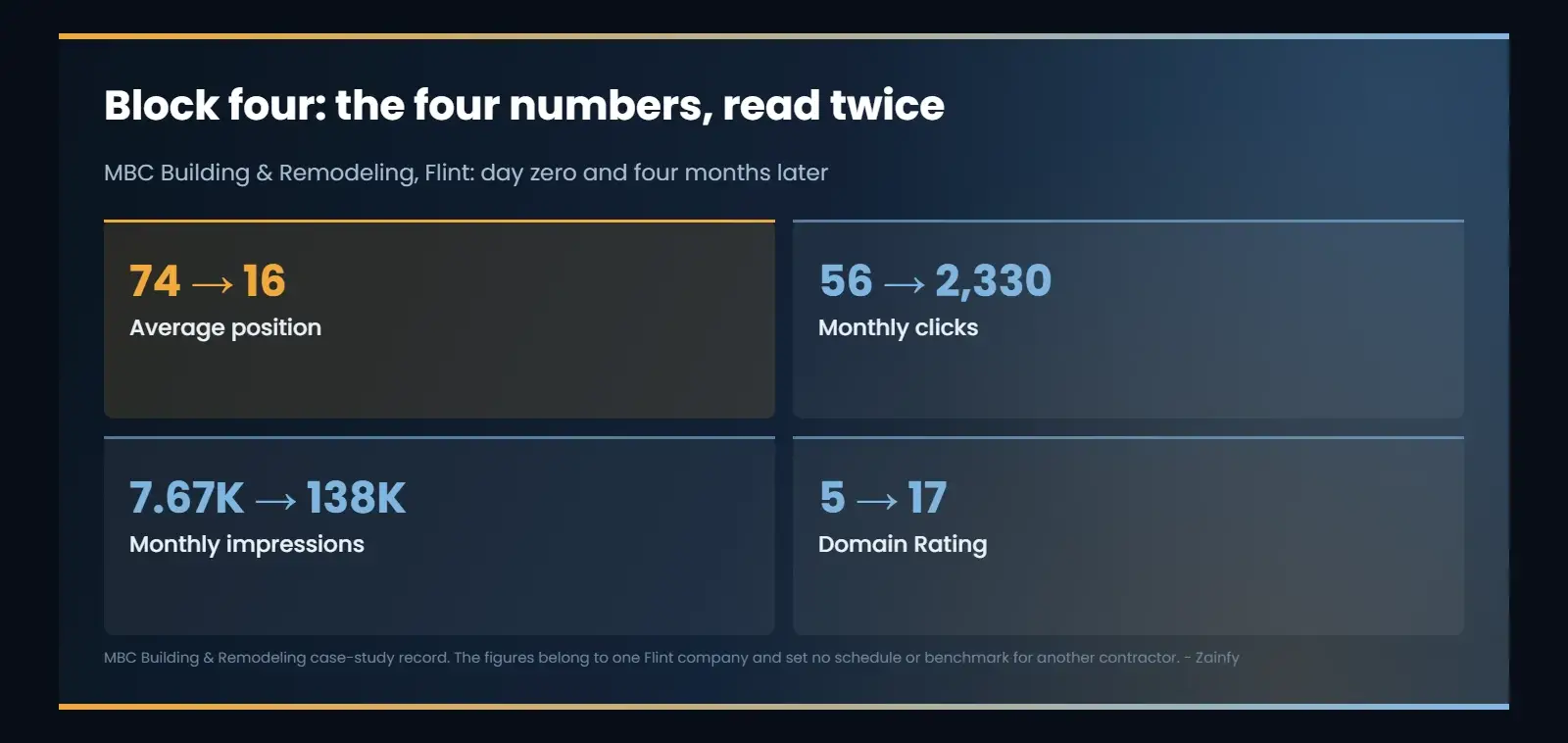
Start with average position. Write down 74.
Then monthly clicks: 56. Monthly impressions: 7.67K. Domain Rating: 5.
Those were MBC Building & Remodeling’s day-zero figures. Three came from Google Search Console: average position, clicks, and impressions. Domain Rating came from the outside authority record used for the project. Put the date beside all four. A loose note saying “traffic is low” does not establish a starting line, and a dashboard viewed after work begins cannot recreate one.
Write the source beside each field too.
Do not improve the numbers before recording them. Do not clean up the date range. The value of this step is its plainness. Four fields, one date, written where they will still be available after the site changes.
This is not the results section. It is the measuring tape sitting on the bench before the first cut. If the baseline is missing, every later claim depends on memory or a report assembled after the fact. MBC’s record remained checkable because 74, 56, 7.67K, and 5 existed before the work did. For a Flint contractor paying for search work, that written starting line is the first completed item.
Block one: the items that make the site readable
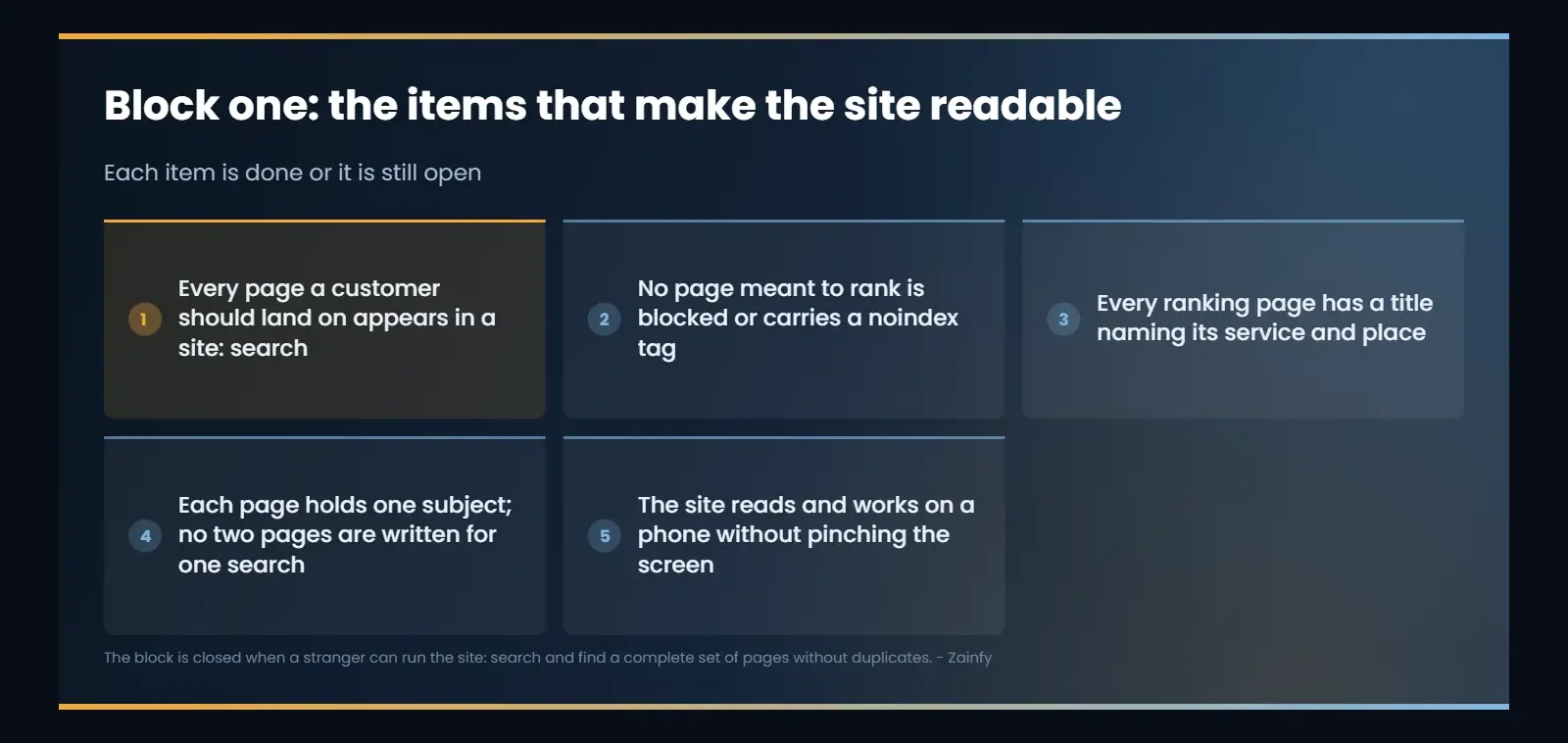
The first work block is binary. Each item is done or it is still open.
- Run a
site:yourdomain.comsearch. Every page you would want a customer to land on must appear, and every page you would keep from a customer must stay out. - Check robots.txt and page-level tags. No page meant to rank may be blocked or carry a noindex tag.
- Give every ranking page a title that names its service and place.
- Hold each page to one subject. Two pages may not be written for one search.
- Use the site on a phone. A customer should not have to pinch the screen to read it or use it.
This block is closed when a stranger can run the site: search and find a complete set of pages without duplicates. “We worked on crawlability” is not a finished state. A clean outside check is. A title sitting in a document is not done. A mobile fix waiting for deployment is not done. The condition has to exist on the public site, not inside the internal work queue.
Nothing farther down this checklist starts until that test passes. The reasoning behind the sequence belongs in why that order was chosen; here, the operating rule is simple: close the readability block before opening the term list.
Block two: the term list is written from the housing stock
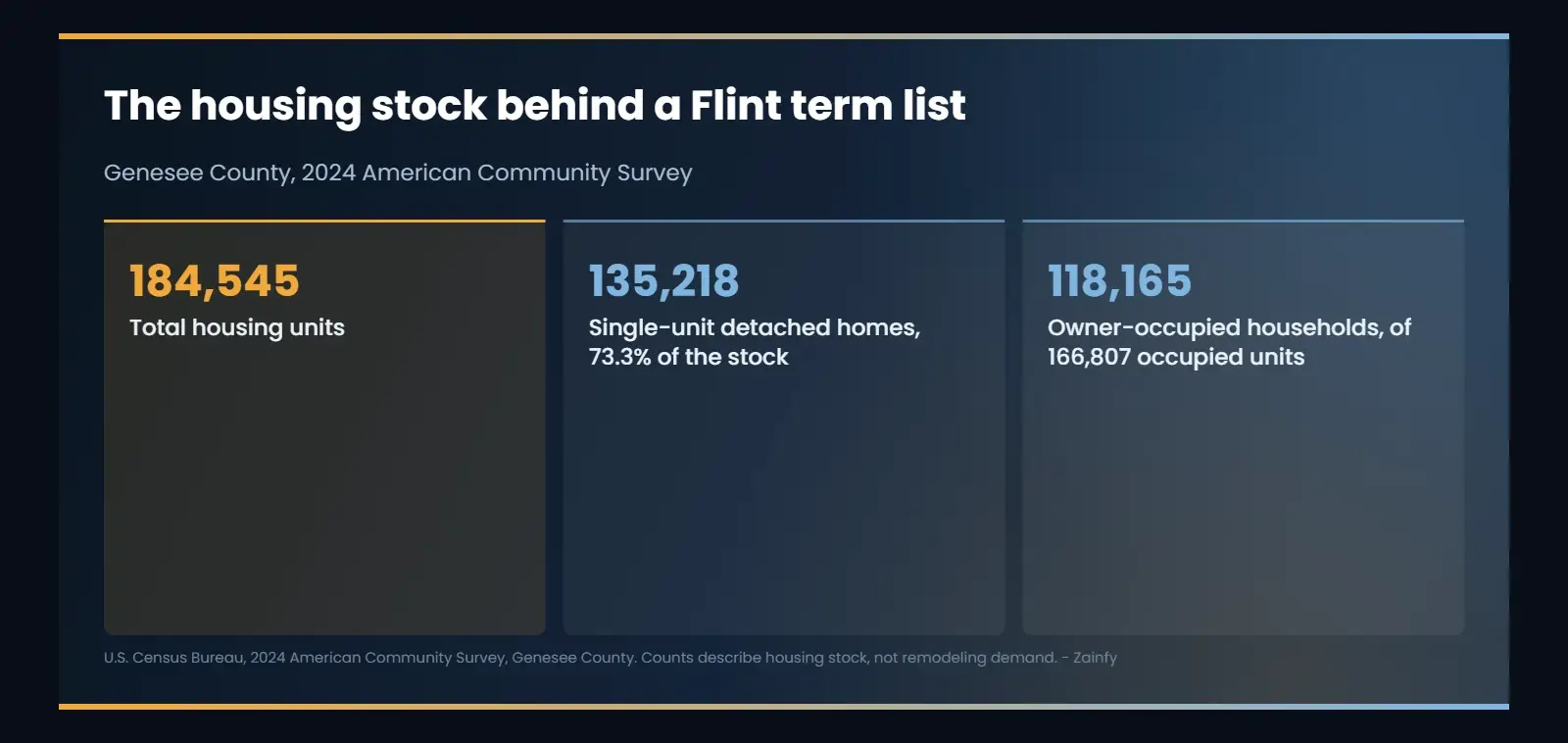
The second block begins with the market MBC could actually serve. Genesee County had 184,545 housing units in the 2024 American Community Survey. Of those, 135,218 were single-unit detached homes. That is 73.3% of the county’s housing stock, which makes detached houses the working base for a Flint remodeling term list, not a decorative local statistic.
The next number narrows the buyer set. The ACS counted 118,165 owner-occupied households among 166,807 occupied units in Genesee County. Those households can commission work on the property they own. For an owner-operator, those two counts establish the stock his crew can be hired to improve and the people able to approve the job.
The term list then becomes trade plus place, with each phrase assigned to a real page. At completion, every term points to exactly one live page. No term waits on a planned page. No live page lacks a term. No phrase appears on two pages competing for one search. The list and the live site must account for each other line by line.
No mapping gaps remain.
MBC ultimately held 81 keywords in the top three and roughly 2,400 organic keywords. Those figures describe the footprint one Flint contractor built; they are not a quota for another company. What matters at this stage is that the map is closed before work advances. Genesee County’s 73.3% detached share gives the list its local shape, while the one-term-to-one-page rule gives it a finish line.
Block three: the off-site items
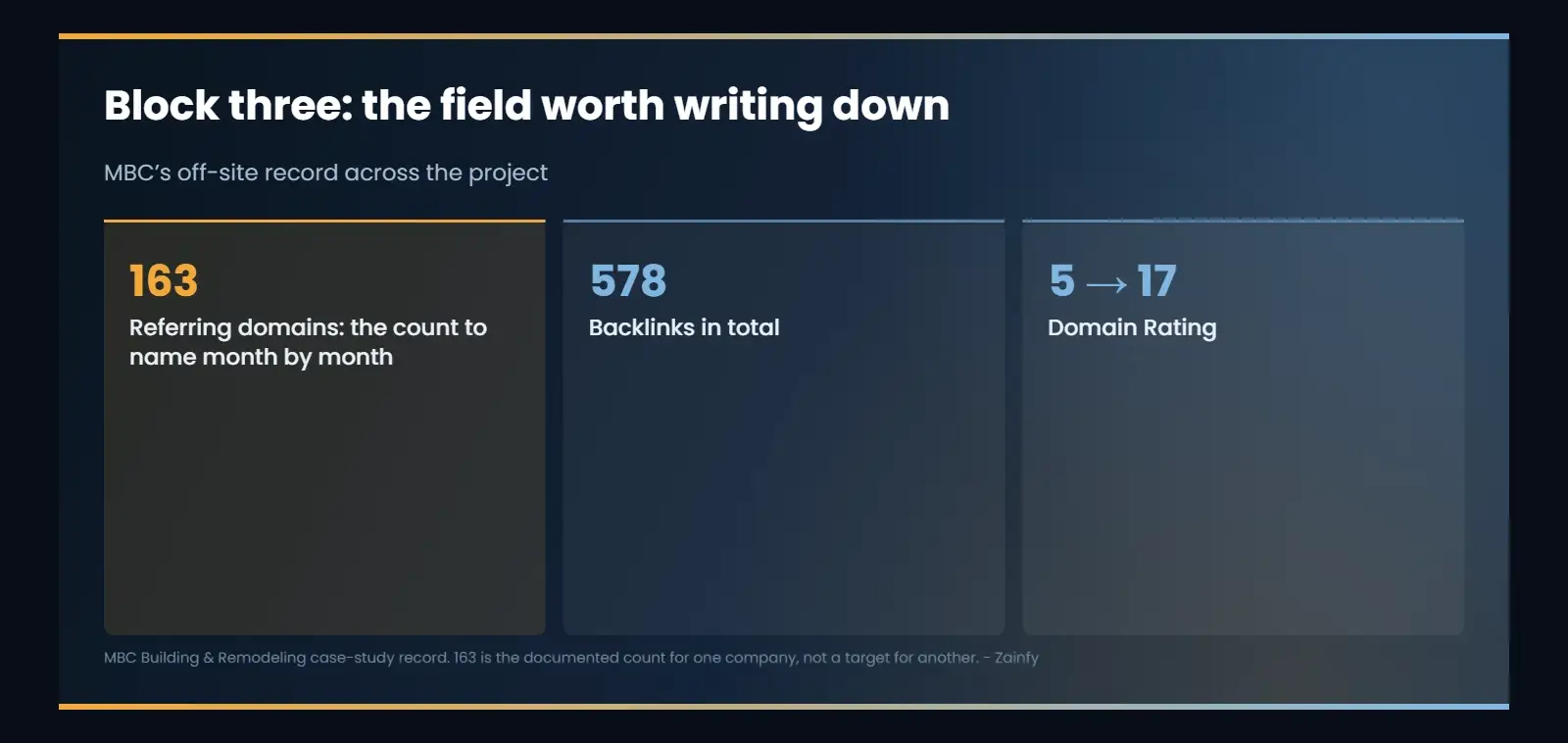
The third block is where an owner-operator has to be honest about capacity. MBC’s record moved from Domain Rating 5 to 17 while accumulating 578 backlinks from 163 referring domains, but the field worth writing down is referring domains. One website sending forty links is still one website. That distinction matters because a large link total can look busy while showing little breadth. The finished state is a referring-domain count that can be named for last month and named again for this month, with the date beside each reading. A report that provides only “links built” describes activity; it does not close the block. For an owner-operator, this work competes directly with estimates, crew calls, change orders, and active jobs. Resourcing contractor SEO in Flint, MI requires someone to own the referring-domain record and the work behind it; without that ownership, the sequence stalls here. That does not make 163 a target for every remodeling company. It makes 163 the documented domain count attached to MBC’s movement from DR 5 to 17. The owner’s check is narrower: can the person responsible state last month’s referring-domain count, this month’s count, and which new domains account for the change? Can each new domain be identified without hiding behind the larger backlink total? If not, block three remains open.
Block four: put the four numbers back up against the first four
After four months of work, MBC pulled the day-zero fields again. Average position read 16 beside the starting 74. Monthly clicks read 2,330 beside 56. Monthly impressions read 138K beside 7.67K. Domain Rating read 17 beside 5.
That side-by-side reading is the deliverable in block four. It is not a fresh dashboard with the starting date forgotten. It is not a screenshot chosen because it looks favorable. The four fields named at the beginning have been pulled again from their original reporting sources, dated, and written next to the earlier reading.
Google Search Console holds the search fields. The authority record holds Domain Rating. Keep their date ranges aligned and preserve both sets of readings. A number without its earlier measure cannot show movement, even when the later number looks strong.
The before-and-after record is what the case-study page records, with MBC identified as the Flint contractor behind it. The figures belong to that company and that body of work. They do not set a schedule or benchmark for another contractor.
Block four closes when another person can see two dated readings of average position, clicks, impressions, and Domain Rating side by side. No reconstruction. No memory. The comparison was designed into the checklist on day zero, then completed when the four fields were pulled again.
That record also fixes the scope of the claim: one Flint company, four named fields, two dated readings.
Two things people put on this list that shouldn’t be on it
The blocks do not run in parallel. Buying links against pages Google is still reading badly spends the budget on the one block that cannot compound yet. Close the readability items. Close the term-to-page map. Then resource the off-site work.
Do not rewrite the term list mid-sequence. A list swapped out because block two has not moved resets the only checklist item that compounds across the remaining work. It also breaks the page map you just finished: the live page still carries one subject while the tracking sheet has started measuring another.
These are operating instructions, not discussion points. Four open blocks are not four times the progress. They are four unfinished jobs competing for attention. One closed block gives the next block something stable to use.
MBC’s sequence can be checked because the starting fields, page set, term map, referring-domain record, and second measurement belong to one ordered run. Keep that chain intact. Parallel work and a rewritten term list turn a short checklist into a pile of activity nobody can verify from beginning to end.
What should be on a remodeling contractor’s SEO checklist?
A remodeling contractor’s SEO checklist should contain four ordered blocks: a readable, non-duplicated page set; a term list mapped one-to-one to live pages; a dated referring-domain count; and two comparable readings of position, clicks, impressions, and Domain Rating. Each block closes only when an outsider can verify it.
MBC Building & Remodeling’s Flint record shows how that definition works. The readability block ended with a complete site: result and no competing pages. The term block ended when every tracked phrase had one live destination. The off-site block used referring domains as the recorded field, reaching 163 domains across 578 backlinks. The measurement block returned to the four day-zero fields and placed the later readings beside them.
“Finished” is stricter than “assigned,” “scheduled,” or “included in the report.” A service page is not finished because a draft exists. A term map is not finished while half its destinations are planned. Off-site work is not finished when nobody can state the domain count. Measurement is not finished when only the latest reading survives.
The outside check is the rule that keeps the list honest. A person with no access to the project calendar should be able to inspect the live pages, match terms to destinations, read dated domain counts, and compare the four recorded fields. If that person cannot verify the item, leave the box open.
The questions that come up once the list exists
[wps_faq style=”classic” question=”What should be finished before block two starts?”]
The ranking page set must be complete, readable, and non-duplicated before the term list opens. Every customer-facing service page must appear in a site:yourdomain.com search, no wanted page may be blocked, and each page must hold one subject with a service-and-place title. Ask someone outside the company to run the search. If a page is missing or two URLs cover one job type, the block remains open. MBC’s term map began with live destinations. That was its handoff into block two. The finish line is a result a stranger can inspect without project notes.
[/wps_faq]
[wps_faq style=”classic” question=”How many keywords should a remodeling contractor actually be targeting?”]
There is no useful universal target. MBC Building & Remodeling ended with 81 keywords in the top three and roughly 2,400 organic keywords. Those figures describe one Flint contractor, not a target to copy. Count mapped terms: each needs one live destination with a clear subject. A term with no page is not ready; two pages claiming it leave the map open. MBC’s footprint shows the planning sheet does not need thousands of rows. Keep the sheet tied to pages that exist. Treat its numbers as one project’s record, never as a quota pinned above your desk.
[/wps_faq]
[wps_faq style=”classic” question=”Does the housing stock in my county change what goes on the term list?”]
Yes. Genesee County’s housing mix tells a Flint remodeler what property sits under search demand. The 2024 American Community Survey counted 135,218 single-unit detached homes among 184,545 housing units, a 73.3% share, plus 118,165 owner-occupied households. For an existing-home crew, those figures support detached-project terms in places it serves. They do not justify pasting “Genesee County” onto every service phrase. That mix is specific to Genesee County. Housing stock sets the scope; job history decides which work belongs. Here, the detached share must shape the term list, not decorate it.
[/wps_faq]
[wps_faq style=”classic” question=”How do I know an item is finished rather than started?”]
An item is finished when an outsider can verify it. Google Search Console preserves dated readings for clicks, impressions, and average position. A site: search exposes the page set. A term map shows one live destination per phrase. A referring-domain record states the count for two dates. None depends on a calendar assignment. Give that sentence to someone outside the meeting and ask whether the evidence matches. The standard is evidence another person can inspect. If the answer requires an explanation about scheduled work, keep the item open. Completion belongs to evidence, not a status label.
[/wps_faq]
Pull four numbers for your own site this week: average position, monthly clicks, monthly impressions, and Domain Rating. Date them. Save the Search Console range used for the first three and the source used for the fourth.
Do it before a title changes, a page moves, or a new link lands. Those starting readings cannot be recovered cleanly after the work has altered them, and “traffic was lower before” is not a baseline. A Flint contractor does not need a long planning meeting to complete this step. He needs four fields and a short, uninterrupted session at the computer.
If the person responsible cannot produce those figures today, the checklist has not started. Fix that first. The next task can wait; the day-zero record cannot.