The high-budget client a Midland remodeling contractor should market to is defined by Midland County, not by the six-figure numbers in articles written for major metros. Those articles offer a convenient label, but the label comes from somebody else’s market. It can make the best client already in your job history look ordinary simply because his project does not resemble work in Chicago or San Francisco.
There is a local way to draw the line without inventing an income bracket or copying a national price threshold. Start with two published county numbers that describe the middle of the market. Then use two years of your own closed jobs to find where the upper end of your actual work begins. The Census can show where Midland sits. Your contracts show who chose you, what that client valued, and which jobs belong in the group you want more often.
Two numbers that point in opposite directions
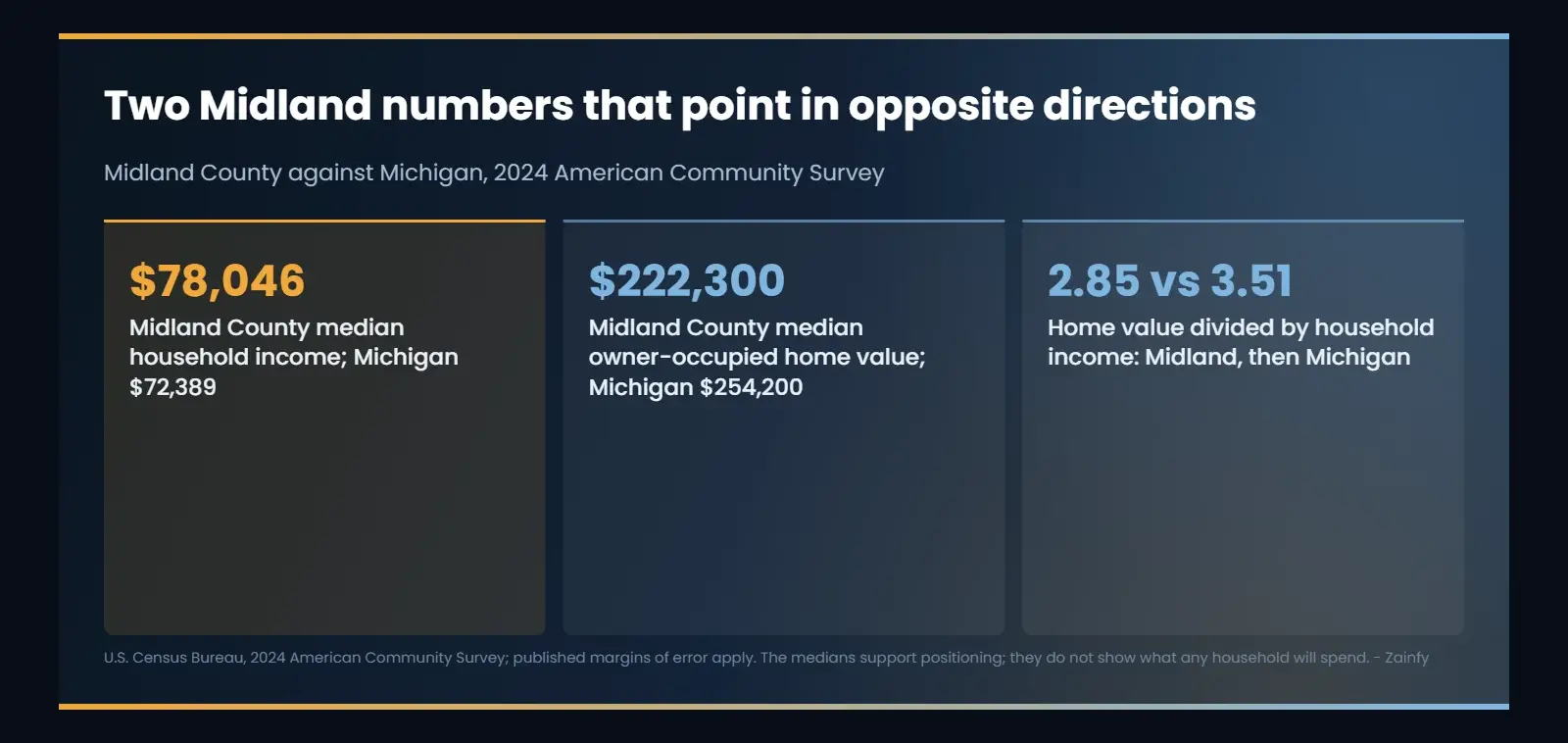
The 2024 American Community Survey puts Midland County’s median household income at $78,046, with a margin of error of plus or minus $4,450. Michigan’s median is $72,389, with a margin of plus or minus $567. The $5,657 difference sits just outside the combined margin of roughly $4,500. It is a real but narrow gap.
Now read property value separately. Midland County’s median value for an owner-occupied home is $222,300, with a margin of plus or minus $11,249. The Michigan median is $254,200, with a margin of plus or minus $1,616. That $31,900 difference is close to three times the combined published margin of roughly $11,400, so this is the firmer half of the comparison.
Divide each published value by its published income figure and Midland comes to 2.85: $222,300 divided by $78,046. Michigan comes to 3.51: $254,200 divided by $72,389. Even at the least favorable ends of the published intervals, the direction remains.
That does not prove what any household will spend on a renovation. It proves something narrower and more useful for positioning: property value is not a clean proxy for the household behind it in Midland County. A competitor who sizes the local opportunity from house prices alone is reading the wrong column. The money is in the household, not in the house.
Metro spending does not set Midland’s upper tier
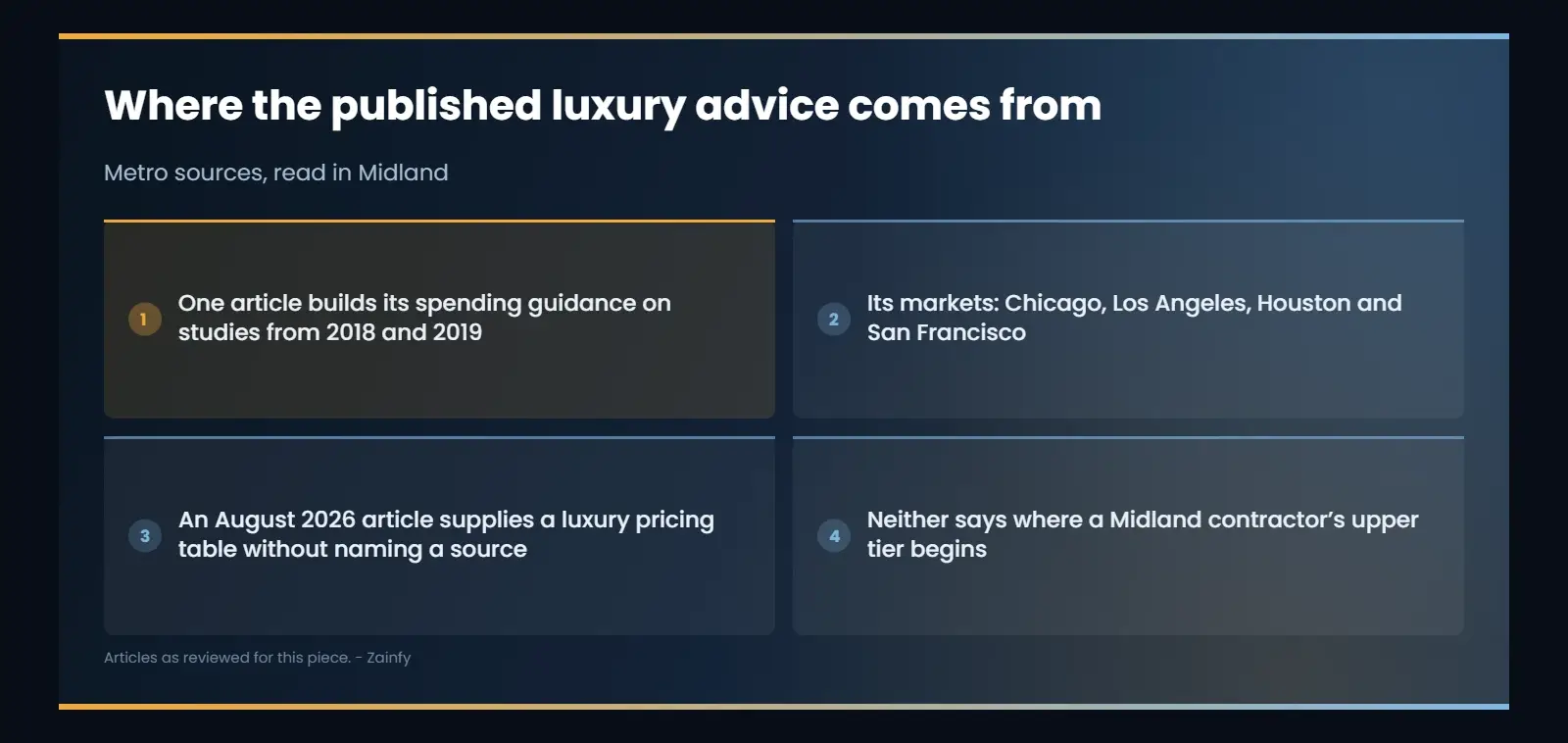
One published article about attracting luxury clients bases its spending guidance on studies from 2018 and 2019. The markets are Chicago, Los Angeles, Houston, and San Francisco. Even if those figures had been current, none would tell a Midland remodeling contractor where the upper end of his own client base begins.
The newer advice does not solve the geography problem. An August 2026 article about high-ticket work recommends guides built around gated communities, exclusive postal areas, and landmark commissions. It also supplies a luxury pricing table without naming a source. That is a metro model presented as if any contractor could carry it home.
Midland requires a different question. Not, “What dollar amount does a national article call luxury?” Ask where the strongest completed work sits inside this company’s local history, and what the clients behind those contracts shared. The county medians establish a local middle. The closed-job records establish the upper group this contractor has actually served.
That distinction matters because borrowed thresholds arrive with a buyer already built into them. The house, income, scope, and expectations belong to another place. A Midland owner who copies the threshold is not defining his market; he is importing somebody else’s. Start with evidence that belongs here, then decide what the client group deserves to be called.
High end is a percentile, not a price
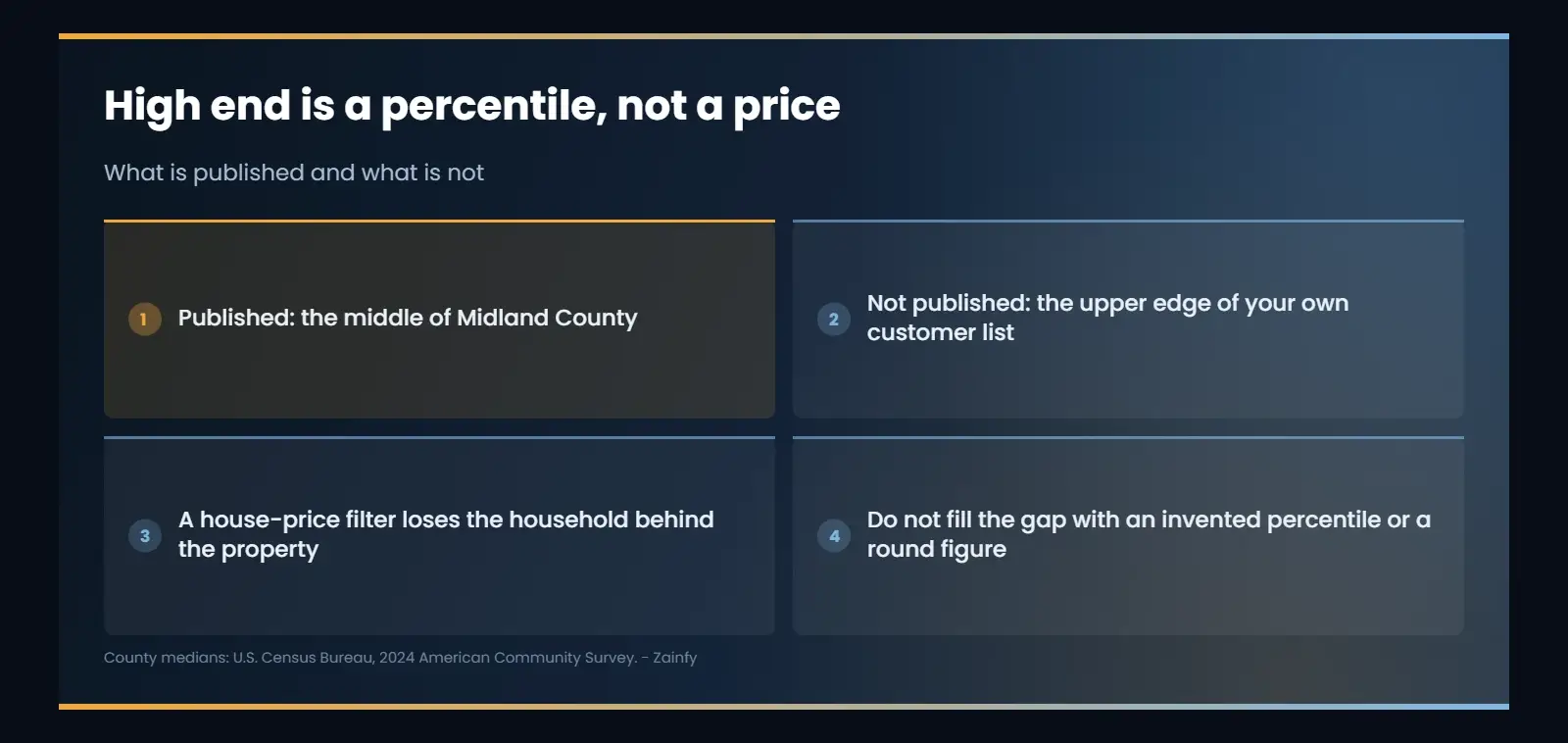
High end is a position inside the market you actually serve. It is not a national dollar threshold that travels intact from one county to another.
Adopt a borrowed threshold and you aim at a buyer constructed from metro spending reports. You may also overlook the local household that belongs near the top of your own client base but lives in a home whose value does not signal that position. Midland’s two medians make that error visible: household income sits above Michigan’s midpoint while owner-occupied home value sits below it. A house-price filter loses the person behind the property.
The Census cannot finish the definition for you. It publishes the middle of Midland County; it does not publish the upper edge of your customer list. There is no government table for the client who approves broader scope, values a more involved service, or chooses your company after a careful comparison.
Do not fill that gap with an invented percentile or a round project figure. The county’s middle is published, the top is not. Your closed Midland work is where that upper group becomes clearly visible.
The top quarter of your own book
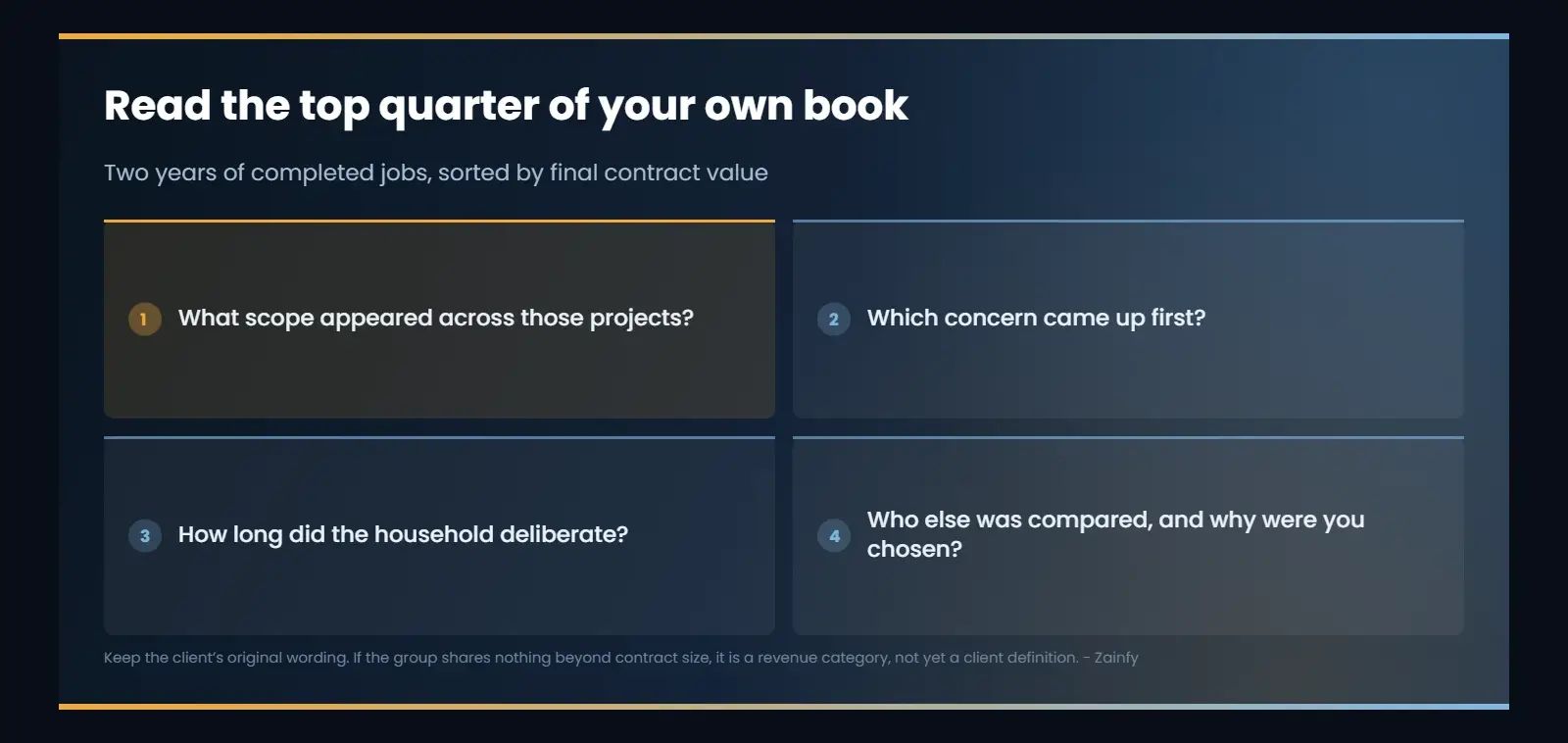
Export two years of completed jobs and sort them by final contract value. Read the top quarter as a set of clients, not merely as a row of larger invoices. That group is your working definition of high end in Midland because it records the people who actually hired your company under local conditions.
Read the files closely. What scope appeared across those projects? Which concern came up first? How long did the household deliberate? Who else did the client compare, and why did the client choose you? Keep the client’s original wording. A phrase repeated in real inquiries says more than a label imported from a national article.
This is not an instruction to create a public rate sheet, change your quoting process, or choose a lead source. It is a way to identify the client before deciding how to speak to him. Nor is it a map of supposedly wealthy parts of Midland. The evidence comes from completed work across your own service history.
If the upper quarter shares no pattern beyond contract size, that is useful too. It means you have a revenue category, not yet a client definition. Go back to the project notes until you can describe the person, the decision, and the scope without relying on the invoice total alone.
A tier that lives in your job list is not positioning
The upper group you found does nothing for the next Midland homeowner while it remains a private spreadsheet category. That homeowner may be comparing three contractors before making a call, looking for evidence that one company understands the kind of decision sitting in front of him. Your task is to make the buyer recognizable: the scope he is considering, the questions he asks early, the tradeoffs he weighs, and the level of involvement he values. If none of that is visible, he cannot tell whether your company regularly handles work like his or merely accepts it when it appears. This is the point where identifying the client becomes getting shortlisted in Midland before anyone calls. The handoff matters because a private label is not public positioning. It also marks the boundary of this argument. The question here is which buyer you mean and what must be legible about that buyer, not the mechanics of building the material. Use the language from your top completed jobs. A homeowner who recognizes his decision in those terms has a reason to keep comparing you; one who sees only a generic premium label has learned nothing about whether he belongs.

Don’t borrow another market’s numbers
Do not describe Midland with figures taken from somebody else’s market. An August 2026 high-ticket article hands contractors an unsourced luxury pricing table, while another topic article relies on metro spending research from 2018 and 2019. Neither source establishes the upper end of your client base.
Borrowed numbers describe a buyer who lives somewhere else. Put them at the center of your positioning and a genuine top-tier Midland client can read the material and conclude that you are addressing somebody else’s project. The issue is not whether a contractor should reveal or withhold prices. The issue is whose evidence defines the buyer.
Use the closed-job group instead. It contains local figures, completed scopes, real questions, and choices that ended in signed work. Write down what that group shares before attaching a category name.
The ranking pages call the buyer “luxury” because that word travels easily. Your records may produce a more precise description. Trust the description supported by the work. Reject the label that requires Midland to pretend it is a major metro.
How do you market to high-end remodeling clients in a smaller market?
Define the high-end tier against your own market, not a national figure. Sort two years of closed jobs by contract value, study the top quarter, and describe those clients in their own terms. Published dollar thresholds usually reflect metro markets and can point you toward a buyer who does not live in your county.
Midland shows why this method matters. The 2024 American Community Survey reports median household income of $78,046 in Midland County against $72,389 across Michigan. Yet the county’s median owner-occupied home value is $222,300, compared with $254,200 statewide. Income and property value move in opposite directions relative to their statewide medians.
That relationship does not establish renovation capacity for any individual household. It does show why reading the market through home value alone misses part of the local picture. A contractor needs a client definition built from the people who bought his work, not an assumption attached to the price of their houses.
Once the top group is isolated, study common scope, early questions, decision pace, and reasons for selection. The useful line is not “projects above X dollars.” It is where actual Midland clients begin sharing a decision pattern your records support inside this county.
Before you call yourself high-end
[wps_faq style=”classic” question=”What counts as a high-end remodeling client for a contractor in Midland?”]
A high-end client falls near the upper end of that contractor’s completed work and shares a buying pattern with other clients there. Midland County’s median locates the market’s middle, not your company’s upper tier. Sort two years of closed contracts, isolate the top quarter, and read the project notes. Look for recurring scope, the first concern raised, decision pace, and the reason your company was selected. Do not turn one unusually large contract into a category. A useful definition describes real Midland clients whose choices your records can explain. That pattern is the line worth naming.
[/wps_faq]
[wps_faq style=”classic” question=”Does a Midland remodeler need a separate brand for higher-budget work?”]
No. A separate brand is unnecessary unless your upper group requires a different business identity, and contract size does not prove that. Determine whether the top quarter of your Midland jobs shares distinct needs, language, or selection criteria. If those clients already chose your current company, make their decision pattern clear without claiming a borrowed luxury category. Keep the name and describe the work through closed projects. A new label cannot repair a vague client definition; it only gives the vagueness another logo. Let completed work decide whether a real division exists. Do not manufacture a second identity.
[/wps_faq]
[wps_faq style=”classic” question=”Why doesn't a home's value tell a Midland remodeler what tier a client sits in?”]
Home value does not identify client tier because Midland’s property and household medians point in opposite directions relative to Michigan. The 2024 ACS puts Midland County’s median owner-occupied home value at $222,300 versus $254,200 statewide. Median household income is $78,046, above Michigan’s $72,389. Those figures cannot show what one owner will spend, but they rule out treating house price as a complete household description. Where the two measures separate this way, sorting prospects by property value can hide the person you mean to reach. Define the tier from signed local work; keep property value as context.
[/wps_faq]
Read the column this week
This week, export two years of closed Midland jobs and sort the contract-value column from highest to lowest. Mark the top quarter, then hide the dollar column.
Read what remains. The notes should tell you what those clients were trying to solve, what they asked first, how they made the decision, and why they chose your company. If the group still looks coherent without the invoice attached, you have a client definition you can use. If it falls apart, keep reading before calling the business high end.
That description will not match a ready-made chart online. Good. The chart came from another market; your definition came from people who trusted a Midland company with valuable work.