A Columbus, Georgia remodeler’s website has to close a buyer who has days, not weeks, has never set foot in Muscogee County, cannot ask a neighbor who to call, and is disciplined about a housing budget capped by BAH.
That buyer is common around Fort Moore.
National contractor website advice usually assumes a settled homeowner with time to compare options calmly. Columbus is different. A PCS family may be vetting contractors from another state before house-hunting leave. A relocating Aflac, TSYS, or Synovus employee can behave that way: new city, no referral list, phone in hand, short deadline.
Your site has to say Columbus, GA clearly enough that nobody confuses it with Columbus, Ohio. It has to show price ranges, real project proof, service-area clarity, and a way to start remotely. Otherwise the buyer does not wait for you to explain it on a call.
She leaves.
Your buyer decides in days, from another state
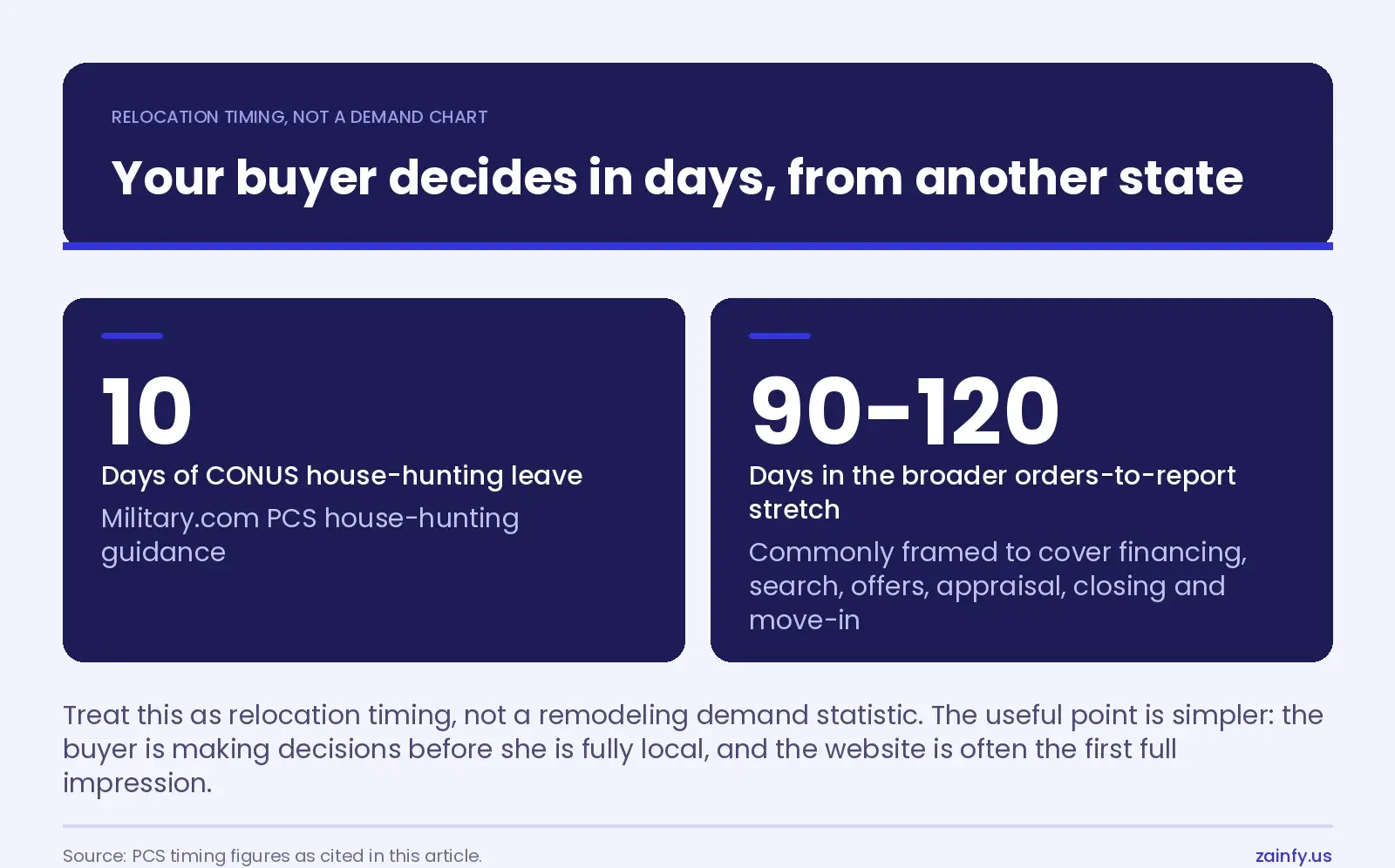
Fort Moore changes the website job because PCS movement changes the buyer’s clock. Military.com’s PCS house-hunting guidance ties CONUS house-hunting leave to 10 days, while the broader orders-to-report stretch is commonly framed around roughly 90 to 120 days for financing, search, offers, appraisal, closing, and move-in. Treat that as relocation timing, not a remodeling demand statistic. The useful point for a Columbus contractor is simpler: the buyer is making decisions before she is fully local. She may be looking at houses near post, checking contractors from a hotel, comparing project photos on base Wi-Fi, or trying to decide which company is worth calling before the actual house-hunting trip starts. The website is often the first full impression. Not the second. Not the handoff after a referral. First. A settled North Columbus homeowner can ask a coworker, a neighbor, or someone at church. A family landing at Fort Moore may not have that network yet. The same applies to a professional relocating for Aflac, TSYS, or Synovus. Different reason for moving, same lack of local context. A site built for this buyer does not waste the top of the page on vague claims. It tells her where you work, what kind of projects you take, what price range she may be entering, whether a remote consult is possible, and how fast she can get a real next step. If the page makes her wait for all of that, the page is built for the wrong market.
The five-second trust test — run by someone with no local referrals
A local referral buyer gives you slack.
The PCS buyer does not.
The settled Muscogee County homeowner may already know your name because a neighbor used you. She visits the site to confirm the referral. If the photos are a little old or the contact button is buried, the referral still carries weight.
The Fort Moore family has no such cushion. For her, the site has to act like the referral she has not earned locally yet.
That changes what belongs above the fold. Stock photos weaken the first screen because they say nothing about Columbus work. A vague “licensed and insured” line buried near the footer is too late. A phone number that cannot be tapped from the top navigation is a small thing until the buyer is juggling orders, lenders, school dates, and a hotel reservation.
The stronger version is direct: real project photos, reviews close to the work they support, license and insurance signals visible without a scavenger hunt, and a click-to-call path that works from a phone. If you serve Midtown, the Historic District, North Columbus, or near-post areas, the site should make that plain before the buyer wonders whether she found the right company.
This is not decoration. It is risk removal.
The buyer is asking one question fast: “Can I trust this contractor before I arrive?”
That is why the proof has to be specific. A photo caption that says “bath remodel” is weak. A caption that says “North Columbus bath update, three-week scope, new tile, vanity, lighting, and ventilation” gives the buyer a frame. A review that mentions punctuality is useful. A review that mentions a move-in deadline near Fort Moore is better when it is real. You are not trying to make the site louder. You are trying to remove the blank spaces that make a remote buyer hesitate.
Show your prices — the budget is capped at BAH
A Columbus remodeler’s website should show price ranges because a Fort Moore buyer is trying to self-qualify before she spends one of her few decision windows on you.
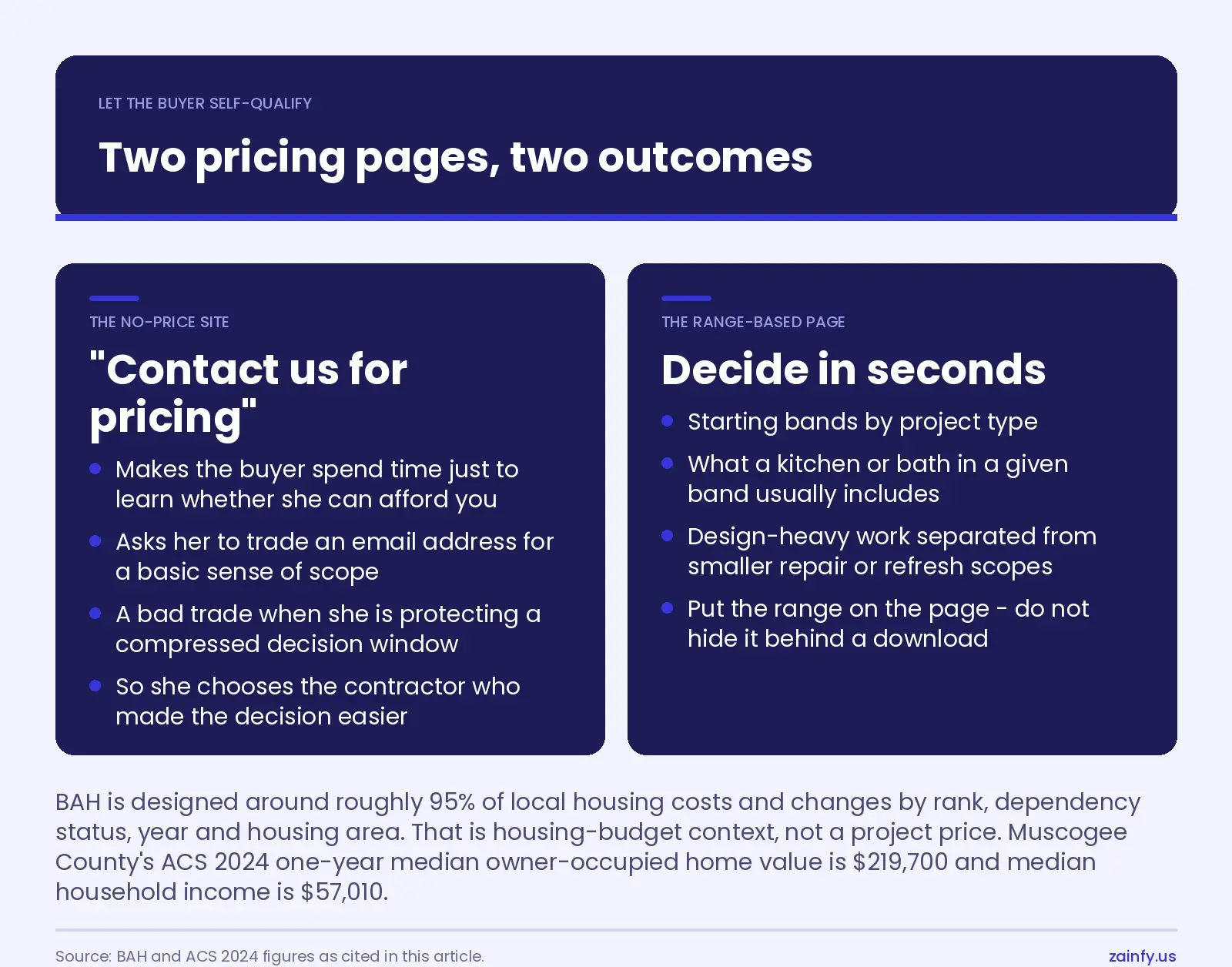
BAH is the budget discipline behind that behavior. It is designed around roughly 95% of local housing costs, and the exact allowance changes by rank, dependency status, year, and housing area. Use that carefully: it is housing-budget context, not a project price and not proof of remodeling demand.
The Census side points the same direction. Muscogee County’s ACS 2024 1-year median owner-occupied home value is $219,700, and median household income is $57,010. That is not Atlanta luxury positioning. It is a budget-aware market where the buyer wants to know whether the contractor is even in range.
So give her a way to know.
Not a fake exact price. Not a promise. A range.
Your pricing page can show starting bands by project type, explain what a kitchen or bath in a given band usually includes, and separate design-heavy work from smaller repair or refresh scopes. If financing guidance belongs on the site, describe the capability without naming a lender or turning the page into financial advice. If VA-loan-aware content matters for the buyer, keep it practical and tied to what the contractor needs to know before the consult.
The no-price site makes the buyer spend time to learn whether she can afford you. The priced-range site lets her decide in seconds whether the next conversation is worth having.
One warning: do not hide the useful range behind a download. If the buyer has to trade an email address for a basic sense of scope, you have recreated the same wall with nicer design. Put the range on the page. Let the serious buyer raise her hand.
Make it unmistakably Columbus, Georgia — and one clear service area
Say Georgia.
A relocating buyer searching from another state can hit the wrong Columbus before she realizes what happened. That is not a ranking argument here. It is a trust problem on the page.
If your header says only “Columbus remodeling,” the buyer has to inspect the address, footer, photos, and service area to confirm she is not looking at Columbus, Ohio. That is unnecessary friction.
Use Columbus, GA. Use Columbus, Georgia. Name Muscogee County when it helps. Name Fort Moore when that buyer segment is real for your business. If you work Midtown, the Historic District/Uptown, North Columbus, and near-post areas, make those areas visible in the service-area copy and project captions.
Do not turn the site into a pile of thin location pages.
Columbus and Muscogee operate as a consolidated city-county government, established in 1971, so the site can define one clear local market. The supporting details can sit in page copy, project captions, service-area language, and LocalBusiness or ServiceArea schema that matches what the visitor can actually read.
The buyer should not have to decode where you work.
This is especially important on project pages. A remote buyer may open one bath remodel, one kitchen gallery, and your contact page before deciding whether to call. If each page says a slightly different version of the service area, the site feels stitched together. Keep the place language steady: Columbus, GA; Muscogee County; Fort Moore area where true.
Build for the buyer who can’t visit — enable the remote decision
The remote buyer needs a site that can do more than look credible.
It has to move the decision forward.
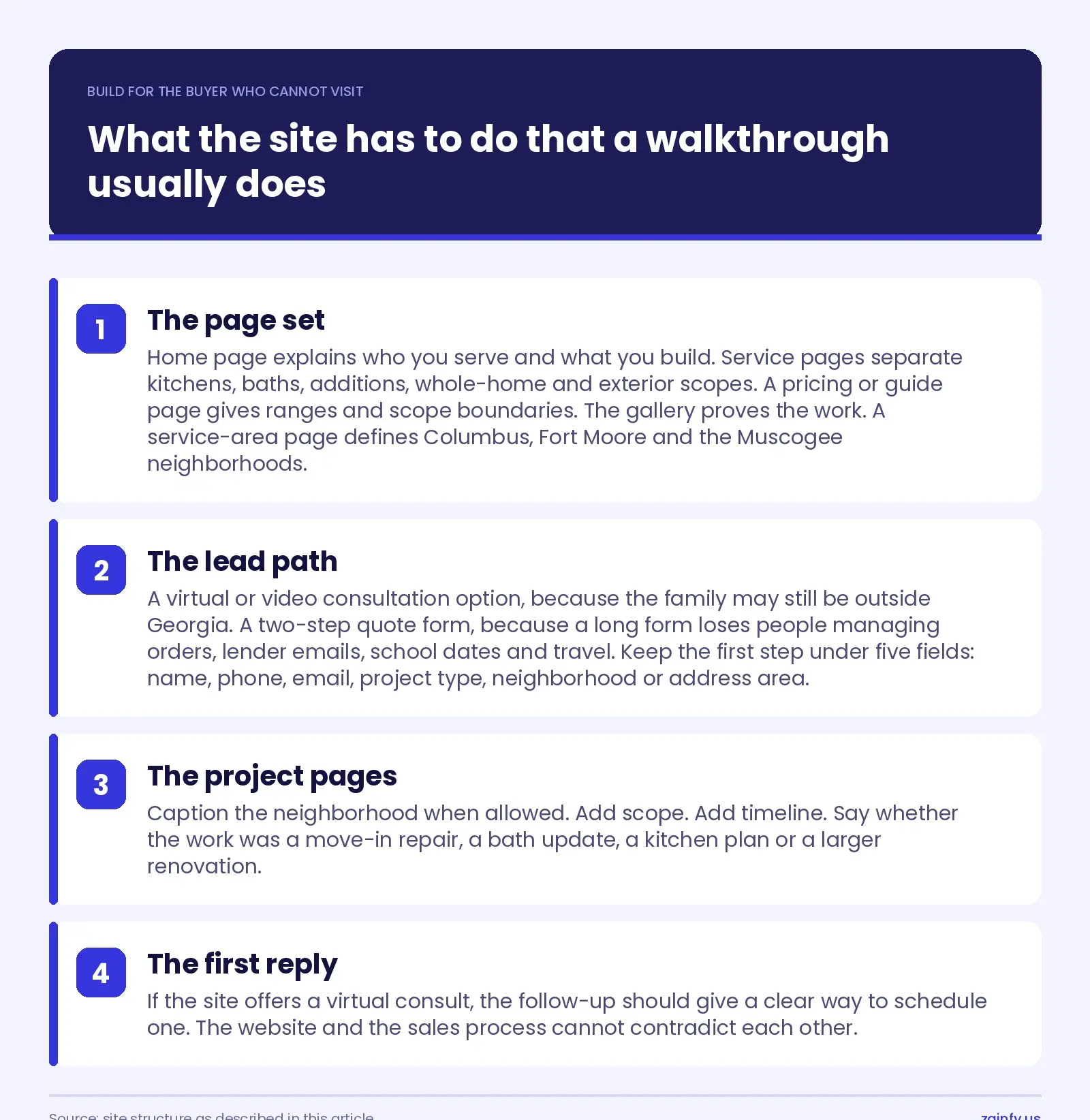
Start with the page set. The home page explains who you serve and what you build. Service pages separate kitchens, baths, additions, whole-home work, exterior scopes, or whatever your company actually sells. A pricing or guide page gives ranges and scope boundaries. The gallery proves the work. A service-area page defines Columbus, Fort Moore, and the Muscogee neighborhoods without pretending every area is the same. The contact page removes every excuse not to start.
Then build the lead path around the buyer’s situation.
A virtual or video consultation option matters because a family may still be outside Georgia. A two-step quote form matters because a long form loses people who are already managing orders, lender emails, school dates, and travel. Keep the first step under five fields: name, phone, email, project type, neighborhood or address area. Ask for details after the lead is real.
Project pages need more than before and after photos. Caption the neighborhood when allowed. Add scope. Add timeline. Say whether the work was a move-in repair, a bath update, a kitchen plan, or a larger renovation. That is where Columbus and Fort Moore remodeler websites connects to the commercial page after this guide.
The site has to answer what an in-person walkthrough would normally answer.
That also means the first reply after the form should match the promise on the page. If the site offers a virtual consult, the follow-up should give a clear way to schedule one. If the gallery invites remote comparison, the first conversation should ask for photos, address area, timing, and budget range. The website and the sales process cannot contradict each other. The gap between the two is what shows up in sites rebuilt for buyers on a deadline.
Speed and mobile aren’t optional for this buyer
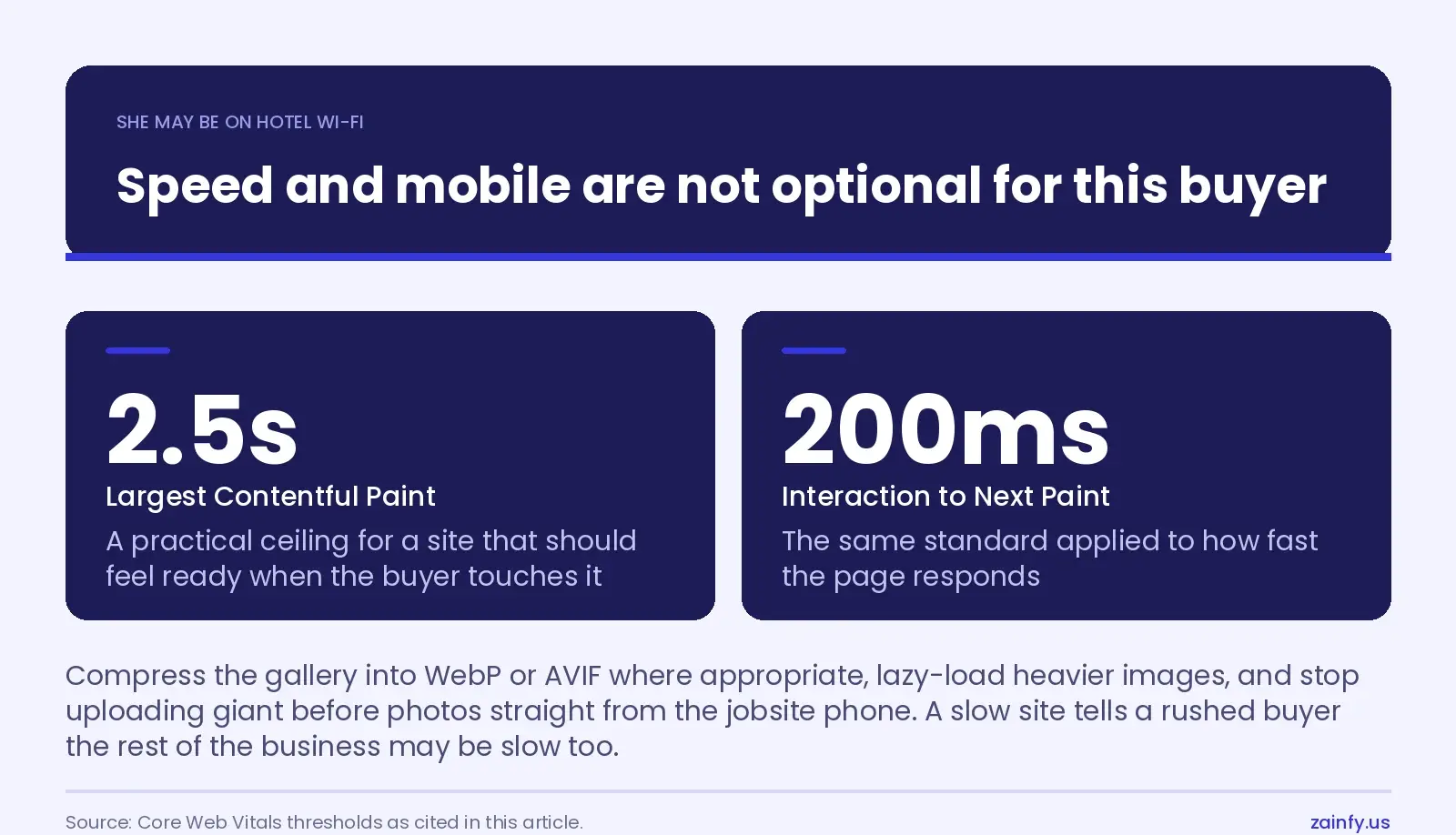
The Fort Moore buyer may not be sitting at a desk with perfect internet and an afternoon to compare contractors. She may be on a phone between lender calls, on hotel Wi-Fi, or in a parked car after a showing. Your gallery has to load before she loses patience. Your quote button has to be tap-ready. Your phone number belongs in the top navigation, not hidden behind a desktop layout that collapses poorly. Core Web Vitals are not abstract here: Largest Contentful Paint under 2.5 seconds and Interaction to Next Paint under 200 milliseconds are practical standards for a site that should feel ready when the buyer touches it. Compress the gallery into WebP or AVIF where appropriate, lazy-load heavier images, and stop uploading giant before photos straight from the jobsite phone. A slow site tells a rushed buyer that the rest of the business may be slow too. That may not be fair. It is still how the screen feels when she is trying to shortlist a contractor before she reaches Columbus.
Don’t run a no-price brochure at a buyer who decides in days
Do not aim a “contact us for pricing” brochure site at a PCS buyer.
Not if she has a 10-day house-hunting leave window. Not if she has no local referral network. Not if her housing math is tied to BAH and she is trying to protect cash for the move.
You are asking her to spend time just to learn whether you are even in range.
That is a bad trade for her, so she will choose a contractor who made the decision easier.
A rented Houzz or Angi profile does not fix the problem. It can show a name, photos, and reviews, but it does not give you the full explanation: Columbus, GA service area, Fort Moore buyer path, price bands, virtual consult, project pages, and a quote route that belongs to you.
An off-the-shelf template has the same issue when it assumes every buyer can wait for a callback and an in-person visit.
Show ranges. Show real work. Give the remote buyer a path to start. If the site refuses to do that, it is not a lead-generation asset. It is a polite delay.
What a fast-conversion site costs — and what a brochure costs you
The wrong question is, “What is a website supposed to cost?”
The useful question is, “What work should the site do before I pay for it?”
A Columbus contractor should not buy a site as a prettier version of the old brochure. That is where the money gets wasted. A brochure cost is quiet: estimates never requested, PCS families never contacted, Fort Moore buyers who saw no price range, and remote clients who picked a company with clearer proof.
Judge the investment by the assets created. Does the site include project pages with scope and timeline? Does it show pricing ranges without pretending every job is identical? Does it offer a remote consult? Does the form capture a serious buyer without asking for a novel? Does the mobile gallery load fast enough for the buyer to keep looking?
If those pieces are missing, a cheap site is not cheap. It is just incomplete.
The cost of an incomplete site shows up every time the military move cycle sends a serious buyer to a contractor who answered faster on the page.
That cost is hard to see because nobody calls to tell you they almost called. They just disappear into another contractor’s calendar. For a Columbus business owner, the better accounting is to count the questions your site answers before the phone rings. If the answer is “almost none,” the site is forcing every lead to start from zero.
Columbus GA remodeler websites: quick answers
[wps_faq style=”classic” question=”Should a Columbus remodeler show pricing on the website?”]Yes. A Columbus remodeler should show price ranges so a Fort Moore or Muscogee County buyer can self-qualify before she calls. The ranges do not have to promise an exact project cost. They should explain starting bands, what different scopes include, and what changes the number. That matters in a market where the 2024 ACS 1-year median owner-occupied home value is $219,700 and the buyer may be budgeting around BAH. A no-price site makes her spend time to learn whether the contractor fits. A range-based pricing page lets her decide whether the consult is worth booking.[/wps_faq]
[wps_faq style=”classic” question=”Do Columbus contractors still need a website in 2026, or is a Houzz or Facebook profile enough?”]A Columbus contractor still needs an owned website because a profile does not control the full trust path. Houzz, Facebook, and similar profiles can show activity, but they cannot replace a site that explains Columbus, GA service coverage, Fort Moore relevance, project scope, price guidance, and the quote process in one place. A PCS family with no referral network is not only checking whether you exist. She is deciding whether to trust you before arrival. Your website is the only surface where those answers can be organized around the buyer’s actual deadline.[/wps_faq]
[wps_faq style=”classic” question=”How does a Columbus remodeler’s website win a family that just moved to Fort Moore?”]It wins by making the next step obvious before the family is settled in Columbus. The site should say Columbus, GA, show Fort Moore-area relevance without overclaiming, offer a virtual consult, and make pricing ranges easy to find. It should also show before and after projects with neighborhood, scope, and timeline notes, because a buyer who cannot visit a jobsite needs proof in the page itself. The 10-day CONUS house-hunting leave context is the clue: this is a compressed decision, not a casual research project. Slow pages, vague galleries, and hidden phone numbers lose that buyer.[/wps_faq]
[wps_faq style=”classic” question=”How much should a Columbus remodeler budget for a website?”]Budget for the site based on what it must include, not on a generic package number. For a Columbus remodeler, the useful scope includes fast mobile performance, service pages, a pricing or guide page, a gallery with real project captions, clear Columbus and Muscogee service-area language, a remote consult path, and a quote form that does not create friction. If the site cannot help a budget-aware Fort Moore buyer decide from another state, the spend is going to the wrong thing.[/wps_faq]
Closing: make the site answer before the buyer arrives
Open your website on a phone and read it like a family still outside Georgia.
Can she tell, without scrolling to the footer, that you mean Columbus, GA? Can she see a price range before she gives you her contact information? Can she request a remote consult? Can she find real projects that look like the work she needs near Fort Moore, Midtown, the Historic District, or North Columbus?
If not, fix that before you change colors or rewrite the slogan. The market behind that visit is read in what 60 days on market actually signals.
Columbus has its own buyer pressure because Fort Moore compresses decisions around relocation, but that discipline matters across Georgia; this is where the statewide picture, not one base town belongs after the Columbus-specific work is clear.
The next useful task is small: write the pricing page headline today. If that feels hard, the buyer already feels it too.