As new-home construction slows across metro Atlanta, the renovation client is the job now, and your remodeling website is where that client is won or lost. This is not about having a prettier online brochure. It is about how to build a remodeling contractor website that converts renovation clients who are comparing contractors from a phone before they call.
The City of Atlanta has its own Office of Buildings and online permitting path, while Fulton, Cobb, and DeKalb each carry their own market signals. That matters because metro Atlanta does not behave like one clean suburb. A homeowner in Buckhead, Decatur, East Cobb, or North Fulton brings a different house, budget, and proof standard to the same screen.
If you want the commercial version of this thinking, start with an Atlanta remodeler site built to convert. This guide is the contractor-side teardown: what your site must show, what it must remove, and where renovation demand leaks before the estimate request ever happens.
The renovation client is already looking
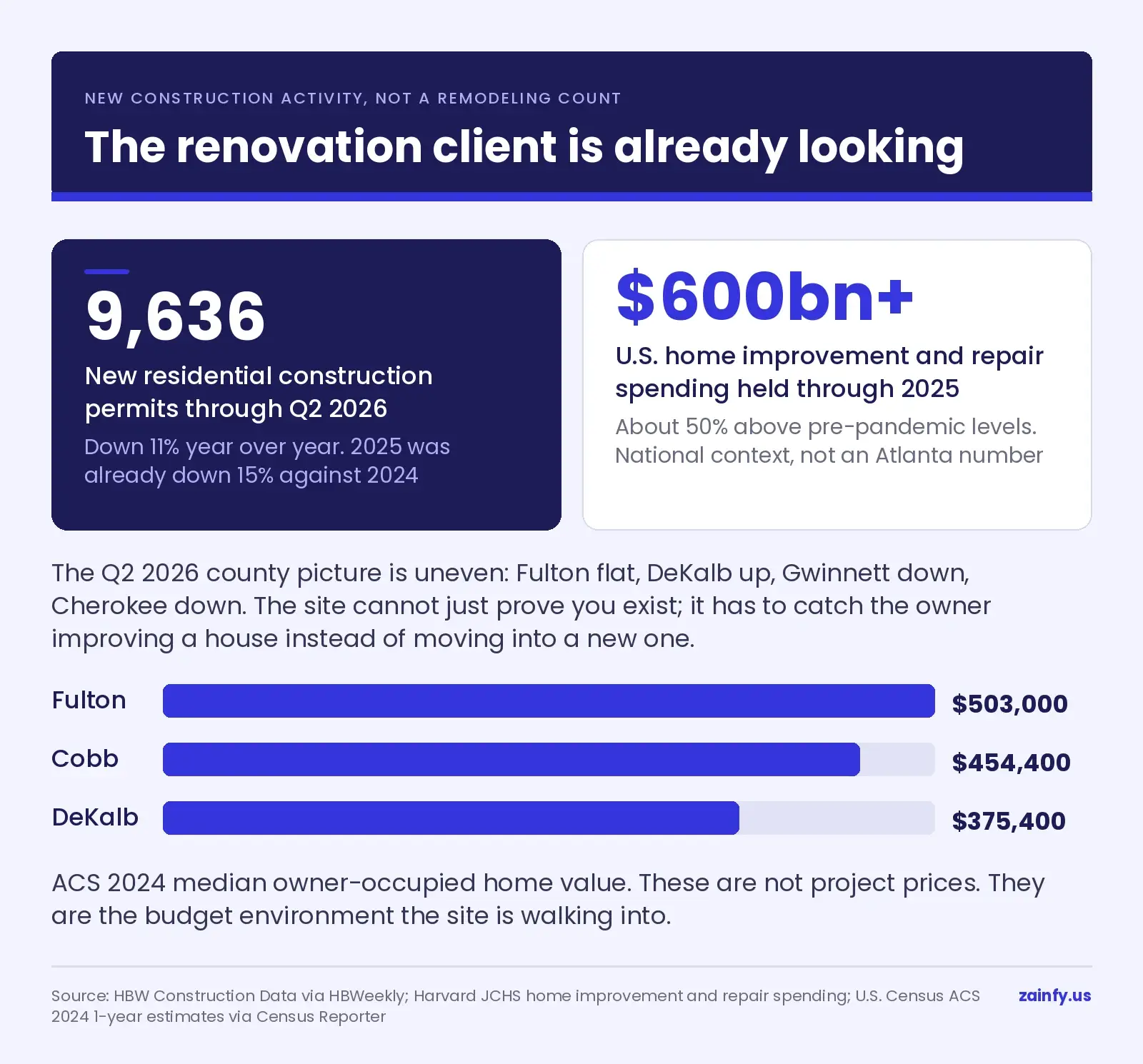
Metro Atlanta had 9,636 new residential construction permits through Q2 2026, down 11% year over year, according to HBW Construction Data via HBWeekly. That is new construction activity, not a remodeling-demand count. Treat it correctly. It says the new-build side of the market is tighter than it was, while 2025 was already down 15% compared with 2024. For a contractor owner, that mix changes the job of the website: the site cannot just prove you exist; it has to catch the homeowner who is improving an existing house instead of moving into a new one. The per-county picture is uneven too, with Fulton flat, DeKalb up, Gwinnett down, and Cherokee down in that Q2 2026 HBW snapshot. Meanwhile, Harvard JCHS reported that U.S. home improvement and repair spending held above $600 billion through 2025, about 50% above pre-pandemic levels. That is national context, not an Atlanta number, but it explains why the existing house still matters. Fulton, Cobb, and DeKalb homeowners are not waiting for every builder cycle to settle before fixing a kitchen, replacing windows, or planning an addition. They are looking at the house they already own and deciding who looks credible enough to enter it. Census Reporter’s ACS 2024 1-year basis puts median owner-occupied home values at $503,000 in Fulton, $454,400 in Cobb, and $375,400 in DeKalb. Those are not project prices. They are the budget environment your site is walking into. A DeKalb homeowner in older housing stock around a 1984 median build year is not shopping like a buyer asking for a quick cosmetic refresh near a newer subdivision. Your site has to make the renovation decision feel organized, credible, and easy to start.
Why most remodeler sites lose the job in the first five seconds
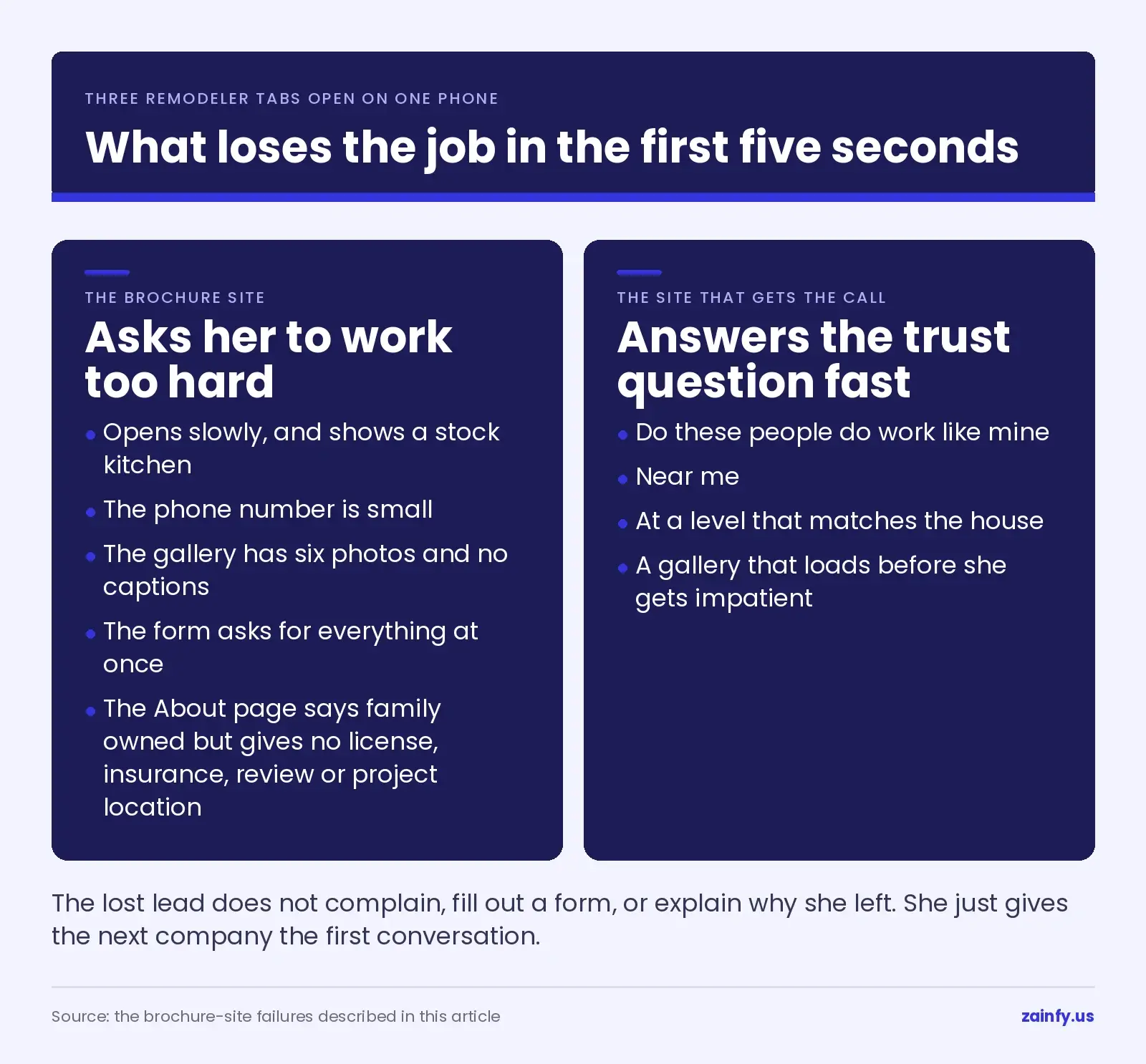
A brochure site asks the homeowner to work too hard. It opens slowly. It shows a stock kitchen that could belong to any contractor in any state. The phone number is small. The gallery has six photos and no captions. The contact form asks for everything at once. The About page says “family owned” but gives no license, insurance, review, project location, or reason to trust the crew.
That site loses before the owner knows he was considered.
Now put yourself in the real screen moment. A Buckhead homeowner has three remodeler tabs open on her phone. A Decatur homeowner is doing the same after dinner, because the kitchen has been bothering her for two years and the new-house option is not simple. She is not reading every word. She is checking whether your site answers the first trust question fast: do these people do work like mine, near me, at a level that matches the house?
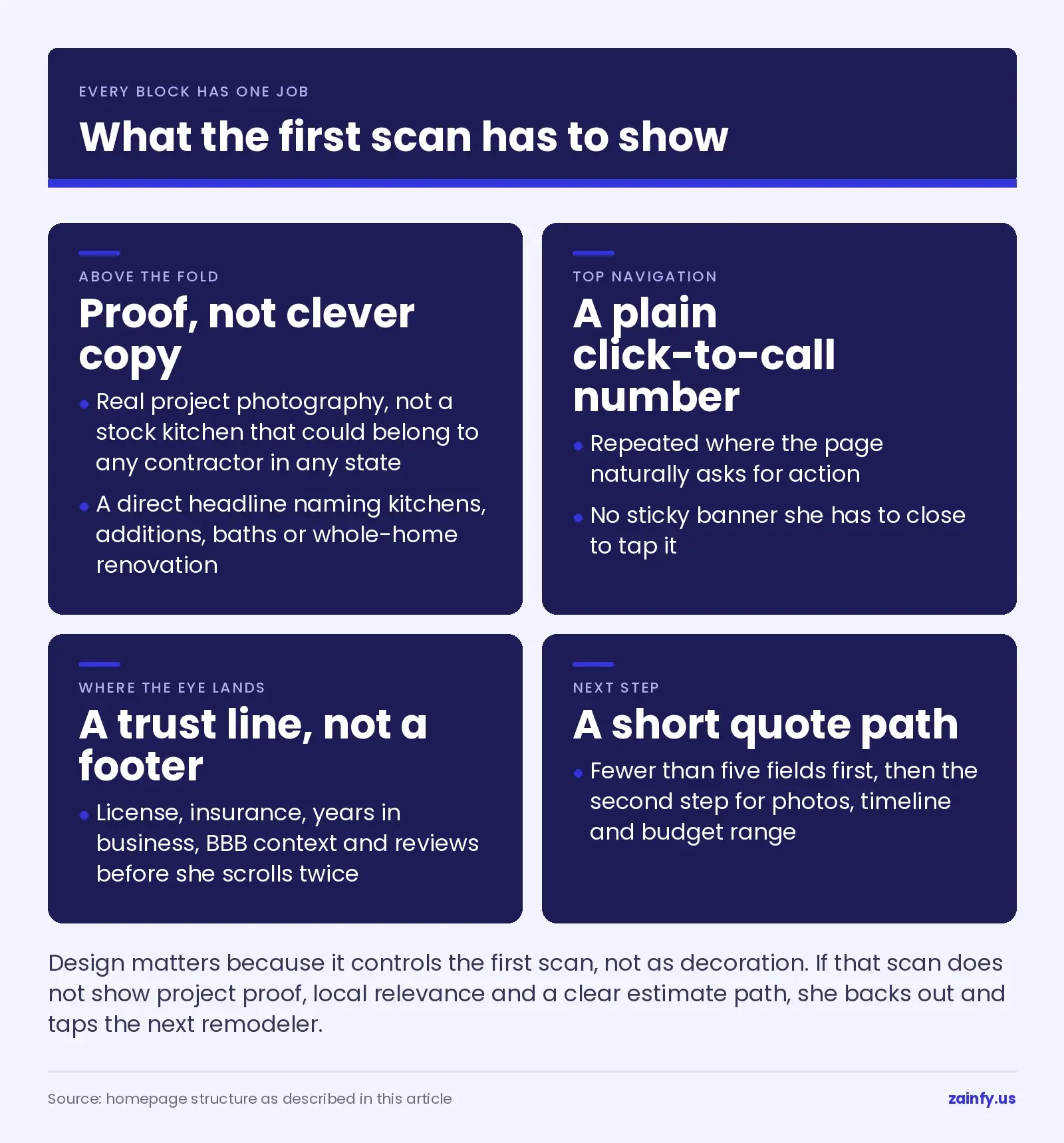
The better site does not start with clever copy. It starts with proof. Real project photography above the fold. A plain click-to-call number in the top navigation. A direct headline that names kitchens, additions, baths, or whole-home renovation. A trust line that sits where the eye lands, not down in the footer. A gallery that loads before she gets impatient.
The contractor owner sees none of that hesitation unless the site is built to catch it. The lost lead does not complain, fill out a form, or explain why she left. She just gives the next company the first conversation.
Design matters, but not as decoration. It matters because it controls the first scan. If that first scan does not show project proof, local relevance, and a clear estimate path, the homeowner does the simplest thing available: she backs out and taps the next remodeler.
Your before/after gallery is the hardest-working page you own
Start with the work that already sells in person.
If a homeowner asks what you do, you probably show photos from your phone. The website version should be better organized than that. A gallery built to convert renovation clients is filterable by service: kitchens, baths, additions, basements, exterior work, and whole-home renovation if that is really part of your scope. The filter matters because a DeKalb kitchen buyer does not want to dig through twenty deck photos to decide whether you can handle cabinetry, lighting, layout, and finish details.
Then each strong project gets its own page.
Not a giant slideshow with no context. A real project page. Location. Scope. Timeline. A short caption that explains what changed. A Decatur kitchen page might say the project opened a closed main-floor layout, replaced dated cabinets, and kept the work inside a defined family schedule. A Cobb County addition page might explain the bedroom count problem, the tie-in challenge, and the finished use of the space. Do not turn those captions into homeowner advice. The point is not teaching the reader how to remodel a house. The point is proving that you have handled the kind of project she is about to price.
Stock photos do the opposite. They tell the homeowner you had to borrow trust because your own work was not ready to show. A few real photos with honest captions beat a polished library that looks rented.
That is especially true when the visitor is comparing your gallery against a referral she already trusts.
The thin gallery costs jobs because it creates doubt at the exact moment the homeowner is deciding whether to call. She may like your referral. She may like your reviews. But if your site cannot show enough real work to support a five-figure conversation, the estimate request gets easier to postpone.
The trust signals a metro-Atlanta homeowner actually checks
Put license, insurance, years in business, BBB context, and reviews where the homeowner can see them before she scrolls twice.
That is the short answer.
Do not bury trust on an About page and expect a North Fulton buyer to go hunting for it. Fulton County’s ACS 2024 median owner-occupied home value basis is $503,000. That does not tell you what her project costs, but it does tell you the trust bar is walking into a serious home-value environment. The buyer is checking risk before taste.
Reviews work harder when they sit beside the project photo they belong to. A line like “kitchen renovation in Alpharetta” beside a review about communication and clean jobsite behavior is more useful than a carousel of anonymous praise. The homeowner connects the words to the work.
If the proof is scattered, the owner makes the buyer assemble the case alone. That is backwards. The site should put the license cue, the review, the location, and the project image close enough that the risk question gets answered in one scan.
That is why Alpharetta sites that convert North Fulton clients has to show proof early. Not after the owner bio. Not after a block of slogans. Early.
For Sandy Springs, Roswell, Brookhaven, Dunwoody, and Alpharetta, the site has to answer a simple question fast: can this contractor manage a project at the level this house requires?
The pages that turn a visitor into a booked estimate
A remodeler website that gets leads does not need fifty pages. It needs the right pages, built around the way renovation clients decide.
The home page has one job: name the work, show proof, and send the visitor toward a call or estimate request. You can see that job done and undone across thirty-two rebuilds, before and after.
The service pages do the sorting. Kitchen remodeling, bathroom remodeling, additions, basement finishing, exterior renovation, whole-home work. If you sell those services, each one needs its own page with real photos and plain scope language. If you do not sell one, do not fake it for traffic.
The gallery proves the work. The service-area pages prove local relevance. A contact page removes friction instead of creating it.
Those pages do not need to be long. They need to be specific enough that the right visitor recognizes the work and the wrong visitor stops wasting your time.
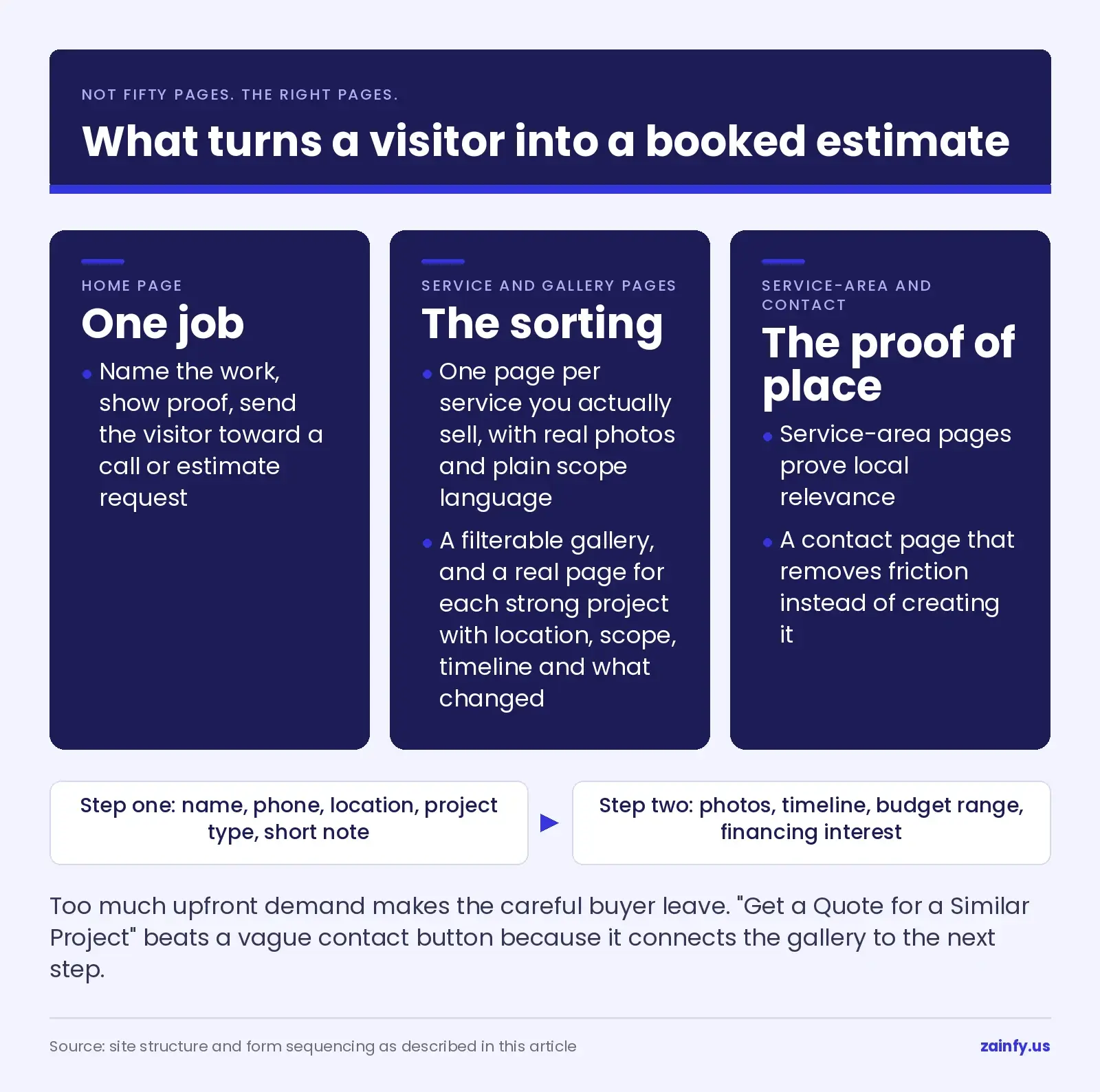
The quote form should not feel like a loan application. Ask for fewer than five fields first: name, phone, location, project type, and a short project note. After the homeowner commits to that first step, the second step can ask for photos, timeline, budget range, or financing interest. That order matters. Too much upfront demand makes the careful buyer leave.
Your primary call to action should match the proof around it. “Get a Quote for a Similar Project” works better than a vague contact button because it connects the gallery to the next step. If financing is part of how your projects are sold, the site should mention the capability without naming vendors or turning the page into a finance pitch.
An established-home market like Marietta and East Cobb needs different proof than a quick flip. Cobb County’s ACS 2024 owner-occupied median value basis is $454,400, and the homeowner is often protecting a house she expects to keep. That is the context behind Marietta and East Cobb remodeler websites: fewer empty claims, more project pages, clearer forms, and stronger proof before the estimate request.
Speed and mobile decide it before your design does
Most renovation clients reach your site from a phone, and a photo-heavy remodeler site is easy to ruin if performance is treated as an afterthought. Core Web Vitals gives you plain thresholds to respect: Largest Contentful Paint under 2.5 seconds and Interaction to Next Paint under 200 milliseconds. Those are not decorative technical goals. They decide whether the Buckhead kitchen gallery opens quickly enough for the homeowner to stay with you.
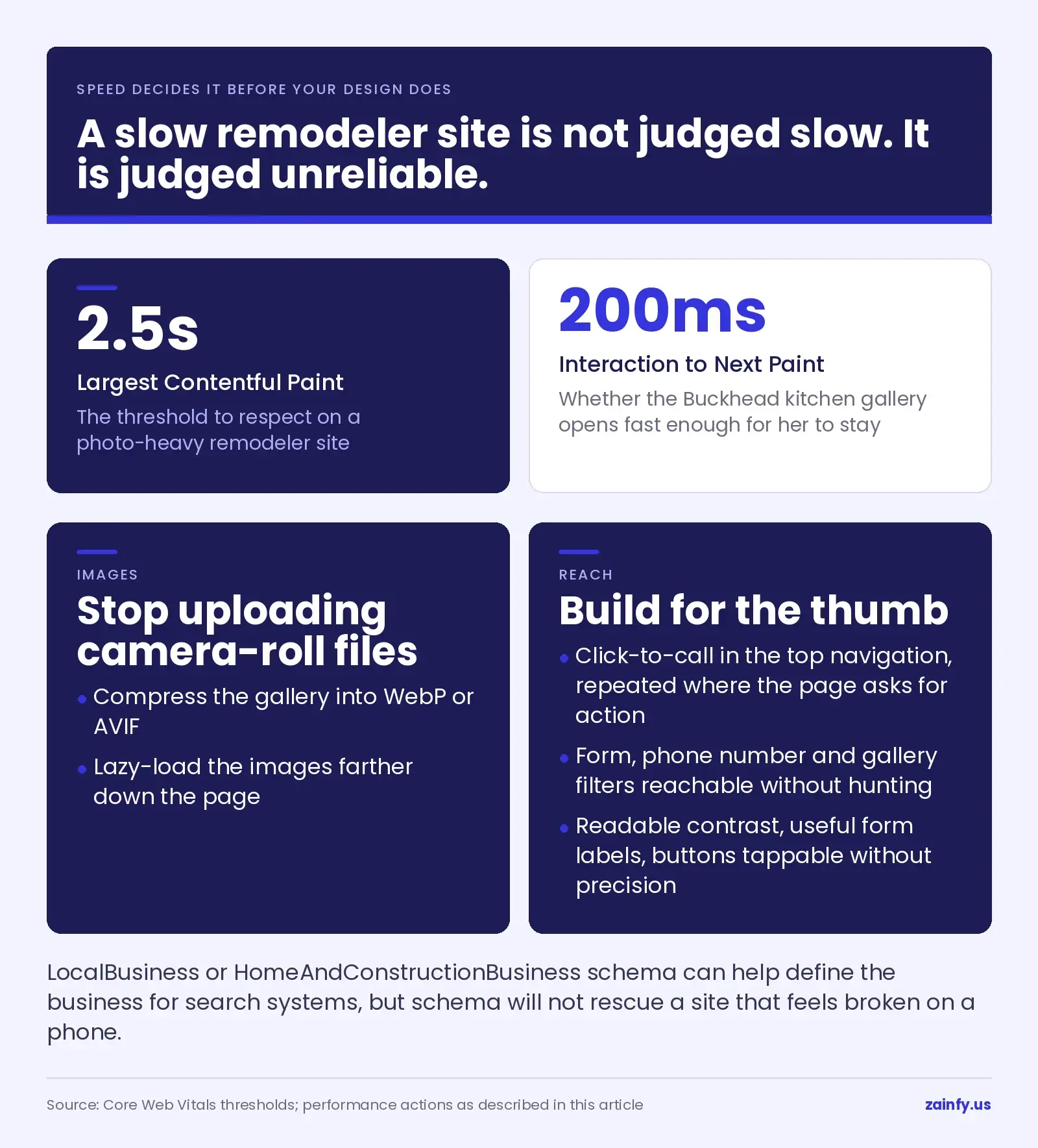
Compress the gallery into WebP or AVIF, lazy-load the images that sit farther down the page, and stop uploading giant jobsite photos straight from a camera roll. Put click-to-call in the top navigation and repeat the phone path where the page naturally asks for action. Keep the mobile layout clean enough that the thumb can reach the form, the phone number, and the gallery filters without hunting. A Fulton homeowner should not have to close a sticky banner to tap the phone number, and a Cobb visitor should not have to wait for ten oversized kitchen photos before the form works. The page can still look custom; it just cannot make the buyer pay for that look with delay. LocalBusiness or HomeAndConstructionBusiness schema can help define the business for search systems, but schema will not rescue a site that feels broken on a phone. Accessibility belongs in the same conversation: readable contrast, useful form labels, and buttons that can be tapped without precision. A slow remodeler website does not get judged as “slow.” It gets judged as unreliable.
Don’t run your pipeline through a rented profile and a template
Do not hand your whole lead pipeline to a rented marketplace profile plus a drag-and-drop template and call it a web presence.
Angi and Houzz can put your name in front of people, but you do not own the audience there. You compete inside someone else’s layout, under someone else’s rules, beside other contractors the homeowner can tap in the same minute. A cheap template has that problem from the other side. It may publish pages, but it is not built around your project proof, your service areas, your estimate flow, or the way a renovation client checks risk.
That matters more in metro Atlanta because the same company may need to look credible in intown Atlanta, East Cobb, and North Fulton without sounding like a generic statewide directory listing.
That combination feels harmless because it is inexpensive at the start. It is not harmless if it keeps the strongest project photos buried, sends callers through a weak form, or makes your business look interchangeable with the next contractor in the list.
Own the site that books estimates. Use rented profiles as supporting visibility if you want them, but do not let them become the center of the business.
What a real remodeler website costs — and what a bad one costs you
The wrong way to answer website cost is to throw out a fake price band and pretend it applies to every remodeling company in metro Atlanta. It does not.
A two-crew bath remodeler in DeKalb, a design-build contractor in North Fulton, and a kitchen specialist serving Cobb County need different page depth, photo organization, form logic, and service-area structure. The investment should match what the site has to sell and how much trust it has to build before the phone rings.
The better comparison is not cheap site versus expensive site. It is conversion-built site versus silent leak.
A weak site costs you the estimates that never get requested. The homeowner sees no recent gallery work, cannot find the phone number, does not understand whether you serve her area, and leaves without telling you. No analytics report makes that lost job feel real. It just shows up later as another slow week where referrals were supposed to carry the calendar.
For an owner trying to keep two to fifteen crew members scheduled, that silent leak is the real cost. The invoice for a better site is visible. The missed Fulton kitchen call is not.
Do not use a conversion-rate percentage you cannot prove from your own traffic. Track the concrete actions instead: calls, quote-form starts, completed estimate requests, gallery visits, and service-area page visits from Fulton, Cobb, and DeKalb. That is enough to show whether the site is earning its place. Feeding it is a separate discipline — the feed that fills those project pages.
Metro Atlanta remodeler websites: quick answers
[wps_faq style=”classic” question=”Do metro-Atlanta contractors still need a website in 2026, or is a Facebook page and Google profile enough?”]Yes, metro-Atlanta contractors still need a website in 2026 because social profiles and search profiles do not give you full control of the estimate path. They can help a homeowner find your name, but your site is where Fulton, Cobb, or DeKalb project proof, service pages, phone access, and quote requests sit together. The risk is relying on channels where your photos, reviews, and competitors are mixed into someone else’s format. A renovation client comparing three remodelers from a phone needs one owned place where your best work is organized and easy to act on. Treat profiles as entry points, not the place where the sale is supposed to happen.[/wps_faq]
[wps_faq style=”classic” question=”How much should a metro-Atlanta remodeler budget for a website?”]A metro-Atlanta remodeler should budget based on the revenue role the site needs to play, not on a generic package price. If the site has to support kitchens, baths, additions, service-area pages, a gallery, a two-step quote form, and financing language, it is a business asset, not a brochure. Cobb’s ACS 2024 owner-occupied median value basis is $454,400, which means many homeowners are evaluating contractors in a serious home-value context. That does not set your website price. It explains why thin proof and a weak form are not small problems. Budget for the system that can book the estimate, not the cheapest way to publish a few pages.[/wps_faq]
[wps_faq style=”classic” question=”What pages does a remodeling contractor’s website need to actually generate leads?”]A remodeling contractor’s website needs a home page, service pages, a real gallery, service-area pages, and a contact page with a short quote path. The gallery should not be a loose photo dump. It should connect before/after images to project type, location, scope, and timeline so a Decatur kitchen client or an East Cobb addition client can see relevant work quickly. Service pages help the homeowner understand whether you handle the exact project she is considering. Service-area pages help her confirm you work where she lives. The contact page should make the next step obvious: call, request an estimate, or send a few project details without filling out a long form.[/wps_faq]
[wps_faq style=”classic” question=”Should I build my own site on a drag-and-drop builder or hire a professional?”]Build your own only if the site is simple, current, fast on mobile, and honest about the work you actually sell. Hire a professional when the website has to support serious renovation leads across Atlanta, Marietta, Alpharetta, Fulton, Cobb, and DeKalb. The issue is not whether a template can look decent. It is whether the structure can carry project pages, gallery filters, service-area logic, trust proof, quote-form sequencing, image performance, and measurement without turning into a mess. If the site is supposed to replace lost referral volume or reduce dependence on rented lead channels, treat it like the front end of your sales process.[/wps_faq]
The next fix is probably not another gallery upload
Before you spend another afternoon adding random photos, open your site on a phone and act like a homeowner with one minute to choose who gets the call. Can she tell what you build? Can she see work in a neighborhood that feels close enough? Can she tap the phone number without pinching the screen? Can she request an estimate without writing a full project essay?
If the answer is no, the next fix is structure. Reorder the home page around proof. Turn the best projects into pages. Shorten the form. Put trust above the fold. Compress the images that are slowing the gallery.
Metro Atlanta is only one version of this problem. A remodeler in Savannah, Columbus, Augusta, or Gainesville still has to make a renovation client trust the screen before the call. That is the statewide standard behind web design for remodelers statewide.